DOI: http://dx.doi.org/10.26483/ijarcs.v8i8.4624
Volume 8, No. 8, September-October 2017
International Journal of Advanced Research in Computer Science
RESEARCH PAPER
Available Online at www.ijarcs.info
ISSN No. 0976-5697
IMPACT OF DDA OPTIMIZATION ON MOBILE ROBOT PATH PLANNING FOR
MIXED IMAGE IN IMAGE PROCESSING
Rama Kanta Choudhury
Department of Computer Science Kalinga University New Raipur, Chhattisgarh, India
Chandra Kanta Samal
Department of Computer Science AND College, Delhi University
New Delhi, India
Abstract:Existing problem solving in the day to environment requires computational intelligence. Path planning is one of the most important technologies in the navigation of the mobile robot, which should meet the optimization and real-time requests. The objective of the paper is to present a noble approach to find the efficient and effective path planning for mobile robot. Here first the image is located on the graph and then a quadtree is formed, according to the working space image with respect to the obstacle image. Then the NFT algorithm is used to obtain the shortest path from the start point to the goal point in the graph. Finally the DDA optimization algorithm is adopted to get the optimal path. Aiming at the shortcoming of the DDA algorithm which is easily plunging into the local minimum, DDA algorithm with NFT is put forward. The results of the simulation demonstrate the effectiveness of the proposed method, which can meet the real-time requests of the mobile robot's navigation. Here we have taken two different types of image, one square shape and other is mixed image of different shapes like triangle and circle. The working space is tested and result is verified using NFT Algorithm with DDA optimization.
Keywords: DDA, Grid search, Quadtreee, NFT (Neighbour finding technique)
I. INTRODUCTION
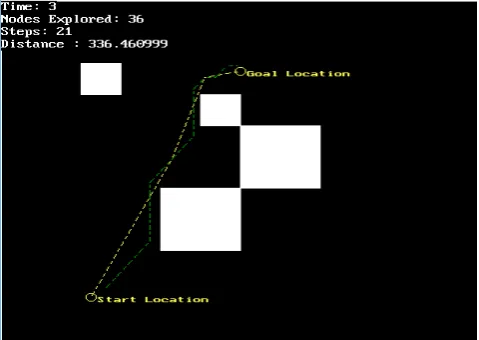
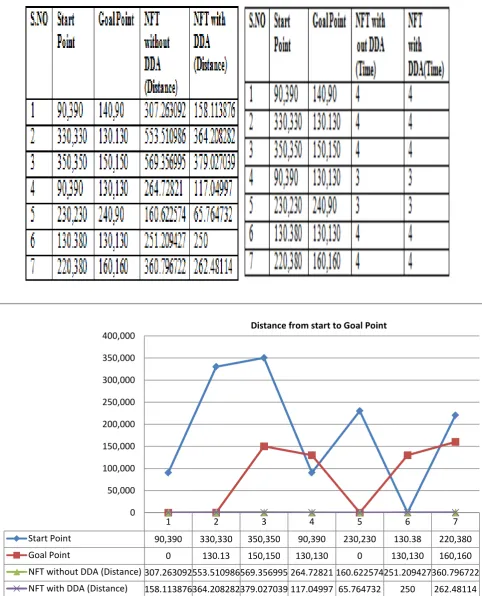
The area home land robotics has assumed a greater importance in the present age and robots are now used extensively to rescue survivors from dangerous environments when dealing with hazardous substances. Here the substance is taken as image and the image is presented as obstacle[2]. The goal of the path planning method is to determine a sequence of configurations for the robot to move around obstacles and avoid collisions while reaching a desired goal[11]. The Digital Differential Analyzer (DDA) method is widely used for planning the path of mobile robot. In a mobile robot path planning researchers used many algorithms for optimization and DDA is one of them and is considered to be subjected to other methods. This has two sections: first one is storing the location points in a vector array and second one is resolving the array step wise. In the DDA field method, we can imagine that all obstacles are represented by an image and we applied quadtree method on the image to make a tree[1]. once the tree is formed we applied the algorithm .The distance from the robot to obstacles will be judge on the basis of the tree structure. While the destination has followed with NFT (Neighbor finding technique) . Then we apply DDA on the path which is stored in the data base it has specific function and is finally the line of path is drawn. The function slopes down towards the target point, so that the robot can reach the target by following the path. We have applied this DDA algorithm on different shape or mixed image obstacles as shown in fig 9 and fig 10.we have applied DDA to 50 different locations and tested in c++ , here we have shown 10 different locations and as in the table III, and plotted the graph as shown in fig 13 and fig 14.
II. THE APPROACH
We have implemented DDA on A*, NFT algorithm to get the optimization .It is simulated and verified the result .The detail of the result and graph is shown in figure 3.
A. A*Algorithm
A* algorithm based implementation is easier and practically faster .to reach the destination, A*algorithm creates sub optimal paths using its neighbors. In A* representation, f'(n) = g(n)+h'(n), where g(n) is the total distance from the initial position to the current position and h'(n) is the estimated distance from the current position to the goal destination/state. To create this estimation a heuristic function is used. f'(n) is the sum of g(n) and h'(n) and is stated as the current estimated shortest path.
B. NFT Algorithm
Quad Tree
Fig 2 Representation of Quadtree
Image processing place an important role in the field of robotics path planning , here we have implemented the NFT
(neighbor finding technique) and Applied DDA
optimization over the NFT with quad tree approach[1,2,3].Here we have
implemented,Equl_adj_neighobur,equal_corner_neighbour, Gte_adj_neighbour,Getqual_adj_neighbour,Get_corner_nei ghbour.
C. DDA Optimization
Let the path followed by the quad tree algorithm be stored in an array P1. Let P1 contains N points.
1. Check from 0 first point in P1 third element ,if a free path exist ,if yes store in a variable called Var.
Note ; Var initially contains 2nd element
2 .Check first point to 4 th point in P1 if there is a path then
overwrite with the element.
3 .Repeat the procedure until all the elements are scanned in such a way.
4. Let the Kth element be stored in Var stored in a new array
[ ] . Now repeat the above four steps from Kth Variable.
If the Kth variable is (n = i)th of the P1[ ], then add these
points in P(New).
5. T last get the point and get the path. As begin
For I = 0:n-2 begin for j = 2 ; n begin
if( path_bw(a [I ],a [j]) begin
var = a[ j] end
end
b [++ counter] = var; end
end end
b[++ counter]= a[n-1] end
III. OPTIMIZATION FOR OPTIMALPATH FINDING
A. Application of DDAa optimization
The DDA optimization network resolve the task to reach all the nodes on the map. The route from the starting node to the target node is resolved, but the solution is not optimal or close to the optimal different methods have been adopted to get the optimized path , DDA is one of them. The proposed DDA Algorithm for finding a closely optimal route between
• Elimination of the duplicate nodes. If the number
of neurons is equal to the number of nodes on the map, the network does not find the solution, because a set of neurons will not be active during the network training process.
• Finding the address from the resulted array vector
with the starting and ending nodes.
• The Array vector values which correspond to node
coordinates on the map are compared with start and end node positions.
• Finding the nodes for which a neighborhood node
with a lower cost to the target node exists.
• Calculating the cost from the start to the end node
and from the neighborhood nodes to the end node for each node found in the previous step and storing the results in a table with the following fields: current node index, neighborhood node index, and the calculated cost.
• Ordering the table in ascending order according to
the cost column.
• Deleting the higher cost overlaps the section with a
Lower cost.
• Finally extracting the closely optimal path from the
start to the end point.
IV. SIMULATED RESULT AND ANALYSIS
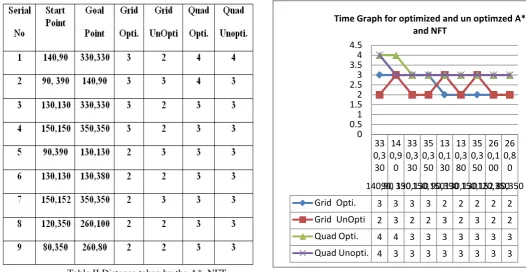
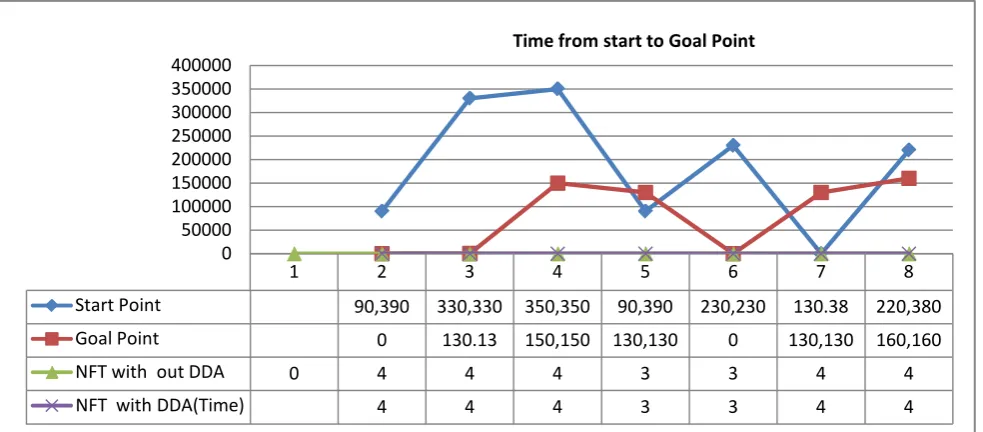
We have simulated A*, NFT algorithm with system configuration Intel® core(TM) i3-3220 GHz 3.30 and Ram-2GB (1.88 GB Usable).system type-32 – Bit Operating system. We applied DDA optimization on the oath finding and tested around 100 different locations i.e different start and goal points we fund that that the time taken and distance covered is very less ,as shown in fig 3,4,shows the unoptimized A*,f fig 4,5 shows optimized NfT , and fig 7,8 shows optimized A*. While comparing with the A* and NFT algorithm, the final output with time and distance covered presented in the graph. we have tested different shape images as shown in fig 11, 12 and tableIII and its graph which shows that the time and distance is reduced and get fully optimized. We have presented 10 outputs with its detail location and time and distance as shown in the fig 3and table1 and table 2. The comparison in graphical form as shown in fig 4.
Fig 4 A* Grid search Algorithm Result
Fig 5 The NFT Algorithm Result
Fig 6 NFT Quad tree search Algorithm result
Fig 7 A* optimized Algorithm Result
[image:3.595.317.557.61.231.2]
Table I I Distance taken by the A*, NFT
Fig 9 Time graph optimized Algorithm Result
Table II Distance taken by the A*, NFT
33 0,3 30
14 0,9 0
33 0,3 30
35 0,3 50
13 0,1 30
13 0,3 80
35 0,3 50
26 0,1 00
26 0,8 0 140,9090, 390130,130150,15090,390130,130150,152120,35080,350
Grid Opti. 3 3 3 3 2 2 2 2 2
Grid UnOpti 2 3 2 2 3 2 3 2 2
Quad Opti. 4 4 3 3 3 3 3 3 3
Quad Unopti. 4 3 3 3 3 3 3 3 3 0
0.51 1.52 2.53 3.54 4.5
Fig 10 The Graph for Distance taken By A*, NFT
Fig 11 NFT optimized Algorithm Result Fig 12 NFT optimized Algorithm Result
330, 330 140 ,90 330, 330 240, 90 350, 350 130, 130 130, 380 350, 350 260, 100 260, 80 120, 380 140, 90 90, 390 130, 130 90, 380 150, 150 90, 390 130, 130 150, 152 120, 350 80, 350 300, 120
Grid Un opti 800.420 299.404 559.010 343.010 544.010 250.803 240 544.010 423.409 338.618 483.611
Grid opti 406.830 279.508 298.737 336.460 295.853 263.058 125 295.853 334.588 320.614 507.457
Quad Un opti 606.662 307.263 567.652 430.009 565.201 264.728 251.209 565.201 413.245 428.589 485.7
Quad opti 403.181 279.508 362.464 326.156 363.633 263.058 125 363.633 312.856 321.01 288.046
0 100 200 300 400 500 600 700 800 900
[image:6.595.50.533.115.711.2]
Fig 13 The Graph for Distance taken By NFT
1 2 3 4 5 6 7
Start Point 90,390 330,330 350,350 90,390 230,230 130.38 220,380
Goal Point 0 130.13 150,150 130,130 0 130,130 160,160
NFT without DDA (Distance) 307.263092553.510986569.356995 264.72821 160.622574251.209427360.796722
NFT with DDA (Distance) 158.113876364.208282379.027039 117.04997 65.764732 250 262.48114
0 50,000 100,000 150,000 200,000 250,000 300,000 350,000
Fig 14 The Graph for Distance taken By NFT
IV. CONCLUSION
In this paper we have implemented DDA optimization technique on A*, NFT algorithm and tested the result taking different start and goal points. We found that the time and distance is reduced around 60 %. The amount of the existing works for each approach has been identified and classified and tested with C++ language. This paper divides the motion planning algorithms into two major groups, namely, the Conventional Approaches and Heuristic Approaches. The conventional approaches are Roadmap, grid search or Quadtree approach, here we tested in heuristic method also and the result as shown. A complete discussion of the portion of each approach in the field of robot motion planning is also presented, including different comparative figures and charts.
V. REFERENCES
[1] H.Samet, Region representation, quad trees from binary arrays, computer graphics and image processing 13, 1980, 88-93.
[2] H.Samet, computing perimeters of an image s represented by quad tree, IEEE Trans, pattern Anal. Mach, Intel press. [3] H.Samet. An algorithm converting from roster to quad tree.
IEEE Transaction, Pattern Anal, Mach. Intel press 3,1981,93-95.
[4] Rahul Kala, Dr.Anupam Shukla, Dr. RituTiwari, SourabhRungta, RJanghe “Mobile Robot Navigation Control in Moving Obstacle Environment using Genetic Algorithm, Artificial Neural Networks and A* Algorithm]”2009 World Congress on Computer Science and Information
Engineering,978-0-7695-3507-4/08©2008IEEE,DOI10.1109/CSIE.2009.854.
[5] Leela Rani.P, Rajalakshmi.P “Clustering Gene Expression Data using Quad Tree based Expectation Maximization Approach” International Journal of Applied Information Systems (IJAIS) – ISSN: 2249-0868, Foundation of Computer Science FCS, New York, USA, Volume 2– No.2, June 2012 –
[6] K. Daniel, A. Nash, S. Koenig, and A. Felner, “Theta*: Any-angle path planning on grids,” Journal of Artificial Intelligence Research, vol. 39,pp. 533–579, 2010.
[7] K. Aizawa and S. Tanaka, “A Constant-Time Algorithm for Finding Neighbors in Quadtrees,” Pattern Anal. Mach. Intell. IEEE Trans., vol. 31, no. 7, pp. 1178–1183, Jul. 2009.
Gargantini, I “An effective way to represent quadtrees communications of the ACM,25”, pp.905-10,1982.
[8] G.M. Hunter and K. Steiglitz, Operation of image using quad tree, IEEE Trans. Pattern Anal. Mach Intell.1, 1979, 145-153. [9] Sebastian Thrun, Robotic Mapping :A Survey, School of
Computer Science Carnegie Mellon University, February 2002.
[10] Shahab Sheikh-Bahaei, ''Discrete Event Modeling Simulation and Control with Application to Sensor Based Intelligent Mobile Robotics'', M.Sc. Thesis, Electrical Engineering, The University of New Mexico, December, 2003.
1 2 3 4 5 6 7 8
Start Point 90,390 330,330 350,350 90,390 230,230 130.38 220,380
Goal Point 0 130.13 150,150 130,130 0 130,130 160,160
NFT with out DDA 0 4 4 4 3 3 4 4
NFT with DDA(Time) 4 4 4 3 3 4 4
0 50000 100000 150000 200000 250000 300000 350000 400000