Multiple Mobile Sink Path Selection Using Weighted
Rendezvous Planning in Wireless Sensor Network
S.G Packiavathy1 , P.Velmani2,S.John Peter3,
Research Scholor (Part Time- External), Register No: 12054, Department of Computer Science1, Assistant Professor of Computer Science2, Head, Departmentof Computer Science3,
St.Xavier’s College,Manonmanium sundaranar University,Abishekapatti, Tirunelveli,,Tamilnadu,India,Pin Code – 6270121,The M.D.T Hindu College, Pettai, Tirunelveli2, St.Xavier’s College, Tirunelveli3.
[email protected],[email protected],[email protected]
Abstract— The energy efficiency is the main issue in wireless sensor networks (WSNs), due to the limited battery capacity of the sensor nodes. Due to data traffic, the battery of the nodes near the sink is exhaust faster than the other nodes. To reduce this problem mobile sinks are introduced. Across the network, it provides equal energy consumption and loads balanced data delivery. The Packet delays and energy consumption are used to market the position of the mobile sink in the network. To handle this problem this paper proposed a multiple mobile sink routing protocol also known as Ring Routing. Ring Routing is a hierarchical routing protocol based on a virtual ring structure which is designed to be easily accessible and easily reconfigurable. The main objective of this paper is path selection for WSN using the mobile sink protocol further the travelling Sales Man Problem (TSP) with weighted rendezvous planning (WRP) algorithm is used to reduce the energy consumption through data transfer. The performance of the TSPWRP is compared with well known Floyd to analyze time complexity. From the experimental result, it is shown that TSPWRP reduces the energy consumption than Floyd and it provides high network lifetime.
Keywords— Mobile sinks, distributed routing, data dissemination, energy efficiency, mobility, wireless sensor networks Mobile sinks, distributed routing, data dissemination, energy efficiency, mobility, wireless sensor networks.
1.INTRODUCTION
A WSN of spatially distributed autonomous sensor is used to monitor physical or environmental conditions such as temperature, sound, pressure etc and to cooperatively pass their data through the network to the main location. The more modern networks are bidirectional and also enabling control of sensor activity. The development of WSN is motivated by military applications like battlefield surveillance. Recently WSN is used in many industrial and consumer applications such as industrial process monitoring and control health monitoring and so on. Regarding real-time applications, energy efficiency is considered to be crucial issue because of battery capacity is limited in the sensor nodes. Due to the joint nature of
traditional WSN packet forwarding approaches resulting in the concentration of data traffic towards the sinks, the surrounding area of the static sink are more likely to deplete their batteries before other node, leading to the energy hole problem, disruptions in the topology and reduction in the sensing coverage[1]. Moreover, this problem could lead to the isolation of the sinks, hindering the delivery of the sensor data traffic [2]. To overcome this problem the researchers were introduced the mobile sink. The Mobile sink is
used to control the sink mobility and guide to give priority that the area with less residual energy [3][4]. This paper is proposed for Multiple Mobile sinks to manage the energy efficiency. The sensor nodes collect the information from the environment and communicate with each other through wireless transceivers. The data collected by these sensor nodes will be delivered to multiple sinks. Multiple sinks in TSPWRP is used to reduce the energy and time consuming. In this algorithm, the sensor node is assigned a weight corresponding to the size of data forward to the sink. The energy consumption and formation of energy holes are reduced by the hybrid moving pattern. The work available in the Literature proved that the hierarchical approach to finding the shortest path based on Floyd-Warshall’s algorithm was efficient and provides better performance [5]. Hence in this work, the TSWRP is compared with Floyd-Warshall’s algorithm.
2. LITERATURE REVIEW
introduced mobile sink, used to balance the load f the sink by shifting the hotspot around the sink and spreading the increased energy drainage around the sink which helps to achieve uniform energy consumption that extends the network lifetime [7]. Existing methods of using a mobile sink in WSN is Rendezvous Point (RP), where a mobile sink only visit nodes designated as RPs. The aim of RP is to find a subset of RPs that maximize energy consumption while adhering to the delay bound provided by an application [8].RP uses a Travelling Salesman Problem(TSP) solve to calculate the tour length[9].TSP is used to find the shortest tour that visits all sensor nodes. Floyd algorithm is used to execute short computational times with additional storage space consumption [10].
3.PROPOSED METHOD
The by step procedure of the proposed system is shown in Figure 1. It involves the nodes creation, system model generation, distance finding, hop count, data transmission, NFD calculation, weighted Rendezvous calculation, and Initial RP calculation.
Figure 1. Overall Block Diagram of Proposed Methods
3.1 Node Creation
A WSN can be defined as a network of devices, denoted as nodes, which can sense the environment and communicate the information gathered from the monitored field.
3.2 System Model Generation: 3.2.1 Node Behaviors
Some of the modeling techniques are used to form the component based modeling to represent a sensor node. The WSN behavior is modeled by specifying the component’s internal behavior, component to component interactions and the communication channel’s characteristics.
3.2.2 Modeling Sensors and Hardware
To create a platform independent model some of the modeling techniques are surveyed. However, even in a platform independent model, there is a necessity to include some of the hardware details. One of the reasons for including the hardware details is that the software in the nodes of a WSN is tightly coupled to the hardware elements of the node. Therefore the binding of software and hardware components should be represented in the model.
3.2.3 Network Behavior
Modeling network behavior in a WSN is crucial because many important performance values are based on the network, like the trade-off between packet loss and power. Due to the fact that the node has limited power resources, it is common to use a power management algorithm that controls the wake-up state of a node from active to sleeping and vice versa.
3.2.4 Topology Modeling
The topology of WSN systems can be dynamic or static. The static topology represents the nodes in a fixed location while the dynamic topology represents the nodes while they are in a moving state.
3.2.5 Code Generation
Code generation is the process of generating source code from a model or another source code representation.
3.3 Distance Finding and Hop Count:
The node, which needs to learn their position, can find the shortest links connecting to at least three consumption on the path does not require network lifetime. To avoid this problem in multi-hop routing the proposed less hop count transmission is used.
3.4 Data Transmission:
(ii)If the receiver node is a gateway node, then it forwards the data packet to the sink; otherwise, it forwards the DATA packet to its next node. (iii)It adds the sender and data sequence number to the list.
3.5 NFD Calculation:
Each sensor node produces one data packet with the length of it’s in time interval.
3.6 Weighted Rendezvous Calculation:
The weight of a sensor node is calculated by multiplying the number of packets that it forwards by its hop distance to the closest RP on the tour. Thus, the weight of sensor node i is calculated as
The energy consumption is proportional to the hop count between source and destination nodes, and the number of forwarded data packets.
The highest weighted node will reduce the number of multi-hop transmissions and thereby minimizes the energy consumption.
WRP Algorithm:
1. WRP works. It takes as input G(V,E), and it outputs a set of RPs.
2. WRP first adds the fixed sink node as the first .Then; it adds the highest weighted sensor node.
3. After that, WRP calls TSP (·) to calculate the cost of the tour.
4. If the tour length is less than the required length the selected node remains as an RP.
5. Otherwise, it is removed from the tour. 6. After a sensor node is added as an RP,
WRP removes those RPs from the tour that no longer receives any data packets from sensor nodes
3.7 Initial RP Calculation:
If the energy level is low the mobile sink node will be dead. At this time choose the new mobile sink and process. This is the recycling process. Hence this work proposes multiple mobile sink.
4.SIMULATION ANALYSIS
4.1 Simulation Setup
To analyse the performance of the proposed system simulation experiments are implemented in Network Simulator (NS2). The parameters used in the simulation setup are listed in Table (1).
Table 1: Parameters used in Simulation Setup
Queue Limit 20 packets Packet Size
(Maximum)
512 Bytes
Packet Interval 0.1 seconds Communication
4.2 Performance Analysis
To analysis, the performance of TSPWRP and Floyd algorithm two important metrics are used. They are the Network lifetime and Average Energy Consumption.
Network Lifetime:
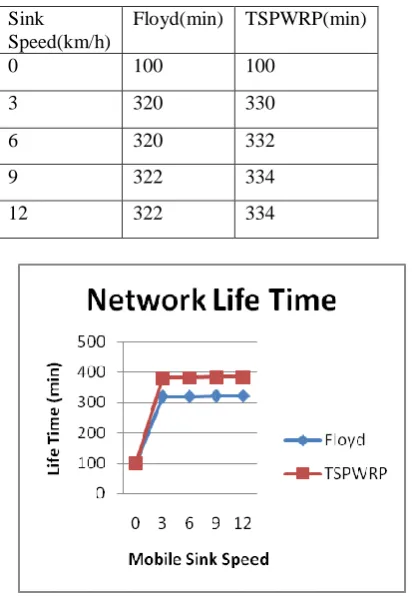
Network lifetime is represented by the number of rounds where each round begins with a set-up phase when the clusters are organized, followed by a steady-state phase when the data transfers to the base station. The network lifetime of the Floyd algorithm available in the literature [10] is compared with TSPWRP.
Table 2: Network Lifetime comparison of Floyd & TSWRP Algorithm
Sink Speed(km/h)
Floyd(min) TSPWRP(min)
0 100 100
3 320 330
6 320 332
9 322 334
12 322 334
Figure 5 – Graphical representation -Network
Lifetime comparison of Floyd & TSWRP Algorithm
From Table (2) and Figure (5) it is seen that if the sink speed increases the network lifetime also increases.
Energy Consumption
Energy consumption is the consumption of energy or power. Table 3 represents the energy consumption and figure 6 represents the same.
Table 3: Average Energy Consumption
Sink Speed(km)
Floyd(J) TSPWRP(J)
0 470 420
3 395 330
6 410 330
9 440 335
12 470 333
Figure 6- Graphical representation – Average
Energy Consumption
From Table (2) and Figure (6) it is seen that if the sink speed increases the energy consumption decreases.
5.CONCLUSION
Many Researchers have demonstrated that the mobile sink is used to reduce the consumption of energy in nodes and to reduce the formation of energy holes in WSN. This paper uses multiple mobile sink and TSPWRP to reduce the consumption of energy and increase the network lifetime against Floyd algorithm. To extend the number of nodes, target area and packet size in the simulation setup and to test for efficiency of the WSN is the next step to be carried out.
REFERENCES
[1] R. Jaichandran, A. Irudhayaraj, and J. Raja, “Effective strategies and optimal solutions for hot spot problem in wireless sensor networks (WSN),” in Information Sciences Signal Processing and their Applications (ISSPA), 2010 10th International Conference on, 2010, pp. 389 –392.
[2] S. Olariu and I. Stojmenovi, “Design guidelines for maximizing lifetime and avoiding energy holes in sensor networks with uniform distribution and uniform reporting,” in IEEE INFOCOM. Society Press, 2006, pp. 1–12.
sensor networks using a mobile sink with nonzero traveling time,” The Computer Journal, 2011.
[4] K. Lin, M. Chen, S. Zeadally, and J. J. Rodrigues, “Balancing energy consumption with mobile agents in wireless sensor networks,” Future Generation Computer Systems, vol. 28, no. 2, pp. 446 – 456, 2012. [5] Floyd, R.W. 1962. “Algorithm 97: Shortest
path”. Communications of the ACM 5:345. [6] R. S. Liu, P. Sinha, and C. E. Koksal, “Joint
energy management and resource allocation in rechargeable sensor networks,” in Proceedings of 10th IEEE International Conference on Information and Communication (INFOCOM ’10), vol. 29, no 16, pp. 1–9, San Diego, Calif, USA, March 2010.
[7] J. Rao and S. Biswas, “Network-assisted sink navigation for distributed data gathering: Stability and delay-energy tradeoffs,” Computer Communications, vol. 33, no. 2, pp. 160–175, 2010.
[8] Z. Wang, S. Basagni, E. Melachrinoudis, and C. Petrioli, “Exploiting sink mobility for maximizing sensor networks lifetime,” in Proceedings of the 38th Annual Hawaii International Conference on System Sciences (HICSS ’05), 2005, p. 287.
[9] G. Xing, T.Wang,Z.Xie, and W.Jia, :Rendezvous planning in wireless sensor networks with mobile elements,”IEEE Trans.Mobile Comput.,Vol.7,no.12,pp. 1430-1443,Dec.2008.
![Figure [2][3][4] shows the node creation, NFD calculation and RP calculation respectively in the targeted field](https://thumb-us.123doks.com/thumbv2/123dok_us/737437.1083643/3.595.301.512.104.704/figure-shows-creation-calculation-calculation-respectively-targeted-field.webp)