Implementation of the Arabic Numerals and their Syntax in GF
Ali Dada
SAP Research CEC Blumenbergplatz 9 9000 St. Gallen, Switzerland
Abstract
The numeral system of Arabic is rich in its morphosyntactic variety yet suffers from the lack of a good computational resource that describes it in a reusable way. This implies that applications that require the use of rules of the Arabic numeral system have to either reimplement them each time, which implies wasted resources, or use simplified, impre-cise rules that result in low quality appli-cations. A solution has been devised with Grammatical Framework (GF) to use lan-guage constructs and grammars as libraries that can be written once and reused in vari-ous applications. In this paper, we describe our implementation of the Arabic numeral system, as an example of a bigger imple-mentation of a grammar library for Arabic. We show that users can reuse our system by accessing a simple language-independent API rule.
1 Introduction
1.1 Problem
Language technology and software localization con-sume a significant share of many companies’ time and work. Translating an operating system or an ap-plication to different languages involves, in the tra-ditional approach, translating out-of-context strings into different languages. This requires a language expert for each new language, and will still in-volve language-related problems because of the dif-ficulty in translating out-of-context strings and
tak-ing care of morphological and syntactic variations at the same time. We illustrate this with an example. A mail reader application wants to display messages like
You have 1 new message You have 2 new messages You have 3 new messages You have 100 new messages
If these are to be translated into Arabic, special mor-phological and syntactic considerations should be made, which include inflecting “message” in num-ber:
1 message
éËA P
ris¯alatun2 messages
àAJËA P
ris¯alat¯ani(3-10) messages
ÉKA P
ras¯a-ila(11-99) messages
éËA P
ris¯alatan
x100 messages
éËA P
ris¯alatinSo the word “messages” is translated into dif-ferent words in Arabic, depending on the numeral counting it. Counted nouns are an extreme example of how varied case inflection can be: The case of the singular and the dual is determined by their syntac-tic function (nominative in the example above). This is not the case for plurals, which assume the geni-tive case from three to ten (
ÉKA P
is diptote, thus theé jJ ¯
marker), then accusative (singular) from eleven to nighty-nine, and genitive again for plurals that are multiples of hundred. This is not to mention noun-adjective agreement which should be taken care of when translating “new messages” into Arabic.The aforementioned details should not be the re-sponsibility of the application programmer, and
ing translators do this work over and over again for each application can be costly and lead to repeated work and/or poor results.
1.2 Solution and Contributions
We reviewed in other works (Dada and Ranta, 2007) an approach that addresses problems in language technology similar but not limited to the above. We applied this approach to Arabic, thus developing a resource grammar for Arabic in which we imple-ment rules that cover the orthography, morphology, and syntax. In short, this approach is based on de-veloping libraries of natural language constructs and rules, which can be used by an application program-mer who is not knowledgeable in a specific lan-guage. The core programming language is Gram-matical Framework (GF) (Ranta, 2004). The lan-guage library, called a resource grammar (Khegai and Ranta, 2004) and comprising the linguistic rules, can be reused in applications through anApplication Programming Interface(API) by programmers that are unaware of the details of the specific natural lan-guage. Such a programmer uses a resource gram-mar assuming it will take care of morphological and syntactic rules. So far, we have implemented signif-icant parts of the Arabic morphology, syntax, ortho-graphic rules, and provided a sample lexicon of 300 words based on the Swadesh list (Hymes, 1960).
In this paper, we only describe part of the work, namely the numeral system of Arabic and its syntax. In the next section we elaborate on the approach, the programming language that implements it, and on Resource Grammars.
2 GF and the Resource Library
GF is a special-purpose functional programming language for defining grammars of (formal or natu-ral) languages. A common API and resource gram-mars for various natural languages accompany GF with a purpose similar to that of libraries in gen-eral programming languages: implementing pieces of code that can be reused by the application pro-grammer.
GF makes a distinction between abstract and con-crete syntaxes. The common API specifies a set of syntactic rules that are language independent (ab-stract syntax), and the resource grammar
imple-ments each rule according to the particular rules of the language (concrete syntax). This latter involves word order, agreement, case inflection, etc. This dis-tinction can abstract over language-dependent fea-tures and enables an application programmer to write sentences in a language only by describing their abstract syntax trees or by translating them from another language, preferably in a limited do-main. The abstract representation would then act as interlingua.
3 The Numerals
We give here an explanation of our treatment of the Arabic number system, namely the numerals and their counted nouns. Our implementation is based on the work done by Hammarstr¨om and Ranta (2004) in defining the cardinal numerals in GF. We will gradually give the governing grammar rules along with their our formal description in GF.
The numbers from one to nineteen in Arabic have two forms, a masculine form and a feminine one, so in general we will take gender to be one of the inflecting attributes of numbers. Which of these two forms to use depends on the counted noun and the counting number:
• The numerals 1 and 2 show gender agreement with the counted noun (their grammatical role is an adjective modifying this noun).
• Numerals 3-10 show gender polarity with the counted noun, so a masculine noun is counted with a number in its feminine form and vice versa, e.g.
ÈA g.P éKC
K
(three [+FEM] men [+MASC]) butZA HCK
(three [+MASC] women [+FEM]).• Numbers 11 and 12 have two constituents which show gender agreement with each other and with the counted noun, e.g.
Cg.P Qå« Yg
@
(eleven [+MASC] men [+MASC]).• Numbers 13-19 show gender polarity between their first constituent and the counted noun.
• Numbers further on, except those ending in 01 and 02, show no gender distinction.
Numerals dictate the number of the counted noun is a way different to what is the case in other lan-guages:
• Numeral Two: The noun is in the dual form.
• Numerals 3-10: The noun is in the plural form, e.g.
ÈA g.P éKC
K
(three men [+PLUR]).• Numerals>10: The noun is in singular form again, e.g.
Cg.P àñ
KCK
(thirty men [+SING]).The numbers inflect also in case, so in the gen-eral case the number can have different forms for the three cases: nominative, accusative, and geni-tive. But again, as with gender, this will depend on the particular range of numerals:
• Numeral 1: full case distinction (it is an adjec-tive)
• Number 2: usually the noun in dual is used alone, and if the number 2 is specified then it is usually only for emphasis. In this case it’s an adjective in the dual form, thus it has two cases: nominative and oblique, e.g.
àA JK@ à@ YËð
[+NOM] andá JK@ áKYËð
[+OBL].• Numerals 3-10 : full case distinction for the numbers; the counted noun is always genitive, e.g.
I.J»
éÔ g
(five [+NOM] books [+GEN]),I.J»
éÔ g
(five [+ACC] books [+GEN]),I.J» éÔ
g
(five [+GEN] books [+GEN]).• Numerals 11 and 13-19: only accusative, same as their counted noun, e.g.
AÒʯ Qå« éªK.P
@
(fourteen [+ACC] pens [+ACC]).• 12: same as 2, but the counted noun is always accusative
• The tens (20, 30, ... 90): nominative and oblique cases, the counted noun is accusative
• multiples of 100 or 1000: the counted noun is genitive.
• composites: the case distinction of the number is the same as each of its constituent parts, and the case of the counted noun is determined by the rule of the last part of the compound con-struction. For example, 23: the three follows the rule of 3-10, the 20 follows the rule of the tens, and the counted noun is accusative as in the rule of the tens, the last part of the construc-tion twenty three (three and twenty in Arabic).
The rules above only treat the indefinite state of the numerals, since the numerals in the definite state will be an adjective modifying the noun. The case
of such a noun will not then follow the rules above but will assume the case dictated by its syntactic role in the sentence. We do however give below the type of the numerals inflection table including all the at-tributes that a number can inflect in: gender, state, and case.
lincat Numeral = {
s : Gender => State => Case => Str ; n : Size
} ;
param Size =
One | Two | ThreeTen | Teen | NonTeen | Hundreds | None ;
param
Gender = Masc | Fem ;
State = Def | Indef | Const ; Case = Nom | Acc | Gen ;
The lincat (linearize category) statement defines the type of a numeral in Arabic. It states that in GF, an Arabic numeral is a record that comprises two fields. The first is a string s which is in this case an inflection table specifying that a numeral is inflected in gender, state, and case. The=>operator is the table operator in GF, so having three inputs to the table means that aNumeralis inflected in these three attributes. The three inflectional attributes are defined asparameters that take one of predefined values: gender can be masculine or feminine, case can be nominative, accusative, or genitive, and state can be definite withal, definite with a genitive con-struction (
é ¯A @
) or indefinite. The second field isnof typeSize, which is also defined as aparameter with several possible values. These values specify which range of numbers does the numeral belong to. This is needed to be able to apply the rules above properly at all stages, including the formation of the number and the formation of the noun phrase from the number and the counted noun.
treat-ment that numbers ending in 2 have in Arabic due to the notion of the dual.
We give here the rules for the first division of numbers and show how we implement them for Ara-bic. The API specifies the following categories and rules for numbers less than ten:
cat
Digit ; -- 2..9
Sub10 ; -- 1..9
fun
n2, n3, n4, n5, n6, n7, n8, n9 : Digit ;
pot01 : Sub10 ; -- 1
pot0 : Digit -> Sub10 ; -- d * 1
So the number 1 is treated separately from the re-maining digits. We want to preserve a difference in our Arabic implementation betweenn2and the re-maining digits because of the different way the digit 2 combines in compound numbers later on. This is the motivation between the division seen in Size
betweenTwoandThreeTen.
Following is the type of the categories above in Arabic (the concrete syntax):
lincat Digit = {
s : DForm => Gender => State => Case => Str; n : Size
} ;
lincat Sub10 = {
s : DForm => Gender => State => Case => Str; n : Size
} ;
param DForm = unit | ten ;
The inflection table shows what we discussed earlier, that Arabic numbers get in the general case inflected in gender, state, and case. The DForm is used to calculate both the digit and its multiple of ten.
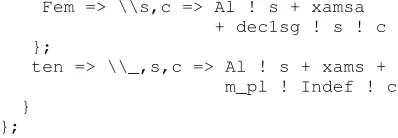
We write functions that form the inflection tables of the digits: one function for numeral 2 (num2, not shown here) and one function for the rest of the dig-its, including 1 (num1_10, shown below).1
oper num1_10 : Str -> { s : DForm => Gender => State => Case => Str } = \xams -> let xamsa = xams + "ap" in {
s= table {
unit => table {
Masc => \\s,c => (sing xams) ! s ! c;
1
Our grammar files are in unicode, but the example codes shown here are written using the Buckwalter (2003) translitera-tion with a few changes that suit our needs. We note our use of ‘c’ to denote the,ayn.
Fem => \\s,c => Al ! s + xamsa + dec1sg ! s ! c };
ten => \\_,s,c => Al ! s + xams + m_pl ! Indef ! c }
};
Note the following GF syntax notations: The key-wordoperdefines a GF function. Anoper judg-ment includes the name of the defined operation (e.g. num1_10 in the example above), its type (e.g. Str -> { s : DForm => Gender => State => Case => Str }), and an ex-pression defining it (everything after the = opera-tor). As for the syntax of the defining expression, notice the lambda abstraction form\x -> tof the function. Inflection tables are either specified by the
tablekeyword or using the shorthand\\... =>
notation. Finally, + is the character concatenation operator and!is the table selection operator.
The num1_10function takes a string which can be any of the stems of the numerals from one to ten excluding two, e.g. h
˘ams. From this stem, and
using helping functions from the nominal morphol-ogy modules, we build the inflection table of the nu-meral. For example, for the case whereDForm is
unitand theGenderis feminine (e.g. h
˘ amsah),
the actual numeral string would be the concatena-tion of a possible definite marker (al), the stem, and a suffix determined by the state and the case of the numeral,sandcrespectively. The helping function that determines if the definite marker is needed is the following:
Al : State => Str = table {
Def => "Al"; _ => "" };
The second helping function defines the suffixes that attach to singular or broken plurals of the first (strong) declension of Arabic nominal words (Rets¨o, 1984). It calculates, given the state of the word and its case, what its suffix will be. Note thatN,F, and
Kare the nominative, accusative, and genitive nuna-tion diacritics.
dec1sg : State => Case => Str = table {
Indef => table {
[image:4.612.319.518.60.129.2]Gen => "K" };
_ => table {
Nom => "u"; Acc => "a"; Gen => "i" }
};
As expected, only words with indefinite state take double diacritics (nunation), where as the rest (al -definite or construct--definite words) take simple di-acritics. The remaining helping functions will not be all explained here as they follow similar logic.
Thenum1_10andnum2produce only the inflec-tion tables (thesfield of the digit record). We sim-ply add the correctSizeparameter to each digit as follows:
oper num3_10 : Str -> { s : DForm => Gender => State => Case => Str ; n : Size } =
\xams ->
num1_10 xams ** { n = ThreeTen } ;
lin n2 = num2 ** {n = Two };
lin n3 = num3_10 "valAv"; lin n4 = num3_10 ">arbac"; lin n5 = num3_10 "xams"; lin n6 = num3_10 "sit˜"; lin n7 = num3_10 "sabc"; lin n8 = num3_10 "vamAnI"; lin n9 = num3_10 "tisc";
lin pot01 = num1_10 "wAHid" ** { n = One } ;
lin pot0 d = d ;
The last function in the linearization shown above, pot0, is used to promote a Digit into a
Sub10 in order to use it later on as any numeral less that ten. This is the way the API specifies dif-ferent numerals, dividing them into categories based on the decimal system. We give here the rest of the API categories and their linearization in Arabic:
cat
Sub100 ; -- 1..99
Sub1000 ; -- 1..999
Sub1000000 ; -- 1..999999
lincat Sub100 = {
s : Gender => State => Case => Str ; n : Size
} ;
We will now show only a few implementation ex-amples of the rules that specify the formation of the
Sub100category. The rest of the rules for this and
other categories don’t show any different logic and will not be detailed here. The first rule we give is for the special cases of numeral 11:
fun
pot111 : Sub100 ;
lin pot111 = { s = \\g,d,_ =>
case g of {
Masc => Al ! d + ">aHada" ++ teen ! Masc; Fem => Al ! d + "<iHdaY" ++ teen ! Fem };
n = NonTeen };
oper teen : Gender => Str = table {
Masc => "ca$ara"; Fem => "ca$rapa" };
The implementation shows how the qualitative rules stated at the beginning are described formally. The inflection table doesn’t give different forms for the three cases, and the accusative is used whatever the context case is. Both parts of the construction show gender agreement.
The numbers 12-19 have a common rule in the API but we should differentiate in the Arabic lin-earization between 12 and 13-19 because of the spe-cial status of the dual in Arabic and the different rules that these numbers assume in Arabic (see rules above).
fun
pot1to19 : Digit -> Sub100 ; -- 10 + d
lin pot1to19 dig = { s = \\g,d,c =>
case dig.n of {
Two => Al ! d + num2.s ! unit ! g ! Const ! c ++ teen ! g ; _ => dig.s ! unit ! g ! Const ! Acc
++ teen ! (genPolarity ! g) };
n =
case dig.n of { Two => NonTeen; _ => Teen }
};
oper
genPolarity : Gender => Gender = table {
Masc => Fem; Fem => Masc };
Sizeof the digit. When theSizeisTwo, i.e. the number will be 12, we apply the rules for number 12 as given in the beginning: gender agreement be-tween the two constituents, the first constituent is inflected in case (it is basically number 2 in the
Const state). Otherwise (when the digit size is
ThreeTen), we apply the rules of numbers 13 - 19: gender polarity between the two constituents and the first constituent is the digit inflected for the construct state and accusative case. The second constituent for all the numbers 11-19 is always accusative as shown in theteenhelping function before.
The rest of the rules for forming numbers will not be detailed here. Instead we will explain how all these numbers will combine with nouns to form noun phrases. The different number ranges as de-fined by theSizeparameter will be now used ex-tensively in applying the proper rules. Following is the rule that takes that takes a Determiner (which can, among others, be a numeral) and a common noun to give a noun phrase.
fun
DetCN : Det -> CN -> NP ;
The rule above has the same type in all languages since it’s part of the language-independent API (ab-stract syntax). The advantage of this is that a user of our system can access the Arabic numerals at this high level of abstraction, without being knowledge-able about the details of our implementation.
When determiners combine with common nouns in the general case, it will make a difference whether or not the determiner was a numeral, and if it were then the range of the numeral will probably deter-mine the case of the noun in the resulting NP. Thus the type of the determiner category should include a
Sizefield which is taken directly from the size of the number if that determiner is a numeral:
lincat Det = {
s : Species => Gender => Case => Str ; d : State;
n : Size } ;
param Species = NoHum | Hum ;
If the determiner is not a numeral, then this will be denoted byn = None.
The first determiner-noun modification we will introduce is the determiner’s gender. If we don’t
consider numerals, then a determiner’s gender is di-rectly deduced from that of the noun. But, as we saw in the rules for Arabic counted nouns, if the numeral was in the range 3-10 or 13-19 (SizeisThreeTen
or Teen), then the numeral will show gender po-larity instead of agreement. The rest of the cases continue to show agreement. This is described in
detGender: oper
detGender : Gender -> Size -> Gender = \g,s ->
case s of {
ThreeTen | Teen => genPolarity ! g; _ => g
};
The arguments are the gender of the noun and the size of the determiner. The correct gender of the de-terminer is calculated after taking cases of theSize. Again, if we were not to consider numerals, the number in which we should inflect the common noun (singular, dual, or plural) would be directly de-termined by the number of the determiner. Now with the consideration of numerals and their special rules that dictate the number of the counted noun, we have to specify a correcting function:
oper sizeToNumber : Size -> Number = \s -> case s of {
ThreeTen | None => Pl; Two => Dl;
_ => Sg } ;
param Number = Sg | Dl | Pl;
This function converts from theSizeof the de-terminer to a number in which the noun should be inflected in. As the rules of Arabic numerals spec-ify, only the 3-10 numeral range dictate a noun in the plural form. Apart from the dual, the remaining numeral ranges take a singular noun.
The last way that a numeral will affect the noun it counts is by specifying its case as we have already seen in the rules. Without considering numerals, the case of the noun would always be determined by its grammatical role in the sentence. Again, this changes with the introduction of numerals. We write now a function that takes the case from the sentence, along with the size and state of the determiner, and modifies the case if required:
oper
case <size,s> of { <Teen,_> => Acc; <NonTeen,_> => Acc; <ThreeTen,_> => Gen; <Hundreds,_> => Gen; <_,Const> => Gen; _ => c
};
Numbers from 11 to 99 dictate the accusative case on the nouns they count, numbers from 3 to 10 and multiples of hundred dictate the genitive case of the nouns they count, and the remaining numbers (1 and 2) don’t change the case determined by the context. The remaining case ofState = Const
takes care of theid. ¯afahgenitive constructions. Thus, after applying all the “correction” functions above, we get the following implementation of the noun determination rule:
lin DetCN det cn =
let number = sizeToNumber det.n in { s = \\c =>
det.s ! cn.h ! (detGender cn.g det.n) ! c ++ cn.s ! number ! (nounState det.d number)
! (nounCase c det.n det.d); a = agrP3 cn.h cn.g number
};
oper agrP3 : Species -> Gender -> Number -> PerGenNum=
\h,g,n ->
case <h,n> of {
<NoHum,Pl> => Per3 Fem Sg;
_ => Per3 g n
};
The agrP3 helping function tests for the case when the species and number are nonhuman and plural. This case is treated in agreement as the fem-inine singular.
4 Related Work
A large-scale implementation of the Arabic mor-phological system is the Xerox Arabic Morphologi-cal Analyzer and Generator (Beesley and Karttunen, 2000; Beesley, 2001). This system is developed us-ing only the Xerox Finite State Technology tools (Beesley and Karttunen, 2003) from which an Ara-bic Finite State Lexical Transducer is written. A re-search version is available for online testing, and an expanded and updated version can be obtained with a commercial license. Another notable computa-tional model of the Arabic morphology is Tim Buck-walter’s Arabic Morphological Analyzer (Buckwal-ter, 2004b,a). Buckwalter’s analyzer parses Arabic
words and gives all their possible morphological in-terpretations, each solution having a unique lemma ID, different word constituents, the part-of-speech, and English glosses.
Other works that also use functional languages for the treatment of Arabic include a morphology sys-tem by Smrˇz (in prep.). This work is based on Func-tional Morphology (Forsberg and Ranta, 2004), a methodology for building morphological systems in the Haskell programming language. Our treatment of Arabic shares similarities with that of Functional Morphology. Both approaches use typed languages, making use of finite algebraic datatypes to define linguistic categories. Both languages are functional, so the approaches use functions to realize linguis-tic abstractions. A large-scale implementation of this approach, in which a typed functional program-ming language is used to build a morphology, is Huet’s Sanskrit dictionary and morphological sys-tem (Huet, 2006) upon which the Zen computational linguistics toolkit is based (Huet, 2005).
Of the available works in Arabic syntax, we men-tion El-Shishiny (1990) who developed a formal de-scription of Arabic syntax in Definite Clause Gram-mar. We also make note of the work in Othman et al. (2003), where the authors describe a parser they wrote in Prolog to parse and disambiguate the Arabic sentence. Shaalan (2005) builds on this work to develop a syntax-based grammar checker for Ara-bic called AraAra-bic GramCheck.
5 Discussion
6 Conclusion
We discussed in this paper the details of implement-ing the Arabic numeral system in GF. We motivated our work by taking an example that shows the value of having the necessary language rules implemented in a reusable fashion. We built up our implementa-tion towards a single language-independent rule that a user can call to access our system. We show how the grammar formalism we use in our implementa-tion parallels the way linguists think.
Acknowledgments
Most of the work was done at Chalmers Univer-sity of Technology. Thanks to Prof. Aarne Ranta for supervising this work and providing constant help. Also thanks to Bj¨orn Bringert, Harald Ham-marstr¨om, and Otakar Smrˇz for giving valuable comments.
References
Kenneth Beesley. Finite-State Morphological Anal-ysis and Generation of Arabic at Xerox Research: Status and Plans in 2001. InWorkshop Proceed-ings on Arabic Language Processing: Status and Prospects, pages 1–8, Toulouse, 2001. ACL.
Kenneth Beesley and Lauri Karttunen. Finite-state non-concatenative morphotactics. InProceedings of the Fifth Workshop of the ACL SIG in Compu-tational Phonology, pages 1–12, 2000.
Kenneth R. Beesley and Lauri Karttunen. Finite State Morphology. CSLI Studies in Computa-tional Linguistics. CSLI Publications, Stanford, California, 2003.
Tim Buckwalter. Arabic transliteration, 2003.http: //www.qamus.org/transliteration.htm.
Tim Buckwalter. Issues in Arabic Orthography and Morphology Analysis. In Proceedings of the COLING 2004 Workshop on Computational Approaches to Arabic Script-based Languages, pages 31–34, 2004a.
Tim Buckwalter. Buckwalter Arabic Morphologi-cal Analyzer Version 2.0. LDC catalog number LDC2004L02, ISBN 1-58563-324-0, 2004b.
Ali Dada and Aarne Ranta. Implementing an Open Source Arabic Resource Grammar in GF. In
Mustafa Mughazy, editor,Perspectives on Arabic Linguistics, volume XX. John Benjamins, 2007.
Hisham El-Shishiny. A formal description of Arabic syntax in definite clause grammar. In Proceed-ings of the 13th Conference on Computational Linguistics, pages 345–347. ACL, 1990.
Markus Forsberg and Aarne Ranta. Functional Mor-phology. InProceedings of the Ninth ACM SIG-PLAN International Conference on Functional Programming, ICFP 2004, pages 213–223. ACM Press, 2004.
Harald Hammarstr¨om and Aarne Ranta. Cardinal Numerals Revisited in GF. In Workshop on Nu-merals in the World’s Languages, Leipzig, Ger-many, 2004. Dept. of Linguistics Max Planck In-stitute for Evolutionary Anthropology.
G´erard Huet. A Functional Toolkit for Morphologi-cal and PhonologiMorphologi-cal Processing, Application to a Sanskrit Tagger. Journal of Functional Program-ming, 15:573–614, 2005.
G´erard Huet. Sanskrit Site, 2006. http:// sanskrit.inria.fr/.
D. H. Hymes. Lexicostatistics so far. Current An-thropology, 1:3–44, 1960.
Janna Khegai and Aarne Ranta. Building and Using a Russian Resource Grammar in GF. In Intelli-gent Text Processing and Computational Linguis-tics (CICLing-2004), pages 38–41, Korea, 2004.
E. Othman, K. Shaalan, and A. Rafea. A Chart Parser for Analyzing Modern Standard Arabic Sentence. In Proceedings of the MT Summit IX Workshop on Machine Translation for Semitic Languages, pages 37–44, 2003.
Aarne Ranta. Grammatical Framework: A Type-theoretical Grammar Formalism. Journal of Functional Programming, 14:145–189, 2004.
Jan Rets¨o. State, Determination and Definiteness in Arabic: A Reconsideration. Orientalia Suecana, 33–35:341–346, 1984.
Khaled F. Shaalan. Arabic GramCheck: a grammar checker for Arabic: Research Articles. Software -Pracice and Experience, 35(7):643–665, 2005.