International Journal of Advanced Research in Computer Science RESEARCH PAPER
Available Online at www.ijarcs.info
Consistent Approach for Enhancing Security using Feature level Fusion
Sapna Saini
Research Scholar (M.Tech)Department of Computer Science and Applications Kurukshetra University, Kurukshetra-136119
Chander Kant
Assistant ProfessorDepartment of Computer Science and Applications Kurukshetra University, Kurukshetra, INDIA
Abstract: High level authentication to an individual is provided by recognizing physiological or behavioural characteristics and this can be done using biometric system. But nowadays spoofing has become an important issue to be taken into account as unibiometric system can be easily spoofed with the use of dummy trait of the legitimate user. But with the use of multiple modalities, authentication level can be enhanced. Multi-Biometric System improves the capability of traditional biometric system. For establishing identity of individual different modalities of an individual can be used in a multibiometric system. The proposed multibiometric approach overcomes the numerous problems observed in unibiometric system by using different modalities instead of using single modality. Here we have proposed a scheme by fusing different modalities (face and iris) for raising the biometric system performance. The approach includes integrating the feature set of face and iris using feature level fusion. The main purpose of the purposed scheme is to enhance the FAR (false acceptance rate), FRR (false reject rate) and total response time.
Keywords - Biometric Trait, Face, Fusion, Iris, Multi-biometric
I. INTRODUCTION
In today’s world there is requirement of reliable security system which provides secure personal identification. So, biometric systems are best suited in providing personal identification. Biometric systems are those which identify an individual based upon physiological or behavioural characteristics. Traditionally, the system uses a single source of information (single trait) is used to authenticate an individual and is known as unibiometric system. As unibiometric systems can be easily spoofed as it uses single source of information are replaced by multibiometric systems. Instead of using a single trait if multiple traits are used for providing authentication then it becomes difficult for the imposter to spoof the biometric system.
Multibiometric system is defined as the system where data collection takes place from various biometric sources (can be physiological or behavioural). This system consists of following:
A. Selection
This process involves retaining of useful data which is to be used by ignoring or discarding data which is of no use.
B. Validation
This process involves checking the integrity of the collected biometric data.
C. Fusion
This process consists of fusing the data obtained / captured from different sources at different levels of biometric system.
Multibiometric system can be classified on the basis of two things one based upon the nature of source and other based upon the type of fusion to be used.
Multibiometric system based upon the nature of source can be categorized as:
A. Multi-Sensor Systems
These are those systems where for capturing a
single biometric trait of an individual multiple sensors are used.
B. Multi-Algorithm Systems
These are those systems where over the same biometric data multiple feature extraction or matching algorithm can be applied.
C. Multiple Instance Systems
Those systems which use multiple instances of the same biometric trait are known to be multiple instance systems.
D. Multi-Sample Systems
System where multiple samples of the same biometric trait can be captured using a single sensor.
E. Multimodal Systems
These are those systems where authentication of an individual is provided using different biometric traits.
F. Hybrid Systems
If two or more of the above mentioned systems are combined then they become hybrid system.
Fusion in multibiometric system can be classified as: A. Sensor Level Fusion
The raw data obtained from different sensors are fused together. This fusion occurs at early stage where trait acquisition takes place.
B. Feature Level Fusion
Feature sets are extracted from the raw data available from different sensors and these obtained feature sets are fused together.
C. Score Level Fusion
After the extraction of feature vector from different biometric traits comparison is done with the template database which generates matching score for each trait. The obtained matching scores are fused together inorder which results in a composite match score.
D.Decision Level Fusion
Figure 1. Different types of fusion [1]
Advantages of Multibiometric system are:
• It improves the matching accuracy.
• Issue of non universality insufficient population coverage can be easily address using multibiometric system.
• Due to the use of multiple biometric traits it becomes difficult for an imposter to spoof the system.
• The problem of noisy data can be reduced using multibiometric system.
Feature level fusion is one that consolidates the cues presented by two biometric feature sets of the same individual. But in some cases feature level fusion is difficult to achieve because of the following reasons:
• Due to the incompatibility between the feature sets of multiple modalities.
• Requirement of large space for storing feature set of different modalities.
• Sometimes access to the feature sets is not provided by most commercial biometric system.
This paper presents a multibiometric approach which includes combining information provided by two modalities (Face and Iris) using feature level fusion.
II. RELATED WORK
The main purpose for designing a multibiometric system is to enhance the overall performance of the system.
Iwasokum G.B. et.al. [2] presents an overview about the use of biometrics for authentication. A Multimodal biometrics system which provides secure and reliable identity management has been discussed. N.S Lakshmiprabha et.al. [3] discussed about a multimodal approach that uses face and periocular biometric. Gabor and LBP filtering is used for the performance analysis of face recoginition and periocular biometric. Rohmaissa Mazouni et.al. [4] discussed about multimodal approach that uses various advanced artificial intelligence techniques like PSO(Particle Swarm Optimization),Genetic algorithm etc. for fusing the matching score. Three data conditions that are clean, varied
and degraded are considered for performing fusion. N.Geethanjali et.al. [5] proposed a multimodal biometrics approach for enhancing ATM system security and a mechanism for email verification code is provided. Ola M. Aly et.al. [6] purposed a multimodal biometric recoginition system that uses feature level fusion based on PSO. This approach uses three biometrics modalities over which feature level fusion that uses new multi objective fitness function for PSO is applied. Shruthi B.M. et.al. [7] presents a multimodal biometric authentication scheme that fuses finger vein and fingerprints modality of individual for achieving high recognition accuracy. In the proposed system finger vein and fingerprint images are fused using a new score level combination strategy (holistic and non linear function). Sachin Gupta & Ashish Gagneja [8] proposed iris recoginition algorithm that is used to recognize an individual using iris trait. Here challenge response test is used in the iris recoginition for checking the uniqueness of eye and correspondingly data is stored in iris database. Gandhimathi Amirthalingam et.al. [9] proposed a multimodal biometric approach that uses face and ear biometric trait for providing authentication. Shyam Sunder and Ram Singh [10] discuss about multimodal biometric system based integrating strategies approach at feature level fusion. Here, face and fingerprint modalities are fused by extracting independent feature point sets from the two modalities. K-Means clustering feature reduction techniques are used for making feature set available for the two modalities more appropriate and suitable for fusion process. Dzati Athiar Ramli et.al. [11] presents two approaches of multibiometric system which are instance and multi-modal system. This paper focuses over the score level fusion and min-max normalization which is used for score normalization.
III. DESIGN OF THE PROPOSED SYSTEM
A. Proposed Method
The new approach has been proposed for individual identification that utilizes acquiring face image and extracting iris image from the acquired face image. Thereafter both images are simultaneously preprocessed and feature level fusion is performed for better throughput and high security. This approach illustrates significantly enhanced performance over previously proposed approaches.
B. Block Diagram
scores obtained after normalising face and iris image feature set are fused together using simple sum rule feature level fusion technique and which in result produces fused score . After that fused score is compared with the score that exists in the database based upon which decision is taken whether a genuine user or imposter is interacting with the system. Fig2 is showing the block diagram of proposed system.
Figure 2. Block diagram for individual identification through feature level fusion
IV. WORKING
A. Enrollment Phase
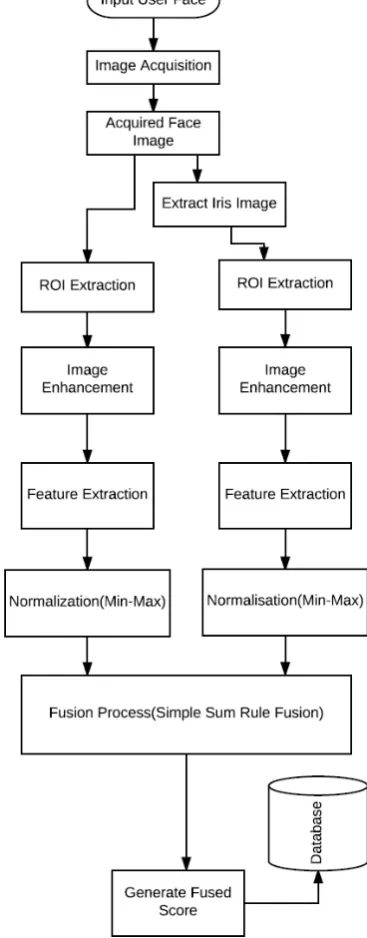
Enrollment phase includes image acquisition, image preprocessing and feature extraction. On the extracted feature set feature level fusion is performed to generate the fused score which will be used in the verification phase later on. Fig 3 is showing the enrollment phase.
1) Image Acquisition: Here in the proposed approach a single
camera is used to acquire both face and iris images. Firstly, using camera whole face image is captured and then iris image is extracted from it. In this way this approach provides the images for both face and iris recognition.
2) ROI Extractor: In order to extract region of interest area
face image is partition into region using Region of Interest (ROI) Extractor. Lip, nose, chin and eye (left eye, right eye) of human facial image are taken as different region of interest on the basis of which extraction takes place based upon skin color and knowledge based methods concerning human facial data. For the extraction of region of interest curves are drawn considering skin pixels which are not in the respective region of skin color. Then shape curves are found from each ROI. After that extreme points of curves are considered which are used to extract the feature points.
[image:3.595.343.527.66.536.2]In case of Iris ROI extraction, the concentric circles of inner and outer boundaries which are region of interest of iris containing the whole information are extracted from the iris image.
Figure 3. Enrollment using multiple traits (Face & Iris)
3) Image Enhancement: Image enhancement techniques are
used to enhance the quality of the image. Here image enhancement techniques (spatial and frequency domain techniques) are applied over face image and iris image.
• Spatial Domain Techniques: These techniques are those which operate directly on pixels and are applied for improving the visual appearance of the image.
• Frequency Domain Techniques: These techniques are those which operate on Fourier Transform of an image provide easiness in the feature extraction. The main purpose of using image enhancement techniques is to improve the poor quality of images with the help of suitable filters that smoothen or sharpen them.
4) Feature extraction: After image enhancement the feature
5) Normalization: Min-Max normalization method used that map raw score in the range [0, 1]. It gives lower and upper bound values of score.
Let F implies set of all scores; f’ denotes the raw score from set F and M implies the normalized score. Then, the formula used for computing the normalized score using min-max normalization is:
M= F-min (f’) ∕max (f’) - min (f’)
6) Feature level fusion: The normalized score of both face and
iris image are fused using Simple Sum Rule feature level fusion which in result produces fused score.
Simple sum rule fusion performs addition of the normalized score obtained from the involved modalities and generates fused score in result. The computation of fused score can be done using:
F=
F denotes the fused score obtain using simple sum rule fusion.
B. Verification Phase
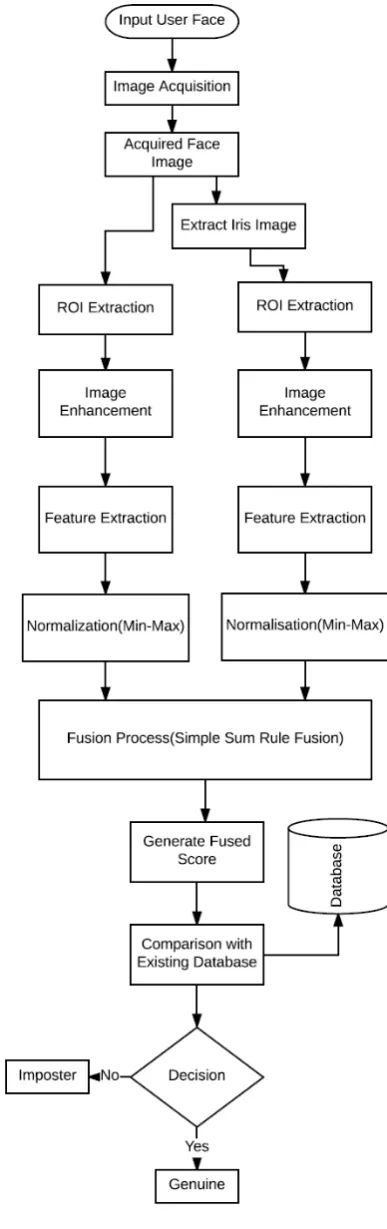
Verification phase includes matching and decision making. In this phase fused score obtained after feature level fusion is matched with the one that is stored in the existing database based upon which decision is made. If the fused score match with the stored score then the user is accepted as genuine user and if not then the user is rejected and considered as imposter. Fig 4 is showing verification phase.
C. Algorithm for authentication in proposed scheme 1. Input user face
2. Acquire face image
3. Extract iris image from face image
4. Apply ROI extraction on face and iris image 5. Perform image enhancement technique over
ROI extracted images 6. Extract feature set
7. Apply Min-Max normalization
8. Apply feature level fusion (Simple Sum Rule) on normalized scores
9. Generate the fusion score
10. Compare the obtained fusion score with the existing database
11. If (score >= threshold) Then 12. Accepted/Genuine
13. Else
14. Rejected/Imposter 15. End
V. ADVANTAGES OF THE PROPOSED SCHEME
A.Single device has been used for acquiring both face and iris image.
B.Human perception and computer interpretability have been improved using image enhancement techniques.
C.Data distortion problem can be easily solved.
[image:4.595.334.528.55.671.2]D.FAR (false acceptance rate) and FRR (false reject rate) have been reduced.
Figure 4. Verification using multiple traits (Face & Iris)
VI. DRAWBACKS OF THE PROPOSED SCHEME
A. Extra storage space is required for storing the two modalities.
VII. COMPARISON OF PROPOSED APPROACH WITH EXISTING TECHNOLOGIES
The proposed approach provides more efficiency and increases the overall performance as compared to existing technologies. It has low cost as single device is used for obtaining the two modalities. Therefore the two modalities can be easily acquired without wastage of time. As compared to the existing technologies this approach takes less time for acquiring the raw data. This approach uses more accurate and permanent biometric modalities provides much better results in comparison to other existing multimodal technologies.
VIII. RESULTS
Normalize density plots are generated for both face and iris modalities after applying min-max normalization method. Fig. 5 and Fig. 6 show the normalized density plot for face and iris respectively.
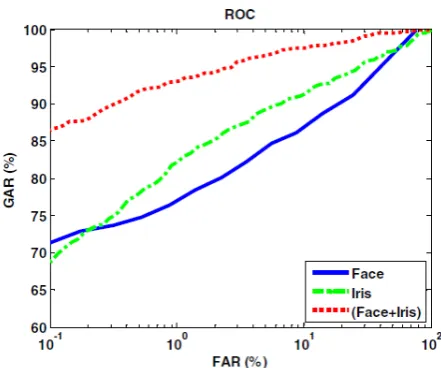
[image:5.595.324.545.64.248.2]The ROC curve is obtained after applying the simple sum rule fusion over the normalized face and iris modality. This curve plots the genuine acceptance rate against the false acceptance rate. Fig. 7 shows the ROC curve for face and iris using weighted sum rule fusion method.
Figure 5. Face normalized density plot
Figure 6. Iris normalized density plot
Figure 7. ROC Curve for Multimodal Fusion (Face + Iris)
IX. CONCLUSION
Multibiometric system overcomes numerous problems observed in unibiometric system. Here the proposed approach uses a combination of two modalities (face and iris) which is more efficient than existing approaches. Feature level fusion of face and iris biometric is presented in this study. Also we have demonstrated normalization technique (Min-Max) that generates the normalized score prior to simple sum rule fusion for improving the recognition performance of the proposed system that uses the face and iris traits for authentication. The combination of two or more types of biometric recognition systems helps to meet extreme performance requirements set by security alert customers. In comparison to the traditional approach, this approach provides more reliable and secure authentication.
X. REFERENCES
[1] Mohamed Soltane & Mimen Bakhti, "Multi-Modal Biometric Authentications: Concept Issues and Applications Strategies," International Journal of Advanced Science and Technology, vol. 48, November 2012.
[2] Udoh S. S & Akinyokun O. K Iwasokun G. B., "Multi-Modal Biometrics: Applications, Strategies and Operations," Global Journal of Computer Science and Technology: G Interdisciplinary, vol. 15, no. 2, 2015.
[3] J. Bhattacharya & S. Majumder N. S. Lakshmiprabha, "Face Recognition using Multimodal Biometric," in 2011 International Conference on Image Information Processing (ICIIP 2011), 2011.
[4] Romaissa Mazouni & Abdellatif Rahmoun, "On Comparing Verification Performances of Multimodal Biometrics Fusion Techniques," International Journal of Computer Applications (0975 – 8887), vol. 33, November 2011.
[5] N.Geethanjali & K.Thamaraiselvi, "Feature Level Fusion of Multimodal Biometrics and Two Tier Security in ATM System," International Journal of Computer Applications (0975 – 8887), vol. 70, May 2013.
[image:5.595.44.252.395.562.2]Ola M. Aly, "A Multimodal Biometric Recognition system using feature fusion based on PSO," International Journal of Advanced Research in Computer and Communication Engineering, vol. 2, no. 11, November 2013.
[7] Pooja Mohnani, Mallinath & Ashwin.R.G Shruthi.B.M, "Multimodal Biometric Authentication Combining Finger Vein and Finger Print," International Journal of Engineering Research and Development, vol. 7, no. 10, pp. 43-54, July 2013.
[8] Sachin Gupta & Ashish Gagneja, "Proposed Iris Recognition Algorithm through Image Acquisition Technique," International Journal of Advanced Research in Computer Science and Software Engineering, vol. 4, no. 2, February 2014.
[9] Gandhimathi Amirthalingam & Radhamani. G, "A Multimodal Approach for Face and Ear Biometric System," IJCSI International Journal of Computer Science Issues, vol. 10, no. 5, September 2013.
[10] Shyam Sunder & Ram Singh, "Multimodal Biometric System Based "Integrating Strategies Approach at Feature Level"," International Journal of Recent Development in Engineering and Technology, vol. 3, no. 6, December 2014.
![Figure 1. Different types of fusion [1]](https://thumb-us.123doks.com/thumbv2/123dok_us/693066.1076870/2.595.38.282.71.261/figure-different-types-of-fusion.webp)