! "
# # "$ % %#
& ''' (
ISSN No. 0976-5697
Simulation of Handoff Management Scheme for Improved Priority Based Call
Scheduling with a Single Traffic System in Mobile Network
Biswajit Bhowmik*
Department of Computer Science & Engineering Bengal College of Engineering & Technology
Durgapur, India [email protected]
Arnab Sarkar
Department of Computer Science & Engineering Adamas Institute of Technology
Kolkata,India [email protected]
Parag Kumar Guha Thakurta
Department of Computer Science & Engineering National Institute of Technology
Durgapur,India [email protected]
Abstract: We are passing through a new era of mobile computing, one that is promising lots of varieties of quality of services to large extend of mobile users in applications, highly improved usability, and speedier networking. A new approach IPBCS for call scheduling with handoff behavior is proposed in this paper. The model introduces heap structure on the basis of call priority in considerably reduced time. Computational cost in both the cases is then shown to be minimized to a large extent. The performance metric in this proposed model is analyzed by simulating handoff scheme to focus the nature of mobility of the users. Finding handoff point of the mobile user reflects the novelty as well as the generality of the model.
Keywords: SIRO; Handoff Point; Mobile Host; Foreign Agent; CBR; CDR.
I. INTRODUCTION
In this day and age, request and demand for mobile communication facilities are greater than ever exponentially. With ever-increasing number of subscribers, on the other hand, quality of connectivity, and bandwidth limitations have become a major problem towards imparting efficient services [8, 10, 13]. Network designers are proposing suitable and fruitful channel allocation schemes for appropriate distribution of resources and effective scheduling policies for handling users’ call so that network congestion can be avoided successfully. The problem of resource allocation [3] has been resolved by proposing a pricing scheme [1] for mobile users. However, the model was static one. A dynamic pricing scheme [4] is then necessary and might be indispensable to improve allocation scheme [3]. Even in the dynamic pricing scheme [4] only two types of mobile users (prioritized and conventional) were allowed. Naturally, priority users avail better Quality of Service (QoS). As a result of more interests of the researchers, an improvement on the strategies [3, 4] has been come out with an effective user’s call scheduling algorithm which has been described with a tree structure and a generalized unique path sequence [1]. Still the problems
remain as in [3, 4]. A competent as well as a new approach on priority queue based scheduling method introducing handoff mechanism for handling incoming calls has been represented in [2].
In this paper, we have extended and have tried to improve our earlier work [2] by introducing the concept of heap structure [5] for call handling in subsequent less computation time from polynomial time bound to logarithmic time function. In addition, the handoff algorithm presented in [2] could be modified by introducing the algorithm Handoff_Heap_MT() in this model. Selection of a call from the priority queue has been considered using Selection for service In Random Order (SIRO) over other approaches (queuing principles) to overcome from starvation problem [2]. The performance analysis illustrates the handoff behavior of a mobile user with respect to the different parameters like arrival rate, departure rate, radial distance, etc. Analysis of the performance metrics (CBR and CDR) in this paper is also focused by simulating the handoff scheme [2] to study the nature of mobility of the users. The model finally intends to locate the point of the ongoing call. We begin with a brief presentation of the previous works [2] for completeness.
II. PRIORITY QUEUE BASED SCHEDULING
WITH HANDOFF IMPLEMENTATION (PQSHI) MODEL [2]
In the dynamic pricing scheme PQSHI model (depicts the call scheduling procedure as well as handoff behavior for mobile networks) [2], the call requests from the users with
1. In this scheme, the call requests with respect to MT are handled by the priority queue [2]. This is a new as well as a variation of PTGM [1] and two major functionalities of this model are described in brief as follows:
Figure 1: Cellular structure for r = 3
II.1. Call Scheduling
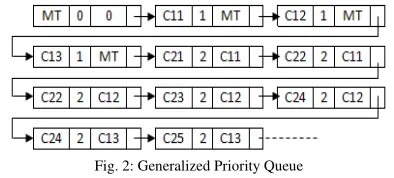
[image:2.612.75.272.351.440.2]The priority factors mentioned in [1] has been assigned to the originated calls with the modified priority queue shown in Fig. 2 to block more calls in lower time complexity.
Fig. 2: Generalized Priority Queue
II.2.Handoff Implementation
Handoffs are built on top of the mobile routing. And these mobile users are sometimes called Mobile Hosts (MHs) who get connection via MTs which act as Foreign Agents (FAs) [9, 12]. The handoff behaviour of various calls has been established using Xie and Kuek’s Traffic single traffic model [7] as well as formulated on the basis of the generated priority queue. It serves as the basic platform to analyse the handoff behaviour of incoming calls [10]. Movements of the mobile users (callers) have been shown in Fig. 4.
III. IMPROVED PRIORITY BASED CALL
SCHEDULING (IPBCS) MODEL
In the mobile computing area, two main trends of development can be typified: Developing enhance communications of mobile network, and providing more and more facilities to users [9, 11]. Through the selection of a suitable model it could be overcome. An approach to towards this view is the IPBCS model. Major activities of this IPBCS model in this work are basically divided into three functional areas. These are as follows:
• Construction of Heap.
• Queuing Analysis.
• Comparative Study.
A. Construction of Heap
The priority queue (shown in Fig. 2) could be represented with the linear data structure tool - linked list. However a large number of generated unique path sequences for many cells might create ambiguities due to more than one optimal path. Although most of the paths are mirror images to each other [2, 5]. Assuming conventions of callers’ movements in [2] possible calls may be enlisted in the queue through devising the following algorithm.
Algorithm: PriorityQ()
Input: A cellular network with maximum N cells for radial distance r.
Output: The generated priority queue.
Assumption: MT has 0 priority value and radial distance r is the priority value assigned to every cell at every level r.
Terms Used: Cij = current cell.
Priority = priority value of the current cell Cij.
Parent = parent cell of Cij.
Next = address of the next cell from Cij.
(1) Initialize, Root = CreateNode(MT, 0, 0, NULL) (2) Initialize, Temp = Root.
(3) Repeat for i = 1 to r through step
(4) Repeat for j = 1 to n // n = number of cells at
r
(i) X = CreateNode(Cij , Priority,
Parent, Next)
(ii) Link(Temp) = X
(iii) X = Temp
(iv) Link(Temp) = NULL
(5) Exit.
Complexity Analysis: As the above queue is implemented using linked list, creating a node requires O(1) time. Step 3 iterates utmost O(r) times. Again there may be maximum n cells at each radial distance r from MT possible which in turn needs O(n). Thus the above procedure runs in O(nr) time which might be quadratic in nature ( O(n2)).
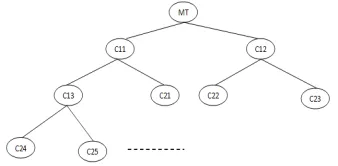
The searching complexity has been further minimized. For the purpose, the priority queue shown in Fig. 2 could be implemented using the heap structure that makes use of
Haep-Extract-Max(), Heap-Increase-Key(),
represented by less key value ( e.g. C11, C12 or simply 11, 12, etc). The procedure Haep-Extract-Max() has been used to extract the cell (mobile user) with minimum key from the above heap [5]. The algorithm for the handoff management in [2] thus could be modified as:
Fig. 3: Heap Representation of the Priority Queue
Algorithm: Handoff_Heap_MT( )
Input: X = selected customer who is in mobile. N = Total Number of nodes in the Heap H = the Heap.
Output: Handoff of a customer from one cell to another cell.
(1) Find X = Heap-Extract-Max (H).
(2) If X moves towards MT
• Call Handoff _towards_MT (X)
(3) If X moves away from MT
• Call Handoff _awayfrom_MT (X)
(4) If X moves along the same level
• Perform no operation.
(5) Exit
[image:3.612.91.255.526.628.2]Time Complexity: It has been observed that the time Complexity for the construction of priority queue could be computed in quadratic function, whereas the time required for the construction of heap would be logarithmic function. Naturally, the corresponding searching time complexity from priority queue to heap structure has been reduced to a large extent, i.e. from O(n2) to O(log n).
Fig. 4: Movements of the Mobile Callers
A. Queuing Analysis
Once a priority queue has been constructed, the next job is to select or assign a caller for handoff. Now, using FCFS [6], only cells near to MT are always selected. Similarly by means of LIFO, FILO [6] cells having lower priorities get selected first which violates our practical circumstances. In all the cases, there is a great chance of starvation. It is perhaps best suitable to employ SIRO [6] principle.
B. Performance Analysis
Before analyzing the performance of the model, it is mandatory introduce and establish a traffic model of for the mobile communication system. Assuming uniform density of mobile users in the coverage area under MT and a user is equally likely to move in any direction with respect to the cell border, Xie and Kuek’s Traffic Model [7] for handoff thus has been thought about here.
In this proposed model, Call Blocking Rate (CBRr) for
radial distance r from MT is defined as follows:
CBRr =
*100% (1)
Obviously, the Call Dropping Rate (CDRr) for the same is given by:
CBRr = (1 - CBRr)*100%
(2)
And, the total number of callers in the network in a particular hour would be considered as:
Q = * 3600
(3)
C. Comparison Study
Performances both in [1] and in the proposed model have been calculated in terms of CBR and CDR.
(i) Performance metrics are fixed and independent of the arrival and departure rates of the callers for static model [1]. They could be defined as:
Call blocking rate in region r =
*100% (4)
= *100%
(5)
Call dropping rate is calculated by subtracting call blocking rate value from 100%.
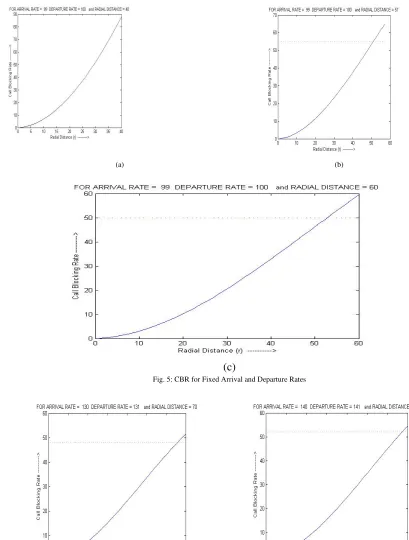
(ii) The users in the proposed model are dynamic (mobile), both the call blocking rate as well as call dropping rate are varied with arrival and outgoing rates of the mobile users at a specific level. Still the model blocks more callers. (iii)Most interesting oh the model is that it is
capable of finding handoff points shown in Fig. 5 and Fig. 6 (with horizontal dotted line).
IV. EXPERIMENTAL RESULTS
results are based on specific radial distance for varying arrival and departure rates of the users as well as keeping
arrival and departure rates constants but varying radial distances.
(a) (b)
[image:4.612.85.494.75.615.2](c)
Fig. 5: CBR for Fixed Arrival and Departure Rates
[image:4.612.120.498.474.663.2](a) (b)
Fig. 6: CBR for Fixed Radial Distance
In case of Fig. 5(b), and 5(c) the handoff points are 55, 50 respectively. But no handoff point will be for Fig. 5(a). In case of Fig. 6(a) and 6(b), the handoff points are 48 and 52 respectively.
V. CONCLUSION
costs) generating the priority queue and modifying the handoff algorithm. We are able to simplify users’ movements. The chance of indefinite blocking of users is also satisfactorily reduced by employing SIRO. Again handoff behavior is studied carefully. And as a result probable radial distance (from current MT) at where a current user may be handed over to another new MT is found. Thus, it could track the belongingness of the mobile user. Further study on the users’ mobility and presence of more callers in each cell are in progress.
VI. REFERENCES
[1] P.K.Guha Thakurta, Subhansu Bandyopadhyay
(2009): A New Dynamic Pricing Scheme with Priority based Tree Generation and Scheduling for Mobile Networks. IEEE Advanced Computing Conference, March 2009 (available in IEEE xplore).
[2] P.K.Guha Thakurta, Souvik Sonar, Biswajit Bhowmik, Swapan Bhattacharya, Subhansu Bandyopadhyay(2010). A New Approach on Priority Queue based Scheduling with Handoff Management for Mobile Networks. SEDE, ISCA, Sanfrancisco, Page(s): 69 – 74.
[3] Saravut Yaipairoj and Fotios C.Harmantzis (2004). Dynamic Pricing with ‘Alternatives’ for Mobile Networks. IEEE WCNC, Page(s): 671-676 vol. 2.
[4] Saravut Yaipairoj and Fotios
C.Harmantzis(2004). A Dynamic Pricing Model for Data Services in GPRS Networks.
Globecom workshops, IEEE Communication Society.
[5] Thomas H. Cormen, Charles E. Leiserson, Ronald L. Rivest, and Clifford Stein (2006). Introduction to Algorithms. PHI, 2nd Edn.. [6] J K Sharma (2006). Operations Research :
Theory and Application. Macmillan
Publishers, 3/e.
[7] Qing-an Zeng and Dharma P. Agrawal (2002) : Handbook of Wireless Networks and Mobile Computing. John Wiley & Sons, Chapter 1.
[8] Robert Godwin-Jones (2008).
Mobile-Computing Trends. Language Learning & Technology, Volume 12, Number 3 pp. 3-9. [9] Jeroen Bijsmans et al (2000). Future Mobile
Computing. Research report, Hewlett Packard Laboratories Bristol.
[10]M. Satyanarayanan. Fundamental Challenges in Mobile Computing. School of Computer Science, Carnegie Mellon University.
[11]Randy H. Katz (2006). Challenges of Mobile Computing. Computer Science Division, University of California, Berkeley.
[12]Steve G. Nortel (2009). Mobile Computing. New York Digital Government Summit, GTC East.