Using Search Engine to Construct a Scalable Corpus for
Vietnamese Lexical Development for Word Segmentation
Doan Nguyen
Hewlett-Packard Company
[email protected]
Abstract
As the web content becomes more accessible to the Vietnamese community across the globe, there is a need to process Vietnamese query texts properly to find relevant informa-tion. The recent deployment of a Vietnamese translation tool on a well-known search en-gine justifies its importance in gaining popu-larity with the World Wide Web. There are still problems in the translation and retrieval of Vietnamese language as its word recogni-tion is not fully addressed. In this paper we introduce a semi-supervised approach in building a general scalable web corpus for Vietnamese using search engine to facilitate the word segmentation process. Moreover, we also propose a segmentation algorithm which recognizes effectively Out-Of-Vocabulary (OOV) words. The result indi-cates that our solution is scalable and can be applied for real time translation program and other linguistic applications. This work is here is a continuation of the work of Nguyen D. (2008).
1
Introduction
The Vietnamese language as a minority language is gaining popularity including content and au-dience. It is important to emphasize a need for natural language such as search engines or trans-lation tools to process the data correctly. With this emphasis, we need to have a way to improve and automate the training process as well as ex-panding its training data. Previous works in con-structing segmentation systems for the Vietnam-ese language relied on single source of informa-tion such as newspapers or electronic dicinforma-tionaries (Le H. Phuong et al. 2008, Dinh Dien and Vu Thuy, 2006, Le T. Ha et al., 2005). Mono-source corpora would work best within their domain, and might not work well externally per O’Neil (2007). Le A. Ha, (2003) described the
dictio-nary based approach as problematic due to the lack of consistency and completeness. This speaks to the need of standardizations between dictionaries, concrete grammar theories, and be-ing up-to-date with the arrival of new words. In the work of Nguyen C. T. et al. (2007), corpus training was done manually by linguists. This was very time-consuming and costly. Because the task is performed only once, a corpus will go stale and will get out-of-date. Dinh et al. (2008), in a comparison with major Vietnamese segmen-tation approaches, concluded that the handling of unknown compound words is a much greater source of segmenting errors and underscored that future effort should be geared at prioritizing to-wards the automatic detection of new com-pounds.
In this paper, we first present the main issues with the Vietnamese word segmentation prob-lem. We describe the two approaches in obtain-ing raw text from the Web. Then, we present our approach in building a large web corpus for a word segmentation function and compare our result against a sophisticated algorithm built on a human trained corpus. Finally, we provide our conclusion and offer suggestions for future re-search directions.
2
Vietnamese Word Segmentation
Problems
Vietnamese (Tiếng Việt) is the official language of Vietnam. The current writing system origi-nates from the Latin alphabet, with diacritics for tones and certain letters. Vietnamese is often mistakenly judged as a “monosyllabic” language. However, the majority of the words are disyllab-ic (Le A. Ha, 2003) covering redupldisyllab-ication and adjectives. Its grammar depends on word order-ing and sentence structure rather than morpholo-gy. Even though there is a space separating
sound units, there is nothing used to identify word boundary.
Examples in Figure 1. are used to illustrate the difficulty of Vietnamese word segmentation when compared it to English. There are 256 possible sequences (2n-1) of segmentation in this example.
Figure 1. Ambiguity of word segmentation
The major segmentation problems with the Vietnamese word segmentation include: the han-dling of word ambiguities, detection of unknown words, and recognition of named entities.
2.1 Addressing Words Ambiguities
In a sequence of Vietnamese syllables, S, com-posing of two syllables A and B occurring next to one another, if S, A, and B are each words, then there is a conjunctive ambiguity in S. In contrast, in a sequence of Vietnamese syllables, S, composing of three syllables A, B, and C ap-pearing contiguously, if A B and B C are each words, then there is a disjunctive ambiguity in S. In order to attain a higher precision rating, word ambiguity must be addressed.
2.2 Detection of Unknown Words
In a dictionary word segmentation based ap-proach, only the words that are in the dictionary can be identified. The unknown words might belong to one of the following categories: (1) Morphologically Derived Word (MDW). There are some lexical elements that never stand alone, which express negation such as: “bất” in “bất quy tắc” (irregular) or transformation such as “hoá” in “công nghiệp hoá” (industrialize). (2) Interchanging usage of vowels i and y and changing in position of tone. For example: “duợc sĩ” and “duợc sỹ”. Both mean “pharmacist”. (3) Phonetically transcribed words. This can be seen in naturalized words like: “phô mai” (fromage), “híp hóp” (hip hop music), or “iPhône” (Apple iPhone).
2.3 Recognition of Named Entities
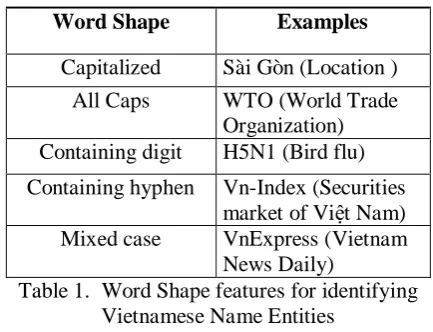
Unlike other Asian languages, Vietnamese per-sonal, location, and organizational names all have the initial letter capitalized. For example: “Nguyễn Du” (a famous Vietnamese poet). Due to the language syntax standardization, a proper name could be written in many different forms. The following organizational name has three ac-ceptable forms: Bộ Nông Nghiệp, Bộ Nông nghiệp, or Bộ nông nghiệp (Department of Agri-culture). We use the following shape features (pattern) to assist with the recognition process:
Word Shape Examples
Capitalized Sài Gòn (Location )
All Caps WTO (World Trade Organization) Containing digit H5N1 (Bird flu)
Containing hyphen Vn-Index (Securities market of Việt Nam) Mixed case VnExpress (Vietnam
News Daily)
Table 1. Word Shape features for identifying Vietnamese Name Entities
3
Using World Wide Web as a Resource
to Build Corpora
There are two approaches to obtain linguistics data from the Web. The first approach is to crawl the web (Baroni et al., 2006 and O’Neil, 2007). This option gives flexibility in choosing or restricting sites to crawl upon. To have good coverage, it requires extensive hardware resource to support storage of content documented in the work of Baroni et al. (2006). Other complexities include a filtering capability to recognize content of a target language from crawling data, remov-ing html code, and handlremov-ing page duplication. The work of Le V. B (2003) indicated that it is very difficult to crawl on Web pages located in Vietnam due to a low network communication bandwidth.
Li-mited number of search queries is allowed by a search engine per day.
4
Our Approach to build corpus
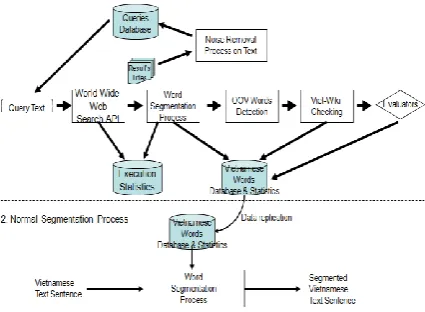
We are structuring our system with two main components. The first component works as a word training and recognition system. The second component utilizes the training informa-tion provided from the first component to per-form just a word segmentation task by leveraging the computed lexical statistics. This is a clear distinction between our work and Nguyen D. (2008). Because there is a limited number of search request imposed by commercial search engines each day, this approach is not practical for a condition where there is constant usage of search requests, for word segmentation purpose. Aside from this limitation, lexical statistics have to be recomputed for each new word segmenta-tion request.
Figure 2. depicts the overall system consists of two components: The training Processing in-cludes a new word discovery function and Nor-mal Segmentation process. The training process would execute continuously and feed the lexical statistics to the second process for segmentation task purely.
Figure 2. Vietnamese Words Corpus Construc-tion Process
4.1 Word Training and Recognition System
This component trains identified words inside a Vietnamese Word Database with its frequency of occurrences. Newly encountered OOV words are recognized by the system then verified by a check against the Vietnamese Wikipedia pro-grammatically. We do not wish to include all words from the Vietnamese Wikipedia as there
are many foreign words. For examples: St. He-lens, Oregon. The remained frequently found OOV words are evaluated by linguists for validi-ty and will be included into the word database as confirmed. Unlike the work of Ghani (2001), in our work, a query to submit to an engine is a sen-tence derived from an unknown document title. The reason here is to enable the system to dis-cover the unknown words and their frequencies naturally. This system performs:
Seed the queries database with an initial set of queries, Qn.
Randomly select a query from Qn and send to a search engine.
From a search result list, process on docu-ment titles and snippet texts directly.
Perform Vietnamese word segmentation on recognized sentences using question mark, exclamation mark, periods as separators. Update the word database with recognized segmented words and their computed fre-quencies and weights.
Recognize and validate OOV words, using the Vietnamese Wikipedia or through mor-phological rules programmatically.
Bootstrap Qn with retrieved document titles. Return to step 2 above.
5
Word Segmentation System
In the Vietnamese language, as the white space cannot be used to denote word boundary, the function of a word segmentation system is to segment a sentence into a sequence of segmented words such that a context (or meaning) of a sen-tence is preserved.
5.1 Data Gathering and Words Extraction
total of the same words in appearing the docu-ments set, N docudocu-ments. Once the extraction process is complete, we perform additional vali-dation steps to discard incorrect generated words. To be accepted as a potential word, a word must satisfy one of the following rules: (1) It appears in the word database. (2) It is recognized as a proper name word. (3) It is a MDR word. (4) It is an OOV word with strong world collocation as defined below.
An OOV word is identified when there is a strong collocation (cohesion) attached between its syllables. That is the following condition(s)
is/are met: (1) For two syllable words to collo-cate: P(s₁ s₂) > P(s₁)P(s₂), (2) For three syllable words to collocate: P(s₁ s₂ s₃) > MAX{ P(s₁)P(s₂)P(s₃), P(s₁)P(s₂s₃), P(s₁s₂)P(s₃) } where w = s₁ s₂ s₃, P(s₁…sn) = Freq(s₁…sn)/N, and N is the number of documents returning from a search engine.
Collocation concept has been utilized in the merging syllables to determine the best possible segment in the work of Wirote (2002).
Suffix Translation
Result
Lexi-cal Category Morphological Rules Examples học "'-logy, -ics" Noun IF Syllable_Suffix("học") AND
Pre-fix_With_Word((Noun(W)) THEN WORD(W+ " "+ "học")
ngôn ngữ (lan-guage) + học ngôn ngữ học (linguistics) hóa "-ize, -ify" Verb IF Syllable_Suffix("hóa") AND
(Pre-fix_With_Word((NOUN(W) ) OR Prefix_With_Word((ADJECTIVE(W) ) ) THEN WORD(W+ " " +"hóa")
công nghiệp (in-dustry) + hóa công nghiệp hóa (industrialize)
Prefix Translation
Result
Lexi-cal Category Morphological Rules Examples sự "Action-" Noun IF Syllable_Prexix("sự") AND
(fix_With_Word((Verb(W)) OR Suf-fix_With_Word((Adjective(W))) THEN WORD(sự+ " "+ W)
sự + thảo luận (discuss, debate)
sự thảo luận (discussion) bất "Un-" Noun IF Syllable_Prexix("bất") AND
(fix_With_Word((Verb(W)) OR Suf-fix_With_Word((Adjective(W))) THEN WORD(bất+ " "+ W)
bất + hợp pháp (legal, lawful)
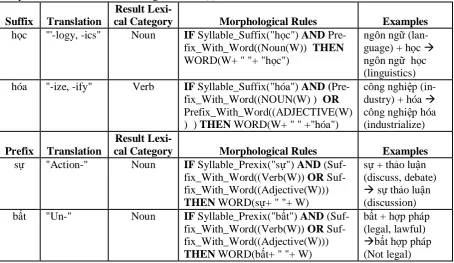
bất hợp pháp (Not legal) Table 2. Examples of derivational morphology and morphological rules
to construct compound words
To recognize for morphological derived words (MDW), we have identified a range of prefixes and suffixes (Goddard, 2005). When a mor-pheme modifies another mormor-pheme, it produc-es a subordinate compound word (Ngo, 2001). For example: nhà (as a prefix) + báo (newspa-per) nhà báo (journalist). The table 2. pro-vides a few examples of Vietnamese suffixes, prefixes, and Morphological Rules to derive subordinate compound words.
5.2 Sentences Construction
Given a set of potential segmented words ob-tained from step 5.1, applied only for training process or for a normal segmentation process (Figure 2.), the task of sentences constructor is to assemble the identified words in such a way that they appear in the same order as the original
query. We use Greedy algorithm to construct sentences using the following heuristic strate-gies: (1) Selection of polysyllabic words over monosyllabic words whenever possible. (2) Eli-minating segments which have already ex-amined. (3) Declaring a solution when a con-structed sentence has all of segmented words appearing in the same order as in the original query text.
5.3 Sentences Refinement and Reduction through Ambiguity Resolution
steps in refining the sentences to a finer solu-tion(s).
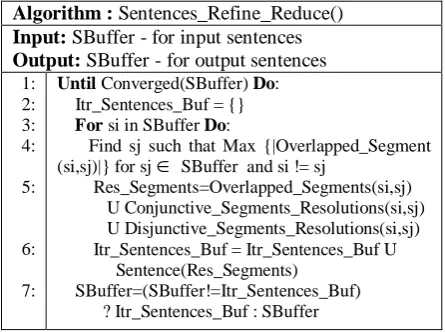
Definition: Let the pipe symbol, |, be designated as a boundary of a segment. Two segments, in two sentences, are overlapped if their first and last syllables are: (1) located next to a segmented boundary. (2) Identical and positioned at the algorithm to perform sentences refinement and reduction as follows:
Algorithm : Sentences_Refine_Reduce() Input: SBuffer - for input sentences Output: SBuffer - for output sentences
1:
Until Converged(SBuffer) Do: Itr_Sentences_Buf = {}
SBuffer=(SBuffer!=Itr_Sentences_Buf) ? Itr_Sentences_Buf : SBuffer
For conjunctive ambiguity resolution, to de-termine if all syllables should be classified as a single word or appeared as individual words, we utilize word collocation strength. We define col-locating strength as follows.
)
We compare it against a probability of finding the syllables occur independently in N docu-ments as shown in equation (3). The outcome determines if the syllables should be collocated or separately appeared:
For disjunctive ambiguity resolution, because a determination involves multiple words with overlapping text, we determine the best possible segments by computing their probability distri-bution of word segments to find out which one
has the highest probability of success. This is discussed further in the section “Sentences Scor-ing and OrderScor-ing” below. Figure 3 illustrates a process where sentences are refined through dis-ambiguating words.
Figure 3. An Example of Sentences Refinement
After the 1st iteration, the sentences 1 and 2 are combined through a resolution of conjunctive ambiguity between “tốc độ” vs. “tốc | độ” . After the 2nd iteration, sentences 1 and 2 are combined through a resolution of disjunctive ambiguity between “truyền | thông tin” vs. “truyền thông | tin”. The process exits when a converged condition is reached. The final seg-mented sentence is translated in English as “The speed of information transmission will increase”.
5.4 Sentences Scoring and Ordering
6
Experimental Results
With no restriction, there were 167,735 searches performed using the Yahoo! Boss Web Service API. We bootstrapped the initial core lexicons from Ho’s Word List (2004) and built up to gather lexical statistics and discovered new OOV words. The corpus syllables classifications and their occurrences are shown in Figure 4.
Figure 4. Syllables Types by Frequency
We compared our collected lexical data, using our approach, against VietLex (Dinh et al., 2008) and found a resembling to one, three, four, and five syllables. For the two syllables, there is a big difference: roughly about 19,000 words. This contributes to the fact that the original Ho’s word list had already covered 49,583 two-syllable words to begin with. On top of it, we have in-cluded 3,000 additional new OOV words includ-ing MDW and proper names words. Accordinclud-ing to the Wiki’s - Vietnamese_morphology, it esti-mates about 80% of the lexicon being disyllabic. In our corpus, we have 72% of disyllabic words.
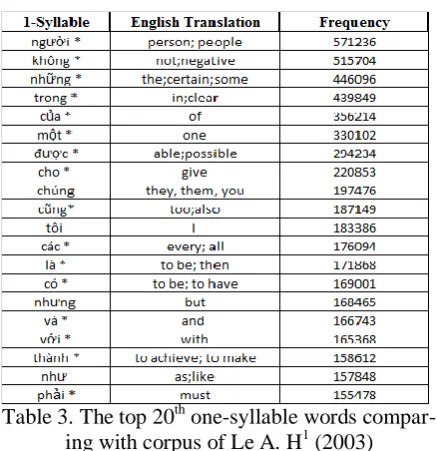
Table 3. The top 20th one-syllable words compar-ing with corpus of Le A. H1 (2003)
1
The star marker indicates the same word is co-occurred in Le’s of top unigram listing.
Table 3 provides a top 20 one-syllable words obtained from our word database. The star mark-er indicates the same word is also co-occurred in Le’s of top unigram listing.
The following disyllabic words, in Table 4, are a few of the new OOV words identified by our approach and absent from Ho’s Word List (2004) .
Common Disyllabic Words
Fre-quency
Uncom-mon Disyllab-ic Words
Fre-quency
Việt Nam (Viet Nam)
206704 lan rộng (spread)
263
Người Việt (Vietnam-ese)
41260 ga lông (gallon)
14
Trung Quốc (China)
35345 Cồn Phụng (Island)
9
Tiếng Việt (Vietnam-ese)
28460 nghị sỹ (congress gress-man)
22
Hoa Kỳ (America)
21262 công xôn (console)
2
Table 4. Some OOV disyllabic words
We evaluated our segmentation system against a popular Vietnamese word segmentation tool - the JVnSegmenter (Nguyen C. T, 2007): A Java-based Vietnamese Word Segmentation Tool (SVM). This tool was also a part of Dinh et al. (2008) evaluation aforementioned. With a source data provided by a neutral evaluator, and about 9600 sentences with an estimate of 100K words, we ran an experiment. The texts were input into both methods. To keep the fairness of the evalu-ation, the segmented output texts were sent out to a neutral assessor to analyze for results. The per-formance results are presented in Table 5. below.
Evaluation Areas
JVnSegmenter Our Ap-proach
Recall 0.814 0.821
Precision 0.883 0.897 F-Measure 0.847 0.857
OOV Rate 0.06 0.06
From the data above, the low OOV rate and high OOV recall in both systems could be ex-plained by the nature of the testing corpus: Viet-namese novels/stories chosen by a neutral evalu-ator. With this type of content, the numbers of OOV words are much lesser when compared to other areas such as news, technology. Even though the results don’t seem much higher than those obtained by JVnSegmenter, given the fact that JVnSegmenter used a manual trained corpus, our result is worth encouragements. Table 6 provides a few examples of the segmentation results.
Q1: tốc độ truyền thông tin sẽ tăng cao (Ambiguity)
JVnSegmenter: [tốc độ] [truyền thông tin] [sẽ] [tăng] [cao]
Our Approach: tốc độ |
truyền | thông tin | sẽ | tăng | cao
Q2: hàn mặc tử là một nhà thơ nổi tiếng (Proper Name) JVnSegmenter: [hàn mặc] [tử] [là] [một] [nhà thơ] [nổi tiếng] Our Approach: hàn mặc tử | là | một | nhà thơ | nổi tiếng
Q3: một người đàn bà làm nghề bán nước trà ven đường (Ambi-guity)
JVnSegmenter: [một] [người đàn bà] [làm nghề] [bán nước] [trà] [ven đường]
Our Approach: một | người đàn bà | làm nghề | bán | nước trà | ven đường
Q4: thủ tướng trung quốc ôn gia bảo (Proper name) JVnSegmenter: [thủ tướng] [trung] [quốc] [ôn] [gia bảo]
Our Approach: thủ tướng | trung quốc | ôn gia bảo
Table 6. Sample outputs of the two approaches: Our approach vs. JVnSegmenter
7
Conclusion
We presented our approach to segment Viet-namese text and to build a web corpus for the function. We made use of the web document titles and their snippet text to build a scalable corpus for segmenting query text. The results so far have shown that this approach has the follow-ing benefits:
From a practical and performance perspective, this approach does not require extended ma-nual effort in building a corpus. The learning from the training engine, running continuously, discovers new OOV words and feeds them into a normal word segmentation process where it supplies solutions to requesters efficiently.
The approach discovers new OOV words and disambiguates words. Additionally, we discov-ered new proper nouns which are not a part of any dictionaries continuously. We integrated the finding knowledge from the Vietnamese Wikipedia into our OOV words confirmation process automatically. This makes the valida-tion of new words much easier as suppose to rely on word adjudicators manually as per O’Neil (2007). And last, the evaluation result is a better edge when comparing to a popular Vietnamese segmentation tool in all the me-trics considered. This tool has a corpus trained manually.
Frequently found OOV words identified by our process which are not available in the Viet-namese Wikipedia can be suggested to Wiki authors’ communities to create content and make them available for the worldwide au-diences for their benefit.
For future works, we would like to look into the possibility of applying grammatical rules in conjunction with our current statistical based sys-tem to obtain a higher identification rate. Spel-ling suggestion and cross-Spel-lingual search are other interesting aspects, as now words can be identi-fied along with their lexical statistics.
Acknowledgement
Our work is credited from the works of Nguyen Bon et al. (2006), Ho Ngoc Duc (The Free Viet-namese Dictionary Project), Cam T Nguyen et al. (JVnSegmenter - 2007), O’Neil (2007), and Ya-hoo! Boss Web Service, which made the API available limitlessly during the course of the work, and many anonymous contributors and reviewers. A Special thank to Mr. Thuy Vu who contributed to an assessment of our approach and the JVnSegmenter.
Reference
C. T. Nguyen, T. K. Nguyen, X. H. Phan, L. M. Nguyen, and Q. T. Ha. 2006. Vietnamese word segmentation with CRFs and SVMs: An investiga-tion. In Proceedings of the 20th Pacific Asia Confe-rence on Language, Information and Computation (PACLIC 2006), Wuhan, CH.
Cliff Goddard. 2005. The Languages of East and Southeast Asia (pages 70-71)
Confe-rence on Computer Science- Research, Innovation and Vision of the Future 2006, HCM City, Viet-nam, pp.247–252.
Dinh Quan Thang, et al, 2008. Word Segmentation of Vietnamese Texts: a comparison of approaches. LREC : 2008
Ghani, R., Jones, R., Mladenic, D. 2001. Using the Web to create minority language corpora’. Pro-ceedings of the 10th International Conference on Information and Knowledge Management
Ho Ngoc Duc, 2004: Vietnamese word list: Ho Ngoc Duc’s word list – http://www.informatik.uni-leipzig.de/~duc/software/misc/wordlist.html John O’Neil. 2007. Large Corpus Construction for
Chinese Lexical Development, Government Users Conference: http://www.basistech.com/knowledge-center/unicode/emerson-iuc29.pdf
Le Thanh Ha, Huynh Quyet Thang, Luong Chi Mai. 2005. A Primary Study on Summarization of Doc-uments in Vietnamese. The First International Congress of the International Federation for Sys-tems Research, Japan.
L. H. Phuong and H. T. Vinh, 2008, Maximum Entro-py Approach to Sentence Boundary Detection of Vietnamese Texts, IEEE International Conference on Research, Innovation and Vision for the Future RIVF 2008, Vietnam.
L. A. Ha. 2003. A method for word segmentation in Vietnamese. In Proceedings of the International Conference on Corpus Linguistics, Lancaster, UK.
Marco Baroni, Motoko Ueyama. 2006. Building gen-eral and special-purpose corpora by Web Crawling. Proceedings of the 13th NIJL International Sympo-sium, Language Corpora: Their Compilation and Application. 31-40.
Ngo. N. Binh, B. H. Tran. 2001. Vietnamese Lan-guage Learning Framework – Part One: s Linguis-tic.
Nguyen D. 2008. Query preprocessing: improving web search through a Vietnamese word tokeniza-tion approach. SIGIR 2008: 765-766.
Stanley F. Chen, J. Goodman. 1998. An empirical study of smoothing techniques for language model-ing. Center Research in Computing Technology, Harvard University, TR-10-98
Thanh Bon Nguyen, Thi Minh Huyen Nguyen, Lau-rent Romary, Xuan Luong Vu. 2006. A lexicon for Vietnamese language processing. Language Re-sources and Evaluation. Springer Netherlands
V-B. Le, B. Bigi, L. Besacier, E. Castelli, 2003. Using the Web for fast language model construction in minority languages", Eurospeech'03, Geneva, Switzerland, September 2003
Wirote Aroonmanakun. 2002. Collocation and Thai Word Segmentation, Proceedings of SNLP-Oriental COCOSDA 2002
Vietnamese morphology: From Wikipedia: http://en.wikipedia.org/wiki/Vietnamese_morpholo gy
Yahoo! Boss Web Service API