Corpus and Evaluation Measures for Multiple Document Summarization
with Multiple Sources
Tsutomu HIRAO
NTT Communication Science Laboratories [email protected]
Takahiro FUKUSIMA
Otemon Gakuin University [email protected]
Manabu OKUMURA
Tokyo Institute of Technology [email protected]
Chikashi NOBATA
Communication Research Laboratories [email protected]
Hidetsugu NANBA
Hiroshima City University [email protected]
Abstract
In this paper, we introduce a large-scale test collec-tion for multiple document summarizacollec-tion, the Text Summarization Challenge 3 (TSC3) corpus. We detail the corpus construction and evaluation mea-sures. The significant feature of the corpus is that it annotates not only the important sentences in a doc-ument set, but also those among them that have the same content. Moreover, we define new evaluation metrics taking redundancy into account and discuss the effectiveness of redundancy minimization.
1 Introduction
It has been said that we have too much informa-tion on our hands, forcing us to read through a great number of documents and extract relevant informa-tion from them. With a view to coping with this situ-ation, research on automatic text summarization has attracted a lot of attention recently and there have been many studies in this field. There is a particular need to establish methods for the automatic sum-marization of multiple documents rather than single documents.
There have been several evaluation workshops on text summarization. In 1998, TIPSTER SUM-MAC (Mani et al., 2002) took place and the Doc-ument Understanding Conference (DUC)1has been
held annually since 2001. DUC has included multi-ple document summarization among its tasks since the first conference. The Text Summarization Chal-lenge (TSC)2 has been held once in one and a half years as part of the NTCIR (NII-NACSIS Test Col-lection for IR Systems) project since 2001. Multiple document summarization was included for the first time as one of the tasks at TSC2 (in 2002) (Okumura et al., 2003). Multiple document summarization is now a central issue for text summarization research.
1http://duc.nist.gov 2
http://www.lr.pi.titech.ac.jp/tsc
In this paper, we detail the corpus construction and evaluation measures used at the Text Summa-rization Challenge 3 (TSC3 hereafter), where multi-ple document summarization is the main issue. We also report the results of a preliminary experiment on simple multiple document summarization sys-tems.
2 TSC3 Corpus
2.1 Guidelines for Corpus Construction
Multiple document summarization from multiple sources, i.e., several newspapers concerned with the same topic but with different publishers, is more dif-ficult than single document summarization since it must deal with more text (in terms of numbers of characters and sentences). Moreover, it is peculiar to multiple document summarization that the sum-marization system must decide how much redun-dant information should be deleted3.
In a single document, there will be few sentences with the same content. In contrast, in multiple doc-uments with multiple sources, there will be many sentences that convey the same content with differ-ent words and phrases, or even iddiffer-entical sdiffer-entences. Thus, a text summarization system needs to recog-nize such redundant sentences and reduce the redun-dancy in the output summary.
However, we have no way of measuring the ef-fectiveness of such redundancy in the corpora for DUC and TSC2. Key data in TSC2 was given as abstracts (free summaries) whose number of char-acters was less than a fixed number and, thus, it is difficult to use for repeated or automatic evalu-ation, and for the extraction of important sentences. Moreover, in DUC, where most of the key data were abstracts whose number of words was less than a
3
fixed number, the situation was the same as TSC2. At DUC 2002, extracts (important sentences) were used, and this allowed us to evaluate sentence ex-traction. However, it is not possible to measure the effectiveness of redundant sentences reduction since the corpus was not annotated to show sentence with same content. In addition, this is the same even if we use the SummBank corpus (Radev et al., 2003).
In any case, because many of the current summa-rization systems for multiple documents are based on sentence extraction, we believe these corpora to be unsuitable as sets of documents for evaluation.
On this basis, in TSC3, we assumed that the pro-cess of multiple document summarization consists of the following three steps, and we produce a cor-pus for the evaluation of the system at each of the three steps4.
Step 1 Extract important sentences from a given set
of documents
Step 2 Minimize redundant sentences from the
re-sult of Step 1
Step 3 Rewrite the result of Step 2 to reduce the
size of the summary to the specified number of characters or less.
We have annotated not only the important sen-tences in the document set, but also those among them that have the same content. These are the cor-pora for steps 1 and 2. We have prepared human-produced free summaries (abstracts) for step 3.
In TSC3, since we have key data (a set of cor-rect important sentences) for steps 1 and 2, we con-ducted automatic evaluation using a scoring pro-gram. We adopted an intrinsic evaluation by human judges for step 3, which is currently under evalu-ation. We provide details of the extracts prepared for steps 1 and 2 and their evaluation measures in the following sections. We do not report the overall evaluation results for TSC3.
2.2 Data Preparation for Sentence Extraction
We begin with guidelines for annotating important sentences (extracts). We think that there are two kinds of extract.
1. A set of sentences that human annotators judge as being important in a document set (Fukusima and Okumura, 2001; Zechner, 1996; Paice, 1990).
4This is based on general ideas of a summarization system
and is not intended to impose any conditions on a summariza-tion system.
Mainichi articles
Yomiuri articles abstract
(a) (b) (c) (d)
Doc. x
Doc. y
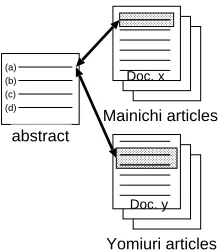
Figure 1: An example of an abstract and its sources.
2. A set of sentences that are suitable as a source for producing an abstract, i.e., a set of sen-tences in the original documents that corre-spond to the sentences in the abstracts(Kupiec et al., 1995; Teufel and Moens, 1997; Marcu, 1999; Jing and McKeown, 1999).
When we consider how summaries are produced, it seems more natural to identify important seg-ments in the document set and then produce sum-maries by combining and rephrasing such informa-tion than to select important sentences and revise them as summaries. Therefore, we believe that sec-ond type of extract is superior and thus we prepared the extracts in that way.
However, as stated in the previous section, with multiple document summarization, there may be more than one sentence with the same content, and thus we may have more than one set of sentences in the original document that corresponds to a given sentence in the abstract; that is to say, there may be more than one key datum for a given sentence in the abstract5.
we have two sets of sentences that correspond to sentence in the abstract.
(1) of document , or
(2) a combination of and of document
This means that alone is able to produce , and
can also be produced by combining and
(Fig-ure 1).
We marked all the sentences in the original doc-uments that were suitable sources for producing the sentences of the abstract, and this made it possible for us to determine whether or not a summariza-tion system deleted redundant sentences correctly at Step 2. If the system outputs the sentences in the original documents that are annotated as cor-responding to the same sentence in the abstract, it
5We use ‘set of sentences’ since we often find that more
Table 1: Important Sentence Data.
Sentence ID of Abstract Set of Corresponding Sentences
1
2
3
has redundancy. If not, it has no redundancy. Re-turning to the above example, if the system outputs , ,and , they all correspond to sentence in the
abstract, and thus it is redundant.
3 Evaluation Metrics
We use both intrinsic and extrinsic evaluation. The intrinsic metrics are “Precision”, “Coverage” and “Weighted Coverage.” The extrinsic metric is “Pseudo Question-Answering.”
3.1 Intrinsic Metrics
3.1.1 Number of Sentences System Should Extract
Precision and Recall are generally used as evalua-tion matrices for sentence extracevalua-tion, and we used the PR Breaking Point (Precision = Recall) for the evaluation of extracts in TSC1 (Fukusima and Oku-mura, 2001). This means that we evaluate systems when the number of sentences in the correct ex-tract is given. Moreover, in TSC3 we assume that the number of sentences to be extracted is known and we evaluate the system output that has the same number of sentences.
However, it is not as easy to decide the number of sentences to be extracted in TSC3 as in TSC1. We assume that there are correspondences between sen-tences in original documents and their abstract as in Table 1. An ASCII space, ” ”, is the delimiter for the sets of corresponding sentences in the table. As shown in the table, we often see several sets of sen-tences that correspond to a sentence in the abstract in multiple document summarization.
An ‘extract’ here is a set of sentences needed to produce the abstract. For instance, we can ob-tain ‘extracts’ such as “ , ,! ," ,# ,"# ”, and
“ $# ,% , ,! ," ,# , , ” from Table 1
6. Often
there are several ‘extracts’ and we must determine which of these is the best. In such cases, we define the ‘correct extract’ as the set with the least number of sentences needed to produce the abstract because it is desirable to convey the maximum amount of information with the least number of sentences.
Finding the minimum set of sentences to produce the abstract amounts to solving the constraint
sat-6In fact, it is possible to produce the abstract with other
sen-tence combinations.
isfaction problem. In the example in Table 1, we obtain the following constraints from each sentence in the abstract:
&('
*)+-,/.#*0/ 1 ,
&('
2)+30/!304" ,
&('
2)+.#504%604718,4.-04#504"#71
With these conditions, we now find the minimum set that makes all the conjunctions true. We need to find the minimum set that makes '
90
'
/0
'
:)<;= >-? @ In this case, the minimum cover is
A
B CB%!7B%"CB%#DB%"#CE , and so the system should
extract six sentences.
In TSC3, we computed the number of sentences that the system should extract and then evaluated the system outputs, which must have the same number of sentences, with the following precision and cov-erage.
3.1.2 Precision
Precision is the ratio of how many sentences in the system output are included in the set of the corre-sponding sentences. It is defined by the following equation.
PrecisionFHGIKJ (1)
where L is the least number of sentences needed
to produce the abstract by solving the constraint satisfaction problem andM is the number of
‘cor-rect’ sentences in the system output, i.e., the sen-tences that are included in the set of correspond-ing sentences. For example, the sentences listed in Table 1 are ‘correct.’ If the system output is
“ #CB B%!B NB%"#DB%" ”, then the Precision is as
follows:
PrecisionFPOQRFRSUT Q%QWV
T (2)
for “ XB #DB%B CB%!B "# ”, the Precision is as
fol-lows:
PrecisionF
Q
Q FZY[T (3)
3.1.3 Coverage
Coverage is an evaluation metric for measuring how close the system output is to the abstract taking into account the redundancy found in the set of sentences in the output.
The set of sentences in the original documents that corresponds correctly to the \ -th sentence of
the human-produced abstract is denoted here as
]_^a`
B ]b^a`
CB%c%c cB ]_^a`d
B%c%c cB ]_^a`e
sets of corresponding sentences. Here, indi-cates a set of elements each of which corresponds to the sentence number in the original documents, de-noted as
instance, from Table 1,
]
Then, we define the evaluation score ? .$\1 for the
\ -th sentence in the abstract as equation (1).
k[lnmo
where.1 is defined by the following equation.
lao
F
Y if the system outputs
S otherwise
(5)
Function ? returns 1 (one) when any ]b^a`d
is out-puted completely. Otherwise it returns a partial score according to the number of sentences
]_^nd
.
Given function? and the number of sentences in
the abstract , Coverage is defined as follows:
Coverage F
? .\1 is computed as follows:
k[l
and its Coverage is 0.553. If the system extracts
“ ,%$# ,% , ,! ,"# ”, then the Coverage is 0.780.
Now we define ‘Weighted Coverage’ since each sentence in TSC3 is ranked A, B or C, where “A” is the best. This is similar to “Relative Utility” (Radev et al., 2003). We only use three ranks in order to limit the ranking cost. The definition is obtained by modifying equation (6).
where=.\1 denotes the ranking of the\ -th sentence
of the abstract and¢£.$=.$\11 is its weight.¤.$= ¤¥1 is
the number of sentences whose ranking is= ¦¥ in
the abstract. Suppose the first sentence is ranked A, the second B, and the third C in Table 1, and their weights are given as¢9.
]
As before, if the system extracts
“ # , , ! , N , "# , " ”, then the Weighted
Coverage is computed as follows:
W.C.F
Sometimes question-answering (QA) by human subjects is used for evaluation (Morris et al., 1992; Hirao et al., 2001). That is, human subjects judge whether predefined questions can be answered by reading only a machine generated summary. How-ever, the cost of this evaluation is huge. Therefore, we employ a pseudo question-answering evaluation, i.e., whether a summary has an ‘answer’ to the ques-tion or not. The background to this evaluaques-tion is in-spired by TIPSTER SUMMAC’s QA track (Mani et al., 2002).
For each document set, there are about five ques-tions for a short summary and about ten quesques-tions for long summary. Note that the questions for the short summary are included in the questions for the long summary. Examples of questions for the topic “Release of SONY’s AIBO” are as follows: “How much is AIBO?”, “When was AIBO sold?”, and “How many AIBO are sold?”.
Now, we evaluate the summary from the ‘exact match’ and ‘edit distance’ for each question. ‘Ex-act match’ is a scoring function that returns one when the summary includes the answer to the ques-tion. ‘Edit distance’ measures whether the system’s summary has strings that are similar to the answer strings. The score³ e
´ based on the edit distance is
normalized with the length of the sentence and the answer string so that the range of the score is [0,1]:
Sed F
length of the sentenceµ edit distance
length of the answer strings T (9)
The score for a summary is the maximum value of the scores for sentences in the summary. The
7¶¸·º¹ ·n»¼¼
Table 2: Description of TSC3 Corpus.
# of doc. sets 30 # of articles (The Mainichi) 175 # of articles (The Yomiuri) 177
Total 352
# of Sentences 3587
score is 1 if the summary has a sentence that in-cludes the whole answer string.
It should be noted that the presence of answer strings in the summary does not mean that a human subject can necessarily answer the question.
4 Preliminary Experiment
In order to examine whether our corpus is suitable for summarization evaluation, our evaluation mea-sures significant information and redundancies in the system summaries.
Below we provide the details of the corpus, eval-uation results and effectiveness of the minimization of redundant sentences.
4.1 Description of Corpus
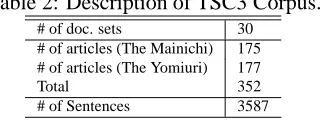
According to the guidelines described in section two, we constructed extracts and abstracts of thirty sets of documents drawn from the Mainichi and Yomiuri newspapers published between 1998 to 1999, each of which was related to a certain topic. First, we prepared abstracts (their sizes were 5% and 10% of the total number of the characters in the document set), then produced extracts using the abstracts. Table 2 shows the statistics.
One document set consists of about 10 articles on average, and the almost same number of articles were taken from the Mainichi newspaper and the Yomiuri newspaper. Most of the topics are classified into a single-event according to McKeown (2001).
The following list contains all the topics.
0310 Two-and-half-million-year old new hominid species
found in Ethiopia.
0320 Acquisition of IDC by NTT (and C&W).
0340 Remarketing of game software judged legal by Tokyo
District Court.
0350 Night landing practice of carrier-based aircrafts of the
Independence.
0360 Simultaneous bombing of the US Embassies in Tanzania
and Kenya.
0370 Resignation of President Suharto.
0380 Nomination of Mr. Putin as Russian prime minister. 0400 Osama bin Laden provided shelter by Taliban regime in
Afghanistan.
0410 Transfer of Nakata to A.C. Perugia. 0420 Release of Dreamcast.
0440 Existence of Japanese otter confirmed.
0450 Kyocera Corporation makes Mita Co. Ltd. its subsidiary. 0460 Five-story pagoda at Muroji Temple damaged by
ty-phoon.
0470 Retirement of aircraft YS-11.
0480 Test observation of astronomical telescope ‘Subaru’
started.
0500 Dolly the cloned sheep. 0510 Mass of neutrinos.
0520 Human Genome Project finishes decoding of the 22nd
chromosome.
0530 Peace talks in Northern Ireland at the end of 1999. 0540 Debut of new model of bullet train (700 family). 0550 Mr. Yukio Aoshima decides not to run for gubernatorial
election.
0560 Mistakes in entrance examination of Kansai University. 0570 Space shuttle Endeavour, from its launch to return. 0580 40 million-year-old fossil of new monkey species found
by research group at Kyoto University.
0590 Dead body of George Mallory found on Mt. Everest. 0600 Release of SONY’s AIBO.
0610 e-one, look-alike of iMac. 0630 Research on Kitora tomb resumes.
0640 Tidal wave damage generated by earthquake in Papua
New Guinea.
0650 Mistaken bombing of the Chinese embassy by NATO.
4.2 Compared Extraction Methods
We used the lead-based method, the TFcIDF-based
method (Zechner, 1996) and the sequential pattern-based method (Hirao et al., 2003), and compared performance of these summarization methods on the TSC3 corpus.
Lead-based Method
The documents in a test set were sorted in chrono-logical and ascending order. Then, we extracted a sentence at a time from the beginning of each docu-ment and collected them to form a summary.
TFcIDF-based Method
The score of a sentence is the sum of the significant scores of each content word in the sentence. We therefore extracted sentences in descending order of importance score. The sentence score Stfidf.
^
1 is
defined by the following.
Stfidfla½ o
where¢9.;XB ij_1 is defined as follows:
;[ÎÏ.$;XB%Ä«³b1 is the frequency of word; in the
docu-ment set,ÐÎ.$;X1 is the document frequency of; , and
Ä©4 is the total number of documents in the set. In
fact, we computed these using all the articles pub-lished in the Mainichi and Yomiuri newspapers for the years 1998 and 1999.
Sequential Pattern-based Method
Table 3: Evaluation results for “Precision”, “Cover-age” and “Weighted Coverage.”
Method Length Prec. Cov. W.C.
Lead ShortLong .426.539 .212.259 .326.369
TFÑIDF
Short .497 .292 .397 Long .604 .325 .434
Pattern ShortLong .613.665 .305.298 .403.418
Table 4: Evaluation results for “Pseudo Question-Answering.”
Method Length Exact Edit
Lead ShortLong .300.275 .589.602
TFÑIDF
Short .375 .643 Long .393 .659
Pattern ShortLong .390.370 .644.640
by using a statistical significance test such as theÒ
metric test and using 1,000 patterns. This is an ex-tension of Lin’s method (Lin and Hovy, 2000). The sentence score Spat.
^
1 is defined by the following.
Spatla½ o
where¢£.$ÕÏ1 is defined as follows:
Î.ÕÏBij_1 is the sentence frequency of patternÕ in
the document set andÎ.ÕÏB
]
³b1 is the sentence
fre-quency of patternÕ in all topics.
]
³r is the number
of sentences in all topics and Û$?¦.ÕÏ1 is the pattern
length.
4.3 Evaluation Result
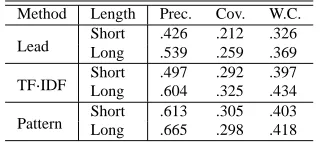
Table 3 shows the intrinsic evaluation result. All methods have lower Coverage and Weighted Cov-erage scores than Precision scores. This means that the extracted sentences include redundant ones. In particular, the difference between “Precision” and “Coverage” is large in “Pattern.”
Although both “Pattern” and “TFcIDF”
outper-form “Lead,” the difference between them is small. In addition, we know that “Lead” is a good extrac-tion method for newspaper articles; however, this is not true for the TSC3 corpus.
Table 4 shows the extrinsic evaluation results. Again, both “Pattern” and “TFcIDF” outperform
“Lead”, but the difference between them is small. We found a correlation between the intrinsic and ex-trinsic measures.
Table 5: Effects of clustering (“Precision”, “Cover-age”, “Weighted Coverage”).
Method Length Prec. Cov. W.C.
TFÑIDF
Short .430 .297 .377 Long .533 .345 .455
Pattern ShortLong .531.620 .289.338 .390.456
Table 6: Effects of clustering (Pseudo Question-Answering).
Method Length Exact Edit
TFÑIDF
Short .401 .650 Long .377 .648
Pattern ShortLong .392.380 .650.655
4.4 Effect of Redundant Sentence Minimization
The experiment described in the previous section shows that a group of sentences extracted in a sim-ple way includes many redundant sentences. To examine the effectiveness of minimizing redundant sentences, we compare the Maximal Marginal Rele-vance (MMR) based approach (Carbonell and Gold-stein, 1998) with the clustering approach (Nomoto and Matsumoto, 2001). We use ‘cosine similarity’ with a bag-of-words representation for the similar-ity measure between sentences.
Clustering-based Approach
After computing importance scores using equations (10) and (12), we conducted hierarchical clustering using Ward’s method until we reachedL (see
Sec-tion 3.1.1) clusters for the first¯7L sentences. Then,
we extracted the sentence with the highest score from each cluster.
Table 5 shows the results of the intrinsic evalu-ation and Table 6 shows the results of the extrin-sic evaluation. By comparison with Table 3, the clustering-based approach resulted in TFcIDF and
Pattern scoring low in Precision, but high in Cov-erage. When comparing Table 4 with Table 6, the score is improved in most cases. These results im-ply that redundancy minimization is effective for improving the quality of summaries.
MMR-based Approach
After computing importance scores using equations (10) and (12), we re-ranked the first¯DL sentences by
MMR and extracted the firstL sentences.
Table 7: Effects of MMR (“Precision”, “Coverage”, “Weighted Coverage”).
Method Length Prec. Cov. W.C.
TFÑIDF
Short .469 .306 .403 Long .565 .376 .475
Pattern ShortLong .469.577 .332.377 .429.500
Table 8: Effects of MMR (Pseudo Question-Answering).
Method Length Exact Edit
TFÑIDF
Short .386 .647 Long .405 .667
Pattern ShortLong .417.390 .663.656
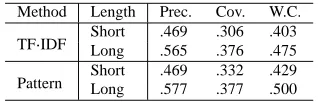
These results show that redundancy minimization has a significant effect on multiple document sum-marization.
5 Conclusion
We described the details of a corpus constructed for TSC3 and measures for its evaluation, focusing on sentence extraction. We think that a corpus in which important sentences and those with the same content are annotated for multiple documents is a new and significant feature for summarization corpora.
It is planned to make the TSC3 corpus available (even if the recipient is not a TSC3 participant) by exchanging memoranda with the National Institute of Informatics in Japan. We sincerely hope that this corpus will be useful to researchers who are inter-ested in text summarization and serve to facilitate further progress in this field.
References
J. Carbonell and J. Goldstein. 1998. The Use of MMR, Diversity-Based Reranking for Reorder-ing Documents and ProducReorder-ing Summaries. In Proc. of the 21th ACM-SIGIR, pages 335–336. T. Fukusima and M. Okumura. 2001. Text
Summa-rization Challenge: Text SummaSumma-rization Evalua-tion in Japan. In Proc. of the NAACL 2001 Work-shop on Automatic summarization, pages 51–59. T. Hirao, Y. Sasaki, and H. Isozaki. 2001. An
Extrinsic Evaluation for Question-Biased Text Summarization on QA tasks. In Proc. of the NAACL 2001 Workshop on Automatic Summa-rization, pages 61–68.
T. Hirao, J. Suzuki, H. Isozaki, and E. Maeda. 2003. Multiple Document Summarization using Sequential Pattern Mining (in Japanese). In The Special Interest Group Notes of IPSJ (NL-158-6), pages 31–38.
H. Jing and K. McKeown. 1999. The Decom-position of Human-Written Summary Sentences. Proc. of the 22nd ACM-SIGIR, pages 129–136. J. Kupiec, J Petersen, and F. Chen. 1995. A
Train-able Document Summarizer. In Proc. of the 18th SIGIR, pages 68–73.
C-Y. Lin and E. H. Hovy. 2000. The Automated Acquisition of Topic Signatures for Text Sum-marization. In Proc. of the 16th COLING, pages 495–501.
I. Mani, G. Klein, D. House, L. Hirschman, T. Fir-man, and B. Sundheim. 2002. SUMMAC: a text summarization evaluation. Natural Language Engineering, 8(1):43–68.
D. Marcu. 1999. The Automatic Construction of Large-scale Corpora for Summarization Re-search. Proc. of the 22nd ACM-SIGIR, pages 137–144.
K. McKeown, R. Barzilay, D. Evans, V. Hatzivas-silogou, M. Y. Kan, B. Schiffman, and S. Teufel. 2001. Columbia Multi-Document Summariza-tion: Approach and Evaluation. In Proc. of the Document Understanding Conference 2001. A. H. Morris, G. M. Kasper, and D.A. Adams.
1992. The Effects and Limitations of Automatic Text Condensing on Reading Comprehension. Information System Research, 3(1):17–35. T. Nomoto and M. Matsumoto. 2001. A New
Ap-proach to Unsupervised Text Summarization. In Proc. of the 24th ACM-SIGIR, pages 26–34. M. Okumura, T. Fukusima, and H. Nanba. 2003.
Text Summarization Challenge 2, Text Summa-rization Evaluation at NTCIR Workshop 3. In Proc. of the HLT/NAACL 2003 Text Summariza-tion Workshop, pages 49–56.
C. Paice. 1990. Constructing Literature Abstracts by Computer: Techniques and Prospects. Infor-mation Processing and Management, 26(1):171– 186.
D. R. Radev, S. Teufel, H. Saggion, W. Lam, J. Blitzer, H. Qi, A. Celebi, D. Liu, and E. Drabek. 2003. Evaluation challenges in large-scale document summarization. In Proc. of the 41st ACL, pages 375–382.
S. Teufel and M. Moens. 1997. Sentence Extrac-tion as a ClassificaExtrac-tion Task. In Proc. of the ACL Workshop on Intelligent Scalable Text Summa-rization, pages 58–65.