An Online Algorithm for Learning over Constrained Latent
Representations using Multiple Views
∗Ann Clifton and Max Whitney and Anoop Sarkar School of Computing Science
Simon Fraser University 8888 University Drive Burnaby BC. V5A 1S6. Canada
{ann clifton, mwhitney, anoop}@sfu.ca
Abstract
We introduce an online framework for dis-criminative learning problems over hidden structures, where we learn both the latent structure and the classifier for a supervised learning task. Previous work on lever-aging latent representations for discrimi-native learners has used batch algorithms that require multiple passes though the en-tire training data. Instead, we propose an online algorithm that efficiently jointly learns the latent structures and the classi-fier. We further extend this to include mul-tiple views on the latent structures with different representations. Our proposed online algorithm with multiple views sig-nificantly outperforms batch learning for latent representations with a single view on a grammaticality prediction task.
1 Introduction
Natural language data is implicitly richly struc-tured, and making use of that structure can be valuable in a wide variety of NLP tasks. How-ever, finding these latent structures is a complex task of its own right. Early work used a two-phase pipeline process, in which the output of a structure prediction algorithm (e.g. a noun phrase finder) acts as fixed input features to train a classi-fier for a different task (e.g. grammaticality predic-tion). Chang et al. (2009), Das and Smith (2009), Goldwasser and Roth (2008), and Mccallum and Bellare (2005) have shown that this approach can propagate error from the structured prediction to the task-specific classifier. Recent work has com-bined unsupervised learning of (latent) structure prediction with a supervised learning approach for the task. Work in this vein has focused on jointly
∗
This research was partially supported by an NSERC, Canada (RGPIN: 264905) grant and a Google Faculty Award to the third author.
learning the latent structures together with the task-specific classifier (Cherry and Quirk, 2008; Chang et al., 2010). Chang et al. (2010) in partic-ular introduce a framework for solving classifica-tion problems using constraints over latent struc-tures, referred to as Learning over Constrained Latent Representations (LCLR). We extend this framework for discriminative joint learning over latent structures to a novel online algorithm. Our algorithm learns the latent structures in an unsu-pervised manner, but it can be initialized with the model weights from a supervised learner for the latent task trained on some (other) annotated data. This can be seen as a form of domain adaptation from the supervised latent structure training data to the different classification task.
We evaluate our algorithm in comparison to the LCLR batch method on a grammaticality test using a discriminative model that learns shal-low parse (chunk) structures. Our online method has standard convergence guarantees for a max-margin learner, but attains higher accuracy. Fur-thermore, in practice we find that it requires fewer passes over the data.
We also explore the use of allowing multiple views on the latent structures using different rep-resentations in the classifier. This is inspired by Shen and Sarkar (2005), who found that using a majority voting approach on multiple representa-tions of the latent structures on a chunking task outperformed both a single representation as well as voting between multiple learning models. We show that the multiple-view approach to latent structure learning yields improvements over the single-view classifier.
2 The Grammaticality Task
To evaluate our algorithms, we use a discrimina-tive language modeling task. A well-known lim-itation of n-gram LMs is that they are informed only by the previously seen word histories of a
fixed maximum length; they ignore dependencies between more distant parts of the sentence. Con-sider examples generated by a 3-gram LM:
• chemical waste and pollution control ( amendment ) bill , all are equal , and , above all else .
• kindergartens are now .
These fragments are composed of viable trigrams, but a human could easily judge them to be un-grammatical. However, if a language model used latent information like a shallow syntactic parse, it could also recognize the lack of grammaticality.
Discriminative models can take into account ar-bitrary features of data, and thus may be able to avoid the shortcomings ofn-gram LMs in judging the grammaticality of text. In the case of language modeling, however, there is no obvious choice of categories between which the model should dis-criminate. Cherry and Quirk (2008) show that by following the pseudo-negative examples approach of Okanohara and Tsujii (2007), they can build a syntactic discriminative LM that learns to distin-guish between samples from a corpus generated by human speakers (positives) and samples gener-ated by ann-gram model (negatives).
Our approach is similar to Cherry and Quirk (2008), but they use probabilistic context-free grammar (PCFG) parses as latent structure, use a latent SVM as the learning model (we use latent passive-aggressive (PA) learning), and they handle negative examples differently. Instead of PCFG parsing, we use a chunking representation of sen-tence structure, which can be seen as a shallow parse, in which each word in the sentence is tagged to indicate phrase membership and boundaries.
Our model simultaneously learns to apply mul-tiple sets of chunk tags to produce chunkings rep-resenting sentence structure and to prefer the shal-low parse features of the human sentences to those sampled from ann-gram LM. The latent chunker will assign chunk structure to examples that yield the widest margin between the positive (grammat-ical) and negative (ungrammat(grammat-ical) examples.
3 Latent Structure Classifier
Our classifier is trained by simultaneously search-ing for the highest scorsearch-ing latent structure while classifying data instances. Here we extend the latent learning framework due to Chang et al. (2010) from a batch setting to an online setting that uses passive-aggressive (PA) updates (Cram-mer and Singer, 2001).
3.1 PA Learning
The latent structure classifier training uses a deci-sion function that searches for the best structure
z∗i ∈ Z(xi) for each training sentence xi with a space of possible structuresZ(xi) according to feature weightsw, i.e.:
fw(xi) = arg max zi
w·φ(xi, zi) (1)
where φ(xi, zi) is a feature vector over the sentence-parse pair. The sign of the prediction
yi∗w·φ(xi, zi∗)determines the classification of the sentencexi.
Using PA max-margin training (Crammer and Singer, 2001), we incorporate this decision func-tion into our global objective, searching for thew
that minimizes
1 2kwk
2+
X X
i=1
`(w·(f(xi), yi)), (2)
where ` is a loss function; we use hinge loss. At each iteration, for each examplexiwe find and update according to a new weight vectorw0 that minimizes:
1
2kw−w
0k2+τ(1−y
i(w0·φ(xi, zi∗)), (3)
where w is the previous weight vector, zi∗
is the structure found by Eqn. (1), yi ∈
{−1,1} is the example’s true label (ungrammat-ical/grammatical), andτ ≥0is a Lagrange multi-plier proportional to the example loss, thus penal-izing classification examples in proportion to the extent that they violate the margin (see Alg. 1).
3.2 Optimization Method
Since Eqn. (3) contains an inner max overzi∗, it is not convex for the positive examples, since it is the maximum of a convex function (zero) and a con-cave function(1−yi(w0·φ(xi, zi∗)). In hinge loss, driving the inner function to higher values min-imizes the outer problem for negative examples, but maximizes it for the positives. So, as in LCLR, we hold the latent structures fixed for the positive examples but can perform inference to solve the inner minimization problem for the negatives.
3.3 Online Training
1 initializew0
2 fort= 0, ..., T−1do
3 foreach training examplexiinXdo
4 repeat
5 findz∗i = arg maxziwt·φ(xi, zi)
6 letyi∗=wt·φ(xi, zi∗) 7 let losslt= max{0,1−yiyi∗)} 8 let multiplierτt=kφ(xlt
i,z∗i)k2
9 updatewt+1:=wt+τtyiφ(xi, zi∗) 10 untilyi>0or (y∗i =yiifyi<0); 11 returnwT
Algorithm 1: Online PA algorithm for binary classification with latent structures.
Joachims and Yu (2009). Since for the positive ex-amples the latent structures are fixed per-iteration, it does a single search and update step for each ex-ample at each iteration. For negative exex-amples it repeats the prediction and PA update for each ex-ample until the model correctly predicts the label (i.e. until y∗i = yi). Because of the intractability to compute all possible negative structures, we use the approximation of the single-best structure for each negative example. We re-decode the negative examples until the highest scoring structure is cor-rectly labeled as negative. This approximation is analogous to the handling of inference over nega-tive examples in the batch algorithm described in Chang et al. (2010). In the batch version, however, updates for all negative examples are performed at once and all are re-decoded until no new structures are found for any single negative example.
3.4 Multiple Views on Latent Representations
Shen and Sarkar (2005) find that using multiple chunking representations is advantageous for the chunking task. Moreover, they demonstrate that the careful selection of latent structure can yield more helpful features for a task-specific classifier. We thus perform inference separately to gener-ate distinct lgener-atent structures for each of their five chunking representations (which are mostly from (Sang and Veenstra, 1999)) at line 5 of Alg. 1; at line 6 we evaluate the dot product of the weight vector with the features from the combined out-puts of the different views.
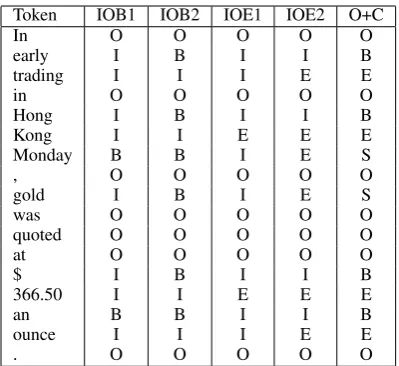
Each of the views use a different representa-tion of the chunk structures, which we will only briefly describe due to space limitations; for more detailed information, please see Shen and Sarkar (2005). Each representation uses a set of tags to la-bel each token in a sentence as la-belonging to a non-overlapping chunk type. We refer to the chunking
Token IOB1 IOB2 IOE1 IOE2 O+C
In O O O O O
early I B I I B
trading I I I E E
in O O O O O
Hong I B I I B
Kong I I E E E
Monday B B I E S
, O O O O O
gold I B I E S
was O O O O O
quoted O O O O O
at O O O O O
$ I B I I B
366.50 I I E E E
an B B I I B
ounce I I I E E
. O O O O O
Table 1: The five different chunking representations for the example sentence “In early trading in Hong Kong Monday , gold was quoted at $ 366.50 an ounce .”
schemas as IOB1, IOB2, IOE1, IOE2, and O+C. The total set of tags for each of the representations are B- (current token begins a chunk), I- (current token is inside a chunk), E- (current token ends a chunk), S- (current token is in a chunk by itself), and O (current token is outside of any chunk). All chunks except O append the part-of-speech tag of the token as a suffix. Table 1 shows the different chunking schemas on an example sentence.
Each of these chunking schemas can be con-ceived as a different kind of expert. Of the in-side/outside schemas, the IOB variants focus on detecting where a chunk begins; the IOE variants focus on the chunk’s end. O+C gives a more fine-grained representation of the chunking.
We use dynamic programming to find the best chunking for each representation. The features of
φ(x, z)are 1-, 2-, 3-grams of words and POS tags paired with the chunk tags, as well as bigrams of chunk tags. We use entirely separate chunk tags for each representation. E.g., although each repre-sentation uses an “O” tag to indicate a word out-side of any phrase, we conout-sider the “O” for each representation to be distinct.
information from any single view), and then we perform a majority vote for each tag in the diction. We convert the winning sequence of pre-dicted tags back to each representation and con-catenate the features from each view as before and train on the supervised learning task.
4 Experiments
For the chunkers we used the CONLL 2000 tagset (23 chunk tags), modified for the five chunking representations of (Shen and Sarkar, 2005). We initialized the weights using a perceptron chun-ker. The chunker-classifier can either be started with a zero weight vector or with weights from training on the chunking task. For the latter, we used weights from supervised discriminative train-ing against gold-standard chunktrain-ing. To transfer the weights to the classifier, we scaled them to the range of values observed after training the zero-initialized chunker-classifier. For training data we used the English side of the HK Chinese-English parallel corpus, using 50,000 sentences as posi-tive examples. For negaposi-tive examples we used the pseudo-negative approach of Okanohara and Tsu-jii (2007): we trained a standard3-gram language model on the 50,000 sentences plus 450,000 addi-tional sentences from the same corpus. From this we sampled 50,000 sentences to create the nega-tive training data set.
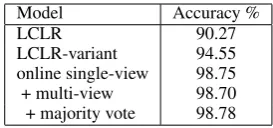
We evaluated the discriminative LMs on the classification task of distinguishing real grammati-cal sentences from generated pseudo-negative sen-tences. As test data we used the Xinhua data from the English Gigaword corpus. We used the first 3000 sentences as positive examples. For nega-tive examples we trained a 3-gram LM on the first 500,000 examples (including those used for posi-tive data).We used this 3-gram LM to generate five separate 3000 example negative data sets. To ac-count for random variation due to using pseudo-negatives, results are reported as a mean over the positive data paired with each negative set. We evaluated our algorithms against LCLR as a base-line.1Table 2 shows that our online algorithm with
1
We implemented two batch baselines. The first is a strict implementation of the LCLR algorithm as in Chang et al. (2010), with per-outer-iteration example caching (LCLR); we use a PA large-margin classifier instead of an SVM. How-ever, we found that this algorithm severely overfits to our task. So, we also implemented a variant (“LCLR-variant”) that skips the inference step in the inner loop. This treated the latent structures from the inference step of the outer loop as fixed, but relabeled and updated accordingly until conver-gence, then resumed the next outer iteration.
Model Accuracy %
LCLR 90.27
LCLR-variant 94.55 online single-view 98.75 + multi-view 98.70 + majority vote 98.78
Table 2: Classification accuracy after 40 outer iterations.
multiple views significantly outperforms the pre-vious approaches. We omit a detailed experimen-tal report of the behaviour of the online algorithm due to lack of space, but our findings were 1) that the batch models were slower to improve than the online versions on test-set accuracy, and 2) the on-line algorithm requires fewer updates total in train-ing compared to the batch version.
5 Related and Future Work
As discussed, our work is most similar to Chang et al. (2010). We expand upon their framework by developing an efficient online algorithm and exploring learning over multiple views on latent representations. In terms of the task, max-margin LMs for speech recognition focus on the word pre-diction task (Gao et al., 2005; Roark et al., 2007; Singh-Miller and Collins, 2007). This focus is also shared by other syntactic LMs (Chelba and Jelinek, 1998; Xu et al., 2002; Schwartz et al., 2011; Charniak, 2001) which use syntax but rely on supervised data to train their parsers. Charniak et al. (2003) and Shen et al. (2010) use parsing based LMs for machine translation which are not whole-sentence models and they also rely on su-pervised parsers. Our focus is on using unsuper-vised latent variables (optionally initialized from supervised data) and training whole-sentence dis-criminative LMs. Our chunker model is related to the semi-Markov model in Okanohara and Tsujii (2007), but ours can take advantage of latent struc-tures. Our work is related to Cherry and Quirk (2008) but differs in ways previously described.
References
Ming-Wei Chang, Dan Goldwasser, Dan Roth, and
Yuancheng Tu. 2009. Unsupervised constraint
driven learning for transliteration discovery. In Pro-ceedings of Human Language Technologies: The 2009 Annual Conference of the North American Chapter of the Association for Computational Lin-guistics, NAACL ’09, pages 299–307, Stroudsburg, PA, USA. Association for Computational Linguis-tics.
Ming-Wei Chang, Dan Goldwasser, Dan Roth, and Vivek Srikumar. 2010. Discriminative learning over
constrained latent representations. InHLT-NAACL,
pages 429–437.
Eugene Charniak, Kevin Knight, and Kenji Yamada. 2003. Syntax-based Language Models for Machine Translation. InProc. of MT Summit IX.
Eugene Charniak. 2001. Immediate-head parsing for
language models. InProc. of ACL 2001, pages 124–
131, Toulouse, France, July. Association for Com-putational Linguistics.
Ciprian Chelba and Frederick Jelinek. 1998.
Ex-ploiting syntactic structure for language modeling. In Proc. of ACL 1998, pages 225–231, Montreal, Quebec, Canada, August. Association for Compu-tational Linguistics.
Colin Cherry and Chris Quirk. 2008. Discriminative, syntactic language modeling through latent SVMs. InProc. of AMTA 2008.
Koby Crammer and Yoram Singer. 2001. Ultracon-servative online algorithms for multiclass problems.
Journal of Machine Learning Research, 3:951–991, January.
Dipanjan Das and Noah A. Smith. 2009. Paraphrase identification as probabilistic quasi-synchronous
recognition. In Proceedings of the Joint
Confer-ence of the 47th Annual Meeting of the ACL and the 4th International Joint Conference on Natural Lan-guage Processing of the AFNLP: Volume 1 - Volume
1, ACL ’09, pages 468–476, Stroudsburg, PA, USA.
Association for Computational Linguistics.
Jianfeng Gao, Hao Yu, Wei Yuan, and Peng Xu. 2005. Minimum sample risk methods for language
model-ing. In Proc. of ACL, pages 209–216, Vancouver,
British Columbia, Canada, October. Association for Computational Linguistics.
Dan Goldwasser and Dan Roth. 2008.
Translitera-tion as constrained optimizaTranslitera-tion. In Proceedings
of the Conference on Empirical Methods in Natu-ral Language Processing, EMNLP ’08, pages 353– 362, Stroudsburg, PA, USA. Association for Com-putational Linguistics.
Thorsten Joachims and Chun-Nam John Yu. 2009.
Sparse kernel svms via cutting-plane training.
Ma-chine Learning, 76(2-3):179–193.
Andrew Mccallum and Kedar Bellare. 2005. A con-ditional random field for discriminatively-trained finite-state string edit distance. InIn Conference on Uncertainty in AI (UAI.
Daisuke Okanohara and Jun’ichi Tsujii. 2007. A dis-criminative language model with pseudo-negative
samples. In Proc. of ACL 2007, pages 73–80,
Prague, Czech Republic, June. Association for Com-putational Linguistics.
Brian Roark, Murat Saraclar, and Michael Collins. 2007. Discriminative n-gram language modeling.
Computer Speech and Language, 21(2):373–392.
Erik F. Tjong Kim Sang and Jorn Veenstra. 1999.
Representing text chunks. In Proceedings of the
ninth conference on European chapter of the Asso-ciation for Computational Linguistics, EACL ’99, pages 173–179, Stroudsburg, PA, USA. Association for Computational Linguistics.
Lane Schwartz, Chris Callison-Burch, William
Schuler, and Stephen Wu. 2011. Incremental
syntactic language models for phrase-based
trans-lation. InProc. of ACL-HLT 2011, pages 620–631,
Portland, Oregon, USA, June. Association for Computational Linguistics.
Hong Shen and Anoop Sarkar. 2005. Voting between multiple data representations for text chunking. In
Canadian Conference on AI, pages 389–400.
Libin Shen, Jinxi Xu, and Ralph Weischedel. 2010. String-to-dependency statistical machine transla-tion. Comput. Linguist., 36(4):649–671.
Natasha Singh-Miller and Michael Collins. 2007.
Trigger-based Language Modeling using a
Loss-sensitive Perceptron Algorithm. InProc. of ICASSP
2007.
Peng Xu, Ciprian Chelba, and Frederick Jelinek. 2002. A study on richer syntactic dependencies for
struc-tured language modeling. In Proc. of ACL 2002,