Modern Natural Language Interfaces to Databases:
Composing Statistical Parsing with Semantic Tractability
Ana-Maria Popescu Alex Armanasu Oren Etzioni University of Washington
{amp, alexarm, etzioni, daveko, ayates}@cs.washington.edu
David Ko Alexander Yates
Abstract
Natural Language Interfaces to Databases (NLIs) can benefit from the advances in statis-tical parsing over the last fifteen years or so. However, statistical parsers require training on a massive, labeled corpus, and manually cre-ating such a corpus for each database is pro-hibitively expensive. To address this quandary, this paper reports on the PRECISENLI, which uses a statistical parser as a “plug in”. The pa-per shows how a strong semantic model cou-pled with “light re-training” enables PRECISE to overcome parser errors, and correctly map from parsed questions to the corresponding SQL queries. We discuss the issues in using statistical parsers to build database-independent NLIs, and report on experimental results with the benchmark ATIS data set where PRECISE achieves 94% accuracy.
1 Introduction and Motivation
Over the last fifteen years or so, much of the NLP community has focused on the use of statistical and machine learning techniques to solve a wide range of problems in parsing, machine translation, and more. Yet, classical problems such as building Natural Language Interfaces to Databases (NLIs) (Grosz et al., 1987) are far from solved.
There are many reasons for the limited success of past NLI efforts (Androutsopoulos et al., 1995). We highlight several problems that are remedied by our approach. First, manually authoring and tuning a se-mantic grammar for each new database is brittle and prohibitively expensive. In response, we have im-plemented a “transportable” NLI that aims to mini-mize manual, database-specific configuration. Sec-ond, NLI systems built in the 70s and 80s had lim-ited syntactic parsing capabilities. Thus, we have an opportunity to incorporate the important advances made by statistical parsers over the last two decades in an NLI.
However, attempting to use a statistical parser in a database-independent NLI leads to a quandary. On the one hand, to parse questions posed to a
particu-lar database, the parser has to be trained on a corpus of questions specific to that database. Otherwise, many of the parser’s decisions will be incorrect. For example, the Charniak parser (trained on the 40,000 sentences in the WSJ portion of the Penn Treebank) treats ‘list’ as a noun, but in the context of the ATIS database it is a verb.1 On the other hand, manually creating and labeling a massive corpus of questions for each database is prohibitively expensive.
We consider two methods of resolving this quandary and assess their performance individually and in concert on the ATIS data set. First, we use a strong semantic model to correct parsing errors. We introduce a theoretical framework for discrim-inating between Semantically Tractable (ST) tions and difficult ones, and we show that ST ques-tions are prevalent in the well-studied ATIS data set (Price, 1990). Thus, we show that the seman-tic component of the NLI task can be surprisingly easy and can be used to compensate for syntactic parsing errors. Second, we re-train the parser using a relatively small set of 150 questions, where each word is labeled by its part-of-speech tag.
To demonstrate how these methods work in prac-tice, we sketch the fully-implemented PRECISE NLI, where a parser is a modular “plug in”. This modularity enables PRECISEto leverage continuing advances in parsing technology over time by plug-ging in improved parsers as they become available.
The remainder of this paper is organized as fol-lows. We describe PRECISEin Section 2, sketch our theory in Section 3, and report on our experiments in Section 4. We consider related work in Section 5, and conclude in Section 6.
2 The PRECISE System Overview
Our recent paper (Popescu et al., 2003) introduced the PRECISEarchitecture and its core algorithm for
1
reducing semantic interpretation to a graph match-ing problem that is solved by MaxFlow. In this sec-tion we provide a brief overview of PRECISE, focus-ing on the components necessary to understandfocus-ing its performance on the ATIS data set in Section 4.
To discuss PRECISE further, we must first intro-duce some terminology. We say that a database is made up of three types of elements: relations, tributes and values. Each element is unique: an at-tribute element is a particular column in a particular relation and each value element is the value of a particular attribute. A value is compatible with its attribute and also with the relation containing this attribute. An attribute is compatible with its rela-tion. Each attribute in the database has associated with it a special value, which we call a wh-value, that corresponds to a wh-word (what, where, etc.).
We define a lexicon as a tuple(T, E, M), where Tis a set of strings, called tokens (intuitively, tokens are strings of one or more words, like “New York”); Eis a set of database elements, wh-values, and join paths; 2 and M is a subset ofT ×E — a binary relation between tokens and database elements.
PRECISE takes as input a lexicon and a parser. Then, given an English question, PRECISEmaps it to one (or more) corresponding SQL queries. We concisely review how PRECISE works through a simple example. Consider the following question q: “What are the flights from Boston to Chicago?” First, the parser plug-in automatically derives a dependency analysis for q from q’s parse tree, represented by the following compact syntactic log-ical form: LF(q) = what(0), is(0,1), f light(1), f rom(1,2), boston(2), to(1,3), chicago(3). LF(q)contains a predicate for each question word. Head nouns correspond to unary predicates whose arguments are constant identifiers.
Dependencies are encoded by equality con-straints between arguments to different predicates. The first type of dependency is represented by noun and adjective pre-modifiers corresponding to unary predicates whose arguments are the identifiers for the respective modified head nouns. A second type of dependency is represented by noun postmodifiers and mediated by prepositions (in the above exam-ple, “from” and “to”). The prepositions correspond to binary predicates whose arguments specify the at-tached noun phrases. For instance, “from” attaches “flight” to “boston”. Finally, subject/predicate, predicate/direct object and predicate/indirect object dependency information is computed for the various
2
A join path is a set of equality constraints between the at-tributes of two or more tables. See Section 3 for more details and a formal definition.
verbs present in the question. Verbs correspond to binary or tertiary predicates whose arguments indi-cate what noun phrases play the subject and object roles. In our example, the verb “is” mediates the dependency between “what” and “flight”. 3
PRECISE’s lexicon is generated by automatically extracting value, attribute, and relation names from the database. We manually augmented the lexicon with relevant synonyms, prepositions, etc..
The tokenizer produces a single complete tokenization of this question and lemmatizes the tokens: (what, is, flight, from, boston, to, chicago). By looking up the tokens in the lexicon, PRECISEefficiently retrieves the set of potentially matching database elements for every token. In this case, what, bostonand
chicago are value tokens, to and fromare at-tribute tokens andflightis a relation token.
In addition to this information, the lexicon also contains a set of restrictions for tokens that are prepositions or verbs. The restrictions specify the database elements that are allowed to match to the arguments of the respective preposition or verb. For example, fromcan take as arguments a flight and a city. The restrictions also specify the join paths connecting these relations/attributes. The syntactic logical form is used to retrieve the relevant set of restrictions for a given question.
The matcher takes as input the information de-scribed above and reduces the problem of satisfy-ing the semantic constraints imposed by the defi-nition of a valid interpretation to a graph matching problem (Popescu et al., 2003). In order for each attribute token to match a value token, Boston
and Chicagomap to the respective values of the database attribute city.cityName, from maps to
flight.fromAirport or fare.fromAirport and to
maps to flight.toAirport or fare.toAirport. The restrictions validate the output of the matcher and are then used in combination with the syntactic in-formation to narrow down even further the possi-ble interpretations for each token by enforcing lo-cal dependencies. For example, the syntactic in-formation tells us that “from” refers to “flight” and since “flight” uniquely maps to flight, this means that from will map to flight.fromAirport rather than fare.fromAirport (similarly, to maps to
flight.toAirport andwhatmaps to flight.flightId). Finally, the matcher compiles a list of all relations satisfying all the clauses in the syntactic logical form using each constant and narrows down the set
3
of possible interpretations for each token accord-ingly. Each set of (constant, corresponding database element) pairs represents a semantic logical form.
The query generator takes each semantic logical form and uses the join path information available in the restrictions to form the final SQL queries corre-sponding to each semantic interpretation.
pronoun verb noun prep noun prep noun prep noun
NP NP
NP
PP
PP
PP
NP
NP NP
VP S
NP
What are flights fromBoston to Chicago on Monday?
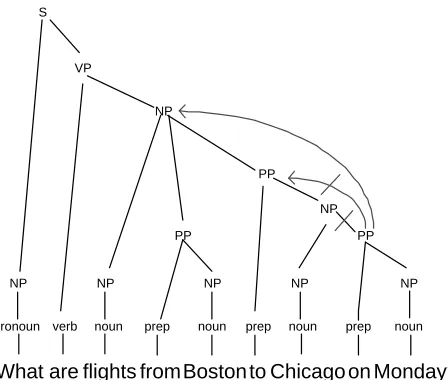
Figure 1: Example of an erroneous parse tree corrected by PRECISE’s semantic over-rides. PRECISEdetects that the parser attached the PP “on Monday” to “Chicago” in error.
PRECISEattempts to re-attach “on Monday” first to the PP “to Chicago”, and then to the NP “flights from Boston to Chicago”, where it belongs.
2.1 Parser Enhancements
We used the Charniak parser (Charniak, 2000) for the experiments reported in this paper. We found that the Charniak parser, which was trained on the WSJ corpus, yielded numerous syntactic errors. Our first step was to hand tag a set of 150 questions with Part Of Speech (POS) tags, and re-train the parser’s POS tagger. As a result, the probabilities associated with certain tags changed dramatically. For example, initially, ‘list’ was consistently tagged as a noun, but after re-training it was consistently la-beled as a verb. This change occurs because, in the ATIS domain, ‘list’ typically occurs in imperative sentences, such as “List all flights.”
Focusing exclusively on the tagger drastically re-duced the amount of data necessary for re-training. Whereas the Charniak parser was originally trained on close to 40,000 sentences, we only required 150 sentences for re-training. Unfortunately, the re-trained parser still made errors when solving dif-ficult syntactic problems, most notably preposition attachment and preposition ellipsis. PRECISE cor-rects both types of errors using semantic informa-tion.
We refer to PRECISE’s use of semantic informa-tion to correct parser errors as semantic over-rides. Specifically, PRECISEdetects that an attachment de-cision made by the parser is inconsistent with the semantic information in its lexicon.4 When this oc-curs, PRECISE attempts to repair the parse tree as follows. Given a noun phrase or a prepositional phrase whose corresponding nodenin the parse tree has the wrong parentp, PRECISEtraverses the path in the parse tree from p to the root node, search-ing for a suitable node to attach n to. PRECISE chooses the first ancestor of p such that when nis attached to the new node, the modified parse tree agrees with PRECISE’s semantic model. Thus, the semantic over-ride procedure is a generate-and-test search where potential solutions are generated in the order of ancestors of nodenin the parse tree. The procedure’s running time is linear in the depth of the parse tree.
Consider, for example, the question “What are flights from Boston to Chicago on Monday?” The parser attaches the prepositional phrase “on Mon-day” to ‘Chicago’ whereas it should be attached to ‘flights’ (see Figure 1). The parser merely knows that ‘flights’, ‘Boston’, and ‘Chicago’ are nouns. It then uses statistics to decide that “on Monday” is most likely to attach to ‘Chicago’. However, this syntactic decision is inconsistent with the semantic information in PRECISE’s lexicon — the preposition ‘on’ does not take a city and a day as arguments, rather it takes a flight and a day.
Thus, PRECISE decides to over-ride the parser and attach ‘on’ elsewhere. As shown in Figure 1, PRECISEdetects that the parser attached the PP “on Monday” to “Chicago” in error. PRECISE at-tempts to re-attach “on Monday” first to the PP “to Chicago”, and then to the NP “flights from Boston to Chicago”, where it belongs. While in our ex-ample the parser violated a constraint in PRECISE’s lexicon, the violation of any semantic constraint will trigger the over-ride procedure.
In the above example, we saw how semantic over-rides help PRECISEfix prepositional attachment er-rors; they also enable it to correct parser errors in topicalized questions (e.g., “What are Boston to Chicago flights?”) and in preposition ellipsis (e.g., when ‘on’ is omitted in the question “What are flights from Boston to Chicago Monday?”).
Unfortunately, semantic over-rides do not correct all of the parser’s errors. Most of the remaining parser errors fall into the following categories: rel-ative clause attachment, verb attachment, numeric
noun phrases, and topicalized prepositional phrases. In general, semantic over-rides can correct local at-tachment errors, but cannot over-come more global problems in the parse tree. Thus, PRECISE can be forced to give up and ask the user to paraphrase her question.
3 PRECISE Theory
The aim of this section is to explain the theoretical under-pinnings of PRECISE’s semantic model. We show that PRECISEalways answers questions from the class of Semantically Tractable (ST) questions correctly, given correct lexical and syntactic infor-mation.5
We begin by introducing some terminology that builds on the definitions given Section 2.
3.1 Definitions
A join path is a set of equality constraints between a sequence of database relations. More formally, a join path for relations R1, . . . , Rn is a set of
con-straintsC⊂ {Ri.a=Ri+1.b|1≤i≤n−1}. Here
the notationRi.arefers to the value of attributeain
relationRi.
We say a relation between token set T and a set of database elements and join paths E respects a lexiconLif it is a subset ofM.
A question is simply a string of characters. A to-kenization of a question (with respect to a lexicon) is an ordered set of strings such that each element of the tokenization is an element of the lexicon’s to-ken set, and the concatenation of the elements of the tokenization, in order, is equal to the original ques-tion. For a given lexicon and question, there may be zero, one, or several tokenizations. Any question that has at least one tokenization is tokenizable.
An attachment function is a functionFL,q :T →
T, where L is the lexicon, q is a question, and T is the set of tokens in the lexicon. The attachment function is meant to represent dependency informa-tion available to PRECISE through a parser. For example, if a question includes the phrase “restau-rants in Seattle”, the attachment function would at-tach “Seattle” to “restaurants” for this question. Not all tokens are attached to something in every ques-tion, so the attachment function is not a total func-tion. We say that a relation R between tokens in a question q respects the attachment function if
∀t1, t2, R(t1, t2) ⇒ (FL,q(t1) = t2)∨(FL,q does
not take on a value fort1).
5We do not claim that NLI users will restrict their questions to the ST subset of English in practice, but rather that identify-ing classes of questions as semantically tractable (or not), and experimentally measuring the prevalence of such questions, is a worthwhile avenue for NLI research.
In an NLI, interpretations of a question are SQL statements. We define a valid interpretation of a question as being an SQL statement that satisfies a number of conditions connecting it to the tokens in the question. Because of space constraints, we pro-vide only one such constraint as an example: There exists a tokenization tof the question and a set of database elementsEsuch that there is a one-to-one map fromttoErespecting the lexicon, and for each value elementv ∈ E, there is exactly one equality constraint in the SQL clause that usesv.
For a complete definition of a valid interpretation, see (Popescu et al., 2003).
3.2 Semantic Tractability Model
In this section we formally define the class of ST questions, and show that PRECISE can prov-ably map such questions to the corresponding SQL queries. Intuitively, ST questions are “easy to un-derstand” questions where the words or phrases correspond to database elements or constraints on join paths. Examining multiple questions sets and databases, we have found that nouns, adjectives, and adverbs in “easy” questions refer to database rela-tions, attributes, or values.
Moreover, the attributes and values in a question “pair up” naturally to indicate equality constraints in SQL. However, values may be paired with implicit attributes that do not appear in the question (e.g., the attribute ’cuisine’ in “What are the Chinese restau-rants in Seattle?” is implicit). Interestingly, there is no notion of “implicit value” — the question “What are restaurants with cuisine in Seattle?” does not make sense.
A preposition indicates a join between the rela-tions corresponding to the arguments of the prepo-sition. For example, consider the preposition ‘from’ in the question “what airlines fly from Boston to Chicago?” ‘from’ connects the value ‘Boston’ (in the relation ‘cities’) to the relation ‘airlines’. Thus, we know that the corresponding SQL query will join ‘airlines’ and ‘cities’.
We formalize these observations about questions below. We say that a question q is semantically tractable using lexiconL and attachment function FL,qif:
1. It is possible to split q up into words and phrases found in L. (More formally, q is to-kenizable according toL.)
(More formally, there exists a tokenization t and a set of database elements and join paths Etsuch that there is a bijective functionffrom
ttoEtthat respectsL.)
3. There is at least one such setEtthat has exactly
one wh-value.
4. It is possible to add ‘implicit’ attributes toEt
to get a set E0
t with exactly one compatible
attribute for every value. (More formally, for someEt with a wh-value there exist attributes
a1, . . . , an such that Et0 = Et ∪ {a1, . . . , an}
and there is a bijective functiongfrom the set of value elements (including wh-values) V to the set of attribute elementsAinE0
t.)
5. At least one such E0
t obeys the syntactic
restrictions of FL,q. (More formally, let
A0 = A ∩ Et. Then we require that
{(f−1
(g−1
(a)), f−1
(a)) | a ∈ A0} respects
FL,q.)
3.3 Results and Discussion
We say that an NLI is sound for a class of questions Q using lexicon L and attachment function FL if
for every inputq ∈ Q, every output of the NLI is a valid interpretation. We say the NLI is complete if it returns all valid interpretations. Our main result is the following:
Theorem 1 Given a lexicon L and attachment functionFL, PRECISEis sound and complete for the
class of semantically tractable questions.
In practical terms, the theorem states that given correct and complete syntactic and lexical informa-tion, PRECISE will return exactly the set of valid interpretations of a question. If PRECISEis missing syntactic or semantic constraints, it can generate ex-traneous interpretations that it “believes” are valid. Also, if a person uses a term in a manner incon-sistent with PRECISE’s lexicon, then PRECISE will interpret her question incorrectly. Finally, PRECISE will not answer a question that contains words ab-sent from its lexicon.
The theorem is clearly an idealization, but the ex-periments reported in Section 4 provide evidence that it is a useful idealization. PRECISE, which em-bodies the model of semantic tractability, achieves very high accuracy because in practice it either has correct and complete lexical and syntactic informa-tion or it has enough semantic informainforma-tion to com-pensate for its imperfect inputs. In fact, as we ex-plained in Section 2.1, PRECISE’s semantic model enables it to correct parser errors in some cases.
Finding all the valid interpretations for a question is computationally expensive in the worst case (even just tokenizing a question is NP-complete (Popescu et al., 2003)). Moreover, if the various syntac-tic and semansyntac-tic constraints are fed to a standard constraint solver, then the problem of finding even a single valid interpretation is exponential in the worst case. However, we have been able to formu-late PRECISE’s constraint satisfaction problem as a graph matching problem that is solved in polyno-mial time by the MaxFlow algorithm:
Theorem 2 For lexiconL, PRECISEfinds one valid interpretation for a tokenizationTof a semantically tractable question in timeO(M n2), wherenis the
number of tokens inTandMis the maximum num-ber of interpretations that a token can have inL.
4 Experimental Evaluation
Semantic Tractability (ST) theory and PRECISE’s architecture raise a four empirical questions that we now address via experiments on the ATIS data set (Price, 1990): how prevalent are ST questions? How effective is PRECISE in mapping ATIS ques-tions to SQL queries? What is the impact of se-mantic over-rides? What is the impact of parser re-training? Our experiments utilized the 448 context-independent questions in the ATIS “Scoring Set A”. We chose the ATIS data set because it is a standard benchmark (see Table 2) where independently gen-erated questions are available to test the efficacy of an NLI.
We found that 95.8% of the ATIS questions were ST questions. We classified each question as ST (or not) by running PRECISE on the question and
System Setup PRECISE PRECISE-1
P arserORIG 61.9% 60.3%
P arserORIG+ 89.7% 85.5%
P arserT RAIN ED 92.4% 88.2%
P arserT RAIN ED+ 94.0% 89.2%
P arserCORRECT 95.8% 91.9%
Table 1: Impact of Parser Enhancements. The PRECISE
column records the percentage of questions where the small set of SQL queries returned by PRECISEcontains the cor-rect query; PRECISE-1 refers to the questions correctly
in-terpreted if PRECISEis forced to return exactly one SQL query. P arserORI Gis the original version of the parser,
P arserT RAI N EDis the version re-trained for the ATIS
do-main, andP arserCORRECT is the version whose output is
PRECISE PRECISE-1 AT&T CMU MIT SRI BBN UNISYS MITRE HEY
94.0% 89.1% 96.2% 96.2% 95.5% 93% 90.6% 76.4% 69.4% 92.5%
Table 2:Accuracy Comparison between PRECISE, PRECISE-1 and the major ATIS NLIs. Only PRECISEand the HEY NLI are database independent. All results are for performance on the context-independent questions in ATIS.
recording its response. Intractable questions were due to PRECISE’s incomplete semantic informa-tion. Consider, for example, the ATIS request “List flights from Oakland to Salt Lake City leaving after midnight Thursday.” PRECISE fails to answer this question because it lacks a model of time, and so cannot infer that “after midnight Thursday” means “early Friday morning.”
In addition, we found that the prevalence of ST questions in the ATIS data is consistent with our ear-lier results on the set of 1,800 natural language ques-tions compiled by Ray Mooney in his experiments in three domains (Tang and Mooney, 2001). As re-ported in (Popescu et al., 2003), we found that ap-proximately 80% of Mooney’s questions were ST. PRECISE performance on the ATIS data was also comparable to its performance on the Mooney data sets.
Table 1 quantifies the impact of the parser en-hancements discussed in Section 2.1. Since PRE -CISE can return multiple distinct SQL queries when it judges a question to be ambiguous, we report its results in two columns. The left column (PRECISE) records the percentage of questions where the set of returned SQL queries contains the correct query. The right column (PRECISE-1) records the percent-age of questions where PRECISE is correct if it is forced to return exactly one query per question. In our experiments, PRECISE returned a single query 92.4% of the time, and returned two queries the rest of the time. Thus, the difference between the two columns is not great.
Initially, plugging the Charniak parser into PRE -CISE yielded only 61.9% accuracy. Introducing se-mantic over-rides to correct prepositional attach-ment and preposition ellipsis errors increased PRE -CISE’s accuracy to 89.7% — the parser’s erroneous POS tags still led PRECISE astray in some cases. After re-training the parser on 150 POS-tagged ATIS questions, but without utilizing semantic over-rides, PRECISEachieved 92.4% accuracy. Combin-ing both re-trainCombin-ing and semantic over-rides, PRE -CISE achieved 94.0% accuracy. This accuracy is close to the maximum that PRECISE can achieve, given its incomplete semantic information— we found that, when all parsing errors are corrected by hand, PRECISE’s accuracy is 95.8%.
To assess PRECISE’s performance, we compared it with previous work. Table 2 shows PRECISE’s
accuracy compared with the most successful ATIS NLIs (Minker, 1998). We also include, for com-parison, the more recent database-independent HEY system (He and Young, 2003). All systems were compared on the ATIS scoring set ’A’, but we did “clean” the questions by introducing sentence breaks, removing verbal errors, etc.. Since we could add modules to PRECISE to automatically handle these various cases, we don’t view this as signifi-cant.
Given the database-specific nature of most previ-ous ATIS systems, it is remarkable that PRECISEis able to achieve comparable accuracy. PRECISEdoes return two interpretations a small percentage of the time. However, even when restricted to returning a single interpretation, PRECISE-1 still achieved an impressive 89.1% accuracy (Table 1).
5 Related Work
We discuss related work in three categories: Database-independent NLIs, ATIS-specific NLIs, and sublanguages.
Database-independent NLIs There has been
ex-tensive previous work on NLIs (Androutsopoulos et al., 1995), but three key elements distinguish PRE -CISE. First, we introduce a model of ST questions and show that it produces provably correct inter-pretations of questions (subject to the assumptions of the model). We measure the prevalence of ST questions to demonstrate the practical import of our model. Second, we are the first to use a statistical parser as a “plug in”, experimentally measure its efficacy, and analyze the attendant challenges. Fi-nally, we show how to leverage our semantic model to correct parser errors in difficult syntactic cases (e.g., prepositional attachment). A more detailed comparison of PRECISE with a wide range of NLI systems appears in (Popescu et al., 2003). The advances in this paper over our previous one in-clude: reformulation of STTHEORY, the parser re-training, semantic over-rides, and the experiments testing PRECISEon the ATIS data.
ATIS NLIs The typical ATIS NLIs used either
require heavy manual processing and only a small number of annotated questions. In addition, PRE -CISE leverages existing domain-independent pars-ing technology and offers theoretical guarantees ab-sent from other work. Improved versions of ATIS systems such as Gemini (Moore et al., 1995) in-creased their coverage by allowing an approximate question interpretation to be computed from the meanings of some question fragments. Since PRE -CISEfocuses on high precision rather than recall, we analyze every word in the question and interpret the question as a whole. Most recently, (He and Young, 2003) introduced the HEY system, which learns a semantic parser without requiring fully-annotated corpora. HEY uses a hierarchical semantic parser that is trained on a set of questions together with their corresponding SQL queries. HEY is similar to (Tang and Mooney, 2001). Both learning systems require a large set of questions labeled by their SQL queries—an expensive input that PRECISEdoes not require—and, unlike PRECISE, both systems can-not leverage continuing improvements to statistical parsers.
Sublanguages The early work with the most
sim-ilarities to PRECISEwas done in the field of sublan-guages. Traditional sublanguage work (Kittredge, 1982) has looked at defining sublanguages for var-ious domains, while more recent work (Grishman, 2001; Sekine, 1994) suggests using AI techniques to learn aspects of sublanguages automatically. Our work can be viewed as a generalization of tradi-tional sublanguage research. We restrict ourselves to the semantically tractable subset of English rather than to a particular knowledge domain. Finally, in addition to offering formal guarantees, we assess the prevalence of our “sublanguage” in the ATIS data.
6 Conclusion
This paper is the first to provide evidence that sta-tistical parsers can support NLIs such as PRECISE. We identified the quandary associated with appro-priately training a statistical parser: without special training for each database, the parser makes numer-ous errors, but creating a massive, labeled corpus of questions for each database is prohibitively expen-sive. We solved this quandary via light re-training of the parser’s tagger and via PRECISE’s semantic over-rides, and showed that in concert these meth-ods enable PRECISEto rise from 61.9% accuracy to 94% accuracy on the ATIS data set. Even though PRECISE is database independent, its accuracy is comparable to the best of the database-specific ATIS NLIs developed in previous work (Table 2).
References
I. Androutsopoulos, G. D. Ritchie, and P. Thanisch. 1995. Natural Language Interfaces to Databases - An Introduction. In Natural Language Engineering, vol 1, part 1, pages 29–81.
E. Charniak. 2000. A Maximum-Entropy-Inspired Parser. In Proc. of NAACL-2000.
R. Grishman. 2001. Adaptive information extraction and sublanguage analysis. In Proc. of IJCAI 2001. B.J. Grosz, D. Appelt, P. Martin, and F. Pereira. 1987.
TEAM: An Experiment in the Design of Trans-portable Natural Language Interfaces. In Artificial In-telligence 32, pages 173–243.
Y. He and S. Young. 2003. A data-driven spoken lan-guage understanding system. In IEEE Workshop on Automatic Speech Recognition and Understanding. R. Kittredge. 1982. Variation and homogeneity of
sub-languages. In R. Kittredge and J. Lehrberger, editors, Sublanguage: Studies of Language in Restricted Se-mantic Domains, pages 107–137. de Gruyter, Berlin. E. Levin and R. Pieraccini. 1995. Chronus, the next
gen-eration. In Proc. of the DARPA Speech and Natural Language Workshop, pages 269–271.
W. Minker. 1998. Evaluation methodologies for inter-active speech systems. In First International Confer-ence on Language Resources and Evaluation, pages 801–805.
R. Moore, D. Appelt, J. Dowding, J. M. Gawron, and D. Moran. 1995. Combining linguistic and statistical knowledge sources in natural-language processing for atis. In Proc. of the ARPA Spoken Language Technol-ogy Workshop.
A. Popescu, O. Etzioni, and H. Kautz. 2003. Towards a theory of natural language interfaces to databases. In Proc. of IUI-2003.
P. Price. 1990. Evaluation of spoken language systems: the atis domain. In Proc. of the DARPA Speech and Natural Language Workshop, pages 91–95.
S. Sekine. 1994. A New Direction For Sublanguage NLP. In Proc. of the International Conference on New Methods in Language Processing, pages 165–177. S. Seneff. 1992. Robust parsing for spoken language
systems. In Proc. of the IEEE International Confer-ence on Acoustics, Speech and Signal Processing. L.R. Tang and R.J. Mooney. 2001. Using Multiple
Clause Constructors in Inductive Logic Programming for Semantic Parsing. In Proc. of the 12th Eu-ropean Conference on Machine Learning (ECML-2001), Freiburg, Germany, pages 466–477.