A Comparative Study of Mixture Models for Automatic Topic Segmentation
of Multiparty Dialogues
Maria Georgescul ISSCO/TIM, ETI University of Geneva [email protected]
Alexander Clark
Department of Computer Science Royal Holloway University of London
Susan Armstrong ISSCO/TIM, ETI University of Geneva [email protected]
Abstract
In this article we address the task of auto-matic text structuring into linear and non-overlapping thematic episodes at a coarse level of granularity. In particular, we deal with topic segmentation on multi-party meeting recording transcripts, which pose specific challenges for topic segmentation models. We present a comparative study of two probabilistic mixture models. Based on lexical features, we use these models in parallel in order to generate a low dimen-sional input representation for topic segmen-tation. Our experiments demonstrate that in this manner important information is cap-tured from the data through less features.
1 Introduction
Some of the earliest research related to the prob-lem of text segmentation into thematic episodes used the word distribution as an intrinsic feature of texts (Morris and Hirst, 1991). The studies of (Reynar, 1994; Hearst, 1997; Choi, 2000) continued in this vein. While having quite different emphasis at dif-ferent levels of detail (basically from the point of view of the employed term weighting and/or the adopted inter-block similarity measure), these stud-ies analyzed the word distribution inside the texts through the instrumentality of merely one feature, i.e. the one-dimensional inter-block similarity.
More recent work use techniques from graph the-ory (Malioutov and Barzilay, 2006) and machine learning (Galley et al., 2003; Georgescul et al.,
2006; Purver et al., 2006) in order to find patterns in vocabulary use.
We investigate new approaches for topic segmen-tation on corpora containing multi-party dialogues, which currently represents a relatively less explored domain. Compared to other types of audio content (e.g. broadcast news recordings), meeting record-ings are less structured, often exhibiting a high de-gree of participants spontaneity and there may be overlap in finishing one topic while introducing an-other. Moreover while ending the discussion on a certain topic, there can be numerous new attempts to introduce a new topic before it becomes the fo-cus of the dialogue. Therefore, the task of automatic topic segmentation of meeting recordings is more difficult and requires a more refined analysis. (Gal-ley et al., 2003; Georgescul et al., 2007) dealt with the problem of topic segmentation of multiparty di-alogues by combining various features based on cue phrases, syntactic and prosodic information. In this article, our investigation is based on using merely lexical features.
short distance. At the other extreme, in the domain of document classification, it is often assumed that the whole document is concerned with one specific topic and in this sense all words in a document are considered to be semantically related. We consider for our application that words occurring in the same thematic episode are semantically related.
In the following, the major issues we will discuss include the formulations of two probabilistic mix-ture approaches, their methodology, aspects of their implementation and the results obtained when ap-plied in the topic segmentation context. Section 2 presents our approach on using probabilistic mix-ture models for topic segmentation and shows com-parisons between these techniques. In Section 3 we discuss our empirical evaluation of these models for topic segmentation. Finally, some conclusions are drawn in Section 4.
2 Probabilistic Mixture Models
The probabilistic latent models described in the fol-lowing exploit hierarchical Bayesian frameworks. Based on prior distributions of word rate variability acquired from a training corpus, we will compute a density function to further analyze the text content in order to perform topic segmentation at a coarse level of granularity. In this model, we will be working with ‘blocks’ of text which consist of a fixed num-ber of consecutive utterances.
In the following two subsections, we use the fol-lowing notation:
• We consider a text corpusB={b1, b2, ..., bM}
containingM blocks of text with words from a vocabulary W = {w1, w2, ..., wN}. M is
a constant scalar representing the number of blocks of text.N is a constant scalar represent-ing the number of terms in vocabularyW.
• We pre-process the data by eliminating con-tent free words such as articles, prepositions and auxiliary verbs. Then, we proceed by lem-matizing the remaining words and by adopt-ing a bag-of-words representation. Next, we summarize the data in a matrix F = (f(bi, wi,j))(i,j)∈M×N, where f(bi, wi,j)
de-notes the log.entropy weighted frequency of wordwi,j in blockbi.
• Each occurrence of a word in a block of text is considered as representing an ob-servation (wm,n, bm), i.e. a realization from
an underlying sequence of random variables (Wm,n, Bm)11≤≤mn≤≤NM. wm,n denotes the term
indicator for then-th word in the m-th block of text.
• Each pair(wm,n, bm)is associated with a
dis-crete hidden random variableZm,n over some
finite setZ ={z1, z2, ..., zK}. K is a constant
scalar representing the number of mixture com-ponents to generate.
• We denote by P(zm,n = zk) or simply by
P(zk) the probability that the k-th topic has
been sampled for the n-th word in the m-th block of text.
2.1 Aspect Model for Dyadic Data (AMDD)
In this section we describe how we apply latent mod-eling for dyadic data (Hofmann, 2001) to text repre-sentation for topic segmentation.
2.1.1 Model Setting
n , m
w
n , m
z
m
b
M
block plate
n , m
w
n , m
z
m
b
block plate
M
word plate
N word plate
N
1) Asymmetric PLSA parameterization 2) Symmetric PLSA parameterization
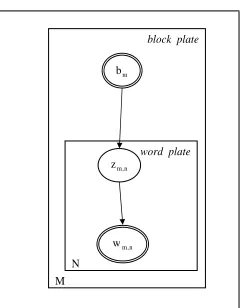
Figure 1: Graphical model representation of the as-pect model.
We express the joint or conditional probability of words and blocks of text, by assuming that the choice of a word during the generation of a block of text is independent of the block itself, given some (unobserved) hidden variable, also called latent vari-able or aspect.
the plate notation. That is, the ovals (i.e. the nodes of the graph) represent probabilistic variables. The double ovals around the variableswm,n andbm
de-note observed variables. zm,n is the mixture
indi-cator, the hidden variable, that chooses the topic for then-th word in them-th block of text. Arrows in-dicate conditional dependencies between variables. For instance, the wm,n variable in the word space
and the bm variable in the block space have no
di-rect dependencies, i.e. it is assumed that the choice of words in the generation of a block of text is in-dependent of the block given a hidden variable. The boxes represent “plates”, i.e. replicates of sampling steps with the variable in the lower left corner re-ferring to the number of samples. For instance, the “word plate” in Figure 1 illustratesNindependently and identically distributed repeated trials of the ran-dom variablewm,n.
According to the topology of the asymmetric AMDD Bayesian network from Figure 1, we can specify the joint distribution of a wordwm,n, a latent
topiczkand a block of textbm:P(wm,n, zk, bm) =
P(bm)·P(zk|bm)·P(wm,n|zk).The joint
distribu-tion of a block of textbmand a wordwm,nis thus:
P(bm, wm,n) = K
X
k=1
P(wm,n, zk, bm) =P(bm)
·PK
k=1 P(zk|bm)
| {z }
mixing proportions
· P(wm,n|zk)
| {z }
mixture components
(1)
Equation 1 describes a special case of a finite mix-ture model, i.e. it uses a convex combination of a set of component distributions to model the observed data. That is, each word in a block of text is seen as a sample from a mixture model, where mixture components are multinomials P(wm,n|zk) and the
mixing proportions areP(zk|bm).
2.1.2 Inferring and Employing the AMDD
Model
The Expectation-Maximization (EM) algorithm is the most popular method to estimate the parameters for mixture models to fit a training corpus. The EM algorithm for AMDD is based on iteratively maximizing the log-likelihood function: LP LSA =
PM
m=1
PN
n=1f(bm, wm,n)·logP(wm,n, bm).
How-ever, the EM algorithm for AMDD is prone to over-fitting since the number of parameters to be
esti-mated grows linearly with the number of blocks of text. In order to avoid this problem, we employed the tempered version of the EM algorithm that has been proposed by Hofmann (2001).
We use the density estimation method in AMDD to reduce the dimension of the blocks-by-words space. Thus, instead of using the words as ba-sic units for each block of text representation, we employ a “topic” basis, assuming that a few top-ics will capture more information than the entire huge amount of words in the vocabulary. Thus, them-th block of text is represented by the vector (P(z1|bm), P(z2|bm), ..., P(zk|bm)). Then, we use
these posterior probabilities as a threshold to iden-tify the boundaries of thematic episodes via sup-port vector classification (Georgescul et al., 2006). That is, we consider the topic segmentation task as a binary-classification problem, where each utterance should be classified as marking the presence or the absence of a topic shift in the dialogue.
2.2 Latent Dirichlet Allocation (LDA)
Latent Dirichlet Allocation (Blei et al., 2003) can be seen as an extension of AMDD by defining a probabilistic mixture model that includes Dirichlet-distributed priors over the masses of the multinomi-alsP(w|z)andP(z|b).
2.2.1 Model Setting
In order to describe the formal setting of LDA in our context, we use the following notation in addi-tion to those given at the beginning of Secaddi-tion 2:
• ~θm is a parameter notation forP(z|b = bm),
the topic mixture proportion for them-th block of text;
• ~α is a hyperparameter (a vector of dimension K) on the mixing proportions~θm;
• Θ = n~θm
oM
m=1 is a matrix (of dimension M × K), composed by placing the vectors ~
θ1, ~θ2, ..., ~θM as column components;
• ϕ~k is a parameter notation for P(w|zk), the
mixture component for topick;
• Φ = {ϕ~k}Kk=1 is a matrix of dimension K × N composed by placing the vectors ~
ϕ1, ~ϕ2, ..., ~ϕK as column components;
• Nmdenotes the length of them-th block of text
and is modeled with a Poisson distribution with constant parameterξ;
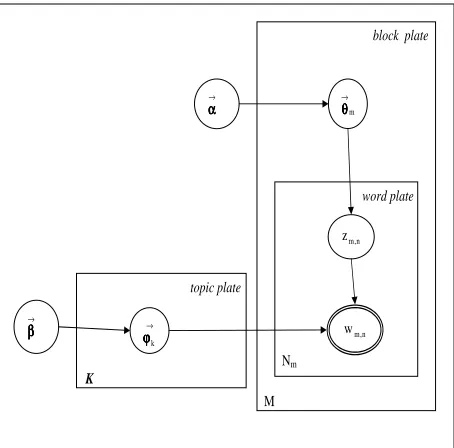
Figure 2: Graphical model representation of latent Dirichlet allocation.
LDA generates a stream of observable words wm,n partitioned into blocks of text~bm as shown
by the graphical model in Figure 2. The Bayesian network can be interpreted as follows: the variables Φ,θandz are the three sets of latent variables that we would like to infer. The plate surroundingϕ~k
il-lustrates the repeated sampling of word distributions for each topiczkuntilKtopics have been generated.
The plate surrounding~θmillustrates the sampling of
a distribution over topics for each block bfor a to-tal of M blocks of text. The inner plate overzm,n
andwm,nillustrates the repeated sampling of topics
and words untilNm words have been generated for
a block~bm.
Each block of text is first generated by drawing a topic proportion~θm, i.e. by picking a distribution
over topics from a Dirichlet distribution. For each wordwm,nfrom a block of text~bm, a topic indicator
kis sampled forzm,naccording to the block-specific
mixture proportion ~θm. That is, θ~m determines
P(zm,n). The topic probabilities ϕ~k are also
sam-pled from a Dirichlet distribution. The words in each block of text are then generated by using the corre-sponding topic-specific term distributionϕ~zm,n.
Given the graphical representation of LDA illus-trated in Figure 2, we can write the joint distribution of a wordwm,nand a topiczkas:
P(wm,n, zk|~θm,Φ) =P(zk|~θm)·P(wm,n|ϕ~k).
Summing over k, we obtain the marginal distribu-tion:
Hence, similarly to AMDD (see Equation 1), the LDA model assumes that a wordwm,n is generated
from a random mixture over topics. Topic proba-bilities are conditioned on the block of text a word belongs to. Moreover LDA leaves flexibility to assign a different topic to every observed word and a different proportion of topics for every block of text.
The joint distribution of a block of text ~bm
and the latent variables of the model ~zm, ~θm,
Φ, given the hyperparameters ~α, β~ is further
specified by: P(~bm, ~zm, ~θm,Φ|~α, ~β) =
Therefore, the likelihood of a block~bmis derived
as the marginal distribution obtained by summing over the zm,n and integrating out the distributions
~
θm andΦ.
2.2.2 Inferring and Employing the LDA Model
Since the integral involved in computing the like-lihood of a block~bm is computationally intractable,
several methods for approximating this posterior have been proposed, including variational expecta-tion maximizaexpecta-tion (Blei et al., 2003) and Markov chain Monte Carlo methods (Griffiths and Steyvers, 2004).
check how well the parameters cluster semantically related blocks of text in a training corpus and then we use these values as estimates for comparable set-tings.
The LDA model provides a soft clustering of the blocks of text, by associating them to topics. We exploit this clustering information, by using the dis-tribution of topics over blocks of text to further measure the inter-blocks similarity. As in Section 2.1.2, the last step of our system consists in em-ploying binary support vector classification to iden-tify the boundaries of thematic episodes in the text. That is, we consider as input features for support vector learning the component values of the vector (θm,z1, θm,z2, ..., θm,zk).
3 Experiments
In order to evaluate the performance of AMDD and LDA for our task of topic segmentation, in our ex-periments we used the transcripts of ICSI-MR cor-pus (Janin et al., 2004), which consists of75 meet-ing recordmeet-ings. A subset of25meetings, which are transcribed by humans and annotated with thematic boundaries (Galley et al., 2003), has been kept for testing purposes and support vector machine train-ing. The transcripts of the remaining 50 meetings have been used for the unsupervised inference of our latent models. The fitting phase of the mix-ture models rely on the same data set that have been pre-processed by tokenization, elimination of stop-words and lemmatization.
Once the models’ parameters are learned, the in-put data representation is projected into the lower dimension latent semantic space. The evaluation phase consists in checking the performance of each model for predicting thematic boundaries. That is, we check the performance of the models for predict-ing thematic boundaries on the same test set. The size of a block of text during the testing phase has been set to one, i.e. each utterance has been consid-ered as a block of text.
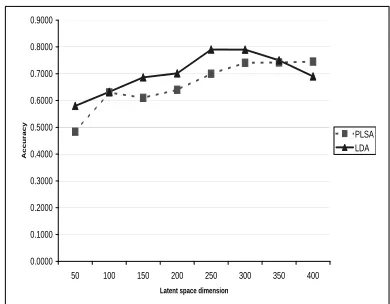
Figure 3 compares the performance obtained for variouskvalues, i.e. various dimensions of the latent semantic space, or equivalently different numbers of latent topics. We have chosenk={50, ...400}using incremental steps of50.
The performance of each latent model is
mea-0.0000 0.1000 0.2000 0.3000 0.4000 0.5000 0.6000 0.7000 0.8000 0.9000
50 100 150 200 250 300 350 400
Latent space dimension
A
c
c
u
r
a
c
y
PLSA LDA
Figure 3: Results of applying the mixture models for topic segmentation.
sured by the accuracy Acc = 1− Pk, where Pk
denotes the error measure proposed by (Beeferman et al., 1999). Note that the Pk error allows for a
slight variation in where the hypothesized thematic boundaries are placed. That is, wrong hypothesized thematic boundaries occurring in the proximity of a reference boundary (i.e. in a fixed-size interval of text) are tolerated. As proposed by (Beeferman et al., 1999), we set up the size of this interval to half of the average number of words per segment in the gold standard segmentation.
As we observe from Figure 3, LDA and AMDD achieved rather comparable thematic segmenta-tion accuracy. While LDA steadily outperformed AMDD, the results do not show a notable advan-tage of LDA over AMDD. In contrast, AMDD has better performances for less dimensionality reduc-tion. That is, the LDA performance curve goes down when the number of latent topics exceeds over300.
LDA LCSeg SVMs
Pkerror rate 21% 32 % 22%
Table 1: Comparative performance results.
been obtained by (Galley et al., 2003) when extra non-lexical features have been adopted in a decision tree classifier. The system proposed by (Georges-cul et al., 2006) is based on support vector machines (SVMs) and is labeled in the table as SVMs. We observe from the table that our approach based on combining LDA modeling with SVM classification outperforms LCSeg and performs comparably to the system of Georgescul et al. (2006). Thus, our exper-iments show that the LDA word density estimation approach does capture important information from the data through 90% less features than a bag-of-words representation.
4 Conclusions
With the goal of performing linear topic segmen-tation by exploiting word distributions in the input text, the focus of this article was on both comparing theoretical aspects and experimental results of two probabilistic mixture models. The algorithms are applied to a meeting transcription data set and are found to provide an appropriate method for reduc-ing the size of the data representation, by perform-ing comparably to previous state-of-the-art methods for topic segmentation.
References
Doug Beeferman, Adam Berger, and John Lafferty. 1999. Statistical Models for Text Segmentation.
Ma-chine Learning, 34:177–210. Special Issue on Natural
Language Learning.
David M. Blei, Andrew Y. Ng, and Michael Jordan. 2003. Latent Dirichlet Allocation. Journal of
Ma-chine Learning Research, pages 993–1022.
Freddy Choi. 2000. Advances in Domain Indepen-dent Linear Text Segmentation. In Proceedings of the
1st Conference of the North American Chapter of the Association for Computational Linguistics (NAACL),
Seattle, USA.
Michael Galley, Kathleen McKeown, Eric Fosler-Luissier, and Hongyan Jing. 2003. Discourse Seg-mentation of Multi-Party Conversation. In
Proceed-ings of the 41st Annual Meeting of the Association for Computational Linguistics (ACL), pages 562–569,
Sapporo, Japan.
Maria Georgescul, Alexander Clark, and Susan Arm-strong. 2006. Word Distributions for Thematic Seg-mentation in a Support Vector Machine Approach. In
Proceedings of the 10th Conference on Computational Natural Language Learning (CoNLL), pages 101–108,
New York City, USA.
Maria Georgescul, Alexander Clark, and Susan Arm-strong. 2007. Exploiting Structural Meeting-Specific Features for Topic Segmentation. In Actes de la
14`eme Conf´erence sur le Traitement Automatique des Langues Naturelles (TALN), pages 15–24, Toulouse,
France.
Thomas L. Griffiths and Mark Steyvers. 2004. Find-ing Scientific Topics. In ProceedFind-ings of the National
Academy of Sciences, volume 101, pages 5228–5235.
Marti Hearst. 1997. TextTiling: Segmenting Text into Multi-Paragraph Subtopic Passages. Computational
Linguistics, 23(1):33–64.
Thomas Hofmann. 2001. Unsupervised Learning by Probabilistic Latent Semantic Analysis. Machine Learning, 42:177–196.
Adam Janin, Jeremy Ang, Sonali Bhagat, Rajdip Dhillon, Jane Edwards, Javier Macias-Guarasa, Nelson Mor-gan, Barbara Peskin, Elizabeth Shriberg, Andreas Stolcke, Chuck Wooters, and Britta Wrede. 2004. The ICSI Meeting Project: Resources and Research. In Proceedings of the International Conference on
Acoustics, Speech and Signal Processing (ICASSP), Meeting Recognition Workshop, Montreal, Quebec,
Canada.
Igor Malioutov and Regina Barzilay. 2006. Minimum cut model for spoken lecture segmentation. In
Pro-ceedings of the 21st International Conference on Com-putational Linguistics and 44th Annual Meeting of the Association for Computational Linguistics (COL-ING/ACL), pages 25–32, Sydney, Australia.
Jane Morris and Graeme Hirst. 1991. Lexical Cohe-sion Computed by Thesaural Relations as an Indicator of the Structure of Text. Computational Linguistics, 17(1):21–48.
Matthew Purver, Konrad P. K¨ording, Thomas L. Grif-fiths, and Joshua B. Tenenbaum. 2006. Unsupervised Topic Modelling for Multi-Party Spoken Discourse. In Proceedings of the 21st International Conference
on Computational Linguistics and 44th Annual Meet-ing of the Association for Computational LMeet-inguistics (COLING/ACL), pages 17–24, Sydney, Australia.
Jeffrey Reynar. 1994. An Automatic Method of Finding Topic Boundaries. In Proceedings of the 32nd Annual
Meeting of the Association for Computational Linguis-tics (ACL), pages 331–333, Las Cruces, New Mexico,