Grammar Induction from Text Using Small Syntactic Prototypes
Prachya Boonkwan†,‡ [email protected] [email protected]
†School of Informatics
University of Edinburgh 10 Crichton Street Edinburgh EH8 9AB, UK
Mark Steedman† [email protected]
‡National Electronics
and Computer Technology Center 112 Phaholyothin Road Pathumthani 12120, Thailand
Abstract
We present an efficient technique to incor-porate a small number of cross-linguistic parameter settings defining default word orders to otherwise unsupervised
gram-mar induction. A syntactic prototype,
represented by the integrated model be-tween Categorial Grammar and depen-dency structure, generated from the lan-guage parameters, is used to prune the search space. We also propose heuristics which prefer less complex syntactic cate-gories to more complex ones in parse de-coding. The system reduces errors gen-erated by the state-of-the-art baselines for WSJ10 (1% error reduction of F1 score for the model trained on Sections 2–22 and tested on Section 23), Chinese10 (26% ror reduction of F1), German10 (9% er-ror reduction of F1), and Japanese10 (8% error reduction of F1), and is not sig-nificantly different from the baseline for Czech10.
1 Introduction
Unsupervised grammar induction has gained gen-eral interest for sevgen-eral decades, offering the pos-sibility of building practical syntactic parsers by reducing the labor of constructing a treebank from scratch. One approach is to exploit the In-side/Outside Algorithm (Baker, 1979; Carroll and Charniak, 1992), a variation of EM algorithm for PCFG, to estimate the parameters of the parser’s language models. More recent advances in this ap-proach are the constituent-context model (CCM) (Klein and Manning, 2001; Klein and Manning, 2002), dependency model with valence (DMV) based on Collin’s head dependency model (1999), and the CCM+DMV mixture (Klein and Manning, 2004; Klein, 2005). Several search techniques and
models have been added to CCM+DMV for deal-ing with local optima and data sparsity (Smith, 2006; Cohen et al., 2008; Headden III et al., 2009). Spitkovsky et al. (2010) proposed a training strat-egy where the model fully trained on shorter sen-tences and roughly trained on longer sensen-tences tend to outperform the model fully trained on the entire dataset. Recently, Gillenwater et al. (2010) proposed the use of posterior regularization in EM in which the posterior distribution of parent-child POS tags are regulated to an expected distribution. However, purely unsupervised learning still does not perform well because the parameter es-timation can be misled by unexpected frequent cooccurrence. A common example of it is the col-location of a verb (VBZ) and a determiner (DT) in a verb phrase. This collocation results in incorrect trees such as ((VBZ DT) NN).
To avoid this problem, the use of syntactic pro-totypes has been proposed. Instead of enumerat-ing every possibility, syntactic structures are cau-tiously constructed regarding some syntactic con-straints. Haghighi and Klein (2006) proposed the use of bracketing rules extracted from WSJ10 in CCM and considerably improved accuracy. Druck et al. (2009) used dependency formation rules handcrafted by linguists to improve the ac-curacy of DMV. Snyder et al. (2009) do semi-supervised grammar induction from bilingual text with the help of a supervised parser on one side and word alignment. However, bilingual cor-pora are not available for many language pairs. Naseem et al. (2010) proposed the use of cross-linguistic knowledge represented as a set of allow-able head-dependent pairs. However, this method still requires provision of language-specific rules to boost accuracy. If language-specific rules are necessary to achieve accuracy, we need more effi-cient ways to encode this knowledge.
This paper proposes a method for inducing language-specific word order regularities
ing cross-linguistically frequent constructions to constrain unsupervised grammar induction. We use the notion of syntactic prototype, a set of grammar rules automatically generated for such constructions. Categorial Dependency Grammar (CDG), which combines rules of constituency and dependency, is used to represent syntactic proto-types. We also propose a novel category penalty score for use in decoding, which defines the most probable parse according to a preference for less complex categories.
The paper is organized as follows. §2 details the method of encoding linguistic prior knowledge as a syntactic prototype. §3 explains an overview of our approach. §4 shows experiment results and discusses the errors. We conclude in §5.
2 Syntactic Prototypes
A syntactic prototype is a set of grammar rules representing default language parameters (such as word order for the most cross-linguistically fre-quent linguistic constructions, following Naseem et al. (2010)’s notion of cross-linguistic knowl-edge. This section shows how CDG rules are de-rived from a set of word order constraints.
2.1 Categorial Dependency Grammar
Categorial Dependency Grammar (CDG) is an ex-tension of pure Categorial Grammar (CG) (Aj-dukiewicz, 1935; Bar-Hillel, 1953) used for defin-ing language-specific prototypes to be discovered. Its syntactic derivations define constituency and dependency in parallel. In CG, each constituent is assigned one or more syntactic categories, de-fined as an atomic category or a function category. For example, the proper name ‘John’ is assigned the atomic categorynp. IfXandY are categories of either kind, then X/Y andX\Y are function categories that map constituents of typeY respec-tively on the right and on the left into those of type X. For example, the intransitive verb ‘walks’ is assigned the functionS\NP.
We extended CG construct dependency struc-ture alongside the syntactic derivation by encod-ing the direction of dependency in slashes. Us-ing the head-outward notation for dependency of (Collins, 1999), the slash is subscripted< (>) if the corresponding dependency is to be linked from the head on the right to its dependent on the left (the head on the left to its dependent on the right). For example, an English adjective (e.g. ‘big’) can
be assigned the categorynp/>np, while a transi-tive verb can be assigneds\>np/<np. CDG dif-fers from PF-CCG (Koller and Kuhlmann, 2009) in that dependency direction is specified indepen-dently from the order of function and argument, while theirs is determined by slash directionality. For them such an adjective has the implicit cat-egory np/>np and acts as the head of the noun phrase. The derivation rules for context-free CDG are listed below:
X/<Y :d1 Y :d2 ⇒ X:h(d1)→h(d2) (1)
X/>Y :d1 Y :d2 ⇒ X:h(d1)←h(d2)
Y :d1 X\<Y :d2 ⇒ X:h(d1)→h(d2)
Y :d1 X\>Y :d2 ⇒ X:h(d1)←h(d2)
where the notationsh(d1)→ h(d2)andh(d1)← h(d2) mean a dependency linking from the head
of the dependency structured1 to the head ofd2,
and that linking from the head ofd2to the head of d1, respectively. Let us denote a constituent type
withC:w, whereCis a syntactic category andw is the head word of the constituent.
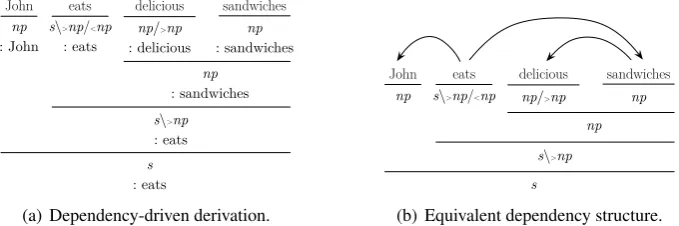
Given the CDG in (2), we obtain the syntactic derivation of the string ‘John eats delicious sand-wiches’ in Figure 1.
John,sandwiches ` np (2)
delicious ` np/>np eats ` s\>np/<np
Figure 1(a) shows dependency-driven derivation, in which the heads of constituents are propagated. Figure 1(b) reflects the formation of the depen-dency structure corresponding to the dependepen-dency- dependency-driven derivation.
John eats sandwiches
np s\>np/<np np
delicious
np/>np
np
s\>np
s
John eats sandwiches
np
: John
s\>np/<np
: eats : sandwichesnp
delicious
np/>np
: delicious
np
: sandwiches
s\>np
: eats
s
: eats
(a) Dependency-driven derivation.
John eats sandwiches
np s\>np/<np np
delicious
np/>np
np
s\>np
s
John eats sandwiches
np
: John
s\>np/<np
: eats : sandwichesnp
delicious
np/>np
: delicious
np
: sandwiches
s\>np
: eats
s
: eats
[image:3.595.130.470.65.178.2](b) Equivalent dependency structure.
Figure 1: Syntactic derivation of ‘John ate delicious sandwiches’ based on CDG. Each constituent type is denoted byC:w, whereCis a syntactic category andwis the head word, such ass\>np/<np:eats.
However, a simple parametric syntactic proto-type will give rise to parsing failures when faced with parametrically exceptional items, which oc-cur in most if not all languages. We allow for such exceptions to be accommodated by defining an ad-ditional wildcard category?which combines with any syntactic category to yield the wildcard itself, according to the following additional combinatory rules:
?:d1 X:d2 ⇒ {?:h(d1)←h(d2), (3)
?:h(d1)→h(d2)}
X:d1 ?:d2 ⇒ {?:h(d1)←h(d2),
?:h(d1)→h(d2)}
The wildcard is assigned to unknown words and large irreducible constituents so as to allow com-plete parses of otherwise unparsable sentences. As shown in (3), each wildcard derivation generates two possible dependency structures; i.e.d1andd2
can be the head of a phrase. The wildcard will be revisited in §3.1.
2.2 Language Parameterization
We generate the CDG for each language automat-ically from language parameters. To facilitate this process, we have devised a questionnaire consist-ing of 30 questions concernconsist-ing word orders for constructions that occur in most languages. Sorted by their importance, the questions can be grouped into the following categories:
1. The orders of subject, verb, direct object, and optional indirect object (1 question)
2. The argument orders of subject- and object-control verbs (2 questions)
3. The orders of adjectives, adverbs, and auxil-iary verbs (4 questions)
4. The use of cardinal numbers and noun classi-fiers (2 questions)
5. The argument orders of adpositions, nomi-nal modifiers, adverbials, possessive mark-ers, relative pronouns, and subordinate con-junctions. (7 questions)
6. The orders of gerunds, infinitive markers, nominalizers, and sentential modifiers (6 questions)
7. The orders of particles, the existence of a copula, the usages of gerunds, the order of negative markers, the use of dative shifts, and the omission of discourse-given subject and object (8 questions)
These language parameters are used to automat-ically generate a CDG representing a syntac-tic prototype including language-specific types of cross-linguistically frequent categories1 will be generated. For example, if a language has the word order SVIO, the syntactic category s\>np, s\>np/<np, ands\>np/<np/<npare generated and assigned by default to intransitive, transitive, and ditransitive verbs, respectively. Each slash in all syntactic categories is assigned with de-pendency directions according to Collins (1999)’s head percolation heuristics. All questions are op-tional; i.e. if any of the questions are left blank, all possible categories for that question will be gener-ated.
Once the cross-linguistic category classes are generated, we then map them to the POS tags in a particular corpus. This part is an engineering task where the mapping should be best fitted to the
corpus. However, we will show in the experiment section that the preparation process for syntactic prototypes is quantifiable and reasonable in com-parison to the improvement in accuracy attained.
3 Grammar Induction
3.1 Structure Enumeration
The first step in grammar induction is to enumer-ate all possible parses for each sentence. We use a table mapping from POS tags to language-specific categories to define the lexicon, and build a parse chart for each sentence with CKY Algorithm. A packed chart is used for both speed and space com-pactness. We apply a right-branching preference to eliminate spurious ambiguity caused by coordi-nation and nominal compounding. In the event of a sentence yielding no parse using that lexicon, we assign the wildcard category ‘?’ to all unknown words and maximal irreducible constituents, and reparse the sentence.
3.2 Parsing Model
We extend the probabilistic context-free gram-mar with role-emission probabilities, defined as the product of the probability of each daughter category performing as a head or a dependent in a derivation. This model was motivated by Collins (1999)’s head-outward dependency model and Hockenmaier (2003)’s generative model for parsing CCG. Given a CDGG, we define the prob-ability of a treethaving the constituent typeC:w by:
P(t|s, G) = 1
Z Y
C:w→α
∈R(t)−L(t)
πexp(α|C:w, G) ×πhead(H :w|G) ×πdep(D:w0|G)
(4)
× Y
C:w∈N(t)
πHE(w|C, G)#t(C:w)
whereZis a normalization constant and each pro-ductionαcontainsH :wandD:w0, andH :w and D : w0 are the head and the dependent, re-spectively. There are four types of parameters as follows.
1. πexp(α|C :w, G): probability of the typeC: wgenerating a productionα.
2. πhead(C : w|G): probability of the typeC : wperforming as a head.
πhead(C:w|G) =
P
C:w0#(C:w0→αChead:w)
P
C0:w0#(C0:w0→αC:w)
(5)
3. πdep(C :w|G): probability of the typeC:w performing as a dependent.
πdep(C:w|G) =
P
C0:w0#(C0:w0→αCdep:w)
P
C0:w0#(C0:w0→αC:w)
(6)
4. πHE(w|C, G): probability of a category C generating the headw.
πHE(w|C, G) =
P
t∈Q#t(C:w)
P
t∈Q
P
w0#t(C:w0) (7)
whereαC:w is a production that containsC : w, andαC:w
head andαdepC:w haveC : w as the head and the dependent, respectively. #t(C :w)is the fre-quency count of the categoryC : win the tree t. N(t)is the set of all nonterminal nodes.
3.3 Parameter Estimation
Learning is achieved using the Variational Bayesian EM Algorithm (VB-EM) (Attias, 2000; Ghahramani and Beal, 2000) to estimate the pa-rameters πexp, πhead, πdep,andπHE. We followed the approach of Kurihara and Sato (2006) for training PCFGs with the VB-EM. This approach places Dirichlet priors over the multinomial gram-mar rule distributions. We set the Dirichlet hyper-parameters to 1.0 for all rules containing the wild-card category and 5.0 for all others. In all other re-gards, we followed Kurihara and Sato (2006). The VB-EM algorithm iterates two processes of expec-tation calculation and parameter maximization. It is favored for the present purpose because it is less data-overfitting than the standard Inside/Outside Algorithm regarding its free-energy criteria for model selection. We calculate expected counts us-ing Dynamic Programmus-ing (Baker, 1979; Lari and Young, 1990).
To further avoid the data over-fitting issue, we smoothed the probability of each substructure with the additive smoothing technique (Lidstone, 1920; Johnson, 1932; Jeffreys, 1948). An approximated parameterπˆ(τ)is calculated by
ˆ
π(τ) = π(τ) +
1 + (8)
whereis a small constant value. In our experi-ments, we chose= 10−25.
3.4 Decoding with Category Penalty
categories. A parse containing more complex cat-egories is preferred to one containing less complex categories, because both simple and complex syn-tactic categories have the same chance of occur-rence in parse enumeration. When learning the parameters, rules containing complex categories tend to have relatively excessive probability, as op-posed to the Zipfian distribution of syntactic cate-gories in which less complex catecate-gories are more frequently found in CCGbank. We therefore intro-duce acategory penaltyscore.
The category penalty score is motivated by the observation that, in practical use of language, sim-pler categories tend to be used more frequently than the more complex ones. The penalty score v(c)of the categorycis defined as follows:
v(c) = kS(c) (9)
whereS(c) is the count of all forward and back-ward slashes incandkis the penalty constant.
We weight each tree by the product of the penalty scores of the syntactic category on each node; i.e.
P(t|s, G) =
v(A)·π(A→w) lexicon
v(A)·π(A→α) branching
·Q|iα=1| P(ti|s, G)
(10)
We use Viterbi decoding to find the most probable parse from a packed chart.
4 Experiments and Discussion
4.1 Datasets and Accuracy Metrics
In order to evaluate the method in comparison to the state of the art, we chose WSJ10, the stan-dard collection of trees from WSJ part of PTB (Marcus et al., 1993) whose sentence length does not exceed ten words after taking out punctuation marks and empty elements. In stead of surface forms, we used a set of POS sequences taken from all WSJ10’s trees to avoid the data sparsity issue. We converted the Penn Treebank into dependency structures with Collins (1999)’s head percolation heuristics. Following the literature, we trained the system with sections 2–22 and evaluated the resul-tant model on section 23.
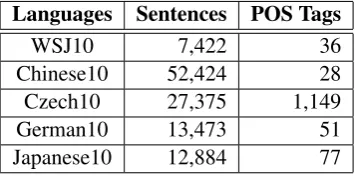
[image:5.595.328.506.96.184.2]For multilingual experiments, we made use of dependency corpora from the 2006 CoNLL X Shared Task (Buchholz and Marsi, 2006). Shown in Table 1, Chinese (Keh-Liann and Hsieh, 2004),
Table 1: Sizes and granularity of POS of multilin-gual corpora
Languages Sentences POS Tags
WSJ10 7,422 36
Chinese10 52,424 28
Czech10 27,375 1,149
German10 13,473 51
Japanese10 12,884 77
Czech (Bohomovà et al., 2001), German (Brants et al., 2002), and Japanese (Kawata and Bartels, 2000) were chosen for the sake of language ty-pology variety. We also chose sentences whose length does not exceed ten words after taking out punctuation marks. As a free-word-ordered, in-flectional language, the Czech dataset was partic-ularly prepared by augmenting the POS tags with inflectional information, resulting in significantly much more granularity. However, Czech’s syntac-tic prototype does not make use of such syntacsyntac-tic information to restrain the search space.
We measured the capability of our system by two metrics: directed dependency accuracy, and undirected dependency accuracy (Klein, 2005). For directed dependency accuracy, we count a di-rected dependency of a word pair to be correct if it exists in the gold standard. For undirected de-pendency accuracy, we neglect the direction of the dependency. All accuracy numbers are reported in terms of precision, recall, and F1 scores.
4.2 Construction of Syntactic Prototypes
In order to construct syntactic prototypes for each language, we conduct an interview with a non-linguist native speaker. We ask him/her each ques-tion in the quesques-tionnaire menques-tioned in §2.2 by giv-ing them a sample sentence and lettgiv-ing them build up the corresponding sentence in their language. We then ask questions to elicit word alignment and analyze the answers. Normally it takes up to two hours per previously unseen language to complete the questionnaire.
4.3 Results
This section presents results of English and multi-lingual experiments using syntactic prototypes as a guide to grammar induction.
[image:6.595.309.524.62.206.2]4.3.1 Experiments on English
Table 2 shows experiment results of English gram-mar induction on WSJ10. In the beginning, we compared the produced trees against the gold stan-dard produced from Collins’s parser. We trained the system with Sections 2–22 of WSJ10 and tested it on Section 23. In decoding, we set the category penalty constant to10−15. The F1 score outperforms the baseline set by (Naseem et al., 2010). To exhibit the stability of the approach, we also ran ten-fold cross validation on English; i.e. we divided WSJ10 into ten parts and, for each fold, we chose nine parts for as a training set and the other one as a test set. We attained higher F1 score, as expected for cross-validation, which ef-fectively tests on the development set.
4.3.2 Effects of Numbers of Constraints and Category Penalties
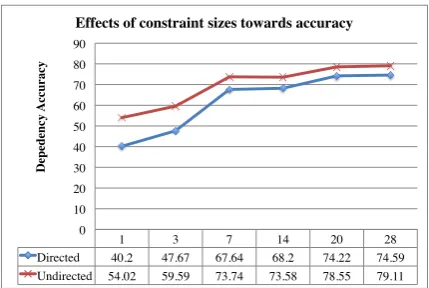
Figure 2 shows the effects of numbers of con-straints towards directed and undirected F1 scores. We varied the number of constraints in English syntactic prototypes. The category class 4 (the us-ages of cardinal numbers and noun classifiers) was neglected, because we can treat cardinal numbers as adjectives or nouns and there are no true noun classifiers in English. Therefore there are 28 con-straints in total for English. We again trained on Sections 2–22 of WSJ10 and tested on Section 23. In decoding, we set the category penalty constant to10−15. We then evaluated the accuracy against the gold standard produced by Collins’s parser.
As we increased the number of constraints in syntactic prototypes, we found that both directed and undirected F1 scores increase and start to sat-urate after the first 20 rules. In keeping with the Zipfian distribution, the first 20 rules cover fre-quent linguistic phenomena. When we pruned the search space with linguistic constraints, the di-rected accuracy starts to approach the undidi-rected accuracy. We also note that errors generated by the system reflect the same attachment ambiguity errors as supervised parsing.
Figure 3 shows the effects of category penalty constants on accuracy. We again trained on Sec-tions 2–22 of WSJ10 and tested on Section 23. We then evaluated the accuracy against the gold
stan-1! 3! 7! 14! 20! 28!
Directed! 40.2! 47.67! 67.64! 68.2! 74.22! 74.59!
Undirected! 54.02! 59.59! 73.74! 73.58! 78.55! 79.11!
0!
10!
20!
30!
40!
50!
60!
70!
80!
90!
D
ep
ed
en
cy
A
cc
u
rac
y
!
Effects of constraint sizes towards accuracy!
Figure 2: Effects of numbers of constraints on the directed and undirected dependency accuracy. The category penalty constant is fixed at10−15.
1! 1.00E-05! 1.00E-10! 1.00E-15! 1.00E-20! 1.00E-25! 1.00E-30! 1.00E-35! 1.00E-40!
Directed! 70.08!73.79!74.68!74.75!74.58!74.51!74.59!74.62!74.52!
Undirected!74.41!78.34! 79.2! 79.27!79.13!79.03!79.11!79.14!79.04!
64!
66!
68!
70!
72!
74!
76!
78!
80!
D
ep
en
d
en
cy
A
cc
u
rac
y
!
Effects of category penalty towards accuracy!
Figure 3: Effects of category penalty on the di-rected and undidi-rected dependency accuracy.
dard produced by Collins’s parser. We notice that both accuracy scores saturate at the penalty con-stant of10−15and slightly decay afterwards.
4.3.3 Multilingual Experiments
[image:6.595.309.523.279.395.2]Table 2: Undirected and directed dependency accuracy of grammar induction on English Penn Treebank. The baseline for English is (Naseem et al., 2010).
Undirected Directed Baseline
Precision Recall F1 Precision Recall F1 Directed F1
WSJ10 (Sect. 23) 79.24 79.29 79.27 74.72 74.77 74.75 73.80
WSJ10 (10X) 79.59 79.65 79.62 75.44 75.50 75.47 —
tags are grouped to easily map to cross-linguistic category classes, each class still contains a lot of syntactic categories. Because we do not use inflec-tional information in restraining the search space, the data sparsity becomes significant in Czech and therefore deteriorates the accuracy.
4.4 Error Analysis
We counted erroneous dependency pairs generated in the English experiment (10X) in §4.3.1, and we classified errors into two types: over-generation and under-generation. From Table 4, we can no-tice that the majority of errors are caused by ad-verbial and prepositional attachment (e.g. RB > VB, CD < IN, and NN < IN), and NP struc-tural ambiguity (e.g. NN > NNP, DT > NN, and NNP > NNP).2 These errors are common in su-pervised parsing. There is also under-generation of adverbial preposition phrases. We believe that the category penalty score accounts for this issue, resulting in the NP-modifying preposition (such asnp\<np/>np) being preferred to the adverbial one (such ass\>np\<(s\>np)/<np).
5 Conclusion
We have demonstrated an efficient approach to grammar induction using linguistic prior knowl-edge encoded as a prototype or lexical schema. This prior knowledge was used to capture frequent linguistic phenomena. To integrate the strength of constituent and dependency models, Categorial Dependency Grammar was used as the backbone formalism. We also proposed a category penalty score preferring less complex categories, based on the observation of the Zipfian distribution of cate-gory types in CCGbank.
Syntactic prototypes can capture the most fre-quent constructions and improve accuracy on al-most all of the selected languages. We found that
2Similar to the dependency directions in §2.1, the nota-tions < and > are pointers to the syntactic head of the phrase. For example, DT > NN means that NN is the head and DT is its dependent.
Table 4: Top-10 over-generation and under-generation in the English experiment (10X) when compared against Collins’s gold standard
Over-generation Under-generation
Errors Counts Errors Counts
RB > VB 402 VBD < IN 364 CD < IN 200 DT > NN 331 NN < IN 197 VBD < TO 283 RB > VBN 188 VBD < RB 275 NN < TO 181 VBZ < RB 244 NNP > CD 180 IN < NN 219 MD > VB 166 JJ > NN 203 NNS < IN 149 MD < RB 194 NNP > NN 145 MD < VB 185 NN > NNP 141 NNP > NNP 179
dependency accuracy correlates with the Zipfian distribution as the number of constraints increases, as the increase in accuracy saturates after the first 20 rules. Error analysis suggests that the main sources of error are in adverbial and prepositional attachment, and NP structural ambiguity, which are also problematic for supervised parsing.
Future work remains as follows. First, we are looking forward to improving the capability of our syntactic prototype to also handle free word or-dered languages by generating syntactic categories with more flexible combination and restraining the search space with inflectional information. Sec-ond, we plan to experiment on grammar induction from untagged words by decomposing the model into tagging and parsing subproblems (Ganchev et al., 2009; Rush et al., 2010; Auli and Lopez, 2011). Third and finally, we will experiment on longer sentences to show the scalability of our ap-proach in dealing with larger data.
Acknowledgement
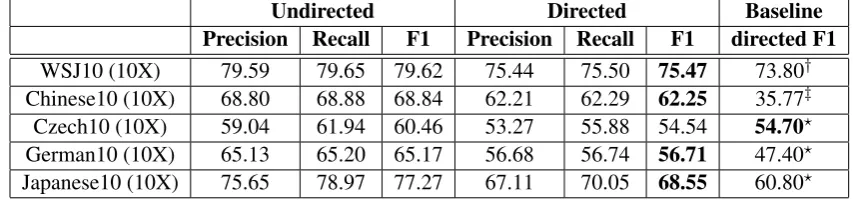
[image:7.595.316.514.222.394.2]Table 3: Undirected and directed dependency accuracy of grammar induction for English, Chinese, Czech, German, and Japanese. Our baseline systems are as follows:†(Naseem et al., 2010) for English, ‡(Snyder et al., 2009) for Chinese, and?(Gillenwater et al., 2010) for Czech, German, and Japanese.
Undirected Directed Baseline
Precision Recall F1 Precision Recall F1 directed F1
WSJ10 (10X) 79.59 79.65 79.62 75.44 75.50 75.47 73.80†
Chinese10 (10X) 68.80 68.88 68.84 62.21 62.29 62.25 35.77‡
Czech10 (10X) 59.04 61.94 60.46 53.27 55.88 54.54 54.70?
German10 (10X) 65.13 65.20 65.17 56.68 56.74 56.71 47.40?
Japanese10 (10X) 75.65 78.97 77.27 67.11 70.05 68.55 60.80?
Emily Thomforde (University of Edinburgh), Adam Lopez (Johns Hopkins University), and Michael Collins (Columbia University) for useful comments and discussion related to this work, and the three anonymous reviewers for their useful feedback. This research was funded by the Royal Thai Government Scholarship to Prachya Boonkwan and EU ERC Advanced Fellowship 249520 GRAMPLUS to Mark Steedman.
References
Kazimierz Ajdukiewicz. 1935. Die Syntaktische
Kon-nexität. Polish Logic, pages 207–231.
Hagai Attias. 2000. A variational Bayesian framework
for graphical models. InAdvances in Neural
Infor-mation Processing Systems (NIPS 2000).
Michael Auli and Adam Lopez. 2011. A compari-son of loopy belief propagation and dual decompo-sition for integrated CCG supertagging and parsing.
InProceedings of ACL-2011, June.
J. K. Baker. 1979. Trainable grammars for speech recognition. In D. H. Klatt and J. J. Wolf, editors, Speech Communication Papers for the 97th
Meet-ing of the Acoustical Society of America, pages 547–
550.
Yehoshua Bar-Hillel. 1953. A Quasi-Arithmetical
No-tation for Syntactic Description. Language, 29:47–
58.
A. Bohomovà, J. Hajic, E. Hajicova, and B. Hladka. 2001. The Prague dependency treebank: Three-level annotation scenario. In Anne Abeillé, editor, Treebanks: Building and Using Syntactically
Anno-tated Corpora.
T. Brants, S. Dipper, S. Hansen, W. Lezius, and
G. Smith. 2002. The TIGER Treebank. In
Proceed-ings Workshop on Treebanks and Linguistic Theo-ries.
Sabine Buchholz and Erwin Marsi. 2006. CoNLL-X shared task on multilingual dependency parsing. In
Proceedings of CoNLL-2006, pages 149–164.
Glenn Carroll and Eugene Charniak. 1992. Two ex-periments on learning probabilistic depedency gram-mars from corpora. In C. Weir, S. Abney, R.
Grish-man, and R. Weischedel, editors,Working Notes of
the Workshop Statistically-Based NLP Techniques,
pages 1–13. AAAI Press, Menlo Park, CA.
Shay B. Cohen, Kevin Gimpel, and Noah A. Smith. 2008. Logistic normal priors for unsupervised
prob-abilistic grammar induction. InAdvances in Neural
Information Processing Systems 21.
Michael Collins. 1999. Head-Driven Statistical
Mod-els for Natural Language Parsing. Ph.D. thesis,
University of Pennsylvania.
Gregory Druck, Gideon Mann, and Andrew McCal-lum. 2009. Semi-supervised learning of depen-dency parsers using generalized expectation criteria.
In Proceedings of 47th Annual Meeting of the
As-sociation of Computational Linguistics and the 4th
IJCNLP of the AFNLP, pages 360–368, Suntec,
Sin-gapore, August.
Kuzman Ganchev, Joao Graca, Jennifer Gillenwater, and Ben Taskar. 2009. Posterior regularization for structured latent variable models. Technical Report MS-CIS-09-16, University of Pennsylvania Depart-ment of Computer and Information Science. Zoubin Ghahramani and Matthew J. Beal. 2000.
Vari-ational inference for Bayesian mixtures of factor
analyses. InAdvances in Neural Information
Pro-cessing Systems (NIPS 2000).
Jennifer Gillenwater, Kuzman Ganchez, Joao Graça, Fernando Pereira, and Ben Taskar. 2010. Sparsity
in dependency grammar induction. InProceedings
of ACL-2010 Short Papers, pages 194–199.
Aria Haghighi and Dan Klein. 2006. Prototype-driven
grammar induction. InProceedings of 44th Annual
Meeting of the Association for Computational
Lin-guistics, pages 881–888.
William P. Headden III, Mark Johnson, and David Mc-Closky. 2009. Improving unsupervised dependency
parsing with richer contexts and smoothing. In
Pro-ceedings of the Conference of the North American Chapter of the Association for Computational
Julia Hockenmaier. 2003. Parsing with generative
models of predicate-argument structure. In
Proceed-ings of the 41st Annual Meeting of the Association
for Computational Linguistics, pages 359–366,
Sap-poro, Japan.
H. Jeffreys. 1948. Theory of Probability. Clarendon
Press, Oxford, second edition.
W. E. Johnson. 1932. Probability: deductive and
in-ductive problems. Mind, 41:421–423.
Y. Kawata and J. Bartels. 2000. Stylebook for the Japanese Treebank in VERBMOBIL. Technical re-port, Eberhard-Karls-Universität Tübingen.
Chen Keh-Liann and Yu-Ming Hsieh. 2004. Chinese
treebanks and grammar extraction. In Proceedings
of IJCNLP-2004, pages 560–565.
Dan Klein and Christopher D. Manning. 2001. Natu-ral language grammar induction using a constituent-context model. In T. G. Dietterich, S. Becker, and
Z. Ghahramani, editors, Advances in Neural
Infor-mation Processing Systems (NIPS 2001), volume 1,
pages 35–42. MIT Press.
Dan Klein and Christopher D. Manning. 2002. A generative constituent-context model for improved
grammar induction. In Proceedings of the 40th
Associations for Computational Linguistics, pages
128–135.
Dan Klein and Christopher D. Manning. 2004.
Corpus-based induction of syntactic structure:
Mod-els of dependency and constituency. InProceedings
of the 42nd Annual Meeting of the Association for
Computational Linguistics.
Dan Klein. 2005. The Unsupervised Learning of
Natu-ral Language Structure. Ph.D. thesis, Stanford
Uni-versity, March.
Alexander Koller and Marco Kuhlmann. 2009. De-pendency trees and the strong generative capacity of
ccg. InProceedings of the 12th Conference of the
European Chapter of the Association for
Computa-tional Linguistics, pages 460–468, April.
Kenichi Kurihara and Taisuke Sato. 2006. Variational Bayesian grammar induction for natural language.
InInternational Colloquium on Grammatical
Infer-ence, pages 84–96.
K. Lari and S. J. Young. 1990. The estimation of stochastic context-free grammars using the
inside-outside algorithm. Computer Speech and Language,
4:35–56.
G. J. Lidstone. 1920. Note on the general case of the
Bayes-Laplace formula for inductive ora posteriori
probabilities. Transactions of the Faculty of
Actuar-ies, 8:182–192.
Mitchell P. Marcus, Beatrice Santorini, and Mary A. Marcinkiewicz. 1993. Building a large annotated
corpus of English: The Penn Treebank.
Computa-tional Linguistics, 19:313–330.
Tahira Naseem, Harr Chen, Regina Barzilay, and Mark Johnson. 2010. Using universal linguistic
knowl-edge to guide grammar induction. InProceedings of
EMNLP-2010.
Alexander M. Rush, David Sontag, Michael Collins, and Tommi Jaakkola. 2010. On dual decomposition and linear programming relaxations for natural
lan-guage processing. InProceedings of EMNLP-2010.
Noah A. Smith. 2006. Novel Estimation Methods for
Unsupervised Discovery of Latent Structure in
Nat-ural Language Text. Ph.D. thesis, Department of
Computer Science, John Hopkins University.
Benjamin Snyder, Tahira Naseem, and Regina Barzi-lay. 2009. Unsupervised multilingual grammar
in-duction. InProceedings of the Joint Conference of
the 47th ACL and the 4th IJCNLP.
Valentin I. Spitkovsky, Hiyan Alshawi, and Daniel Ju-rafsky. 2010. From baby steps to leapfrog: How “less is more” in unsupervised dependency parsing.