Text Patterns and Compression Models for Semantic Class Learning
Chung-Yao Chuang Institute of Information Science
Academia Sinica, Taiwan [email protected]
Yi-Hsun Lee
Institute of Information Science Academia Sinica, Taiwan
Wen-Lian Hsu Institute of Information Science
Academia Sinica, Taiwan [email protected]
Abstract
This paper proposes a weakly-supervised approach for extracting instances of se-mantic classes. This method constructs simple wrappers automatically based on specified seed instances and uses a com-pression model to assess the contextual ev-idence of its extraction. By adopting this compression model, our approach can bet-ter avoid erroneous extractions in a noisy corpus such as the Web. The empiri-cal results show that our system performs quite consistently even when operating on a noisy text with a lot of possibly irrelevant documents.
1 Introduction
Extracting instances of semantic classes is a fundamental task in natural language processing (NLP). Such a task aims to extract instances be-longing to a specific category such as acquiring
Tom Hanks and Al Pacino into a list containing other actors. This kind of information serves as building blocks for various NLP tasks. For example, major search engines such as Yahoo and Google gather large amount of such classes (Pas¸ca, 2007; Chaudhuri et al., 2009) to bet-ter inbet-terpret queries and provide search sugges-tions. Other applications include ontology learn-ing (Cimiano et al., 2004), co-reference resolution (McCarthy and Lehnert, 1995) and advertisement matching (Chang et al., 2009).
Most of the approaches for this task can be roughly classified into two categories: distribu-tional and pattern-based. The distribudistribu-tional ap-proaches use contextual similarity to model the instances of a given class. Following the distri-butional hypothesis (Harris, 1970), these methods take a small set of seed instances and generate new instances from noun phrases that are most similar
to the seeds in terms of the distributions of sur-rounding words (Sarmento et al., 2007; Pantel et al., 2009).
The pattern-based approaches use text patterns to extract instances of a given semantic class (Riloff and Shepherd, 1997; Riloff and Jones, 1999; Banko et al., 2007; Pas¸ca, 2007). The most representative study is the group of patterns pro-posed by Hearst (1992). For example, patterns like ‘X such as Y’ and ‘X including Y’ can be applied to extract instances from ‘actors such as Tom Hanks’ and ‘countries including Japan’. In these approaches, semantic classes are specified by providing small sets of seed instances or seed patterns such as (Kozareva et al., 2008) which utilized a single hyponym pattern combined with graph structure to extract semantic lexicons from the Web. In addition to natural language pat-terns, Wang and Cohen (2007) demonstrated an approach that learns the pattern of specific meta-structure of the document (e.g., tags in HTML) automatically from seed instances.
In this paper, we propose a method similar to (Kozareva et al., 2008) and (Wang and Cohen, 2007) in that it also employs graph ranking al-gorithm to assess the reliability of the extracted candidates and uses the Web as the source of ex-traction. Different from them, the wrappers we in-duced from web pages are less specific and do not contain any structural cues such as HTML tags. In our approach, those wrappers serve primarily as a means to bracket candidate mentions. The main discriminative power resides in adopting a text compression model called Prediction by Par-tial Matching (PPM) (Cleary and Witten, 1984) to evaluate the contextual similarity between a men-tion and seed instances. The similarity is mea-sured by compression ratio achieved when com-pressing the surrounding context of the mention using the PPM model loaded with context statis-tics of seed instances. In this work, we focused on
assessing the effectiveness of such measurement and this effort can potentially be extended to sys-tems that adopt more elaborated text patterns.
The rest of this paper is organized as follows. Section 2 briefly describe the PPM compression model. In section 3, we detail the idea of using compression ratio as similarity measure. Section 4 outlines our approach. Section 5 shows the results of experiments and section 6 concludes this paper.
2 Prediction by Partial Matching
In this work, we use the Prediction by Partial Matching (PPM) compression scheme (Cleary and Witten, 1984) which has become a benchmark in the lossless text compression. It generates “predic-tions” for each input token in turn. Each prediction takes the form of a probability distribution that is provided to an encoder, which is usually an arith-metic coder. However, the details of actual coding technique are of no relevance to this paper.
PPM can be seen as an n-gram approach that
uses finite-context models of tokens, where the previous few tokens predict the upcoming one. The conditional probability distribution of tokens, conditioned on the preceding context, is main-tained and updated as each token of input is pro-cessed. This distribution, along with the the pre-ceding few input tokens, is used to predict each upcoming token. Exactly the same distributions are maintained by the decoder, which updates the appropriate distribution as each token is received.
Rather than using a fixed context length, the PPM chooses a maximum context length, say ℓ,
and maintains statistics for this and all shorter con-texts. To combine these statistics, for each up-coming token, the PPM starts with the order ℓ
model. If that model contains a prediction for the token, the token is encoded according to the order
ℓmodel. Otherwise, both encoder and decoder es-capedown to orderℓ−1. There are two possible
situations. If the orderℓcontext has not been
en-countered before, then escaping to order ℓ−1is
inevitable, and both encoder and decoder can ar-rive at that fact without any communication. On the other hand, if the precedingℓtokens have been
encountered in sequence before but not followed by the upcoming character, then only the encoder knows that an escape is necessary. In this case, it must signal the decoder by transmitting anescape event. Thus, space must be reserved for this event in every probability distribution that encoder and
decoder maintain.
Once any necessary escape event has been transmitted and received, both encoder and de-coder agree that the upcoming token will be coded by ℓ−1 order model. Of course, this may not
be possible either, and further escapes may take place. Ultimately, the order 0 model may be reached; in this case, the token can be encoded if it has occurred before. Otherwise, there is one further escape, and both encoder and decoder will agree that the token itself will be literally transmit-ted.
There is one remaining question regarding this backoff strategy: how much space to preserve for the escape probability. In this work, we assign the escape probability in particular context as
1 2d
n
where n is the number of times that context has
appeared anddis the number of different tokens
that have directly followed it. And the probability of a token that has occurredctimes in that context
before is
c−12 n
This allocation strategy is called PPMD (Howard, 1993) and has shown great performance in text compression. Once the token has been processed, the model will be updated to include this context-to-token prediction.
Most of the discourses of PPM were on character-based compression, although the above backoff strategy can be equally applied to other class of symbols such as words. Previous ex-periments with a wide range of English text has shown that word-based models consistently out-perform the character-based counterpart (Teahan and Cleary, 1997). In this work, we adopt the word-based model for our task. A more compre-hensive description of the PPM algorithm can be found in (Bell et al., 1990).
3 Compression Ratio as Similarity
In this work, we use the compression ratio as a measure of similarity between the context of a mention and the contexts of seed instances. More specifically, this ratio is defined as
wherexis the sequence of words surrounding the mention, λB(x) is the code length ofx encoded
by a blank PPM, i.e., the PPM without any con-text statistics pre-loaded. AndλM(x)is the code
length of x compressed by the modelM which
loaded with the context statistics of seed instances, i.e., the model that has run through the contexts collected from the vicinity of seed instances ob-served in the corpus.
The encoding of a tokenxi inx =x1x2· · ·xn
is based on the probability predicted by the PPM, which conditioned on the preceding tokensyi = · · ·xi−2xi−1. LetpM andpB be the probabilities
predicted by those two models, from an informa-tion theoretic perspective, the above ratio can be interpreted as follows,
which is the log-likelihood ratio. Intuitively, this ratio gives an estimate of how much betterM
pre-dicts x compared to the prediction without any prior assumptions. And the more effective the pre-diction, the more similarxand the contexts of seed instances, whichM was built upon.
Leveraging this concept, we can filter possibly irrelevant mentions by comparing the ratio to a thresholdθ. More specifically, we test whether
λM(x) λB(x)
> θ (1)
If this inequality holds, we skip the corresponding mention. In this work, we adoptθ = 0.3, which
empirically gives a good performance.
4 Proposed Approach
Our approach is outlined in Algorithm 1. The pro-cedure starts at collecting the contexts of seed in-stances observed in the corpus and making wrap-pers based on these occurrences. In this work, a wrapper is constructed as a regular expression of two tokens1preceding and one or two tokens
fol-lowing a seed occurrence depending on what next to the occurrence is a punctuation or word. The collected contexts are then fed into a PPM. Uti-lizing this PPM, we filter the mentions according to Inequality 1. Following that, a graphGis build based on the wrappers and remaining mentions. In
1A token means a word or a punctuation.
Algorithm 1The Proposed Approach
Input: A set of seed instancesSand corpusC
Output: A ranked list of extracted instances
W =ϕ,T =ϕ
foreachsinSdo
foreach occurrence ofsinCdo
Make a wrapper and add it intoW.
Collect the surrounding text intoT.
end for end for
Build a PPMM based onT.
foreachwinW do
foreach mention inCcaptured bywdo
x←text surrounding this mention
ifλM(x)/λB(x)> θthen
Skip this mention.
end if end for end for
Construct a wrapper-mention graphG.
Rank the vertices in Gby graph random walk.
returnranked list of mentions.
this graph, a vertex represents either a wrapper or a mention, and an edge denotes a captured-by or produced-by relationship. The vertices in G are then ranked by graph ranking algorithm. In this work, we adopt RageRank with Prior (White and Smyth, 2003). Finally, we obtain a list of mentions according to the vertices ranking inG.
5 Experiment Settings and Results
In this work, the experiments are designed to eval-uate the effectiveness of the proposed filtering strategy in learning semantic classes. The pro-posed approach is compared with a baseline coun-terpart which runs without the filtering mecha-nism. A noted impediment (McIntosh and Curran, 2009) to a fair evaluation is that the same seeds used to initiate the algorithms can cause different algorithms to generate diverse lexicons which vary greatly in precision. This makes evaluation unre-liable — seeds which perform well on one algo-rithm can perform poorly on another.
vot-ing function which is based on two hypotheses of the ranked lexicons: firstly, the candidates ranked higher in lexicons are considered more reliable; secondly, this ranking evidence can be better sup-ported if a run extracted more candidates. More specifically, for each run, the candidate extracted with ther-th rank is assigned with a score by
Sc(r) = m log(r)
in whichmis the number of candidates extracted
in this run. This score is averaged over all lexicons in which the candidate is listed.
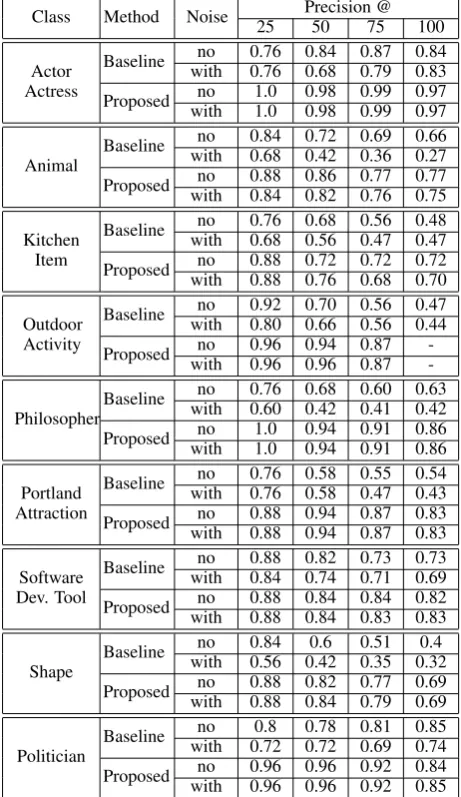
In this work, we evaluated the algorithms on nine semantic classes as listed in Table 1. In each run, the systems operate on 50 web pages re-trieved from Google by submitting a query con-taining three seed instances. To further test the ability of the filtering mechanism, we also con-ducted experiments which added another 500 web pages gathered fromreddit.com2into the orig-inal retrieval to simulate a noisy source.
It can be observed from the results that the pro-posed approach consistently outperforms the base-line system and maintains the precision better as the evaluation includes more instances. Moreover, the results of experiments that includes noise web pages further demonstrate the effectiveness of the filtering mechanism. In those experiments, the baseline system often exhibits a performance drop compared to the results obtained without the addi-tional noise web pages. On the other hand, the pro-posed approach displays a consistent performance regardless whether there is additional noise or not. This shows that the filtering mechanism does help the overall performance and is better in preventing erroneous extractions.
6 Conclusion and Future Works
In this work, we have proposed a weakly-supervised approach for extracting instances of se-mantic classes. The proposed approach utilizes a compression model for filtering possibly irrelevant mentions, and uses a graph ranking algorithm for sorting the extraction.
This study focused primarily on assessing the effectiveness of using PPM model for evaluating the contextual evidence, and thus we use only very simple wrappers. Our approach can potentially be
2www.reddit.com, a social bookmark website. 500
URLs gathered in May, 25th, 2011.
Class Method Noise 25 Precision @50 75 100
Actor Actress
Baseline withno 0.760.76 0.840.68 0.870.79 0.840.83 Proposed withno 1.01.0 0.980.98 0.990.99 0.970.97
Animal Baseline
no 0.84 0.72 0.69 0.66 with 0.68 0.42 0.36 0.27 Proposed withno 0.880.84 0.860.82 0.770.76 0.770.75
Kitchen Item
Baseline withno 0.760.68 0.680.56 0.560.47 0.480.47 Proposed withno 0.880.88 0.720.76 0.720.68 0.720.70
Outdoor Activity
Baseline withno 0.920.80 0.700.66 0.560.56 0.470.44 Proposed withno 0.960.96 0.940.96 0.870.87 -
-PhilosopherBaseline
no 0.76 0.68 0.60 0.63 with 0.60 0.42 0.41 0.42 Proposed withno 1.01.0 0.940.94 0.910.91 0.860.86
Portland Attraction
Baseline withno 0.760.76 0.580.58 0.550.47 0.540.43 Proposed withno 0.880.88 0.940.94 0.870.87 0.830.83
Software Dev. Tool
Baseline withno 0.880.84 0.820.74 0.730.71 0.730.69 Proposed withno 0.880.88 0.840.84 0.840.83 0.820.83
Shape Baseline
no 0.84 0.6 0.51 0.4 with 0.56 0.42 0.35 0.32 Proposed withno 0.880.88 0.820.84 0.770.79 0.690.69
Politician Baseline
no 0.8 0.78 0.81 0.85 with 0.72 0.72 0.69 0.74 Proposed withno 0.960.96 0.960.96 0.920.92 0.840.85
Table 1: Empirical results compared with the base-line system on the precision of the instances ex-tracted. The experiments include settings with and without the addition of 500 noise web pages col-lected randomly fromreddit.com.
extended to adopt more elaborated patterns such as Kozareva et al. (2008) and Xu et al. (2007). In addition, as our future work, we plan to apply this method to other languages such as Japanese and Chinese.
Acknowledgments
References
Michele Banko, Michael J. Cafarella, Stephen Soder-land, Matt Broadhead, and Oren Etzioni. 2007.
Open information extraction from the web. In
Pro-ceedings of the 20th International Joint Confer-ence on Artifical IntelligConfer-ence, pages 2670–2676, San Francisco, CA, USA. Morgan Kaufmann Publishers Inc.
Timothy C. Bell, John G. Cleary, and Ian H. Witten. 1990. Text compression. Prentice-Hall, Inc., Upper Saddle River, NJ, USA.
William Chang, Patrick Pantel, Ana-Maria Popescu, and Evgeniy Gabrilovich. 2009. Towards
intent-driven bidterm suggestion. In Proceedings of the
18th International Conference on World Wide Web, WWW ’09, pages 1093–1094, New York, NY, USA. ACM.
Surajit Chaudhuri, Venkatesh Ganti, and Dong Xin. 2009. Exploiting web search to generate synonyms for entities. InProceedings of the 18th International Conference on World Wide Web, WWW ’09, pages 151–160, New York, NY, USA. ACM.
Philipp Cimiano, Aleksander Pivk, Lars S. Thieme, and Steffen Staab. 2004. Learning taxonomic relations
from heterogeneous sources of evidence. In
Pro-ceedings of the ECAI 2004 Ontology Learning and Population Workshop.
John G. Cleary and Ian H. Witten. 1984. Data com-pression using adaptive coding and partial string
matching. IEEE Transactions on Communications,
32:396–402.
Zelig Harris. 1970. Distributional structure. In
Pa-pers in Structural and Transformational Linguis-tics, pages 775–794. D. Reidel Publishing Company, Dordrecht, Holland.
Marti A. Hearst. 1992. Automatic acquisition of
hy-ponyms from large text corpora. InProceedings of
the 14th Conference on Computational Linguistics,
volume 2 ofCOLING ’92, pages 539–545,
Strouds-burg, PA, USA. Association for Computational Lin-guistics.
Paul Glor Howard. 1993. The design and
analy-sis of efficient lossless data compression systems. Ph.D. thesis, Providence, RI, USA. UMI Order No. GAX94-06956.
Zornitsa Kozareva, Ellen Riloff, and Eduard Hovy. 2008. Semantic class learning from the web with
hyponym pattern linkage graphs. InProceedings of
the 46th Annual Meeting of the Association of Com-putational Linguistics: Human Language
Technolo-gies, pages 1048–1056, Columbus, Ohio, June.
As-sociation for Computational Linguistics.
Joseph F McCarthy and Wendy G Lehnert. 1995. Us-ing decision trees for coreference resolution. InIn Proceedings of the 14th International Joint Confer-ence on Artificial IntelligConfer-ence, pages 1050–1055.
Tara McIntosh and James R. Curran. 2009. Re-ducing semantic drift with bagging and distribu-tional similarity. InProceedings of the Joint confer-ence of the 47th Annual Meeting of the Association for Computational Linguistics and the 4th Interna-tional Joint Conference on Natural Language Pro-cessing, volume 1 ofACL-IJCNLP ’09, pages 396– 404, Stroudsburg, PA, USA. Association for Com-putational Linguistics.
Marius Pas¸ca. 2007. Weakly-supervised discovery of
named entities using web search queries. In
Pro-ceedings of the 16th ACM Conference on Informa-tion and Knowledge Management, CIKM ’07, pages 683–690, New York, NY, USA. ACM.
Patrick Pantel, Eric Crestan, Arkady Borkovsky, Ana-Maria Popescu, and Vishnu Vyas. 2009. Web-scale distributional similarity and entity set expansion. In
Proceedings of the 2009 Conference on Empirical Methods in Natural Language Processing, volume 2 of EMNLP ’09, pages 938–947, Stroudsburg, PA, USA. Association for Computational Linguistics.
Ellen Riloff and Rosie Jones. 1999. Learning dic-tionaries for information extraction by multi-level
bootstrapping. In Proceedings of National
Con-ference on Artificial Intelligence, AAAI-99, pages 474–479.
Ellen Riloff and Jessica Shepherd. 1997. A corpus-based approach for building semantic lexicons. In
Proceedings of the 2nd Conference on Empirical Methods in Natural Language Processing, pages 117–124.
Luis Sarmento, Valentin Jijkuon, Maarten de Rijke, and Eugenio Oliveira. 2007. “more like these”: grow-ing entity classes from seeds. InProceedings of the 16th ACM Conference on Information and Knowl-edge Management, CIKM ’07, pages 959–962, New York, NY, USA. ACM.
W. J. Teahan and John G. Cleary. 1997. Models of
english text. In Proceedings of the Conference on
Data Compression, pages 12–21, Washington, DC, USA. IEEE Computer Society.
Richard C. Wang and William W. Cohen. 2007.
Language-independent set expansion of named en-tities using the web. InProceedings of the 7th IEEE International Conference on Data Mining, volume 0 of ICDM ’07, pages 342–350, Washington, DC, USA. IEEE Computer Society.
Scott White and Padhraic Smyth. 2003. Algorithms for estimating relative importance in networks. In
Proceedings of the 9th ACM SIGKDD International Conference on Knowledge Discovery and Data
Min-ing, KDD ’03, pages 266–275, New York, NY, USA.
ACM.