Meta-level Statistical Machine Translation
Sajad Ebrahimi
†,*, Kourosh Meshgi
††, Shahram Khadivi
†and Mohammad Ebrahim Shiri Ahmad Abady
*†
Human Language Technology Lab, Amirkabir University of Technology, Tehran, Iran
††Graduate School of Informatics, Kyoto University, Kyoto, Japan
*
Department of Computer Science, Amirkabir University of Technology, Tehran, Iran
[email protected], [email protected]
[email protected], [email protected]
Abstract
We propose a simple and effective method to build a meta-level Statistical Machine Transla-tion (SMT), called meta-SMT, for system combination. Our approach is based on the framework of Stacked Generalization, also known as Stacking, which is an ensemble learning algorithm, widely used in machine learning tasks. First, a collection of base-level SMTs is generated for obtaining a meta-level corpus. Then a meta-level SMT is trained on this corpus. In this paper we address the issue of how to adapt stacked generalization to SMT. We evaluate our approach on English-to-Persian machine translation. Experimental results show that our approach leads to signifi-cant improvements in translation quality over a phrase-based baseline by about 1.1 BLEU points.
1
Introduction
Currently, there exist a number of commercial and research Machine Translation (MT) systems, which are developed under different paradigms such as rule-based, example based, statistical machine translation, trained using different algo-rithms, e.g., phrase-based SMT, hierarchical phrase-based SMT, syntax-based SMT with dif-ferent types and amounts of training data. With the emergence of these various structurally dif-ferent systems, system combination methods have taken a great importance during the past few years.
There are several techniques for combining multiple SMT systems to achieve higher transla-tion quality, e.g. sentence-level combinatransla-tion
(Hildebrand and Vogel, 2008) simply selects "the best" of the provided translations and phrase-level combination (Matusov et al., 2006; Rosti et al., 2007) can generate new translations differing from all original translations.
Most of the state-of-the-art SMT system com-bination methods require multiple SMT systems based on different models. Since it is not easy to have multiple SMT systems, in this work we fo-cus on applying stacking algorithm on a single SMT system rather than multiple SMT systems.
We try to increase the performance of an SMT system by introducing a meta-level SMT which can learn how to decrease or modify translation errors on the translation outputs of original SMT system. This task is also known as automatic post-editing (APE) which is a well-studied topic in machine translation community (Simard et al., 2007a; Béchara et al., 2011). To do this, we use stacked generalization which is an ensemble learning algorithm
Ensemble Learning is a machine learning par-adigm where multiple learners are trained to solve the same problem. An ensemble is viewed as a collection of learners which are usually called base learners. Base learners are usually generated from training data by a base learning algorithm which can be decision tree, neural network or other kinds of machine learning algo-rithms. Most ensemble methods use a single base learning algorithm to produce homogeneous base learners, but there are also some methods which use multiple learning algorithms to produce het-erogeneous learners. The concept of ensembles appeared in classification literature has subse-quently been studied in several frameworks, in-cluding stacked generalization (Wolpert, 1992),
bagging (Breiman, 1996b), boosting (Scharpire, 1990), model averaging (Perrone et al., 1993),
forecast combining (Granger, 1989) and so on. Previous work have tried to introduce some of these frameworks into SMT (Xiao et al., 2010), none of them adapt stacked generalization to SMT. While stacked generalization has been ex-tensively investigated in machine learning, its adaption to SMT is not a trivial task. In this pa-per, we show how to make stacked generaliza-tion work for a single SMT system.
Stacked generalization is a general method of using a meta-level model to combine base-level models to achieve higher accuracy. However, this algorithm is introduced for combining multi-ple models, we focus our attention to utilize this algorithm in order to improve only a single SMT system. The basic idea of stacked generalization is to perform cross-validation on the base-level dataset in order to create a meta-level dataset. Then a meta-level model is trained on it. Finally, this system can generate better outputs than orig-inal system that is trained on the whole origorig-inal dataset.
2
Background
Given a source sentence
s
, the goal of SMT is to find a target sentence t among all possible target strings t1, that maximizes the probability:)} translation of the given source string
s
. The tar-get string t1 is a machine translation fors
. In meta-SMT, a monolingual two-side corpus con-sists of these machine translations along withfinal machine translation for
s
.In the next section, we are going to describe stacked generalization for classification tasks and
in section 3, we present a general solution to adapting this algorithm to SMT.
2.1 Stacking for Classification
Wolpert (1992) introduced a novel approach for combining multiple classifiers, known as stacked generalization or stacking. The key idea is to learn a meta-level (or level-1) classifier based on the output of base-level (or level-0) classifiers, estimated via cross-validation as follows:
Define D={(xi,yi),i=1,...,K} as a data set , also referred to as level-0 data, where xi is a fea-ture vector representing the n th instance and
i
y is the class value, and L1...LN a set of different learning algorithms. During a J-fold cross-validation process, D is randomly split into J gorithms, we invoke each of them on the data in the training set D\Dj to induce classifiers to the test part Dj. The concatenated predictions of the induced classifiers on each feature vector tutes the full meta-level data set, also referred to as level-1 data, which is used for applying a
to be used at runtime. In order to classify a new instance, the concatenated predictions of all base-level classifiers C1...CN form a meta-level
vector that is assigned a class value by the meta-level classifier CM. In the next section we adapt this framework to SMT.
3
Adapting Stacking to SMT
Stacking is composed of two phases and we adapt it to SMT as follows:
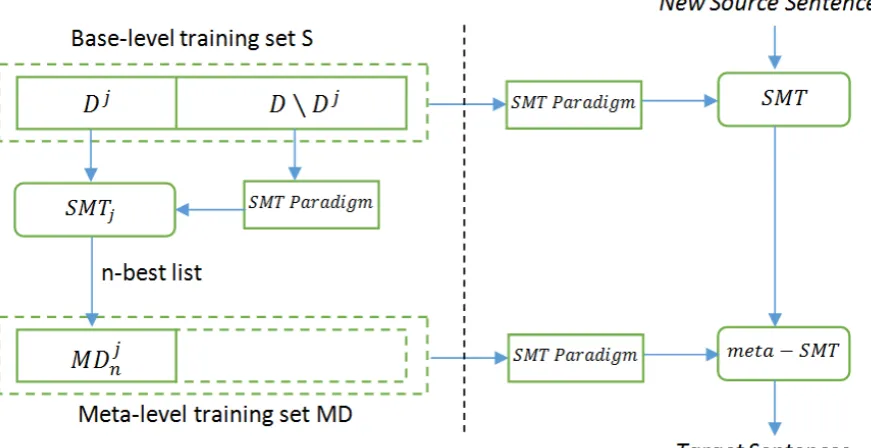
First, a typical SMT paradigm is trained using
Figure 1. Stacking framework for SMT.
-pus. A popular setting of J is 5 and in this case it is called as 5-fold cross-validation. We use this setting in our work. At the end of this step, 5 dif-ferent systems are built based on 5 difdif-ferent training sets, calledSMTj,j=1,...,5. Then, the n-best outputs of these systems are collected to create a new corpus called meta-level corpus
MD. For example, if we have a training corpus of N sentences and we use 3-best outputs of each system in cross-validation process, the ef-fective size of the meta-level corpus will be
N
×
3 . In this new corpus, all the generated translations from the source sentences are paired to correct human translations.
Second, this corpus is used with another SMT paradigm -we call it meta-SMT- that could be identical to the SMT paradigm we used in cross-validation process or another SMT paradigm, in order to provide the final translation. In this algo-rithm, any SMT paradigm could be used in base-level and meta-base-level SMTs such as phrase-based SMT, hierarchical phrase-based SMT and syn-tax-based SMT. In this work, we utilize a phrase-based SMT for both base-level and meta-level. We use a phrase-based model for meta-level SMT, because we are supposed to improve a sin-gle SMT system. In addition, we train another phrase-based SMT based on full training set to produce target 1-best outputs and then use these outputs as input test set for meta-level SMT.
Figure 1 (left side) illustrates the cross-validation methodology, while Figure 1 (right
side) illustrates the stacking framework at runtime. Figure 2 also shows the algorithm in details.
3.1 Training base-level SMTs
After splitting the whole training corpus to sepa-rate training and test sets during cross-validation process, we train 5 phrase-based SMT systems on the training part and obtain the result of these systems on the corresponding test sets. We need these results for the next step.
3.2 Training meta-level SMTs
We gathered the n-best outputs of base-level SMTs on the corresponding test sets and built a meta-level corpus using these outputs along with correct human translations which was available from our original corpus. Then a meta-level SMT is trained on this corpus. We train our meta-SMT system on 10 meta-level corpus which is pro-gressively created from n-best outputs of base-level systems, n=1,...,10 ; i.e. each meta-level corpus that is created from n-best list also con-tains (1... n−1)-best list. In the results, we call these systems as SMT (1-best) and meta-SMT (2-best) and so on.
3.3 Tuning meta-level SMTs
Figure 2. Stacking algorithm adapted to SMT
5 base-level SMT systems on the tuning part and obtain the result of these systems on the corre-sponding test sets. Finally a meta-level develop-ment set is created by gathering these outputs paired with correct human translations to tune meta-level SMTs.
4
Experiments
4.1 Data
The corpus that is used for training and cross-validation process is Verbmobil project corpus which includes some tourists’ conversations about time scheduling and appointment settings in German and English (Ney, 2000). Then a large part of English sentences are translated to Per-sian by human translators to build an English-Persian corpus (Bakhshaei et al., 2010). This da-taset includes 23K lines in both sides, 249K and 216K words in Persian and English sides, respec-tively. We have chosen this corpus because it is small enough to perform cross-validation.
4.2 Experimental Setup
We use GIZA++ (Och and Ney, 2000) to perform the bi-directional word alignment between source and target side of each sentence pair. The final word alignment is generated using the
grow-diag-final-and symmetrizing strategy. To speed up alignment, all the sentences with more than 80 words are removed. A 3-gram language model is trained on the target side of the bilin-gual data using the SRILM toolkit (Stolcke, 2002). The translation quality is evaluated in terms of case-insensitive BLEU metric.
We have run a phrase-based statistical ma-chine translation with the Moses decoder (Koehn et al., 2007) to build baseline, base-level and me-ta-level SMTs.
We use MERT (Och, 2003) to tune the feature weights on the development data.
4.3 Evaluation
We investigate the effectiveness of our approach on improving a phrase-based SMT system. BLEU scores are computed on 250 test sentences
Input: Training set D={(e1, f1),(e2, f2),...,(ed, fd)};
Tuning set T={(e'1,f'1),(e'2,f'2),...,(e't,f't)};
Test set S={(e''1,f ''1),(e''2,f ''2),...,(e''s,f ''s)};
Base-level and Meta-Level SMT paradigms Bparadigm and Mparadigm, respectively. Process:
baseline_SMT=Bparadigm (D) % Train baseline SMT on the whole training set.
baseline_SMT=baseline_SMT(T) % Tune baseline SMT on the whole tuning set.
T1=baseline_SMT(S) % Test baseline SMT on the original test set.
J-fold cross-validation: Divide the training and tuning sets into J roughly equal parts.
MD=φ; % Generate a new training set.
MT=φ; % Generate a new tuning set. for j=1,...,J:
) \
( j
j Bparadigm D D
SMT = % Train base-level SMTs by their training partsD\Dj.
) ( j
j j
n SMT D
MD = % Test base-level SMTs on the corresponding test set to obtain n-best list.
j n MD MD
MD= ∪ % Collect the outputs of base-level SMTs to create meta-level training corpus.
) \ ( j
j
j SMT T T
SMT = % Tune base-level SMTs by their tuning partsT \T j.
) ( j j j
T SMT
MT = % Test base-level SMTs on the corresponding test set of tuning set.
j MT MT
MT= ∪ % Collect the outputs of base-level SMTs to create meta-level tuning corpus. end;
) (MD Mparadigm SMT
meta− = % Train meta-level SMT by applying it to the new training corpus.
) ( meta SMT MT SMT
meta− = − % Tune meta-level SMT by applying it to the new tuning corpus.
Output: T2 =meta−SMT(T1) % Test meta-SMT on the outputs of baseline SMT as test set.
Type of SMT Test set
Table 1: BLEU (%) scores of baseline SMT and meta-SMTs on the Verbmobil test set.
Figure 3. Comparison of Stacking, Straight1 and Straight2.
with four reference translations. Table 1 shows the results of our approach against baseline SMT on the test set. We see that almost all meta-SMTs are achieved over 0.5 BLEU improvement on the test set. The biggest improvement is obtained by meta-SMT (10-best) by 1.07 BLEU improve-ment. Moreover, we see a similar behavior of our approach on the development set. Considering the results on the development set, meta-SMT (4-best) and meta-SMT (8-(4-best) will be good choic-es for meta-level SMT.
While these results are very encouraging, we must investigate why this approach is helpful. We find that two factors possibly contribute to these results. first, performing cross-validation on the training set; second, and possibly more importantly, the re-optimization on the system. In order to verify whether the improvements are due to the cross-validation or re-optimizing, we perform two experiments. The first is to test this approach without any cross-validation process, but with the development set obtained from stacking. It means that all source side sentences of the training corpus are translated by using an SMT system that is trained on the bilingual same corpus. This experiment is referred to as Straight1 in the results. The second is to build meta-level SMTs tuned with a development set which is obtained directly from baseline SMT (i.e., without performing cross-validation on it. This experiment is referred to as Straight2 in the results.
A comparison between the results of the three settings (Stacking, Straight1 and Straight2) is shown in Figure 3. The figure shows BLEU curve on the test set, where the X-axis is the number of base-level outputs (n-best) that is used to create meta-level corpus for meta-SMT, and
the Y-axis is the BLEU scores of the final meta-SMT calculated from each approach. After ana-lyzing the results, it can be concluded that both factors, i.e., cross-validation and re-optimizing the system with the stacking-based development set, are important to outperform the baseline SMT system. Since use of both factors, consist-ently lead to the best results.
In all of the experiments, the size of the n-best list varies from 1 up to 10. The main reason for the upper limit is just that the experiments are very time consuming.
We conducted statistical significance tests us-ing paired bootstrap resampling proposed by Koehn (2004) to measure the reliability of the conclusion that meta-SMTs are really better than baseline SMT. It is observed that all stacking-based meta-SMTs are really better than the base-line SMT in 99% of the times.
5
Related Work
Stacking is a machine learning (ML) algorithm that is a well-studied topic in the ML community (Wolpert, 1992; Breiman, 1996a), and has been successfully adapted in natural language pro-cessing and information retrieval , such as named entity recognition (Wu et al., 2003) and Infor-mation extraction (Sigletos et al., 2005).
There are also some researches on applying ensemble learning algorithms into SMT. Xiao et al. (2010) presented a general solution for adap-tion of bagging and boosting to SMT. The results of their work showed that ensemble learning al-gorithms are promising in SMT.
Most other researches are in the statistical post-editing (SPE) techniques which have been used successfully to improve the output of
Based MT (RBMT) systems. Simard et al. (2007a), trained a “mono-lingual” Phrase-based SMT system (the Portage system) on the output of an RBMT system for the source side of the training set of the Phrase-based SMT system and the corresponding human translated (manually post-edited) reference. More recently, Béchara et al. (2011) designed a full phrase-based SMT pipeline that included a translation step and a post-editing step. The authors report significant improvements of 2 BLEU points for a French to English translation task, using a novel context aware approach. This method takes into account the source sentences during the post-editing pro-cess through a word-to-word alignment between the source words and the target words generated by the translation system.
As far as we are aware, the research presented in this paper is the first attempt to apply stacking algorithm to SMT with the configuration pre-sented.
6
Conclusion and Future Work
We have presented a simple and effective ap-proach to translation error modification by build-ing a meta-level SMT usbuild-ing a meta-level corpus that is created form original corpus by cross vali-dation. Experimental results showed that such a meta-SMT can fix many translation errors that occur in the baseline translations. The proposed method outperforms the baseline SMT on the same test set. We also believe that stacked gen-eralization can be used to combine multiple SMT systems. As a future work, we have planned to develop a technique for combining multiple SMT systems using stacked generalization algorithm.
Moreover, we are running more tests with dif-ferent language-pairs and larger corpora. We also have planned to use the confusion network methods on the input of meta-level SMTs, so that the meta-SMT can translate a confusion network built based on the n-best output of baseline SMT. As another future work, we will apply our framework under different SMT paradigms such as hierarchical phrase-based SMT and syntax-based SMT.
Acknowledgments
We would like to thank Somayeh Bakhshaei and Abbas Masoumzadeh for their helpful dis-cussions.
References
Almut Silja Hildebrand and Stephan Vogel. 2008.
Combination of machine translation systems via hypothesis selection from combined n-best lists. In Proc. of the 8th AMTA conference,
pages 254-261.
Evegeny Matusov, Nicola Ueffing and Hermann Ney. 2006. Computing consensus translation from multiple machine translation systems using enhanced hypotheses alignment. In Proc. of EACL 2006, pages 33-40.
Antti-Veikko Rosti, Spyros Matsoukas and Richard Schwartz. 2007. Improved word-level system combination for machine translation. In Proc. of the 45th Annual Meeting of the Association for Computational Linguistics, pages. 312-319.
Michel Simard, Cyril Goutte, and Pierre Isabelle. 2007a. Statistical phrase-based post-editing. In NAACL-HLT, pages 508-515
Béchara, H., Y. Ma, and J. van Genabith. 2011. Post-editing for a statistical MT system. In MT Summit XIII, pages 308-315
David H. Wolpert. 1992. Stacked generalization. Neural Networks, 5(2): 241-259.
Leo Breiman. 1996b. Bagging predictors.Machine Learning,24(2):123-140.
Robert E. Scharpire. 1990. The strength of weak learnability.Machine Learning, 5(2):197-227.
Michael P. Perrone and Leaon N. Cooper. 1993.
When networks disagree: ensemble methods for hybrid neural networks. Neural Networks for Speech and Image Processing. Chapman-Hall, Chapter 10.
Clive W.J Granger. 1989. Combining forecasts-twenty years later. Journal of Forecasting, 8(3):167-173.
Tong Xiao, Jingbo Zhu, Muhua Zhu and Huizhen Wang. 2010. Boosting-based system combina-tion for machine translacombina-tion. in Proceedings of the 48th Annual Meeting of the Association for Computational Linguistics (ACL), pages 739– 748.
Hermann Ney, Franz J. Och and Stephan Vogel. 2000. Statistical translation of spoken dia-logues in the verbmobil system. In Workshop on Multi-Lingual Speech Communication, pages 69-74.
Somayeh Bakhshaei, Shahram Khadivi and Noushin
translation through bridge language. Tele-communications (IST), 5th International Sym-posium on, pages 557-561.
Franz Josef Och and Hermann Ney. 2000. Improved statistical alignment models. In Proc. of the 38th Annual Meeting of the Association for Computational Linguistics, pages 440-447.
Andreas Stockle. 2002. SRILM - an extensible language modeling toolkit. In Proc. of Inter-national Conference for Spoken Language Processing, pages 901-904.
P. Koehn, H. Hoang, A. Birch, C. Callison-Burch, M. Federico, N. Bertoldi, B. Cowan, W. Shen, C. Mo-ran, R. Zens, C. Dyer, O. Bojar, A. Constantin and E. Herbst. 2007. Moses: Open source toolkit for statistical machine translation. In Proc.of the 45th Annual Meeting of the Association for Computational Linguistics. Demo and Poster Sessions, pages. 177-180.
Franz Josef Och. 2003. Minimum error rate train-ing in statistical machine translation. In Proc. of the 41th Annual Meeting of the Association for Computational Linguistics, pages 160-167.
Philip Koehn, 2004. Statistical significance tests for machine translation evaluation. In Proc. of Conference on Empirical Methods in Natural Language Processing (EMNLP), pages 388-395.
Leo Breiman. 1996a. Stacked regressions.Machine Learning,24(1): 49-64.
Dekai Wu, Grace Ngai and Marine Carpuat. A stacked, voted, stacked model for named enti-ty recognition. In Proc. of CoNLL-2003, pages 200-203.
Georgios Sigletos, Georgios Paliouras, Constantine D. Spyropoulos and Michali Hatzopoulos. 2005.
Combining information extraction systems us-ing votus-ing and stacked generalization.Journal of Machine Learning Research, 6: 1751-1782.
Tong Xiao, Jingbo Zhu and Tongran Liu. 2013. Bag-ging and boosting statistical machine transla-tion systems. Artificial Intelligence. vol. 195, pages 496-527.
Kai Ming Ting and Ian H. Witten. 1999. Issues in stacked generalization.Journal of Artificial In-telligence Research (JAIR), 10: 271-289.
Zhi-Hua Zhou. 2012. Ensemble Methods: Founda-tions and Algorithms. Chapman & Hall/CRC
Michel Simard, Nicola Ueffing, Pierre Isabelle, and Roland Kuhn. 2007b. Rule-based translation