Annotating Zero Anaphora for Question Answering
Yoshihiko Asao, Ryu Iida, Kentaro Torisawa
National Institute of Information and Communications TechnologyKyoto 619-0289, Japan {asao, ryu.iida, torisawa}@nict.go.jp
Abstract
We constructed a large annotated dataset of zero pronouns that correspond to adjuncts marked by-de(translated to English asin,at,by
orwith) in Japanese. Adjunct zero anaphora resolution plays an important role in extracting information such as location and means from a text. To our knowledge, however, there have been no large-scale dataset covering them. In this paper, focusing on the application of zero anaphora resolution to question answering (QA), we proposed two annotation schemes. The first scheme was designed to efficiently collect zero anaphora instances that are useful in QA. Instead of directly annotating zero anaphora, annotators evaluated QA instances whose correctness hinges on zero anaphora resolution. Over 20,000 instances of zero anaphora were collected with this scheme. We trained a multi-column convolutional neural network with the annotated data, achieving an average precision of 0.519 in predicting the correctness of QA instances of the same type. In the second scheme, zero anaphora is annotated in a more direct manner. A model trained with the results of the second annotation scheme performed better than the first scheme in identifying zero anaphora for sentences randomly sampled from a corpus, suggesting a tradeoff between application-specific and general-purpose annotation schemes.
Keywords:zero anaphora, question answering, convolutional neural networks
1.
Introduction
Zero anaphora refers to anaphora in which the anaphor has a phonetically null form. Zero anaphora resolution is an important sub-problem of many NLP tasks such as question answering (QA). To successfully apply machine learning algorithms to zero anaphora, it is crucial to construct a large and consistent annotated dataset.
In this paper, we focus on zero pronouns that correspond to non-obligatory adjuncts marked by postposition-de in Japanese, which mark the location, means, reason or man-ner of an event and can be translated to English prepositions such asin,at,byorwith. Although the identification of ad-junct zero pronouns plays an important role in extracting such information as location and means from a text, to our knowledge, there have been no attempts to create a large-scale dataset covering them.
While it is possible to exhaustively annotate zero anaphora in a corpus to achieve our goal, such an approach might be inefficient when we are interested only in instances that are useful in a specific application. Given this, we pro-pose two different annotation schemes in this paper. In the first scheme, annotators annotate QA instances that poten-tially involve zero anaphora. In the second scheme, anno-tators directly annotate noun-predicate pairs with regard to whether they are in a zero anaphora relationship. We eval-uated the performance of these two schemes using an exist-ing neural network-based zero anaphora resolution method (Iida et al., 2016). Our experimental results show that the first scheme achieved better performance when it is used to train a module for a QA system, suggesting that the effec-tiveness of an annotation scheme depends on applications even in a relatively well studied task like zero anaphora res-olution. Conversely, the model trained with annotation re-sults of the second scheme achieved better performance in identifying zero anaphora for sentences randomly sampled from a corpus.
We collected 20,830 instances of -dezero anaphora with
I rent a motorcyclei
andtravelthe island [by∅i].
How does our environment change [by ∅i] if
solar electricityiexpands?
Nagoya City University will hold a ‘science caf´e’ in the city of Nagoyai, in which citizens and
scientistsdiscussscience [in∅i] while drinking coffee at a
caf´e.
Table 1: Examples of-dezero anaphora in our data
our first annotation scheme alone, while the Kyoto Univer-sity Text Corpus (Kawahara et al., 2002), the largest exist-ing resource that we are aware of, has only 333 instances of-dezero anaphora of the equivalent type. Table 1 shows a few illustrative examples of zero anaphora successfully collected in our work.1
2.
Related work
Anaphora or coreference has been annotated in sev-eral projects including Message Understanding Confer-ence (MUC) (Hirschman and Chinchor, 1997), Automatic Context Extraction (ACE) (Doddington et al., 2004) and OntoNotes (Hovy et al., 2006), but zero anaphora is not annotated in their English corpora. The OntoNotes cor-pora for pro-drop languages like Chinese and Arabic con-tain coreference annotations for cercon-tain types of zero nouns. They do not, however, include adjunct zero pro-nouns, which we deal with in this paper.
Another kind of resources that are relevant to our work is annotated corpora of semantic roles or frame elements such as PropBank (Palmer et al., 2005) and FrameNet
1
(Baker et al., 1998). In FrameNet, for example, frame ele-ments that are not overtly encoded are annotated as Null In-stantiation, some of which can be regarded as adjunct zero anaphors, although their antecedents are not annotated. As for Japanese resources, zero anaphora was annotated in 5,000 sentences of the Kyoto University Text Corpus (Kawahara et al., 2002), including -de zero anaphora, al-though its size is small; it has only 333 instances of intra-sentential -de zero anaphora. Zero anaphora is also annotated for 20,000 sentences in the NAIST corpus (Iida et al., 2007), but only for -ga (nominative), -o (ac-cusative) and-ni(dative).
While zero anaphora resolution has been recognized as an important task in pro-drop languages such as Chinese and Japanese, the task has been less prominent in languages like English, in which core arguments are usually realized as overt forms. However, adjuncts can be omitted in any lan-guage, and in such cases, they must be inferred from the context. For example, consider the following English sen-tence:Shortly after her arrival in Tokyo, she began her
ca-reer as a journalist. Given this sentence, we can infer that
she began her career as a journalistin Tokyo, but it is not a trivial task to identify this implicit relation. Thus, although the target language of our current work is Japanese, it has relevance to other types of languages as well.
3.
-de
zero anaphora of Japanese
In this paper, we focus on adjuncts marked by -de in Japanese. The postposition-dein Japanese marks the lo-cation, means, reason, or manner of an event or action de-noted by the predicate it modifies; it can be translated into a number of English prepositions includingin,at,byandwithdepending on the context. Examples of the usage of -deare shown below. In sentence (1),-demarks the location of the action, whereas in sentence (2),-demarks the means by which the action is performed.
(1) k¯oen-de ‘eat with a spoon’
In some cases, a-dephrase is not overt, but can be recov-ered from the context. Such cases constitute examples of
-dezero anaphora:
(4) shizen-gengo-shorii-o
natural-language-processing-ACC
‘We can improve medicine with∅iutilizing
natural language processingi’
In sentence (3), the location of studying is not directly ex-pressed, but can be inferred from the preceding part, he
went to school. In the same vein, in sentence (4), natural
language processingdoes not directly modifyimprove, but
we can clearly see that it is the means of the action denoted by the predicate.
Solving-dezero anaphora is useful in a variety of appli-cations including question answering. For example, given sentence (4), to build a QA system that can correctly answer to the question ‘What can we improve medicine with?’, the system must resolve-dezero anaphora. More generally,-de
anaphora resolution plays a crucial role when we would like to extract information like location and means that must be inferred from context.2
4.
Data construction
To generate datasets for annotation, we used WISDOM X (Mizuno et al., 2016), a question-answering system that our team has been developing.3 The factoid QA module of
WISDOM X accepts a question in Japanese and returns nouns as answers, as well as original sentences from the web corpus that support the answers. An example is below.
(5) Question AI-de ‘What will be realized by AI?’
Answer kaji-robotto‘housekeeping robot’
Sentence AI-ga ‘If AI develops further, housekeeping robots will be brought into reality.’
Human annotators judge whether the answer is correct, or in other words, whether the sentence supports the answer given the question. In this example, we expect that the an-notators’ judgment is positive. When the judgment is posi-tive, we can suppose that the sentence entailshousekeeping robots will be realized by AI, although the-dephrase (trans-lated asby AI) is not overtly expressed. This indicates that the original sentence involves zero anaphora, as shown in sentence (6). ‘If AIidevelops further, housekeeping robots will be
brought into reality by∅i.’
Thus, this annotation task can be regarded as an indirect way to discover zero anaphora instances. With this scheme,
2
Assuming zero pronouns for adjuncts may be non-conventional, but this is just one way of capturing covert semantic relationships between nouns and predicates in text. Instead of us-ing the notion of adjunct zero anaphora, we can say that there are implicit semantic links between ‘school’ and ‘study’ in sentence (3) and between ‘natural language processing’ and ‘improve’ in sentence (4) that can be expressed by postposition-de. This alter-native view does not affect our discussion.
3
tofu
What to eat in Kyoto KyotoKyotoKyoto tourists visit Kyoto
eat ramen in Kyoto buy souvenir in Kyoto
Binary pattern recommend you eat
tofu.
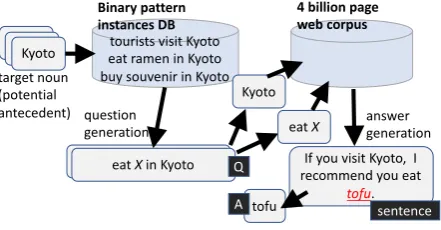
Figure 1: Construction of QA instances
we can focus on zero anaphora instances that are likely to be useful in QA, rather than zero anaphora in general. Another advantage of this annotation scheme is that annotators do not have to know what zero anaphora is, and therefore non-experts can more readily work on it.
In our approach, QA instances for annotation are automati-cally generated by combining the question suggestion mod-ule and the factoid QA modmod-ule of WISDOM X. Figure 1 illustrates our workflow, which we also summarize below.
1. Choose a-de candidate(e.g.,Kyoto)
2. Generate questions:
(a) Extract binary pattern instances that contain the
-decandidate (e.g.,eat ramen in Kyoto)
(b) Generate questions based on these binary pattern instances (e.g.,What is there to eat in Kyoto?)
3. Generate answers:
(a) Decompose the questions into a -de candidate and a unary pattern
(b) Search for sentences with both the-decandidate and the unary pattern
In the first step, we choose a noun that is frequently used with-de, which we call the-de candidate. The following steps are designed to find a zero anaphor which has this-de
candidate as the antecedent.
In the second step, we generate questions using the ques-tion suggesques-tion module. The module works in the follow-ing way. First, it searches for binary pattern instances in our database that contain the -de candidate.4 Here a
bi-nary pattern instancerefers to a dependency tree fragment
that consists of a predicate and two nouns that depend on it. For example, when the -decandidate isKyoto, exam-ples of binary pattern instances include ⟨kank¯okyaku-ga Ky¯oto-o otozureru⟩‘tourists visit Kyoto’,⟨Ky¯oto-de r¯amen-o taberu⟩‘eat ramen in Kyoto’ and⟨Ky¯oto-de kaigi-ga
hi-rakareru⟩‘a conference is held in Kyoto’. While the-de
candidate Kyoto may appear in a variety of syntactic po-sitions, we only use questions in which it appears with -de. Next, questions are generated by replacing the non-de -candidate noun with an interrogative word. For example,
4
Our binary pattern database is based on the four-billion-page web corpus that we constructed, which is also used by the factoid QA module.
the questionKy¯oto-de nani-o taberu(literally ‘eat what in Kyoto’, i.e., ‘what is there to eat in Kyoto?’) is generated based on such instances as⟨Ky¯oto-de r¯amen-o taberu⟩‘eat
ramen in Kyoto’.
In the third step, the generated questions are input into our QA system, WISDOM X. While WISDOM X uses multi-ple methods to find answers, for our present work, we only use answers obtained via the method that we describe here. WISDOM X decomposes the question into the-de candi-date and theunary patternthat corresponds to the question minus the-decandidate. Here aunary patternrefers to a dependency tree fragment that consists of a predicate and a slot for a noun, such as⟨X-ni iku⟩‘go to X’ or⟨X-ga aku⟩
‘X opens’. In our ‘eat what in Kyoto’ example, the-de can-didate isKyotoand the unary pattern is‘eat X’. The system then searches for sentences that containboththe unary pat-tern and -decandidate. We will obtain, for example, the following sentence from the corpus: ‘If you visit Kyoto, I
recommend you eat tofu’. Here, the nountofufillsXof the
‘eat X’ pattern; therefore, tofu is presented as an answer
along with the original sentence, which the answer is based on. As is the case in this example, we only use sentences in which the-decandidate (‘Kyoto’ in this example) and the target predicate (‘eat’) arenotin a dependency relationship. We expect sentences collected with this method to have a higher-than-average chance of involving-dezero anaphora. This is because our procedure guarantees that the-de can-didate is a noun that frequently occurs in the-deposition. Note that, because WISDOM X does not search for con-texts beyond a single sentence, our target is limited to intra-sentential anaphora.
We created two datasets for annotation,QAAnnotand All-Nouns, based on the QA instances generated by the proce-dure above.
QAAnnot Annotators directly evaluate QA instances that potentially involve zero anaphora. This task can be simultaneously interpreted as both a QA evaluation task and a zero anaphora annotation task. For this task, we obtained 100,000 QA instances in the follow-ing manner. First, we generated questions for 10,000 nouns randomly sampled from the nouns that most frequently appear in the -de position in the TSUB-AKI corpus (Shinzato et al., 2008) of 600 million web pages. Next, we randomly sampled questions accord-ing to the frequency distribution of the predicates; these questions were then input into WISDOM X un-til we obtained 100,000 QA instances. Finally, human annotators judge each QA instance for its correctness.
#sentences #predicates #pairs #-dezero anaphora #annotators approx. person days Fleiss’κ
QAAnnot 100,000 100,000 100,000 20,830 (20.8%) 24 500 0.556
AllNouns 10,000 10,000 70,971 7,749 (10.9%) 8 100 0.539
General 1,433 3,790 17,392 1,126 (6.5%) 4 20 0.495
KTC 5,127 14,987 90,731 333 (0.4%) – – –
KTC: Kyoto University Text Corpus (Kawaraha et al. 2002)
Table 2: Annotation results
seven nouns to annotate per sentence. More than one noun can be simultaneously in a-deanaphora relation with the same target predicate.
We also created a small third dataset for evaluation, which we refer to as General. For this dataset, sentences were randomly sampled from the four-billion-page web corpus. For each noun-predicate pair that was identified as not being in a dependency relationship, annotators annotated whether it was in a-deanaphora relationship or not. In or-der to restrict our data to Japanese body texts, we only used sentences that (i) have at least two postpositions and (ii) end with the Japanese full stop ( ).
To identify nouns and predicates to annotate, we used the morphological analyzer MeCab (Kudo et al., 2004), as well as the dependency parser J.DepP (Yoshinaga and Kitsuregawa, 2009).
5.
Annotation results
In this section, we describe annotation results obtained from the annotation tasks described above. Table 2 sum-marizes the sizes of our datasets as well as our annotation results.
For each dataset, three annotators independently evaluate each instance, and the final judgment was determined by a majority vote. An annotator was sometimes replaced by another person after completing a set of 1,000 instances. The total numbers of annotators participated in our work, as well as the time required to create each dataset, are included in Table 2.
While 20.8% of the instances were judged to be positive inQAAnnot, the percentage was only 10.9% inAllNouns
and 6.5% in General. This difference is expected given the way each dataset was built;QAAnnothas the highest proportion of positive instances because it is designed to annotate only likely candidates of zero anaphora.AllNouns
has a smaller proportion of positive instances because not only the original -decandidates but also the other nouns are annotated. The third dataset,General, has the lowest proportion of positive instances, as it consists of random sentences in the corpus.
Table 2 also shows a comparison with the Kyoto University Text Corpus (Kawahara et al., 2002). In the Kyoto Univer-sity Text Corpus, the number of noun-predicate pairs that are targets of zero anaphora annotation based on our cri-teria is 90,731. Among them, only 333 pairs (0.3%) are annotated as-de zero anaphora. The number of-de zero anaphora that we collected is substantially larger, in terms of both absolute numbers and the frequency relative to the size of the corpus.
6.
Experiments
train valid devel test
QAAnnot 62,527 20,805 10,401 10,409
QAAnnot-Small 44,603 14,753 -
-AllNouns 44,603 14,753 7,231 7,253
General - - - 18,265
Table 3: Dataset sizes for our experiments
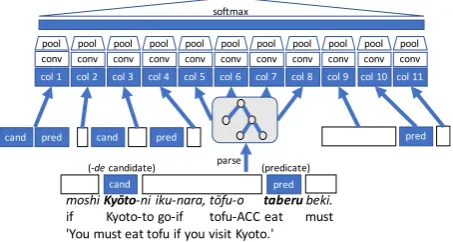
To see how our annotation results could be generalized to new data, we employed the multi-column convolutional neural network (MCNN) (Cires¸an et al., 2012). An MCNN is a variant of a convolutional neural network and has mul-tiple independent columns, each of which has its convolu-tional and pooling layers. MCNNs have recently been suc-cessfully used to model subject zero anaphora in Japanese (Iida et al., 2016). In this work, Iida et al. extracted eleven distinct column inputs from the target predicate (pred), the
-de candidate (cand) and their context. The column in-puts consist of (a) the word sequence ofcandandpred, (b) the surface word sequences beforecand, betweencandand
predand afterpred, (c) the four word sequences extracted from the dependency tree, and (d)pred and the word se-quences before and after pred. We used the same eleven column inputs for our experiments; our architecture is il-lustrated in Figure 2. More details on the definition of each column are given in (Iida et al., 2016).
cand pred
moshiKyōto-ni iku-nara, tōfu-o taberubeki.
if Kyoto-to go-if tofu-ACC eat must 'You must eat tofu if you visit Kyoto.'
cand pred
col 1 col 2 col 3 col 4 col 5 col 6 col 7 col 8 col 9 col 10 col 11
(-decandidate) (predicate)
cand pred
parse
pred
conv conv conv conv conv conv conv conv conv conv conv
pool pool
pool pool pool pool pool pool pool pool pool
softmax
Figure 2: Our multi-column convolutional network archi-tecture
test data training data R P F avg. P QAAnnot QAAnnot 0.263 0.629 0.371 0.519 QAAnnot-Small 0.199 0.677 0.307 0.510 AllNouns 0.335 0.523 0.408 0.452 AllNouns QAAnnot 0.198 0.563 0.293 0.402 QAAnnot-Small 0.124 0.589 0.204 0.369 AllNouns 0.288 0.569 0.382 0.451 General QAAnnot 0.125 0.379 0.188 0.218 QAAnnot-Small 0.081 0.414 0.135 0.197 AllNouns 0.186 0.413 0.257 0.269
Table 4: Performance comparison for different combina-tions of training and test data
100 and a learning rate decay of 0.95. We used 3-, 4- and 5-grams with 100 filters each. Average precision was used as our evaluation metric. Tuning embeddings in training was turned off, as we found no performance improvements.
QAAnnotandAllNounswere divided into training, vali-dation, development and test data as summarized in Table 3, such that noun-predicate pairs from the same sentence were included in the same bin.5 ForGeneral, all instances
were used as test data. Further, becauseQAAnnotis larger thanAllNouns, we could not easily determine whether the performance differences between these two datasets were due to differences in annotation methods or size. To avoid this complication, we constructedQAAnnot-Smallby ran-domly samplingQAAnnot such that the sizes of training and validation data exactly matched those of AllNouns; note thatQAAnnot-Smallwas only used for training. Table 4 summarizes our results. Regardless of the type of training data, the average precision was highest when the test data wasQAAnnot, and lowest when the test data wasGeneral. This is probably becauseQAAnnothas the largest proportion of positive instances, whereasGeneral
has the smallest.
The model trained with QAAnnot outperformed that of
AllNounswhen the test data wasQAAnnot, whereas the model trained withAllNounsoutperformed that of QAAn-notwhen it wasAllNounsorGeneral, in terms of average precision. As expected, the model trained with QAAnnot-Smallperformed worse than that ofQAAnnotfor all test data, but not to the extent that the gap between the two annotation schemes was reversed, showing that the perfor-mance differences betweenQAAnnotandAllNounswere not caused by their size differences. Our results suggest that
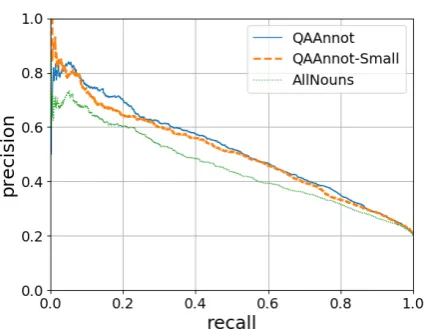
QAAnnothas an advantage when our goal is to improve a module of a QA system, whileAllNounsis better for iden-tifying-dezero anaphora in randomly sampled sentences. Figure 3, 4 and 5 show the precision-recall curves corre-sponding to different training data when QAAnnot, All-NounsandGeneralwere used as test data respectively. To improve QA, we would be able to set a threshold such that only relatively reliable answers are returned.
5The total number of instances does not exactly match the total
number of annotated noun-predicate pairs because sometimes the same noun occurs more than once in a sentence. In these cases, annotations were made only once without distinguishing different occurrences of the same noun, but each occurrence of the noun was used as a different instance for experiments.
Figure 3: The precision-recall curves for experiments in whichQAAnnotwas used as test data
Figure 4: The precision-recall curves for experiments in whichAllNounswas used as test data
To the best of our knowledge, this work is the first at-tempt to identify -dezero anaphora on a large scale, and thus a direct performance comparison with existing work is not possible. For reference, Ouchi et al. (2017) report zero anaphora resolution experiments for -ga (nominative), -o
(accusative) and -ni (dative); their best F-measures were 50.65%, 35.07% and 9.83% respectively. Our best F-measure onGeneralis 25.7%, which surpass the best score for dative, but not for nominative or accusative. This sug-gests that-dezero anaphora is more difficult to solve than
-gaand-ozero anaphora.
7.
Conclusions
In this paper, we described our work in constructing a large annotated dataset of zero pronouns that correspond to ad-juncts marked by -de in Japanese. The contrast between
QAAnnot and AllNouns can be equated to the contrast between an end-to-end approach and a component-based approach. While QAAnnot performs better for QA, it does not generalize well to sentences randomly sampled from a corpus, suggesting that there is a tradeoff between application-specific and general-purpose annotation meth-ods.
8.
Bibliographical References
Baker, C. F., Fillmore, C. J., and Lowe, J. B. (1998). The Berkeley Framenet Project. In Proceedings of the 36th Annual Meeting of the Association for Computational Linguistics and 17th International Conference on
Com-putational Linguistics-Volume 1, pages 86–90.
Associa-tion for ComputaAssocia-tional Linguistics.
Bastien, F., Lamblin, P., Pascanu, R., Bergstra, J., Good-fellow, I., Bergeron, A., Bouchard, N., Warde-Farley, D., and Bengio, Y. (2012). Theano: new features and speed improvements. In In Proceedings of the NIPS 2012 Workshop: Deep Learning and Unsupervised Fea-ture Learning.
Cires¸an, D., Meier, U., and Schmidhuber, J. (2012). Multi-column deep neural networks for image classification.
International Conference of Pattern Recognition, pages
3642–3649.
Doddington, G. R., Mitchell, A., Przybocki, M. A., Ramshaw, L. A., Strassel, S., and Weischedel, R. M. (2004). The Automatic Content Extraction (ACE) program-tasks, data, and evaluation. In Proceedings of the 4th International Conference on Language Resources
and Evaluation (LREC), volume 2, pages 837–840.
Hirschman, L. and Chinchor, N. (1997). MUC-7 corefer-ence task definition.
Hovy, E., Marcus, M., Palmer, M., Ramshaw, L., and Weischedel, R. (2006). Ontonotes: the 90% solution. In
Proceedings of the Human Language Technology Con-ference of the NAACL, Companion Volume: Short Pa-pers, pages 57–60. Association for Computational Lin-guistics.
Iida, R., Komachi, M., Inui, K., and Matsumoto, Y. (2007). Annotating a Japanese text corpus with predicate-argument and coreference relations. InProceedings of
the Linguistic Annotation Workshop, pages 132–139.
As-sociation for Computational Linguistics.
Iida, R., Torisawa, K., Oh, J.-H., Kruengkrai, C., and Kloet-zer, J. (2016). Intra-sentential subject zero anaphora resolution using multi-column convolutional neural net-work. InProceedings of the 2016 Conference on Empir-ical Methods in Natural Language Processing
(EMNLP-2016), pages 1244–1254.
Kawahara, D., Kurohashi, S., and Hashida, K. (2002). Construction of a Japanese relevance-tagged corpus. In
Proceedings of the 3rd International Conference on
Lan-guage Resources and Evaluation (LREC-2002), pages
2008–2013.
Kudo, T., Yamamoto, K., and Matsumoto, Y. (2004). Ap-plying conditional random fields to Japanese morpho-logical analysis. InProceedings of the 2004 Conference on Empirical Methods in Natural Language Processing
(EMNLP-2004), pages 230–237.
Mikolov, T., Chen, K., Corrado, G., and Dean, J. (2013). Distributed representations of words and phrases and their compositionality. In Proceedings of Advances in
Neural Information Processing Systems 26 (NIPS 2013),
pages 3111–3119.
Mizuno, J., Tanaka, M., Ohtake, K., Oh, J.-H., Kloetzer, J., Hashimoto, C., and Torisawa, K. (2016). WISDOM X, DISAANA and D-SUMM: Large-scale NLP systems for analyzing textual big data. In Proceedings of the 26th International Conference on Computational Linguistics
(COLING 2016) (Demo Track).
Ouchi, H., Shindo, H., and Matsumoto, Y. (2017). Neu-ral modeling of multi-predicate interactions for Japanese predicate argument structure analysis. InProceedings of the 55th Annual Meeting of the Association for
Compu-tational Linguistics, pages 1591–1600.
Palmer, M., Gildea, D., and Kingsbury, P. (2005). The Proposition Bank: An annotated corpus of semantic roles.Computational Linguistics, 31(1):71–106. Shinzato, K., Shibata, T., Kawahara, D., Hashimoto, C.,
and Kurohashi, S. (2008). TSUBAKI: An open search engine infrastructure for developing new information ac-cess methodology. In Processings of the 3rd Interna-tional Joint Conference on Natural Language Process-ing, pages 189–196.
Yoshinaga, N. and Kitsuregawa, M. (2009). Polynomial to linear: Efficient classification with conjunctive fea-tures. InProceedings of the 2009 Conference on Empir-ical Methods in Natural Language Processing