A Taxonomy for In-depth Evaluation of Normalization for User Generated
Content
Rob van der Goot, Rik van Noord, Gertjan van Noord
University of GroningenBroerstraat 5, Groningen,
[email protected], [email protected], [email protected]
Abstract
In this work we present a taxonomy of error categories for lexical normalization, which is the task of translating user generated content to canonical language. We annotate a recent normalization dataset to test the practical use of the taxonomy and read a near-perfect agreement. This annotated dataset is then used to evaluate how an existing normalization model performs on the different categories of the taxonomy. The results of this evaluation reveal that some of the problematic categories only include minor transformations, whereas most regular transformations are solved quite well.
Keywords:normalization, user generated content, social media, error taxonomy
1.
Introduction
For other natural language processing tasks, such as gram-matical error correction and machine translation, there al-ready exist detailed error taxonomies, which help in get-ting insights in the strengths and weaknesses of systems. For normalization, such an evaluation does not exist yet. Reynaert (2008) proposed an evaluation framework which evaluates the different sub-tasks in more detail; enabling the evaluation of error detection, candidate generation and candidate ranking. In the more recent shared task on lexical normalization hosted at the WNUT workshop (Baldwin et al., 2015b), the outputs of systems were evaluated on preci-sion, recall and F1 score. Orthogonal to these approaches, we propose a more in-depth evaluation of normalization, focusing on categories of different normalization replace-ments.
Existing error taxonomies are unfortunately not suitable for the task of normalization, since the categories are substan-tially different. For machine translation, taxonomies as the Multidimensional Quality Metrics (Mariana, 2014) are pro-posed, which contains 3 main categories: accuracy, verity and fluency. The last category would be the most relevant for normalization, but the normalization task compromises a different variety of errors and anomalies. In grammatical error correction, often a more detailed taxonomy for errors is used; the default benchmark has 28 categories (Ng et al., 2014). However, many of the errors in this taxonomy are not annotated in the normalization benchmarks and many normalization replacements are not included in this taxon-omy.
Different benchmarks for normalization specify the task slightly different; one striking example is the inclu-sion of the expaninclu-sions of phrasal abbreviations (e.g. ‘lol’7→‘laughing out loud’). However, this might not be the desired output, since one might argue that this expansion does not represent the intended meaning. This reveals an-other potential use for a taxonomy of normalization actions: it enables us to filter the categories before training, and thus learn a model which only handles the desired categories.
2.
Normalization
There is ample of previous work on normalization, but there is no consensus about the scope of the normalization task. Some existing corpora with normalization annotation for English are shown in Table 1. The corpora by Baldwin and Li (2015) and Kaljahi et al. (2015) are also annotated with error categories. However, the guidelines for the annotation of these corpora are substantially different compared to the other, more commonly used, corpora. The taxonomy pro-posed by Baldwin and Li (2015) has a very high percentage of normalizations since it allows deletion and insertion of tokens as well as the correction of capitalization. In con-trast, The Foreebank (Kaljahi et al., 2015) has a very low percentage of normalized words. This is due to its more canonical forum domain; it is mostly focused on grammat-ical error correction.
In the rest of this section, we will discuss two examples from these datasets to give a clearer idea of the task:
(1) most most
social social
pple people
r are
troublesome troublesome
Example 1 shows an example tweet from the LexNorm2015 (Baldwin et al., 2015b) corpus and it’s annotated normalization. This example includes two subsequent words which are shortened by omitting vowels.
(2) i i
aint ain’t
messin messing
with with
no1s no one’s
wifey wifey
yo you
lol
laughing out loud
Source Name Punct. Caps. 1-n n-1 Words %normalized
Yang and Eisenstein (2013) LexNorm1.2 - - - 10,576 11.5
Li and Liu (2014) - +- - 40.560 10.5
Baldwin et al. (2015b) LexNorm2015 - - + 73,806 9.1
Baldwin and Li (2015) + + + 11,890 28.7
[image:2.595.59.540.216.308.2]Kaljahi et al. (2015) Foreebank + + + 15,595 3.3
Table 1: Properties of different annotation guidelines. Punct. and Caps.: if respectively punctuation and capitalization is corrected. +- means capitalization is simply copied from the original utterance. The ‘1-n n-1’ column indicates if normalization corrections beyond the word level are allowed.
Anomalies
Unknown Intentional
Slang Transformations
Regular Phonetical Shortening
Other End Vowels Repetition Phrasal
abbreviation Unintentional
Merge Split Word-word
Spelling Missing
apostrophe Typographical
Figure 1: Our proposed taxonomy of anomalies in user generated text.
3.
Proposed Taxonomy
Our proposed taxonomy is loosely based on the categories used by the Foreebank (Kaljahi et al., 2015) and Bald-win and Li (2015). Furthermore we took categories from the annotation guidelines of LexNorm2015 (Baldwin et al., 2015a), since they include which kind of anomalies should be annotated. The categories of our taxonomy are a combi-nation of the previously used categories, but are empirically refined during the early stages of annotation. We make a main distinction between intentional and unintentional anomalies since they have a different origin; meaning they might require different handling in NLP systems. Note that we do not include word reordering and capitalization, since these phenomena are not annotated in our dataset. Our tax-onomy is shown in Figure 1; accompanying examples can be found in Table 2. We will now describe each final cate-gory in more detail.
1. Typographical error This includes small errors, which are a result of mistyping keys on keyboards. In case of doubt with another category, we put words with a charac-ter edit distance of one in this category (e.g. bidge7→bridge, feela7→feels).
2. Missing apostrophe In social media text, the apostro-phe is often skipped. Even though this category is relatively trivial to solve, it might have large effects in a pipeline ap-proach, since it can resolve tokenization issues.
3. Spelling error This category includes all cases in which a word is unintentionally used in the wrong form/context, including spelling and grammatical errors. We also include mismatches between American and British English here. When in doubt with the first category, anno-tators should answer the following question: if the sender were to send the message again, would he/she make the same mistake?
4. Split When a word is split into multiple words. There is one case in our corpus where this happens intentionally (‘l o v e’7→love), this is still annotated in this category.
5. Merge There is no space between two different words, this is a special case of a typograpical error.
6. Phrasal abbreviation In some datasets, phrasal abbviations, such as ‘lol’, ‘idk’ and ‘brb’ are expanded to re-spectively ‘laughing out loud’, ‘I don’t know’ and ‘be right back’. These abbreviations consist of all first characters of the words they represent.
7. Repetition In social media, extra focus is put on words by character repetition. Repetition can also occur on a character N-gram level, e.g. ‘hahahahahaha’. Even when adding only one extra character, we categorize the replace-ment here. If this category collides with a phrasal abbre-viation (e.g. lololol), we choose to categorize it as phrasal abbreviation, since this is more defining for the intended meaning.
8. Shortening vowels A simple way to shorten words is to leave out vowels. In this category we also place words in which most of the vowels are removed, e.g. pple7→people.
9. Shortening end Another way to shorten words is too leave out the last syllable(s) or character(s). Based on con-text, it is often trivial for humans to understand which end-ing is intended. If the anomaly includes a suffix to in-dicate plurality, we still classify it in this category (e.g. favs7→favorites).
Category Examples
1. Typographical error spirite7→spirit, complaing7→complaining, throwg7→throw 2. Missing apostrophe im7→i’m, yall7→y’all, microsofts7→microsoft’s
3. Spelling error favourite7→favorite, dieing7→dying, theirselves7→themselves 4. Split pre order7→preorder, screen shot7→screenshot
5. Merge alot7→a lot, nomore7→no more, appstore7→app store 6. Phrasal abbreviation lol7→laughing out loud, pmsl7→pissing myself laughing 7. Repetition soooo7→so, weiiiiird7→weird
8. Shortening vowels pls7→please, wrked7→worked, rmx7→remix 9. Shortening end gon7→gonna, congrats7→congratulations, g7→girl 10. Shortening other cause7→because, smth7→something, tl7→timeline, 11. Phonetic transformation hackd7→hacked, gentille7→gentle, rizky7→risky
12. Regular transformation foolin7→fooling, wateva7→whatever, droppin7→dropping 13. Slang cuz7→because, fina7→going to, plz7→please
[image:3.595.110.485.75.259.2]14. Unknown skepta7→sunglasses, putos7→photos
Table 2: Examples of normalization pairs for each category.
11. Phonetic transformation In an effort to shorten texts phonetic transformations are often used. In this case one or multiple characters are converted to their literal pronuncia-tion to form a word. This can be done with numbers as well as letters. Other cases of phonological transformation oc-cur when people replace characters with similar sounding characters, e.g. s7→z, c7→k d7→t. Note that transformations of word endings like -er7→-a (e.g. brotha7→brother) fit in the next category, as the normalization is pronounced dif-ferently compared to the original word.
12. Regular transformation For this category, we con-sider common transformations of endings of words. On Twitter it is common to end participles and gerunds with ‘in’ instead of ‘ing’. Another common transformation is to replace the last syllable with ‘a’. Note that transformations like cuz7→because does not fit in this category, because this transformation is not transferable to other words.
13. Slang This category includes all other transforma-tions as well as novel words specific to this domain.
14. Unk Annotator is not sure in which category a word belongs. This can be because the annotator does not agree with the normalization annotation, or because the Tweet is not understandable for the annotator.
4.
Annotation
To test our proposed taxonomy, we annotated the LexNorm2015 dataset (Baldwin et al., 2015b) with an extra layer, which indicates for each normalization replacement to which category in our taxonomy it belongs. We choose to annotate this dataset because it is publicly available, the most recent, the largest and annotation is verified by shared task participants. It should be noted however, that as long as alignment is available, the taxonomy can easily be adopted for other corpora.
To ease the annotation effort, we annotate unique normal-ization replacement pairs. Since most ambiguity problems should already be solved by the normalization layer, this is a safe generalization. However, annotators still have access to the contexts, in case of doubt. Sometimes a replacement
1 2 3 4 5 6 7 8 9 10 11 12 13 14
Category 0
0.25 0.5 0.75 1.0 1.25 1.5 1.75 2.0
% of tokens
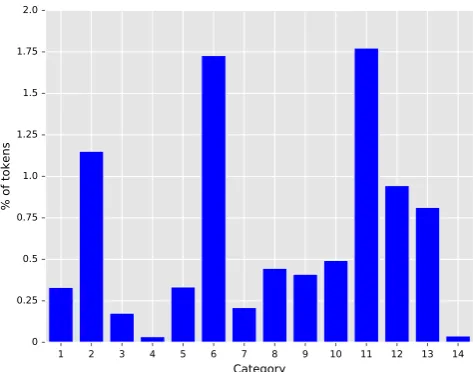
Figure 2: The distribution of the different categories. The percentages of tokens occuring in the categories with re-spect to all words in the corpus.
fits in two categories, e.g. diffffff7→different (fits in cate-gory 7 and 9). In these cases it is up to the annotator to decide which category defines the replacement most. We only annotate the training part of the dataset, to keep the test data strictly for the final testing of a tuned model (note that there is no default development split). The train data can be used in a k-fold cross validation experiment to in-spect the strengths and weaknesses of a model.
[image:3.595.308.545.300.486.2]1 2 3 4 5 6 7 8 9 10 11 12 13 14 Category
0 100 200 300 400 500 600 700 800
number of tokens
[image:4.595.306.546.68.257.2]Correctly normalized Not correct
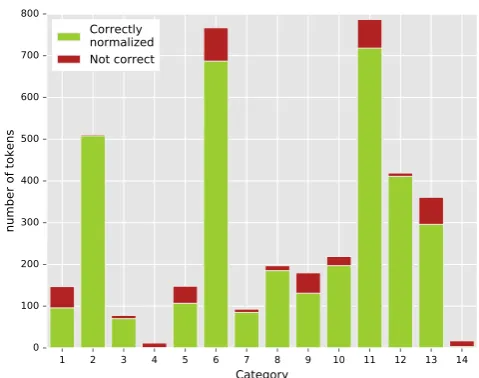
Figure 3: Performance of MoNoise on the different cat-egories in a 10-fold experiment on the training part of LexNorm2015.
and refined the description of the categories.
Figure 2 shows the distribution of the different categories. Most of the replacements are intentional word-word re-placements (7-12); about half of these are phonetic trans-formations. Other popular categories are phrasal abbrevia-tions and missing apostrophe.
5.
Evaluation of Normalization Model
In this section we evaluate the normalization model MoNoise (van der Goot and van Noord, 2017) in more de-tail using our proposed taxonomy. This system is based on the idea that the normalization task consists of different malization replacement actions. MoNoise generates nor-malization candidates for all words, and includes the orig-inal word as a candidate, so that it can decide whether or not to normalize when the candidates are ranked. It gener-ates candidgener-ates using the out-of-the-box spelling correction system Aspell1, combined with a word embeddings mod-ule and a lookup list generated from the training data. The candidates are then ranked in a random forest classifier us-ing features from the generation modules combined with N-gram probabilities from a canonical dataset as well as a Twitter dataset. For more details we refer to the original paper (van der Goot and van Noord, 2017).For maximum performance we train MoNoise using the As-pell bad-sAs-pellers mode. We run MoNoise in a 10-fold cross validation setup to get predictions for the whole training set. The absolute number of correctly normalized as well as the missed transformations are plotted in Figure 3. Note that besides these errors, 198 canonical words are wrongly nor-malized, so this still accounts for a large part of the errors. Two categories are not handled at all by MoNoise, namely split (4) and unknown (14). Besides these, the most diffi-cult categories are typographical erros (1), phonetic trans-formations (11) and merge (5). Surprisingly, two of these categories consists of a lot of minor transformations (1, 11). Replacements beyond the word level are clearly difficult; a
1http://www.aspell.net
1 2 3 4 5 6 7 8 9 10 11 12 13 14
Category 0
100 200 300 400 500 600 700 800
number of tokens
Correctly normalized Not correct
Figure 4: Performance of MoNoise on the different cate-gories when using gold error detection.
closer look at the typographical errors revealed that in these cases the original token is often ranked first by the normal-ization model. The categories that are almost completely resolved are missing apostrophe (2) and regular transfor-mations (12). For missing apostrophe this is due to the rel-ative restricted number of different replacements, whereas for regular transformations this is due to the fact that they are clearly in need of normalization, and their correct coun-terparts are quite similar (often in7→ing).
Figure 4 shows the performance per category when us-ing gold error detection. The performance is substantially higher on almost all categories, confirming that error de-tection is still a relevant problem. Unsurprisingly, the cat-egories split (4) and unknown (14) do not improve much, since the correct candidates are not generated by MoNoise, also the phrasal abbreviation category does not improve. This is because these are only solved by using the lookup list; this module does not improve by using gold error de-tection. Categories which previously performed well (2, 12) are now almost completely solved.
6.
Conclusion
We proposed a taxonomy for normalization replacements, which can be used for detailed evaluation of normaliza-tion systems as well as the filtering of training data. While some categories can potentially overlap, the inter-annotator agreement indicates near perfect agreement. We tested a state-of-art normalization model to see which categories are still most problematic: typographical errors, phonetical er-rors and merging. On most of the other categories the sys-tem performs quite well. When using gold error detection, the performance goes up for almost all categories, indicat-ing that this is still a far from solved problem. Interestindicat-ing future work would be an extrinsic evaluation: how impor-tant are the different normalization categories for specific downstream tasks.
[image:4.595.53.291.68.260.2]Acknowledgements
We would like to thank Barbara Plank and Antonio Toral for discussions about the taxonomy. This work is part of the Parsing Algorithms for Uncertain Input project, funded by the Nuance Foundation.
Bibliographical References
Baldwin, T. and Li, Y. (2015). An in-depth analysis of the effect of text normalization in social media. In Pro-ceedings of the 2015 Conference of the North American Chapter of the Association for Computational
Linguis-tics: Human Language Technologies, pages 420–429,
Denver, Colorado, May–June. Association for Compu-tational Linguistics.
Baldwin, T., de Marneffe, M.-C., Han, B., Kim, Y.-B., Rit-ter, A., and Xu, W. (2015a). Guidelines for English lexi-cal normalisation. Technilexi-cal report, Workshop on Noisy User-generated Text.
Baldwin, T., de Marneffe, M.-C., Han, B., Kim, Y.-B., Ritter, A., and Xu, W. (2015b). Shared tasks of the 2015 workshop on noisy user-generated text: Twitter lexical normalization and named entity recognition. In
Proceedings of the Workshop on Noisy User-generated Text, pages 126–135, Beijing, China, July. Association for Computational Linguistics.
Cohen, J. (1960). A coefficient of agreement for nomi-nal scales. Educational and psychological measurement, 20(1):37–46.
Kaljahi, R., Foster, J., Roturier, J., Ribeyre, C., Lynn, T., and Le Roux, J. (2015). Foreebank: Syntactic analy-sis of customer support forums. In Proceedings of the 2015 Conference on Empirical Methods in Natural
Lan-guage Processing, pages 1341–1347, Lisbon, Portugal,
September. Association for Computational Linguistics. Li, C. and Liu, Y. (2014). Improving text normalization
via unsupervised model and discriminative reranking. In
Proceedings of the ACL 2014 Student Research Work-shop, pages 86–93, Baltimore, Maryland, USA, June. Association for Computational Linguistics.
Mariana, V. R. (2014). The Multidimensional Quality Met-ric (MQM) framework: A new framework for translation quality assessment. The Journal of Specialised Transla-tion.
Ng, H. T., Wu, S. M., Briscoe, T., Hadiwinoto, C., Susanto, R. H., and Bryant, C. (2014). The CoNLL-2014 shared task on grammatical error correction. In Proceedings of the Eighteenth Conference on Computational
Natu-ral Language Learning: Shared Task, pages 1–14,
Bal-timore, Maryland, June. Association for Computational Linguistics.
Reynaert, M. (2008). All, and only, the errors: more complete and consistent spelling and ocr-error correc-tion evaluacorrec-tion. In Proceedings of the Sixth Interna-tional Conference on Language Resources and
Evalu-ation (LREC’08), Marrakech, Morocco, may. European
Language Resources Association (ELRA).
van der Goot, R. and van Noord, G. (2017). MoNoise: Modeling noise using a modular normalization system.
Computational Linguistics in the Netherlands Journal,
7.
Yang, Y. and Eisenstein, J. (2013). A log-linear model for unsupervised text normalization. In Proceedings of the 2013 Conference on Empirical Methods in Natural
Language Processing, pages 61–72, Seattle,