An overview of Amalgam:
A machine-learned generation module
Simon Corston-Oliver, Michael Gamon, Eric Ringger, Robert Moore
Microsoft Research
Redmond, WA 98052
{simonco, mgamon, ringger, bobmoore}@microsoft.com
Abstract
We present an overview of Amalgam, a sentence realization module that combines machine-learned and knowledge-engineered components to produce natural language sentences from logical form in-puts. We describe the decomposition of the task of sentence realization into a lin-guistically informed series of steps, with particular attention to the linguistic issues that arise in German. We report on the evaluation of component steps and of the overall system.
1
Introduction
Since the mid 1990s, there has been increasing in-terest in the application of statistical and machine learning techniques to various aspects of natural language generation, ranging from learning plans for high-level organization of texts and dialogues (Zukerman et al., 1998; Duboue and McKeown, 2001) or ensuring that the macro properties of gen-erated texts such as the distribution of sentence lengths and lexical variety mirror the properties of naturally occurring texts (Oberlander and Brew, 2000) to sentence planning (Walker et al., 2001.). As generation proceeds through successively less abstract stages, nearing the final output string, it would appear that current generation systems are still likely to employ knowledge-engineered ap-proaches. Indeed Walker et al. (2001), commenting on sentence realization, rather succinctly summa-rize what is no doubt a widely-held belief, namely that “This phase is not a planning phase in that it only executes decisions made previously.” Al-though the kinds and number of decisions to be made during sentence realization will depend on
the nature of the prior sentence planning phase and on the linguistic complexity of the domain, myriad encoding decisions must still be made. Machine learning approaches have been successfully ap-plied to such aspects of sentence realization as de-termining the appropriate form of referring expressions (Poesio et al., 1999) and the gram-matical relations of noun phrases (Corston-Oliver, 2000) as well as performing lexical selection (Bangalore and Rambow, 2000b). Traditional knowledge engineering approaches to sentence realization founder on our inadequate understand-ing of the mappunderstand-ing from propositional content to surface form, a mapping that encompasses such problems as equi-NP deletion, movement opera-tions such as extraposition and left-dislocation, ordering of modifiers within constituents, and voice alternations. Research in knowledge engi-neered solutions to these problems continues (see for example, Aikawa et al., 2001). However, the task of broad-coverage sentence realization would appear to be of comparable complexity to sentence analysis, and equally difficult to adapt to new do-mains. Sentence realization therefore appears to be an ideal candidate for statistical and machine-learned approaches.
or to augment the n-gram model, has produced fa-vorable improvements over n-gram models used alone (Bangalore and Rambow, 2000a; Ratna-parkhi, 2000).
In the current paper we describe an on-going research project code-named Amalgam. Amalgam is a (predominantly) machine-learned generation module that performs sentence realization and a small degree of lexical selection. Amalgam takes as input a logical form graph. Proceeding through a series of machine-learned and knowledge-engineered steps, it transforms that graph into a fully articulated tree structure from which an out-put sentence can be read. Amalgam has been suc-cessfully applied to the realization of non-trivial German sentences in diverse technical domains. An extended description is given in Gamon et al. (2002a).
2
Linguistic issues in German generation
Although English and German are closely related languages, they now differ typologically in dra-matic ways. German makes a three-way distinction in lexical gender (masculine, feminine, neuter). Nominal elements are morphologically marked for one of four grammatical cases (nominative, accu-sative, dative and genitive), with adjectives and determiners agreeing in gender, number and case. Verbal position is fixed, and is sensitive to clause type; the order of other constituents is relatively free. So-called “separable prefixes” are elements that may occur prefixed to verbs or as separate elements at a great distance from the verb to which they are syntactically dependent. Extraposition, a rare phenomenon in English text, is pervasive: de-pending on genre, one quarter to one third of all relative clauses in natural German texts are extra-posed (Gamon et al., 2002b; Uszkoreit et al., 1998). Relatively free constituent order, separable prefixes and extraposition force us to deal with long distance dependencies much more frequently than in the analysis and generation of English sen-tences.
3
The logical form representation
The logical form representation that we employ is a graph data structure that expresses the proposi-tional content of a sentence. Nodes in the graph contain lemmas (citation forms) of content words
with additional annotations for definiteness, num-ber, person and so on. Relations between nodes are indicated by labeled arcs. The logical form normal-izes surface syntactic alternations. For example, active and passive alternations receive the same graph representation, differing only in the presence of the [+Pass] feature on the verbal head of the logical form that results from the analysis of the passive. Since the logical form is a graph, nodes may have more than one parent. Figure 1, Hans isst die Kartoffeln auf, die er gestern geernet hat, “Hans eats the potatoes up, which he has gathered yesterday” (i.e., “Hans eats up the potatoes which he gathered yesterday”), illustrates the graph na-ture of the representation.1 A given node may be in more than one relationship to the same parent, as is the case with Hans, which functions both as the underlying subject of aufessen “to eat up” and the logical topic of the sentence. A given node may also be dependent on more than one parent node, as is the case with Kartoffel “potato”, which func-tions as both the object of aufessen and the object of ernten “to gather”. Long distance dependencies receive a rather direct representation in the logical form, as shown in the representation of the extra-posed relative clause die er gestern geernet hat, “that he gathered yesterday”, which is represented in the logical form as directly dependent on Kartof-fel, which it modifies semantically.
1
Figure 1 Logical form for the sentence Hans isst die Kartoffeln auf, die er gestern geernet hat.
4
The sentence realization process
For our experiments, we begin with a broad-coverage grammar of German (in the framework described in (Heidorn, 2000)) that parses sentences to produce a syntactic analysis. Additional process-ing yields a logical form analysis. Our task is es-sentially to learn the mapping from the output logical forms to the input sentences, with reference to the intermediate syntactic analysis. The goal is to apply Amalgam to the realization of sentences in contexts such as machine translation in which the input logical form is constructed by transfer opera-tions. In the interim, using logical forms that result from the analysis of German text frees us from is-sues related to noise introduced by the process of transfer. We do not require an annotated corpus; we are able to create unlimited (though imperfect) quantities of training data by application of the German analysis system. We have been using a corpus of 100,000 German sentences drawn from technical manuals and computer help files. De-pending on the phenomenon of interest, each sen-tence typically produces multiple training cases. For some models, such as the punctuation model, the use of the full set of sentences yielded as many as one million cases.
The first stage in the Amalgam process is a proce-dure that converts the input logical form into a more manageable tree data structure in which lin-ear order has not been determined. Nodes with multiple parents in the input logical form are du-plicated and co-indexed in the tree data structure. By consultation of the system dictionary, each node is annotated with lexical features such as sub-categorization information that is not otherwise needed in the logical form. Nouns with nominal modifiers are collapsed to form compounds. 2
2
Work in progress.
Most of the remaining stages involve machine learning. With the exception of the generative lan-guage model used to determine intra-constituent order, all machine-learned modules have been im-plemented as decision tree classifiers using the WinMine toolkit (Chickering, nd.). Decision trees provide an easily accessible inventory of the se-lected features and some indication of their relative importance in predicting the target features in question. Significantly, decision trees built by WinMine predict a probability distribution over all possible target values. We formulate a series of questions that lend themselves to implementation in decision tree classifiers. For example, we ask, “What case should this NP have?”, “Which deter-miner from the set {NULL, definite deterdeter-miner, indefinite determiner, …} should modify this NP?”, “Should this constituent be realized?”. Fea-tures are extracted from each node, its parent and grandparent. Knowledge-engineered approaches have been employed for problems for which there were insufficient data to train models, for certain graph and tree manipulation operations, and for straightforward operations such as performing con-tractions.
of being realized in the surface string. For exam-ple, logical subjects of infinitival clauses do not usually receive overt expression. Finally, morpho-logical case features and verb position features (verb second, verb final, verb initial) are assigned.
The third major stage deletes logical subjects and objects whose probability of being realized is below a given threshold. The degraphed logical form is transformed deterministically into a repre-sentation that more closely resembles a syntactic constituent representation, albeit with linear order still unspecified. Non-terminal nodes are given the syntactic labels that were chosen previously. A function splits separable prefixes from verbal stems, based on verb-position features assigned in the previous stage, and based on lexical informa-tion. A simple tree transformation reverses the headedness of constituents in which the syntactic head is not the semantic head, e.g., in cases involv-ing quantification such as viele der Leute “many of the people”.
Processing proceeds to global movement opera-tions, i.e., movement that reattaches nodes, as dis-tinct from ordering within a constituent. Mandatory movement, whether raising, Wh-movement, or the movement of relative pro-nouns/relative expressions, are handled by three simple functions—these phenomena, which have received considerable attention in the theoretical literature, have extremely low text frequency in the technical corpus that we use, with the result that there were insufficient examples for training deci-sion tree classifiers. Extraposition of relative, in-finitival and complement clauses is based on a decision tree classifier which decides for each in-stance of such a clause whether it should move up one step and attach to the parent of its parent (Ga-mon et al., 2002b). Once reattached there, the next “hop” is evaluated, until a position is found where the probability of further movement is less than the probability of staying put (i.e., it falls below 0.5).
Now that the basic constituency has been re-solved, two functions set morphological properties of verbs, copying tense information to the finite verb (which might be an auxiliary that was inserted during flesh-out), and copying participial informa-tion onto the non-finite verb. The verb is made to agree with the subject, which is identified as the first nominative NP in the domain of the finite verb.
Next, linear order within each constituent is de-termined by consulting a generative statistical lan-guage model (see Ringger et al., in preparation (A)). For a given constituent, the ordering stage employs a beam search to select the optimal order-ing of modifiers relative to one another and to the head, in the context of the syntactic category of the parent constituent and the head part-of-speech. In addition to leveraging the constituency, the order model is sensitive to the semantic relation between each modifier and the head as well as the syntactic category of the modifier.
A series of operations cleans up the tree. Deci-sion tree classifiers select the appropriate forms to replace the placeholders for determiners and rela-tive pronouns. This is a non-trivial task in Ger-man—the training data contain 55 different lexical realizations of determiners and 23 different lexical realizations of relative pronouns. Reflexive pro-nouns, which also received an abstract form during insertion in flesh-out, are converted into their sur-face form by a simple function. Finally, we must perform conjunction reduction, reducing sentences such as the grammatical but dysfluent Hans hat die Kartoffeln gekocht, und Hans hat die Kartoffeln gegessen “Hans has cooked the potatoes, and Hans has eaten the potatoes” to the more fluent Hans hat die Kartoffeln gekocht und gegessen “Hans has cooked and eaten the potatoes”. A decision tree classifier assigns a probability to each NP under coordination that it will be overtly realized. A sim-ple function then selects only the most likely NP to be realized. A final housekeeping function re-moves duplicated prepositions and auxiliaries that remain as artifacts of earlier degraphing opera-tions.
5
Evaluation
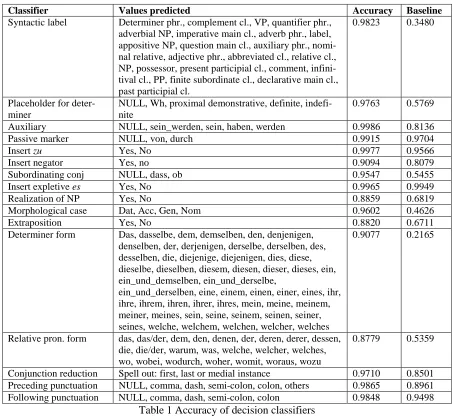
Table 1 presents the accuracy of the various deci-sion tree classifiers. Extended discusdeci-sion of these and other classifiers is given in Gamon et al. (in preparation), including precision/recall figures for each value of the target feature. The baseline is calculated by predicting the most frequent value in the held-out test data. This proved easier to calcu-late from the intermediate WinMine data files, and is a slightly higher bar than predicting the most frequent value from the training data. All decision tree classifiers outperform the baseline. The accu-racy for the extraposition model is based on a sin-gle “hop”, i.e., for a sinsin-gle decision concerning whether an extraposable clause ought to ascend one level in the syntax tree. For a more extensive
evaluation that considers the final attachment site after a clause has undergone multiple hops, see Gamon et al. (2002b).
We evaluate the overall system by parsing a blind test set of 564 German sentences to produce logical forms and then applying Amalgam to gen-erate output strings from those logical forms. For this sample, 71.1% of the words are correctly in-flected and occur in the correct position in the sen-tence. We also compute the word-level string edit distance of the generated output from the original reference string: the number of errors (insertions, deletions, and substitutions) is 44.7% of the num-ber of words in the reference string.
Classifier Values predicted Accuracy Baseline
Syntactic label Determiner phr., complement cl., VP, quantifier phr., adverbial NP, imperative main cl., adverb phr., label, appositive NP, question main cl., auxiliary phr., nomi-nal relative, adjective phr., abbreviated cl., relative cl., NP, possessor, present participial cl., comment, infini-tival cl., PP, finite subordinate cl., declarative main cl., past participial cl.
0.9823 0.3480
Placeholder for deter-miner
NULL, Wh, proximal demonstrative, definite, indefi-nite
0.9763 0.5769
Auxiliary NULL, sein_werden, sein, haben, werden 0.9986 0.8136
Passive marker NULL, von, durch 0.9915 0.9704
Insert zu Yes, No 0.9977 0.9566
Insert negator Yes, no 0.9094 0.8079
Subordinating conj NULL, dass, ob 0.9547 0.5455
Insert expletive es Yes, No 0.9965 0.9949
Realization of NP Yes, No 0.8859 0.6819
Morphological case Dat, Acc, Gen, Nom 0.9602 0.4626
Extraposition Yes, No 0.8820 0.6711
Determiner form Das, dasselbe, dem, demselben, den, denjenigen, denselben, der, derjenigen, derselbe, derselben, des, desselben, die, diejenige, diejenigen, dies, diese, dieselbe, dieselben, diesem, diesen, dieser, dieses, ein, ein_und_demselben, ein_und_derselbe,
ein_und_derselben, eine, einem, einen, einer, eines, ihr, ihre, ihrem, ihren, ihrer, ihres, mein, meine, meinem, meiner, meines, sein, seine, seinem, seinen, seiner, seines, welche, welchem, welchen, welcher, welches
0.9077 0.2165
Relative pron. form das, das/der, dem, den, denen, der, deren, derer, dessen, die, die/der, warum, was, welche, welcher, welches, wo, wobei, wodurch, woher, womit, woraus, wozu
0.8779 0.5359
[image:5.612.79.532.292.708.2]Conjunction reduction Spell out: first, last or medial instance 0.9710 0.8501 Preceding punctuation NULL, comma, dash, semi-colon, colon, others 0.9865 0.8961 Following punctuation NULL, comma, dash, semi-colon, colon 0.9848 0.9498
String edit distance is a harsh measure of sen-tence realization accuracy. Because string edit dis-tance does not consider movement as an edit operator, movements appear as both deletions and insertions, yielding a double penalty. Furthermore, as observed earlier, some edits have a greater im-pact on the intelligibility of the output than others, especially the position of the German verb. Work in progress on a tree edit distance metric addresses both of these issues (Ringger et al., in preparation (B)). Closely related work includes that of Banga-lore, Rambow and Whittaker (2000).
It is possible that generated sentences might dif-fer from the redif-ference sentences and yet still prove satisfactory. We therefore had five independent human evaluators assess the quality of the output for a random sample of 564 sentences.3 These sen-tences had been analyzed to yield logical forms from which Amalgam generated output sentences. The evaluators assigned an integer score to each sentence, comparing it to the reference sentence using the scoring system given in Table 2.4
The average score was 2.96 with a standard de-viation of 0.81. The mode was 4, occurring 104 times, i.e. 104/564 sentences, or 18.4% received the maximum score. In 63 of these cases, the score of 4 had been automatically assigned because the output sentence was identical to the reference sen-tence. In the other 41 cases, all five human evalua-tors had assigned a score of 4, i.e., the output differed from the reference sentence, but was still “Ideal”.
3
We extract a random sample of generated sentences. We take the first n sentences in the sample necessary to ensure 500 sentences that differ from the reference sentence.
4
These guidelines were originally intended for assessing the quality of machine translation, measuring fluency and transfer of semantic content from the source language. Evaluating the sentence realization component is conceptually a case of Ger-man-to-German translation.
1. “Unacceptable”.Absolutely not comprehensible and/or little or no information transferred accurately.
2. “Possibly Acceptable”. Possibly comprehensible (given enough context and/or time to work it out); some information transferred accu-rately.
3. “Acceptable”. Not perfect (stylistically or grammatically odd), but definitely com-prehensible, AND with accurate transfer of all important information.
4. “Ideal”. Not necessarily a perfect translation, but grammatically correct, and with all infor-mation accurately transferred.
Table 2 Evaluation guidelines
6
Conclusion
Some elements of the approach to sentence realiza-tion presented here are peculiar to our logical form representations, e.g., the fact that negation is repre-sented as a feature on a node rather than as an op-erator with scope over a sub-graph, or the procedural operations necessary to prune artifacts introduced by the degraphing process. The more linguistic aspects of the procedure deal with issues that would be problems for any approach that pro-ceeds from a representation of propositional con-tent to a surface string, such as extraposition and conjunction reduction. As with more traditional knowledge-engineered approaches to sentence re-alization (e.g., Aikawa et al. 2001), we have at-tempted to model such linguistic phenomena in terms of syntactic constituency. Unlike these tradi-tional approaches we have implemented the solu-tions to these problems in machine-learned components.
candidate output sentences in the examples that Langkilde and Knight give, it is doubtful whether it would be practical for a language such as Ger-man with a rich inflectional morphology. We be-lieve that a linguistically informed approach allows for a more direct model of the underlying phenom-ena, which constrains the search space and reduces the burden on the generative language model by presenting it with fewer spurious candidate sen-tences.
Although our exposition has focused on the pre-ferred value (the mode) predicted by the models, decision trees built by WinMine predict a probabil-ity distribution over all possible target values. For a system such as Amalgam, built as a pipeline of stages, this point is critical, since finding the best final hypothesis will require the consideration of multiple hypotheses and the concomitant combina-tion of probabilities assigned by the various mod-els in the pipeline to all possible target values. In its current implementation, Amalgam follows a greedy search, but in future research we intend to experiment with a beam search that entertains mul-tiple intermediate hypotheses.
Acknowledgements
Our thanks go to Max Chickering for assistance with the WinMine decision tree tools, to Zhu Zhang who made significant contributions to the development of the extraposition and punctuation models and to Karin Berghöfer and the five anonymous evaluators from the Butler Hill Group for assistance with evaluation.
References
T. Aikawa, M. Melero, L. Schwartz, and A. Wu. 2001. Multilingual Sentence Generation. In Proceedings of 8th European Workshop on Natural Language Gen-eration. Toulouse, France. 57-63.
S. Bangalore and O. Rambow. 2000a. Exploiting a probabilistic hierarchical model for generation. In Proceedings of the 18th International Conference on Computational Linguistics (COLING 2000). Saar-brücken, Germany. 42-48.
S. Bangalore and O. Rambow. 2000b. Corpus-based lexical choice in natural language generation. In Pro-ceedings of the 38th Annual Meeting of the Associa-tion for ComputaAssocia-tional Linguistics (ACL 2000). Hong Kong, PRC. 464-471.
S. Bangalore, O. Rambow, and S. Whittaker. 2000. Evaluation metrics for generation. International Con-ference on Natural Language Generation (INLG 2000). Mitzpe Ramon, Israel. 1-13.
D. Max. Chickering. nd. WinMine Toolkit Home Page. http://research.microsoft.com/~dmax/WinMine/ Tooldoc.htm
S. Corston-Oliver. 2000. Using Decision Trees to Select the Grammatical Relation of a Noun Phrase. In Pro-ceedings of the 1st SIGDial workshop on discourse and dialogue. Hong Kong, PRC. 66-73.
P. Duboue and K. McKeown. 2001. Empirically esti-mating order constraints for content planning in gen-eration. In Proceedings of the 39th Annual Meeting of the Association for Computational Linguistics (ACL-2001). Toulouse, France. 172-179.
Duden. 2000. Die deutsche Rechtschreibung. Duden-Verlag: Mannheim, Leipzig, Wien, Zürich.
M. Gamon, E. Ringger and S. Corston-Oliver. 2002a. Amalgam: A Machine-learned Generation Module. Microsoft Research Tech Report. To appear.
M. Gamon, S. Corston-Oliver, E. Ringger, Z. Zhang, B. Moore. 2002b. Extraposition of relative clauses: A case study in German sentence realization. To appear in Proceedings of COLING 2002, Taipei, Republic of China.
G. Heidorn. 2000. Intelligent Writing Assistance. In R. Dale, H. Moisl, and H. Somers (eds.), A Handbook of Natural Language Processing: Techniques and Applications for the Processing of Language as Text. Marcel Dekker, New York. 181-207.
I. Langkilde and K. Knight. 1998a. The practical value of n-grams in generation. In Proceedings of the 9th International Workshop on Natural Language Gen-eration, Niagara-on-the-Lake, Canada. 248-255.
I. Langkilde and K. Knight. 1998b. Generation that ex-ploits corpus-based statistical knowledge. In Pro-ceedings of the 36th Annual Meeting of the Association for Computational Linguistics and 17th International Conference on Computational Linguis-tics (COLING-ACL 1998). Montréal, Québec, Can-ada. 704-710.
J. Oberlander and C. Brew. 2000. Stochastic text gen-eration. To appear in Philosophical Transactions of the Royal Society of London, Series A, volume 358.
A. Ratnaparkhi. 2000. Trainable methods for surface natural language generation. In Proceedings of the 6th Applied Natural Language Processing Conference and the 1st Meeting of the North American Chapter of the Association of Computational Linguistics (ANLP-NAACL 2000). Seattle, Washington, USA. 194-201.
E. Ringger, B. Moore, M. Gamon, S. Corston-Oliver. In preparation (A). A linguistically-informed generative language model for intra-constituent ordering during sentence realization.
E. Ringger, R. Moore, M. Gamon, S. Corston-Oliver. In preparation (B). A tree edit distance metric for evaluation of natural language generation.
H. Uszkoreit, T. Brants, D. Duchier, B. Krenn, L. Konieczny, S. Oepen and W. Skut. 1998. Aspekte der Relativsatzextraposition im Deutschen. Claus-Report Nr.99, Sonderforschungsbereich 378, Universität des Saarlandes, Saarbrücken, Germany.
M. Walker, O. Rambow, and M. Rogati. 2001. SPoT: A trainable sentence planner. In Proceedings of the North American Meeting of the Association for Computational Linguistics.