T h e a u t o m a t i c c o n s t r u c t i o n of a s y m b o l i c parser via
statistical t e c h n i q u e s
Shyam Kapur
D e p a r t m e n t of C o m p u t e r S c i e n c e J a m e s C o o k U n i v e r s i t y T o w n s v i l l e
QLD
4811 ( A u s t r a l i a )k a p u t @ c o r a l , c s . j c u . e d u . a u
Robin Clark
Department of Linguistics
University of Pennsylvania
Philadelphia PA 19104
rclark@babel, l i n g . upenn, edu
A b s t r a c t
We
report on the development of a robust pars- ing device which aims to provide a partial expla- nation for child language acquisition and help in the construction of better natural language pro- cessing systems. The backbone of the new ap- proach is the synthesis of statistical and symbolic approaches to natural language.M o t i v a t i o n
We report on the progress we have made towards developing a robust 'self-constructing' parsing de- vice that uses indirect negative evidence (Kapur, 1992) to set its
parameters.
Generally, by param- eter, we mean any point of variation at which two languages may differ. Thus, the relative place- ment of all object with respect to the verb, a de- terminer with respect to a noun, the difference be- tween prepositional and postpositional languages, and the presence of long distance anaphors l i k e Japanese "zibun" and Icelandic "sig" are all pa- rameters. The device would be exposed to an in- put text consisting of simple unpreprocessed sen- tences. Oil the basis of this text, the device would induce indirect negative evidence in support of some one parsing device located in the parameter space.The development of a self-constructing pars- ing system would have a number of practical and theoretical benefits. First, such a parsing de- vice would reduce the development costs of new parsers. At the moment, grammars must be de- veloped by hand, a technique which requires a significant investment in money and man-hours. If a b~mic parser could be developed automati- cally, costs would be reduced significantly, even if the parser requires some fine-tuning after the initial automatic learning procedure. Second, a parser capable of self-modification is potentially more robust when confronted with novel or semi- grammatical input. This type of parser would haw~ applications in information retrieval as well
as language instruction and grammar correction. Finally, the development of a parser capable o f self-modification would give us considerable in- sight into the formal properties of complex sys- tems as well as the twin problems of language learnability and language acquisition.
Given a linguistic parameter space, the prob- lem of locating a target language somewhere in the space on the basis of a text consisting of only grammatical sentences is far from trivial. Clark (1990, 1992) has shown that the complexity of the problem is potentially exponential because the relationship between the points of variation and the actual data can he quite indirect and tangled. Since, given n parameters, there are 2 n possible parsing devices, enumerative search through the space is clearly impossible. Because each datum may be successfully parsed by a num- ber of different parsing devices within the space and because the surface properties of grammati- cal strings underdetermine the properties of the parsing device which must be fixed by the learning algorithm, standard deductive machine learning techniques are as complex as a brute enumera- tive search (Clark, 1992, 1994). In order to solve this problem, robust techniques which can rapidly eliminate inferior hypotheses must be developed. We propose a learning procedure which unites symbolic computation with statistical tools. His- torically, symbolic techniques have proven to be a versatile tool in natural language processing. These techniques have the disadvantage of be- ing both brittle (easily broken by new input or by user error) and costly (as grammars are ex- tended to handle new constructions, development becomes more difficult due to the complexity of rule interactions within the grammar). Statisti- cal techniques have the advantage of robustness, although the resulting grammars may lack the intuitive clarity found in symbolic systems. We propose to fuse the symbolic and the statistical techniques, a development which we view as in- evitable; the resulting system will use statistical
learning techniques to output a symbolic parsing device. We view this development to provide a nice middle ground between the problems of over- training versus undertraining. That is, statistical approaches to learning often tend to overfit the training set of data. Symbolic approaches, on the other hand, tend to behave as though they were undertrained (breaking down on novel input) since the grammar tends to be compact. Combin- ing statistical techniques with symbolic parsing would give the advantage of obtaining relatively compact descriptions (symbolic processing) with robustness (statistical learning) that is not over- tuned to the training set.
P r e l i m i n a r i e s
Naturally, a necessary preliminary for our work is to specify a set of parameters which will serve as a testing ground for the learning algorithm. This set of parameters must be embedded in a parsing system so that the learning algorithm can be tested against data sets that approximate the kind of input that parsing devices are likely to en- counter in real world applications.In this section, we first list some parameters that gives some idea of the kinds of variations between languages that our system is hoped to be capable of handling. We then illustrate why parameter setting is dif- ficult by standard methods. This provides some additional explanation for the failure so far in de- veloping a truly universal parameterized parser.
L i n g u i s t i c P a r a m e t e r s
Our goal will be to first develop a prototype. We do not require that the prototype accept any arbi- trarily selected language nor that the coverage of the prototype parser be complete in any given lan- guage. Instead, we will develop a prototype with coverage that extends to some basic structures that any language learning device must account for, plus some structures that have proven dif- ficult for various learning theories. In particular, given an already existing parser, we will extend its coverage by parameterizing it, as described below. Our initial set of parameters will include the following other points of variation:
1. R e l a t i v e o r d e r o f specifiers a n d heads: This parameter covers the placement of deter- miners relative to nouns, relative position of the subject and the placement of certain VP- modifying adverbs.
R e l a t i v e o r d e r o f h e a d s a n d c o m p l e - m e n t s : This parameter deals with the po- sition of objects relative to the verb (VO or OV orders), placement of nominal and adjecti- val complements as well as the choice between prepositions and postpositions.
.
61
3. Scrambling: Some language.~ allow (rein. tively) free word order. For examph', Germall has rules for displacing definite N Ps and clan.yes out of their canonical positions. Japanese al- lows relatively free ordering of NPs and post- positional phrases so long as the verbal ~'om- plex remains clause final. Other languages al- low even freer word orders. We will focus on German and Japanese scrambling, bearing ill mind that the model should be extendible to other types of scrambling.
4. R e l a t i v e p l a c e m e n t o f n e g a t i v e m a r k - ers a n d verbs: Languages vary as to where they place negative markers like English not.
English places its negative marker after the first tensed auxiliary, thus forcing do insertion when there is no other auxiliary, while Italian places negation after the tensed verb. French uses discontinuous elements like n e . . . p a s . . , or
n e . . . p l u s . . , which are wrapped around the tensed verb or which occur as continuous el- ements in infinitivals. Italian differs from both English and French in placing its negative marker before the first verb, whether tensed or infinitive. The proper treatment of negation will require several parameters, given the range of variation.
5. R o o t w o r d o r d e r changes: In general, lan- guages allow for certain word order changes in root clauses but not in embedded clauses. An example of a root word order change is subject- auxiliary inversion in English which occurs ill root questions (Did John leave? vs. *I wonder did John leave?). Another example Would be inversion of the subject clitic with the tensed verb in French ( Quelle pomme a-t-il mangle
["which apple did he eat?"]) and process of subject postposition and PP preposition in En- glish ( A man walked into the room vs. Into the
room walked a man).
6. R i g h t w a r d dislocation: This includes extra- position structures in English ( That John is late amazes me. vs. It amazes me that John is late.), presentational there structures (A man
was in the park. vs. There was a man in the park.), and stylistic inversion in French (Quelle
piste Marie a-t-elle choisie? ["What path has Marie chosen?"]). Each of these constructions present unique problems so that the entire data set is best handled by a system of interacting parameters.
7. W h - m o v e m e n t v e r s u s wh-in situ: Lan- guages vary in the way they encode wh-
Polish allows wh-phrases to be stacked at the beginning of the question.
8. E x c e p t i o n a l Case M a r k i n g , S t r u c t u r a l Case M a r k i n g : These parameters have lit- tle obvious effect on word order, but involve the treatment of infinitival complements. Thus, exceptional case marking and structural case marking allow for the generation of the order V[+t~.,d NP VPl-ten,e], where
"V[+tense]"
is a tensed verb and"VPl-tense]"
is a VP headed by a verb in the infinitive. Both parameters involve the semantic relations between the NP and the infinitival VP as well as the treatment of case marking. These relations are reflected in constituent structure rather than word or- der and thus pose an interesting problem for the learning algorithm.9. R a i s i n g a n d c o n t r o l : In the case of raising verbs and control verbs, the learner must cor- rectly categorize verbs which occur in the same syntactic frame into two distinct groups based on scmantic relations as reflected in the distri- bution of elements (for example, idiom chunks) around the verbs.
10. L o n g a n d s h o r t d i s t a n c e a n a p h o r a : Short distance anaphors, like "himself" in English must be related to a coreferential NP within a constrained local domain. Long distance anaphors (Japanese "zibun", Korean "caki") must also be related to a coreferential NP, but tiffs N P need not be contained within the same type of local domain as in the short distance case.
The above sampling of parameters has the virtue of being both small (and, therefore, possible to implement relatively quickly) and posing interest- ing learnability problems which will appropriately test our learning algorithm. Although the above list can be described succinctly, the set of possi- ble targets will be large and a simple enumerative search through the possible targets will not be efficient.
C o m p l e x i t i e s o f P a r a m e t e r S e t t i n g
Theories based on the principles and parame- ters (POP) paradigm hypothesize that languages share a central core of universal properties and that language variation can be accounted for by appeal to a finite number of points of variation, the so-called parameters. The parameters them- selves may take on only a finite number of pos- sibh, values, prespecified by Universal Grammar.
A fully spooled
I'~:~i'
theory would account for
I;mguagc acquisition by hypothesizing that the h'aruer sets parameters to the appropriate val- ues by monitoring the input stream for "trigger- ing data"; triggers are sentences which cause the
6 2
learner to set a particular parameter to a partic- ular value. For example, the imperative in (1) is a trigger for the order "V(erb) O(bject)":
(1) Kiss grandma.
under the hypothesis that the learner analyzes
grandma as
the patient of kissing and is predis-posed to treat patients as structural objects. Notice that trigger-based parameter setting presupposes that, for each parameter p and each value v, the learner can identify the appropriate trigger in the input stream. This is the problem
of
trigger detection.
That is, given a particularinput item, the learner must be able to recognize whether or not it is a trigger and, if so, what pa- rameter and value it is a trigger for. Similarly, the learner must be able to recognize that a particular input datum is not a trigger for a certain param- eter even though it may share many properties with a trigger. In order to make the discussion more concrete, consider the following example:
(2)
a. John: thinks that Mary
likes
~aim
i.
b. *John thinks that Maryj
likes herj.
English allows pronouns to be coreferent with a c-commanding nominal just in case that nominal is not contained within the same local syntactic domain as the pronoun; this is a universal prop- erty of pronouns and would seem to present little problem to the learner.
Notice, however, that some languages, includ- ing Chinese, Icelandic, Japanese andKorean, al- low for long distance anaphors. These are ele- ments which are obligatorily coreferent with an- other nominal in the sentence, but which may be separated from that nominal by several clause boundaries. Thus, the following example from Icelandic is grammatical even though the anaphor
sig
is separated from its antecedentJSn
by a clause boundary (Anderson, 1986):(3)
J6n i segir ad Maria John says that Mary elski sigi/hann iloves self/him
John says that Mary loves him.
Notice t h a t the example in (3) is of the same structure as the pronominal example in (2a). A learner whose target is English must not take ex- amples like (2a) as a trigger for the long distance anaphor parameter; what prevents the learner from being deceived? Why doesn't the learner conclude that English
him
is comparable to Ice- landicsig?
We would argue that the learner is sensitive to distributional evidence. For example, the learner is aware of examples like (4):(4) John i likes himj.
where the pronoun is not coreferential with any- thing else in the sentence. The existence of (4) implies t h a t
him
cannot be a pure anaphor, long distance or otherwise. Once the learner is aware of this distributional property ofhim,
he or she can correctly rule out (2a) as a potential trigger for the long distance anaphor parameter.Distributional evidence, then, is crucial for pa- rameter setting; no theory of parameter setting can avoid statistical properties of the input text. How far can we push the statistical component of parameter setting? In this paper, we suggest that statistically-based algorithms can be exploited to set parameters involving phenomena as diverse as word order, particularly verb second construc- tions, and cliticization, the difference between free pronouns and proclitics. The work reported here can be viewed as providing the basis for a theory of trigger detection; it seeks to establish a theory of the connection between the raw input text and the process of parameter setting.
Parameter Setting Proposal
Let us suppose t h a t there are n binary parameters each of which can take one of two values ( ' + ' or ' - ' ) in a particular natural language. The core of a natural language is uniquely defined once all the n parameters have been assigned a value)
Consider a random division of the parameters into some m groups. Let us call these groups
P1, P~,..., Pro.
The Parameter Setting Machinefirst goes about setting all the parameters within the first group Px concurrently as sketched below. After these parameters have been fixed, the ma- chine next tries to set the parameters in group P2 in a similar fashion, and so on.
a Parameters can be looked at as fixed points of variation among languages, From a computational point of view, two different values of a parameter may simply correspond to two different bits of code in the parser. We are not committed to any particular scheme for the translation from a tuple of parameter values to the corresponding language. However, the sorts of parameters we consider have been listed in the previous section.
6 3
1. All parameters are unset initially, i.t,., l.h,,r,, arc no preset values. The parser' is organized to only obey all the universal principles. At. this stage, utterances from any possible natural lan- guage are accommodated with equal ea.s,~, but no sophisticated structure can be built. 2. Both the values of each of the parameters pl E
P1 are 'competing' to establish themselves. 3. Corresponding to Pi, a pair of hypotheses are
generated, say H~. and Hi_.
4. Next, these hypotheses are tested on the basis of input evidence.
5. If H~. fails or H~. succeeds, set
Pi'S
value to ' + ' . Otherwise, setpi's
value to ' - ' .F o r m a l A n a l y s i s o f t h e P a r a m e t e r S e t t i n g M a c h i n e
We next consider a particular instantiation of the hypotheses and their testing. The way wc hart, in mind involves constructing suitable window- sizes during which the algorithm is sensitive to occurrence as well as non-occurrence of specific phenomena. Regular failure of a particular phe- nomenon to occur in a suitable window is one nat- ural, robust kind of indirect negative evidence.
For example, the pair of hypotheses may be 1. Hypothesis H~: Expect not to observe phe-
nomena from a fixed set O i of phenomena which support the parameter value ' - ' . 2. Hypothesis H~_: Expect not to observe phe-
nomena from a fixed set O~. of phenomena which support the parameter value '+'. Let wi and ki be two small numbers. Testing the hypothesis H~ involves the following proce- dure:
1. A window of size wi sentences is constructed and a record is maintained whether or not a phenomenon from within the set O~_ occurred among those wi sentences.
2. This construction of the window is repeated ki different times and a tally ci is made of the fraction of times the phenomena occurred at least once in the duration of the window. 3. The hypothesis H+ succeeds if and only if the
ratio of ci to kl is less than 0.5.
• always capable of analyzing the input. Also, there is no need to explicitly store any input evidence. Saitable window-sizes can be constructed during which the algorithm is sensitive to occurrence as well as non-occurrence of specific phenomena. By using windows, just the relevant bit of informa- tion from the input is extracted and maintained. (For detailed argumentation that this is a rea- sonable theoretica! argument, see Kaput (1992, 1993).) Notice also that we have only sketched and analyzed a particular, simple version of our algorithm. In general, a whole range of window- sizes m a y be used and this may be governed by the degree to which the different hypotheses have earned corroboration. (For some ideas along this direction in a more general setting, see Kaput (199l, 1992).)
O r d e r i n w h i c h p a r a m e t e r s g e t s e t
Notice that in our approach certain parameters get set quicker than others. These are the ones that are expressed very frequently. It is possi- ble that these parameters also make the informa- tion extraction more efficient quicker, for exam- pie, by enabling structure building so that other parameters can be set. If our proposal is right, then, for example, the word order parameters which are presumably the very first ones to be set must be set based on a very primitive parser capable of handling any natural language. At this early stage, it m a y be t h a t word and ut- terance boundaries cannot be reliably recognized and the lexicon is quite rudimentary. Further- more, the only accessible property in the input stream m a y be the linear word order. Another particular difficulty with setting word-order pa- rameters is that the surface order of constituents in the input does not necessarily reflect the un- derlying word-order. For example, even though Dutch and German are SOV languages, there is a preponderance of SVO forms in the input due to the V2 (verb-second) phenomenon. The finite verb in root clauses moves to the second position and then the first position can be occupied by the subject, objects (direct or indirect), adverbials or prepositional phrases. As we shall see, it is impor- t;rot to note that if the subject is not in the first position in a V2 language, it is most likely in the first position to the right of the verb. Finally, it has been shown by Gibson and Wexler (1992) that the parameter space created by the head-direction parameters along with the V2 parameter has
lo-
cal maxima,
thai. is, incorrect parameter settingsfront which the learner can never escape.
C o m p u t a t i o n a l A n a l y s i s o f t h e P a r a m e t e r S e t t i n g M a c h i n e
V 2 p a r a m e t e r In this section, we summarize results we have obtained which show that word or-
6 4
der parameters can plausibly be set in our model. 2 The key concept we use is t h a t of
entropy,
an information-theoretic statistical measure of ran- domness of a random variable. The entropyH(X)
of a random variable X, measured in bits, is
- ~ x p(z)logp(z). To give a concrete exam- ple, the outcome of a fair coin has an entropy of - ( . 5 * log(.5) + .5 * log(.5)) = 1 bit. If the coin is not fair and has .9 chance of heads a n d . 1 chance of tails, then the entropy is around .5 bits. There is less uncertainty with the unfair coin--it is most likely going to turn up heads. Entropy can also be thought of as the number of bits on the average required to describe a random vari- able. Entropy of one variable, say X, conditioned on another, say Y, denoted as
H(X]Y)
is a mea- sure of how much better the first variable can be predicted when the value of the other variable is known.Descriptively, verb second (V2) languages place the tensed verb in a position t h a t immediately follows the first constituent of the sentence. For example, German is V2 in root clauses, as shown in (refex:v2-root), but not in embedded clauses, as shown in (telex:embedding): 3
(5)
a. Hanshat
Maria H. has M. getroffen.met
"Hans has met Maria."
b. Hans wird Maria
H. will M.
getroffen haben. met has
"Hans will have met Maria."
(o)
a. well Hans Maria because H. M. getroffen, hat. met has"Hans has met Maria."
b. well Hans Maria because H. M. getroffen haben wird. met has will "because Hans will have met Maria."
In the examples in (5), a constituent, XP, has
2Preliminary results obtained with Eric Brill were
presented at the 1993 Georgetown Roundtable on
Language and Linguistics: Pre-session on Corpus- based Linguistics.
3See the papers collected in Haider & Prinzhorn
been moved into the Specifier position of CP, trig- gering movement of the finite verb to C o . This results in the structure shown in (7). Notice that the constituent X P can be of any category, may be extracted from an embedded clause ormay be an adverbial; thus, the XP need not be related to the finite verb via selectional restrictions or sub- categorization:
(7) [CP XPi [C O Vj] . . . t i . . . tj] where Vj is a finite verb.
T h e V2 parameter (or set of parameters) would regulate the movement of a constituent to the Specifier of CP, forcing movement of the finite verb to C O as well as determining whether the V2 structures are restricted to the root clause or may occur in embedded clauses.
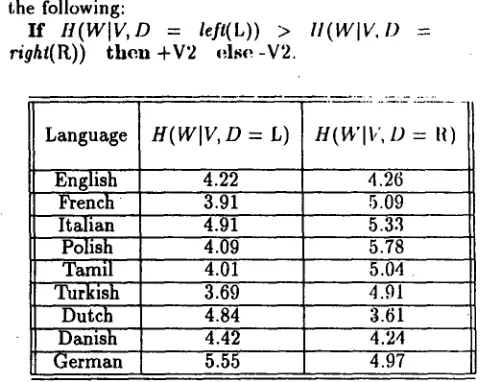
We considered the possibility that by investi- gating the behavior of the entropy of positions in the neighborhood of verbs in a language, word order characteristics of t h a t language m a y be discovered. 4 For a V2 language, we expect that there will be more entropy to the left of the verb than to its right, i.e., the position to the [eft will be less predictable than the one to the right. This is because the first position need not be related to the verb in any systematic way while the posi- tion following the verb will be drawn from a more restricted class of elements (it will either be the subject or an element internal to the VP); hence, there is more uncertainty (higher entropy) about the first position than about the position follow- ing the verb. We first show t h a t using a simple distributional analysis technique based on the five verbs the algorithm is assumed to know, another fifteen words most of which turn out to be verbs can readily be obtained.
Consider text as generating tuples of the form ( v , d , w ) , where v is one of the top twenty words (most of which are verbs), d is either the position to the left of the verb or to the right, and w is the word at t h a t position. ~ V, D and W are the corresponding r a n d o m variables.
The procedure for setting the V2 parameter is
4In the competition model for language acquisition (MacWhinney, 1987), the child considers cues to de- termine properties of the language but while these cues are reinforced in a statistical sense, the cues themselves axe not information-theoretic in the way that ours are. In some redent discussion of trigger- ing, Niyogi and Berwick (1993) formalize parameter setting as a Maxkov process. Crucially, there again the statistical assumption, on the input is merely used to ensure that convergence is likely, and triggers are simple sentences.
SWe thank Steve Abney for suggesting this formu- lation to us.
65
the following:
I f
U(WIV, D
= left(L)) > right(It)) t h e n + V 2 e l s e - V 2 ., ( W l V , z> =
Language
English F r e n c h Italian
Polish Tamil Turkish
Dutch Danish German
H ( W I V , O = L) HCW[V,I) = R
5.55
4.22 4.26
3.91 5.09
4.91 5.33
4.09 5.78
4.01 [ 5.04
I
3.69 i 4.91
4.84 3.61
4.42 4.24
4.97
Table 1. Entropy in the Neighborhood of Verbs
On each of the 9 languages on which it has been possible to test our algorithm, the correct result was obtained. (Only the last three lan- guages in the table are V2 languages.) Further- more, in almost all cases, it was also shown to be statistically significant. T h e a m o u n t (only 3000 utterances) and the quality of the input (unstruc- tured unannotated input caretaker speech subcor- pus from the CHILDES database (MacWhinney, 1991)), and the computational resources needed for parameter setting to succeed are psycholog- ically plausible. Further tests were successfully conducted in order to establish both the robust- ness and the simplicity of this learning algorittun. It is also clear that once the value of the V2 pa- rameter has been correctly set, the input is far more revealing with regard to other word order parameters and they too can be set using similar techniques.
In order to make clear how this procedure lits into our general parameter setting proposal, we spell out what the hypotheses are. In the case of the V2 parameter, the two hypotheses are not separately necessary since one hypothesis is the exact complement of the other. So the hypothesis H+ may be as shown.
Hypothesis H+: Expect not to observe that the entropy to the left of the verbs is lower than that to the right.
[image:6.596.297.538.82.273.2]pronoun system (see below) but also get infor- mation about the V2 parameter. The first step of learning is same as above; that is, the learner acquires additional verbs based on distributional analysis. We expect that in the V2 languages (Dutch and German), the pronouns will appear more often immediately to the right of the verb than to the left. For French, English and Ital- ian exactly the reverse is predicted. Our results (2 to 1 or better ratio in the predicted direction) confirm these p r e d i c t i o n s :
C l i t i c p r o n o u n s We now show that our tech- niques can lead to straightforward identification and classification of clitic p r o n o u n s 7 Briefly, clitic pronouns are phonologically reduced ele- ments which obligatorily attach to another ele- ,,,ent. Syntactic clitics have a number of syntactic consequences including special word order prop- crties and an inability to participate in conjunc- t.ions and disjunctions. For example, in French,, fldl direct objects occur after the lexical verb but accusative clitics appear before the verb:
(s)
a. Jean a vu les J. has seen the filles.girls
"Jean saw the girls."
b. Jean les a rues. J. clitic has seen
"Jean saw them."
Restricting our attention, for the m o m e n t to French, we should note that clitic pronouns may occur in sequences, in which case there are a num- ber of restrictions on their relative order. Thus, nominative clitics (eg., "je", "tu", "il", etc.) oc- cur first, followed by the negative element "ne", fi)llowed by accusative clitics (eg., "la", "me", "re") and dative clitics ("lui"), followed, at last, I)y the first element of the verbal sequence (an auxiliary or the main verb). There are further or- dering constraints within the accusative and da- tive elites based on the person of the clitic; see Perlmutter (1971) for an exhaustive description of clitic pronouns in French.
In order to correctly set the parameters govern- ing the s y n t a x of pronominals, the learner must distinguish clitic pronouns from free and weak pronouns as well as sort all pronoun systems ac- cording to their proper case system (e.g., nomi- natiw' pronouns, accusal.iw, pronouns). Further-
r W c also vcrilicd that tile object clitics in French were not primarily responsible for the correct result. 7preliminary results were presented at the Berne workshop on L|- and [,2-acquisition of clause-internal rules: scrambling and cliticization in January, 1994.
more, the learner must have some reliable m e t h o d for identifying the presence of clitic pronouns in the input stream. T h e above considerations sug- gest that free pronouns occur in a wider range of syntactic environments than clitic pronouns and, so, should carry less information a b o u t the syntactic nature of the positions t h a t surround them. Clitic pronouns, on the other hand, occur in a limited number of environments and, hence, carry more information a b o u t the surrounding positions. Furthermore, since there are system- atic constraints on the relative ordering of clitics, we would expect them to fall into distribution classes depending on the information they carry about the positions t h a t surround them. T h e al- gorithm we report, which is also based on the observation of entropies of positions in the neigh- borhood of pronouns, not only distinguishes accu- rately between clitic and free-standing pronouns, but also successfully sorts clitic pronouns into lin- guistically natural classes.
It is assumed t h a t the learner knows a set of first and second person pronouns. T h e learning algorithm computes the entropy profile for three positions to the left and right of the pronouns ( H ( W ] P = p) for the six different positions), where ps are the individual pronouns. These pro- files are then compared and those pronouns which have similar profiles are clustered together. Inter- estingly, it turns out t h a t the clusters are syntac- tically appropriate categories.
In French, for example, based on the Pearson correlation coefficients we could deduce t h a t the object clitics "me" and "te", the subject clitics "je" and "tu", the non-clitics "moi" and "toi", and the ambiguous pronouns "nous" and "vons" are most closely related only to the other element in their own class.
Table 2. Correlation Matrix for the French Pronouns
VOOS 1 TOI 0 . 6 2 1 MOI 0 . 5 7 0 . 9 8 1 RE 0 . 8 6 0 . 2 4 0 . 1 7 1 3E 0 . 2 8 0 . 8 9 0 . 8 8 - 0 . 0 2
'I'D" 0 . 4 1 0 . 9 4 0 . 9 4 0 . 0 9 'rE 0 . 8 8 0 . 3 9 0 . 3 0 0 . 9 5
NOOS 0 . 9 1 0 . 7 3 0 . 6 8 0 . 8 2 1 0 . 9 7 1 0 . 1 6 0 . 2 4 1 0 . 5 3 0 . 6 4 0 . 8 7 1
VOUS TOI MOI lie ~ TU TE IOUS
6 6
they are two or three positions away). These re- suits are quite good. The stickiness is as high as 54-55% for the subject clitics; non-clitics have stickiness no more than 17%.
The Dutch clitic system is far more complicated than the French pronoun system. (See for ex- ample, Zwart (1993).) Even so, our entropy cal- culations made some headway towards classify- ing the pronouns. We are able to distinguish the weak and strong subject pronouns. Since even the strong subject pronouns in Dutch tend to stick to their verbs very closely and two clitics can come next to each other, the raw stickiness measure seems to be inappropriate. Although the Dutch case is problematic due to the effects of V2 and scrambling, we are in the process of treating these phenomena and anticipate that the pronoun cal- culations in Dutch will sort out properly once the influence of these other word order processes are factored in appropriately.
Conclusions
It needs to be emphasized that in our statisti- cal procedure there is a mechanism available to the learning mechanism by which it can deter- mine when it has seen enough input to reliably determine the value of a certain parameter. (Such means are non-existent in any trigger-based error- driven learning theory.) In principle at least, the learning mechanism can determine the variance in the quantity of interest as a function of the text size and then know when enough text has been seen to be sure that a certain parameter has to be set in a particular way.
We are currently extending the results we have obtained to other parameters and other lan- guages. We are convinced that the word or- der parameters (for example, those in (1-2) in the section Preliminaries) should be fairly easy to set and amenable to an information-theoretic analysis along the lines sketched earlier. Scram- bling also provides a case where calculations of entropy should provide an immediate solution to the parameter-setting problem. Notice however that both scrambling and V2 interact in an in- teresting way with the basic word order parame- ters; a learner may be potentially misled by both scrambling and V2 into mis-setting the basic word order parameters since both parameters can al- ter the relationship between heads, their comple- ments and their specifiers.
Parameters involving adverb placement, extra- position and wh-movement should be relatively more challenging to the learning algorithm given the relatively low frequency with which adverbs are found in adult speech to children. These cases provide good examples which motivate the use of multiple trials by the learner. The interac- tion between adverb placement and head move-
6 7
R e f e r e n c e s
Anderson, S. 1986. The typology of anaphoric dependencies: Icelandic (and other) reflexives in L. Hellan & K. Christensen (eds) Topics in Scan-
dinavian Syntax. D. Reidel Publishing Company,
l)ordrecht, the Netherlands, pp. 65-88.
Robin Clark. 1990. Papers on learnability and natural selection.
Technical Report 1,
Universit6 de Gen6ve, D~partement de Linguistique g6n~rale et de linguistique framjaise, Facult6 des Lettres, CH-1211, Gen~ve 4, 1990. Technical Reports in Formal and Computational Linguistics.Robin Clark. 1992. The selection of syntactic knowledge.
Language Acquisition,
2(2):83-149.Robin Clark. 1994. Hypothesis formation as adaptation to an environment: Learnability and natural selection. In Barbara Lust, Magui Suffer, and Gabriella Hermon, editors,
Syntactic Theory
and First Language Acquisition: Crosslinguistic
Perspectives.
Lawrence Erlbaum Assoc.. Pre-sented at the 1992 symposium on 'Syntactic The- ory and First Language Acquisition: Cross Lin- guistic Pcrspectives' at Cornell University.
Huber Ilaider and Martin Prinzhorn (eds). 1985.
Verb Second Phenomena in Germanic
Languages.
Forts Publications, Dordrecht, theNetherlands.
Edward Gibson and Kenneth Wexler. 1992. Triggers. Presented at GLOW.
Shyam Kapur. 1991.
Computational Learn-
ing of Languages.
PhD thesis, Cornell University.Computer Science Department Technical Report 91-1234.
Shyam Kapur. 1993. How much of what? Is this what underlies parameter setting? In
Pro-
cccdings of the 25th Stanford University Child
Language Research Forum.
Also in Cognition.('lb appear.)
Shyam Kapur. 1994. Some applications of for- real learning theory results to natural language acquisition. In Barbara Lust, Magui Suffer, and Gabriella Hermon, editors,
Syntactic Theory and
b'irst Language Acquisition: Crosslinguistic Per-
.spectives.
Lawrence Erlbaum Assoc.. Presentedat the 1992 symposium on 'Syntactic Theory and First Language Acquisition: Cross Linguistic Per- spectives' at Cornell University.
Shyaru Kaput and Gianfranco Bilardi. 1992. Iml,guage learning from stochastic input. In
Pro-
cccdin.qs of lhr fifth conference on Computational
6 8
Learning Theory.
Morgan-Kaufman.Brian MacWhinney. 1987. The competition model. In Brian MacWhinney, editor,
Mecha-
nisms of Language Acquisition.
Lawrence Erl-baum Assoc..
Brian MacWhinney. 1 9 9 1 .
The CHILDES
Project: Tools for analyzing Talk.
L. ErlbaumAssoc., Hillsdale, New Jersey.
Partha Niyogi and Robert C. Berwick. 1993. Formalizing triggers: A learning model for finite spaces. Technical Report A.I. Memo No. 1449, Massachusetts Institute of Technology. Also Center for Biological Computational Learning, Whitaker College Paper No. 86.
David Perlmutter. (1971).
Deep and Surface
Constraints in Syntax.
Holt, Reinhart and Win-ston, New York.
C. Jan-Wouter Zwart. 1993. Notes on clitics in dutch. In Lars Hellan, editor,
Clitics in Ger-
manic and Slavic,
pages 119-155. Eurotyp work-