A Broad-coverage Natural Language Analysis
System
Karen Jensen IBM April, 1989
0. Introduction
This paper discusses the components of our broad-covcrage natural language analysis system, as they appear at this time.
A broad-coverage goal requires a robust and flexible natural language processing base, one that is adaptable to linguistic needs and also to the exigencies of computation. The Programming l a n guage for Natural language Processing (PLNLP: lleidorn |9 72) is well suited for this task. PLNLP provides a general programming capability, including a rule-writing formalism and algo rithms for both parsing ("decoding") and generation ("encoding'). Although linguistic scholarship and linguistic intuitions motivate our system strongly, we have chosen not to commit our com pu tational formalism to any of the reigning linguistic theories. To quote Ron Kaplan:
the p r o b l e m is that, at lea s t in the c u rren t st ate o f the art, (lin gu ists) d o n t k n o w w h ic h g e n e r a l i z a t i o n s a n d res trictions are really g o i n g to be true a n d c o rr ec t, a n d w h ic h nre cither a c c i d e n t a l , u n in ter e stin g or false. T h e d a ta just isn t in... ( K a p l a n 1 9 8 5 . p. 5)
So our work is experimental, descriptive, and data-driven. This docs not mean that it has no the oretical implications. Any functioning unit of this size is an embodiment of some theory. The theory behind this program of grammar development just hasn't l>ccn thoroughly articulated yet. The system that is emerging has, so far, three components:
1. The PLN LP English Grammar (PF.G) makes an initial syntactic analysis for each input sen tence (Jensen 1986).
2. ['he reattachmcnt component takes syntactically consistent, but semantically inaccurate, parses, and then reattaches constituents, when ncccssary, based on information gained from a rich semantic data base (Jensen and Binot 1987).
3. I lie paragraph modelling component rcccivcs sentence parses and, for connected text, builds them into logically consistent and coherent models of the chunks of discourse that arc typically called paragraphs (Zadrozny and Jensen 1989).
Iland-in-hand with each of these components goes a separate dictionary .access.
1. The first dictionary acccss (for PFG) is to a lexicon that is essentially just a glorified word list. However, it is a word list that, when couplcd with morphological rules and a default strategy provided by the acccss mechanism, aims at supplying an entry for every word of the language, including neologisms. We started with the full online W chuer'i Seventh New Collegiate. Dic
tionary (W7). Wc have modified this word list somewhat, but (inly to enlarge it -- never to
reduce its scopc Although th\* word coverage is great, the amount of information per word
is small. Only rcduccd, streamlined feature information is available in each entry; subcat egorization, or valency, information is not distinguished by word senses.
2. The second dictionary access (for reattachment) consults a far richcr sourcc than before. For English, we make central use of online dictionary entries -- both their definitions and their example sentences. W7 and the Longman Dictionary o f ('nntcmporary English (LDOCE) are available to us. We can parse the definitions and examples with PEG, and use the syntactic information that PEG provides in order to bootstrap our way into semantics. The amount of information per word obtainable during this second access is huge -- much greater than what is typically described, even for lexicalist systems.
3. The third access (for paragraph modeling) again includes full natural language text. Since this component is only at a very early stage, there is not much to be said about it. We envision a NL knowledge base that contains information from every available sourcc, from word lists to dictionaries and beyond, to encyclopedias.
It is interesting that the purposes of the separate components divide so neatly along linguistic levels: syntax, semantics, discourse. We do not mean to insist that the ultimate version of this system would need to have its components so cleanly divided. Neither has separation of the components been done for reasons of theoretical elegance or symmetry, but simply because the necessities of broad-coverage NLP have brought it about.
1. A syntactic sketch: P E G
PEG is an augmented phrase structure grammar which has been useful in a number of different settings - text critiquing and machine translation, to name two. PP.G's significant characteristics include:
• binary rules, in most cases (Jensen 1987);
• a wealth of conditions on the operation of the rules - conditions that range from those that are strongly general, and express real grammatical patterns of the language, to those that are quite specific, and are intended to filter out certain semantically anomalous parses;
• a "relaxed" or "textual" approach to parsing, which means that we consistently avoid the use of selectional ("semantic ") information to condition the parse, and that we also try, in so far as possible, to avoid, or at least to soften, the use of subeatcgorization (valency) information for that purpose. We assume, for example, that almost any verb can have a sense which will fit almost any frame; and that almost any noun might be used as an argument to almost any verb; and that the job of a computational parsing grammar is not to separate grammatical and ungrammatical sentences, but to provide the most reasonable analysis for any input string. The system is certainly able to distinguish grammatical from ungrammatical input, but this can be done by commenting on, rather than by failing to accept, an ungrammatical string.
The lexicon that supports this initial syntactic parse started out, in 1981, as a list of all the main entries in W7 - minus, of course, morphological variants that could be productively described by rules. W7 claims to have 130,000 entries; after morphological variants were subtracted, the list contained 63,850 entries. That number has been increased from time to time; it now stands at roughly 70,000. As stated earlier, the goal of this lexicon is to supply useful syntactic information for every word of the language, including neologisms.
Because it contains so many entries, this lexicon provides very broad coverage. However, for each entry it contains only very limited information. The information is for parts of spcech, morphology (tense, number, etc.), and word class features (transitive, ditransitivc, factive, ctc.). The features arc mostly binary (present or absent), but include some lists, such as lists of verbal particles.
Word class features are valency features -- granted. But both the presentation and the use of these features are different from what is described for most other parsing systems. First, no attempt is made to specify the nature of the valency arguments. Second, although different parts of speech for a single word arc listed and marked separately, all other sense distinctions, within each part of speech, arc collapscd. One Icxical item might have many, often contradictory, feature markings. The word "go," for example, appears in the lexicon as follows:
go(NOUN SING)
go(VFRB CO PL INF PLUR PRFS I RAN)
The first definition of "go," as a SINGular NOUN, collapses’two difTcrent noun entries for "go" in W7. One is the Japanese game; the other has seven subsenses, including 'the act or manner of going"; 'the height of fashion"; etc. The definition of "go" as a VF.RB collapses 19 intransitive or COPLulative senses (e.g., "to go crazy"), and six TRANsitivc senses (e.g., to eo his wav," "to 20 bail for").
TTie word "Tcnow" also has two entries: know(NOUN SING)
know(VF,RB INF NPTOV PLUR PRFS TTIATCOMP I RAN W IICOM P)
This means that "know" can he a singular noun ("in the know") or a verb. If it is a verb, besides being INFinitive, PLURal, and PRFSent, it might he expected, with fair frequency, to have one of the following complementation types:
NPTOV: We know him to he a good man. T IIA TC O M P: We know that he is here. TRAN: We know him.
W IICOM P: We know what he wants.
The great advantage to this collapsing strategy (affectionately known as "smooshing") is that it helps to avoid multiple parses in a simple, straightforward way. And this is no trivial accomplishment: a broad-coverage, bottom-up parallel parser can easily strangle on proliferating parses. With simple lexical information, however, we can expect a manageable number of parses, even in the worst case. We aim for a single parse that carries forward all of the necessary data. We like to think of this as a syntactic sketch; we have also called it an "approximate parse. The techniques for writing this kind of grammar are varied, and use all sorts of syntactic and morphological hooks. We can exploit the presence of valency features, but we try to blunt their force, using them to favor one situation over another, rather than as strict necessary conditions for the success of a certain rule.
The result of the operation of PFG 's augmented phrase structure rules, coupled with the stream lined lexicon just described, is an attribute-value data structure (in PI NI P terms, a "record struc ture"). Here is a somewhat pared-down example of the top-level record produced from the simple input sentence, "Geometry is a very old science":
SEGTYPE ’SENT'
SEGTYP2 'DECL1
STR " geometry is a very old science" RULES 4000 4080 5080 7200
BASE 'BE'
POS VERB
INDIC SING PRES COPL PERS3 PRMODS NP1 "geometry"
HEAD VERB1 "is"
PSMODS NP2 "a very old science"
PSMODS PUNC1
SUBJECT NP1 "geometry"
PREDNOM NP2 "a very old science" TOPIC NP1 "geometry"
Figure 1. PI,NLP record for "Geometry is a very old
Attribute names are in the left-hand column; their values arc to the right. The attributes SFG I YPF and SFG TY P2 refer to different labelings of the topmost node; S I R has as its value the character string covered by this node; and RU I.FS contains a list of rule numbers, a deriva tional history for the parse at this level. POS indicates the possible parts of speech of the BASF,; the INDIC ator features arc fairly self-explanatory. Most of the values in Fig. I are actually pointers
t o o t h e r r e c o r d s . F o r e x a m p l e , t h e v a l u e o f t h e P R M O D S a t t r i h u t c is a p o i n t e r t o t h e n o u n p h r a s e ( N P 1 ) w h i c h c o v e r s t h e n o u n " g e o m e t r y . "
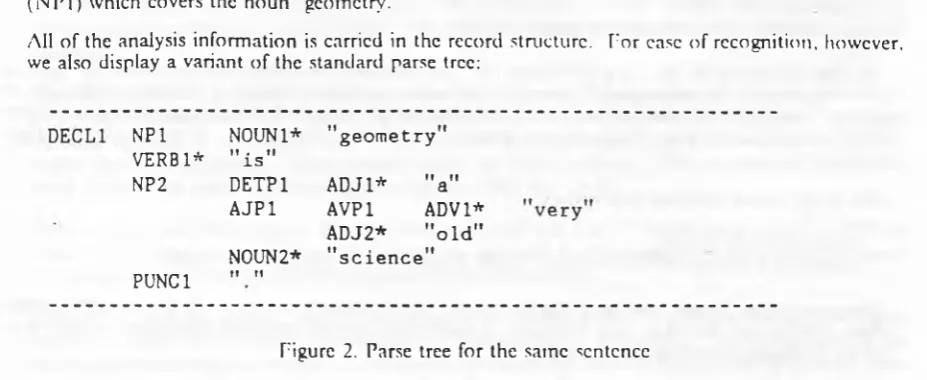
A l l o f t h e a n a l y s i s i n f o r m a t i o n is c a r r ie d in t h e r e c o r d s t r u c t u r e . F o r c a s e o f r e c o g n i t i o n , h o w e v e r , w e a l s o d i s p l a y a v a r i a n t o f t h e s t a n d a r d p a r s e tree:
NP1 N0UN1* "geometry" VERB 1* If I S* fl
NP2 DETP1 ADJ1* "a"
AJP1 AVPl ADV1*
ADJ2* "old" N0UN2* f t science. »» PUNC1 »» ii
Figure 2. Parse tree for the same sentence
Note that the start node presents the value of the SFGTYP2 attribute from Fig. I, plus a number (each node is numbered for easy reference). The other, fairly standard, node names are the values of the SCGTYP2 attributes in their corresponding records. Trees are produced by a routine that uses just five attributes from the record structure: PRM ODS, I IFAD, PSMOOS, SFGTYP2, and STR. Since such a tree is conventionally said to depict phrase- or constitucnt-structurc, it might be said that these five attributes make up the constituent structure for the parse.
More than constituent structure is contained in the records, however. During the operation of the grammar rules, attributes arc assigned that point to subject, object, indirect objcct, predicate nominative, etc. In other parlance, these might be assigned by "...a function that goes from the nodes of a tree into f-structure space" (Kaplan 1985, p. II). Figure I shows two examples, SU B J E C T and P R F D N O M . Such attributes, and their values, could be said to present the functional
structure. The T O PIC of the sentence is also computed, based on some exploratory work done in
Davison 1984. Other attributes will be added during further processing, and these attributes will define higher levels of analysis. Progress in the analysis seems not to involve jumping between levels, but rather a smooth accumulation (and sometimes an erasing) of attributes and values. Now, some people might object that the same analysis could be obtained by using subcategori zation frames (together, perhaps, with sclcctional features on NPs), cither as conditions on the rules or, within a lexicalist framework, as statements within the dictionary, to be honored by the rules. According to this way of thinking, we would control multiple parses by exercising valency infor mation, not by ignoring it. From experience, we have found this to be a dangerous path, for several reasons. The most forceful reason is that real text (at least, real FngJish text) just does not behave in the well-disciplined fashion that such specifications would require. If we really want to do broad-coverage parsing, then we have to be prepared for many imaginative uses of words to occur; and strict subcategorization docs not allow for that.
Strict subcategorization cxpccts, for example, that verbs will occur in well-defined contexts. "Give" should be cither transitive or ditransitivc, surely not intransitive. Hut what about the sentence I gave at the office"? It's no good saying that there is an "understood" NP; if the computational grammar depends on the prcscncc of at least one objcct in contcxt, then this sentence will fail to parse. And even though there arc subcatcgorizational differences between "go" and "know" (by our own earlier definitions), it is possible to use go" with a //^/-complement, as in:
I said, no. And then he goes, "See you later." or with a w/i-complcmcnt, as in:
We'll go whatever amount (i.e., bail) is necessary.
These real-life facts of language tend in one direction: stated in extreme form, any word can, and might, be used in any contcxt. Rut to mark every verb in the tcxicon with every possible
[image:4.563.49.513.68.258.2]egorization frame would be absurd, of course. And to add some sort of 'recovery ' procedures into the grammar would be costly. The most sensible way to regard subcategorization (valency frames) is as codified frequency information. A verb that is marked transitive is quite frequently used in its transitive sense -- that's all.
This docs not mean that we ignore the semantic implications of valencies. On the contrary, what we do is postpone the differentiation of word senses until after the initial syntactic sketch is com pleted. This strategy allows us to get our hands on any input string, assign it some (reasonable, we hope) structure, and then interpret the input, whatever it might be. Before making the inter pretation, however, the parse may have to pass through the rcattachmcnt component.
2. Semantic readjustment
No matter how clever the grammarian's exploitation of word order, word class, and morphological hooks is, there are many analyses in Fnglish that just will not yield a correct analysis from syntax alone. Among these are the correct attachment of prepositional phrases and of relative and other embedded clauses; the optimal structure of complex noun phrases; and the degree of structural ambiguity exhibited by coordinated elements (Langendocn, p.c.). There arc no markers, in Rnglish, that serve to disambiguate these constructions; the plain fact is that semantic (or even broader, contextual) information is required.
Consider the following parse, summarized in Pig. 3 by its tree structure. Where the correct structure cannot be determined by syntax, attachment is arbitrarily made to the closest available node, en couraging right branching.
DECL2 NP6
VERB2* AJP1
DETP7 NOUN9* PP1
was ADJ3* PP3
ADJ1* » » . ! _ . thist f re-measuring
PP2 PREP1* "of" DETP2 ADJ2* "the" NOUN 1* "land"
f t f t
necessary
PP4 PREP2* "due tor t DETP3 ADJ4* "the" AJP2 ADJ5* f t annual-Ii t N0UN2* t » overflowf i I I
PP5 PP6 PREP3* f t ofr f f
NP2 DETP4 ADJ6* t f . i thet t NP3 NOUN3* f t river. t t N0UN4* ffKT •Nile 1 11
? C0NJ1* f f , 11
and
NP4 DETP5 ADJ7* "the"
AJP3 ADJ8* i t consequent, i t NOUNS* t i i destroying. «»
PP7 PP8 PREP4* "of" DETP6 ADJ9* "the" N0UN6* "boundaries"
PP9 PP10 PREP5*
NP5 N0UN7*
N0UN8* "lands
»» c It
of ( f c f
farm
PUNC1
I i g u r e V I’ a r s c t ree f o r a s e n t e n c e w i t h s t r u c t u r a l a m b i g u i t y
Fhe question mark indicates doubt about the acceptability of the coordinate NP inside PP5: 'the river Nile and the consequent destroying of the boundaries of farm lands.'' Should NP4, "the consequent destroying..,'' be and-eel with NP2, "the river Nile," or with the NP in PP3, "the annual overflow../'?
Question marks are placed at various points in the parse tree by a routine that is sensitive to problematic constructions in English. We could have produced two separate analyses; but, given the large number of such attachment situations, this approach would have led straight to the fatal trap of proliferating parses. The question marks, in effect, collapse different possible parses, and allow for efficient handling of ambiguities (Jensen 1986, pp. 22-2.1).
Human readers of the sentence will not hesitate to say that the NP attachment shown in PP3 of Figure 3 is not the intended one; the attachment indicated by the question mark is what we want. Our problem is how to enable the computer to determine that.
Tlie sort of information that enables the right decision to be made, in this and similar cases, gen erally falls under the rubric of "background or commonscnsc knowledge. I he usual method for making such knowledge available to a computer program has been to hand-codc the relevant con cepts, in whatever format. Although some hand-coding will undoubtedly be nccessary and valu able, we approach the problem from another angle.
Written text is itself a rich source of information. It can be viewed a s a knowledge base; the lan guage that it is written in, even though this is a natural language, is a knowledge representation language. In particular, reference works like dictionaries actually contain a storehouse of commonscnse knowledge. We can parse the entries in an online dictionary with a syntactic gram mar. and retrieve a surprising amount of the information that is nccessary to resolve syntactic am biguities, like the one displayed in l;ig. 3 (Hinot and Jensen 1087, Jensen and Binot 1088).
I he problem presented in Fig. 3 reduces to a question: which of the following pairs is more likely?
■ overflow and destroying
• Nile and destroying
Hearing in mind the old adage that likes conjoin," we will consider that pair more likely whose terms can be more easily related through dictionary entries -- including both definitions arid exam ple sentences. (Das Gupta 1087 also uses dictionary entries for interpreting conjoined words.) Decisions on where to start these search procedures will ultimately be important, but here we avoid them. Assume that we start with the first pair, first word. The noun definition for "overflow'' in W7 begins:
overflow...n 1: a flowing over: IN U N D A T IO N
Here "inundation" is asserted to be a synonym for "overflow." I he noun "inundation" has no de finition of its own, but is merely listed under the verb "inundate
inundate...vt...: to cover with a flood: O V FR F I.O W
Ihe circularity of the synonym definitions is no problem, bccausc now we can infer something new about "overflow ": it involves the act of covering by means of a flood. I he definition of "flood" in W7 is not much help, but in LDOCE, the first example sentence quoted in the entry for the noun
"flood," when analyzed by PEG, takes us right where wc want to go:
flood..n... I... I he town was destroyed by the floods after the storm.
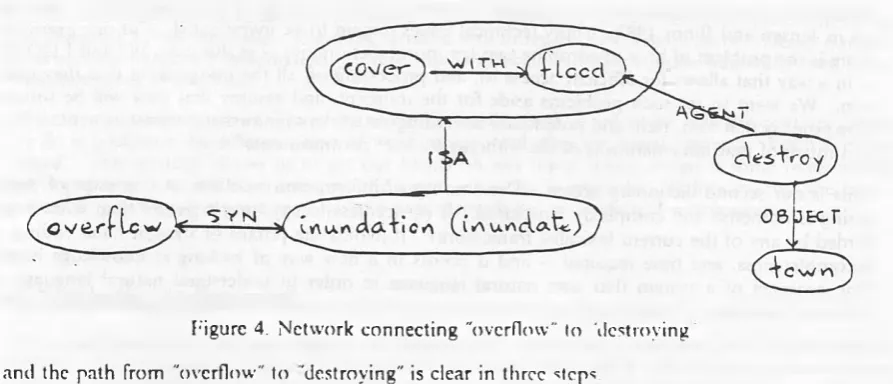
Focusing on only the relevant information, these dictionary entries present a small part of a con ceptual network:
Figure 4. Network connecting "overflow" to 'destroying and the path from "overflow" to "destroying" is clear in three steps
Any attempt to connect "Nile'' with destroying" is bound lo take longer. We can link "'Nile'' with "river" (this link is actually present in W7, in the Pronouncing (n/cttcer); but we still have to get from "river'' to "water," and then from "water" to "flood," and from flood" to "destroy'' (a total of four steps). The link between "water" and "flood" is also likely to incur a penalty, ; ince moving from "water" to flood" is difficult (i.e., flood" docs not appear in the definition of water"), al though moving in the reverse direction is easy ("water' docs appear in the definition of "flood "). On this basis, we can revise the analysis of the sentence in I ig. * to reflect the more likely coordi nate structure:
DECL2 NP6
VERB2*
AJP1
DETP7 N0UN9* PP1
was ADJ3* PP3
ADJ1* "this" "re-measuring" PP2 PREP 1* DETP2 ADJ2* N0UN1* "land"
necessary PP4
NP2
CCJNJ1* NP5
PREP2* DETP3 AJP2 N0UN2* PP5
"and" DETP5 AJP3 NOUN5* PP7
"of" "the"
"due to"
ADJ4* "the" ADJ5* "annual" "overflow"
PP6 NP3
PREP3* "of"
DETP4 ADJ6* "the" NP4 N0UN3* "river’ N0UN4* "Nile"
ADJ7- "the"
AD.J8* "consequent"
M i , . II
destroying
PP8 PREP4* "of" DETP6 ADJ9* "the" N0UN6* "boundaries"
PP9 PP10 PREPS* "of" NP6 N0UN7* "farm" N0UN8* "lands"
PUNC1
ligure 5. Readjusted parse for sentence in l :igure
[image:7.563.65.512.54.246.2]We have not yet implemented this particular disambiguation, although it is similar to work reported on in Jensen and Binot 1087. Many technical issues remain to be investigated. Tor one example, there is the problem of how to combine two (or more) dictionaries -- in this case, W7 and I .IXXT, - in a way that allows for efficient access to, and processing of, all the information that they con tain. We want to set such problems aside for the moment, and assume that they will be solved. The point is that vast, rich, and potentially rewarding networks of information exist in written text, and much of that information is of the hitherto elusive "commonsensc sort.
1 his is our second dictionary access. The amount of information available at this stage of proc essing is immense and complexly structured. It is, needless to say, much greater than what is af forded by any of the current lexicalist frameworks. It avoids the pitfalls of straight hand-coding - incompleteness, and time required -- and it points to a new wav of looking at knowlcdcc bases. The prospect of a system that uses natural language in order to understand natural language is pleasingly recursive. Words may yet prove to be the most adequate knowledge representation tools.
3. The paragraph as a discourse unit
Beyond the semantic readjustment component lies the whole world of connected text processing. This area is generally referred to as "discourse/' We take the paragraph (loosely defined) to be the first formal unit of discourse. It is the smallest reasonable domain of anaphora resolution, and the smallest domain in which topic and coherence can be reliably defined (Zadrozny and .lenscn 1989, p. 1, pp. 4(T).
The sentences in Figures 2 and 3 are actually part of a paragraph taken from a reading compre hension exercise in a well-known scries used by countlcss prospective collcgc students who want to prepare for the standard Scholastic Aptitude l'cst (Brownstein et al. I()87, pp. 144-5). Here is the complete text:
Geometry is a very old science. We are told by Herodotus, a Greek historian, that geometry had its origin in Fgypt along the banks of the river Nile. The first record we have of its study is found in a manuscript written by .Ahmcs, an Fgyptian scholar, about 1550 B . C . This manuscript is believed to be a copy of a treatise which dated back probably more than a thousand years, and describes the use of geometry at that time in a very crude form of sur veying or measurement. In fact, geometry, which means "earth measurement," received its name in this manner. ITiis re-measuring of the land was necessary due to the annual overflow of the river Nile and the consequent destroying of the boundaries of farm lands. This early geometry was very largely a list of rules or formulas for finding the areas of plane figures. Many of these rules were inaccurate, but, in the main, they were fairly satisfactory.
Figure 6. Paragraph from Barron 'a,flow to prepare for the S A T
I’FG parse trees for the paragraph in Fig. <S, sentence by sentence, are presented in Appendix A. If we arc going to make discourse sense of this text, however, we n^cd something more than a linear concatenation of syntactic sentence parses -- just as, in order to make syntactic sense out of a sen tence, w e need something more than a linear concatenation of w o r d s . A popular and effective way
of modeling this non-linear set of sentence relationships is as a network with nodes connected by arcs (e.g., Sowa 1984). We can label the nodes with content words and the arcs with function (or relation) names, for a simple beginning. For now, we use a fairly intuitive set of relation names, rather than take the time to explain precisely how each arc gets labeled.
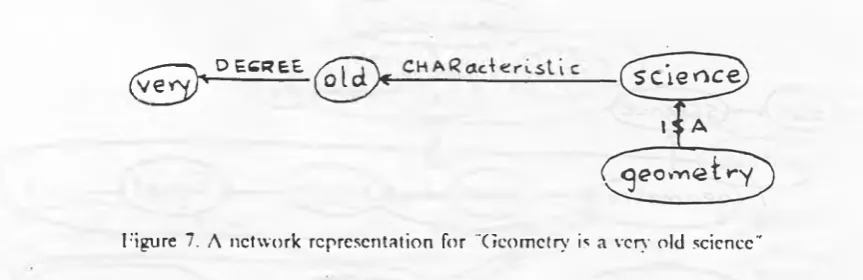
I he basic network for one sentence derives not directly from the surface syntactic structure, but from the underlying prcdicatc-argumcnt structure, which itself is derived from the surface structure, after all necessary readjustments have been made (Jensen forthcoming). Here is a network repre sentation, or model, for the first sentence in the geometry paragraph:
( C ^ ) ^ - s c g £ £ ( g d >
Figure 7. A network representation for "Geometry is a very old science"
To build a model for an entire paragraph (a P-modcl), the trick now is to map the network for each consecutive sentence onto the network for the prcccding sentence or sentences, joining nodes whenever possible. Stated simply, nodes can be joined when they mean the same thing. To a first approximation, sameness of meaning can be defined by:
1. use of the same word;
2. use of a synonym or paraphrase; 3. use of a pronoun reference;
4. use of zero anaphora (e.g., ellipsis in coordination).
Identification of "same word" is easy enough, and syntax will suffice to determine the referents for most cases of zero anaphora, and for many pronouns. However, there arc also many pronoun referents that cannot be syntactically resolved, and nothing in syntax will identify synonyms and paraphrases. This fact has prevented the development of a formal discourse model (Hond and Haves 1983, p. 16).
For a solution to the problems of pronoun reference and synonym identification, wc turn again to reference works written in natural language. Dictionaries and thesauri are full of such information. Here is part of the model that can be built for the paragraph in Fig. 6 It includes information from only the first, second, fifth, and sixth sentences in that paragraph. Fven so, many details have been left out:
[image:9.563.66.498.52.192.2]In order to build the link between "necessary" and "geometry," we have to know that "re-measuring of the land" is a paraphrase for "geometry." We are told that "earth measurement" is a synonym for "geometry" in the fifth sentence. Syntax allows us to say that "NO ON measurement" and "measurement of NO UN " arc possible equals. If we can establish that "earth measurement" and land re-measuring" arc equals, then the problem is solved. "Measurement" and "re-measuring" are transparently related, so the problem reduces to finding a link between "earth" and "land."
This, of course, is quite 5asy to find in dictionaries and thesauri. In LDOCE, one definition of "earth" contains land" as a synonym, and vice versa (actually, the first four definitions for "land' contain the word "earth" in a critical position in the parse). Similar conditions exist in W7. Roget's
Thesaurus (RT) lists "land" as a synonym for "earth" and "earth" as a synonym for "land." Q.E.D.
The intended purpose for paragraphs like the one we have been playing with, of course, is to test a reader's comprehension ability by requiring sensible answers to questions based on the informa tion in the paragraph. In Brownstcin et al., the first tcM conccrning our paragraph is
(1) The title below that best expresses the ideas of this passage is
and the possible solutions are
(A) Plane Figures
(B) Beginnings of Geometry (C) Manuscript of Ahmes (D) Surveying in E;,gypt
(E) Importance of the Study of Geometry
It-is tempting to ask whether a program that is able to build and manipulate the P-modcl in Fig. 8 could also answer (I) successfully
Without going into any formal explanation of topic definition, let’s assume that we can identify the node labeled "geometry" as the main idea, or topic, of the paragraph. (Note that it occupies a central position in the network.) So we discard all possible answers to (I) except for those that contain the word "geometry." This leaves us with two candidates. (B) and (f:). We then search the graph around the "geometry" node, looking for related nodes that express either "beginnings" or "importance of the study of." The latter alternative is not easy to find. But the "origin'' node can be immediately identified with "beginnings." In W7, the entry for beginning" has "origin" as a synonym, and the second sense definition for "origin" is 'rise, heginning, or derivation from a source..." Furthermore, origin" and "beginning" arc mutual synonyms in RT.
Resolving the referent for the possessive pronoun "its" in the second sentence of our test paragraph allQwed us to draw the arc between the "geometry" and "origin" nodes in Fig. 8, which we now la bel:
Figure (). Network for the answer to (I)
In this subgraph, the preferred answer to question (1) is clear: the title that best expresses the ideas in the test passage is (B), Beginnings of Geometry."
Obviously a tremendous amount of important detail has been left out in order to produce this blueprint for a formal model of a discourse unit. The challenges of implementation lie ahead. But the general structure seems promising, and most promising of all is the possibility of finding a re pository of background knowledge, already coded for us. in online natural language sources. Here is another comprehension question on the same paragraph:
(2) It can be inferred that one of the most important factors in the development of geometry as a science was
An answer must be picked from the following alternatives: (A) Ahmes' treatise
(B) the inaccuracy of the early rules and formulas (C) the annual flooding of the Nile Valley
(D) the destruction of farm crops by the Nile (F) an ancient manuscript copied by Ahmes
We suggest that the preferred answer to (2) can also bo found by using the I’-modcl in Fig. S, in conjunction with a good dictionary and thesaurus; and we leave this as an exercise for the interested reader.
4. Conclusion
1 his paper contains an overview of our broad-coverage NI, analysis system, including components that already exist, that are currently being worked on, and that arc projected for the future. Some aspects of our system that differentiate it from other NI, analysis systems are
• It is not modeled along the lines of any currently accepted linguistic theory; rather it is highly experimental and data-driven.
• Separate components are emerging from this experimental process; they coincidc roughly with the accepted linguistic levels: syntax, semantics, discourse.
PO 5 5
• Each component makes its own dictionary access or accesses, and the dictionaries associated with different components will differ in the type and amount of information they contain. • The written text of standard reference works is used as a repository for much of the background
or commonsense knowledge that is necessary to solve many analysis problems. This know ledge base can be accessed with the syntactic parser that forms one component of the system.
Acknowledgments
FTianks are due to Joel Fagan, George lleidom, I,ee Schwartz, and Lucy Vanderwende, who pro vided helpful comments and criticism. Any errors remain the author's responsibility.
References
Binot, J.-L. and K. Jensen. 1987. "A semantic expert using an online standard dictionary" in Pro ceedings o f MCA 1-87.
Bond, S.J. and J.R. Hayes. 108.1. "Cues people use to paragraph text." Dept, of Psychology, Carnegie Mellon University.
Brownstcin, S.C., M. Weiner, and S.W. Green. 1987. How (o prepare fo r ihe. Scholastic Aptitude
Test. New York, Barron's.
Das-Gupta, P. 1987. "Boolean interpretation of conjunctions for document retrieval" in Journal o f
the American Society fo r Information Science 38.4.245-254.
Davison, A. 1984. "Syntactic markedness and the definition of sentence topic" in Language
60.4.797-846.
Ileidorn, G.E. 1972. "Natural language Inputs to a Simulation Programming System." Ph.D. dissertation, Yale University.
Jensen, K. 1986. "PFG 1986: A broad-coverage computational syntax of English." Unpublished paper.
Jensen, K. 1987. "Binary rules and non-binary trees" in A. Manastcr-Ramcr (cd.), Mathematics o f
Language. Amsterdam, John Benjamins, pp. 65-86.
Jensen, K. forthcoming. "PEGASUS: deriving prcdicatc-argumcnt structures from a syntactic parse."
Jensen, K. and J.-L. Binot. 1987. "Disambiguating Prepositional Phrase Attachments by Using On-Line Dictionary Definitions." in CL 13.3-4.251-60.
Kaplan, R. 1985. "Three scductions of computational psycholinguistics" in P. Whitclock, M.M. Woods, ILL. Somers, R. Johnson, P. Bennett (cds.), Linguistic Theory and Computer
Applications. Ixmdon, Academic Press, 1987, pp. 140-81.
Longman Dictionary o f Contemporary English. 1078. Harlow and I ondon, I ongman Group Lim
ited.
Roget's 7'hesaurus o f English Words and Phrases. 1962. New York, St. Martin's Press.
Sowa, J.F. 1984. Conceptual Structures: Information Processing in M ind and Machine. Reading, MA; Addison-Weslcy.
IVehstcr's Seventh New Collegiate Dictionary. 1967. Springfield, Mass., G. & C. Mcrriam Co.
Zadrozny, W. and K. Jensen. 1080 "Semantics of paragraphs." Unpublished paper.
Appendix A
Sentence 1:
DECL1 N P 1 N0UN1* M geometry, it VERB 1* II . I S If
NP2 DETP1 ADJ1* "a"
AJP1 AVP1 ADVI* if veryit ADJ2* "old"
NOUN2* tt science. ft PUNC1 it if
Sentence 2:
DEC LI NP1 PRON1* t t wet t AUXP1 VERB 1* • t _ i t
are VERB2* "told"
PP1 PP2 PREP1* I f , byft N0UN1* "Herodotus" PUNC1 f t Jtf
NAPP0S1 DETP1 ADJ1* "a" NP2 N0UN2* "Greek1 N0UN3* t t i , . i t
historian PUNC2 f t ft
VP1 C0MPL1 "that"
NP3 N0UN4* f t geometry. ft VERB3* "had"
NP4 DETP2 ADJ2* ft . . itstt NOUN5* "originft
? PP3 PP4
NOUN6*
PREP2* "Egypt1
? ? PP5 PP6
DETP3 N0UN7* PP7
in
PREP3* "along” ADJ3* "the" "banks"
PP8 PREP4* "of" DETP4 ADJ4* "the" NPS N0UN8* "river’ N0UN9* "Nile"
PUNC3
S e n t e n c e 3:
DECL1 NP1 DETP1 ADJ1* "the" AJP1 ADJ2* "first" N0UN1* "record"
RELCL1 NP2 PRON1* "we" VERB1* "have"
PP1 PP2 PREP 1* "of" DETP2 ADJ3* "its" NOUN2* "study"
AUXP1 VERB2* "is" VERB3* "found"
PP3 PP4 PREP2* "in" DETP3 ADJ4* "a" N0UN3* "manuscript"
PTPRTCL1VERB4* "written"
? ? PP5 PP6 PREP3* "by"
N0UN4* "Ahmes"
PUNC1
NAPP0S1 DETP4 ADJ5* "an" NP3 N0UN5* "Egyptian" N0UN6* "scholar"
PUNC2
? ? ? ? PP7 PP8 PREP4* "about”
YEAR1* "1550"
LABEL1 N0UN7* "B.C." PUNC3
Se n t e n c e 4:
DECL1 NP1 DETP1 A D J 1 * i t h i si . ii
N 0U N1* n m a n u s c r i p t, .it
VP1 AUXP1 VERB1* u . iti s
VERB2 * " b e l i e v e d "
INFCL1 I N F T O l
VERB3*
NP2
" t o " " b e "
DETP2 N 0U N 2* P P I
" p r o b a b l y "
" t h a n "
" a t h o u s a n d "
C 0 N J 1 * " a n d "
VP2 VERB5* " d e s c r i b e s "
A D J 2 * it ita
m it c o p y
PP2 PREP 1* " o f "
DETP3 ADJ 3 * " a "
N0U N3* it. t r e a t i s e, . it
RELCL1 NP3 P R 0 N 1 * " w h i c h "
VERB4* " d a t e d "
AVP1 ADV1* " b a c k "
AVP2 AVP3 ADV2*
ADV3* " m o r e "
PP 3 PP4 P R E P 2*
QUANP1 A D J 4 *
N 0 U N 4 * " y e a r s '
PUNC1 " "
NP4 DETP4
N 0U N 5 *
A D J 5 *
M I t
u s e
" t h e "
PP5 PP6 P R E P 3* ff o fr - H
N 0 U N 6 * i t g e o m e t r y. u
. . t t
t i m e
? ? PP7 AVP4 ADV4* " a t t h a t
? ? ? PP8
DETP5
PR E P4*
A D J 6 *
f t . ft
m
" a "
A J P 1 AVP5
A D J 7 *
ADV5*
ft i tt
c r u d e
t t t t
v e r y
NOUN7 * i t cf o r mi »
PP9 P P 1 0
NP5
P R E P 5 *
N 0 U N 8 *
t t f i t
o f
" s u r v e y i n g "
? ? ? C 0 N J 2 *
NP6
i t t t
o r
N 0 U N 9 * " m e a s u r e m e n t "
PUNC2
S e n t e n c e 5:
PP1 PP2
N0U N1* PUNCl
PR EP1*
II r .11
f a c t f f »!
9
it . it
i n
NP1 N0U N2* ft g e o m e t r y, ff
PUNC2 ff yff
? RELCL1 NP2
VERB 1*
P R 0 N 1 *
it ii
m e a n s
" w h i c h ”
NP3 PUNC3
NP4 N 0U N 4* PUNC4
ff ft ff
N 0U N3* " e a r t h "
" m e a s u r e m e n t "
m i i» >
VERB2* II r e c e i v e d. ,11
NP5 DETP1
N 0U N5*
A D J 1 *
M n
n am e
i» , . m i t s
? PP3 PP4 PREP2 * i i . i i
m
DETP2 A D J 2 * M . , . i i
t h i s
N0U N6* " m a n n e rm
PUNC5
S e n t e n c e 6 :
DECL1 NP1 DETP1 A D J 1 * f t . t t h i s. f t
NOUNI* " r e - m e a s u r i n g "
PP1 PP2 P R E P 1* " o f "
DETP 2 A D J 2 * " t h e "
N0U N2* " l a n d "
VERB1* " w a s "
A J P 1 A D J 3 * it n e c e s s a r yu
PP3 PP4 P R E P 2* " d u e t o f f
DETP 3 A D J 4 * " t h e "
A J P 2 A D J 5 * a n n u a lf t
N0U N 3* " o v e r f l o w "
PP5 P P6 P R E P 3* f t o f, - f t
NP2 DETP4 A D J 6 * " t h e "
NP3 N 0U N 4* it r i v e r, M
N 0U N 5* l » v t • N i l e1 I I
? C 0 N J 1 * " a n d "
NP4 DETP5 A D J 7 * " t h e "
A J P 3 A D J 8 * " c o n s e q u e n t "
N 0U N 6* i id e s t r o y i n g, , . M
PP7 PP8 P R E P 4 * " o f "
DETP6 A D J 9 * " t h e "
NOUN7 * " b o u n d a r i e s "
PP9 P P 1 0 PR E P S*
NP5 N 0 U N 8 *
N 0 U N 9 * " l a n d s
PUNCl " . "
" o f "
"farm"
S e n t e n c e 7:
DECL1 NP1
VERB1* AVPl
NP2
ADJ1* "this" ADJ2* "early”
r* geometry. ii
ADV1* "very' "largely" ADJ3* "a" DETP1
AJP1
N0UN1*
f t ?»
was AVP2 ADV2* DETP2
NOUN2* "list"
PP1 PP2 PREP1* "of" NP3 N0UN3* "rules" C0NJ1* "or"
NP4 N0UN4* "formulas"
? PP3 PREP2 "for"
VERB2* "finding"
NP5 DETP3 ADJ4* "the" N0UN5* "areas"
PP4 PP5 PREP3*
AJP2 ADJ5* NOUN6* "figures
"of" "plane"
PUNC1
Sentence 8:
CMPD1 DECLI NP1 QUANP1 ADJ1* II many of, -lf DETP1 ADJ2* "these" N0UN1* ft rules-1 1i t
VERB1* t t i t
were
AJP1 ADJ3* " inaccurate" PUNC1 f t >ft
C0NJ1* C0NJ2* PUNC2
"but" If »t
9
DECL2 PP1 PP2 PREP1* I t m. I I DETP2 ADJ4* i i. , i t
the NOUN2* I t m a in_ . It
PUNC3 t t 9t t
? NP2
VERB2*
PRON1* t t t t
were
"they"
AJP2 AVPl ADV1* • i f fairly. i i t ADJ5* "satisfactory" PUNC4 t i i t