Best-First Surface Realization
S t e p h a n B u s e m a n n * D F K I G m b H S t u h l s a t z e n h a u s w e g 3
D-66123 S a a r b r i i c k e n
e m a i h b u s e m a n n @ d f k i , u n i - s b , de
A b s t r a c t
Current work in surface realization concen- trates on the use of general, abstract algo- rithms that interpret large, reversible gram- mars. Only little attention has been paid so far to the m a n y small and simple appli- cations that require coverage of a small sub- language at different degrees of sophistica- tion. The system T G / 2 described in this pa- per can be smoothly integrated with deep gen- eration processes, it integrates canned text, templates, and context-free rules into a sin- gle formalism, it allows for both textual and tabular output, and it can be parameterized according to linguistic preferences. These fea- tures are based on suitably restricted produc- tion system techniques and on a generic back- tracking regime.
1
M o t i v a t i o n
Current work in surface realization concen- trates on the use of general, abstract algo- rithms that interpret declaratively defined, non-directional grammars. It is claimed that this way, a g r a m m a r can be reused for parsing
*This work h a s b e e n s u p p o r t e d by a g r a n t from T h e Federal M i n i s t r y for R e s e a r c h a n d T e c h n o l o g y ( F K Z I T W 9402). I a m g r a t e f u l to Michael Wein, who i m p l e m e n t e d t h e i n t e r p r e t e r , a n d to J a n A l e x a n - d e r s s o n for i n f l u e n t i a l work on a p r e v i o u s version of t h e s y s t e m . Finally, I wish to t h a n k two a n o n y m o u s reviewers for useful suggestions. All errors c o n t a i n e d
in t h i s p a p e r are m y own.
and generation, or a generator can interpret different g r a m m a r s (e.g. in machine transla- tion). A prominent example for this type of abstract algorithm is semantic-head-driven generation [Shieber et al., 1990] that has been used with HPSG, CUG, DCG and several oth- er formalisms.
• can be smoothly integrated with 'deep' generation processes,
• integrates canned text, templates, and context-free rules into a single formalism, • allows for both textual and tabular out-
put,
• efficiently reuses generated substrings for additional solutions, and
• can be parameterized according to lin- guistic properties (regarding style, gram- mar, fine-grained rhetorics etc.).
TG/2 is based on restricted production sys- tem techniques that preserve modularity of processing and linguistic knowledge, hence making the system transparent and reusable for various applications. Production systems have been used both for modeling human thought (e.g. [Newell, 1973]) and for the con- struction of knowledge-based expert systems (e.g. [Shortliffe, 1976]). In spite of the modu- larity gained by separating the rule basis from the interpreter, production systems have dis- appeared from the focus of current research because of their limited transparency caused by various types of side effects. In particu- lar, side effects could modify the data base in such a way that other rules become applicable [Davis and King, 1977].
However, precondition-action pairs can be used in a more restricted way, preserving transparency by disallowing side effects that affect the database. In T G / 2 preconditions are tests over the database contents (the gen- erator's input structure), and actions typical- ly lead to a new subset of rules the applicabil- itv of which would be tested on some selected portion of the database. By constraining the effects of production rules in such a way, the disadvantages of early production systems are avoided. At the same time, considerable flex- ibility is maintained with regard to linguistic knowledge used. A production rule may
• involve a direct mapping to surface forms (canned text),
• require to fill in some missing portion from a surface text (template), or • induce the application of other rules
(classical grammar rules)
Early template-based generation methods have correctly been criticized for beeing too inflexible to account adequately for the com- municative and rhetorical demands of many applications. On the other hand, templates have been successfully used when these de- mands could be hard-wired into the rules. In T G / 2 the rule writer can choose her degree of abstraction according to the task at hand. She can freely intermix all kinds of rules.
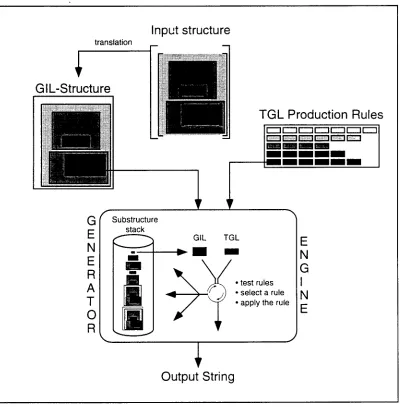
The rest of the paper is organized as fol- lows. T G / 2 assumes as its input a predicate- argument structure, but does not require any particular format. Rather, a separate transla- tion step is included that translates the out- put of feeding components into expressions of the Generator Interface Language (GIL) (Section 2). In Section 3 the formalism TGL (Template Generation Language) for produc- tion rules is introduced. The properties of TGL allow for efficient generation of all pos- sible solutions in any order. The TGL inter- preter and its generic backtracking regime are presented in Section 4. It is used to param- eterize T G / 2 by inducing an order in which the solutions are generated (Section 5).
Figure 1 gives an overview of the system and its components.
2
T h e G e n e r a t i o n Interface
L a n g u a g e (GIL)
Input structure
translationG IL-Structure
f
G Substructure
stack
i -
t ~ GIL
N
E
i
= m mT
J
o
m
R
TGL Production Rules
l~l EZ3 I---I r--11EE3 I'--I r~l m m ~ m m u m m m
m m m m m - - m m m m m m
TGL E
• test rules • select a rule • apply the rule
Output String
N
G
I
N
E
Figure 1: Overview of the system T G / 2 .
is first translated into GIL before being pro- cessed. It is of considerable practical benefit to keep the rule basis as independent as possi- ble from external conditions (such as changes to the o u t p u t specification of the feeding sys- tem).
GIL is designed to be a target language suited for deep generation processes. Similar aims have been pursued with the development of the Sentence Plan Language (SPL) [Kasper and V'hitney, 1989] that is used in a variety of generation systems. Like SPL, GIL assumes only little grammatical information. GIL can
represent DAG-like feature structures. Fig- ure 2 contains a sample GIL expression. The example shows the major language elements: • The top level consists of a speech act predicate and arguments for author, ad- dressee and t h e m e (the speechact prop- er).
• Discourse objects can be assigned unique constants (I.D) that denote SETs of dis- course objects.
[image:3.596.77.480.106.513.2][(PRED request)
(HEARER [(ID refo365) (SET < nussbaum >)]) (SPEAKER [(ID refo752) (SET < digisec >)])
(THEME [(SMOOD [(TOPIC #i) (MODALITY unmarked) (TIME pres)]) (PRED meet)
(DREF [(ID refo610) (SET < meetl >)]) (ARGS < #1= [(ROLE agent)
(CARD single)
(CONTENT [(DREF [(ID refo621) (SET < zweig >)]) (QFORCE noquant)
(PRED humname)
(NAME [(TITLE \"Prof.\") (SURNAME \"Zweig\") (SORT female)])])], [(ROLE patient)
(CARD single)
(CONTENT [(DREF [(ID refo365) (SET < nussbaum >)]) (QFORCE iota)
(PRED object)])] >)
(TIME-ADJ [(ROLE on) (CONTENT [(WEEKDAY 5)])])])]
Figure 2: A sample GIL input structure (Prof. Zweig will Sic am Freitag treffen [Prof. Zweig wants to meet you on Friday]. < and > are list delimiters; # denotes coreferences.
cluding sentence type, time, a specifica- tion of which constituents to topicalize in a German declarative sentence, etc.
• The predicate argument structure is re- flected by corresponding features: ARGS contains a list of arguments.
• Different sorts of free temporal and local adjuncts can be specified by correspond- ing features. In Figure 2, a temporal ad- j u n c t is represented under TIME-ADJ.
• Arguments and, in part, adjuncts are specified for their role, for cardinal- ity, for quantificational force (under C0NTENT.QFORCE), and further details such as name strings and natural gender.
• Temporal adjuncts relate to some context (e.g. tomorrow) or are indexical (e.g. on Wednesday, February 7, 1996). All com- mon combinations in G e r m a n are cov- ered.
3
The Template Generation
Language (TGL)
T G L defines a general format for expressing production rules as precondition-action pairs (cf. Figure 3). A T G L rule is applicable if its preconditions are met. A T G L rule is suc- cessfully applied, if the action part has been executed without failure. Failure to apply a T G L rule signals that the rule does not cover the portion of the input structure s u b m i t t e d to it.
[image:4.596.110.469.106.355.2]<rule>
<tgl-rule>
<category>
<template>
::= (DEFPRODUCTION <string> <tgl-rule>)
::= (:PRECOND (:CAT <category> :TEST (<lisp-code>+)) :ACTIONS (:TEMPLATE <template>+
{:SIDE-EFFECTS <lisp-code>}
{:CONSTRAINT < f e a t u r e - e q u a t i o n > + } ) )
::= TXT I S l VP I NP J PP ] PPdur ] INF J ADJ ] ...
::= (:RULE <category> <lisp-code>) ] (:0PTRULE <category> <lisp-code>) I
(:FUN <lisp-code>) I <string>
Figure 3: An excerpt of T G L Syntax.
material in the GIL input structure (under THEME. TIME-ADJ).
Every T G L rule has a unique name, denot- ed by the initial string. This name is used for expressing preferences on alternative rules (cf. Section 5).
C a t e g o r y i The categories can be defined as in a context-free grammar. Correspond- ingly, categories are used for rule selec- tion (see below). T h e y ensure t h a t a set of T G L rules possesses a context-free backbone.
T e s t : The Lisp code under : TEST is a boolean predicate (usually about properties of the portion of input structure under investi- gation or about the state of some mem- ory). In the sample rule, an argument is required t h a t fills the patient role.
T e m p l a t e : Actions under :TEMPLATE 1 in- clude the selection of other rules ( : RULE, : 0PTRULE), executing a function (:FUN), or returning an ASCII string as a (par- tial) result.
W h e n selecting other rules by virtue of a category, a Lisp function is called t h a t
1The notion of template is preserved for histori- cal reasons: the predecessor system TG/1 was strictly template-based,
identifies the relevant portion of the in- put s t r u c t u r e for which a candidate rule must pass its associated tests. In Fig- ure 4, the first action selects all rules with category NP; the relevant substructure is the a r g u m e n t filling the patient role (cf. the second element of the ARGS list in Fig- ure 2). If there is no such substructures an error is signalled 2 unless an 0PTRULE slot (for "optional rule") was executed. In this case, processing continues with- out results from t h a t slot.
Functions must r e t u r n an ASCII string. T h e y are mostly used for word inflection; otherwise, for G e r m a n every inflection- al variant would have to be encoded as a rule. T G / 2 uses the morphological inflec- tion c o m p o n e n t M O R P H I X [Finkler and Neumann, 1988].
S i d e e f f e c t s : T h e Lisp code under : SIDE-EFFECTS is a function whose value is ignored. It accounts for non-local de- pendencies between substructures, such as u p d a t e s of a discourse memory. Note t h a t these effects can be traced and un- done in the case of backtracking.
[image:5.596.105.432.94.319.2](defproduction "VPinf with temp/loc adjuncts" (:PRECOND (:CAT VP
:TEST ((role-filler-p 'patient)))
:ACTIONS (:TEMPLATE (:RULE NP (role-filler 'patient)) (:0PTRULE PP (temp-adjunct)) (:0PTRULE PPdur (temp-duration)) (:0PTRULE PP (lot-adjunct)) (:RULE INF (theme))
:CONSTRAINTS (CASE (NP) :VAL 'akk))))
Figure 4: A sample production rule for a VP with an infinitive verb form placed at the end.
C o n s t r a i n t s : Agreement relations are en-
coded into the rules by virtue of a PATR style [Shieber et al., 1983] feature per- colation mechanism. The rules can be a n n o t a t e d by equations that either as- sert equality of a feature's value at two or more constituents or introduce a fea- ture value at a constituent. Attempt- ing to overwrite a feature specification yields an error. In Figure 4, the right- hand side constituent NP is assigned ac- cusative case. Any of these effects are subject to backtracking.
Using TGL, small task- and domain-specific g r a m m a r s can be written quickly. For in- stance, in the domain of appointment schedul- ing the system COSMA [Busemann et al., 1994] has to accept, reject, modify, or re- fine suggested meeting dates via email. The sublanguage encoded in TGL only needs a few speech acts, about twenty sentential tem- plates, and a complete account of G e r m a n date expressions. Moreover, formal as well as informal opening and closing phrases for emails are covered.
Larger g r a m m a r s may become difficult to maintain unless special care is taken by the g r a m m a r writer to preserve a global struc- ture of rules, both by defining suitable cat- egories and by documenting the rules. TGL rules are presently written using a text editor. A specialized T G L g r a m m a r editor could im- prove the development and the organization of
g r a m m a r s considerably. Syntactic correctness is checked at compile-time by an LR-Parser generated by Zebu [Laubsch, 1992] on the ba- sis of a BNF syntax for TGL.
4
An interpreter with
generic backtracking
T G / 2 has a simple interpretation proce- dure that corresponds to the classical three- step evaluation cycle in production systems (matching, conflict resolution, firing) [Davis and King, 1977]. T h e algorithm receives a GIL structure as its input and uses a distin- guished category, TXT, to start from.
1. M a t c h i n g : Select all rules carrying the current category. Execute the tests for each of these rules on the input structure and add those passing their test to the conflict set.
2. C o n f l i c t r e s o l u t i o n : Select an element from the conflict set.
3. F i r i n g : Execute its side effect code (if any). Evaluate its constraints (if any). For each action part, read the catego- ry, determine the s u b s t r u c t u r e of the in- put by evaluating the associated func- tion, and goto 1.
B1 /32
B2~ [
pre context ego post context
st ~\ -- {s2i[1 _< i _<
Isll}
s3.v2.ss .51.v1.83 ~? = {s4jll _< j _<IB21}
ss
st.Vl.sa's5j = {s6kll _< k < IB2,1}w h e r e 84j -~- 85j'V21 "87j
87j "88
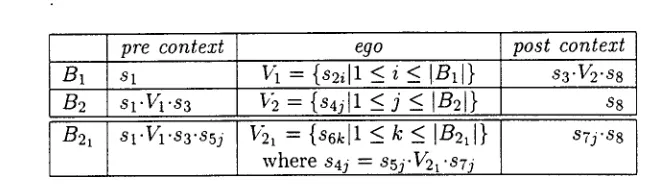
Figure 5: Table of Backtrack Points: B2 is encountered outside of the ego of Bt. B2~ is encountered inside the ego of B2.
left to right. Failure of executing some action causes the rule to be backtracked.
The interpreter yields all solutions the g r a m m a r can generate. It a t t e m p t s to gener- ate and o u t p u t a first solution, producing pos- sible alternatives only on external demand. Any alternative is based on backtracking at least one rule. Backtrack points correspond to conflict sets containing more than one ele- ment.
Backtracking may turn out to be inefficient if it involves r e c o m p u t a t i o n of previously gen- erated substrings. In T G / 2 this effort is re- duced considerably because it is only neces- sary to recompute the part licensed by the newly selected rule. W h a t has been generat- ed before or after it remains constant (modulo some word forms that need to agree with new material) and can thus be reused for subse- quent solutions. This is possible due to the design properties of TGL: rules cannot irre- vocably influence other parts of the solution. In particular, the context-free backbone im- plicit in any solution and the restrictions to side effects mentioned above keep the struc- tural effects of T G L rules local.
In the sequel, technical aspects of the back- tracking regime are discussed. Let us as- sume that the interpreter c o m p u t e a back- track point. Let us call the sequence of strings generated by previous actions its pre-context, the set of string sequences generated from the elements of the conflict set its ego, and the se- quence of strings generated from subsequent actions its post-context. For every ego, the
pre- or the post context may be empty. Each time a backtrack point is encountered during processing, an entry into a global table is made by specifying its pre-context (which is already known due to the left-to-right process- ing), a variable for the ego (which will collect the sequences of strings generated by the el- ements of the conflict set), and a variable for the post-context (which is unknown so far). a Figure 5 shows the state of a sample table comprising three backtrack points after all so- lutions have been computed. The ego vari- able is shown using indices running over the elements of the respective conflict sets. The operator '.' denotes concatenation of strings with strings or sets of strings, delivering all possible combinations.
After the first solution has been found (i.e.
Sl"S21 '83"851 "861"871 "S8), every ego set contains one element. The post contexts for all back- track points can be entered into the table.
The next solution is generated by selecting anyone of the backtrack points and adding a new element to the ego set. At the same time. all other entries of the table are updated, and the set of additional solutions can be read off straightforwardly from the entry of the back- track point just processed. Assume, for in- stance, that B21 generates a second solution. thus causing V2~ to have two elements. We then get Sl'S21"83"851"862"871"88. N o w assume that Bi also generates a second solution. This
[image:7.596.121.447.105.197.2]directly yields two more solutions since the post context of B1 includes, via 84j, the two elements of V21.
This way only the alternative elements of a conflict set have to be expanded from scratch. All other material can be reused. This is highly efficient for backtrack points introduc- ing "cheap" alternatives (e.g. different word- ings). Since the ego must be recomputed from scratch, much less is gained with backtrack points occurring at a higher level (e.g. active vs. passive sentence). In order to avoid hav- ing to recompute successfully generated par- tial results within the ego, such results are stored during processing together with the part of the input structure and the current category. T h e y can be reused when passing an applicability test that requires the stored category and input structure to be identical to the current ones.
The backtracking approach described is based on the assumption that any constraints introduced for some ego can be undone and recomputed on the basis of rules generating an alternative ego. Clearly, features instanti- ated for some ego may have effects onto the pre- or post-context. If an agreement feature receives a different value during backtracking and it relates to material outside the ego, in- flectional processes for that material must be c o m p u t e d again. These cases can be detected by maintaining a trace of all constraint ac- tions. The r e c o m p u t a t i o n is rendered possi- ble by adding, in addition to storing terminal strings in the table, the underlying calls to the inflection component as well.
5
P a r a m e t e r i z a t i o n
Parameterization of T G / 2 is based on spec- ifying the way how the generic backtracking regime should operate. It can be influenced with regard to
• the element in the conflict set to be pro- cessed next, and
• the backtrack point to be processed next. Both possibilities taken together allow a sys- tem that feeds T G / 2 to specify linguistic cri- teria of preferred solutions to be generated first.
The criteria are defined in terms of rule names, and a criterion is fulfilled if some cor- responding rule is successfully applied. We call such a rule c-rule. T G / 2 implements a simple strategy that processes those back- track points first that have conflict sets con- taining c-rules, and preferrably choses a c-rule from a conflict set. W h e n applied incremen- tally, this procedure yields all solutions fulfill- ing (some of) the criteria first.
It would be desirable to see the solution ful- filling most criteria first. However, incremen- tal application enforces decisions to be taken locally for each conflict set. Any c-rule chosen may be the last one in a derivation, whereas chosing a non-c-rule may open up further op- portunities of chosing c-rules. These limits are due to a lack of look-ahead information: it is not known in general which decisions will have to be taken until all solutions have been generated. 4 Clearly, sacrificing incrementali- ty is not what should be desired although it may be acceptable for some applications. The drawbacks include a loss of efficiency and run- time. This leaves us with two possible direc- tions that can lead to improved results.
A n a l y z i n g d e p e n d e n c i e s o f c r i t e r i a :
The solution fulfilling most criteria is gener- ated first if sets of mutually independent cri- teria are applied: fulfilling one criterion must not exclude the applicability of another one. unless two criteria correspond to rules of the same conflict set. In this case, they must allow for the the application of the same subset of criteria. If these conditions are met, chosing a c-rule from every conflict set, if possible, will lead to a globally best solution first. There is, however, the practical problem that the con- ditions on the criteria can only be fulfilled by
analyzing, and possibly modifying, the TGL g r a m m a r used. This contradicts the idea of having the user specify her preferences inde- pendent of T G / 2 properties.
Learning dependencies of criteria: Missing look-ahead information could be ac- quired automatically by exploiting the deriva- tional history of previously generated texts. For every applied rule, the set of c-rules ap- plied later in the current subtree of a deriva- tion is stored. From this information, we can derive off-line for any set of criteria which c- rules have applied in the corpus and how of- ten each c-rule has applied within a deriva- tion. C o m p u t i n g such information from the context-free backbone of T G L g r a m m a r s in- stead would be less effective since it neglects the drastic filtering effects of preconditions. However. checking the g r a m m a r this way in- dicates which c-rules will not appear in some subtree.
During processing, T G / 2 can then judge the global impact of chosing the locally best c-rule and decide to fulfill or violate a cri- terion. The success of this m e t h o d depends on how well the derivation under construction fits with the sample data. The more examples the system observes, the more reliable will be its decisions.
The latter approach is in fact independent on how the criteria influence each other. In addition, it can be extended to cope with
weighted criteria. A weight is specified by the user (e.g. a feeding system) and expresses the relative importance of the criterion being ful- filled in a solution. T G / 2 would give prefer- ence to derivations leading to the m a x i m u m global weight. The global weight of a solution is the sum of the c-rule weights, each divided by the n u m b e r of times the c-rule occurs.
However, different GIL structures may, for a T G L rule, lead to different sets of follow-up c-rules. This causes the decision to be non- deterministic unless the reasons for the dif- ference are learned and applied to the case at hand. We must leave it to future research to identify a r d apply suitable learning algo-
rithms to solving this problem.
Criteria have been implemented for choos- ing a language, for chosing between active and passive sentences, for preferring paratactical over hypotactical style, and for choice of for- mal vs. informal wordings. Additional uses could include some rhetorical structuring (e.g. order of nucleus and satellites in RST-based analyses [Mann and Thompson. 1988]).
The approach presented offers a technical framework that allows a deep generation pro- cess to abstract away from many idiosyn- crasies of linguistic knowledge by virtue of meaningful weighting functions. Ideally, these functions must implement a theory of how mutual dependencies of criteria should be dealt with. For instance, lexical choice and constituent order constraints may suggest the use of passive voice (cf. e.g. [Danlos, 1987]). It is a yet open question whether such a theory can be encoded by weights. However, for some sets of preferences, this approach has proven to be sufficient and very useful.
6
C o n c l u s i o n
In this contribution, we have introduced T G / 2 , a production-rule based surface gen- erator that can be parameterized to generate the best solutions first. The rules are encoded in TGL, a language that allows the definition of canned text items, templates, and context- free rules within the same formalism. TGL rules can, and should, be written with gen- eration in mind, i.e. the goal of reversibility of g r a m m a r s p u r s u e d with m a n y constraint- based approaches has been sacrificed. This is justified because of the limited usefulness of large reversible g r a m m a r s for generation.
instance, time and date descriptions encod- ed for the COSMA domain can be reused in other TG/2 applications. On the other hand, TGL sublanguage grammars can be devel- oped using existing resources. For instance, suitable fragments of context-free grammars translated into TGL could be augmented by the domain and task specific properties need- ed. Practical experience must show whether this approach saves effort.
The system is fully implemented in Allegro Common Lisp and runs on different platforms (SUN workstations, PC, Macintosh). Com- puting the first solution of average-length sen- tences (10-20 words) takes between one and three seconds on a SUN SS 20. TG/2 is being used in the domain of appointment scheduling within DFKI's COSMA system. In the near future, the system will be used within an NL- based information kiosk, where information about environmental data must be provided in both German and French language, includ- ing tabular presentations if measurements of several substances are involved.
R e f e r e n c e s
[Busemann et al., 1994] S. Busemann, S. Oe-
pen, E. Hinkelman, G. Neumann, and
H. Uszkoreit. COSMA-multi-participant
NL interaction for appointment scheduling. Research Report RR-94-34, DFKI, Saar- brficken, 1994.
[Danlos, 1987] L. Danlos. The Linguistic Ba-
sis of Text Generation. Cambridge Univer- sity Press, Cambridge, 1987.
[Davis and King, 1977] R. Davis and J. King.
An overview of production systems. In
E. W. Elcock and D. Michie. editors, Ma-
chine Intelligence 8, pages 300-332. Ellis Horwood, Chichester, 1977.
[Finkler and Neumann, 1988] W. Finkler and G. Neumann. Morphix: A fast realizatiop of a classification-based approach to mor-
phology. In H. Trost, editor, Proc. der
4. dJsterreichischen Artificial-Intelligence Tagung, pages 11-19, Berlin, August 1988. Springer.
[Kasper and Whitney, 1989] R. Kasper and R. Whitney. SPL: A sentence plan language for text generation. Technical report, USC- ISI. Marina del Rey, 1989.
[Laubsch, 1992] J. Laubsch. Zebu: A Tool for Specifying Reversible LALR(1) Parsers. Technical Report HPL-92-147. Hewlett- Packard Labs, Palo Alto, CA, July 1992.
[Mann and Thompson, 1988] W. C. Mann and S. A. Thompson. Rhetorical structure theory: Toward a functional theory of text
organization. Text, 8(3):243-281. 1988.
[Newell, 1973] A. Newell. Production sys-
tems: Models of control structures. In
W. G. Chase, editor, Visual Informa-
tion Processing, pages 463-526. Academic
Press, New York, 1973.
[Russell et al., 1990] G. Russell. S. Warwick,
and J. Carroll. Asymmetry in parsing
and generating with unification grammars:
Case studies from ELU. In Proc. 28th A CL,
pages 205-211., Pittsburgh, 1990.
[Shieber et al., 1983] S. Shieber, H. Uszko-
reit, F. Pereira, J. Robinson, and M. Tyson. The formalism and implementation of PATR-II. In B. J. Grosz and M. E. Stick-
el, editors, Research on Interactive Acqui-
sition and Use of Knowledge, pages 39-79. AI Center, SRI International, Menlo Park. CA, 1983.
[Shieber et al., 1990] S. Shieber, G. van
Noord, R. C. Moore, and F. Pereira. A semantic-head-driven generation algorithm
for unification-based formalisms. Compu-
tational Linguistics, 16(1):30-42, 1990.
[Shortliffe, 1976] E. H. Shortliffe. Computer-
based Medical Consultations: MYCIN. El-