Metagrammars: a new implementation for FTAG
S´ebastien Barrier, Nicolas Barrier
Laboratoire de linguistique formelle
Case Postale 7031
2, place Jussieu 75251 Paris Cedex 05, France
sebastien,nicolas
[email protected]
Abstract
This paper describes work on creating elemen-tary trees for adjective and predicative noun families (Barrier, 2002; Barrier and Barrier, 2003) using Metagrammars, for the FTAG grammar (Abeill´e, 1991; Abeill´e, 2002). Based on the Candito’s work on Metagrammars (Can-dito, 1996; Can(Can-dito, 1999a), it adds a fourth dimension, specially designed for word order specification.
1
The metagrammar compiler
Metagrammars represent a TAG as a multiple inheritance network, whose classes specify syntactic properties. An important aspect of classes is that they are all related to one another. Inheritance enables classes that are logi-cally related to one another to share the behaviors and attributes that they have in common.
Our metagrammar imposes an overall organization for syntactic data and formelizes the well-formedness con-ditions on elementary tree sketches (Vijay-Shanker and Schabes, 1992; Rogers and Vijay-Shanker, 1994).
Each syntactic property of the hand-written inheritance network – the hierarchy – is declared as a complete syn-tactic set of partial descriptions. Those partial descrip-tions can be seen as syntactic constraints (dominance, lin-ear precedence, ...) which may leave underspecified the relation between two nodes – the relation can be further explained by adding constraints in sub-classes of the net-work.
In concrete terms, data are defined as global variables augmented with specific meta-features, constraining for instance the possible part of speech of a node, or function for argument ones.
Structures sharing the same initial subcategorization frame may only differ in the surface realization of the
fi-nal syntactic function of the arguments nodes, according to their redistribution.
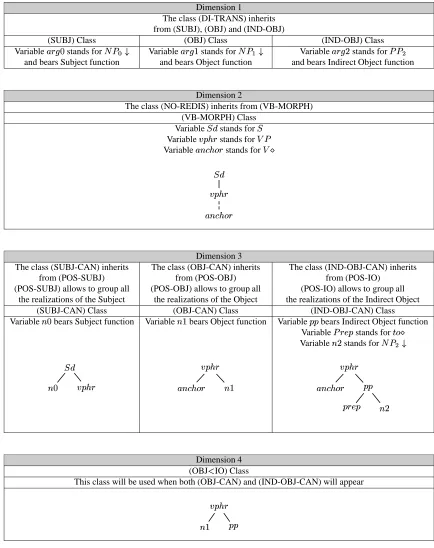
The hand-written hierarchy was initially divided into 3 dimensions, and has been more recently extended to 4 dimensions (Barrier and Barrier, 2003):
Dimension 1 : initial subcategorization.
Dimension 2 : redistribution of functions.
Dimension 3 : Surface realizations of syntactic func-tions.
Dimension 4 : word order specification of surface realizations of syntactic functions.
Contrary to (Vijay-Shanker and Schabes, 1992), we do not have explicit lexical rules: diathesis alternations are represented by classes of dimension 2, whereas marked and unmarked cases are represented by classes of dimen-sion 3. Dimendimen-sion 4 allows to express word order in a directly readable and not confusing way: classes of di-mension 1 and 2 were clearly inappropriate (word order has nothing to deal with declaration of grammatical func-tions), whereas classes of dimension 3 couldn’t predict the existence or the lack of another argument.
Dimension 1 The class (DI-TRANS) inherits from (SUBJ), (OBJ) and (IND-OBJ)
(SUBJ) Class (OBJ) Class (IND-OBJ) Class
Variable stands for Variable stands for Variable stands for
and bears Subject function and bears Object function and bears Indirect Object function
Dimension 2
The class (NO-REDIS) inherits from (VB-MORPH) (VB-MORPH) Class
Variable stands for
Variable stands for !
Variable"$#%'&( stands for )
*
"$#'&(
Dimension 3
The class (SUBJ-CAN) inherits The class (OBJ-CAN) inherits The class (IND-OBJ-CAN) inherits
from (POS-SUBJ) from (POS-OBJ) from (POS-IO)
(POS-SUBJ) allows to group all (POS-OBJ) allows to group all (POS-IO) allows to group all the realizations of the Subject the realizations of the Object the realizations of the Indirect Object
(SUBJ-CAN) Class (OBJ-CAN) Class (IND-OBJ-CAN) Class
Variable"$ bears Subject function Variable" bears Object function Variable+ bears Indirect Object function
Variable,.-/ stands for01&()
Variable"2 stands for 34
"$
"$#%'&( "
"$#%'&. +
'.-/ "2
Dimension 4 (OBJ5 IO) Class
This class will be used when both (OBJ-CAN) and (IND-OBJ-CAN) will appear
*
[image:2.612.87.521.112.660.2]"
An inheritance hierarchy such as the one shown in Ta-ble 1, allows to represent the relevant tree sketch for the english sentence Max gives a book to Peter. It will be compiled out of an initial subcategorization with subject, direct object and indirect object (dimension 1), an active canonical redistribution (dimension2), canonical realiza-tions of subject, direct object and indirect object (dimen-sion 3), and a special word order, specifying indirect ob-ject follows direct obob-ject (dimension 4).
The compiler will automatically cross (DI-TRANS), (NO-REDIS), (SUBJ-CAN), (OBJ-CAN) and (IND-OBJ-CAN) classes. As (OBJ-CAN) and (IND-OBJ-CAN) are crossed, (OBJ IO) will also be crossed with the other classes. The resulting tree sketch will be the conjunction of all quasi-tree descriptions contained in each class. The nodes with same variables will unify; the variables with same function will also unfify.
[image:3.612.118.251.295.409.2]
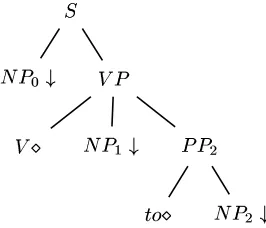
Figure 1: Elementary tree for Mary gives a book to Peter
Note that the metagrammar compiler makes use of variables as global variables. There is no way to use local variables. Linear precedence can’t be expressed without reference to dominance.
The Metagrammar compiler we use was first devel-oped by (Candito, 1999a) in Lucid Common Lisp and has been in part reimplemented in CLISP by (Barrier, 2002). It generates tree sketches in both XTAG or TAGML2 for-mat with t-feature structures (see below).
2
Choices and implementation
2.1 Linguistics principles and general choices
As mentionned in (Abeill´e et al., 2000), FTAG elemen-tary trees respect the following well-formedness princi-ples :
Strict lexicalization: all elementary trees are an-chored by at least one lexical element (the empty string cannot anchor a tree by itself)
Semantic consistency: no elementary tree is seman-tically void
Semantic minimality: elementary trees correspond to no more than one semantic unit
Predicate argument cooccurence principle : an ele-mentary tree is the minimal syntactic structure that includes a leaf node for each realized semantic argu-ment of the anchor(s)
Semantic minimality and consistency imply that func-tion words appear as co-anchors.
Most of the linguistic analyses follow those of (Abeill´e, 1991; Abeill´e, 2002) (except that clitic argu-ments are substituted and not adjoined), complemented by (Candito, 1999a). We dispense with most empty cate-gories, especially in the case of extraction. Semantically void (or non autonomous) elements, such as complemen-tizers, argument marking prepositions or idiom chunks are co-anchors in the elementary tree of their governing predicate.
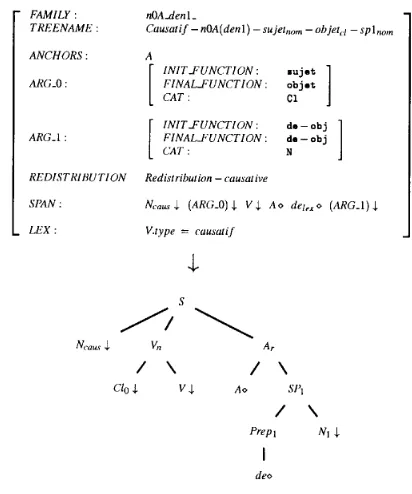
Passive is characterized by a particular morphology, with a substitution node for the auxiliary verb. Causative constructions are analyzed as complex predicates, with a flat structure, with a substitution node for the causative verb.
For oblique complements, we distinguish between a-objects, a-objects, locatives and other prep-a-objects, de-pending on the pronominal realization of the comple-ment.
2.2 New families for FTAG
We have chosen not to reuse Candito’s verbal hierarchy because of inconsistencies: it was not fully documented and hard to understand. Some classes of dimension 3 in-herit from classes of dimension 1 or 2, which is normally not allowed by the metagrammar concept. Furthermore, this verbal hierarchy contains some empty classes.
We developed 34 new families: 16 adjectival families allow us to create 2690 tree sketches, whereas 18 support verb families allow us to create over 10.000 tree sketches.
2.2.1 Adjectival families
We regard the adjective as the local head of the ad-jectival predicate, and consider object predicate’s con-structions as an alternative of causative concon-structions. An unique family provides tree sketches for both predicative and attibutive adjectives, so that we can encode relative clauses or clitics for different kind of adjective comple-ments. We describe the concept of subject as the cate-gory modified by the adjective. No object function can be found: all the complements of the adjectival predicate are always indirect ones.
Our grammar covers the following types of redistribu-tion :
Causative : Sarah Vaughan rend les gens heureux
Passive causative : Des gens sont rendus heureux
Impersonal causative passive : Il est rendu impossi-ble de faire cela
Impersonal : Il est inacceptable de dormir ici
Attributive adjective : Un homme heureux
The syntactic realizations covered are canonical po-sition, extraction (cleft and relativized), clitic or non-realized.
2.2.2 Predicative noun families
The lexical head is only the predicative noun, whereas the support verb is substituted into the tree associated with the noun. This differs from the light verb fami-lies from XTAG (and also from the previous versions of FTAG) where the verb and the noun both anchor the tree. An unique family provides tree sketches for support verb constructions and nominal phrases.
Our grammar covers the following types of redistribu-tion :
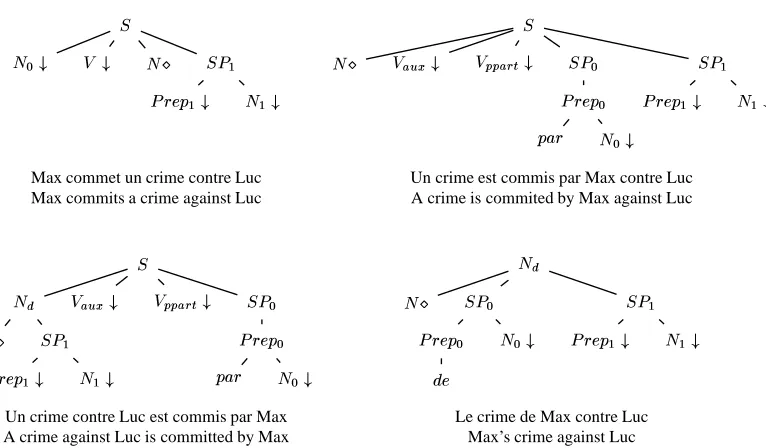
Active: Max commet un crime contre Luc
Passive: Un crime est commis par Max contre Luc
Middle: Un crime se commet contre Luc en 5 min-utes
Causative: L´ea fait commettre une crime `a Max con-tre Luc
Passive Impersonal: Il est commis un crime par Max contre Luc
Impersonal Middle: il se commet un crime toutes les 5 minutes
Nominal phrase: le crime de Max contre Luc
The syntactic realizations covered are canonical posi-tion, extraction (cleft, relativized and questionned), clitic and non-realized.
Datasheet for adjective and predicative noun hierar-chies can be found at the end of this article. Each page represents Dimension 1, 2 and 3. Dimension 4 is not shown since it is not particular to these hierarchies. It is specially used for clitic word order.
2.3 Main difficulties
A typical error consists in encoding more than a class expects. One may de facto limit the syntactic proper-ties sharing. Metagrammars do not exempt from study-ing syntactic phenomena but force ones to understand what classes share with in terms of syntactic properties.
Since arguments are realized as independent functions the metagrammar’s writer not only has to find a way to ar-range them correctly inside the tree but has to encode his classes so that they can be reused for another category.
Another place metagrammars and inheritance net-works go wild is in making very deep hierarchy. It can be very tedious to look many levels up to the tree to find out what a particular inherited variable is supposed to be: it is easy to create complex hierarchy that is hard to un-derstand, even for the metagrammer’s writer who created it. Inheritance, just like many other elements of OOP is just a tool. If the problem calls for it, it seems interest-ing to use it, but one doesn’t see it as a solution to all problems. With proper usage, metagrammars will save the writer from retyping and will show him that different linguistic objects are related.
3
Current and future work
[image:4.612.321.527.353.600.2]To take advantage of the hierarchical representation of tree sketches within our metagrammar, we characterize tree sketches as feature structures we call t-feature struc-tures (Abeill´e et al., 1999).
Figure 2: Tree sketch for a causative construction used for an adjectival predicate
!
"
Un homme fier de sa fille Max qui est fier de sa fille A man proud of his daughter Max who is proud of his daughter
$#
#&%
'(
%
'
%)
"
'
[image:5.612.185.424.89.343.2]
C’est de sa fille qu’est fier Max It is of his daughter that Max is proud
Table 2: Some elementary trees taken from n0A(den1) family
*
)+
"
*
,.- %
0/1/2,13
!
546
Max commet un crime contre Luc Un crime est commis par Max contre Luc Max commits a crime against Luc A crime is commited by Max against Luc
87
9
)
"
,1-%
//2,.3
546
7
*
"
Un crime contre Luc est commis par Max Le crime de Max contre Luc A crime against Luc is committed by Max Max’s crime against Luc
Table 3: Some elementary trees taken from the:<;= ?>A@
[image:5.612.118.501.431.655.2]tion process.
Characterizing tree sketches as a combination of fea-tures allows us to refer to a set of tree sketches simply by under specifying a feature structure.
It could also be interesting to merge all the hierachies into one. But this will probably be a hard task1. Each
Metagrammar’s writer has indeed his own view of spe-cific problems.
We hope to evaluate our grammar in few weeks by us-ing treebank ’Le Monde’ developed at Paris 7 University (Abeill´e et al., 2003).
References
Anne Abeill´e and Owen Rambow. 2000. Tree Adjoining grammars. CSLI Publications.
Anne Abeill´e, Marie-H´el`ene Candito, and Alexandra Kinyon. 1999. Ftag: current status and parsing scheme. In Vextal’99.
Anne Abeill´e, Marie-H´el`ene Candito, and Alexandra Kinyon. 2000. The current status of FTAG. In Pro-ceedings of TAG+5.
Anne Abeill´e, Nicolas Barrier, and S´ebastien Barrier. 2001. FTAG, une grammaire LTAG du franc¸ais. Tech-nical Report 1.0.
Anne Abeill´e. 1991. Une grammaire lexicalis´ee d’arbres adjoints pour le franc¸ais. Ph.D. thesis, Uni-versit´e Paris 7.
Anne Abeill´e. 2002. Une grammaire ´electronique du franc¸ais. CNRS Editions.
Anne Abeill´e, Lionel Cl´ement, and Franc¸ois Toussenel. 2003. Building a treebank for French. In A. Abeill´e, editor, Treebanks: building and using parsed corpora, pages 165–188. Kluwer academic publishers.
S´ebastien Barrier and Nicolas Barrier. 2003. Une m´etagrammaire pour les noms pr´edicatifs du franc¸ais. In TALN 2003.
Nicolas Barrier. 2002. Une m´etagrammaire pour les ad-jectifs du franc¸ais. In TALN 2002.
Davy Boonen. 2001. Le pr´edicat adjectival en ftag. Mas-ter’s thesis, Universit´e Paris 7.
Marie-H´el`ene Candito. 1996. A principle-based hier-archical representation of ltag. In Proceedings B COLING.
Marie-H´el`ene Candito. 1999a. Repr´esentation modu-laire et param´etrable de grammaires ´electroniques lex-icalis´ees, application au franc¸ais et `a l’italien. Ph.D. thesis, Universit´e Paris 7.
1
Of course, it does not mean all the new tree sketches cannot be combined into one grammar.
Marie-H´el`ene Candito. 1999b. Un outil multilingue de construction semi-automatique de grammaire d’arbres adjoints. In TAL, volume 40.
Laurence Danlos. 1992. Support verb constructions. In Journal of French Linguistic Study.
Laurence Danlos. 1998. GTAG, un formalisme lexicalis´e pour la g´en´eration inspir´e de TAG. In TAL, volume 39.2.
Bertrand Gaiffe, Benoˆıt Crabb´e, and Azim Roussanaly. 2002. A new metagrammar compiler. In Proceedings of TAG+6.
Kim Gerdes. 2002. Topologie et grammaires formelles de l’allemand. Ph.D. thesis, Universit´e Paris 7.
Jacqueline Giry-Schneider. 1978. Les nominalisations en franc¸ais. Droz. Gen`eve-Paris.
Jacqueline Giry-Schneider. 1987. Les pr´edicats nom-inaux en franc¸ais. Droz. Gen`eve-Paris.
Jan Goes. 1999. L’adjectif entre nom et verbe. Duculot.
Maurice Gross. 1981. Les bases empiriques de la notion de pr´edicat s´emantique. In Langages, volume 63.
Zellig Harris. 1968. Mathematical structures of lan-guage. Wiley-Interscience.
Alexandra Kinyon. 2000. Even better than supertags: introducing hypertags. In Proceedings of TAG+5.
Mich`ele Noailly. 1990. Le substantif ´epith`ete. PUF. Paris.
Mich`ele Noailly. 1999. L’adjectif en franc¸ais. OPHRYS. Paris.
J. Rogers and K. Vijay-Shanker. 1994. Obtaining trees from their descriptions, an application to tree adjoining grammar. In Computational intelligence, volume 10.4.
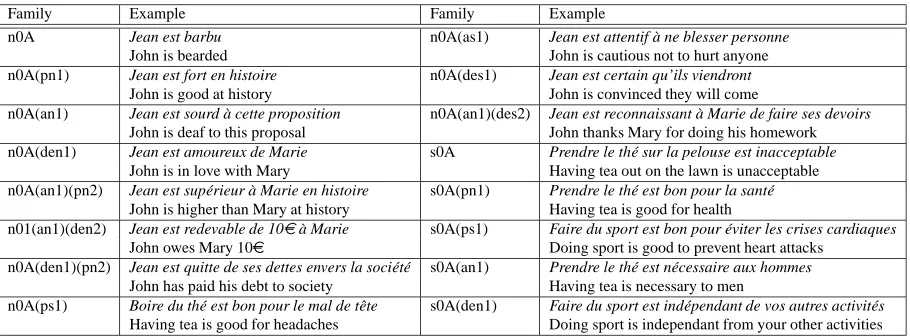
Annexe A - Datasheet for Adjectives
Family Example Family Example
n0A Jean est barbu n0A(as1) Jean est attentif `a ne blesser personne
John is bearded John is cautious not to hurt anyone
n0A(pn1) Jean est fort en histoire n0A(des1) Jean est certain qu’ils viendront
John is good at history John is convinced they will come
n0A(an1) Jean est sourd `a cette proposition n0A(an1)(des2) Jean est reconnaissant `a Marie de faire ses devoirs John is deaf to this proposal John thanks Mary for doing his homework n0A(den1) Jean est amoureux de Marie s0A Prendre le th´e sur la pelouse est inacceptable
John is in love with Mary Having tea out on the lawn is unacceptable n0A(an1)(pn2) Jean est sup´erieur `a Marie en histoire s0A(pn1) Prendre le th´e est bon pour la sant´e
John is higher than Mary at history Having tea is good for health
n01(an1)(den2) Jean est redevable de 10 `a Marie s0A(ps1) Faire du sport est bon pour ´eviter les crises cardiaques
John owes Mary 10 Doing sport is good to prevent heart attacks
n0A(den1)(pn2) Jean est quitte de ses dettes envers la soci´et´e s0A(an1) Prendre le th´e est n´ecessaire aux hommes John has paid his debt to society Having tea is necessary to men
[image:7.612.80.535.102.270.2]n0A(ps1) Boire du th´e est bon pour le mal de tˆete s0A(den1) Faire du sport est ind´ependant de vos autres activit´es Having tea is good for headaches Doing sport is independant from your other activities
Table 4: Adjectival families
Initial subject
Construction N Cl S Redistribution Example
Predicative adjective + + + No redistribution Jean est barbu
Causative + + - Subject Object Sarah Vaughan rend les gens heureux Causer Subject
Passive causative + + + Causer Par obj Des gens sont rendus heureux (par Sarah) Object Subject
Impersonal causative passive + + + Causer empty Il est rendu impossible de faire cela Impersonnal Subject
Attributive adjective + - - Subject Subject epi Un homme heureux
Impersonal - - + Subject Sentencial Il est inacceptable de commettre des erreurs indirect cmpl
[image:7.612.88.525.491.694.2]Impersonal Subject
Table 5: Redistribution frame for adjectives
Surface realizations
Nominal Clitic Cleft Sentencial Relativized Non-realized
Subject Canonical X Nominal X qui
Inverted Sentencial
Prep-obj X Nominal X X X
Sentencial
A-obj X X Nominal X X X
Sentencial
De-obj X X Nominal X dont X
Sentencial
Prep-obj2 X Nominal X X
De-obj2 X Nominal X dont X
Indirect Sentencial cmpl X
Predicative object Anteposed X Postposed
Par-Obj X X
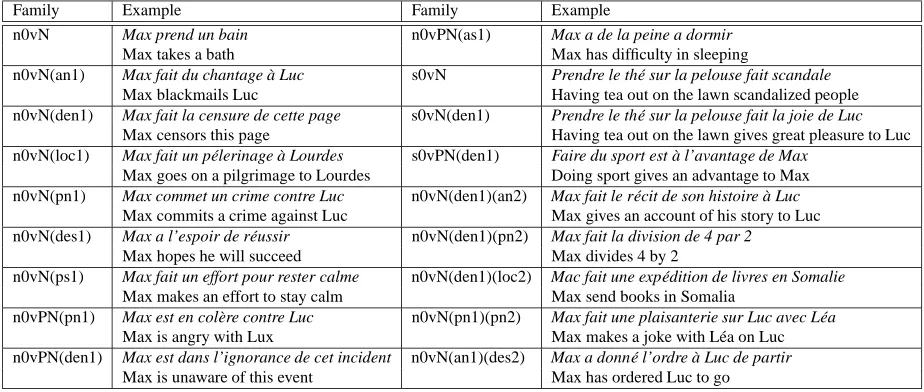
Annexe B - Datasheet for Predicative Nouns
Family Example Family Example
n0vN Max prend un bain n0vPN(as1) Max a de la peine a dormir
Max takes a bath Max has difficulty in sleeping
n0vN(an1) Max fait du chantage `a Luc s0vN Prendre le th´e sur la pelouse fait scandale
Max blackmails Luc Having tea out on the lawn scandalized people n0vN(den1) Max fait la censure de cette page s0vN(den1) Prendre le th´e sur la pelouse fait la joie de Luc
Max censors this page Having tea out on the lawn gives great pleasure to Luc n0vN(loc1) Max fait un p´elerinage `a Lourdes s0vPN(den1) Faire du sport est `a l’avantage de Max
Max goes on a pilgrimage to Lourdes Doing sport gives an advantage to Max n0vN(pn1) Max commet un crime contre Luc n0vN(den1)(an2) Max fait le r´ecit de son histoire `a Luc
Max commits a crime against Luc Max gives an account of his story to Luc n0vN(des1) Max a l’espoir de r´eussir n0vN(den1)(pn2) Max fait la division de 4 par 2
Max hopes he will succeed Max divides 4 by 2
n0vN(ps1) Max fait un effort pour rester calme n0vN(den1)(loc2) Mac fait une exp´edition de livres en Somalie
Max makes an effort to stay calm Max send books in Somalia
n0vPN(pn1) Max est en col`ere contre Luc n0vN(pn1)(pn2) Max fait une plaisanterie sur Luc avec L´ea
Max is angry with Lux Max makes a joke with L´ea on Luc n0vPN(den1) Max est dans l’ignorance de cet incident n0vN(an1)(des2) Max a donn ´e l’ordre `a Luc de partir
[image:8.612.73.535.107.303.2]Max is unaware of this event Max has ordered Luc to go
Table 7: Predicative nouns families
Construction Redistribution Example
Passive object subject Un crime est commis par Max contre Luc subject par object Un crime contre Luc est commis par Max Middle subject empty Un crime se commet contre Luc en 5 minutes
object subject Un crime contre Luc se commet en 5 minutes Causative-A subject empty L´ea fait commettre un crime `a Max contre Luc
causer subject
Impersonal Middle subject empty Il se commet un crime toutes les 5 minutes Impers subject
Impersonal Passive subject par object Il est commis un crime par Max contre Luc impers subject Il est commis un crime contre Luc par Max Nominal phrase object empty Le crime de Max contre Luc
prep object cdn
Table 8: Redistribution frame for predicative nouns
Surface realizations
Nominal Clitic Cleft Sentencial Relativized Questionned Non-realized
Subject Canonical X Nominal X qui X
Inverted
Predicative Noun X Nominal que
Prep Obj X Nominal X X X X
A-Obj X X Nominal X X X
De-obj X X Nominal dont X X
Prep-Obj2 X Nominal X X X
A-Obj2 X X Nominal X X X
Indirect X
sentencial cmpl
Par-Obj X Nominal X X