T h e I n f l u e n c e o f T a g g i n g on t h e C l a s s i f i c a t i o n o f L e x i c a l
C o m p l e m e n t s
C a t h e r i n e M a c l e o d , A d a m Meyers, and R a l p h G r i s h m a n ,
C o m p u t e r S c i e n c e D e p a r t m e n tN e w Y o r k U n i v e r s i t y
715 B r o a d w a y , 7 t h F l o o r N e w Y o r k , N Y 1 0 0 0 3
{macleod, meyers, gri shman}@c s. nyu. edu
A b s t r a c t
A large corpus (about 100 MB of text) was selected and examples of 750 fl'e- quently occurring verbs were tagged with their compleinent (:lass as defined by a large computational syntactic dictionary, C O M L E X
Syntax.
This tagging task led to the refinement of already exist- ing classes and to the addition of classes t h a t had previously not been defined. This has resulted in the enrichment and improvement of the original C O M L E X Syntax dictionary. Tagging also provides statistical d a t a which will allow users to select, more common complelnents of a particular verb and ignore rare usage. We discuss below some of the problems encountered in tagging and their resolu- tion.1
I n t r o d u c t i o n
COMLEX Syntax is a moderately-broad-coverage English lexicon (with about 38,000 root; forms) de- veloped at New York University under contract to the Linguistic D a t a Consortium; the first version of the lexicon was delivered in May 1994. The tagged version was delivered in August 1995. The h;xicon is available to members of the Linguistic Data Consortium for both research and commer- cial applications. It was developed specifically for use in processing natural language by computer.
C O M L E X Syntax is particularly detailed in its treatment of subeategorization (cotnplement structures). It includes 92 different subcategoriza- tion features for verbs, 14 for adjectives, and 9 for nouns. These distinguish not only the (lifter- ent constituent structures which may appear in a complement, but also the different control features associated with a constituent structure.
In order to make this dictionary useful to the entire Natural Language Processing coinmunity, an effort was made to provide detailed yet the- ory neutral syntactic information. In part, this involved using categories that are generally recog-
nized, i.e. norms, verbs, adjectives, prepositions, adverbs, and their corresponding phrasal expan- sions np, vp, adjp, pp, advp. C O M L E X cites the specific: prepositions and adverbs hi preposi- tional anti particle phrases associated with partic- ular verbs. 1
As a starting point, the classes for complements and features developed by the New York Univer- sity Linguistic String Project (LSP) (Fitzpatrick, 1981), were selected sin(x, the coverage is very broad and the classes well defined. These classes were augmented and flnther refined by studying the coding employed by several other major lexi- cons used for automated language analysis. The Oxford Advanced Learner's Dictionary (OALD) (Hornby, 1980), the Longman Dictionary of Con- t e m p o r a r y English (LDOCE) (Proctor, 1978), the verb (:odes developed for English by Sanfilippo as part of the ACQUILEX project(Sanfilippo, 1992), and The Brandeis Verb Lexicon 2 were consulted. A Brandeis-like notation was adopted for COM- I,EX complement naines. The Brandeis nota- tion is compositional, consisting of lists of ele- ments joined by hyphens e.g. pl-ing-sc (preposi- tion "about" followed by a gerund where tile ma- trix subject is the subject of the gerund e.g. "he lied about going"). In adapting this notation for COMLEX, the list of complement nmnes became fixed and a separate explicit definition of tile syn- tactic structure associated with each complement name was provided. I,hrther information on these classes and definitions can be found in the Refer- ence Manual (Macleod, 1993) and the C O M L E X Word Classes Manual (Wolff', 1995).
2
Tagging Task
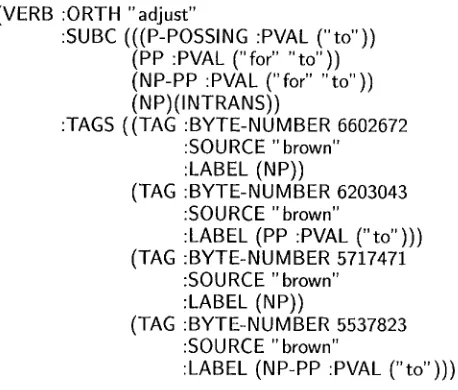
We tagged 100 exmnples for each of 750 common verbs which had previously been entered in the C O M L E X lexicon. These tags, which becmne part of the dictionary entry, contain tile location of the example and the name of the w~'rbal complement identified at that location (see figure 1 for a sample
1e.g. pp :pval "to" for he went to the party; part-np :adval "up" for he woke up the child.
t a g g e d entry). T h e original m o t i v a t i o n lot t a g g i n g was l,wofold, (1) to g a t h e r stadstil:s on the fix> q u e n c y of oc(:urrencc of a parti(:ular c o m p l e m e n t of a verb a n d (2) 1,o check on COMI3BX (:overag(;, ascertaining @ a t l,he m o s t {:(mun(mly o c c u r r i n g (',{}mph~meni;s h a d no|, be(;n (}verl(/oked in tim (}rig- inal cntries.
T h e (:orI)us us(xl for this t;agging {:(resists (if Brown (all, i.e. 7 MB), Wall Sia'{'.{;t ,hmrna.1 (] 7 MB), San .lose Mc, l'(:ury (3(} MB), Asso{:iate{t Press (29.5 MB), Mis{:eJlaneous (Trc(;1}ank litcra- t;ure 1.5 MB) etc. a d d i n g up L{I a b o u t 1{}0 MB of rex|;.
T h e tags ill figure 21 are all fl'(}ln I;ll{} Bl(/wn C{)l'- t)ils. Wc (:h()s(? 1;o give pref(_~r{~n{;(~ to t a g g i n g exam- t}tes K()m tlrown. In t h a t way, we i:{ml(t overlap, as mu(;h as ln)ssible, with ()ttmr Lagging i~itort;s l;hat ha,ve l)e{m d{}ne on l;h(', ]h'own (]orlms lly dm l){mn Treet)ank and Wor{1NeL
]ill {,h('. cr(}a£ion of the original C ( ) M I , E X , tra(li- t;ional di{:ti(mary pr()cedur(,' was followc{l/)y classi- fying verbs as h a v i n g the {:omt)h;nmnts wid~ which |;hey can a p p e a r in isolation in simple declarative sentences. This {:lassiticadon is cerl;ainly useful in mt{lersta,n(ling the argument; stru(:iaue (if dm
v{',l'l)s.
lh}wever, this at}i}r{}a{:h rims inl;o {',{}nil|el, with tin'. task of t a g g i n g cxmnl}lcs in a {:{)ri}us. Com- t)hunents m a y l}e |;l'ansfo]ln{xl (so]nel;inles l)(:y(/nd r e a d y r{~(:ognition) or {:ontextualty z(;roed. Tim
c o n l p l e n i ( ~ i l t l [ l a y (}C{;llr in |;lit; s a n l ( ~ H(~ilf,(~Jic( ', ,%s
in topi{:a]izal;i(m and l}assivizati(m, it, m a y t}(; ze- roed b u t re{:ov(;ral)h~ (to a gre, ater or less(!r {h,'gr('s) as in wh-clmlses, and wh-qu('.stions, it m a y 1}e ze- lO(~,d a n d re{:{)veral)]{~ s{unmlt;i(:;dly (it it m a y I}e zeroe{1 but; r{~(:overable only fl'om dis{',ourse anal- ysis {1] it can l}e ambiguous. T{} t)e {:onsistent with tim original at)t)roa(:h , t h e (:omt}lenmnt, s have been r(x;onsl;ru(:|;(~,{[ who, r(; t){}ssil)le. Furl;herinor(% we have n o t e d t h a t not; a,ll verbs are equally sub- ject; U} p a r d c u l a r types of {:ontexl;ua] zeroing of (:ontplenmnl;s. a T h e l;ype (}[ zeroing involved in th(: (~xmnt}le, s has l)(:(m recorded in tim |;ags a n d a,{lded U) the di('{;i{mary.
3
P a s s i v i z a t i o n a n d T o p i c a l i z a t i o n
T h e rccov(;ry {)f th(; c(}mt)hmmnt in passivization and |;opicalizati{nl is r e a s o n a b l y straig]lt-forwar(l, {;hough p a s s i v i z a d o n m a y lead t;{) misintert)r(',ta- t;ion of d m (:omI}lement. In a sent{;nc( ~, like (1) given l;hc distance l}(;twe{;n "orde, r" and "to dig", dm |;endency is 1,o m a r k th(; to-intinitivc as p a r t of Lhe COml)lemIml; rath(u' t h a n l}arl, {if the noun phrase. In cxamt}h;s (2) - (4) t;h{: separate{1 1}p's a n d np are, ill
1";1121;,
parl; {}f |;he (?()MI,EX (:omph>:~e.g "He suggested dtat 1 should go and I agr(:e{1." zeroed %o go' vs * "lie sugg('sl;e{1 dmt l should g(} and I wan~ed." where it; is not 1)ossibh~ to zer(} '{;o go'.
in(~n|,. 4
(i) Orders were GIVEN to dig.
[np]
(2) Annual a u t h o r i z a t i o n s of $15 mi].lion were ADDED for area v o c a t i o n a l
e d u c a t i o n p r o g r a m s that meet n a t i o n a l d e f e n s e needs for h i g h l y s k i l l e d ..
[np-pp :pval "for"]
(3) sets were d e v e l o p e d and distributed,
and l a n t e r n slide t e a c h i n g sets on 2J p a t h o l o g y s u b j e c t s were ADDED to the
loan l i b r a r y of the M e d i c a l I l l u s t r a -
t i o n Service. [np-pp :pval "to"]
(4) The front part of my h e a d was C A L L E D
a face, and I could talk w i t h Jr.
[np-np-pred]
(5) To that R o u s s e a u could AGREE. [pp :pval "to"]
(6) E v e n if that's all the p r o m i s e he over GAVE... [np]
(?) Arthur W i l l i a m s h a d to be located, t h e y A G R E E D . [ t h a t - s ]
Topicalization (;xamt)h;s (5) t h r o u g h (7) show thai, the complem{mt is readily a{:c{Bssil)l(;, ltow--
C,V(',I'~ CV{UI ]l{~,l'{ ~, WC, (;idll SC, C l;hal; in (~,Xaill-
t)le (7) {;h(; {:{)mt}hmmnl; at}pears t{) need a
(;ha, t - c o i n l } l { ~ n l ( ~ n l ; i z ( ' , r w h { ' , n it ()CCtll'H a t ' l ; e l ' {;h(~
verb. Tol}i{;aliz~rtion (t()es n{}t alh)w a thai,- i:Oml)hmmnt, iz{!]
( 8 ) * T h a t A r t h u r W i l l i a m s h a d t o b e locat-,
ed, t h e y a g r e e d .
so we either have to sl;al;(~ tluzI; "agree" takes a ]}al;e senI;(~,iic(~ or w(B h;~vo, to add material t h a t iH not in tim texi,.
4
W h - c l a u s e s
T h e cxist,(;n(',(; ()[' "missinp;" {',omplenmnl;s f()r(:(',s one into d m u n c o m f o r t a b l e 1)osidon (}t' t a g g i n g items t,hat (lo not app(~a.r ill I;]m text. If {;he {-{im- i)lement ca.n be recov(u'ed st;raighd'orwardly from the surrom~(ling
S(~III;(~IICO,
(;he verb was m a r k e d far t h a t (:omphmmnl;. IPor examt)le , in relal;ive clauses Lhe (;(inll)l(~in(?nt; 4;311 llSu0Jly I){~ r(~{;over{!(1.(9) . . . t o s i t m o r e p a t i e n t l y w i t h
w h a t t h e y h a v e B O U G H T . [np] (I0) T h e r e is p e r h a p s n o v a l u e s t a t e m e n ~
o n w h i c h p e o p l e w o u l d m o r e u n i v e r -
s a l l y A G R E E t h a n t h e s t a t e m e n t t h a t
i n t e n s e p a i n is b a d . [pp : p v a l " o n " ] (ii) " W h a t h a v e y o u G O T o n t o d a y " ?
s h e i n q u i r e d . [ p a r t - n p : a d v a l " o n " J (12) W h e r e w e r e t h e y a l l W A L K I N G t o ?
[ p p : p v a l " t o " ]
4NIl in |;]m examples tlm capitalized vert) is I;h{', one in question. The conq)lemenI; with whi(:h the vea'l) should 1)e tagged appea,rs in square brackets. Unless otherwise specified dmsc exmnples are all from the
(VERB :ORTH "adJust"
:SUBC (((P-POSSING :PVAL ("to"))
(PP :PVAL ("for .... to"))
(NP-PP :PVAL ("for
....to"))
(NP)(INTRANS))
:TAGS ((TAG :BYTE-NUMBER 6002672
:SOURCE "brown"
:LABEL (NP))
(TAG :BYTE-NUMBER 6203043
:SOURCE "brown"
:LABEL (PP :PVAL ("to")))
(TAG :BYTE-NUMBER
5717471:SOU RCE
" b r o w n ":LABEL (NP))
(TAG :BYTE-NUMBER 5537823
:SOU RCE "brown"
:LABEL (NP-PP :PVAL
( " t o " ) ) )Figure 1: Partial Comlex Syntax dictionary entry for A D J U S T .
(13) .. School where their d e l i c a t e t r a n s f o r m a t i o n BEGAN. [where]
In all the above cases, except for sentence (13) the complement can be unambiguously recovered. In sentence (9) they bought something, in (10) they would agree on the statement, and in (11) h e / s h e has got somettfing on. However, even though "where" is to be reconstructed in b o t h (12) and (13) only in (12) can it be unambigu- ously interpreted as being p a r t of a pp (they were walking to somewhere); in (13) "where" could be interpreted as a pp or an a d v p (it began t h e r e / i t began at school) so we classify it as having the class "where" (which is not a C O M L E X comple- ment).
5
P a r e n t h e t i c a l s
h l r t h e r "missing" complements were found in par- entheticals.
(14) For example, to m o v e (as the score REQUIRES) f r o m the lowest -F-major r e g i s t e r up to a b a r e l y audible ~N m i n o r in four seconds, not skipping, at the same time, even one of the 407 fingerings, seems a feat too a b s u r d to consider, and it is to the f l a u t i s t ' s credit that he r e m a i n - ed silent t h r o u g h o u t the passage. (15) The ideal home, they AGREED, w o u l d
be a small p r i v a t e house or a city a p a r t m e n t of four to five rooms, just e n o u g h for a f a m i l y
Reconstructing a T O - I N F ~ r "requires" in (14) would not be correct since "require" needs a NP- T O - I N F (*the score requires to move), but it is not clear what the np could be (perhaps "the
flautist"? the tone?). We felt these cases to be different from the other cases t h a t we have dis- cussed above not only because of the difficulty of locating the complement but in the nature of the construction. This construction is more similar, in fact, to C O M L E X ' s V-SAY feature which allows a verb like "say" to occur in sentence adjunct po- sitions without its complement, s
(16) He s a i d , " I want t o s e e y o u . " (17) " I " , he s a i d , "want t o s e e y o u . " (18) " I w a n t " , he s a i d , " t o s e e y o u . " (19) " I want t o s e e y o u , " he s a i d .
Therefore, we concluded t h a t the fact t h a t these verbs can occur without their complements is a fact a b o u t the g r a m i n a r of parentheticals. These examples, then, have been tagged as "parenthet- ical" and the new C O M L E X feature P A R E N - T H E T I C A L has been given to the verbs which can occur in parentimtical constructions.
6 T h e " I n t r a n s i t i v e " Q u e s t i o n
We have encountered several types of zeroing in the corpus which occur with verbs which we would normally consider transitive (~ or verbs which can be intransitive only under special circumstances. For example, in isolation, "agree" m a y not occur intransitively unless it has a plural subject (COM- LEX intrans-recip class). 7
(20) he a g r e e d w i t h h e r .
(21) t h e y a g r e e d . ( w i t h e a c h o t h e r )
~Examples not from the corpus.
aNote, that while ibr some "transitive" verbs are defined only as verbs which take NP complements, we consider verbs "transitive" that take any type of complement, including PPs
[image:3.596.85.314.102.297.2](22) *he a g r e e d .
However, the d a t a is rife with examples of in- transitive '!agree" occurring with a singular sub- jeer as seen by the following examlfles.
(23) t h e gourmet i n s i s t e d t h a t i t i s done that way at the most fashion- able dinners, the girl reluctantly
AGREED.
(24) Why, it's all right, isn't it,
Mother"7 Her woolly-minded
parent AGREED "Of course, dear", she said. "It's only that I like
to know where you go".
(25) "He's one hell of a decent boy. I like that kid". "I AGREE, yes".
(26)... he hoped to persuade him to become his assistant in research
for the labor novel; if Breasted
AGREED, they would get a car and
tour the country,
(27) ..spoke up, "plenty of it. Let
me give Papa blood". The doctor
AGREED, but explained that it
would be necessary first to check
Fred's blood to ascertain whether
or not it was of the same type...
We have estat)lished the. class I N T R A N S - E L L I P S I S for these cases and since we feel t h a t the coInplement is "underlyingly" t)resent (the tagger is able. to supply the missing material) we would like to 1)e able to reconstruct a coral)l(> inent tot- the above instances of "agree". There scent to be twe 1)ossi/)ilities: (A) whe.re someone agrees with someone that-s (in (23) she agreed [with h i m / t h a t it was done t h a t way], s in (24) she agreed [with h e r / t h a t it was all right], in (25) I agree [with y o u / w i t h t h a t / t h a t he is a decent boy]); (B) a toqnfinitive (in (26) if he agreed [to become his assistant], in (27) he agreed (to let h i m / h e r give him blood]).
Even though this last example (27) I)resents some difli('ultics in re(:onstruction (1) because it o(:curs outside the senten(:e containing the verb and (2) beemlse there is a (:hange of m o o d fl:om imperative to inlii|itival, we can mMerstand t h a t the doctor agreed to let [hint] give blood and re- construct a subject controlled to-infinitive. T h e C O M L E X tag entry is
(INTRANS-ELLIPSIS :ELLIP ( t o - i n f - s c ) )
lntrans-ellii)sis is the nalne, of the (:lass and what is elided (:ell|p) is a subject eontrolh,d to infinitive (to-inf-sc, a C O M L E X eolnplelnent). T h e others (senteImes 23-25) were tagged, arbitrarily, as hav- ing a prepositional phrase containing the l)reposi - tion "with" and they will be entered in the diet|o- n a r y with the tag I N T R A N S - E I ~ M P S I S :ELLII )
a l
SThere is Mso th(; reading st e agreed to do it; that
w&y"
(pp :pval ("with")). T h e new C O M L E X comple- ment I N T R A N S - E L L I P S I S is added to verbs of this type and therefore C O M L E X differentiates between "true" intransitives 9 and eases like the above.
W~ also found occurrences of "hat)itual" intran- sit;ives in the text. Even verbs which are always considered to be transitive, like "hit" for example, can be used intransitively if the action is consid- ered to be habitual. 10
(28) That child always hits.
(29) She always abbreviates,
a very annoying habit. (30) He nagged constantly.
We tagged these [INTRANS-HABITUAL].~1 Since it seems t h a t this ix really a g r a m m a t i c a l question, as any verb (it would seem) m a y occur an a habitual intransitive, it has not been proposed as a C O M L E X comph;inent.
7
N e w N o u n P h r a s e C o m p l e m e n t ,
N A D V P
During ore: tagging, we tound t h a t |her(; are a group of noun phrases t h a t t)attern with adverbs and prepositional phrases, which we have called N A D V I " s (Noun Adverbial Phrases). These arc divided into N A D V P - T I M E , N A D V P - D I R , N P - N A D V P - L O C and N A D V P - M A N N E R . ()flea these expressions are adjuncts, but in the follow- ing examples, they are comt)lelnents since they are. required to t)roduce a g r a m m a t i c a l sentence.(The examples in this section are not from the corpus but similar examt)les were fo(md)
The meeting took 3 hours. [nadvp-time]
*The meeting took.
He headed home~east~that way. [nadvp-dir]
*He headed.
He put the stakes every five feet.
[np-nadvp-loc]
*He put the stakes.
He put it that way. [np-nadvp-manner]
*He put it.
These noun phrases m a y be substituted tbr by ad- verbs or prepositional phrases.
The meeting took 3 h o u r s . [nadvp-time]
The m e e t i n g t o o k l o n g . [advp]
He headed h o m e / e a s t / t h a t way. [ n a d v p - d i r ] He headed t o t h e s t o r e . [pp]
tie put the stakes every five feet.
[np-nadvp-loc]
He put the stakes at designated places. [pp]
"e.g. sh'.ep, in It('. slept and arriw; in he arrived I°EXaml)les no|; DOln |;it{; corpus
He put it that way. [np-nadvp-manner]
He put it firmly. [nadvp-dir]
In general these verbs do not take regular np com- plenlents, at least not with the same meaning.
The meeting took/lasted 3 hours.
He took/*lasted the car. He headed/went home.
He headed/*went the cow down the road.
*He put the stakes the table. *He put it the interest.
8 N U N I T P : t o T a g o r n o t t o T a g
Another (:lass of noun t)hrases caused us great soul searching. A number of verbs take very particular noun phrases. Verbs like "increase", "decrease" and "expand" take complement groups which re- quire a noun with the subclass NUNIT. ~2 These verbs occurred t)redoIninately in environments like
The p r i c e i n c r e a s e d 5 t o :tO p e r c e n t .
The price increased 5 dollars a share.
We decided not to make this a separate NP coni- plement for several reasons: (1) these verl)s also take regular NP complements, though in some in- stances (as in the below example) the meaning of the verb changc.s. As C O M L E X does not sense disambiguate the semantic difference does not af~ feet the dictionary entry.
"Those vitamins increased his appetite."
(2)the N U N I T P s are not syntacticly distin- guished; other nouns occur with similar struc- tures.
"He a t e 5 t o :tO p i c k l e s (a d a y ) . "
On the other hand, the increase-type verbs can appear with a whole range of nunitp comt)lements (cornpleinents which contain an nunitp 1at:
The p r i c e i n c r e a s e d (5Z) t o $10 (a s h a r e ) . The p r i c e i n c r e a s e d (SY,) from $10 (a s h a r e ) . The p r i c e i n c r e a s e d from $10 (a s h a r e ) t o $30 (a s h a r e ) .
The price increased to 30 dollars from i0
dollars.
The price increased by 5Z to end at $i00.
whereas verbs like "eat" can not
*He a t e t o / f r o m 10 p i c k l e s .
*He a t e by 10~ t o 20 p i c k l e s (a d a y ) .
M t h o u g h we decided not to add N U N I T P as a separate NP complement, we have let the N U N I T P tags for verb complements remain, to re- flect the information that in our corpus this type
t~These art'. nouns which can appear in quantifier phrases including a scalar adjectiw~ before another noun o1 as a head noun tollowed by a prel)ositional phrase containing a scalar mmn (a two FOOT long board/a board two FEET in length).
laThe nunitp is S/dollars in the examples
of verb occurs almost exclusively with this type of NP. Wc have added a separate frame group with the name N U N I T P - T O - I { A N G E which includes the conq)leinents mentioned abow~'. Although, it is called N U N I T P to underline the fact that or- dinarily the nouns that occur are NUNITs or at'('. coerced into being NUNITs in this structure ~4, the. NPs are not formally distinguished as such in the notation of the fl'ame group. The fact (hal; these noun phrases, and the N A D V P s above, behave in a manner distinct Dom other NPs is recognized and discussed in Ross's paper on Defective Noun Phrases (Ross, 1995)
9 T a g g i n g I m p r o v e s C O M L E X
Aside fl'om presenting these interesting and llil- expected phenomena, tagging has tightened ut) the classification of some coml)lements, leading in the direction of combining some complements ghat had been separate and re-grouping oth- ers. COMLGX had a frame-group which classi- fie<l together a number of wh-comt)lements. Now there is a different grouping with the original " w h e t h e r " / " i f " / " w h a t " (WIt-S comt)lement) and "how" (HOW-S, P I ' - H O W - T O - I N F ) augmented by "where"/"when" / "how much" / "how
Inany"
( W H E R E - W H E N - S ) . This last; group was estM> lished for verbs like "define" and "forecast" which do not take members of the original fi'ame groups."Last y e a r , t h e Supreme C o u r t DEFINED
when companies, such as military
contractors, may defend themselves."
*The Supreme Court defined if companies may defend themselves.
"Ptolemy's problem is to FORECAST
where, against the inverted bowl of
night, some particular light will be
found at future times."
*The problem is to forecast how to find
the light.
?The problem is to forecast how he will
react.
Tags l;hat were not deemed worthy to be- come C O M L E X complements for various reasons (e.g. rarity or sublanguage use) are defined in the C O M L E X Syntax Mmmal for ~l%gged Entri(!s
(Meyers, 1995). All in all, our tagging has been interesting and informative. We have acquired not only statistical d a t a on the occurrence of colnple- ments in texts but information on possible gaps in C O M L E X ' s syntactic coverage which we moved to rectify, when it seemed justified, and we have a record in our tagged data of those instances which we. did not add to C()MM';X classes. We have
often been ~sked why we did not m~u:llin(; t~g in- stead of painstakingly hand tagging. We drink our response now is obvious, with m~u:hinc tagging we would not have been abl(; to r(;(:ogniz(; ~m([ r(~(:or(1 these facts about language.
Acknowledgements
1)esign and pr(;paration of (]OMLI~]X Syntax has been sul)porte(1 by the Adwm(:(;d I{esear(:h Projects Ag(;n(:y through tim ()tti(:('~ of N;Lwfl Re- s(;~r(:h un(ler Awards No. MI)A972-92-.I-]0] 6 an(l N00014-90-J-1851, and The q]:ust('~(!s of tim Uni- v('rsity of l'(;m~sylvanim
R e f e r e n c e s
Eile(m I,'itzpatri(:k ~md Naomi Sager. The Lexi(:al Su|)(:lass(;s of th(; LSP English G r a m m a r A1)- t)en(tix 3. in Naomi Sager Natural I,an.q'u,,g(" ln-
formatio'n t"roccssin, g. Addison-W(;sley, ll,(;ad-
ing, MA, 71981.
A. S. lIornby, (;ditor. Ozford Adva'nced Lt'a'rn(er's
Dictionaw of 6',wr'r(ent English. lq80.
Cal, herine Ma(:h;od an(l l/,alph Grishman. COM- LEX Syntax lh;fer(mce Mamml. New York Uni- v(',rsity, 1993
A(lmn M('~yc'rs, Cath(;rin(; Mi~(:l(~o(l and R.alt)h (h'- ishman. COMLEX Synta,x Mamml for Tagged Entries. New York University, ]995
P. ])ro(:tor, ('ditor. l)on.q'ma'n Dictio'na, W of Co'n-
t(','m, porary ]']nglish. Longinan, ] 978.
John ll,oberl, ]/,oss. Def(',(:dve Noun Phrns('~s. In Barbm'a Need et.al., editors, Pa, pc'r.s f i r m tit(:
3lst R, qlional Meeting of tit,(: (;hicago l,i'nguistic
Society. To appear.
Antonio Sanfilipl)O. I~KI] encoding of l(',xi(:~fl knowledge. In T. Brisco('~, A. Cot)estak(; , and V. (te Pavia, editors, D@'ult l~fl~,eritanc('~ ir~,
U~tiJication-llased AppTvachcs to the Lcxicon.
Cambridge University Press, 1992.