Proceedings of the IJCNLP-08 Workshop on NER for South and South East Asian Languages, pages 75–82,
An Experiment on Automatic Detection of Named Entities in Bangla
Bidyut Baran Chaudhuri
Head- CVPR Unit Indian Statistical Institute 203,B.T. Road, Kolkata-108
Suvankar Bhattacharya
Systems Executive ABP Pvt. Ltd. 6, P.S. Street, Kolkata-1
Abstract
Several preprocessing steps are necessary in various problems of automatic Natural Language Processing. One major step is named-entity detection, which is relatively simple in English, because such entities start with an uppercase character. For In-dian scripts like Bangla, no such indicator exists and the problem of identification is more complex, especially for human names, which may be common nouns and adjectives as well. In this paper we have proposed a three-stage approach of named-entity detection. The stages are based on the use of Named-Entity (NE) dictionary, rules for named-entity and left-right co-occurrence statistics. Experimental results obtained on Anandabazar Patrika (Most popular Bangla newspaper) corpus are quite encouraging.
1 Introduction
The discipline of Natural Language Processing (NLP) is concerned with the design and implemen-tation of compuimplemen-tational approaches that communi-cate with human using natural language. Name searching, matching and recognition have been active areas of research in the field of NLP and Information retrieval for a long period. This is an important problem since search queries are often proper nouns while all proper nouns cannot be ex-haustively maintained in the dictionary for auto-matic identification. Moreover, human names may be picked from common nouns and adjective words (e.g. Surya, Anindya) and hence
dictionary-based syntactic information can confuse the Natu-ral Language Processor in such a situation. Pet and other animal names, organization and place names, can also come from common nouns and adjectives e.g. Shyamali (cow name), Bardhaman (Place name), Bhalobasha (Building name), Nandan (Auditorium name) etc. So, it becomes a non-trivial problem to automatically detect the named entity from a sentence.
This paper aims at attacking this problem for Bangla language, especially on the NE detection from newspaper text. Name recognition in English is somewhat easier since quite often the proper noun starts with an uppercase character. Bangla names cannot be identified by such case informa-tion because Bangla has single-case alphabet.
Some studies on Named Entity (NE) identifica-tion are reported in the literatures (from Zhou and 2007 to Narayanswamy et al., Narayanswamy as listed in the reference section of this paper). The approaches mainly employ dictionary based,rule based and statistical tools such as HMM, Maxi-mum entropy, Support vector machine and condi-tional random field for this purpose. Name search-ing in the context of information retrieval and query answering are also reported in the literature (Thompson and Dozier, 2007). However, these studies are done on non-Indian languages. Among Indian languages typical efforts based on HMM and CRF are presented by EKbal et al. (2007) and Li and McCallum (2003) respectively.
The NE identification approach presented here employs a three tier combination of dictionary-based, rule-based and statistical information. The approach employed here is explained in Section 2 where use of the hybrid approach is also justified. In Section 3, the data collection and experimental
setup is described. Tests have been made on a moderate size Anandabazar (most popular Bangla newspaper) news corpus. The results are presented in Section 4.
2 Proposed Named Entity (NE) detection
approach
As mentioned before, our method of NE detection is a combination of dictionary-based, rule-based and statistical (n-gram based) approaches. In the dictionary based approach, we need a word-level morphological parser as well. The approaches are sequentially described here and demonstrated in Fig.1. However, at first, we describe some proper-ties of named entity.
2.1 Properties of named entity
If we look at a corpus of reasonable size from the perspective of NEs, we note that the words may belong to three categories: (a) words that almost never act as NE, (b) the words that almost always act as NE, (c) the words that sometimes act as names and sometimes as common nouns or adjec-tives. Words like I, the, to, from, go belong to
category (a) while words like India, Ganges, Paris, Himalayas belong to category (b). Words like Nirmal, Swapan, Rabi belong to category (c). The
English meanings of these third category words are clean, dream and sun, respectively, but they are used as names of persons in Bangla and thus can create problems for the NLP of Bangla language. In English, the names begin with uppercase, and are less problematic in nature.
Another point to note is that the named entity may be a single word or a multi word expression. The multi-word names pose additional difficulty for automatic identification of NE. A multi-word may have a component that alone is also a name, like England in New England or it may consist of
adjective and common noun, like White House.
Such multi-words generate additional problems for NE detection.
Fig 1. Flow chart for NE detection
2.2 Justification of hybrid approach
In the NE detection tasks, the entries that are con-sidered are person, organization, location, date, time, money, percentage. In case of English, there are indicators like uppercase character, dot mark, Dollar and Pound symbol etc. to identify them. In addition, rule-base or machine learning approaches are employed and hence an impressive result is obtained.
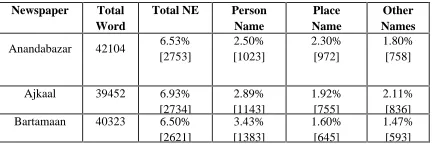
In Bangla, date, time, money, percentage also use special symbols in some occasions, but for per-son, organization or location name this is not true. Moreover, nouns and adjectives are very fre-quently used for single-word or multi-word names of above types. Now, a dictionary or some special kind of word data-base is used in most NLP prob-lems. If we equip the same dictionary or data-base which have information about NE, then every word of a text need not pass through more sophisticated NE detection software. We have noted that even for NE-rich text like news, the percentage of such words does not exceed 7% (See Table-1). The dic-tionary helps us to detect 65% of Nes and discard more than 90% of the non-NE words. For that pur-pose, we have to tag the dictionary in the manner described in Section 2.3. We can be left with about 1.4% words, which may be ambiguous (can be or cannot be NE) and about 1.15% words, which are not there in the dictionary (hence nothing can be said using dictionary).
Newspaper Total Word
Total NE Person Name
Place Name
Other Names Anandabazar 42104 6.53%
[2753]
2.50% [1023]
2.30% [972]
1.80% [758]
Ajkaal 39452 6.93% [2734]
2.89% [1143]
1.92% [755]
2.11% [836] Bartamaan 40323 6.50%
[2621]
3.43% [1383]
1.60% [645]
1.47% [593]
Table 1. NEs from different Bangla Newspapers
distinct middle names and 500 distinct last names (title) of persons. Then the total number of distinct human names that can be created is 1000 X 50 X 500 = 25 million. If the full names appear in the test, then they could be very easily tackled by a rule and a database of middle names and titles. On the other hand, any statistical technique is based on probability, and estimation of probability needs a reasonable corpus size that is costly and may not be available for design. Even if the corpus is avail-able, the statistical approach will perhaps discover the same rule along with the same database in a different manner. Moreover, extension for a few more names can be quickly accommodated in the database or another rule, but the statistical ap-proach will need re-training, resulting in a new set of absolute and conditional probabilities.
On the other hand, rule-based system cannot tackle ambiguous situations very well. So, when it is the question of a noun or adjective word being used as NE or not NE, good rules cannot be formu-lated for every situation. Rule-based system is also useless for a word not falling under any of the rules generated so far. In such a situation the statistical learning technique may be very useful.
In this way, we believe that the combination of three approaches will help us in detecting NE in a robust way. Moreover, we believe that it will be easily adapted to changed environment of the test set.
2.3 Dictionary based NE detection
If a dictionary is maintained where one of the above three category tags are attached to each word and if a word morphological analyzer is de-veloped, then the combination of these two can act as a NE detector for a text file. The dictionary should be generated from a corpus of reasonable size, say 5-10 million words, as well as from con-ventional dictionary book of say 50,000 root words. Normally, 10 million word corpus of Bangla contains between 100,000 and 200,000 sur-face words. A small fraction of these words belong to the set of NEs not found in the conventional dic-tionary. These surface words should be properly NE tagged as per three types described above and entered in the NE dictionary. The corpus provides important information about the inflectional nature of root words, which, in turn, helps in building the morphological analyzer. On the other hand, if we want to avoid building sophisticated morph
ana-lyzer, the most common inflected surface words of the corpus may also be included in the dictionary with the three tags described above. We have fol-lowed this procedure for our NE detection ap-proach.
The detection algorithm will proceed as follows. Given a test word W, at first, a match is searched in the NE tagged dictionary. If no match is found, W is rejected and the next word is considered for examination. But if a match occurs, we look at the tag of the matched word. If the tag is ‘almost al-ways NE’ then we declare this W as NE with
weight 1. If the tag is ‘almost never NE’ then W is
declared as not NE (ie with weight 0). But if the tag is ‘may or may not be NE’ then again W has to
be rejected (say with weight 0.5), which makes this approach uncertain for such word. To remedy this drawback, we next employ some rule-based ap-proach described in the next Section.
However, before sending to the rule-based mod-ule, each of the words with weight 0.5 is subject to morphological analysis. Here for each word, the suffix is stripped using a previously stored suffix database. If no database suffix matches, then the whole word is sent to rule based method. Else, the suffix-stripped word is again matched in the NE dictionary. If a match is found, then it is checked if the suffix can be morphologically accepted by the dictionary root word category. Then W is properly tagged with weight 1 or 0. Else, it is sent to the module for rule-based approach described below with the hope for better decision.
2.4 Rule-based NE detection
Rule-based approaches rely on some rules, one or more of which is to be satisfied by the test word W. There may be positive and negative rules. The positive rules make the inference system biased towards NE while the negative rules tend to be bi-ased against NE. Some small databases may be needed to execute the rules. For Bangla text NEs, some typical rules are given below. Here, 1-8 are positive and 9-12 are negative rules.
Rule1. If there are two or more words in a
Rule 2. If the previous word of W is a pre-name
word like ,
, then W belongs to the named entity (with high weight). To detect them, all words of this type can be maintained in a data-base.
Rule 3. If after W there are title words and
mid-name words to human names like etc. and
etc., respectively, then W along with such words are likely to constitute a multi-word NE (with high weight).. For example,
, are all NEs. A set of title and mid-name words should be collected and maintained in a database.
Rule 4. If a substring like – - - -- - - occurs at the end of the word W, then W is likely to be a NE (with high weight). These strings can be collected in a database for future use.
Rule 5. If at the end of a word W there are
strings like – - - -
-- then W is likely to be a name (with high weight).
Rule 6. If a word like
is found after W of type unknown in diction-ary then W along with such word may belong to NE (with high weight). For example,
are all NEs.
Rule 7. We note that only a few names or words
in Bangla consist of characters (Chandrabindu) or (Khanda Ta). So, if W does not belong to those words and has the occurrence of any of these two characters, then W may be a named entity (with high weight). For example, ‘‘ ’’ is a French name.
Rule 8. If in the sentence containing unknown
word W or a word W with may or may not be NE tag, the following words are
which imply action that can be done by human being, then W is likely to be a name (with high weight). A database of action verbs of various types is needed to check this rule.
Rule 9. If W of the type given in rule 8 is
fol-lowed by verb not in the set of verbs described above, then W is not likely to be a NE. So, the weight should be reduced from 0.5 to a smaller value.
Rule 10. If there is re-duplication of W in a
sen-tence then W is not likely to be a named entity. This is so because rarely name words are redupli-cated. In fact, reduplicated name word may signify something else. For example is used to greet a person. So, the NE weight should be reduced in a such case to near zero.
Rule 11. If at the end of W there are suffixes like
–
-
- - --- - etc., then W is usually not a named en-tity.
Rule 12. If there is an echo-word after W e.g.
, then none of these two words is a named entity. The exact value of the weight for a rule is decided from training dataset. We increase or decrease the weight of the test word if a rule fires. To be consis-tent, we have included the dictionary-based ap-proach under the same framework.
Thus, in our scheme, if the weight is more than certain value (say 0.75) then the word is finally accepted to be NE. On the other hand, if the weight is less than certain value (say 0.25) then the word is rejected to be NE. For intermediate cases, the word may be subject to the n-gram based technique described below.
2.5 n-gram based NE detection
The n-gram based approach relies on the co-occurrence of other words before and after a NE. To generate the n-gram we need a corpus where the NE words are tagged manually. From these tagged words the left neighbor and right neighbor words are checked (for a 2-gram model). The fre-quencies of each pair of left-right neighbor are counted from the corpus. The probability of each left-right pair with respect to W may be estimated as
Plr(W) = No of this left-right word pair around
W/ total no of all left-right words around W in the training corpus.
non-NE. From these positive and negative instance counts, a NE weight value is found for a particular pair of left-right word pair around W as
wlr (W) = Plr(W) Rlr(W)
where Rlr(W) = No of positive instances /(No of
positive instances + No of negative instances). However, a large number of words will be nega-tive instances at all times, so their wlr (W) value
will come out as zero. Examples are the so-called
stop words. They can be dealt in the dictionary
it-self, as discussed in Sec 2.2, reducing a lot of computational effort for this n-gram based ap-proach. Some words which will also be positive instance, irrespective of the left right words. The NE dictionary described in Section 2 can deal them as well. This fact partly justifies the scheme of having three approaches combined in our NE de-tection algorithm.
Thus, the generation of training phase is com-pleted. Now, in thetest phase, if a word W has left-right neighbors whose weight is wlr (W) based on the training phase, then W may be assigned this weight of being named entity. This is the modified weight over and above what was given in the pre-vious phases. For the test phase, a threshold t is set on the weight. If the weight for the test word W is w > t then we declare W as a NE. Otherwise, we call it not-NE.
There may be left-right pair for a test word that is absent in our probability list. If none of the pair exist then the word is rejected since no decision can be made. If only left or right word is present then we take a pessimistic estimate based on it. In other words, we take the minimum of probabilities individually this W and the said left word.
3 Data collection
To obtain the corpus for our experiment, we browsed the net and found the site of Anandabazar Patrika, the largest Bangla daily newspaper. We downloaded the e-newspapers for the years 2001-2004. Of this huge data, a portion for the years 2001-2003 were used for training the system (about 20 million words) and a portion from 2004 (about 100, 000 words) was used for testing. The data could not be utilized in a straightforward way, since the newspaper authority used a proprietary glyph code. So, we had to discover which glyph code denotes which character of Bangla script and
then convert the text into ISCII coding format. Af-ter that, all the developed softwares were run on these ISCII files. At first a program was written was used to collect all distinct surface words from this corpus of 20 million words. These distinct words were ranked in descending order of fre-quency and the top 20,000 ranked words were cho-sen for manual tagging of named entity by giving weight 0, 0.5 or 1.0.
The manual tagging was done by the linguists based on their global knowledge. However, if the person is in doubt, (s)he would consult a few ex-amples in the original corpus involving the word in question. Using the contextual information, most problematic cases could be disambiguated. Those which still appeared unclear were given ‘may or may not be’ status. A morphological analyzer was previously developed in connection with the design of a spell checker in Bangla (Chaudhuri, 2001). That analyzer has been employed for stemming of the type-words in the current NE detection prob-lem also. Moreover, a rule-based system as de-scribed in Section 2.3 is also developed. The data-base needed for each rule is being continuously updated to give better experimental results.
Experimental results:
The software was trained with the Anandabazar Patrika web corpus of the year 2001-2003. Some geographical names were further added to enrich the database. Then several files of the corpus of the same newspaper of the year 2004 were used for testing. The results are presented in the form of recall(R), precision (P) and F-measure percentage. Here the recall is the ratio of number of NE words retrieved and the number of NE words actually expressed in percent. So, we can write
J. van Rijsbergen. F1- measure is the ratio of the twice of the multiplication of precision (P) and re-call (R) and the sum of these two. In other words,
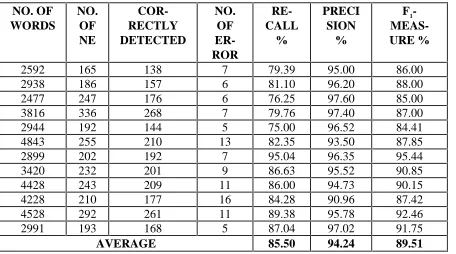
% (P) with an equal weight and hence is the harmonic mean of the two quantities. Note that F1 cannot exceed 100%. Experimental results on 10 sets of test documents are shown in Table 2.
NO. OF
It is noted from Table 1 that the precision is rea-sonably high but the recall is somewhat moderate. The reason of moderate occurrence of recall is that the training has been done with only 20,000 corpus words, while actual number of corpus words was about 200,000. Also, we have to improve the data-base for rules, as well as search for other potential rules that we have not included here. The front back 2-grams are also at present aggregated over all NE words tagged manually. Such global occur-rence statistics can mask the local phenomenon. We are working towards improving our NE detec-tion approach.
Every detection system is to be judged by some automatic evaluation techniques, e.g. BLEU (Bi-lingual Evaluation Understudy) (Papineni, 2002) and several others. So, in case of ours we intro-duced an Automatic Evaluation approach for the main detection algorithm. The evaluation system is actually based upon a manually annotated dataset of almost 70,000 words. These datasets are tagged in a “non-NE <NE Name NE> non-NE” format
Location”. As the evaluation system starts
evaluat-ing, a word by word comparison is done between the target and annotated locations. At the end of evaluation number of correctly detected words, the number of wrong detection and the number of real NE is found and so the Precision, Recall and F1-Measure is calculated easily. We have also ob-served that our evaluation system gives almost the same result as found by manual evaluation.
References
G. Zhou and J. Su 2002. Named Entity recognitionusing
HMM Based chunk tagger, Proc. 40-th Annual Meet-ing of ACL,Philadelphia,pp. 473-480.
A. Borthwick,1999. A maximum Entropy approach to
Named Entity recognition, Computer Sc. Dept. New York University.
J. R. Finkel, T. Grnagar & C. Maning, 2005.
Incorpo-rating non-local information into information extrac-tion systems by Gibbs sampling, Proc. 43-rd Annual meeting of ACL, pp. 363-370.
U. Pfeiffer; T. Poersch, and N. Fuhr. 1996. Retrieval
effectiveness of proper name search methods, Infor-mation Processing & Management, Vol. 32, pp. 667-679.
K. Takeuchi and N. Collier, 2002, Use of support vector
machines in extended Named Entity recognition,
Proc. 6th Conference Natural Language Learning, Taipei, pp. 119-125.
D. Marynard, V.Tablan, K. Cunningham and Y. Wilks. 2003. Muse : a multisource entity recognition system. Computers and the Humanities. Website Reference:
http://gate.ac.uk/sale/muse/muse.pdf
D. Maynard, K. Bonteheva, H. Cunningham, 2003.
To-wards a semantic extraction of named entity,.
Web-site reference: http://eprints.akfors.org
/267/01/maynard.pdf.
P. Thompson and C. C. Dozier, on Name Searching
and Information Retrieval. Website reference:
http://arxiv.org/html/cmplg/9706017.
H. Cunningham. 2002. Gate, a general architecture for
text engineering. Computers and the Humanities, Vol. 36, pp. 223- 254.
Proceed-ings of the Pacific Symposium on Biocomputing, Hawaii.
A. EKbal ,S. Naskar and S. Bandopadhyay, 2007,
Named Recognition and Transliteration in Bengali,
Special Issue of Lingvisticae Investigationes Jour-nal,30:1 (2007), pp. 95-114, John Benjamins Publish-ing Company.
S. Cucerzon and D. Yarowsky. 1999. Language
inde-pendent named entity recognition combining mor-phological and contextual evidence. Proceedings of the 1999 Joint SIGDAT conference on EMNLP and VLC.
B.B. Chaudhuri. 2001. A Novel Spell-checker for
Bangla Text Based on Reversed-Word Dictionary.
Vivek Vol. 14 No. 4,pp. 3-12.
W. Li, A. McCallum, 2003. Rapid development of Hindi
Named Entity recognition using Conditional Random Fields and Feature Extraction. ACM Trans on Asian Language Information Processing, Vol 2, No. 3, pp. 290-293.
D. Okanohara, Y. Miyao, Y. Tsuruoka and J. Tsujii. 2006. Improving the Scalability of Semi-Markov
Conditional Random Fields for Named Entity Recog-nition. Proceedings of the COLING-ACL, Sydney, Australia, 17-21 July, pp. 465-472.
Papineni, K., Roukos, S., Ward, T., and Zhu, W. J. 2002. BLEU: a method for automatic evaluation of
machine translation in ACL-2002: 40th Annual
meeting of the Association for Computational Lin-guistics pp. 311--318
Annotated Bengali Corpus by Prof. B. B. Chaudhuri, ISI, Calcutta and Suvankar Bhattacharya. Website
Reference: http://cybersuv.googlepages.com
/Annotated.zip
Rapid Development of Hindi Named Entity Recognition using Conditional Random Fields and Feature Ex-traction by Wei Li, University of Massachusetts