T h e D e s i g n for t h e Wall S t r e e t J o u r n a l - b a s e d
C S R Corpus*
Douglas B. Paul
Lincoln Laboratory, M I T Lexington, Ma. 02173
and
Janet M. Baker
Dragon Systems, Inc. 320 Nevada St. Newton, Ma. 02160
A B S T R A C T
The DARPA Spoken Language System (SLS) community has long taken a leadership position in designing, imple- menting, and globally distributing significant speech corpora widely used for advancing speech recognition research. The Wall Street Journal (WSJ) CSR Corpus described here is the newest addition to this valuable set of resources. In contrast to previous corpora, the WSJ corpus will provide DARPA its first general-purpose English, large vocabulary, natural language, high perplexity, corpus containing signif- icant quantities of both speech data (400 hrs.) and text data (47M words), thereby providing a means to integrate speech recognition and natural language processing in ap- plication domains with high potential practical value. This paper presents the motivating goals, acoustic data design, text processing steps, lexicons, and testing paradigms incor- porated into the multi-faceted WSJ CSR Corpus.
I N T R O D U C T I O N
As spoken language technology progresses and goals expand, progressively larger, and more challenging corpora need to be created to support advanced research. The SLS DARPA 1994 goals are ambitious, focusing on cooperative speak- ers, generating goal-directed, spontaneous continuous speech, in speaker-adaptive and speaker-independent modes, for ex- pandable vocabularies (5000 or more words active), moder- ate perplexity (100-200), with integrated speech and natural language processing, for speakers in a moderate noise envi- ronment, using multiple types of microphones, engaged i n command/database and dictation applications. In contrast to typical command/database applications, dictation (i.e. in- teractive speech-driven word processing) tasks focus on coop- erative speakers (e.g. speaker dependent/adaptlve sustained usage) who generate continuous speech (usually in a some- what careful fashion to facilitate accurate transcription) ver- balizing their words and sentence punctuation. The existing Resource Management[15] and subsequent Air Travel Infor- mation System[16] corpora target specific database inquiry tasks, characterized by medium vocabularies (<1500 words) with language model perplexities ranging from 9 to 60. The WSJ corpus described here is designed to advance CSR tech- nology and support the 1994 SLS research goals. A similar read speech corpus in the French language has been success-
*This work was sponsored by the Defense Advanced Research Projects Agency. The views expressed are those of the authors and do not reflect the official policy or position of the U.S. Government.
fully completed using text from the newspaper Le Monde[5].
Commencing with serious contractor concerns regarding suit- able CSR corpora[12] starting in the mid 1980's, the DARPA SLS Coordinating Committee started considering new cor- pora requirements in early 1990, with the subsequent for- mation of the CSR Corpus Committee, culminating in the WSJ Corpus design. The CSR Corpus Committee mem- bers include J.M. Baker (Dragon, chair), F. Kubala (BBN), D. Pallett (NIST), D. Paul (LL), M. Phillips (MIT), M. Picheny (IBM), R. Rajasekran (TI), B. Weide (CMU), M. Weintraub (SRI), and 3. Wilpon (ATT). A survey taken of the DARPA contractors for CSR research interests dis- closed highly diverse, often opposing views of research in- terest. All contractors, however, cited a common inter- est in pursuing research on "Domain-independent Acous- tic Models", "Domain-independent Language Models", and "Speaker-adaptation".
The outcome of lively meetings and discussions resulted in the definition and preliminary authorization of a ma- jor (>400 hrs.) corpus with materials based primarily on WSJ material (backed by WSJ text from 1987-89 provided by the ACL/DCI[9] to enable statistical language modeling) and supplemented by other material (spontaneous dictation, Hansard, etc., shown in Table 1). This corpus will provide a uniquely rich resource, in a carefully crafted structure de- signed to elicit a highly productive flow of diagnostic research information with an array of comparative test paradigms.
Although this WSJ corpus is large relative to many other available corpora, it should be cautioned that insofar as most research experiments continue to show marked improvement with the increased availability of training data, it is likely that this corpus also will fail to allow us to find or achieve asymptotic performance. Most systems continue to be under- trained or constrained to work in suboptimal lower dimen- sional spaces, due to their data-starvation. Indeed, this result is not really surprising in light of the much larger amounts of speech data to which young children must be exposed before gaining recognition proficiency of even modest size vocabu- laries.
will be more heavily used by one or more research groups, and not at all by others. Nonetheless, the common basis and careful structuring of these materials should allow for highly informative intra- and inter-group comparisons. The mem- bers of this committee are to be commended and should take pride in their success in jointly exercising a rare "statesman- like" cooperation to support the legitimate diversity of expert research interests in this field (often overcoming strong pres- sures of both personal and political convictions to support only their own narrower research interests).
T H E W S J - C O R P U S S T R U C T U R E
A N D
C A P A B I L I T I E S
Specifically, the W S J corpus is scalable and built to accommodate variable size large vocabularies (SK, 20K, and larger), variable perplexities (80, 120, 160, 240, and larger), speaker dependent (SD) and independent (SI) train- ing with variable amounts of d a t a (ranging from 100 to 9600 sentences/speaker), including equal portions of ver- balized and non-verbalized punctuation (to reflect both d i c t a t i o n - m o d e and non-dictation-mode applications), sepa- rate speaker a d a p t a t i o n materials (40 phonetically rich sen- tences/speaker), simultaneous s t a n d a r d close talking and multiple secondary microphones, variable moderate noise en- vironments, equal numbers of male and female speakers cho- sen for diversity of voice quality and dialect. In order to collect large quantities of speech d a t a very cost-effectively, it was decided to collect the m a j o r i t y of the recorded speech in a "read" speech mode, whereby speakers are p r o m p t e d by newspaper text paragraphs. The presentation of coher- ent p a r a g r a p h blocks of text provides semantically meaning- ful material, thereby facilitating the production of realistic speech prosodies. Small amounts of u n p r o m p t e d "sponta- neous" speech are provided for comparison (utilizing some naive speakers as well as some who are experienced at dicta- tion for human transcription).
Testing paradigms were carefully constructed to accommo- d a t e efficient comparisons of SI and SD performance and variable size vocabulary "open" and "closed" tests to per- mit evaluation both with and without "out-of-vocabulary" lexical items. The value of variable amounts of training set materials can be directly assessed both within and across speakers. Well-trained speaker-dependent performance pro- vides an upper bound against which the success of different speaker-independent modeling and speaker-adaptive method- ologies may be rigorously compared.
A d a p t i v e acoustic and language modeling is easily sup- ported through the following simple though rigorous auto- matic paradigm: 1) Recognition of a sentence is performed and assessed as usual against existing system acoustic and language models. 2) T h e system commences to a d a p t using (supervised) or not using (unsupervised) the correct "clear text" to modify its internal acoustic and language models a u t o m a t i c a l l y before proceeding to recognition of the next utterance.
Recognition performance with this kind of a u t o m a t i c axlapta-
tion is assessable with s t a n d a r d scoring routines. This mode provides an easy means to maximize performance for speakers by tracking and accommodating to speaker and environmen- tal changes in a dynamic fashion, also simulating (in a repro- ducible fashion) an interactive system mode where speakers correct system recognition errors, and using systems which can utilize this feedback to improve performance, in a contin- uous a u t o m a t i c fashion. T h e results of a u t o m a t i c a d a p t a t i o n can be assessed in an on-going "dynamic" fashion, or stopped after varying amounts of a d a p t a t i o n , for subsequent "static" testing on materials to which the system is not subsequently adapted[I,2,3].
The availability of large amounts of machine-readable text from nearly three years of the Wall Street Journal enables meaningful statistical benchmark language models (including bigrams and trigrams) to be generated, and the results from these to be easily contrasted. By varying the types of lan- guage models chosen, the effect on recognition performance of variable perplexities for the same textual materials can be assessed. The availability of this text provides a valuable re- source enabling novel language models and language models a d a p t e d from other tasks to be developed and evaluated as well.
T H E W S J - P I L O T D A T A B A S E
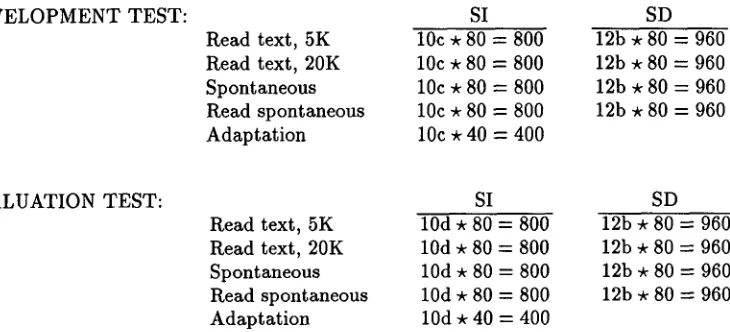
It was judged to be too ambitious to i m m e d i a t e l y record a 400 hour recognition database. Therefore, a smaller pilot d a t a b a s e built around the W S J t a s k was designed. A joint BBN/Lincoln proposal for the pilot was adopted by the CSR committee. In an a t t e m p t to "share the shortage" this pro- posal provided equal amounts of training d a t a for each of three popular training paradigms. This proposal was also rich enough t h a t it provided for "multi-mode" use of the d a t a to allow many more t h a n j u s t three paradigms to be explored. The original plan was for about a 45 hour database, but the three recording sites, (MIT, SRI, and TI), each recorded about a half share for a t o t a l of 80 hours. The resultant database is shown in Table 4 and described below. (About 1.5K additional SI training sentences are not shown in the table.)material.
The original W S J text d a t a were supplied by Dow Jones, Inc. to the ACL/DCI[9] which organized the d a t a and dis- tributed it to the research community in CD-ROM format. The W S J text d a t a were supplied as 313 1MB files from the years 1987, 1988 and 1989. The d a t a consisted of articles t h a t were p a r a g r a p h and sentence marked by the A C L / D C I . (Since a u t o m a t i c marking methods were used, some of the paragraphs and sentence marks are erroneous.) The article headers contained a WSJ-supplied document-control number.
The preprocessing began with integrity checks: one file from 1987 and 38 from 1988 were discarded due to duplication of articles in the same file (1987) or duplication of d a t a found in other files (1988). 274 files were retained, which yielded 47M with-verbalized-punctuation words from 1.8M sentences. (The yield is on the order of 10% fewer words in the non-verbalized-punctuation version.) Each file contain a scatter of dates, usually within a few days, but sometimes up to six months apart. Each file was characterized by its most frequent d a t e (used later to temporally order the files).
Since the CSR C o m m i t t e e had decided to support b o t h with and without verbalized p u n c t u a t i o n modes, it was necessary to produce four versions of each text: w i t h / w i t h o u t verbal- ized punctuation x p r o m p t / t r u t h texts. (A p r o m p t text is the version read by the speaker and the t r u t h text is the version used by the training, recognition, and scoring algo- rithms.) The preprocessing consisted of a general prepro- cessor (GP) followed by four customizing preprocessors to convert the G P o u t p u t in the four specific outputs. The tra- ditional computer definition of a word is u s e d - - a n y white- space separated object is a word. Thus, a word followed by a comma becomes a word unless t h a t comma is separated from the word. (Resolution of the role of a period or an apostro- phe/single quote can be a very difficult problem requiring full understanding of the text.)
The general preprocessor s t a r t e d by labeling all paragraphs and sentences using an SGML-Iike scheme based upon the file name, document-control number, p a r a g r a p h number within the article, and sentence number within the paragraph. This marking scheme, which was carried transparently though all of the processing, made it very easy to locate any of the text at any stage of the processing. A few bug fixes were applied for such things as common typos or misspellings. Next the numbers are converted into orthographics. "Magic numbers" (numbers such as 386 and 747 which are not pronounced nor- mally because they have a special meaning) are pronounced from an exceptions table. The remaining numbers are pro- nounced by r u l e - - t h e algorithms cover money, time, dates, "serial numbers" (mixed digits and letters), fractions, feet- inches, real numbers, and integers. Next sequences of let- ters are separated: U.S.---~U. S., Roman numerals are written out as cardinals or ordinals depending on the left context, acronyms are spelled out or left as words according to the common pronunciation, and abbreviations (except for Mr., Mrs., Ms., and Messrs.) are expanded to the full word. Fi- nally, single letters are followed by a "." to distinguish them
from the words "a" and "I". This o u t p u t is the input to the four specific preprocessors.
The punctuation processor is used in several modes. In its normal mode, it is used to produce the with-verbalized- punctuation texts. It resolves apostrophes from single quotes (an apostrophe is p a r t of the word, a single quote is not), resolves whether a period indicates an abbreviation or is a punctuation mark, and separates punctuation into individ- ual marks separate from the words. This punctuation is written out in a word-like form (eg. ,GOMMA) to ensure t h a t the speaker will pronounce it. This o u t p u t is the with- punctuation prompting text. Until this point, the text retains the original case as suppled on the CD-ROM. If one wishes to perform case-sensitive recognition (ie. the language model predicts the case of the word), this same text can be used as the with-punctuation t r u t h text or if one wishes to per- form case-insensitive recognition, the text may be m a p p e d to upper-case. (A post-processor is supplied with the database to perform the case mapping without altering the sentence markings.) Initial use of the d a t a b a s e will center on case- insensitive recognition.
The without-punctuation p r o m p t i n g text is very similar to the G P output. Only a few things, such as mapping "%" to "percent", need to be performed. This text contains the mixed case and normal p u n c t u a t i o n to help the subject speak the sentence. (The subject is instructed not to pronounce any of the punctuation in this mode.) The punctuation processor is used in a special mode to produce the without-punctuation t r u t h - t e x t . It performs all of the same processing as described above to locate the punctuation marks, but now, rather than spelling them out, eliminates t h e m from the output. (Since the punctuation marks do not appear explicitly in the acous- tics, they must be eliminated from the t r u t h texts. Pre- dicting punctuation from the acoustics has been shown to be i m p r a c t i c a l - - h u m a n transcribers d o n ' t punctuate consis- tently, and, in an a t t e m p t to perform punctuation predic- tion by the language model in a CSR, IBM found a high percentage of their errors to be due to incorrectly predicted punctuation]14]. People dictating to a human transcriber verbalize the punctuation if they feel t h a t correct punctua- tion is i m p o r t a n t : e.g. lawyers. T h e y also verbally spell un- common words and issue formatting commands where appro- priate.) This w i t h o u t - p u n c t u a t i o n t r u t h text is again mixed case and can be m a p p e d to upper case if the user desires.
W S J T E X T S E L E C T I O N I N T O
D A T A B A S E
P A R T S
Next it was necessary to divide the text into sections for the various parts of the database. Since the plan called for the pilot to become a portion of the full database, all text processing and selection were performed according to criteria t h a t were consistent with the full database.
ordered (see above) and 28 were selected for t e s t i n g - - t h e odd ordinal files for development testing and the even ordinal flies for evaluation testing. (The Treebank included the 21 most recent files so it was not possible to simulate the real c a s e - - train on the past and test on the "present").
All of the non-test data, with the exception of the sentences recorded for acoustic training, is available for training lan- guage models. T h e acoustic training d a t a is eliminated to allow a s t a n d a r d sanity check: CSR testing on the acoustic training d a t a without also performing a closed test on the language model.
W S J T E X T S E L E C T I O N F O R
R E C O R D I N G
Next the recording sentences were selected. Separate sen- tence "pools" were selected from the a p p r o p r i a t e text sec- tions for SI train (10K sentences), SD train (20K sentences), 20K-word vocabulary test (4K development test and 4K eval- uation test sentences), and 5K-word vocabulary test (2K de- velopment test and 2K evaluation test). It was originally hoped t h a t the 5K vocabulary test set could be formed as a subset of the 20K test set, but this was not possible---thus the 4 test sets are completely independent.
The recording texts were filtered for readability. (The W S J uses a lot of uncommon words and names and uses com- plex sentence structures t h a t were never intended to be read aloud.) The first step was to form a. word-frequency list ( W F L ) (ie. a frequency-ordered unigram list) from all of the upper-case with-punctuation t r u t h texts. This yielded a list of 173K words. (For comparison, mixed case yields 210K words). Next, a process of a u t o m a t e d "quality filtering" was devised to filter out the m a j o r i t y of the erroneous and un- readable paragraphs. This filtering is applied
only
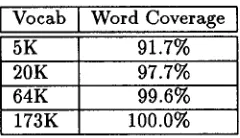
to the recorded texts, not to the general language model training texts. Since m a n y typos, misspellings and processing (both A C L - D C I and preprocessing) errors m a p into low frequency words, any p a r a g r a p h which contained an out-of-top-64K- W F L word or was shorter t h a n 3 words was rejected. (The top 64K W F L words cover 99.6% of the frequency-weighted words in the database.) Any p a r a g r a p h containing less than three sentences or more than eight sentences was rejected to maintain reasonable selection unit sizes. Any p a r a g r a p h containing a sentence longer than 30 words was rejected as too difficult to read 1. Because the W S J contains many in- stances of certain "boiler-plate" figure captions which would be pathologically over represented in the test data, duplicate sentences were removed from the test sentence pools. Finally human checks verified the high overall quality of the chosen sentences. Note t h a t this does not mean p e r f e c t - - t h e r e were errors in both the source material and the preprocessing.1 One of the authors (dbp) has recorded about 2500 WSJ sen- tences. The most difficult sentences to record were the longest ones. After a little practice, verbalized punctuation sentences were only slightly harder to read than the non-verbalized punctuation ones. This slight additional difficulty can be accounted for by the fact that the verbalized punctuation sentences average about 10% longer than the non-verbalized punctuation ones.
The 20K test pools were produced by randomly selected quality-filtered paragraphs until 8K (4K dev. test and 4K eval. test) sentences were selected. This produced a realized vocabulary of 13K words. Since this d a t a set was produced in a vocabulary insensitive manner, it can be used without bias for open and closed recognition vocabulary testing at any vocabulary size up to 64K words. (However, using it for open vocabulary testing at any vocabulary size less than 20K will yield a large number of out-of-vocabulary e r r o r s - - the top-20K of the W F L (the 20K open vocabulary) has a frequency weighted coverage of 97.8% of the data.)
A t t e m p t s to produce the 5K vocabulary test pools by the same m e t h o d produced too few sentences to be useful (,-,1200). Thus it was necessary to use a vocabulary sen- sitive p r o c e d u r e - - p a r a g r a p h s were allowed to have up to 1 out-of-top-5.6K-WFL words. This produced the highest yield ( ~ 4 K sentences with a realized vocabulary of 5K words) and reduces, but does not completely eliminate the tail of the word frequency distribution. This test set allows open and closed vocabulary testing at a 5K-word vocabulary, but would be expected to yield somewhat biased test results if used at larger test vocabularies[10,14]. The top-5K of the W F L (the 5K open vocabulary) has a frequency weighted coverage of 91.7% of the data.
Finally, the evaluation test paragraphs were broken into four separate groups. This was done to provide four independent evaluation test sets.
The recording sites selected a randomly chosen subset of the paragraphs from the pool corresponding to the database sec- tion being recorded (with replacement between subjects) for each subjects to read. T h e sentences were recorded one per audio file. All subjects recorded one set of the 40 a d a p t a t i o n sentences.
O T H E R W S J D A T A B A S E
C O M P O N E N T S
NIST compiled the data from the three recording sites (MIT, SRI, and TI), formatted it, and shipped it to MIT where WORM CD-ROMS were produced for rapid distribution to the CSR development sites.
CONCLUSION
The WSJ Corpus and its supporting components have been very carefully and efficiently designed by the joint efforts of the DARPA SLS CSR Committee to support advanced strategic CSR research of many different types. It is hoped that eventually, these materials will be instrumental in facil- itating the speech recognition research community to create spoken language technology capabilities suited to broad prac- tical application.
R E F E R E N C E S
1. J. M. Baker, "DragonDictate-30K: Natural Lan- guage Speech Recognition with 30,000 Words," EU- ROSPEECH 89, Paris, September 1989.
2. J. M. Baker, Presentation at ESCA Workshop on Per- formance Evaluation and Databases Noordwijkerhout, Netherlands, September. 1989.
3. J. M. Baker, Presentation at the Kobe Workshop on Performance Evaluation and Databases,Kobe Japan November 1990
4. J. Allen., M. S. Hunnicutt, and D. Klatt, "From Text to Speech: The MITalk System, Cambridge University Press, New York, 1987.
5. J. L. Gauvain, L. F. Lamel, and M. Esk~nazi, "Design Considerations and Text Selection for BREF, a large French Read-Speech Corpus," ICSLP 90, Kobe, Japan, November 1990.
6. H. W. Hon and K. F. Lee, "On Vocabulary-Independent Speech Modeling," Proc. ICASSPg0, Albuquerque, New Mexico, April 1990.
7. F. Jelinek and R. Mercer, personal communication.
8. S. M. Katz, "Estimation of Probabilities from Sparse Data for the Language Model Component of a Speech Recognizer," ASSP-35, pp 400-401, March 1987.
9. M. Liberman, "Text on Tap: the ACL/DCI," Proceed- ings October, 1989 DARPA Speech and Natural Lan- guage Workshop, Morgan Kanfmann Publishers, Octo- ber, 1989.
10. R. Mercer, personal communication.
11. D. B. Paul, "Experience with a Stack Decoder-Based HMM CSR and Back-Off N-Gram Language Models," Proc. DARPA Speech and Natural Language Workshop, Morgan Kaufmann Publishers, Feb. 1991.
12. D. B. Paul, J. K. Baker, and J. M. Baker, "On the In- teraction Between True Source, Training, and Testing Language Models," Proceedings June 1990 Speech and Natural Language Workshop, Morgan Kaufmann Pub- lishers, June, 1990.
13. D. B. Paul, CSR results presented at the October 91 SLS Mid-Term Workshop, CMU, October 1991.
14. M. Picheny, personal communication.
15. P. Price, W. Fisher, J. Bernstein, and D. Pallett, "The DARPA 1000-Word Resource Management Database for Continuous Speech Recognition," ICASSP 88, New York, April 1988.
16. P. Price, The ATIS Common Task: Selection and Overview," Proceedings June 1990 Speech and Natu- rM Language Workshop, Morgan Kaufmann Publishers, June, 1990.
17. B. Santorini, "Annotation Manual for the Penn Tree- bank Project," Technical Report, CIS Department, Uni- versity of Pennsylvania, May 1990.
W S J - s p o n Spontaneously spoken data. T h e subjects simulate dictating a short WSJ-like article. (Included in the WSJ-pilot database.)
H a n s a r d - r e a d Read d a t a from the Hansard database.
R a d i o l o g y - r e a d Read radiology (medical) reports.
C A L S - r e a d (Computer-aided Acquisition & Logistic Support) Read repair manuals.
D A R T - r e a d (Database Query for Material Routing) Read database queries.
U S E N E T - r e a d Read computer bulletin board mes- sages.
N P R - r e a d (National Public Radio) Read transcrip- tions of radio programs.
B l i n d - r e a d Taped recordings for the blind.
Table 1. Proposed complementary datasets for the Large Vocabulary CSR database.
I Vocab [ Word Coverage
5K 91.7%
20K 97.7%
64K 99.6%
173K 100.0%
[image:5.612.385.505.468.537.2]T R A I N I N G : SI-160 SI-16/SD-2400 LSD-9600 Train 1 6 0 a . 260 = 41600 16b * 2400 = 38400
A d a p t a t i o n 1 6 0 a * 40 = 6400 1 6 b * 40 = 640
4b' * 7200 = 28800
Est. total training data: S I - 1 6 0 : 8 6 hrs, S I - 1 6 : 7 9 hrs, S D - 2 4 0 0 : 5 hrs/spkr, L S D - 9 6 0 0 : 2 0 hrs/spkr
D E V E L O P M E N T T E S T : SI SD
Read text, 5K 3 2 c . 100 = 3200 16b * 100 = 1600 Read text, 20K 3 2 c . 100 = 3200 16b * 100 = 1600 Spontaneous 3 2 c . 100 = 3200 16b * 100 = 1600 Read spontaneous 3 2 c . 100 = 3200 16b * 100 = 1600 A d a p t a t i o n 3 2 c . 40 = 1280
E V A L U A T I O N T E S T : SI SD
Read text, 5K 3 2 d . 100 = 3200 16b * 100 = 1600 Read text, 20K 32d * 100 = 3200 1 6 b . 100 = 1600 Spontaneous 3 2 d . 100 = 3200 1 6 b . 100 = 1600 Read spontaneous 32d * 100 = 3200 16b * 100 = 1600 A d a p t a t i o n 3 2 d * 40 = 1280
Table 3. T h e plan for the W S J portion of the full database. Format: no. spkr * no. sent = total no. sent. The letters following the number of speakers indicate the speaker sets (b t is a subset of b). T h e d a t a in all sections, except for adaptation, is half verbalized p u n c t u a t i o n and half non-verbalized punctuation. Training times do not include the a d a p t a t i o n data. Times based on 7.4 sec/sentence. Total database size: 157K sentences=323 hrs=37 GB.
T R A I N I N G : SI-84 SI-12/SD-600 LSD-2400
Train 8 4 a . 100~ = 7240 12b * 600 = 7200 A d a p t a t i o n 8 4 a . 40 = 3660 8 b * 40 = 320
3b ~ . 1800 = 5400
Total training data: S I - 8 4 : 1 5 . 3 hrs, S I - 1 2 : 1 4 . 3 hrs, SD-600 ..~1.2 hrs/spkr, SD-2400:--~4.8 hrs/spkr tSome speakers recorded 50 sentences.
D E V E L O P M E N T T E S T :
Read text, 5K Read text, 20K Spontaneous Read spontaneous A d a p t a t i o n
SI SD
1 0 c . 80 = 800 10c * 80 = 800 10c * 80 = 800 10c * 80 = 800 lOc * 40 = 400
1 2 b . 80 = 960 1 2 b . 80 = 960 1 2 b . 80 = 960 1 2 b . 80 = 960
E V A L U A T I O N T E S T : SI SD
Read text, 5K 10d * 80 = 800 1 2 b . 80 = 960 Read text, 20K 1 0 d . 80 = 800 1 2 b . 80 = 960 Spontaneous 10d * 80 = 800 12b * 80 = 960 Read spontaneous 10d * 80 = 800 12b * 80 = 960 A d a p t a t i o n 10d * 40 = 400
Table 4. T h e W S J - P i l o t database. Format: no. s p k r . no. sent = total no. sent. T h e letters following the number of speakers indicate the speaker sets (b ~ is a subset of b). The average sentence length is .-,7.4 sec. (Verbalized p u n c t u a t i o n sentences tend to be somewhat longer than average and non-verbalized p u n c t u a t i o n sentences somewhat shorter.) T h e d a t a in all sections, except for adaptation, is half verbalized p u n c t u a t i o n and half non-verbalized punctuation. Training times do not include a d a p t a t i o n data. Total database size: 39K sent=80 hrs=9.2 GB.
[image:6.612.78.443.437.603.2]