User Specification of Syntactic Case Frames in TELI,
A Transportable, User-Customized Natural Language Processor
B r u c e W . B a l l a r d
A T & T B e l l L a b o r a t o r i e s 600 M o u n t a i n A v e n u e M u r r a y H i l l , N J 07974
1. Introduction
In this paper, we present methods that allow the users of a natural language processor (NLP) to define, inspect, and modify any case frame information associated with the words and phrases known to the system. An implementation of this work forms a critical part of the Transportable English-Language Interface (TELI) system. However, our techniques have enabled customization capabilities largely independent of the specific NLP for which information is being acquired.
The primary goal of the syntactic acquisitions of TELI is to redress the fact that many NL prototypes have failed (1) to make known to users exactly what inputs are allowed (e.g. what words and phrases are defined) and (2) to meet the needs of a given user or group of users (e.g. appropriate vocabulary, syntax, and semantics). Experience has shown that neither users nor system designers can predict in advance all the words, phrases, and associated meanings that will arise in accessing a given database (cf. Tennant, 1977). Thus, we have chosen to make T E L l "transportable" in an extreme sense, where customizations may be performed (1) by end users, as opposed to computer professionals, and (2) at any time during English processing.
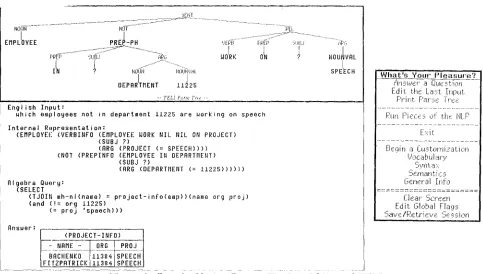
The current prototype of TELI, which runs on a Symbolics Lisp Machine, derives from work at Duke University on the LDC project (Ballard, 1982; Ballard, 1984; Ballard, Lusth, and Tinkharn, 1984; Ballard and Tinkham, 1984). The top-level menu of TELl, and also a sample snapshot of a session with TELl, which may give the flavor of how the System operates, are shown in
Figure 1. A discussion of semantic acquisitions
appeared in Baltard and Stumberger (1986).
2. The Importance of Case Frame Information
Following Ballard and Tinkham (1984), TELI seeks to enable domain-independent English processing by maintaining detailed case frame information about the phrase types provided for by the system. For example, when accessing a restaurant database, the system would know not only that "serve" is a transitive verb but also that it requires objects of type Restaurant as subject and either Food or Meal as object. Thus, if
"Japanese" is known to be a type of Food, and "lunch" a Meal, then the system would accept
"Which restaurants serve lunch?"
"How many restaurants serve Japanese food?"
and reject
.... Which meals serve Japanese food?" * "How many meals serve a restaurant?"
As a more elaborate example, suppose we are accessing information about researchers at Bell Labs, and we ask
"Which manager does the newest speech employee not in building two report to?"
The exact phrase types involved in the above input are
Verb Phrase: (employee report nil nil to manager)
Prepositional Phrase: (employee in building)
Noun-Noun Phrase: (project employee)
where "nil" denotes unfilled optional slots for direct object and particle. Adverbials ("not") and inflections of single-word modifiers ("newest") are handled by mechanisms separate from those associated with what we are calling phrase types (see Section 9).
As suggested above, we treat the noun being modified by a prepositional phrase as an argument of the modifier i n question (e.g "in"). Thus, departing from more conventional treatments, our "head noun" is part of the prepositional case frame, which therefore
comprises three rather than two slots. Similarly,
adjective phrase case frames comprise four rather than three slots (see Section 5). Our syntactic and semantic treatment of prepositional phrases is suggested by the "Intermediate Representation" shown in Figure 1.
3. Situations In Which Case Frames May Be Considered
There are presently five situations in TELI where users are able to examine and possibly modify syntactic case frames. The first of these occurs during initial customization, when the system first confronts a new
5El,IT
. . . -ZL~---- = = . . . _ ~
[image:2.612.54.537.100.374.2]NOUN NOT PEL
... ~..~<:.-~ ... -~ . . . ..
EMPLIOYEE
PRE~-PH
','EP6 FPE;:' :,u} ar',3...
...
.OIRK
ol,
!
oub,t.
it,
l
• NIJUN... "
...
NI)UNU,qL S P E[E C HOEPflRITIIENT ±1~25
E n g l i s h I n p u t :
Nhich employees not in d e p a r t m e n t 11225 are N o r k i n g on speech
I n t e r n a l Representation:
(EMPLOYEE (VERBINFO (EMPLOYEE WORK NIL NIL OM PROJECT) (SUBJ ?)
(ARG (PROJECT (= SPEECH)))) (NOT (PREPINFO (EMPLOYEE I~ DEPORTMENT)
(SUBJ ?)
(BRG (DEPARTMENT (= 11225))))))
Olgebra Query: (SELECT
(TJOIN mh-nl(name) = project-info(emp))(name org proj) (and ( ! = org 11225)
(= p r o j ' s p e e c h ) ) )
Answer:
( ROJEC.I EO)
:. ,,ME
BaCHENKO [1138~ISPEECH I T Z P B T R I C K I I t 3 8 4 1 ~
Figure 1: Sample Display Screen; Top-Level Menu of
T E L 1W h a t ' s Y o u r P l e a s u r e ? ,~]n$~,,icr- 19 I~!u65tiot] Edit the La:;L Input,
Print FIar:,~. )r~_:c
Frl.ltl I;'iCL-{E, i?l: thc NLF'
Es:il.
E;¢~qir, a I~,tl:st,_~lrlizat.i,<,Fi
Uocabularv
q >.,'n ta ;,; SF.Krqant ic~5
6cneral Info
. . . . . .
Clear Screen Edit 61obal Flags '~av~;/Ret.riev~ 5e:ssiorl
database. The remaining four, which concern the
central English processing mode of TEL1 relevant to this paper, are as fellows.
When explicitly requested by the user. When logging on to the system, or at a later time, uscrs can ask what words and phrases are associated with a particular domain object. This contributes to the habitability of the interface.
When adding new vocabulary items. For example, if the user specifies "open" as an adjective, the system asks for its associated case frames.
When attempting to recover front a parsing failure. For example, if a sentence that the system cannot parse contains the word "with", the system will offer to show the user all existing prepositional triples of the form Entity-with-Fntity. This permits the user to ascertain whether the parsing failure was caused by missing case frame information or for some other reason. If the problem is due to missing case frame information, the user can add it, then have the system retry the input.
When semantic information is being considered. Users may ask to examine or modify current definitions of prepositional phrases, verb phrases that take "up" as a particle, and so forth. To do so, the user first specifies the syntactic relationships of the phrases of interest.
As shown below, the m a n n e r in which the user specifies a phrase or range of phrases is independent of the reason the case frame information is being sought.
4. Principles Behind Case Frame Specifications
The primary criteria our methods of case frame specification are designed to meet are:
To be independent of the specific NLP that information is being supplied to. This permits us to alter or augment the underlying case frames used by the parser without having to change any of the actual code responsible for acquiring phrasal compatibilities from the user. For instance, we have made several changes in the way relational nouns like "classmate" are processed, without any changes to the customization modules.
To be fully data-driven. O u r knowledge acquisition modules provide general capabilities for a large class of phrase types, but they know nothing specific about verb phrases, etc. This is our principal method of achieving the previous criterion. At present, about two pages of specifications of a form shown below are used to drive T E L I ' a knowledge acquisition component.
To be driven by data which can in principal be inferred f r o m the underlying grammar. This means that any
changes to the g r a m m a r will be automatically reflected in the modules that acquire case frame information. A t present, about half of the two pages of data that drive our syntactic knowledge acquisition module are taken directly from the grammar.
information which f u n c t i o n similarly, from the user's standpoint, appear similar as presented by the system.
Thus, output formats do not always reflect how
information is stored and manipulated by the system.
5. Defining the User Interface to Case Frames
At present, T E L I provides for five phrase types:
Adjective Phrase:
e.g. researchers associated with TEL1 Noun-Modifier Phrase:
e.g. the COLING presentations Verb Phrase:
e.g. employees working with Brachman Prepositional Phrase:
e.g. the researchers in Marcus' d e p a r t m e n t Relational Noun Phrase:
e.g. the associates of Litman, the salary of Smith
In discussing how actual case frame acquisitions are done, we wilt find it convenient to give in detail all the information associated with one of the phrase types provided for by the system grammar. For this purpose, we have chosen to consider adjective phrases, since the situations they involve are fairly representative. The actual system provides somewhat more sophisticated capabilities than what we have space to describe here, especially in its t r e a t m e n t of verb phrases.
Before proceeding, we note that the actual data structures used in T E L l differ slightly from those presented here, although they contain precisely the same information. Also, we mention that our use of the term "interface designer" reflects our belief that most of the job about to be described can be done by a trained user of the system, as opposed to the actual system builders.
Before T E L I is supplied with phrase type
information, it will have been given lexical information about each part of speech recognized by the underlying grammar. Parts of speech are also classified as either "open" or "closed", the f o r m e r enabling the user to supply new words of that type. For example, the system designer might have specified
Open (adjective, noun, verb .... )
Closed = (article, prep, ...)
This information is used by the acquisition module in deciding which case frame slots may be filled with vocabulary items not already in the system lexicon.
As a first step in telling the system about phrase types, the interface designer must indicate for each case frame slot (1) a name to be used inside the system to identify this slot, (2) an appropriate f i l l e r type, and (3) an external name to be used as a label in system output. For adjective phrases this might be given as
(adjinfo
(head entity "Subject")
(adj adjective "Adjective")
(prep prep "Preposition")
(obj entity "Object"))
where "adjinfo" is an arbitrary symbol used internally to r e f e r e n c e adjective phrase case frames. Slot names (head, adj, prep, obj) are arbitrary; f i l l e r types (entity, adj, prep) generally correspond to parts of speech, although "entity" denotes the subset of nouns that comprise the primitive object types of the domain at hand. For example, in a building domain, R o o m might be a basic object type (entity), while "office" is merely a noun that refers to some of the objects of type Room. Finally, extenTal names ("Subject" etc.) may be any string useful in identifying a case role.
Next, the interface designer specifies an arbitrary number of templates which the system will seek to
match against a user's English-like case frame
specification. For example,
(adjinfo (a Head can be Adj Prep an Obj))
enables the system to recognize a specification such as
"a room can be adjacent to a corridor"
as a r e f e r e n c e to an adjective phrase case frame. Recall that this information is given by the i n t e r f a c e designer
and does not define, but merely reflects, the
grammatical coverage provided by the underlying
parser. Note that case frame templates are specified in terms of case frame labels rather than parts of speech. This allows transposing the etements of a case frame containing two or more elements of the same type.
In the event that the interface designer wishes to specify optional items, (s)he can either give multiple specifications or denote optionality within parentheses. Thus, the verb phrase specification
(subj verb (obj) (part) (prep obj))
will expand into eight patterns having from two to six elements each.
Since the interface designer will have specified slot names for each type of case f r a m e , the system can easily detect the presence of "noise" words. In addition, small matters such as the equivalence of "a" and "an" must be taken care of, and the interface designer does this be a giving a translation map such as
Noise-Translations = ((an a) (the a))
6. A User's View of Case Frame Specification
There are two ways in which a user may designate which case f r a m e i n f o r m a t i o n is of i n t e r e s t , n a m e l y (1)
by m e n u , a n d (2) by English-like specification. The
f o r m e r is s t r a i g h t f o r w a r d , while the l a t t e r is more convenient, and m o r e i n t e r e s t i n g .
In s p e c i f i c a t i o n by menu, the user first i n d i c a t e s a p h r a s e type to be i n q u i r e d about, and is t h e n i n s t r u c t e d by the s y s t e m to p r o v i d e a filler for e a c h slot in the associated case f r a m e s . For e x a m p l e , to find out w h a t d o m a i n objects c a n be "in" a c o u n t y , a user would m a k e the selections i n d i c a t e d in F i g u r e 2. Since our case f r a m e s allow b o t h the h e a d - n o u n and a r g u m e n t - o f - p r e p o s i t i o n slots to be filled w i t h any basic object type of the d o m a i n at h a n d , the s e c o n d and f o u r t h m e n u s c o n t a i n the same options. T h e i n t e r n a l list t h a t results f r o m these specifications is essentially
Phrase Type: Prepositional Phrase
Head Noun: (all)
Preposition: in
Object: county
A s suggested in Figure 2, d u r i n g m e n u specification, the system considers in t u r n e a c h case slot of the p h r a s e type in question and, for e a c h of t h e m , p r e s e n t s to the user for selection a list of c u r r e n t fillers, along with an option to "look at all". For slots whose filler type is e i t h e r an open category, or a closed c a t e g o r y having possible fillers not p r e s e n t l y b e i n g listed, an option to select some "other" filler is included. Finally, for optional p h r a s e e l e m e n t s (e.g. d i r e c t object of a vcrb), an option a p p e a r s that allows the user to select "nonc".
In English-like spccification, the user typcs a p h r a s e that indicates e a c h desired slot value, not necessarily in the o r d e r they a p p e a r in internally. A p p r o p r i a t e noise words may a p p e a r , and "?" may be used as a "wildcard" to i n d i c a t e an i n t e r e s t in all possible values. For e x a m p l e , the s a m p l e s p e c i f i c a t i o n given above by m e n u could be i n d i c a t e d by
"a ? can be in a county"
As with m e n u specification, it is possible for the user to i n t r o d u c e new vocabulary. For i n s t a n c e , if the italicized i t e m s Were new in the specifications
"an employee can report to a m a n a g e r " "an employee can be rerponsible for a project" "an employee can be the
supervisor
of a project"the system would have sufficient i n f o r m a t i o n to find a u n i q u e m a t c h a m o n g the p a t t e r n s stored. In these situations, the system will h a v e a u t o m a t i c a l l y d e t e r m i n e d the p a r t of s p e e c h of the new word.
A l t h o u g h our use of "?" may seem artificial in the e x a m p l e above, w h e n c o m p a r e d against a more fluent m e t h o d of inquiry such as "what can be in a county", it allows any case f r a m e slot to be i n s p e c t e d , not just those slots t h a t are filled with nominals. For e x a m p l e , a user might specify
"a city can be ? a county"
to find ali p r e p o s i t i o n s linking "city" w i t h "county", or
"an employee can ? a project ?"
to find all v e r b - p a r t i c l e pairs c o n n e c t i n g "employee" with "project". We p r e f e r to provide a small n u m b e r of simple and p o w e r f u l m e c h a n i s m s , e v e n t h o u g h o t h e r m e t h o d s might a p p e a r p r e f e r a b l e in some situations. For the r e a d c r whose aesthetics clif[cr from ours, we note that a l t e r n a t e phrasings can bc p r o v i d e d for by simple modifications to the a l g o r i t h m given in Section 7.
U n l i k e m e n u specification, English-like specification allows c e r t a i n a m b i g u i t i e s to arise, especially w h e n the system designer has chosen to p e r m i t terse forms with few or no noise words. For e x a m p l e , the r e s p e c t i v e absence of the noise words "can" and "can be" in the specifications
"employee responsible for project"
"employee report to manager"
m a k e s it impossible for the system to decidc w h e t h e r the new word is an adjectivc or a verb. In such situations,
Examine Inf'o f o r Some: Adjective Phrase Noun-l%difier Phrase -l..--Pr-epositional Phr'a >e
Verb I~ hra'_=.e Fur, ctionat Noun Phrasr:.
. . .
Look exhau~.t.iveJy at .. . .
= = = = = = = = = = = = = = = = = = = = = = = = = [ ret.urrl ]
H e a d N o u n
( o f " P r e p P h r a s e )
,ADDRESS CITY COUNTY
FOOD PHOHE RES T,'~UR,qI'.IT
-D---(all of these)
(,qbort!)
P r e p o s i t i o n (of" Prep Phrase) [ So f a r : ( a l l ) ... ]
IN W I l t l
(other)
(tlbor t!)
A r ( j t l m e n t o f P r e p o s i t i o n ( o f Prep Phrase) [ So r a m ( a l l ) IIq . . . ]
,qOORESS CITY ---.,-~ C OUIqT Y
FDOD PHONE REST4UF.,'Ar',IT
. . .
(all of t,k, cs,:)
(,qt:,ort b
[image:4.612.47.536.579.707.2]the system c o n s t r u c t s a suitable m e n u , which for the above specifications would be roughly
W h a t t y p e o f i n f o r m a t i o n a r e y o u ( l i v i n q ?
- t)erb P h r a - ~ P a t ' t i ci e - - -
gt"dinarv 9e:rb Pt-,ras:e ¢hdject.ive Phrase
... -(F;F;7-,-s- . . .
In the o t h e r e x t r e m e , it is possible that none of the stored p a t t e r n s m a t c h the user's specification, in which case the system r e q u i r e s the user e i t h e r to p a r a p h r a s e or to r e s o r t to m e n u specification.
In our e x p e r i e n c e , English-like specification yields a u n i q u e m a t c h about 80 p e r c e n t of the time; m o r e t h a n one m a t c h a b o u t 15 p e r c e n t of the time; and no m a t c h e s a b o u t 5 p e r c e n t of the time. T h e most f r e q u e n t s i t u a t i o n in which a multiple m a t c h occurs c o n c e r n s the possibility that a p r e p o s i t i o n a p p e a r i n g in a v e r b p h r a s e is a particle. For e x a m p l e , if the user types
"an employee can pick a project up"
t h e n "up" is k n o w n to be a particle by its position• If instead the user were to type
"an employee can pick up a project"
t h e n the system will n e e d to d e t e r m i n e w h e t h e r "up" is a particle. A l t h o u g h we g e n e r a l l y aw)id yes-no questions, as discussed below, we decided to allow one in this f r e q u e n t and p r e d i c t a b l e situation, as i n d i c a t e d by
I Can
an e m p l o y e e can w o r k f o r a m a n a g e r be p a r a p h r a s e d as
an e m ~ e.V~e_can wot'k a m ~ ( o r
- - [ - - "( ~: :5,
... . ...
Finally, it is useful to allow the s y s t e m to p r e s e n t the user with r e l e v a n t i n f o r m a t i o n t h a t the system knows it will n e e d , r a t h e r t h a n wait ( a n d hope) for the user to o f f e r it. A s a first e x a m p l e , suppose the system has failed to parse the input
"Which c o r r i d o r is S t u m b e r g e r ' s office a d j a c e n t to'?"
and the user accepts tile system's o f f e r to provide help in t r a c k i n g down the p r o b l e m . Since the word "adjacent" is an adjective, and adjectives are k n o w n to have phrases associated with t h e m , the system will supply all c u r r e n t i n f o r m a t i o n a b o u t those a d j e c t i v e phrases h a v i n g "adjacent" in the adj slot and leaving tile r e m a i n i n g slots unspecified. T h a t is, the system will r e s p o n d as t h o u g h the user has s p e c i f i e d
Phrase
Type: Adjective PhraseHead Noun:
(all)
Adjective: adjacent
Preposition:
(all)
Object:
(all)
7. How English-Like Specifications are Processed
W h e n an E n g l i s h - L i k e S p e c i f i c a t i o n is r e c e i v e d f r o m the user, the system must (1) d e t e r m i n e w h a t p h r a s e type is b e i n g dealt with; (2) d e t e c t any new words; a n d (3) account for any u n s p e c i f i e d ( w i l d c a r d ) case slots. As a n e x a m p l e , suppose a user w a n t s to k n o w w h a t things c a n be "associated with" a n e m p l o y e e , a n d suppose f u r t h e r t h a t the word "associated" is not yet k n o w n to the system. In this case, the system will n a t u r a l l y k n o w of n o t h i n g t h a t c a n be "associated with" a n e m p l o y e e , but will give the user an o p p o r t u n i t y to add to its k n o w l e d g e . If tile user were to type
an employee can be associated with a ?
this specification is first is s c a n n e d a n d t u r n e d into
a employee can be ?? with a ?
where "??" m a r k s the position of all u n k n o w n word a n d "'~" continues to d e n o t e a wildcard slot. N o t e t h a t (1) a "noise t r a n s l a t i o n " from Section 5 has b e e n used for "an", and (2) the noise words "can" and "be" have not yet b e e n r e m o v e d , since they may a c t a s c o n t e n t w o r d s in a
p a t t e r n for s o m e t h i n g ()tiler t h a n an adjective phrase.
T h e next step is to substitute p a r t - o f - s p e e c h labels for each word in the partially processed specification. Only those parts of s p e e c h t h a t tile system knows are r e l e v a n t , as i n d i c a t e d by the i n f o r m a t i o n supplied by the i n t e r f a c e designer as shown above, are i n c l u d e d (e.g. %" is not r e p l a c e d by "article"). Thus, tile system c o n v e r t s tile s t r u c t u r e shown above into
a (noun entity) can be ?? (prep) a ?
• at which point an a t t e m p t can be m a d e to m a t c h tile internal p a t t e r n s that r e p r e s e n t the a c c e p t a b l e case f r a m e specifications.
T h e p a t t e r n m a t c h i n g t h a t occurs at this point is simple, w h e r e
? matches any case slot
?? matches any "open" c a t e g o r y case slot
x matches x
(x y ...) matches any of x, y ....
In particular, the single m a t c h found for the s t r u c t u r e shown above is
a entity can be adj prep a entity
which is k n o w n to be associated with adjective p h r a s e s (since it was d e f i n e d for t h a t purpose).
Next, the system strips noise words and so the case f r a m e s to be e x a m i n e d are i n d i c a t e d by
Phrase Type:
Adjective Phrase
Head Noun:
employee
Adjective:
associated
Preposition:
with
Object:
(all)
Finally, the system p r e s e n t s a l - d i m e n s i o n a l mentt, similar to t h a t s h o w n below in Figurc 3b, which allows the user to specify w h a t things an e m p l o y e e can be associated with.
8, Display of Relevant h f f o r m a t i o n
The f o r m a t s t h a t we have c h o s e n for T E L l to display the c u r r e n t case f r a m e i u f o r m a t i o n r e l e v a n t to a user's s p e c i f i c a t i o n are b a s e d on the desires
I. to allow i n f o r m a t i o n to bc inspected and updated s i m u l t a n e o u s l y , and
2. t o m i n i m i z e t h e n u m b e r of s p e c i f i c m e n u t y/)es p r e s e n t e d t o t h e u s e r .
In p a r t i c u l a r , thc system constucts, w h e n e v e r possible, a m e n u in w h i c h e a c h possible setting of unspecified case f r a m e values may i n d e p e n d e n t l y be t u r n e d "on" or "off" by a m o u s e click. In the c u r r e n t i m p l e m e n t a t i o n , " w h e n e v e r possible" a m o u n t s to precisely those situations in which no m o r e than two case f r a m e slots are left unspecified. T h u s , a m e n u will c o n t a i n choice boxes w h i c h h a v e f r o m z e r o t h r o u g h two d i m e n s i o n s , according to the n u m b e r of u n s p e c i f i e d case slots. E x a m p l e s a p p e a r in Figures 3a t h r o u g h 3c. Note that a p p r o p r i a t e row and c o l u m n labels, and also a suitable m e n u label, m u s t be c o n s t r u c t e d by the system. Since the system has no initial domain-specific vocabulary, these m e n u s must be f o r m u l a t e d at r u n - t i m e .
W h e n m o r e t h a n two case slots are u n s p e c i f i e d , the system simply p r i n t s all existing case f r a m e s that satisfy the i n d i c a t e d c o n s t r a i n t s , supplying an initially filled box for each, as i n d i c a t e d in Figure 3d. This allows the user to r e m o v e individual case f r a m e s , and the "Add" o p l i o n allows i n f o r m a t i o n to be added.
A l t h o u g h we have c h o s e n to avoid asking literal yes-no questions w h e n e v e r possible, largely because of the low i n f o r m a t i o n c o n t e n t they provide, the choice- box s c h e m e we have a d o p t e d implicitly asks a n u m b e r of s i m u l t a n e o u s yes-no questions. T h u s , w h e n the user c h e c k s the box in a m e n u for the p r e p o s i t i o n "with" h a v i n g City as row label a n d C o u n t y as c o l u m n label, (s)he is in e f f e c t a n s w e r i n g "yes" to the implicit question "can a city be in a county".
9. Discussion
W e now consider (a) t r e a t m e n t of single-word m o d i f i e r s , (b) p h m n e d e n h a n c e m e n t s to case f r a m e c a p a b i l i t i e s , and (c) r e l a t e d acquisition modules.
i t i c,,,.~
1 D Pl-,r . . . E M F'L,-,',' Upd.dt_ e EE IltO DE F'FIR 1 r'IEItT [ ]
!11
[_Pr~d;,,D~iglo,-,al Ph, ~seLEMP_LOYEE IH : _
IDEPARTrlEHT [ ]
IEI'IPLOYEE []
IrlaHnGER
[]
I IDFFICE
I_PPOJ_ECT . . . .
u
[E,<it [ ] Update [ ]
F~lEPRPfl. EIIT {'!',-k':~l ~ i'~t-'! -[!!!: -'#i" L ] Ill :r I;E!:'QST!'![[] H[ EI!F![]I'I'I [[i ~:~)! IE;~F~ Qf([l[] [t F FFF,[]I~[ I
IE r-if:It I:,,'F f N O [] N [] I
Im,.*,l ~ N [] [] El [] I
F,F~I, I [] [] [] [] [] I
Ir~:~'YEc! N ~ [] [] O I
F: ! ' ~ 'UP t '
q
l
~ o : - - , i t i on.-~ l F'hca-~e : DEPARIPIEIIT IdlTII llfltlfli~EF,' EI'IPLUYEE III DEPAPII'IEHI IEMPLOYEE IN O F F I C E EMF'I.O','EE I.lI1H DEPRRIIIEItT
zfIPLOYEE I.tITH nFFIF:E -IIPLOYEE MITH PPOHEH1 "IRHHGEF~' I I t [IEF'RRHIEHI 3RO._IECT I I t DEF'RF'rI'IEItT qdd [ ] leet,,,-n [ ]
[] [] [] [] [] []
N
N
Figure 3: Case Frame Display for Varying
Number of Queried Slots
The t e c h n i q u e s p r e s e n t e d in this p a p e r , ~ h i c h arc d i r e c t e d t o w a r d case f r a m e s for m u l t i p l e - w o r d phrases, are actually used for single-word modifiers as well. Internally, one i m p o r t a n t d i f f e r e n c e is t h a t the associated m o d i f i e r c o m p a t i b i l i t y i n f o r m a t i o n is m a i n t a i n e d in the lexicon r a t h e r t h a n s t o r e d into auxiliary case frames. A'~ an e x a m p l e , if the user says that the word "large" can modif 3 obiccts of type D e p a r t m e n t and Office, onc associated lcxical e n t r y is
(larger compar large (nt department office))
As with case l r a m c s , the user
may
i m p a r t c o m p a d b i l i t > i n f o r m a t i o n for single-word modifiers by e i t h e r m e n u or English-like specification. F h e l a t t e r is typified bya room can be large
while an e x a m p l e of how the user may ask to see e v e r y t h i n g k n o w n a b o u t a c c e p t a b l e adjective m o d i f i c a t i o n s is shown in Figure 4.
Several e n h a n c e m e n t s to our facilities for E n g l i s h q i k e capabilitites are p l a n n e d . For i n s t a n c e , we n o t e d in section 6 that w h e r e a s the use of "?" to d e n o t e an u n s p e c i f i e d slot works for all p a r t s of speech, it might be m o r e n a t u r a l to d e n o t e u n s p e c i f i e d norms by
EX.PEHSI UE [] []
QUIET r l [ ]
:~r'Ic)'
_ N
[]
E>Ht [ ] U[],JL]te []
Figure 4: Modifier I n f o r m a t i o n for Adjectives
[image:6.612.318.522.104.335.2] [image:6.612.351.485.668.709.2]"w[aat" and possibly t r a n s p o s e the s p e c i f i c a t i o n accordingly. As n o t e d previously, the q u e s t i o n is one of g e n e r a l i t y versus n a t u r a l n e s s in specific situations; simple m o d i f i c a t i o n s to the a l g o r i t h m g i v e n in the p r e c e d i n g section would e n a b l e a l t e r n a t e forms. W e are considering w h e t h e r to a l t e r our m e t h o d s of inquiry, p e r h a p s to p r o v i d e for b o t h forms. A n o t h e r e n h a n c e m e n t being c o n s i d e r e d is to p e r m i t i n f l e c t e d forms, as i n d i c a t e d by the italicized e l e m e n t s of
s t u d e n t s can be f a i l e d by an instructor
Finally, we wish to give some feeling for the lexical and s e m a n t i c acquisition facilities alluded to in the paper. Figure 4a gives the top-level m e n u p e r t a i n i n g to p a r t - o f - s p e e c h i n f o r m a t i o n . This m e n u e n a b l e s the user to o b t a i n o u t p u t which as with case f r a m e i n f o r m a t i o n allows s i m u l t a n e o u s i n s p e c t i o n and m o d i f i c a t i o n , as illustrated in Figure 4c. W o r d and p h r a s e m e a n i n g s are a c q u i r e d similarly, and also involve e i t h e r m e n u or English-like specification. As an example of the latter, if the user has said t h a t
an employee can work with an employee
t h e n the system will ask w h a t "work with" m e a n s in this sense by selecting two example e m p l o y e e s in t e r m s of which the user is a s k e d to define semantics. For e x a m p l e , the system will in e f f e c t ask
What does it mean for Bob to work with Jill?
at which point the user might say
the dept of Bob is equal to the dept of Jill
10, Related Work
Some of the systems which, like T E L I , seek to provide for user c u s t o m i z a t i o n w i t h i n the c o n t e x t of d a t a b a s e query are ASK ( T h o m p s o n and T h o m p s o n 1983, 1985), f o r m e r l y R E L ( T h o m p s o n and T h o m p s o n , 1975), f r o m C a l t e c h ; I N T E L L E C T , f o r m e r l y R o b o t (Harris, 1977), m a r k e t e d by A r t i f i c i a l I n t e l l i g e n c e C o r p o r a t i o n ; IRUS (Bates and Bobrow, 1983; Bates, M o s e r , and Stallard 1984), f r o m BBN L a b o r a t o r i e s ; TQA ( D a m e r a u , 1985), f o r m e r l y R E Q U E S T ( P l a t h , 1976), from IBM Y o r k t o w n Heights; T E A M ( M a r t i n et al, 1983; G r o s z et al, 1985), f r o m SRI I n t e r n a t i o n a l ; and USL ( L e h m a n n , 1978), f r o m IBM H e i d l e b e r g . O t h e r high-quality d o m a i n - i n d e p e n d e n t systems include D A T A L O G ( H a f n e r and G o d d e n , 1985), f r o m G e n e r a l M o t o r s R e s e a r c h Labs; I t A M - A N S ( H o e p p n e r et at, 1983; W a h l s t e r , 1984), from the U n i v e r s i t y of H a m b u r g ; and P t t L I Q A ( B r o n n e n b e r g et al, 1978-1.979), f r o m Philips R e s e a r c h .
Due to the space limitations e n d e m i c to c o n f e r e n c e papers, we r e f e r the r e a d e r to Ballard and S t u m b e r g e r (1986) for some s u b s t a n t i v e c o m p a r i s o n s , largely r e l a t e d to s e m a n t i c issues, b e t w e e n T E L l and e a c h of T E A M , I R U S , T Q A , and ASK.
References
Ballard, B. A "Domain Class" Approach to Transportable Natural Language Processing. Cognition and Brain Theory 5, 3 (1982), 269-287.
Ballard, B. The Syntax and Semantics of User-Defined Modifiers in a Transportable Natural Language Processor. Proc. Coling-84, Stanford University, July 1984.52-56.
Ballard, B., Lusth, J.. and Tinkham, N. LDC-I: A Transportable Natural Language Processor for Office Environments. ACM l'rcmsactions oll Office Information S3'stem.~ 2. 1 (1984), 1-23, Ballard, B. and Stumberber, D. Semantic Acquisition in TELl: A
Transportable, User-Customized Natural Language Processor. Proc. 24th Annual Meeting oj" the ACL, Columbia University. June 1986.
Ballard, B. and Tinkham, N. A Phrase-Structured Grammatical Framework for Transportable Natural Language Processing. Computational Linguistics 10, 2 (1984), 81-96,
Bates, M. and Bobrow, R. A Transportable Natural Language Interface for Information Retrieval, 6th Int. ACM SIGIR Conference, Washington. D.C,, June 1983.
Bates, M.. Moser, M. and Stallard. D. The IRUS Transportable Natural Language [nterface. Proc. First Int. Workshop on Erpert Database Systems, Kiawah Island, October 1984. Bronnenberg, W., Landsbergen. S., 8cha, R.. Schoenmakers, W.
and van Uttcren. E. PHLIQA-I.a Question-Answering System for Data-Base Consnltatioa in Natural English. Philips tech. Rev. 38(1978-79),229-239and269-284.
Damerau, F. Problems and Some Solutions in Customization of Natural Language Database Front Ends. ACM Transactions on Office Information Systems 3, 2 (1985). 165-184.
Grosz. B.. Appelt, D., Martin, P. and Pereira, F. TEAM: An Experiment in the Design of Transpartable Natural-Language Intrfaces. Artificial Intelligence, to appear.
Hafner, C. and Godden, C. Portability of Syntax and Semantics in Datalog. ACM Transactions on Office Information Systems 3, 2 (1985). 141-164.
Harris, L. User-Oriented Database Query with the ROBOT Natural Language System. lnt. Journal of Man.Machine Studies 9 (1977), 697-713.
Hoeppner, W., Christaller. T., Marburger, H., Morik, D., Nebel. B., O'Leary, M., and Wahlster. W. Beyond Domain-Independence: Experience with the Develapment of a German Language Access System to Highly Diverse Background Systems. Proc. 8th lnt. J. Conf. on Artificial Intelligence, Karlsruhe. West Germany, 1983, pp. 588-594.
Johnson, T. Natural Language Conlputing, The Commercial Applications, Ovum ktd. London. 1985.
Lehmann, H. Interpretation of natural language in an information system, lBM J. Res. Dev. 22.5(1978).pp. 560-571.
Martin, P.. Appelt, D. and Pereira, F. Transportability and Generality in a Natural Language Interface System, Proc. 8th Int. J. Cot(. on Artificial Intelligence, Karlsruhe. West Germany, 1983, pp, 573-581.
Moser, M. Domain Independent Semantic Acquisition. BBN Report No. 5694, Research in Knowledge Representation for Natural Language Understanding, September 1984,
Thompson, F. and Thompson, B, Practical Natural Language Processing: The REL System as Prototype. In Advances in Computers, Vol, 3. M. Rubinoff and M. Yovits, Eds., Academic Press, 1975.
Thompson, B, and Thompson. F. Introducing ASK: A Simple Knowledgeable System, Conf. on Applied Natural Language Processing, Santa Monica, 1983. 17-24.
Thompson. B. and Thompson, F. ASK Is Transportable in Half a Dozen Ways. ACM Trans, on Office Information Systems 3, 2 (1985). 185-203.