Evaluating Scoped Meaning Representations
Rik van Noord, Lasha Abzianidze, Hessel Haagsma, Johan Bos
CLCG, University of Groningen{r.i.k.van.noord, l.abzianidze, hessel.haagsma, johan.bos}@rug.nl
Abstract
Semantic parsing offers many opportunities to improve natural language understanding. We present a semantically annotated parallel corpus for English, German, Italian, and Dutch where sentences are aligned with scoped meaning representations in order to capture the semantics of negation, modals, quantification, and presupposition triggers. The semantic formalism is based on Discourse Representation Theory, but concepts are represented by WordNet synsets and thematic roles by VerbNet relations. Translating scoped meaning representations to sets of clauses enables us to compare them for the purpose of semantic parser evaluation and checking translations. This is done by computing precision and recall on matching clauses, in a similar way as is done for Abstract Meaning Representations. We show that our matching tool for evaluating scoped meaning representations is both accurate and efficient. Applying this matching tool to three baseline semantic parsers yields F-scores between 43% and 54%. A pilot study is performed to automatically find changes in meaning by comparing meaning representations of translations. This comparison turns out to be an additional way of (i) finding annotation mistakes and (ii) finding instances where our semantic analysis needs to be improved.
Keywords:parallel corpus, semantic annotation, discourse representation structure, evaluation, semantic scope
1.
Introduction
Semantic parsing is the task of assigning meaning represen-tations to natural language expressions. Informally speak-ing, a meaning representation describes who did what to whom, when, and where, and to what extent this is the case or not. The availability of open-domain, wide coverage se-mantic parsers has the potential to add new functionality, such as detecting contradictions, verifying translations, and getting more accurate search results. Current research on open-domain semantic parsing focuses on supervised learn-ing methods, uslearn-ing large semantically annotated corpora as training data.
However, there are not many annotated corpora avail-able. We present a parallel corpus annotated with for-mal meaning representations for English, Dutch, German, and Italian, and a way to evaluate the quality of machine-generated meaning representations by comparing them to gold standard annotations. Our work shows many simi-larities with recent annotation and parsing efforts around Abstract Meaning Representations, (AMR; Banarescu et al., 2013) in that we abstract away from syntax, use first-order meaning representations, and use an adapted version of SMATCH(Cai and Knight, 2013) for evaluation. How-ever, we deviate from AMR on several points: meanings are represented by scoped meaning representations (arriv-ing at a more l(arriv-inguistically motivated treatment of modals, negation, presupposition, and quantification), and the non-logical symbols that we use are grounded in WordNet (con-cepts) and VerbNet (thematic roles), rather than PropBank (Palmer et al., 2005). We also provide a syntactic analy-sis in the annotated corpus, in order to derive the semantic analyses in a compositional way.
We make the following contributions:
• A meaning representation with explicit scopes that combines WordNet and VerbNet with elements of for-mal logic (Section 2).
• A gold standard annotated parallel corpus of
for-mal meaning representations for four languages (Sec-tion 3).
• A tool that compares two scoped meaning represen-tations for the purpose of evaluation (Section 4 and Section 5).
2.
Scoped Meaning Representations
2.1.
Discourse Representation Structures
The backbone of the meaning representations in our an-notated corpus is formed by the Discourse Representa-tion Structures (DRS) of Discourse RepresentaRepresenta-tion The-ory (Kamp and Reyle, 1993). Our version of DRS in-tegrates WordNet senses (Fellbaum, 1998), adopts a neo-Davidsonian analysis of events employing VerbNet roles (Bonial et al., 2011), and includes an extensive set of com-parison operators. More formally, a DRS is an ordered pair of a set of variables (discourse referents) and a set of con-ditions. There are basic and complex concon-ditions. Terms are either variables or constants, where the latter ones are used to account for indexicals (Bos, 2017). Basic conditions are defined as follows:
• If W is a symbol denoting a WordNet concept and x is a term, then W(x) is a basic condition;
• If V is a symbol denoting a thematic role and x and y are terms, then V(x,y) is a basic condition;
• If x and y are terms, then x=y, x6=y, x∼y, x<y, x≤y, x≺y, and x./y are basic conditions formed with com-parison operators.
24/3221: No one can resist. 00/2302: `E tutto nuovo. 00/3008: Hij speelde piano en zij zong.
¬
x1person.n.01(x1)
♦
e1resist.v.02(e1)
Agent(e1, x1)
x1
thing.n.12(x1) ⇒
s1 t1
new.a.01(s1)
Time(s1, t1)
Theme(s1, x1)
time.n.08(t1)
t1=now
k1::
x1 x2 e1 t1 male.n.02(x1) play.v.03(e1)
Time(e1, t1) Theme(e1, x2) Agent(e1, x1) time.n.08(t1)
t1≺now piano.n.01(x2)
k2::
x3 e2 t2 female.n.02(x3) time.n.08(t2)
t2≺now sing.v.01(e2)
Time(e2, t2) Agent(e2, x3)
CONTINUATION(k1, k2)
k0 NOT b2 b2 REF x1
b2 person n.01 x1 b2 POS b3
b3 Agent e1 x1 b3 REF e1
b3 resist v.02 e1
k0 IMP b2 b3 b2 REF x1 b2 thing n.12 x1 b3 REF s1 b3 Theme s1 x1 b3 new a.01 s1 b3 Time s1 t1 b4 REF t1 b4 time n.08 t1 b4 EQU t1 "now"
k0 DRS k1 k0 DRS k2
b1 REF x1 b4 REF x3
b1 male n.02 x1 b4 female n.02 x3
k1 REF e1 k2 REF e2
k1 play v.03 e1 k2 sing v.01 e2 k1 Agent e1 x1 k2 Agent e2 x3 k1 Theme e1 x2 b5 REF t2 k1 REF x2 b5 time n.08 t2 k1 piano n.01 x2 b5 TPR t2 "now"
b3 REF t1 k2 Time e2 t2
[image:2.595.55.545.75.366.2]b3 time n.08 t1 k0 CONTINUATION k1 k2 b3 TPR t1 "now" k1 Time e1 t1
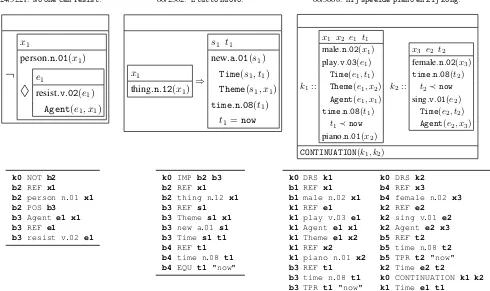
Figure 1: Examples of PMB documents with their scoped meaning representations and the corresponding clausal form. The first two structures are basic DRSs while the last one is a segmented DRS.
• If B is a DRS, then¬B,♦B,B are complex condi-tions;
• If x is a variable, and B is a DRS, then x:B is a complex condition;
• If B and B’ are DRSs, then B⇒B’ and B∨B’ are com-plex conditions.
Besides basic DRSs, we also have segmented DRSs, fol-lowing Asher (1993) and Asher and Lascarides (2003). Hence, DRSs are formally defined as follows:
• If D is a (possibly empty) set of discourse referents, and C a (possibly empty) set of DRS-conditions, then <D,C>is a (basic) DRS;
• If B is a (basic) DRS, and B’ a DRS, then B↓B’ is a (segmented) DRS;
• If U is a set of labelled DRSs, and R a set of discourse relations, then<U,R>is a (segmented) DRS.
DRSs can be visualized in different ways. While the com-pact linear format saves space, the box notation increases readability. In this paper we use the latter notation. The examples of DRSs in the box notation are presented in Fig-ure 1.
However, for evaluation and comparison purposes, we con-vert a DRS into a flat clausal form, i.e. a set of clauses. This is carried out by using the labels for DRSs as introduced in Venhuizen (2015) and Venhuizen et al. (2018), and break-ing down the recursive structure of DRS by assignbreak-ing them a label of the DRS in which they appear. Let t, t’, and t”
be meta-variables ranging over DRSs or terms. LetC be a set of WordNet concepts,T a set of the thematic roles, and Othe set of DRS operators (REF, NOT, POS, NEC, EQU, NEQ, APX, LES, LEQ, TPR, TAB, IMP, DIS, PRP, DRS). The resulting clauses are then of the form t R t’ or t R t’ t” where R∈ C ∪T ∪O. The result of translating DRSs to sets of clauses is shown in Figure 1. In a clausal form, it is as-sumed that different variables are represented with different variable names and vice versa. Due to this, before translat-ing a DRS to a clausal form, different discourse referents in the DRS must be represented with different variable names. This assumption significantly simplifies the matching pro-cess between clausal forms (Section 4) and makes it possi-ble to recover the original box notation of a DRS from its clausal form.
2.2.
Comparing DRSs to AMRs
Type Description Example Total
REF Discourse referent b3 REF x2 7,592
NOT Negation b1 NOT b2 204
POS Possibility (♦) b4 POS b5 55
NEC Necessity () b2 NEC b3 14 IMP Implication (⇒) b1 IMP b2 b3 104 PRP Proposition (:) b1 PRP x6 50 REL Discourse relation b1 CONTINUATION b2 71 DRS DRS as a condition b4 DRS b5 84 Compare Comparison operators x1 APX x2 2,100 Concept WordNet senses b2 hurt v.02 e3 7,545 Role Semantic roles b2 Agent e3 x4 7,516
Table 1: Distribution of clause types for 2,049 gold DRSs.
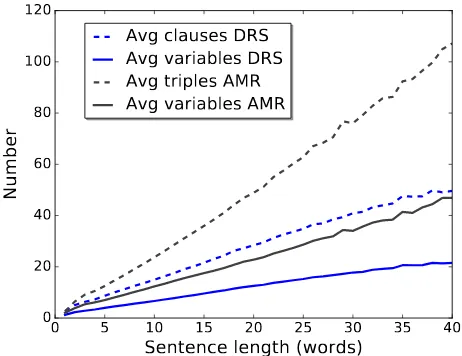
Unlike AMRs, DRSs model tense. In general, the tense re-lated information is encoded in a clausal form with three additional clauses, which express a WordNet concept, se-mantic role and a comparison operator. In order to give an intuition about the diversity of clauses in DRSs, Table 1 shows a distribution of various types of clauses in a cor-pus of DRSs (see Section 3). Since every logical operator carries a scope, their number represents a lower bound of the number of scopes in the meaning representations. In addition to logical operators, scopes are introduced by pre-supposition triggers like proper names or pronouns. To make a meaningful comparison between AMRs and DRSs in terms of size, we compare the DRSs of 250,000 English sentences from the Parallel Meaning Bank (PMB; Abzianidze et al., 2017) to AMRs of the same sentences, produced by the state-of-the-art AMR parser from van No-ord and Bos (2017). Statistics of the comparison are shown in Figure 2. On average, DRSs are about twice as large as AMRs, in terms of the number of clauses as well as the number of unique variables. This is obviously due to the explicit presence of scope in the meaning representation. However, for both meaning representations the number of clauses and variables increase linearly with sentence length.
0
5
10
15
20
25
30
35
40
Sentence length (words)
0
20
40
60
80
100
120
Number
[image:3.595.54.288.70.211.2]Avg clauses DRS
Avg variables DRS
Avg triples AMR
Avg variables AMR
Figure 2: Comparison of the number of triples/clauses and variables between AMRs and DRSs for sentences of differ-ent length.
Documents Sentences Tokens
English 2,049 2,057 11,664
German 641 642 3,430
Italian 387 387 1,944
[image:3.595.54.285.548.726.2]Dutch 394 395 2,268
Table 2: Statistics of the first PMB release.
3.
The Parallel Meaning Bank
The scoped meaning representations, integrating word senses, thematic roles, and the list of operators, form the final product of our semantically annotated corpus: the Par-allel Meaning Bank. The PMB is a semantically annotated corpus of English texts aligned with translations in Dutch, German and Italian (Abzianidze et al., 2017). It uses the same framework as the Groningen Meaning Bank (Bos et al., 2017), but aims to abstract away from language-specific annotation models. There are five annotation layers present in the PMB: segmentation of words, multi-word expres-sions and sentences (Evang et al., 2013), semantic tagging (Bjerva et al., 2016; Abzianidze and Bos, 2017), syntactic analysis based on CCG (Lewis and Steedman, 2014), word senses based on WordNet (Fellbaum, 1998), and thematic role labelling (Bos et al., 2012). The semantic analysis for English is projected on the other languages, to save manual annotation efforts (Evang, 2016; Evang and Bos, 2016). All the information provided by these layers is combined into a single meaning representation using the semantic parser Boxer (Bos, 2015), in the form of Discourse Representa-tion Structures. Note that the goal is to produce annotaRepresenta-tions that capture the most probable interpretation of a sentence; no ambiguities or under-specification techniques are em-ployed.
At each step in this pipeline, a single component pro-duces the automatic annotation for all four languages, using language-specific models. Human annotators can correct machine output by adding ‘Bits of Wisdom’ (Basile et al., 2012). These corrections serve as data for training better models, and create a gold standard annotated subset of the data. Annotation quality is defined per layer and language, at three levels: bronze (fully automatic), silver (automatic with some manual corrections), and gold (fully manually checked and corrected). If all layers are marked as gold, it follows that the resulting DRS can be considered gold standard, too.
The first public release1of the PMB contains gold standard
scoped meaning representations for over 3,000 sentences in total (see Table 2). The release includes mainly relatively short sentences involving several semantic scope phenom-ena. A detailed distribution of clause types in the dataset is given in Table 1. A larger amount of texts and more complex linguistic phenomena will be included in future releases.
In addition to the released data, the PMB documents are publicly accessible through a web interface, called the PMB explorer.2 In the explorer, visitors can view natural
lan-1
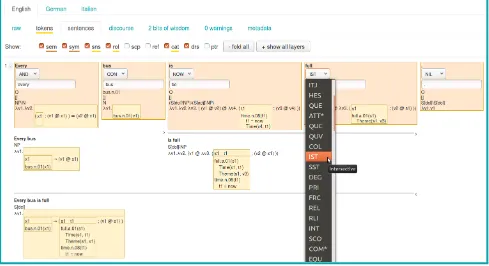
Figure 3: The edit mode of the PMB explorer: semantic tag (sem) and symbol (sym) layers of the document are bronze and therefore editable, while the word sense (sns), semantic role (rol) and CCG category (cat) layers are gold and uneditable.
guage texts with several layers of annotations and compo-sitionally derived meaning representations, and, after reg-istration, edit the annotations. It is also possible to use a word or a phrase search to find certain words or construc-tions with their semantic analyses. Figure 3 shows the PMB explorer with the semantic analysis of a sentence in the edit mode.
4.
Matching Scoped Representations
4.1.
Evaluation by Matching
In the context of the Parallel Meaning Bank there are two main reasons to verify whether two scoped meaning repre-sentations capture the same meaning or not: (1) to be able to evaluate semantic parsers that produce scoped meaning rep-resentations by comparing gold-standard DRSs to system output; and (2) to check whether translations are meaning-preserving; a discrepancy in meaning between source and target could indicate a mistranslation.
The ideal way to compare two meaning representations would be one based on inference. This can be imple-mented by translating DRSs to first-order formulas and us-ing an off-the-shelf theorem prover to find out whether the two meanings are logically equivalent (Blackburn and Bos, 2005). This method can compare meaning representation that have different syntactic structures but still are equiva-lent in meaning. The disadvantage of this approach is that it yields just a binary answer: if a proof is found the meanings are the same, else they are not.
An alternative way of comparing meaning representations is comparing the corresponding clausal forms by comput-ing precision and recall over matched clauses (Allen et al., 2008). The advantage of this approach is that it returns a
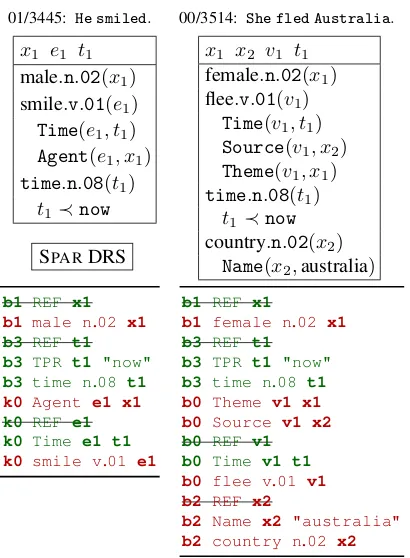
score between 0 and 1, preferring meaning representations that better approximate the gold standard over those that are completely different. Since the variables of different clausal forms are independent from each other, the compar-ison of two clausal forms boils down to finding a (partial) one-to-one variable mapping that maximizes intersection of the clausal forms. For example, the maximal matching for the clausal forms in Figure 4 is achieved by the following partial mapping from the variables of the left form into the variables of the right one:{k07→b0,e17→v1}.
For AMRs, finding a maximal matching is done using a hill-climbing algorithm called SMATCH (Cai and Knight, 2013). This algorithm is based on a simple principle: it checks if a single change in the current mapping results in a better matching mapping. If this is the case, it continues with the new mapping. Otherwise, the algorithm stops and has arrived at the final mapping. This means that it can easily get stuck in local optima. To avoid this, SMATCH does a predefined number of restarts of this process, where each restart starts with a new and random initial mapping. The first restart always uses a ‘smart’ initial mapping, based on matching concepts.
Our evaluation system, called COUNTER3, is a modified version of SMATCH. Even though clausal forms do not form a graph and clauses consist of either three or four components, the principle behind the variable matching is the same. The actual implementation differs, mainly be-cause SMATCH was not designed to handle clauses with three variables, e.g.hk0 Agent e1 x1i.
In contrast toSMATCH,COUNTERtakes a set of clauses di-rectly as input. COUNTERalso uses two smart initial
01/3445: He smiled. 00/3514: She fled Australia. x1 e1 t1
male.n.02(x1)
smile.v.01(e1)
Time(e1, t1)
Agent(e1, x1)
time.n.08(t1) t1≺now
SPARDRS
x1 x2 v1 t1
female.n.02(x1)
flee.v.01(v1)
Time(v1, t1)
Source(v1, x2)
Theme(v1, x1)
time.n.08(t1) t1≺now
country.n.02(x2)
Name(x2,australia)
b1 REF x1 b1 male n.02 x1 b3 REF t1 b3 TPR t1 "now" b3 time n.08 t1 k0 Agent e1 x1 k0 REF e1 k0 Time e1 t1 k0 smile v.01 e1
b1 REF x1
b1 female n.02 x1 b3 REF t1
b3 TPR t1 "now" b3 time n.08 t1 b0 Theme v1 x1 b0 Source v1 x2 b0 REF v1 b0 Time v1 t1 b0 flee v.01 v1 b2 REF x2
[image:5.595.71.276.66.345.2]b2 Name x2 "australia" b2 country n.02 x2
Figure 4: The SPAR DRS (Section 5.1) matches the DRS of 00/3514 PMB document with an F-score of 54.5%. If redundant REF-clauses are ignored, the F-score drops to 40%. These results are achieved with the help of the map-ping{k07→b0,e17→v1}.
pings, based on either role-clauses, likehk0 Agent e1 x1i, or concept-clauses, likehk0 smile v.01 e1i. Also specific to this method is the treatment of REF-clauses in the matching process. Before matching two DRSs, re-dundant REF-clauses are removed. A REF-clause hb1 REF x1iis redundant if its discourse referentx1occurs in some basic condition of the same DRSb1. Figure 4 shows some examples of redundant REF-clauses. Not removing these redundant clauses would lead to inflated matching scores since for each matched variable the corresponding REF-clause will also match. Comparison of the clausal forms in Figure 4 demonstrates this fact. Note that not all REF-clauses are redundant: if a discourse referent is de-clared outside the scope of negation or an other scope op-erator, the REF-clause is kept. This is very infrequent in our data, since only a single REF-clause was preserved in 2,049 examples.
4.2.
Evaluating Matching
As we showed in Figure 2, DRSs are about twice as large as AMRs. This increase in size might be problematic, since it increases the average runtime for comparing DRSs. More-over, if there are more variables, more restarts might be needed to ensure a reliable score, again increasing runtime. Therefore, our goal is thatCOUNTERgets close to optimal performance in reasonable time. Since we want to be sure that this also holds for longer sentences, we use a balanced data set. We take 1,000 DRSs produced by the semantic parser Boxer for each sentence length from 2 to 20 (punc-tuation excluded), resulting in a set of 19,000 DRSs.
She removed the dishes from the table.
(r / remove-01
:ARG0 (s / she)
:ARG1 (d / dish)
:ARG2 (t / table))
à
b0 REF x1
b0 remove v.01 x1
b4 REF x5 b4 TPR x5 "now" b4 time n.08 x5 b0 Time x1 x5
b0 Agent x1 x2 b1 REF x2
b1 female n.02 x2 b0 Patient x1 x3 b2 REF x3
b2 dish n.01 x3 b0 Theme x1 x4 b3 REF x4 b3 table n.01 x4
Figure 5: A clausal form obtained from an automatically generated AMR of the document 14/0849.
To testCOUNTERin a realistic setting, we cannot compare the DRSs to themselves or to a DRS of the translation, since those are too similar. Therefore, the 19,000 English sen-tences of the DRS are parsed by an existing AMR parser (van Noord and Bos, 2017) and subsequently converted into a DRS by a rule-based system, AMR2DRS, as moti-vated by Bos (2016). An example of translating an AMR to a clausal form of a DRS is shown in Figure 5. We con-vert AMR relations to DRS roles by employing a manually created translation dictionary, including rules for semantic roles (e.g. :ARG07→Agentand:ARG17→Patient) and pronouns (e.g.she7→female.n.02). Since AMRs do not contain tense information, past tense clauses4 are
pro-duced for the first verb in the AMR (see four tense related clauses in Figure 5). Also, since AMRs do not use Word-Net synsets, all concepts get a default first sense, except for concepts that are added by concept-specific rules, such as female.n.02andtime.n.08.
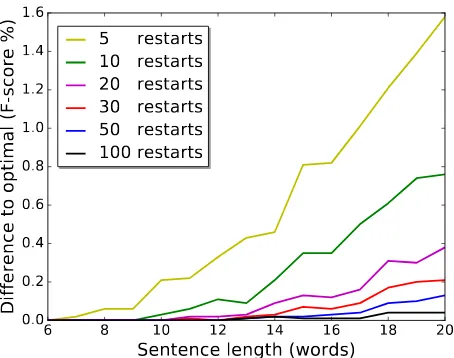
We compare the sets of DRSs using different numbers of restarts to find the best trade-off between speed and accu-racy. The results are shown in Table 3. The optimal scores are obtained using a Prolog script that performs an exhaus-tive search for the optimal mapping. As expected, increas-ing the number of restarts benefits performance. Cai and Knight (2013) consider four restarts the optimal trade-off between accuracy and speed, showing no improvement in F-score when using more than ten restarts.5 Contrary to SMATCH, performance for COUNTER still increases with more than 4 restarts. In our case, it is a bit harder to select an optimal number of restarts, since this number depends on the length of the sentence, as shown in Figure 6. We see that for long sentences, 5 and 10 restarts are not sufficient to get close to the optimal, while for short sentences 5 restarts might be considered enough. In general, the best trade-off between speed and accuracy is approximately 20 restarts.
4
Past tense was chosen because it is the most frequent tense in the data set.
5
[image:5.595.311.541.68.225.2]Restarts P% R% F1% Time (h:m:s)
(random) 1 27.20 22.71 24.75 4:19 (smart concepts) 1 27.45 22.92 24.98 4:35 (smart roles) 1 27.27 22.76 24.81 4:37 5 30.25 25.25 27.53 19:33 10 30.65 25.59 27.89 37:08 20 30.84 25.75 28.07 1:10:13 30 30.90 25.80 28.12 1:41:43 50 30.94 25.83 28.16 2:41:38 75 30.96 25.85 28.17 3:53:01 100 30.97 25.85 28.18 5:01:25
Optimal 30.98 25.86 28.19
Table 3: Results of comparing 19,000 Boxer-produced DRSs to DRSs produced byAMR2DRS, for different num-ber of restarts. For three or more restarts, we always use the smart role and concept mapping.
6
8
10
12
14
16
18
20
Sentence length (words)
0.0
0.2
0.4
0.6
0.8
1.0
1.2
1.4
1.6
Difference to optimal (F-score %)
5 restarts
10 restarts
20 restarts
30 restarts
50 restarts
100 restarts
Figure 6: Comparison of the differences to the optimal F-score per sentence length for different number of restarts.
5.
COUNTERin Action
5.1.
Semantic Parsing
The first purpose of COUNTER is to evaluate semantic parsers for DRSs. Since this is a new task, there are no ex-isting systems that are able to do this. Therefore, we show the results of three baseline systemsPMB PIPELINE, SPAR, andAMR2DRS(Subsection 4.2).6
The PMB PIPELINE produces a DRS via the pipeline of the tools used for automatic annotation of the PMB.7This
means that it has no access to manual corrections, and hence it uses the most frequent word senses and default VerbNet roles. SPARis a trivial semantic ‘parser’ which always outputs the DRS that is most similar to all other DRSs in the most recent PMB release (the left-hand DRS in Figure 4).
The results of the three baseline parsers are shown in Ta-ble 4. The surprisingly high score of SPAR is explained by the fact that the first PMB release mainly contains
rel-6
SPARandAMR2DRSare available at:https://github. com/RikVN/DRS_parsing/
7http://pmb.let.rug.nl/software.php
Precision% Recall% F-score%
SPAR 53.1 36.6 43.3
AMR2DRS 46.5 48.2 47.3
[image:6.595.54.286.70.213.2]PMBPIPELINE 53.0 54.8 53.9
Table 4: Comparison of three baseline DRS parsers to the gold-standard data set.
atively short sentences with little structural diversity. The average number of clauses per clausal form (excluding re-dundant REF-clauses) is 8.7, where a substantial share (ap-proximately 3) comes from tense related clauses. Due to this fact, guessing temporal clauses for short sentences has a big impact on F-score. This is illustrated by the compar-ison of the clausal forms in Figure 4, where matching only temporal clauses results in an F-score of 40%.
AMR2DRS outperforms SPAR by a considerable margin, but is still far from optimal. This is also the case for PMB PIPELINE, which shows that, within the PMB, manual annotation is still required to obtain gold standard meaning representations.
5.2.
Comparing Translations
The second purpose of COUNTER is checking whether translations are meaning-preserving. As a pilot study, we compare the gold standard meaning representations of Ger-man, Italian and Dutch translations in the release to their English counterparts. The results are shown in Table 5. The high F-scores indicate that the meaning representations are often syntactically very similar, if not identical. However, there is a considerable subset of meaning representations which are different from the English ones, indicating that there is at least a slight discrepancy in meaning for those translations.
F-score% Docs F<1.0 % total
German 98.4 579 61 10.5
Italian 97.6 341 46 13.5
Dutch 98.3 355 37 10.4
Table 5: Comparing meaning representations of English texts to those of German, Italian and Dutch translations.
[image:6.595.56.283.283.462.2]She removed the dishes from the table. Ze ruimde de tafel af.
x1 x2 e1 x3 t1
female.n.02(x1)
remove.v.01(e1)
Time(e1, t1)
Source(e1, x3)
Theme(e1, x2)
Agent(e1, x1)
time.n.08(t1) t1≺now
dish.n.01(x2)
table.n.03(x3)
x1 x2 e1 t1
female.n.02(x1)
unclutter.v.01(e1)
Time(e1, t1)
Source(e1, x2)
Agent(e1, x1)
time.n.08(t1) t1≺now
table.n.03(x2)
b1 REF x1
b1 female n.02 x1 b5 REF t1
b5 TPR t1 "now" b5 time n.08 t1 k0 Agent e1 x1 k0 REF e1 k0 Theme e1 x2 k0 Time e1 t1 k0 remove v.01 e1 b2 REF x2
b2 dish n.01 x2 k0 Source e1 x3 b4 REF x3 b4 table n.03 x3
b1 REF x1
b1 female n.02 x1 b4 REF t1
b4 TPR t1 "now" b4 time n.08 t1 k0 Agent e1 x1 k0 REF e1 k0 Source e1 x2 k0 Time e1 t1 k0 unclutter v.01 e1 b2 REF x2
b2 table n.03 x2
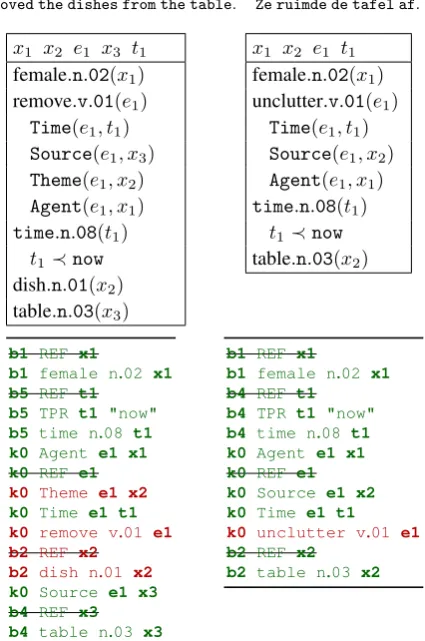
Figure 7: English and Dutch non-literal translations of the document 14/0849. Their clausal forms match each other (excl. redundant REF-clauses) with an F-score of 77.8%. This matching is achieved by the mapping of variables {b57→b4,b47→b2}.
heeft geen ervaring’ (lit. ‘Tom has no experience’), ‘can’t use chopsticks’ with the German ‘kann nicht mit St¨abchen essen’ (lit. ‘cannot eat with sticks’), and ‘remove the dishes from the table’ with the Dutch translation ‘ruimde de tafel af’ (lit. ‘uncluttered the table’).
The mapping of clausal forms involving non-literal trans-lations is illustrated in Figure 7. This preliminary analy-sis shows that this comparison of meaning representations provides an an additional method for detecting mistakes in annotation. It also showed that there are cases where our semantic analysis needs to be revised and improved.
6.
Conclusions and Future Work
Large semantically annotated corpora are rare. Within the Parallel Meaning Bank project, we are creating a large, open-domain corpus annotated with formal meaning repre-sentations. We take advantage of parallel corpora, enabling the production of meaning representations for several lan-guages at the same time. Currently, the these are lanlan-guages similar to English, two Germanic languages (Dutch and German) and one Romance language (Italian). Ideally, fu-ture work would include more non-Germanic languages. The DRSs that we present are meaning representations with substantial expressive power. They deal with negation, uni-versal quantification, modals, tense, and presupposition. Asa consequence, semantic parsing for DRSs is a challeng-ing task. Compared to Abstract Meanchalleng-ing Representations, the number of clauses and variables in a DRS is about two times larger on average. Moreover, compared to AMRs, DRSs rarely contain clauses with single variables. All non-logical symbols used in DRSs are grounded in WordNet and VerbNet (with a few extensions). This makes evalua-tion using matching computaevalua-tionally challenging, in partic-ular for long sentences, but our matching systemCOUNTER achieves a reasonable trade-off between speed and accu-racy.
Several extensions to the annotation scheme are possible. Currently, the DRSs for the non-English languages con-tain references to synsets of the English WordNet. Con-ceptually, there is nothing wrong with this (as synsets can be viewed as identifiers for concepts that are language-independent), but for practical reasons it makes more sense to provide links to synsets of the original language (Hamp and Feldweg, 1997; Postma et al., 2016; Roventini et al., 2000; Pianta et al., 2002). In addition, we consider im-plementing semantic grounding such as wikification in the Parallel Meaning Bank.
As for other future work, we plan to include a more fine-grained matching regarding WordNet synsets, since the cur-rent evaluation of concepts is purely string-based, with only identical strings resulting in a matching clause. For many synsets, however, it is possible to refer to them with more than one word.POS.SenseNumtriple, and this should be ac-counted for (e.g. fox.n.02and dodger.n.01both refer to the same synset). In a similar vein, we plan to experiment with including WordNet concept similarity techniques in COUNTERto compute semantic distances between synsets, in case they do not fully match.
Finally, we would like to stimulate research on semantic parsing with scoped meaning representations. Not only are we planning to extend the coverage of phenomena and the number of texts with gold-standard meaning represen-tations for the four languages, we also aim to organize a shared task on DRS parsing for English, German, Dutch and Italian in the near future.
7.
Bibliographical References
Abzianidze, L. and Bos, J. (2017). Towards universal se-mantic tagging. InProceedings of the 12th International Conference on Computational Semantics (IWCS 2017) – Short Papers, Montpellier, France, September. Associa-tion for ComputaAssocia-tional Linguistics.
Abzianidze, L., Bjerva, J., Evang, K., Haagsma, H., van Noord, R., Ludmann, P., Nguyen, D.-D., and Bos, J. (2017). The Parallel Meaning Bank: Towards a multi-lingual corpus of translations annotated with composi-tional meaning representations. In Proceedings of the 15th Conference of the European Chapter of the Asso-ciation for Computational Linguistics: Volume 2, Short Papers, pages 242–247, Valencia, Spain, April. Associa-tion for ComputaAssocia-tional Linguistics.
[image:7.595.73.286.73.394.2]Proceedings, volume 1 of Research in Computational Semantics, pages 343–354. College Publications. Asher, N. and Lascarides, A. (2003). Logics of
conversa-tion. Studies in natural language processing. Cambridge University Press.
Asher, N. (1993). Reference to Abstract Objects in Dis-course. Kluwer Academic Publishers.
Banarescu, L., Bonial, C., Cai, S., Georgescu, M., Griffitt, K., Hermjakob, U., Knight, K., Koehn, P., Palmer, M., and Schneider, N. (2013). Abstract Meaning Represen-tation for sembanking. In Proceedings of the 7th Lin-guistic Annotation Workshop and Interoperability with Discourse, pages 178–186, Sofia, Bulgaria.
Basile, V., Bos, J., Evang, K., and Venhuizen, N. (2012). A platform for collaborative semantic annotation. In Pro-ceedings of the Demonstrations at the 13th Conference of the European Chapter of the Association for Computa-tional Linguistics (EACL 2012), pages 92–96, Avignon, France.
Bjerva, J., Plank, B., and Bos, J. (2016). Semantic tagging with deep residual networks. InProceedings of COLING 2016, the 26th International Conference on Computa-tional Linguistics: Technical Papers, pages 3531–3541, Osaka, Japan.
Blackburn, P. and Bos, J. (2005). Representation and In-ference for Natural Language. A First Course in Compu-tational Semantics. CSLI.
Bonial, C., Corvey, W. J., Palmer, M., Petukhova, V., and Bunt, H. (2011). A hierarchical unification of LIRICS and VerbNet semantic roles. In Proceedings of the 5th IEEE International Conference on Semantic Computing (ICSC 2011), pages 483–489.
Bos, J., Evang, K., and Nissim, M. (2012). Annotating semantic roles in a lexicalised grammar environment. In Proceedings of the Eighth Joint ACL-ISO Workshop on Interoperable Semantic Annotation (ISA-8), pages 9–12, Pisa, Italy.
Bos, J., Basile, V., Evang, K., Venhuizen, N., and Bjerva, J. (2017). The Groningen Meaning Bank. In Nancy Ide et al., editors,Handbook of Linguistic Annotation, vol-ume 2, pages 463–496. Springer.
Bos, J. (2015). Open-domain semantic parsing with Boxer. In Be´ata Megyesi, editor,Proceedings of the 20th Nordic Conference of Computational Linguistics (NODALIDA 2015), pages 301–304.
Bos, J. (2016). Expressive power of Abstract Meaning Representations. Computational Linguistics, 42(3):527– 535.
Bos, J. (2017). Indexicals and compositionality: Inside-out or outside-in? InProceedings of the 12th International Conference on Computational Semantics (IWCS 2017) – Short Papers, Montpellier, France, September. Associa-tion for ComputaAssocia-tional Linguistics.
Cai, S. and Knight, K. (2013). Smatch: an evaluation met-ric for semantic feature structures. InProceedings of the 51st Annual Meeting of the Association for Computa-tional Linguistics (Volume 2: Short Papers), pages 748– 752, Sofia, Bulgaria, August. Association for Computa-tional Linguistics.
Cucerzan, S. (2007). Large-scale named entity disam-biguation based on Wikipedia data. In Proceedings of the 2007 Joint Conference on Empirical Methods in Nat-ural Language Processing and Computational NatNat-ural Language Learning (EMNLP-CoNLL), pages 708–716, Prague, Czech Republic. Association for Computational Linguistics.
Evang, K. and Bos, J. (2016). Cross-lingual learning of an open-domain semantic parser. InProceedings of COL-ING 2016, the 26th International Conference on Compu-tational Linguistics: Technical Papers, pages 579–588, Osaka, Japan.
Evang, K., Basile, V., Chrupała, G., and Bos, J. (2013). Elephant: Sequence labeling for word and sentence segmentation. In Proceedings of the 2013 Conference on Empirical Methods in Natural Language Processing (EMNLP), pages 1422–1426, Seattle, Washington, USA. Evang, K. (2016). Cross-lingual Semantic Parsing with Categorial Grammars. Ph.D. thesis, University of Groningen.
Christiane Fellbaum, editor. (1998). WordNet. An Elec-tronic Lexical Database. The MIT Press, Cambridge, Ma., USA.
Hamp, B. and Feldweg, H. (1997). GermaNet - a lexical-semantic net for German. In In Proceedings of ACL workshop Automatic Information Extraction and Build-ing of Lexical Semantic Resources for NLP Applications, pages 9–15.
Kamp, H. and Reyle, U. (1993). From Discourse to Logic; An Introduction to Modeltheoretic Semantics of Natural Language, Formal Logic and DRT. Kluwer, Dordrecht. Lewis, M. and Steedman, M. (2014). A* CCG
pars-ing with a supertag-factored model. InProceedings of the 2014 Conference on Empirical Methods in Natural Language Processing (EMNLP), pages 990–1000, Doha, Qatar.
Palmer, M., Gildea, D., and Kingsbury, P. (2005). The proposition bank: An annotated corpus of semantic roles. Computational Linguistics, 31(1).
Pianta, E., Bentivogli, L., and Girardi, C. (2002). Multi-WordNet: developing an aligned multilingual database. InProceedings of the First International Conference on Global WordNet, pages 293–302.
Postma, M., van Miltenburg, E., Segers, R., Schoen, A., and Vossen, P. (2016). Open Dutch WordNet. In Proceed-ings of the Eight Global Wordnet Conference, Bucharest, Romania.
Roventini, A., Alonge, A., Calzolari, N., Magnini, B., and Bertagna, F. (2000). ItalWordNet: a large semantic database for Italian. InProceedings of the Ninth Inter-national Conference on Language Resources and Evalu-ation (LREC 2000), pages 783–790.
van Noord, R. and Bos, J. (2017). Neural semantic pars-ing by character-based translation: Experiments with Abstract Meaning Representations. Computational Lin-guistics in the Netherlands Journal, 7:93–108.