E-ISSN: 2321-9637
Survey on Adaptive Traffic Signal Control
K. Rajasri
1, S. Rahul
2, Pulaka Gupta
3Computer Science and Engineering1, 2, 3
Christ College of Engineering and Technology, Pondicherry, India1, 2, 3
Email: [email protected]1,[email protected], [email protected]3
Abstract - The objective of this paper is to review the various varieties of control systems present within the
conveyance Adhoc Network (VANET). Throughout the last year’s heap of efforts are created to boost the potency of the control System (TCS) to fulfill ever increasing traffic demands. Traffic congestions in urban networks could contribute to adverse impact on the economy, surroundings and so the standard of life. As a result, verdant analysis has been conducted to supply countermeasures through traffic-responsive management ways that. These ways aim to supply machine-driven laws of traffic through varied management methodologies. Our study focuses on each Static and Dynamic control System.
Index Terms – Traffic control system, Adaptive traffic control system, congestion.
1.INTRODUCTION
Due to fast increasing of urbanization and traffic congestion creates associate imperative got to operate our transportation systems with most potency. Traffic congestion has been inflicting several crucial problems and challenges in most cities of contemporary countries. To a commuter or traveller, congestion means lost time, incomprehensible opportunities, and frustration. As traffic volume continues to increase, the street becomes further and extra engorged. One in every of the foremost cost-effective measures for addressing this downside is traffic signal management. Traffic signal re temporal order and coordination of existing signals are tested to achieve substantial reductions in traffic delays, consequently, a Brobdingnagian reduction in the amount and increased, immense reduction in travel time and exaggerated safety for the general public.
2.TYPESOFSIGNALPROCESSING
2.1. Signal processing
Signal processes encompass two ways of gestures sign within the traffic control system one is static sign and another one is dynamic sign.
Static traffic signal processing: (1) Pre timed signaling
(2) Solid state pre timed signaling (3) Pre-timed actuated control
2.1.1. Pre-timed Signal
Pre-timed signal management [5] directs traffic to stop or permits it to proceed in step with a predetermined ‘fixed” cycle length and a division of the “fixed” cycle time between the assorted approaches to the intersection
no matter the actual vehicle demand. The sequence throughout that the signal indications unit of measurement shown, and therefore the time-relation of the signal to totally different signals also are preselected. Any or all of those features is also modified to accommodate specific needs.
Pre-timed management [5] could also be used at isolated intersections wherever traffic volumes square measure inevitable. Or wherever the installation is to be coordinated within the near future with adjacent intersections. However, traffic motivated signals could also be desirable at the most intersections thanks to their potential for being additional efficient for such locations than Pre-timed signals[1].
Pre-timed management [5] is that the simplest type of signalization. In Pre-timed signal management, the cycle length, phases, inexperienced times, and alters intervals square measure all planned. The signal is updated through this outlined cycle in cycle length, phases, inexperienced times, and alter intervals repetitive order. Reckoning on the controller instrumentation, several planned temporal arrangement patterns could also be used. Multiday controllers offer for various temporal arrangement plans which will be initiated by clock at planned times of the day. As an example, three-dial controllers typically offer completely different signal temporal arrangement plans for AM, off-peak, and PM conditions.
2.1.1.1 Advantages of pre-timed control
capability will allow progressive movement through a system of many well-spaced traffic signals. Precise coordination of temporal arrangement permits the operation of 2 or additional terribly closely spaced intersections to control at most potency for correct operation, Pre-timed controllers are not addicted to vehicle detectors. Thus, the operation of the controller isn't adversely affected by such conditions as a stopped vehicle or construction work at intervals the world.
Pre-timed management might even be further acceptable than impelled management in areas wherever large and fairly consistent pedestrian volumes are present, and wherever confusion might occur with the operation of pedestrian push buttons.
2.1.2. Solid-state Pre-timed Control
In the early l980s, makers began to provide Pre-timed controllers supported solid-state circuits. The dial motors and cam shafts of the mechanical device controllers were replaced with code driven instrumentation. Timings area unit accomplished through the utilization of temporal arrangement plans, that area unit keyboard entered. Cam shafts were replaced with signal plans contained on a promenade, or Program browse solely Memory, chips that were burned in. Newer models of these controllers do not want that the PROM’s be burned. The fundamental functions of the mechanical device were duplicated, however done digitally. Several extra options like extra temporal arrangement plans signal plans and restricted detection capabilities were intercalary. Solid-state Pre-timed controllers aren't interchangeable between makers.
2.1.3. Pre-timed actuated control
Pre-timed motivated management [5] employs a similar basic controller as represented within the preceding section except that vehicle detection amplifiers may be wired into the controller electronic equipment. The controller will dwell in AN extremely specified half until a vehicle is detected on one in all the approaches having detection. This kind of operation has the advantage of permitting the controller to dwell in a very inexperienced condition, usually for the most Street. a drawback is that the controller should follow through the pre-set minimum signal intervals and doesn't simply allow the skipping of any intervals. With the solid-state controllers, signal plans what is more as temporal property plans square measure typically changed through the detection, which, with certain brands, closely mimics the operation of the wholly motivated controller.
3. DYNAMIC TRAFFIC SIGN CONTROl
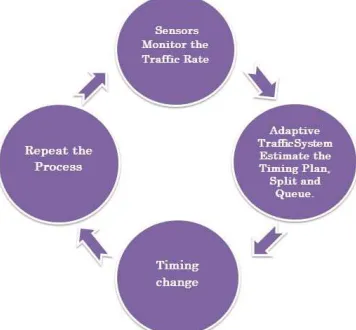
Dynamic Traffic Signal Control [25] monitors the traffic rate by every second, according to that traffic rate the system will easily adapt. It changes the traffic timing according to the traffic rate. Dynamic Traffic Signal Control also called as Adaptive Traffic Signal Control
[image:2.595.309.487.255.420.2]4. ADAPTIVE TRAFFIC SIGNAL CONTROL
Fig.2. Working of Adaptive Traffic Signal Control Fig. (2) Shows that operating of adaptive Traffic System. It’ll carry on sensing the traffic rate victimization the detectors. Per that traffic rate traffic system can mechanically estimate the temporal arrangement arrange, split, queue sequence and section sequence. If the traffic rate is high then the system can increase the cycle temporal arrangement. Adjective traffic light management [1] [4] [10] technologies alter once inexperienced lights begin and finish to accommodate current traffic patterns to push swish flow and ease tie up. The main advantages of adaptive signal system over standard signal systems area unit that it can:
• Automatically adapt to unforeseen changes in traffic conditions.
• Improve period dependability.
• Reduce congestion in high traffic and fuel consumption.
• Prolong the effectiveness of stoplight temporal order.
• It minimizes the complaints that agencies receive in response to the obsolete signal temporal order.
E-ISSN: 2321-9637
4.1. Working Methodology of Adaptive Traffic control System
By receiving and process knowledge from sensors to optimize and update signal temporal order settings, adaptation signal management [1] [4] [10] technologies will confirm once and the way long lights ought to be inexperienced. Adaptive signal controls technologies facilitate improve the standard of service that traveler’s expertise on our native roads and highways. The process is straightforward. First, traffic sensors collect info. Next, traffic info is evaluated and signal temporal property enhancements are developed. Finally, the adaptation signal management technology implements signal temporal property updates. The tactic is perennial every second to remain the traffic flowing smoothly. Ancient signal retiming might alone repeat this technique every 3 to 5 years.
The traditional signal temporal property technique is long and wishes substantial amounts of manually collected traffic info. Ancient time-of-day signal temporal order plans don't accommodate variable and unpredictable traffic demands. This ends up in annoyed drivers, a lot of fuel consumption, inflated delays, and degraded safety.
4.2. Need of Adaptive Signal Control Technologies
Adaptive signal management technologies [1] [4] [10] deliver improved service to road users. Outdated stoplight temporal property presently accounts for over 100 percent of all traffic delays. On average, adaptationsignal management technologies improve amount of your time by over 100 percent. In areas with considerably obsolete signal temporal property, Associate in nursing improvement is five hundredth or plenty of. Adaptive signal management technologies together react to shocking events, like crashes and special events. By adjusting stoplight temporal property in amount to copy actual conditions on the road, travelers relish an extra reliable trip.
Studies indicate that crashes could be reduced by up to five hundredth through improved signal temporal property. Adaptation signal management technology can reduce the intersection congestion that causes many crashes.
Adaptive light management technologies solve issues for signal operators.
Performance management and deed the info necessary to measure performance area unit challenges facing many transportation agencies. Adaptation signal management technologies capture an elegant set of data that signal operators can use to watch their performance.
By determination traffic problems as they occur, adaptation signal management can reduce subject complaints and frustration. Adaptation signal management technology could also be a proactive step that signal operators can fancy improve service. Adaptive light management technologies [16] give price. The prices of congestion and delay to road user square measure substantial, and adaptation signal management technology delivers benefits to users that method outweighs its price
Adaptive signal management technologies to boot provide price on to signal operators. By extending the effectiveness of sunshine temporal property plans, implementing adaptation signal management technologies can yield direct savings by reducing the frequency of manually retiming signals.
4.3. Adaptive Traffic signal control Technologies
(1) Vehicle Actuated Method • Semi Actuated • Fully actuate (2) SCOOT
(3) SCATS (4) RHODES (5) ACS Lite (6) OPAC
4.3.1. Vehicle Actuated Method
Actuated signals [3] [5] have the aptitude to retort to the presence of vehicles or pedestrians at the intersection. Motivated traffic light management consists of intervals that are referred to as an extended in response to vehicle detectors. The traffic light controllers are capable of not solely varied the cycle length & inexperienced times in response to sight or effort, but of fixing the order and sequence of phases. Accommodative {traffic management control} systems (ATCS) [24] belong to the newest generation of signalized intersection control. ATCS repeatedly sight vehicle traffic volume; optimum signal timings supported this detected volume and at constant time implement them. Reacting to those volume variations usually finally ends up in reduced delays, shorter queues and bated travel times.
4.3.1.1. Semi Actuated Signal
Fig.3.Layout of Semi Actuated Control
Fig.3.Shows that the layout of Semi motivated management. The detectors arranged within
approaches. Semi-actuated management [5] uses detection just for the minor movements at associate degree intersection. The phases associated with the major-road through movements are
actuated.” That is, these phases do not appea provided detection information. Throughout
operation, the controller is programmed to dwell at intervals the non-actuated section and, thereby, sustain associate degree inexperienced indication for the most effective flow movements (normally the key street through movement). Minor movement phases serviceable when a concern their service is received.
Semi-actuated management is best suited to application at intersections that
coordinated blood vessel street system.
Semi-actuated management may additionally be appropriate for isolated intersections with a low major road and lighter intersection volume. Semi actuated management has many edges. Its primary advantage is that it will be used effectively during a coordinated signal system. Also, relative to
management, it reduces the delay incurred by the major-road through movements (i.e., the movements related to the non-actuated phases) in periods of sunshine traffic. Finally, it does not want detectors f the major-road through movement phases and so, its operation is not compromised by the failure of these detectors. the key disadvantage of semi
operation is that continuous demand on the phases related to one or a lot of minor movements will ca excessive delay to the key road through movements if Fig.3.Layout of Semi Actuated Control
3.Shows that the layout of Semi motivated arranged within the minor actuated management [5] uses detection just for the minor movements at associate degree intersection. The phases associated with the are operated as “non-actuated.” That is, these phases do not appear to be
Throughout this kind of operation, the controller is programmed to dwell at actuated section and, thereby, sustain associate degree inexperienced indication for the most rmally the key street through movement). Minor movement phases are serviceable when a concern their service is received.
actuated management is best suited to application at intersections that are a part of a coordinated blood vessel street system.
actuated management may additionally be appropriate for isolated intersections with a low-speed major road and lighter intersection volume. Semi-actuated management has many edges. Its primary advantage is that it will be used effectively during a rdinated signal system. Also, relative to Pre-timed management, it reduces the delay incurred by the road through movements (i.e., the movements actuated phases) in periods of does not want detectors for road through movement phases and so, its operation is not compromised by the failure of these detectors. the key disadvantage of semi-actuated operation is that continuous demand on the phases related to one or a lot of minor movements will cause excessive delay to the key road through movements if
the utmost inexperienced and therefore the passage time parameters aren't suitably set.
detectors ought to be used on the minor approaches, thus requiring installation and o
Semi-actuated operation collectively wants than that needed for pre-timed management.
4.3.1.2. Fully Actuated control
Fig.4. Layout of Fully actuated control
Fully-actuated [3] [20] management refers to intersections that all phases area unit
It wants detection for all traffic movements. Fully actuated management is ideally suited to isolated intersections wherever the traffic demands and patt vary wide throughout the course of the day. controllers in coordinated signal systems may be programmed to control in a very fully
throughout low-volume periods wherever the system is working in a very “free” (or non
The major disadvantage of fully
is that its value (initial and maintenance) is above that of different management sorts attributable to the number of detection needed.
end in the next proportion of ve
result of inexperienced time isn't command for upstream platoons.
4.3.2. SCOOT
SCOOT [2] [9] is nothing however Split Cycle Offset improvement Technique. Flash
widely-used adaptational control system with over 200implernentations throughout the planet. The flash [19] system divides a network into “regions”, every containing variety of “nodes” (signalized intersections and pedestrian crossings that run at identical cycle time to permit coordination). Nodes could also be
the utmost inexperienced and therefore the passage time arameters aren't suitably set. Another drawback is that detectors ought to be used on the minor approaches, installation and ongoing maintenance. actuated operation collectively wants extra work
timed management.
Fully Actuated control
Fig.4. Layout of Fully actuated control
actuated [3] [20] management refers to intersections that all phases area unit motivated and so. It wants detection for all traffic movements. Fully-actuated management is ideally suited to isolated intersections wherever the traffic demands and patterns vary wide throughout the course of the day. Hottest controllers in coordinated signal systems may be programmed to control in a very fully-actuated mode volume periods wherever the system is working in a very “free” (or non-coordinated) mode. The major disadvantage of fully-actuated management is that its value (initial and maintenance) is above that of different management sorts attributable to the number of detection needed. It’s going too additionally end in the next proportion of vehicles stopping as a result of inexperienced time isn't command for
E-ISSN: 2321-9637
cycled” (i.e. Operate at 1/2 the system cycle length) at pedestrian crossings of under-saturated intersections. Regional boundaries area unit set at long links wherever coordination might not be possible. The performance of flash considerably depends on traffic flow information obtained from the detectors. The system needs an oversized range of detectors set at pre-determined locations on each link. The situation of detectors is crucial, usually placed at the upstream finish of the approach link.
Fig.5. Architecture of SCOOT
SCOOT has 3 improvement procedures: the Split Optimizer, the Offset Optimizer, and also the Cycle Time Optimizer. The rule predicts vehicle delays and stops on every link, and calculates the system’s performance index supported these measures. From the general performance of the network, flash [24] incrementally changes the pre-determined signal temporal order plans. Before making changes to the trail splits, the Split Optimizer evaluates this red and inexperienced split to examine whether or not or not the splits got to be extended, shortened or keep constant. The Split Optimizer works in increments of 1 to four seconds. With the on top of represented optimizers, SCOOTS will really modification signal temporal order plans, consistent with traffic flow fluctuations in numerous time periods.
It may follow daily traffic flow trends over time and maintain a seamless coordination of the signal network.
4.3.3. SCATS
SCATS [7] square measure nothing however state capital coordinatedadaptive Traffic signals. SCATS square measure most likely the foremost advanced and wide used adaptive control system; SCATS were
developed by the Roads and Traffic Authority of latest South Wales, Australia. As a true time adaptive signal system, SCATS [23] can modification the signal temporal arrangement in response to fluctuations in traffic flow and system capability. The SCATS square measure designed with 3 management levels: central, regional and native. For each intersection, SCATS distributes computations between a regional laptop at the traffic operations center and also the field controller. The central level is operated by the central system that communicates with different levels at intervals the hierarchy, primarily for observance functions. SCATS mix adaptive light management with standard methods to produce users with a system that may meet varied operational desires. Management methods include: adaptive operation, time of day and day of week coordination, and isolated signal operation. With time period news tools, the system permits traffic engineers to watch system operations. Continuous intersection watching quickly alerts operators of any uncommon conditions or instrumentality failures.
4.3.4. RHODES
RHODES [8] [17] may be a time period traffic accommodative system with a hierarchical data structure. RHODES can take input from different types of detectors and, supported what future traffic conditions square measure foreseen, generate optimized signal management plans.
The RHODES has 3 major system options were noted by the event team that produces RHODES a viable and effective accommodative signal system. First, recent new technologies and ways square measure well adopted in RHODES to create positive the system has high performance in transferring, processing, predicting traffic knowledge and signal management.
Second. RHODES takes into thought the random nature of traffic flow variations. Third, categorical prediction of individual vehicle arrivals, platoon arrivals and traffic flow rates square measure completely thought-about in RHODES.
4.3.5. AC–S LITE
conniving the progressed flow or captured flow. This performance live can be a surrogate for vehicle stops and delay, that cannot be directly measured within the field from purpose detectors. Specifically, the captured or progressed transport flow ¡s the quantity of flow (in units of vehicle-seconds of occupancy) inbound at the stop line at a given purpose within the cycle increased by the p.c of your time the progression part was inexperienced at that point throughout the cycle. The algorithm evaluates fully completely different offsets by conniving the captured flow on every approach and choosing the offset that maximizes the overall quantity of captured flow.
5. CONCLUSION
A new way to reduce the delay experienced by the vehicles in the traffic signal posts in a dynamic way by determining the vehicle density of the platoons in respective directions and minimizing the conflicts.Scheduling the platoons on the basis of LAR routing of vehicle in the platoon. By eliminating the buffer we can significantly increase the efficiency of adaptive traffic signal monitoring system.
REFERENCES
[1] AleksandarSteVaflOvic, Adaptive Traffic Control Systems: Domestic and Foreign State of Practice, National Cooperative Highway Research Program.
[2] Hunt, P. B., Robertson D. I., Bretherton R. D..and Winton, R. 1.. “SCOOT – A Traffic Responsive Method of Coordinating Signals”. Laboratory Report 1014. Transport and Road Research Lab, Crowthorne, Berkshire, U.K., 1981.
[3] Jin-yiGuo, Bao-hua Mao, Ming-Jun Liu, Li-Ping Ga, “Study on actuated signal controlled system in isolated intersection” IEEE Control and Decision Conference, 2008 , Page(s):2261
–2265.
[4] KartikPandit. DipakGhosal Michael Zhang, and Chen-Nee Chuah “Adaptive Traffic Signal Control With Vehicular Ad hoc Networks” IEEE transactions on vehicular technology. Vol. 62, no. 4, May 2013.
[5] Li-Wen Chen and Thea-Yin Hu. Flow Equilibrium Under Dynamic Traffic Assignment and Signal Control—An Illustration of Pre-timed and Actuated Signal Control Policies. IEEE Transactions On Intelligent Transportation Systems. VOL. 13.NO. 3. September 2012.
[6] Luyanda. F., Gettman, D., Head, L., Shelby, S., Bullock. D.. and Mirchandani, P.. “ACS Lite Algorithmic Architecture: Applying Adaptive Control System Technology to Closed-Loop Traffic Signal Control Systems”, Transportation Research Record 1856, pp 175-184, 2007.
[7] M. Besley, R. Akeelik, and E. Chung, “An evaluation of SCATS master isolated control.” in Proc. 19th ARRB Transp. Res. Conf, May 1998, pp. l—24.
[8] Mirchandani, P. and Head, L., “RHODES: A Real-Time Traffic Signal Control System: Architecture, Algorithms, and Analysis”. Transportation Research Part C, 9(6). pp 415-432. 2001.
[9] Robertson, D. I.; Bretherton, R. D. Optimizing Networks of Traffic Signals in Real-time - the SCOOT Method. IEEETransactions on Vehicular Technology, 40 (1991), pp. 11- 15. [10] Shelby, S. G., “Design and Evaluation of
Real-time Adaptive Traffic Signal Control Algorithms”. Ph. D. Dissertation, The University of Arizona. 2001.
[11] Sims, A. G. and Dobinson, K. W., “The Sydney Coordinated Adaptive Traffic (SCAT) System Philosophy and Benefits”. IEEE Transactions on Vehicular Technology, 29(2), 1980.
[12] Stallard,C, Ghaman,R.S., Li Zhang; McHale, G, “The role of traffic simulation in traffic signal control system development” Intelligent Transportation Systems, 2003. Proceedings. 2003 IEEE, Page (s): 872 - 877, Vol. 1 [13] Kevin Fehon, P.E., PTOE and Jim Peters, P.E., PTOE, “Adaptive Traffic Signals, Comparison and Case Studies” Intelligent Transportation System.
[14] The InSync Traffic System Devolopershttp://rhythmtraffic.com/
[15] Gartner, Nathan H. et al., “Implementation of the OPAC adaptive control strategy in a traffic signal network” Intelligent Transportation Systems, 2001. Proceedings. 2001 IEEE, pp. 195 – 200.
[16] Deng, L.Y., Hsu Chun Liang ; Chin-Thin Wang ; Ching-Sheng Wang et al., “The development of the adaptive traffic signal control system” Parallel and Distributed Systems, 2005. Proceedings. 11th International Conference on Vol 2, pp. 634 - 638
E-ISSN: 2321-9637
Control Strategies", PROCEEDINGS OF THE IEEE, VOL. 91, NO. 12, DECEMBER 2003. [18] Rachmadi, M.F, Al Afif, F. ; Jatmiko,
W. ; Mursanto, P. et al., “Adaptive traffic signal control system using camera sensor and embedded system” TENCON 2011 - 2011 IEEE Region 10 Conference pp.1261 – 1265. [19] Taale, H, Fransen, W.C.M &Dibbits, J. (1998).
"The second assessment of the SCOOT system in Nijmegen." IEE Road Transport Information and Control, 21-23 April 1998. Conference Publication No 454.
[20] Maslekar, N. ; Boussedjra, M. ; Mouzna, J. ; Labiod,H. “VANET Based Adaptive Traffic Signal Control” Vehicular Technology Conference (VTC Spring), 2011 IEEE 73rd , 2011 , pp. 1 – 5.
[21] M.Amin, S. Jalili "Urban Signal Control using Intelligent Agents" in eProceedings of Applied Artificial Intelligence, pp. 811-816.
[22] Z.Liu "A Survey of Intelligence Methods in Urban Traffic Signal Control, " in International Journal of Computer Science and Network Security. vol. 7, July 2007, pp. 105-112. [23] Gartner, Nathan H. ; Pooran, F.J. Andrews,
C.M. “Implementation of the OPAC adaptive control strategy in a traffic signal network” Intelligent Transportation Systems, 2001. Proceedings. 2001 IEEE, 2001 , pp. 195 – 200
[24] BHUVANESWARI,P.T.V,RAJ,G.V.A. ; BALAJI, R. ; KANAGASABAI, S. “ADAPTIVE TRAFFIC SIGNAL FLOW CONTROL USING WIRELESS
SENSOR NETWORKS” COMPUTATIONAL
INTELLIGENCE AND COMMUNICATION
NETWORKS (CICN), 2012 FOURTH
INTERNATIONAL CONFERENCE ON3-5 NOV. 2012,85–89.