Cross-Language Information Retrieval Based on
Category Matching Between Language Versions of a Web Directory
Fuminori Kimura
Graduate School of Information Science,
Nara Institute of Science and Technology
8916-5 Takayama, Ikoma, Nara, Japan
Akira Maeda
Department of Computer Science, Ritsumeikan University
1-1-1 Noji-Higashi, Kusatsu, Shiga, Japan
Masatoshi Yoshikawa
Information Technology Center, Nagoya University
Furo-cho, Chigusa-ku, Nagoya, Aichi, Japan
Shunsuke Uemura
Graduate School of Information Science,
Nara Institute of Science and Technology
8916-5 Takayama, Ikoma, Nara, Japan
Abstract
Since the Web consists of documents in various domains or genres, the method for Cross-Language Information Retrieval (CLIR) of Web documents should be in-dependent of a particular domain. In this paper, we propose a CLIR method which employs a Web directory provided in mul-tiple language versions (such as Yahoo!). In the proposed method, feature terms are first extracted from Web documents for each category in the source and the tar-get languages. Then, one or more corre-sponding categories in another language are determined beforehand by comparing similarities between categories across lan-guages. Using these category pairs, we in-tend to resolve ambiguities of simple dic-tionary translation by narrowing the cat-egories to be retrieved in the target lan-guage.
1 Introduction
With the popularity of the Internet, more and more languages are becoming to be used for Web ments, and it is now much easier to access docu-ments written in foreign languages. However, exist-ing Web search engines only support the retrieval of documents which are written in the same language as the query, so the monolingual users are not able to retrieve documents written in non-native languages
efficiently. Also, there might be cases, depending on the user’s demand, where information written in a language other than the user’s native language is rich. Needs for retrieving such information must be large. In order to satisfy such needs on a usual monolingual retrieval system, the user him-/herself has to manually translate the query by using a dic-tionary, etc. This process not only imposes a burden to the user but also might choose incorrect transla-tions for the query, especially for languages that are unfamiliar to the user.
To fulfill such needs, researches on Cross-Language Information Retrieval (CLIR), a tech-nique to retrieve documents written in a certain lan-guage using a query written in another lanlan-guage, have been active in recent years. A variety of meth-ods, including employing corpus statistics for the translation of terms and the disambiguation of trans-lated terms, are studied and a certain results has been obtained. However, corpus-based disambigua-tion methods are heavily affected by the domain of the training corpus, so the retrieval effectiveness for other domains might drop significantly. Besides, since the Web consists of documents in various do-mains or genres, the method for CLIR of Web docu-ments should be independent of a particular domain.
category correspondences between languages are es-timated in advance. First, feature terms are extracted from Web documents for each category in the source and the target languages. Then, one or more cor-responding categories in another language are de-termined beforehand by comparing similarities be-tween categories across languages. Using these cat-egory pairs, we intend to resolve ambiguities of simple dictionary translation by narrowing the cat-egories to be retrieved in the target language.
2 Related Work
Approaches to CLIR can be classified into three cat-egories; document translation, query translation, and the use of inter-lingual representation. The approach based on translation of target documents has the ad-vantage of utilizing existing machine translation sys-tems, in which more content information can be used for disambiguation. Thus, in general, it achieves a better retrieval effectiveness than those based on query translation(Sakai, 2000). However, since it is impractical to translate a huge document collection beforehand and it is difficult to extend this method to new languages, this approach is not suitable for mul-tilingual, large-scale, and frequently-updated collec-tion of the Web. The second approach transfers both documents and queries into an inter-lingual repre-sentation, such as bilingual thesaurus classes or a language-independent vector space. The latter ap-proach requires a training phase using a bilingual (parallel or comparable) corpus as a training data.
The major problem in the approach based on the translation and disambiguation of queries is that the queries submitted from ordinary users of Web search engines tend to be very short (approximately two words on average (Jansen et al., 2000)) and usually consist of just an enumeration of keywords (i.e. no context). However, this approach has an advantage that the translated queries can simply be fed into ex-isting monolingual search engines. In this approach, a source language query is first translated into target language using a bilingual dictionary, and translated query is disambiguated. Our method falls into this category.
It is pointed out that corpus-based disambiguation
methods are heavily affected by the difference in do-main between query and corpus. Hull suggests that the difference between query and corpus may cause bad influence on retrieval effectiveness in the meth-ods that use parallel or comparable corpora (Hull, 1997). Lin et al. conducted comparative experi-ments among three monolingual corpora that have different domains and sizes, and has concluded that large-scale and domain-consistent corpus is needed for obtaining useful co-occurrence data (Lin et al., 1999).
On the Web retrieval, which is the target of our re-search, the system has to cope with queries in many different kinds of topics. However, it is impracti-cal to prepare corpora that cover any possible do-mains. In our previous paper(Kimura et al., 2003), we proposed a CLIR method which uses documents in a Web directory that has several language versions (such as Yahoo!), instead of using existing corpora, in order to improve the retrieval effectiveness. In this paper, we propose an extension of our method which takes account of the hierarchical structure of Web directories. Dumais et al.(Dumais and Chen, 2000) suggests that the precision of Web document classification could be improved to a certain extent by limiting the target categories to compare by us-ing the hierarchical structure of a Web directory. In this paper, we try to improve our proposed method by incorporating the hierarchical structure of a Web directory for merging categories.
3 Proposed System
3.1 Outline of the System
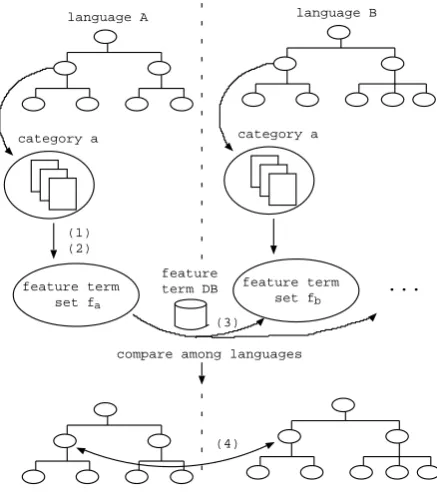
Our system uses two or more language versions of a Web directory. One version is the query language (language A in Figure 1), others are the target lan-guages to be retrieved (language B in Figure 1). From these language versions, category correspon-dences between languages are estimated in advance.
example shows a case that categoryain language A corresponds to a category in language B. First, the system extracts terms from Web documents which belong to categorya(1). Secondly, the system cal-culates the weights of the extracted terms. Then higher-weighted terms are extracted as the feature term set fa of category a(2). Thirdly, the system translates the feature term set fa into language B (3). Lastly, the system compares the translated fea-ture term set of category a with feafea-ture term sets of all categories in language B, and estimates the cor-responding category of categoryafrom language B (4).
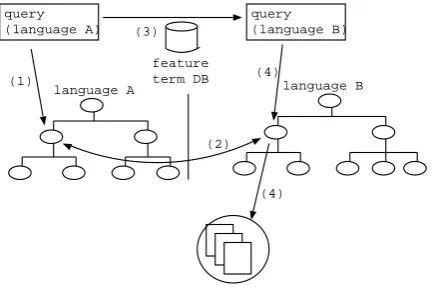
These category pairs are used on retrieval. First, the system estimates appropriate category for the query in the query language. Next, the system se-lects the corresponding category in the target lan-guage using the pre-estimated category pairs. Fi-nally, the system retrieves Web documents in the se-lected corresponding category.
language A
category a
feature term set f
language B
category a
feature term
set f ...
compare among languages (1)
(2)
(3)
(4) feature term DB
a b
Figure 1: Preprocessing.
3.2 Preprocessing
3.2.1 Feature Term Extraction
The feature of each category is represented by its feature term set. Feature term set is a set of
terms that seem to distinguish the category. The feature term set of each category is extracted in the following steps: First, the system extracts terms from Web documents that belong to a given cate-gory. In this time, system also collect term fre-quency of each word in each category and normal-ize these frequency for each category. Second, the system calculates the weights of the extracted terms using TF·ICF (term frequency·inverse category fre-quency). Lastly, topnranked terms are extracted as the feature term set of the category.
Weights of feature terms are calculated by TF·ICF. TF·ICF is a variation of TF·IDF (term fre-quency · inverse document frequency). Instead of using a document as the unit, TF·ICF calculates weights by category. TF·ICF is calculated as fol-lows:
tf ·icf(ti, c) = fN(ti) c
·logN
ni + 1
where ti is the term appearing in the category c, f(ti)is the term frequency of termti,Ncis the total number of terms in the categoryc,ni is number of the categories that contain the termti andN is the number of all categories in the directory.
3.2.2 Category Matching Between Languages
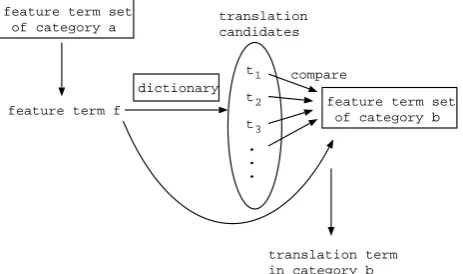
For estimating category correspondences between languages, we compare each feature term set of a category which is extracted in section 3.2.1, and cal-culates similarities between categories across lan-guages.
re-solved.
If no translation candidate for a feature term ex-ists in the feature term set of the target category, that term is ignored in the comparison. However, there are some cases that the source language term itself is useful as a feature term in the target language. For example, some English terms (mostly abbreviations) are commonly used in documents written in other languages (e.g. “WWW”, “HTM”, etc.). Therefore, in case that no translation candidate for a feature term exists in the feature term set of the target cat-egory, the feature term itself is checked whether it exists in the feature term set of the target category. If it exists, the feature term itself is treated as the translation of the feature term in the target category.
As an example, we consider that an English term “system” is translated into Japanese for the
cate-gory “ >
> (Computers and Internet> Soft-ware>Security)” (hereafter called “ ” for short). The English term “system” has the fol-lowing translation candidates in a dictionary; “ (universe/space)” “ (method)” “
(orga-nization)” “ (organ)” “ (system)”
etc. We check each of these translation candidates in the feature term set of the category “ .” Then the highest-weighted term of these translation candidates in the category “ ” is deter-mined as the translation of the English term “sys-tem” in this category. If no translation candidate ex-ists in the feature term set of the category “
,” the English term “system” itself is treated as the translation.
Once all the feature terms are translated, the sys-tem calculates the similarities between categories across languages. The similarity between the source categoryaand the target categorybis calculated as the total of multiplying the weights of each feature term in the categoryaby the weight of its transla-tion in the category b. The similarity of the category afor the categorybis calculated as follows:
sim(a, b) = X
f∈fa
w(f, a)·w(t, b)
wheref is a feature term,fa is the feature term set of categorya,tis the translation offin the category
feature term set
Figure 2: Feature term translation.
b, andw(f, a)is the weight off ina.
The system calculates the similarities of category afor each category in the target language using the above-mentioned method. Then, a category with the highest similarity in the target language is selected as the correspondent of categorya.
As an example, we consider an example of calculating the similarity of an English category “Computers and Internet>Security and Encryption” (hereafter called “Encryption” for short) for the cat-egory “ ” which is mentioned above. Suppose that the feature term set of the category “Encryption” has the following feature terms; “pri-vacy”, “system”, etc., and the weights of these terms are 0.007110, 0.006327,· · ·. Also suppose that the Japanese translations of these terms are “
(privacy)”, “ (system)”, etc., and the weights of these terms are 0.023999, 0.047117,· · ·. In this case, the similarity of the category “Encryp-tion” (s1) for the category “ ” (s2) is
In our system, a query consists of some keywords, not of a sentence. We define the query vector~q as follows:
~q= (q1, q2, . . . , qn)
where qk is the weight of the k-th keyword in the query. We define the values of allqkare 1.
First, the system calculates the relevance between the query and each category in the source language, and determines the relevant category of the query in the source language (1). The relevance between the query and each category is calculated by multiply-ing the inner product between query terms and the feature term set of the target category by the angle of these two vectors. The relevance between query qand categorycis calculated as follows:
rel(q, c) =~q·~c· ~q·~c |~q| · |~c|
where~cis a vector of categorycdefined as follows:
~c= (w1, w2, . . . , wn)
wherewkis the weight of thek-th keyword in the feature term set ofc.
If there is more than one category whose rele-vance for the query exceeds a certain threshold, all of them are selected as the relevant categories of the query. It is because there might be some cases that, for example, documents in the same domain belong to different categories, or a query concept belongs to multiple domains.
Second, the corresponding category in the tar-get language is selected by using category corre-spondences between languages mentioned in section 3.2.2 (2). Third, the query is translated into the tar-get language by using a dictionary and the feature term set of the corresponding category (3). Finally, the system retrieves documents in the corresponding category (4).
4 Category Merging
4.1 Previous Experiments
In our previous paper(Kimura et al., 2003), we con-ducted experiments of category matching using the subsets of English and Japanese versions of Yahoo!.
language A language B
(4) feature
term DB query
(language A)
query (language B)
(1)
(2) (3)
(4)
Figure 3: Processing in retrieval.
The English subset is 559 categories under the cat-egory “Computers and Internet” and the Japanese subset is 654 categories under the corresponding
category “
(Com-puters and Internet).” Total size of English web pages in each category after eliminating HTML tags are 45,905 bytes on average, ranging from 476 to 1,084,676 bytes. Total size of Japanese web pages are 22,770 bytes on average, ranging from 467 to 409,576 bytes.
In our previous experiments, we could not match categories across languages with adequate accuracy. It may have been caused by the following reasons; one possible reason is that the size of Web docu-ments was not enough for statistics in some cate-gories, and another is that some categories are ex-cessively divided as a distinct domain.
For the former observation, we eliminated the cat-egories whose total bytes of Web documents are less than 30KB, but the results were not improved.
4.2 Method of Category Merging
Considering the result of the above experiments, we need to solve the problem of excessive division of categories in order to accurately match categories between languages.
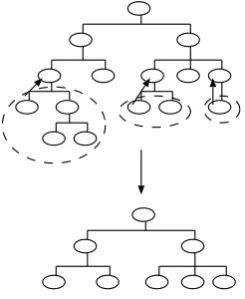
im-proved by merging child categories at some level in the category hierarchy in order to merge some cate-gories similar in topic and to increase the amount of text in a category.
Accordingly, we solve the problem by merging child categories into the parent category at some level using the directory hierarchy. As child cate-gories are specialized ones of the parent category, we can assume that these categories have similar topic. Besides, even if two categories have no direct link from each other, we can assume that categories that have same parent category might also have sim-ilar topic.
However, we still need further investigation on at which level categories should be merged.
Figure 4: Category merging.
5 Experiments
We are conducting experiments of the proposed method to detect relevance category of a query. In this experiment, we used the same subsets men-tioned in section 4.1. We merged the categories three levels below the category “Computers and Internet” into the parent. The number of categories after cate-gory merging is 342 in English and 265 in Japanese.
At first, we have done the experiment using the following formula that uses only inner product, before using the calculation mentioned in section 3.2.3.
relinner(q, c) =~q·~c
In this experiment, the query has three terms: “encryption”(=q1), “security”(=q2), and
“system”(=q3).
Table 1 is the list of top 10 relevant categories in first experiment. Almost all the categories in the Ta-ble 1 are relevant to the query. Thus, the relevance calculation method by only inner product is regarded as an effective method. However, this method has the following problem. The category that has few query terms might be given high relevance when the category has the only one query term whose weight in the category is extremely high.
In order to reduce this effect, we propose the im-proved method mentioned in section 3.2.3. The method is revised to take account of the angle be-tween ~qand~c. Ultimately, the most relevant cate-gory has the vector whose length is long and whose factors are flat. The length is considered by inner product, on the other hand, flatness is considered by the angle between~qand~c.
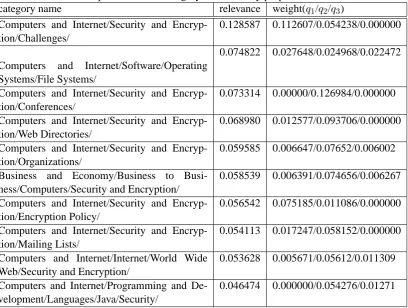
Table 2 is the list of top 10 relevant categories in the second experiment using revised method. Al-though noticeable improvement does not appear, the relevance of the categories which matches few query terms are ranked lower than the first experiment.
6 Conclusions
In this paper, we proposed a method using a Web directory for CLIR. The proposed method is inde-pendent of a particular domain because it uses docu-ments in a Web directory as the corpus. Our method is particularly effective for the case that the docu-ment collection covers wide range of domains such as the Web. Besides, our method does not require expensive linguistic resources except for a dictio-nary. Therefore, our method can easily be extended to other languages as long as the language versions of a Web directory exist and the dictionary can be obtained.
Future work includes improving the category matching method and the evaluation of retrieval ef-fectiveness.
References
ACM International Conference on Research and De-velopment in Information Retrieval(SIGIR2000).
David A. Hull. 1997. Using structured queries for dis-ambiguation in cross-language information retrieval.
Electronic Working Notes of the AAAI Symposium on Cross-Language Text and Speech Retrieval.
Bernard J. Jansen, Amanda Spink, and Tefko Saracevic. 2000. Real life, real user queries on the Web.
Infor-mation Processing & Management, 36(2).
Fuminori Kimura, Akira Maeda, Masatoshi Yoshikawa, and Shunsuke Uemura. 2003. Cross-Language Infor-mation Retrieval using Web Directory Structure. The
14th Data Engineering Workshop, (in Japanese).
Chuan-Jie Lin, Wen-Cheng Lin, Guo-Wei Bian, and Hsin-Hsi Chen. 1999. Description of the NTU Japanese-English cross-lingual information retrieval system used for NTCIR workshop. First NTCIR
Work-shop on Research in Japanese Text Retrieval and Term Recognition.
Tetsuya Sakai. 2000. MT-based Japanese-English cross-language IR experiments using the TREC test collec-tions. Proceedings of The Fifth International
Table 1: The list of top 10 relevant category calculated by inner product.
category name relevance weight(q1/q2/q3)
Computers and Internet/Security and Encryp-tion/Challenges/
0.166845 0.112607/0.054238/0.000000
Computers and Internet/Security and Encryp-tion/Conferences/
0.126984 0.000000/0.126984/0.000000
Computers and Internet/Security and Encryp-tion/Web Directories/
0.106283 0.012577/0.093706/0.000000
Computers and Internet/Security and Encryp-tion/Organizations/
0.089169 0.006647/0.076520/0.006002
Business and Economy/Business to Busi-ness/Computers/Security and Encryption/
0.087314 0.006391/0.074656/0.006267
Computers and Internet/Security and Encryp-tion/Encryption Policy/
0.086271 0.075185/0.011086/0.000000
Computers and Internet/Security and Encryp-tion/Mailing Lists/
0.075399 0.017247/0.058152/0.000000
Computers and Internet/Software/Operating Systems/File Systems/
0.075088 0.027648/0.024968/0.022472
Computers and Internet/Internet/World Wide Web/Security and Encryption/
0.073100 0.005671/0.05612/0.011309
Computers and Internet/Software/Operating Systems/Inferno/
0.070922 0.000000/0.000000/0.070922
Table 2: The list of the top 10 relevance category calculated by proposed method in section 3.2.3.
category name relevance weight(q1/q2/q3)
Computers and Internet/Security and Encryp-tion/Challenges/
0.128587 0.112607/0.054238/0.000000
Computers and Internet/Software/Operating Systems/File Systems/
0.074822 0.027648/0.024968/0.022472
Computers and Internet/Security and Encryp-tion/Conferences/
0.073314 0.00000/0.126984/0.000000
Computers and Internet/Security and Encryp-tion/Web Directories/
0.068980 0.012577/0.093706/0.000000
Computers and Internet/Security and Encryp-tion/Organizations/
0.059585 0.006647/0.07652/0.006002
Business and Economy/Business to Busi-ness/Computers/Security and Encryption/
0.058539 0.006391/0.074656/0.006267
Computers and Internet/Security and Encryp-tion/Encryption Policy/
0.056542 0.075185/0.011086/0.000000
Computers and Internet/Security and Encryp-tion/Mailing Lists/
0.054113 0.017247/0.058152/0.000000
Computers and Internet/Internet/World Wide Web/Security and Encryption/
0.053628 0.005671/0.05612/0.011309
Computers and Internet/Programming and De-velopment/Languages/Java/Security/