
© 2015, IRJET.NET- All Rights Reserved
Page 1762
A Method for Increasing of Metallic Bone Implant Performance
Rohollah Askarpour
1, Seyed Ebrahim Vahdat
11
Department of Engineering, Bandar Abbas Branch, Islamic Azad University, Bandar Abbas, Iran.
---***---Abstract -
Nowadays materials are developing fasterthan at any other time historically; the challenges and opportunities are therefore greater than ever before. A systematic and numerical method for material selection will help the material designers to choose and compare the new material with the common materials database. This paper introduces a mathematical method based on fuzzy logic which is used in designing of metallic bone implant. Five sets of criteria are defined as follow: total corrosion resistance, biocompatibility, adherence, technical specs and price. Each of these criterions is divided into its subsets. Then membership functions of sets are defined. In continuation the satisfactory degree is calculated. Finally, biomaterial favorability is determined and the effect of price on sensitivity analysis is analyzed. Twelve common metallic biomaterials are used in the database. These methods show the satisfactory value for metallic bone implant as a continuous value ranging from zero to one. Therefore, biomaterial designer can compare a new material to the database systematically and he/she can determine restricted parameters to increase the performance of metallic bone implant.
Key Words:
Design, Fuzzy logic, Materials selection
1. Introduction
Dieter defined the material selection as swiftness of the process of designing any component which its purpose is to reduce cost while gaining product performance goals [1]. Therefore, logical selection of the best material for a given application begins with properties and price of candidate materials.
An Ashby plot is a scatter scheme which displays two or more properties of different materials [2]. Therefore, a material of excellent technical specs may have not sufficient biocompatibility, while a material with good compatibility may have low technical specs.
Nowadays materials are developing faster than at any other time historically; the challenges and opportunities are therefore greater than ever before. Karande and Chakraborty found out that a systematic and numerical method for material selection will help the material
designers to choose and compare the new material with the common materials database [3]. Ramalhete et al., Jahan et al., Chatterjee and Chakraborty concluded that on the basis of mathematical methods, it is possible to maximize the utilization of design [4, 5, 6]. Therefore, this paper deals with mathematical strategies of developing metallic bone implant selection.
A few researches, using various approaches, have been done about the selection and optimization of metallic bone implant. Albiñana and Vila analyzed a workflow that breaks the work down into stages and gates, and specifies how the preliminary selection is to be performed [7]. Rao and Patel used subjective and objective integrated multiple attribute decision making method for material selection [8]. Rao and Davim used a combined multiple attribute decision-making method for material selection [9]. Also, Bahraminasab and Jahan used comprehensive special method (VIKOR) for material selection of femoral component of total knee replacement [10]. José et al selected a biomaterial approach to the construction of valve leaflets for cardiac bio-prostheses [11]. Zander and Sandström expected the optimum material is strongly dependent on the chosen target functions and constraints. It is demonstrated that the two approaches for materials optimization give identical results for pressure vessel [12]. As it is clear, none of them focused on material selection of metallic bone implants based on fuzzy logic.
Fuzzy logic investigates the relative properties of the material. In order to accomplish this, fuzzy approach defines a set for each property. For example, various materials have different biologic properties and price, so these materials have different membership degree in the set of biomaterials. Using these sets and fuzzy rules, biomaterial designer can compare and evaluate different materials for specific applications. Therefore, in this paper, a mathematical method based on fuzzy logic is used in selection of metallic bone implant. This method is proposed because it has not been used for selection of metallic bone implant material, until now. It helps metallic bone implant designers to choose which one is the best for metallic bone implant material?
© 2015, IRJET.NET- All Rights Reserved
Page 1763
satisfaction is to choose a favorite metallic bone implantand at the same time not a very expensive one, so it is appropriate to study their properties and cost relatively.
2. Material and methods
1.2 Algorithm
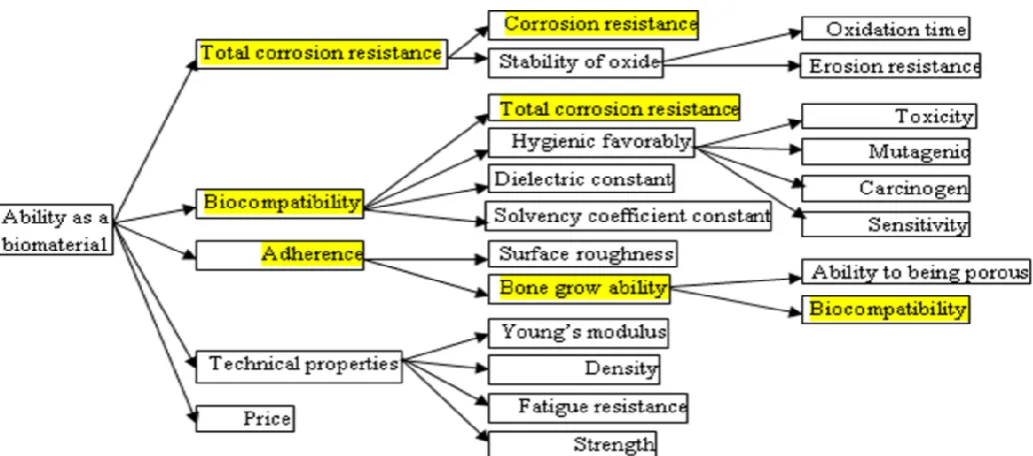
The algorithm of relationship between biomaterial properties and cost, contemplating long usage of metallic bone implant, is shown in Figure 1. Grey boxes show that biocompatibility is affected by total corrosion resistance, whereas total corrosion resistance is affected by corrosion resistance. In addition, adherence is affected by biocompatibility. These are the complex relationships between the biomaterial selection factors which are considered in these methods.
Corrosion and erosion in artificial moving parts like knee joint or screw and sheet systems cause many problems such as reduction of strength and in case of long time usage it can harm the body tissues. So, total corrosion resistance is studied as an independent set.
Biocompatibility is one of the most important properties of a biomaterial which shows how much a biomaterial is compatible with body. Since it is a function of corrosion resistance and oxide stability, different substances have different corrosion rate in human body. It shows how much oxide can resist different situations and how long the oxidation prolongs if corrosion oxidation fails. The corrosion free ions, in long time, could be harmful for body tissues. It leads to disorders such as mutagenic, cancer and sensitivity [13, 14]. Therefore, these parameters are also studied as a subset of biocompatibility. The co-efficiency of the biomaterials IARC (International Agency Research for Cancer) and FDA (Food and Drug Administration of USA) have been studied relatively. However, it may be noted that fuzzy logic is quite useful in uncertain environments, such as the case in this work. Dielectric constant is a subset of biocompatibility. When corrosion occurs in a system it leads to mobility of electron that makes negative results in neurotic system. Material solutions cause them to move to other parts of human body, the way that can be harmful [15, 16]. So, this is another subset of biocompatibility set.
For better adherence of material that leads to better joint, adherence is another set that depends on the ability of bone growth. This ability depends on biocompatibility because if a material doesn’t behave biocompatible, there would be putrefaction and welt that prevent the growth. Blood is the most important requirement in bone growth, so the implanted devices should allow blood transition to the joints. So, to gain this purpose the ability of making the material porous is needed as another subset for the bone growth set. Another subset for adherence is the ability to make surface shaggy.
The next big set for biomaterials set is the technical properties that divide into four subsets. The first one is the Young’s modulus. The object is to choose a material with Young’s modulus equal to the bone’s Young’s modulus.
Then, when force is exerted on the system, changes of elastic length of the bone and that of the devices are similar [13, 15]. For example, when they are the same, the favorability of Young’s modulus will be 1. When they are not the same, the favorability of Young’s modulus will be less than 1. The bones are under various forces, so the superseded devices should have enough fatigue and mechanical strength. When a biomaterial has the highest fatigue and the highest mechanical strength among their subset, it is the best selection for biomaterial to be chosen in their subset [13, 15]. Thus these are the second and third subsets for the sets of technical properties. The implant should be more flexible to force than the bone. That is, biomaterial tensile strength should be higher than that of bone, but with smaller thickness. Material density is another subset factor. When a biomaterial has the least density in the density subset, it would be the best selected biomaterial among the density subset.
2.2. Methodology of fuzzy approach
In this method some symbols are used that are listed in Table 1. Also, the procedure is done according to flowchart presented in Figure 2.
2.2.1 Membership functions
The definition of fuzzy rules and membership function of each set is presented in Table 2. More explanation is given in remark column.
Finally, by fuzzy conjunctive rules, the favorability degree, as a biomaterial (FdBi), is determined as Esq. (1) just in the same way that a biomaterial designer considers the worse conditions for biomaterial selection; the fuzzy conjunctive rule is used in this paper.
FdBi = Min (TCR, Bi, Ad, MP) (1)
According to the functions, properties and chemical compositions of twelve metallic biomaterials; presented in Table 2, Table 3 and Table 4, and Table 5 respectively, the favorability of these biomaterials are determined, calculated and shown in Table 6. Also the favorability degree, as a biomaterial (FdBi), is determined according to Esq. (1) and shown in Table 6.
© 2015, IRJET.NET- All Rights Reserved
Page 1764
Hygienic favorability = min(1.000, 0.8964, 0.6977, 0.7517)= 0.6977
Biocompatibility favorability = min(1.0000, 0.4458, 0.0005, 0.6977) = 0.0005
Bone growth ability = min(1.0000, 0.0005) = 0.0005 Adherence favorability = min(0.0005, 1.0000) = 0.0005
Technical properties favorability = min (1.0000, 0.0881, 0.5538, 1.0000) = 0.0881
Ability as a biomaterial= FdBi = min(0.0881, 0.0005, 0.0005, 0.0005) = 0.0005
2.2.2. Price analysis
A biomaterial may have a high degree of favorability as a bone but it may be expensive. In general, everybody likes using the cheapest one.
Price is an effective parameter in biomaterial selection, so it is defined as a set. In fact, price changes of metallic biomaterial during a day, and approximate prices are mentioned in Table 7 [22, 23]. The price membership function is defined as Esq. (2) and the alloy cheap degree is calculated and shown in Table 7. ACD is calculated as
It is explained for X2CrNiMo17133 as an example. In this research (for body skeleton), the co-efficiency of the price importance is affected just by customer demand. It is done for sensitivity analysis of this algorithm. They are not constant and vary between 0 and 1 (0% and 100%). So the final favorability of a biomaterial is defined as Esq. (3).
FFdBi = (FdBi × FdBi importance) + (ACD × ACD importance)
Whereas FdBi importance + ACD importance =1 (3)
It is explained for X2CrNiMo17133 as an example. X2CrNiMo17133 line is calculated as following:
FFdBi of X2CrNiMo17133 = (0.0005 × FdBi importance) + (1.0000 × (1- FdBi importance)) →
FFdBi of X2CrNiMo17133 = 1-0.9995× FdBi importance
3. Results and discussion
The results of each method about the topic, which was discussed, are as follows:
3.1. Increasing of metallic bone implant
performance
For all materials except X2CrNiMo17133, technical properties were not favorable because of their small strength membership degree as a metallic bone implant set. That is because they have a high Young’s modulus in comparison with actual bones. So, the chance of Young’s modulus in metallic bone implantation decreases in favor of other new techniques. For example, the use of porous material is considered.
In addition, since X2CrNiMo17133 has the lowest favorability value (0.0005), the oxidation time becomes a restrictive parameter which is shown in Table 6. Therefore, it tends to increase its oxidation time. Therefore a new method was introduced for the recognition of restrictive parameters in metallic bone implant selection. In the other word, a new method was presented to increase the metallic bone implant performance.
3.2. Metallic bone implant selection based on
technical specs
© 2015, IRJET.NET- All Rights Reserved
Page 1765
According to data in Table 6, dmFBi, the most favorablemetallic bone implant is Ti30T with the degree of 0.2429 based on technical specs.
dmFBi = Max(FFdBi) (3)
3.3. Price Analysis
The final favorability degree of a metallic bone implant (FFdBi) is calculated according to Esq. (3). Figure 3 shows the degree of the final favorability of the metallic bone implant when the FdBi importance changes between 1 and 0.
4. CONCLUSIONS
This paper introduces a mathematical method based on fuzzy logic which is used in designing of metallic bone implant.
(1) According to Figure 3, between 12 metallic biomaterials, it shows Ti30Ta as the most favorable metallic bone implant when the price importance changes between 0 and ≈0.0710. Also, Ti30Nb is the most favorable metallic bone implant when it changes between ≈0.0710 and ≈0.1750. In addition, Ti5Al2.5Fe is the most favorable metallic bone implant when it changes between ≈0.1750 and ≈0.9966. Finally, X2CrNiMo17133 is the most favorable metallic bone implant when it changes between ≈0.9966 and 0. In the other word, the favorability of metallic bone implant was measured by continuous values between 0 and 1 and also price effect is analyzed by continuous values ranging between 0 and 1. Therefore, this method raises the customer satisfaction according to his/her request.
(2) According to Table 6, the favorability of all biomaterials except X2CrNiMo17133 is restricted by technical specs because the favorability of technical specs of biomaterials is the lowest value. Also, the favorability of technical specs is restricted by Young’s modulus because the favorability of Young’s modulus has the lowest value. It means Young’s modulus is the most restrictive parameter for this database. Therefore, it helps the biomaterial designer to raise biomaterial performance by focusing on the restricted parameters.
(3) This method does not require any predetermined weights of criteria to be used in selection process, while in other prevalent methods such as AHP. These weights must be determined by experts.
(5) The line slop of Ti30Ta shows the minimum in Figure 3. Because Ti30Ta has the highest price in the price set.
REFERENCES
[1] G.E. Dieter, Overview of the Materials Selection Process, H Kuhn, D Medlin, ed., ASM Handbook Vol. 20, Materials Selection and Design, Ohio, ASM international, 1997, p. 549-553.
[2] M. Ashby, Materials Selection in Mechanical Design. 3th ed. Burlington, Massachusetts, Butterworth-Heinemann,1999, p. 77-100.
[3] P. Karande, S. Chakraborty, "Application of multi-objective optimization on the basis of ratio analysis (MOORA) method for materials selection," Materials and Design; Vol. 37, 2012, p. 317–324.
[4] P.S. Ramalhete, A.M.R. Senos, C. Aguiar, "Digital tools for material selection in product design," Materials and Design; Vol. 31, 2010, p. 2275-2287.
[5] A. Jahan, M. Bahraminasab, A.L. Edwards, "A target-based normalization technique for materials selection," Materials and Design; Vol. 35, 2012, p. 647–654. [6] P. Chatterjee, S. Chakraborty, "Material selection using
preferential ranking methods," Materials and Design; 35, 2012, p. 384–393.
[7] J.C. Albiñana, C. Vila, "A framework for concurrent material and process selection during conceptual product design stages," Materials and Design; Vol. 41, 2012, P. 433-446.
[8] R.V. Rao, B.K. Patel, "A subjective and objective integrated multiple attribute decision making method for material selection," Materials and Design; Vol. 31, 2010, p. 4738-4747.
[9] R.V. Rao, J.P. Davim, "A decision-making framework model for material selection using a combined multiple attribute decision-making method," Int J Adv Manuf Techno; Vol. 35, 2010, p. 751-760.
[10]M. Bahraminasab, A. Jahan, "Material selection for femoral component of total knee replacement using comprehensive VIKOR," Materials and Design; Vol. 32, 2011, p. 4471-4477.
[11]M. José, G. Páez, E. Jorge-Herrero, A. Carrera, I. Millán, A. Rocha, P. Calero, A. Cordón, N. Sainz, L. José, O. Castillo, P. Ostrich, "A biomaterial for the construction of valve leaflets for cardiac bio prostheses: mechanical behavior, selection and interaction with suture materials," Biomaterials; Vol. 22, 2001, p. 2731-2740.
[12]J. Zander, R. Sandström, "Material selection with several sizing variables taking environmental impact into account," Materials and Design; Vol. 37, 2011, p. 243-250.
[13]J.H. Boss, Biocompatibility: Review of the Concept and Its Relevance to Clinical Practice, D.L. Wiss, editors, Biomaterials and Bioengineering Handbook, Israel: Gershon Golomb publication, 2000, p. 1-94.
[14]H. Petite, R. Quarto, Engineered Bone, USA, Landes Bioscience publication, 2005, p. 20-25.
[15]H.A. Yuehuei, Mechanical Properties of Bone, H.A. Yuehuei, R.A. Draughn, editors, Mechanical Testing of Bone and the Bone Implant Interface, USA, CRC Press, 2000, p. 41-64.
[16]J. Park, R.S. Lakes, Biomaterials an introduction, 3th ed., USA, Springer, 2007, p. 50-71.
[17]URL: http://www.iarc.fr
[18]URL:http://www.fda.gov/Food/InternationalActiviti es/Imports/ToxicElementsinFoodsFoodware [19]URL:
© 2015, IRJET.NET- All Rights Reserved
Page 1766
[20]T. Steiniche, E.M. Hauge, Normal Structure andFunction of Bone, H.A. Yuehuei, K.L. Martin, editors, Handbook of Histology Methods for Bone and Cartilage, USA, New Jersey, Humana Press, 2003, p. 59-72.
[21]J.B. Park, Y.K. Kim, Metallic Biomaterials, J.B. Park, J.D. Bronino editors, Biomaterials Principals and Applications, USA, CRC Press, 2003, p. 1-20.
[22]URL:
http://www.alibaba.com/showroom/aluminium-titanium-alloy-price.html
[23]URL:
http://www.roymech.co.uk/Useful_Tables/Matter/C osts.html
BIOGRAPHIES
Rohollah Askarpour is studying MSc in materials science at Department of Engineering, Bandar Abbas Branch, Islamic Azad University, Iran.
Seyed Ebrahim Vahdat is a tutor at Department of Engineering, Ayatollah Amoli Branch, Islamic Azad University, Iran.
© 2015, IRJET.NET- All Rights Reserved
Page 1767
Figure -2:Biomaterial selection methodology of metallic bone implantFigure -3: FFdBi of biomaterial for metallic bone implant when the price importance changed between 0 and 1
Table -1: List of Symbols
Symbol Description Symbol Description
CAP Cheapest alloy price in the set dmFBi Degree of the most favorable biomaterial as a bone Ad Adherence degree FdBi Favorability degree as a biomaterial
AP Alloy price FFdBi Final favorability degree as a biomaterial Bi Biocompatibility degree MP Mechanical properties degree
© 2015, IRJET.NET- All Rights Reserved
Page 1768
Table -2: Strength Membership function of fuzzy set as a metallic bone implant [17-19]Set name and their fuzzy rules Variant (=X) Membership
function Remark
A favorably
Hy
Sensitivity* Quantity of disease Nomination of less disease agent[19]
Carcinogen* Carcinogen
Group In IRAC [17]
Group1 0.1
Nomination of less carcinogenicity
Group2b 0.5
Group3 0.8
Group4 0.99
Toxicity* LD50 [18 and 19] Toxicity limit (amount of metal that lead to
50%of cell die) nomination of less toxicity
Mutagenic Material mutagenic
resistance [19] Materials Mutagenic
Total corrosion resistance --- --- Total corrosion resistance set
Dielectric constant Oxide electricity
resistance at 20C Amount of electric resistance
Solvency coefficient constant Solvency coefficient
constant
Ion transition to different part of body after solution of material
T
Corrosion resistance
Alloy break down potential(mV) hanks solution
Inception of corrosion depends on break down potential(mV) in hanks solution
Stability
Oxidation
time Time of oxidation (ms) Oxidation rate after remove of oxide layer
A
Surface roughness Surface roughness More surface roughness lead to better
adherence
porous Ability to being porous
Porosity allow the vessel to transmit the blood to the joint
Te
Strength** Ultimate tensile
strength (MPa)
UTS<130
Mechanical Strength
UTS=130 1
UTS>130 1
Fatigue resistance Fatigue limit
(stress ratio=-1) Endurance of cycle of tension
Young’s modulus *** Young's modulus(GPa) Change in the dimension depends on tension
Density Density (g/cm3) Material weight in the unit volume
* They are obtained from IARC and FDA sites [17 and 18]. Above functions are for element and for alloy we have:
Member ship degree for Sensitivity, Carcinogen and also Toxicity = sum of element percentage in alloy multiply by member ship degree Sensitivity, Carcinogen and also Toxicity element one by one
© 2015, IRJET.NET- All Rights Reserved
Page 1769
Table -3: Biomaterial properties which are used to calculate favorability degree [20, 21]Special electric resistance in
20C )µΩm(
Break down potential (mV) Hanks solution Time of
oxidation (ms) (-500mV) Time of
oxidation (ms)1
(+500mV) Density
(g/cm3) Fatigue
Limit Tensile yield
strength (MPa) Young's modulus
(GPa)
Table -4: Element properties which are used to calculate favorability degree [17-19]
Carcinogen grouping with IARC Quantity
of disease LD50 for rate
mg/kg body weight Element Carcinogen
grouping with IARC
Quantity of disease2 LD50 for rate
mg/kg body weight Element
Table -5: Element percentage in biomaterial alloy
Fe
X2CrNiMo17133
1.00
G-Co29Cr5Mo
1.00
Co20Cr35Ni10Mo
0.20
Ti5Al2.5Fe
0.00
1This parameter is calculated in two different potential and the minimum of them is considered as membership degree
2Elements (from implants) make disease in the body. Some disease happens certainly, some disease happen ordinary and the others happen rarely.
Quantity of disease is formulated as follows:
© 2015, IRJET.NET- All Rights Reserved
Page 1770
Table -6: Favorability degree for 12 metallic biomaterialsAbility as a biomaterial
Fa
Favorability of Total corrosion
resistance Favorability of Biocompatibility
Favorability of Adherence Favorability of Technical
properties
Stability of oxide Hygienic favorably
Tot
cp-Ti grade 1
4
cp-Ti grade 2
5
cp-Ti grade 3
6
cp-Ti grade 4
© 2015, IRJET.NET- All Rights Reserved
Page 1771
Table -7: Alloy price and alloy cheap degree [22, 23]Cheap degree Price (Pound / gram)
Alloy
1.0000 0.1886
X2CrNiMo17133
0.4365 0.4309
G-Co29Cr5Mo
0.5414 0.3474
Co20Cr35Ni10Mo
0.9483 0.1984
cp-Ti grade 1
0.9506 0.1979
cp-Ti grade 2
0.9516 0.1977
cp-Ti grade 3
0.9534 0.1973
cp-Ti grade 4
0.8182 0.2299
Ti6Al4V
0.9995 0.1887
Ti5Al2.5Fe
0.8665 0.2171
Ti6Al7Nb
0.6694 0.2810
Ti30Nb
0.2718 0.6920

![Table -2: Strength Membership function of fuzzy set as a metallic bone implant [17-19]](https://thumb-us.123doks.com/thumbv2/123dok_us/975187.1119953/7.595.28.567.147.646/table-strength-membership-function-fuzzy-metallic-bone-implant.webp)
![Table -7: Alloy price and alloy cheap degree [22, 23]](https://thumb-us.123doks.com/thumbv2/123dok_us/975187.1119953/10.595.152.445.134.349/table-alloy-price-alloy-cheap-degree.webp)