R E S E A R C H
Open Access
Anti-synchronization control for delayed
memristor-based distributed parameter NNs
with mixed boundary conditions
Weiyuan Zhang
1*, Junmin Li
2and Chenyang Ding
2*Correspondence: [email protected] 1Institute of Nonlinear Science,
Xianyang Normal University, Xianyang, 712000, P.R. China Full list of author information is available at the end of the article
Abstract
This paper addresses the anti-synchronization control problem of memristor-based distributed parameter neural networks (MDPNNs) with time-varying delays. An intermittent sampled-data controller is proposed such that the response system can be anti-synchronized with the drive system by using Lyapunov stability theory. The design approach of the desired intermittent sampled-data controller is first proposed. Based on a differential inequality and linear matrix inequality (LMI) technology, novel sufficient conditions for the exponential anti-synchronization are obtained in terms of line matrix inequalities. Numerical simulations are shown to demonstrate the
effectiveness of the theoretical results.
Keywords: memristor; distributed parameter neural networks; intermittent sampled-data control; anti-synchronization
1 Introduction
During the last decades, neural networks (NNs) have been successfully employed in many different fields such as pattern recognition, information science, associative memories, and so on [–]. In the implementation of NNs, time delays frequently arise in actual appli-cations because of the finite switching speed of amplifies and the implicit communication of neurons. The existence of time delay often causes poor performance or instability of the designed networks [–]. As is well known, conventional NNs can be implemented by circuits: the Hopfield NNs models [] can be implemented in a very large-scale electronic circuit where the self feedback connection weights are implemented by resistors, in which resistors are applied to emulate neural synapses. The synapses among neurons in biolog-ical NNs are called long-term memories. In , Chua [] predicted the existence of a fourth fundamental device, which is called a memristor, and due to the Hewlett-Packard (HP) research team, the realization of the memristor was demonstrated by [, ]. Since the memristor has been successfully utilized as a notional tool to analyze signals and non-linear semiconductor devices, now it is becoming an interesting problem to investigate the memristor-based neural networks (MNNs) because of its practical applications of the NNs [–]. In [], the MNNs coming from very large-scale integration on account of the memristor or made of bio-inspired neuron oscillatory circuits with neural memristor were considered. In fact, the MNNs can be utilized to carry out analog multiplication and
contain some identical memristors in a bridge circuit. Because of the individual ability of memristor for memorizing the passed quantity of electric charge, the MNNs can keep in memory its past dynamical history. For the sake of emulating the human brain in real time, the memristor could play an important role in novel analog circuits of NNs. In addi-tion, complex switching phenomena and the switching rule depending on the state of the network are shown by memristor-based circuit networks.
Synchronization means that the dynamical behavior of coupled chaos systems achieves the same time spatial state. In fact, synchronization is a common phenomenon in nature, which has been investigated for a rather long time. Ever since the famous physicist Chris-tian Huygens found the synchronization phenomenon on two pendulum clocks in , the applications of chaos synchronization are concerned with secret communication, in-formation science, optimization problems, and some related nonlinear areas. Based on different initial conditions, Pecora and Carroll [] have studied synchronization analysis for two identical chaotic systems in , which is the first idea of theoretical research on synchronization and the approach was improved in electronic circuits. During recent years, synchronization for the chaotic NNs systems has rapidly been developed by dif-ferent control methods including feedback control, intermittent control, adaptive control, sampled-data control, etc. [–]. At the same time, the synchronization control problem of MNNs has been studied extensively []. The anti-synchronization analysis of MNNs plays an important role in many possible uses, neuromorphic devices to imitate learning, including non-volatile memories, and adaptive spontaneous behavior, which has been suc-cessfully applied to many different areas besides information science, image processing, secure communication, and so on []. Additionally, by applying anti-synchronization to communication systems, one may transmit digital signals by transforming between syn-chronization and anti-synsyn-chronization continuously, which will strengthen the security and secrecy. Furthermore, the anti-synchronization control study for MNNs can provide the designer with various properties, opportunities, and richness of flexibility. Thus, there are a few works dealing with the anti-synchronization analysis of the MNNs [–].
a kind of MDPNNs with mixed time delays by using an adaptive controller and Lyapunov stability theory. The authors of [] investigated the stability problem for a class of delayed uncertain MDPNNs with leakage term. In addition, an adaptive learning control strategy was applied to investigate the synchronization problem for delayed NNs with reaction-diffusion terms and unknown time-varying coupling strengths in []. In [], by utilizing the Lyapunov functional method combined with the inequality techniques, a sufficient condition was given to ensure that the proposed coupled chaos reaction-diffusion NNs with hybrid coupling was synchronized.
On the other hand, since modern society extensively uses digital technology in imple-menting controllers, the sampled-data control scheme has gained significant attention. Because of the rapid development of the digital hardware technologies, the sampled-data control strategy, whose control signals are permitted to alter only at the sampling instant and are maintained constant during the sampling period, has been more advantageous than other control approaches. The sampled-data control theory also has rapidly devel-oped. In many real-world applications, it is difficult to ensure that the state variables trans-mitted to controllers are continuous. During the past decades, sampled-data control of finite-dimensional systems has been widely studied. In order to make full use of mod-ern computer techniques, the sampled-data feedback control method has been used to synchronize delayed networks []. With sampled-data measurements, ever since the au-thors of [] investigated the observability of parabolic distributed parameter systems, the sampled-data control scheme has been applied to some partial differential systems; see,e.g., [–]. Recently, many authors have used the sampled-data control scheme to resolve synchronization control problems in various ordinary differential systems such as complex dynamical networks [] etc. In [], the sampled-data synchronization schemes for a class of delayed DPNNs have been investigated. In fact, there are few theoretical re-sults for MDPNNs by applying the sampled-data control method. Intermittent control, which was first proposed to control nonlinear models in [], has been applied for vari-ous aims, including communication manufacturing, transportation, and so on. Intermit-tent control is an especial modality of switching control, which has been divided into two classes. That is to say, one is a state-development switching regulation and the other is a time-switching regulation. The former activate control operation only in some particu-lar region, while the latter means that control operation is activated only in some certain finite time intervals. In comparison with continuous synchronization control, the discon-tinuous control approaches including intermittent control have attracted much interest recently because of their easy implementation in engineering control fields and in real-life uses [–]. For instance, in [], the authors have investigated exponential synchro-nization of delayed memristor-based NNs with periodically intermittent control strategy. From the point of view of complicated mathematical models, the discontinuous control chaotic delayed systems are difficult and offer more challenges.
intermittent sampled-data anti-synchronization control analysis for a kind of MDPNNs with time-varying delays; the second relates to that an intermittent sampled-data (in time and in space) controller is designed to get the anti-synchronization of the considered net-works. Here we assume that the sampling intervals in time and in space are bounded; the third aspect obtains simple and less conservative anti-synchronization criteria by using the drive-response concept, extended Wirtinger’s inequality and technical estimations. A di-rect Lyapunov approach for the stability analysis of the resulting closed-loop system is developed, which is based on the application of a differential inequality technology. Novel sufficient conditions for the exponential anti-synchronization are derived in terms of line matrix inequalities. Finally, a numerical example is shown to demonstrate the effectiveness of the proposed results.
The remainder of this paper is organized as follows. In the next section, an anti-synchronization scheme by means of intermittent sampled-data control is given. In ad-dition, we present some necessary preliminaries there. Section proposes the main re-sults of this paper. Section illustrates the effectiveness of the proposed rere-sults through numerical simulations. Finally, the conclusion is drawn in Section .
Notation: Throughout this paper, solutions of all the concerning systems in the follow-ing are intended in the sense of Filippov.A= (aij)n×n denotes ann×nreal matrix,AT
represents the transpose of matrixA. For symmetric matricesP,P,P>P(P≥P, P<P,P≤P) means thatP–P> (P–P≥,P–P< ,P–P≤) is symmetric
and positive (negative) definite matrix. The symmetric terms in a symmetric matrix are denoted by∗. Leta∗ij=max{aij,
aij},a∗∗ij =min{aij,
aij}. LetC[(–τ, ]×R;Rn] denote the
Banach space of continuous functions which map (–τ, ]×RintoRnwith the topology of uniform convergence.={x|≤x≤d}is a compact set with smooth boundary∂and mes> inR,d> is a constant;L() is the space of real functions onwhich isL
for the Lebesgue measure. It is a Banach space for the norm
u(t,x)=
n
i=
ui(t,x),
where u(t,x) = (u(t,x), . . . ,un(t,x))T ∈Rn and ui(t,x)= (
|ui(t,x)|dx)/. For any
ϕ(t,x)∈C[(–τ, ]×R;Rn], we define
ϕ= sup –τ≤s≤
n
i=
ϕi(s,x),
whereϕi(s,x)= (
|ϕi(s,x)|
dx)/.
2 Model description and preliminaries Consider the following delayed MDPNNs:
∂ui(t,x)
∂t = ∂ ∂x
Di∂ui(t,x)
∂x –di(ui)ui(t,x) + n
j=
aij(uj)gjuj(t,x)
+
n
j=
bij(uj)gjuj(t–τj,x)
with mixed boundary conditions and initial conditions
∂ui(t, )
∂x = , ui(t,d) = , t∈(–τ, +∞), ()
ui(s,x) =ϕi(s,x), (s,x)∈(–τ, ]×, ()
where x∈,ui(t,x) denotes the state of theith neural unit at timet and in spacex;
di(ui) > corresponds to the rate with which theith neuron will reset its potential to the resting state;aij(uj) andbij(uj) correspond to the connection weight and the time-varying delay connection weight of thejth neuron on theith neuron, respectively;gj(·) corresponds to the activation function.τjis the time delay and satisfies ≤τj≤τ, whereτ is constant;
Di> corresponds to the transmission diffusion coefficient along the neurons.ϕi(s,x) cor-responds to bounded and continuously differential function on (–τ, ]×,i,j= , , . . . ,n. According to the characteristic of the memristor and the current-voltage feature [, , ], we are able to know:
where switching jumpsTi> ,
For model (), we can obtain () by using the theories of set-valued maps and differential inclusions as follows:
Considering model () as the drive system, we introduce the response system for model () as
The mixed boundary conditions and initial conditions of model () are of the form
˜
uix(t, ) = , ui˜(t,d) = , t∈(–τ, +∞), ()
˜
whereu˜(t,x) = (u˜(t,x), . . . ,un˜ (t,x))T,v(t,x) = (v(t,x), . . . ,vn(t,x))Tis the appropriate
con-trol input that will be devised in order to get a certain concon-trol objective. In practical situa-tions, the response system () is able to receive the output signals of the drive system ().
˜
ϕi(s,x) is bounded and continuously differential function on (–τ, ]×,yix(t, ) =∂yi∂(xt,).
Throughout this paper, the assumptions to be used are given as follows:
(A) The functionsgj(·),j= , , . . . ,n, are bounded and odd functions, and satisfies the
Lipschitz condition, that is, for all,∈R, there exists a Lipschitz constant Lj> such that
gj() –gj()≤Lj|–|.
The anti-synchronization error of drive system () and response system () are defined as
y(t,x) =y(t,x), . . . ,yn(t,x)
T
=u˜(t,x) +u(t,x).
By using the theories of set-valued maps and differential inclusions,we have the following error system:
∂yi(t,x) ∂t ∈
∂ ∂x
Di∂yi(t,x) ∂x –
codi(ui)ui(t,x) +codi(ui˜)ui˜ (t,x)
+
n
j=
coaij(uj)gjuj(t,x)+coaij(uj˜)gjuj˜(t,x)
+
n
j=
cobij(uj)gjuj(t–τj,x)
+cobij(uj˜)gjuj˜(t–τj,x)
+vi(t,x), t≥,x∈. ()
Next, model () with the mixed boundary conditions () is taken into account. Set the points =x<x<· · ·<xN =ldivide [,l] intoNsampling intervals. We assume thatN
sensors are laid in the middlexj¯ =xj+xj+ (j= , . . . ,N– ) of these intervals. The sampling intervals in space may be bounded and variable,
xj+–xj≤ .
Ones design the intermittent sampled-data control as follows:
vi(t,x) =Ki(t)yi(t,xj¯), Ki(t) =
–ki, mω≤t≤mω+δ,
, mω+δ<t≤(m+ )ω, ()
in whichxj¯ =xj+xj+,x∈[xj,xj+),j= , . . . ,N– ,i= , . . . ,n,ω> is the control period, ω> is called the control width (control duration), andK=diag(k,k, . . . ,kn) > is the
gain control matrix.
By applyingyi(t,xj¯) =yi(t,x) –¯xx
jyis(t,s)ds,vi(t,x) in model () can be represented as
vi(t,x) =
–Kyi(t,x) +Kx¯x
jyis(t,s)ds, mω≤t≤mω+δ,
By applying the theories of differential inclusions and set-valued maps, we can get the anti-synchronization error system as follows:
∂yi(t,x)
Remark On the basis of assumption (A), we know the activation functionsgj(·),j= , , . . . ,n, are odd functions. Then we are able to derivegj˜(yj(·,x)) possess the following properties:
gj˜yj(·,x)≤Ljyj(·,x), gj˜() =gjyj(·,x)+gj–yj(·,x), j= , , . . . ,n. ()
For the sake of obtaining our main results, the following lemmas are necessary.
where a>b> ,then Rn×n,then the following matrix inequality holds:
XTY≤ε–XTQ–X+εYTQY.
Lemma Under the assumption(A),we get
(iii) Foruj(t,x)≤Tj,uj˜(t,x)≥Tjoruj(t,x)≥Tj,uj˜(t,x)≤Tj, we suppose thatuj(t,x)≤
The proof is completed.
3 Main results
¯
σ–L¯I–bP≤, ()
σ=α(δ–τ) – (a+a)(ω–δ), ()
in whichL¯ =max≤i≤n(Li),α> is the unique solution to a–α–beατ = . Then the response system()and drive system()can be exponentially anti-synchronized under the intermittent sampled-data controller().
Proof We introduce a Lyapunov functional candidate as
V(t) =
y(t,x)TPy(t,x)dx. ()
Fort∈[mω,mω+δ], calculating the derivatives ofV(t) along the trajectory of (), and combining with Lemma yields
˙
In view of assumption (A), we have
gj˜yj(t,x)≤Ljyj(t,x), gj˜() =gjuj(t,x)+gj–uj(t,x), j= , , . . . ,n. ()
Moreover, we can know
g˜y(t,x)≤ ¯Ly(t,x), g˜y(t–τ,x)≤ ¯Ly(t–τ,x). ()
Integrating by parts and by substitution of the mixed boundary conditions, we have
For any scalarε> , we have the following inequality by using Young’s inequality:
According to the Schur complement to (), by (), (), (), and (), we can conclude
˙
V(t)≤–aV(t) +b sup –τ≤s≤
V(t+s) ()
whent∈(mω+δ, (m+ )ω], similar to (), we obtain
˙ V(t)≤
y(t,x)T–PD˜ +σ¯PA¯A¯TP+σ¯PB¯B¯TP+σ¯–L¯I
y(t,x)
+σ¯–y(t–τ,x)TL¯Iy(t–τ,x)dx+
∂y(t,x)T
∂x (–PD) ∂y(t,x)
∂x dx. ()
Using the Schur complement to (), from condition () in addition to Lemma , we get
˙
V(t)≤aV(t) +b sup –τ≤s≤
V(t+s). ()
From () and Lemma , we get
V(t)≤V()τe–αt, ≤t≤δ, ()
in whichα> is the unique solution toa–α–beατ= .
Whenδ≤t≤ω, we can conclude by () and Lemma
V(t)≤V(δ)τe(a+b)t, δ≤t≤ω. ()
From (), it follows that
V(δ)τ= sup
δ–τ≤t≤δ
V(t)≤V()τe–α(δ–τ). ()
By the above inequality and (), we obtain the following:
V(t)≤V(δ)τe(a+b)(t–δ)≤V()
τe
–α(δ–τ)e(a+b)(t–δ). ()
Thus, we have
V(ω)≤V()τe–α(δ–τ)+(a+b)(ω–δ)=V()
τe
–σ
, ()
in whichσ=α(δ–τ) – (a+b)(ω–δ).
Therefore, we have
V(ω)τ= sup
ω–τ≤t≤ω
V(t)≤ sup
ω–τ≤t≤ω
V()
τe
–α(δ–τ)e(a+b)(t–δ)
≤ sup ω–τ≤t≤ω
V()τe–α(δ–τ)e(a+b)(ω–δ), ()
and
V(ω)τ≤V()τe–(a–b)(δ–τ)+(a+b)(ω–δ)=V()
τe
–σ
For the positive integerm, applying mathematical induction, we are able to conclude
V(mω)≤V()τe–mσ. ()
Suppose () holds whenm≤r. Now, we prove () is true whenm=r+ . Similar to the process to get (), we know
V(rω)τ≤V()τe–rσ. ()
Fort∈[rω,rω+δ], we obtain
V(t)≤V(rω)τe–α(t–rω)≤V()τe–rσe–α(t–rω). ()
Hence, we have
V(rω+δ)τ ≤V()τe–rσe–αδ. ()
Whent∈[rω+δ, (r+ )ω],
V(t)≤V(rω+δ)τe(a+b)(t–δ–rω)≤V()
τe
–rρ
e–αρe(a+b)(t–δ–rω). ()
Thus, fort=rω+δ, we derive
V(r+ )ω≤V()τe–rσe–αδe(a+b)(ω–δ)≤V()
τe
–(r+)σ
. ()
Therefore, () is true for all positive integers.
For anyt> , there exists am≥, such thatmω≤t≤(m+ )ω.
V(t)≤V()τe(a+b)ωe–mσ ≤V()
τe
(a+b)ωeσexp
–σt
ω . ()
LetM=V()τe(a+b)ωeσ, we know
V(t)≤Mexp
–σt
ω , t> . ()
According to () and Lemma , we derive
λm()y(t,x)
≤Mexp
–σt
ω . ()
Then we easily get
y(t,x)≤ M
λm()
exp
–σt
ω , fort> . ()
Consequently, the equilibrium point of error system () is exponentially stable, this means that the drive system () and response system () are exponentially anti-synchronized
In Theorem , we choose the Lyapunov function asV(t) =y(t,x)Ty(t,x)dx,i.e.,P=I,
then Corollary holds.
Corollary Under the assumption(A),if there exist positive scalarsε,σ,σ,σ¯,σ¯,a, b,a,bsuch that a>band the following condition holds:
⎧ ⎪ ⎨ ⎪ ⎩
–D˜– K+επK+σA¯A¯T+σB¯B¯T+σ–L¯I+aI≤,
–D+ε–πK< ,
σ–L¯I–bI≤,
()
–D˜ +σ¯A¯A¯T+σ¯B¯B¯T+σ¯–L¯I–aI≤, ¯
σ–L¯I–b I≤,
()
σ=α¯(δ–τ) – (a+a)(ω–δ), ()
in whichL¯=max≤i≤n(Li), α¯ > is the unique solution to a–α¯ –beατ¯ = . Then the systems()and()realize exponential anti-synchronization.
In the following, anti-synchronization problem of system () and system () under the generalized intermittent sampled-data control is discussed. We have
¯
vi(t,x) =ξi(t)y(t,xj¯) +ηi(t)y(t–τ,xj¯),
ξi(t) =
–ξi, mω≤t≤mω+δ,
, mω+δ<t≤(m+ )ω,
ηi(t) =
–ηi, mω≤t≤mω+δ,
, mω+δ<t≤(m+ )ω, ()
in whichxj¯ =xj+xj+,x∈[xj,xj+),j= , . . . ,N– ,i= , . . . ,n,ω> is the control period, ω> is called the control width (control duration), ξ =diag(ξ,ξ, . . . ,ξn) > , andη=
diag(η,η, . . . ,ηn) > are the gain control matrices.
By applying the relationy(·,xj¯) =y(·,x) –x¯x
jys(·,s)ds, () can be represented as
¯
v(t,x) = –ξ(t)y(t,x) +ξ(t)
x
¯
xj
ys(t,s)ds–η(t)y(t–τ,x) +η(t)
x
¯
xj
ys(t–τ,s)ds,
ξi(t) =
–ξi, mω≤t≤mω+δ,
, mω+δ<t≤(m+ )ω,
ηi(t) =
–ηi, mω≤t≤mω+δ,
, mω+δ<t≤(m+ )ω, ()
whereξ(t) =diag(ξ(t),ξ(t), . . . ,ξn(t)),η(t) =diag(η(t),η(t), . . . ,ηn(t)).
Under the control (), fort> ,y(t,x) satisfies the following:
∂yi(t,x)
∂t ∈ ∂ ∂x
Di∂yi(t,x) ∂x –
codi(ui)ui(t,x) +codi(ui˜)ui˜ (t,x)–ξiyi(t,x)
–ηiyi(t–τ,x) +
n
j=
+
The mixed boundary conditions of model () are of the form
yix(t, ) = , yi(t,d) = , t∈(–τ, +∞). ()
Theorem Under the assumption(A),assume that there exist positive definite matrices
P,Q,η¯and positive scalarsζ,γ,σ,σ,a,bsuch that the following conditions hold:
system()can be exponentially anti-synchronized under the intermittent sampled feedback
Proof We consider another Lyapunov functional, combine with Lemma , and one obtains
˙
For any scalarζ> , we get the following inequality through Young’s inequality:
From Lemma , we see that
Choosing nextζ=πζ, we obtain from () and ()
Similar to ()-(), we know
+y(t–τ,x)Tσ–L¯I–e–θ τQy(t–τ,x)
dx
+
yx(t,x)T
ζ–
πPξ+η¯– PD yxdx
+
yx(t–τ,x)T
γ–
πPη–e –θ τη¯ y
x(t–τ,x)dx
=(t,x)T(t,x)≤, ()
where(t,x) = (y(t,x)T,y(t–τ,x)T,yx(t,x)T,yx(t–τ,x)T)Tis a column vector, which im-plies that
V(t,x)≤V(mω,x)e–θ(t–mω), t∈[mω,mω+δ]. ()
Thus, we have
V(t,x)≤V()τe–θt, t∈[,δ]. ()
Whent∈(mω+δ, (m+ )ω], we see from the Schur complement, ()-(), and () that
˙ V(t)≤
y(t,x)T–PD˜ +σPA¯A¯TP+σ–L¯TL¯+σPB¯B¯TP+Q
y(t,x)
+y(t–τ,x)Tσ–L¯TL¯–Qy(t–τ,x)dx+
yx(t,x)Tγ∗η¯– PDyxdx
+
yx(t–τ,x)T
–γ∗η¯yx(t–τ,x)dx
≤aV(t) +bV(t–τ). ()
Thus, applying Lemma , we get
V(t)≤V(mω+δ)τe(a+b)t, mω+δ≤t≤(m+ )ω. ()
Forδ≤t≤ω, we know
V(t)≤V(δ)τe(a+b)t, δ≤t≤ω. ()
From (), we are able to get
V(δ)τ= sup
δ–τ≤t≤δ
V(t)≤V()τe–θ(δ–τ). ()
From the above inequality and (), forδ≤t≤ω, we obtain the following:
V(t)≤V(δ)τe(a+b)(t–δ)≤V()
τe
–θ(δ–τ)e(a+b)(t–δ). ()
Hence, we have
V(ω)≤V()τe–θ(δ–τ)+(a+b)(ω–δ)=V()
τe
–σ¯
whereσ¯ = θ(δ–τ)+(a+b)(ω–δ). The next proof is similar to Theorem . Consequently,
the drive system () and the response system () realize exponential anti-synchronization
with the intermittent sampled feedback controller ().
Remark In Theorem and Theorem , the sufficient conditions on anti-synchroniza-tion criteria are derived by different sampled-data controllers in space and continuous in time. It should be mentioned that there are few results concerning the anti-synchroniza-tion schemes for distributed parameter MNNs using intermittent sampled-data con-trol. This motivated us to write this paper. It is the first time that one builds the anti-synchronization criteria for delayed MDPNNs via intermittent sampled-data control. Our results are novel and they effectively supplement the existing results. In this paper, the sampled-data control is generalized to consider a more reasonable MDPNNs model. Fur-thermore, the deduction process to deal with reaction-diffusion terms is also different due to the different boundary conditions. Accordingly, an interesting and important open problem is whether or not we also obtain similar results for MDPNNs with Neumann boundary conditions or Dirichlet boundary conditions.
Remark As a universal and important tool, LMI has been widely used in many fields, such as control systems, NNs and its applications etc. In this paper, we have obtained the anti-synchronization criteria for a class of delayed MDPNNs, and the LMI can be used to express and solve the derived anti-synchronization criteria. Additionally, there are some advantages of LMI in stability and synchronization analysis of NNs. Initially, since the LMI-based synchronization results investigate the sign difference of the elements in con-nection matrices, the neuron’s excitatory and inhibitory effects on NNs have been inves-tigated, which overcome the shortcomings of the results via other methods such as M-matrix, algebraic inequality, etc. Furthermore, the stability analysis by utilizing Lyapunov stability theory can be considered as an optimization problem with multiple matrix vari-ables and many constraints. Thus, LMI has been the best and only tool to solve this kind of stability problems until now. Finally, LMI-based anti-synchronization criteria can be solved directly by using LMI ToolBox of MATLAB.
4 An illustrative example
In this section, a numerical example is presented to demonstrate the effectiveness of our results obtained.
Example Consider the following MNNs with time delays:
∂ui(t,x) ∂t =Di
∂ui(t,x)
∂x –di(ui)ui(t,x) +
j=
aij(ui)gjuj(t,x)
+
j= bij(ui)gj
uj(t–τj,x)
+Ji, i= , , ()
wherex∈={x|≤x≤},t≥,gj(α) =tanh(α),i= , , andD=D= ,τj= .,
d(z) =
., |z| ≤,
., |z|> , d(z) =
., |z| ≤,
., |z|> , a(z) =
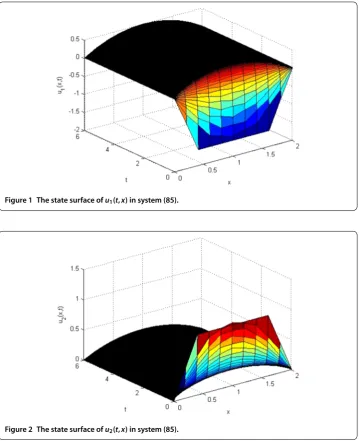
Figure 1 The state surface ofu1(t,x) in system (85).
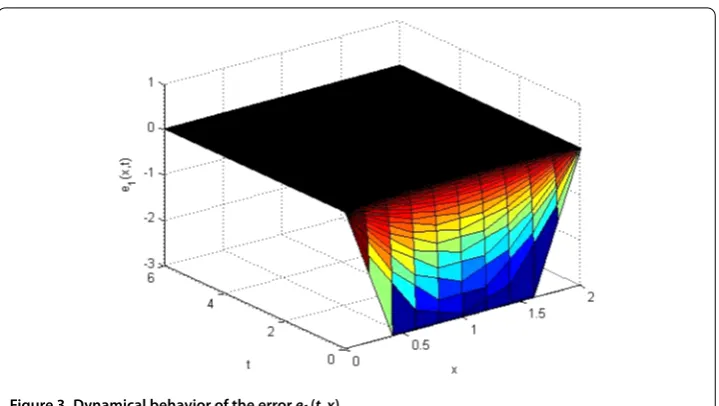
Figure 2 The state surface ofu2(t,x) in system (85).
a(z) =
–., |z| ≤,
–., |z|> , a(z) =
–., |z| ≤, –., |z|> ,
a(z) =
., |z| ≤,
., |z|> , b(z) =
–., |z| ≤, –., |z|> ,
b(z) =
–., |z| ≤,
., |z|> , b(z) =
., |z| ≤, ., |z|> ,
b(z) =
–, |z| ≤,
–., |z|> , herez∈R.
Obviously,gj(·) satisfies (A). It can be verified thatL¯= . The numerical simulations of model () with initial conditionsu(t,x) = –,u(t,x) = ., and the mixed boundary
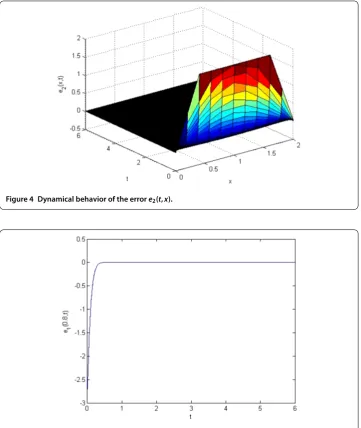
Figure 3 Dynamical behavior of the errore1(t,x).
Next, we consider the anti-synchronization of driving system () and the response sys-tem () described by
∂u˜i(t,x) ∂t =Di
∂u˜i(t,x)
∂x –di(ui˜ )ui˜(t,x) +
j=
aij(ui˜ )gjuj˜(t,x)
+
j= bij(u˜i)gj
˜
uj(t–τj,x)
+Ji+vi, ()
with initial conditionsu˜(t,x) = –,u˜(t,x) = , and the mixed boundary conditions, where
the intermittent sampled-data control is devised as follows:
vi(t,x) =Ki(t)yi(t,xj¯), Ki(t) =
–ki, mω≤t≤mω+δ, , mω+δ<t≤(m+ )ω,
m= , , , . . . . Here the parametersDi,ai(ui˜ ),wij(ui˜ ),hij(ui˜),τjand the activation functions gj(·) are the same as defined in system (). Setk= .,k= ., =π, the control period ω= and the control widthδ= .. Selectε=σ=σ=σ¯=σ¯= ,a= .,b= ., a= .,b= ., and the conditions in Corollary are satisfied.
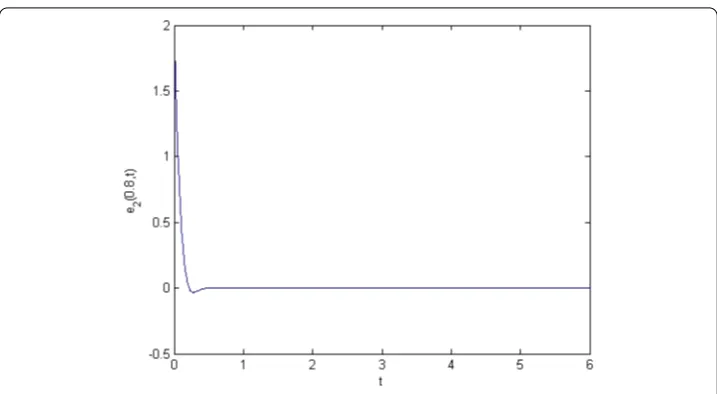
Letei(t,x) =ui˜ (t,x) +ui(t,x),i= , . The simulation results of the state variablesui(t,x) and ei(t,x), are given in Figures to , where Figures and show the state surfaces
of u(t,x) and u(t,x) in system (), respectively. Figures and exhibit the
anti-synchronization errors e(t,x) ande(t,x), respectively. Figures and depict the
anti-synchronization errorse(t,x) ande(t,x) whenx= ., respectively.
Figure 4 Dynamical behavior of the errore2(t,x).
Figure 5 Dynamical behavior of the errore1(t,x) whenx= 0.8.
Remark The motivation for presenting the experimental results is to prove that the
pro-posed intermittent sampled-data-based controller can be applied to anti-synchronization strategy for MDPNNs with time delays. The proposed controllers will get improved anti-synchronization new results. The simulation is performed using Matlab software. By applying the classical implicit format solving the partial differential equations and the method of steps for differential difference equations,we provide a numerical example to show the theoretical results.
5 Conclusions
re-Figure 6 Dynamical behavior of the errore2(t,x) whenx= 0.8.
strictive conditions. Thus, the intermittent sampled-data controllers are developed based on the available information to guarantee that the controlled drive system can anti-synchronize with the response system regardless of their initial states. We assume that the intermittent sampling intervals in space are bounded. All the developed results are shown in terms of LMIs and tested on an illustrative example to prove the feasibility and applicability of the proposed method.
Competing interests
The authors declare that they have no competing interests.
Authors’ contributions
WZ designed and performed all the steps of proof in this research and also wrote the paper. JL and CD participated in the design of the study and suggested many good ideas that made this paper possible and helped to draft the first manuscript. All authors read and approved the final manuscript.
Author details
1Institute of Nonlinear Science, Xianyang Normal University, Xianyang, 712000, P.R. China.2School of Mathematics and
Statistics, Xidian University, Xi’an, 710071, P.R. China.
Acknowledgements
This work is partially supported by the National Natural Science Foundation of China under Grants No. 61573013, the National Science Foundation for Post-doctoral Scientists of China under Grant No. 2013M540754, and the Natural Science Foundation of Shaanxi Province under Grant No. 2015JM1015.
Received: 4 June 2016 Accepted: 31 October 2016
References
1. Hopfield, JJ: Neural networks and physical systems with emergent collective computational abilities. Proc. Natl. Acad. Sci.79(8), 2554-2558 (1982)
2. Amit, DJ: Modeling Brain Function: The World of Attractor Neural Networks. Cambridge University Press, Cambridge (1992)
3. Ackley, DH, Hinton, GE, Sejnowski, TJ: A learning algorithm for Boltzmann machines. Cogn. Sci.9(1), 147-169 (1985) 4. Bengio, Y: Learning deep architectures for AI. Found. Trends Mach. Learn.2(1), 1-127 (2009)
5. Zhang, Z, Cao, J, Zhou, D: Novel LMI-based condition on global asymptotic stability for a class of Cohen-Grossberg BAM networks. IEEE Trans. Neural Netw. Learn. Syst.25(6), 1161-1172 (2014)
6. Lakshmanan, S, Park, JH, Jung, HY, Kwon, OM, Rakkiyappan, R: A delay partitioning approach to delay-dependent stability analysis for neutral type neural networks with discrete and distributed delays. Neurocomputing111, 81-89 (2013)
7. Balasubramaniam, P, Vidhya, C: Exponential stability of stochastic reaction-diffusion uncertain fuzzy neural networks with mixed delays and Markovian jumping parameters. Expert Syst. Appl.39, 3109-3115 (2012)
9. Chua, LO: Memristor - the missing circut element. IEEE Trans. Circuit Theory18, 507-519 (1971) 10. Strukov, DB, Snider, GS, Stewart, DR, Williams, RS: The missing memristor found. Nature453, 80-83 (2008) 11. Tour, JM, He, T: Electronics: the fourth element. Nature453, 42-43 (2008)
12. Guo, ZY, Wang, J, Yan, Z: Global exponential dissipativity and stabilization of memristor- based recurrent neural networks with time-varying delays. Neural Netw.48, 158-172 (2013)
13. Pecora, LM, Carroll, TL: Synchronization in chaotic systems. Phys. Rev. Lett.64(8), 821-824 (1990)
14. Guo, Z, Wang, J, Yan, Z: Global exponential synchronization of two memristor-based recurrent neural networks with time delays via static or dynamic coupling. IEEE Trans. Syst. Man Cybern. Syst.45(2), 235-249 (2015)
15. Ren, F, Cao, J: Anti-synchronization of stochastic perturbed delayed chaotic neural networks. Neural Comput. Appl. 18(5), 515-521 (2009)
16. Wu, A, Zeng, Z: Anti-synchronization control of a class of memristive recurrent neural networks. Commun. Nonlinear Sci. Numer. Simul.18(2), 373-385 (2013)
17. Zhang, G, Shen, Y, Wang, L: Global anti-synchronization of a class of chaotic memristive neural networks with time-varying delays. Neural Netw.36, 1-8 (2013)
18. Murray, JD: Mathematical Biology. Springer, Berlin (1989)
19. Wang, JL, Wu, HN, Guo, L: Pinning control of spatially and temporally complex dynamical networks with time-varying delays. Nonlinear Dyn.70, 1657-1674 (2012)
20. Wu, H, Zhang, X, Li, R, Yao, R: Adaptive anti-synchronization and H1 anti-synchronization for memristive neural networks with mixed time delays and reaction-diffusion terms. Neurocomputing168, 726-740 (2015)
21. Li, R, Cao, J: Stability analysis of reaction-diffusion uncertain memristive neural networks with time-varying delays and leakage term. Appl. Math. Comput.278, 54-69 (2016)
22. Li, J, Zhang, W, Chen, M: Synchronization of delayed reaction-diffusion neural networks via an adaptive learning control approach. Comput. Math. Appl.65, 1775-1785 (2013)
23. Wang, J, Wu, H: Synchronization and adaptive control of an array of linearly coupled reaction-diffusion neural networks with hybrid coupling. IEEE Trans. Cybern.44(8), 1350-1361 (2014)
24. Lee, TH, Wu, Z, Park, JH: Synchronization of a complex dynamical network with coupling time-varying delays via sampled-data control. Appl. Math. Comput.219, 1354-1366 (2012)
25. Khapalov, AY: Continuous observability for parabolic system under observations of discrete type. IEEE Trans. Autom. Control38(9), 1388-1391 (1993)
26. Logemann, H, Rebarber, R, Townley, S: Stability of infinite-dimensional sampled-data systems. Trans. Am. Math. Soc. 35, 301-328 (2003)
27. Logemann, H, Rebarber, R, Townley, S: Generalized sampled-data stabilization of well-posed linear infinite-dimensional systems. SIAM J. Control Optim.44(4), 1345-1369 (2005)
28. Fridman, E, Blighovsky, A: Robust sampled-data control of a class of semilinear parabolic systems. Automatica48, 826-836 (2012)
29. Zhang, W, Li, J, Xing, K, Ding, C: Synchronization for distributed parameter NNs with mixed delays via sampled-data control. Neurocomputing175, 265-277 (2016)
30. Cheng, M, Radisavljevic, V, Chang, C, Lin, C, Su, W: A sampled data singularly perturbed boundary control for a diffusion conduction system with noncollocated observation. IEEE Trans. Autom. Control54(6), 1305-1310 (2009) 31. Deissenberg, C: Optimal control of linear econometric models with intermittent controls. Econ. Plan.16, 49-56 (1980) 32. Zhang, W, Li, C, Huang, TW, Huang, J: Stability and synchronization of memristor-based coupling neural networks
with time-varying delays via intermittent control. Neurocomputing173, 1066-1072 (2016)
33. Zhang, GD, Shen, Y: Exponential synchronization of delayed memristor-based chaotic neural networks via periodically intermittent control. Neural Netw.55, 1-10 (2014)
34. Huang, T, Li, C, Liu, X: Synchronization of chaotic systems with delay using intermittent linear state feedback. Chaos, 18, 033122 (2008)
35. Hardy, GH, Littlewood, JE, Polya, G: Inequalities. Cambridge University Press, Cambridge (1988) 36. Halanay, A: Differential Equations: Stability, Oscillations, Time Lags. Academic Press, New York (1966)