R E S E A R C H
Open Access
R
bits user selection switch feedback for zero
forcing MU-MIMO based on low rate codebook
Shiyuan Li
*, Qimei Cui, Xiaofeng Tao and Xin Chen
Abstract
Channel feedback for multi-user (MU)-multiple-input multiple-output (MIMO) has been widely studied and some results have been got with random vector quantization scheme. However, while the low rate fixed codebook feedbacks are adopted, the performance of zero forcing (ZF) MU-MIMO will decrease as the unpredictable inter-user interference is introduced because of quantized channel state information (CSI). To decrease inter-inter-user interference in low rate fixed codebook feedback, an enhanced user selection switch (USS) feedback scheme for ZF MU-MIMO is proposed in this article. In USS feedback, the extra USS information is added after quantized CSI and received signal-to-noise ratio feedback. The USS information indicates inter-user interference and it can be used in user selection procedure to avoid large inter-user interference. Simulation results show that the proposed USS feedback scheme is efficient to solve the problems of unpredictable inter-user interference in conventional feedback scheme with low rate codebook in ZF MU-MIMO.
Keywords:MU-MIMO, feedback, user slection, user pairing
1. Introduction
It is well known that multiple-input multiple-output (MIMO) can make full use of spatial diversity and enhance data rate by spatial multiplexing. In rich scatter-ing environment, the data rates increase linear with the minimal antenna number of the base station (BS) and user equipment (UE) compared to the single-input sin-gle-output (SISO) scheme [1]. Usually, BS equips more antennas than UE, so the spatial diversity of MIMO sys-tem is not fully utilized. To overcome this drawback, the multi-user MIMO (MU-MIMO) technique is introduced. In downlink MU-MIMO transmission, the data streams of multiple UEs are simultaneously transmitted from BS to UEs at same time and frequency resource. Each UE demodulates its data only by his own channel state infor-mation (CSI) and the data of other UEs are treated as interference.
While BS and UEs know the perfect CSI,“Dirty Paper
Coding” (DPC) [2-6] is known to achieve the capacity of the MIMO downlink channel, but DPC has very high complexity to be realized in actual system. To reduce
the complexity of coding, zero forcing (ZF) [7-10] is proposed as the sub-optimal solution and the perfor-mance of ZF is close to DPC in many scenarios [11].
ZF technique needs CSI between BS and UEs while performing user selection and computing precoding matrix. The exact CSI can be got by channel recipro-city in TDD system. However, BS only can get quan-tized CSI by UE feedback in FDD system because the feedback channel has limited rate. So, the signals of paired UEs cannot be perfectly separated by ZF pre-coding and UE will receive the unwished signals of other paired UEs which is called inter-user interfer-ence. Hence, the MU-MIMO performance will be decreased with the quantized CSI in FDD system [12,13]. Some important conclusions with limited feed-back for MU-MIMO have been got [14-19], and these studies show that the quantization bit scales linear with number of transmit antennas and logarithmic with received SNR of UE while a constant performance gap are hold compare to perfect-CSI.
In former research, the derivation of sum-rate is based on the assumption of random vector quantization (RVQ), which means the codebook of each UE is ran-domly generated and they are uniformly distributed on
* Correspondence: [email protected]
Wireless Technology Innovation (WTI) Institute, Key Laboratory of Universal Wireless Communications, Ministry of Education, Beijing University of Posts and Telecommunications (BUPT), Beijing, P.R. China
the unit sphere. There are some disadvantages for RVQ scheme in the actual communication system:
(1) It needs a great deal feedback bits in the case of high SNR and large number of transmit antennas [16-18]. For example, while SNR is 10 dB with 4 trans-mit antennas, it needs about 14 bits (16,384 codebooks) and while SNR is 20 dB with 8 transmit antennas, it needs about 35 bits (34,359,738,368 codebooks).
(2) The codebook needed in RVQ scheme should ran-domly be generated by UE before CSI feedback, and then the codebook is sharing with BS through feedback channel. So, the large codebook number will also increase feedback overhead of codebook sharing, the computational complexity of codebook generation, and cache costs of codebook storage.
(3) RVQ needs different quantized bits for different SNR cases, so it will bring some design problems. For examples, if the feedback bits are fixed, it will cause waste for low SNR case and not enough for high SNR case. If feedback bits are flexible, new codebook will be retransmitted while SNR changed and it will decrease the effects of user selection between UEs with different SNR.
Moreover, most of the current communication system adopt small codebook size and fixed codebook structure, which both known by UE and BS, to reduce the system complexity feedback overhead. In this feedback scheme, the former performance analysis for RVQ will be not suitable. In low rate fixed codebook feedback scheme, the interference between paired users is the key problem and conventional feedback and user selection scheme have on mechanism to avoid large inter-user interfer-ence. To overcome this drawback in low rate fixed codebook feedback scheme, the reasons of large inter-user interference are analyzed detailed and an enhanced scheme named user selection switch (USS) feedback is proposed here. The USS feedback adds some extra information besides CSI and SNR to show the inter-user interference while performing ZF MU-MIMO transmis-sion. With USS information, BS can avoid large inter-user interference in MU-MIMO transmission in user selection procedure and enhance MU-MIMO performance.
The rest of the article is organized as follows. Section 2 introduces conventional MU-MIMO transmission model and analyzes the problem of low rate fixed code-book feedback scheme. Section 3 proposes USS feedback to enhance MU-MIMO performance and gives related user selection procedure. Section 4 gives the numerical simulation to verify the performance enhancement. Sec-tion 5 provides some conclusions.
2. System model
In this article, the single cell MIMO downlink channel is
considered, in which the transmitter has M antennas
and each UE has 1 antenna. Each user only receives one
data stream, and at most Musers can be communicated
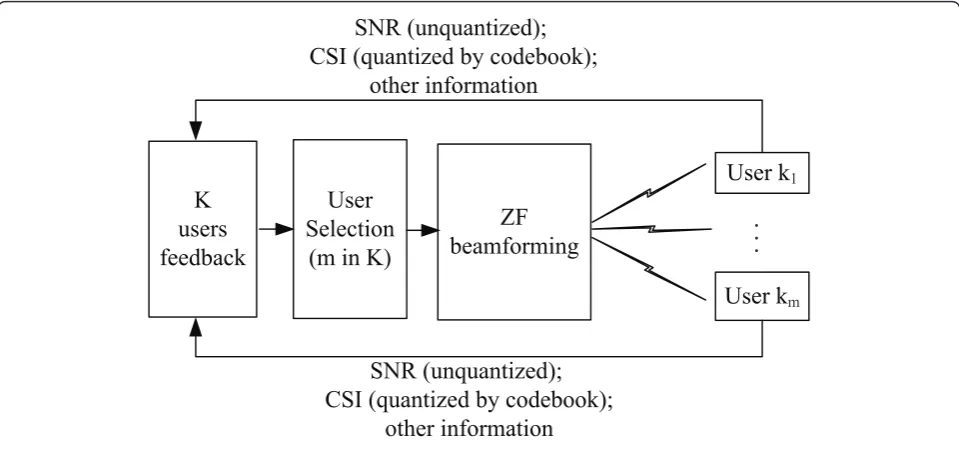
at the same time. The system model is shown in Figure 1. In conventional feedback, only SNR and CSI are fed back to BS.
The signal received by a single user i can be
repre-sented as
yi=√giHixi+
j=i √
giHixj+ni, (1)
wheregi is pathloss between BS and UEi, HiÎ C1 ×M
is the normalized channel matrix between BS and UEi,
xiis the transmitted signals with an average power con-straint E{||xi||2} =Pi, ||·|| stands for norm operator,Pi
is the power constraint of each user’s data stream,niis
the additive white Gaussian noise with s2variance, and
yiis the signal received by UEi.
The procedure of conventional ZF MU-MIMO is as follows [10,18].
2.1. Quantized CSI feedback
It assumed that each user knows perfect CSI and
nor-malized it to a unit norm vector Hi. The quantization
vector is chosen from a fixed codebook of sizeN= 2B
C={c1· · ·cN}, (cj∈C1×M,N= 2B). (2)
The codebook Cis designed offline and both known
to the BS and UE. UE will select a vector from code-book according to the minimum distance criterion as following equation,
k= arg max
1≤j≤NHic H
j . (3)
Then the indexkis fed back to BS, and BS treatswi= ckas the channel matrixHiof UEi.
2.2. SNR Feedback
Each user will feed back its received SNR with assump-tion of single user transmission. The SNR of users is
SNRi=
√giHixi2
σ2 =giPi/σ
2. (4)
UE can measure it by reference signals (RS), as the RS sequence and its power are known to UE. In the practi-cal system, this information is quantized with small number of bits. In order to concentrate on the effect of CSI quantization and user selection, it assumes that the SNR is directly fed back without quantization.
2.3. User selection
correspond to all the users served by BS. The number of selected users is determined by higher layer and must be
no more thanmwhich is the number of transmit
anten-nas. There have been many proposed user selection cri-teria [20-25] and the basic principle is to maximize the total throughputs of the paired users. It is known that in MIMO transmission, the higher throughput will be gotten with the smaller channel correlation between paired users. So, in the simulation of conventional MU-MIMO in the article, BS will select users which have the minimal spatial channel correlation between each other.
That’s means the maximum correlation between
selected users will be minimal in all possible MU-MIMO user combinations. The user selection criterion can be expressed as
min
V i,maxj∈V;i=j|HiH H
j |, (5)
where |·| stands for absolute value, (·)Hstands for
Her-mite transpose, Vis paired user set in which the users
are scheduled together to form MU-MIMO.
2.4. ZF precoding
After the paired user setVis determined, BS will calcu-late the precoding matrix for these paired users. The precoding matrix is computed by ZF methods:
wherepiis precoding vector of UEi, wiis the quantized
CSI of UEi, (·)+stands for pseudo-inverse operation.
So, the received signals of uses in setVare ⎛
Here, the total power should be reallocated among
multiple users’ data stream. The power adjustment
includes coefficient scaling of users’precoding vector and power allocation of users’data stream. The received signals of users change to following equation:
⎛
where aiis coefficient scaling factor,biis power
allo-cation factor, andsiis transmit symbols with unit
var-iance. The total power should be no more than max transmit powerPtotal, and the constraint is
M
The received signal of each user is
yi=√giHiβi
where √giHiβi
pjsj is inter-user interference.
2.5. MU-MIMO performance with conventional feedback The user SNR of MU-MIMO is
MU SNRi=
The total throughput is
RMU=
m
i=1
log(1 + MU SNRi). (12)
2.6. The problems of conventional feedback
In the conventional feedback scheme, BS and UE cannot
know the MU_SNR clearly. For UEi, it knows its
chan-nel matrixHi, but does not know the channel of paired
users. For BS, it knows paired users, but does not know exact channel matrix of UEs. So, the ||Hipj||2cannot be
known for BS and UE. Hence, the transmitting rate Ris
evaluated in conventional user selection.
Usually R is evaluated with the assumption of no
inter-user interference, which means ||Hipj||2≈0. But for
the paired user, the inter-user interference may be very large and lead the performance decrease heavily, while ||Hipj||2≫0. In user pairing, BS does not know the exact
inter-user interference, so it has no mechanism to avoid large inter-user interference in user selection criteria.
The large inter-user interference will decrease throughput largely. For example, if the user inter-ference ||Hipj||2 is more than 0.0833 in the
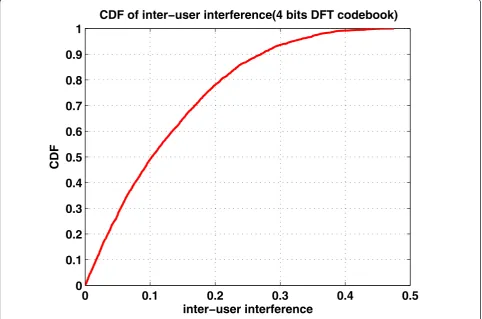
configura-tion of 2Tx, 2 paired UE, 10 dB SNR, the sum rate of MU-MIMO will less than SISO transmission. And the inter-user interference should be smaller in high SNR region than in low SNR region. Unfortunately, the inter-user interference usually is not small enough for MU-MIMO requirement in low fixed codebook scheme. Fig-ure 2 shows the CDF of inter-user interference with 4 bits DFT codebook while the quantized CSI of paired user is orthogonal. It can be seen that about 50% of inter-user interference are more than 0.1; so many users are paired with large inter-user interference. Although the MU-MIMO will not work well with the large inter-user interference, the conventional feedback and inter-user selection method cannot provide enough information to distinguish large user interference and small inter-user interference.
These will cause two serious problems:
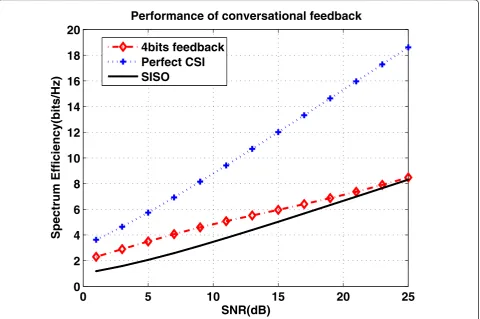
(1) The performance gain of MU-MIMO will decrease, especially in high SNR case. Figure 3 shows the MU-MIMO (two paired users) performance of 4 bits feed-back with DFT codebook, compared to SISO case and perfect CSI feedback. It can be seen that MU-MIMO with perfect CSI feedback has very high rate about dou-ble of that in SISO case. But for low rate quantized feedback (4 bits), the performance gain falls largely com-pare to perfect CSI feedback, as the CSI is the quantized version with low codebook size. The performance gain is little at high SNR region because the user inter-ference of paired users is randomly in quantized feed-back with conventional user selection methods, and MU-MIMO performance is sensitive to user inter-ference in high SNR case.
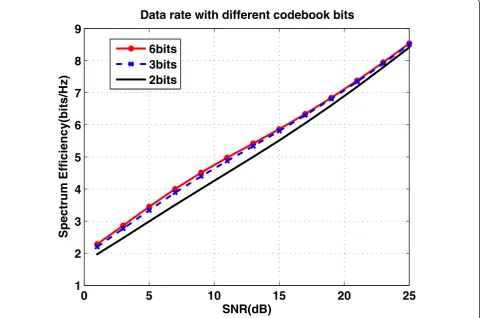
(2) While the quantized bits increase, the performance enhancement may not be obvious for some codebook types. Figure 4 shows the sum data rate of MU-MIMO quantized with DFT codebook of different bits. It can be seen that while the number of quantized bits increase from 2 to 3 bits the performance enhancement is obvious, and performance enhancement is little while number of quantized bits increase from 3 to 6 bits. Con-cluded from the growth trend, when the number quan-tized bit is more than 6 bits, the performance is near to case of 6 bits. So, increasing codebook size is no use to enhance MU-MIMO performance. The reason is that the increasing number of quantized bits cannot decrease the inter-user interference of paired users for fixed codebook structure unlike RVQ feedback scheme.
3. Algorithm
To decrease the bad effect of random inter-user interfer-ence in low rate fixed codebook feedback scheme, a novel USS feedback scheme is proposed. In the USS feedback, extra USS information is added after CSI feed-back to show the inter-user interference. And this infor-mation is used in user selection algorithm to avoid large inter-user interference. The detailed process of the pro-posed scheme is elaborated as follows.
3.1. Grouping quantized codebook
In MU-MIMO transmission, the paired users are usually selected with small correlation between their channels.
In USS feedback scheme, codebook C is divided into
several groups, and only the users whose quantized CSI from the same group can be paired together. The code-bookCis divided as follows:
Ck={ck1, ...,ckl}(ckicHkj<R;ki=kj;ki,kj,k= 1, ...,N), (13)
where Ck is subset of codebook C satisfied
C= ∪
codebookC, m is number of groups,lis element num-ber of subset,Nis codebook size with the relevance N =
l*m, Ris correlation threshold between code vector in subset, which means the correlation between any two paired users are no more thanR.
Only the users which their feedback belong to same group can be paired together, so the correlation between
any two paired users are no more than R. At mostM
users can be transmit at same time in MU-MIMO, so
lets l ≥M, and all the M users can be selected in the
same set. In the simulation of this article, the DFT
code-book is adopted with settingl = M and r = 0, as DFT
codebooks are naturally separated into orthogonal
groups, which hasMorthogonal vectors.
3.2. USS information feedback
In USS feedback scheme, (l-1)*radditional bits named USS information are fed back to BS besides CSI and SNR, and this information is used to indicate the MU-MIMO performance. In sub-codebook groups, user can be paired with other (l-1) vector, so USS information usesrbit(s) for each vector to show the MU-MIMO performance while user is paired with this vector. The feedback con-tents are (USS1,..., USSi-1) and USSicorresponding to the
ith vector in sub-codebook except the vector which user is fed back. For example, ifr= 1, the user can be paired with
ith vector while USSi= 1, and the user cannot be paired
withith vector while USSi= 0.
The value of USS information is relative to transmis-sion and feedback configuration, such as number of paired usermand USS information bitsr. The details of the value calculation will be shown in Section 3.4 for different configurations.
3.3. User selection procedure
In USS feedback scheme, the user selection will use USS information to avoid large inter-user interference. The step is as follows:
(1) BS defines three sets: serving user setU= {UE1,...,
UEK}, corresponding to all the users served by BS; (2)
user CSI set W = {w1,...,wK}, corresponding to users’
CSI; (3) paired user set MU =∅, corresponding to the
users scheduled together to adopt MU-MIMO. BS sets the number of paired users (more than 1 and no more than the number of transmit antennas).
(2) BS selects first two users (i,j) from set U. The UEi
and UEjshould satisfy the conditions: (a) their CSI
feed-back should be in the same codebook group Ck, that
0
0.1
0.2
0.3
0.4
0.5
0
0.1
0.2
0.3
0.4
0.5
0.6
0.7
0.8
0.9
1
inter−user interference
CDF
CDF of inter−user interference(4 bits DFT codebook)
means wi, wj Î Ck; (b) the USS information for paired
vector should not be equal to zero, that means (USSil1 >
0, USSjl2 > 0,ckl1 =wj, ckl2 =wj); (c) the summation of
USS information for paired vector should be maximum in all users which satisfy conditions (a) and (b), that
means (i,j) =UEi,UEjsatisfy (a) and (b)max (USSil1+ USSjl2).
If the two users can be found, BS will put them into paired user set MU = {UEi, UEj}, and remove them from
serving user setU = U-{UEi, UEj}. Otherwise, user pairing
will be stopped and single user mode will be adopted. (3) If the number of paired user is enough, start ZF pro-cedure to compute precoding matrix. Otherwise, select the next userofrom setU. The UEoshould satisfy the
condi-tions: (a) its CSI feedback should be in codebook group
Ck, same to users in set MU, that meanswoÎCk; (b) the
USS information for paired vector of UEoand users in set
MU should be more than zero, that means (USSoli> 0,
USSilo> 0,ckli= wi, cilo= wo, UEiÎMU); (c) the
summa-tion of USS informasumma-tion for paired vector should be maxi-mum in all users which satisfy conditions (a) and (b), that
means (o) =UEosatisfy (a) and (b)max
UEi∈MU
(USSoli+ USSilo).
If the usero can be found, BS will put it into paired
user set MU = MU+{UEo}, and remove them from
ser-ving user set U = U-{UEo}. Otherwise, user pairing will
be stopped and start ZF procedure to compute precod-ing matrix for the users in set MU.
(4) If the number of paired user is enough, start ZF procedure to transmit users’data. Otherwise, go to step 3 to select another user.
3.4. USS value calculation
The value of USS information is relative to the number of paired usermand USS information bitsr. In this sec-tion, different cases will be discussed separately.
(a)r= 1 andm= 2
For two paired users, the SNR for each user can get from Equation (11),
MU SNRi= giβ
2
i
α2
i
Hipi2
gi
β2
j
α2
j
Hipj2+σi2
, (14)
0
5
10
15
20
25
0
2
4
6
8
10
12
14
16
18
20
SNR(dB)
Spectrum Efficiency(bits/Hz)
Performance of conversational feedback
4bits feedback
Perfect CSI
SISO
where aiis coefficient scaling factor,biis power
allo-cation factor. The total power should no more than
max transmit power Ptotal, and the constraint is
β1
α1
p12+β2
α2
p22=Ptotal.
The precoding vector can be gotten from Equation (6),
p1,p2
=wH
1,wH2 w1
w2
wH
1,wH2 −1
= 1
(|w1|2|w2|2− |w1wH
2| 2
)
wH
1,wH2 |
w2|2−w2wH1
−w1wH
2|w1|2
. (15)
Define the correlation of vector: w1wH2 =σejφ. So, the
precoding matrix changes to
pi=
|wj|2wHi −σe−jφwHj
(|wi|2|wj|2−σ2)
(i=j) (16)
Each user knows its channel matrix and the vector of paired user is selected in subsetCk. So, user can
calcu-late the exact SNR of MU-MIMO for each vector in setCk.
The equation can be simplified with following assump-tions: (1) usually the codebook is normalize vector, that means ||wi||2 = 1; (2) normalize precoding vector for
each users, that means pi2=α2i; (3) power is equally allocated in the paired users, that means βi2=Ptotal/m,
wheremis number of paired users; (4) define correlation of CSI quantized as HiwHi =aiejφai; (5) define inter-user interference as HiwHj =bijejφbij(i=j). By substituting Equation (16) into Equation (14), we can get
MU SNRi=
giPtotal
2pi2
|aiejφai−σe−jφbijejφbij|2
(1−σ2)2
giPtotal
2pj2
|bijejφbij−σejφaiejφai |2
(1−σ2)2 +σ 2
i
. (17)
This result can be used in USS information
calcula-tion. In USS feedback scheme, a correlation thresholdR
is used in codebook subset. It means in above equations
that the correlation smust be no more than R as the
paired vector is selected from same subset. With differ-ent value ofR, it can be divided into two categories:
(a-1) R≈ 0. In this case, it can be thought that the
paired vector is orthogonal, so the correlation scan be
0
5
10
15
20
25
1
2
3
4
5
6
7
8
9
SNR(dB)
Spectrum Efficiency(bits/Hz)
Data rate with different codebook bits
6bits
3bits
2bits
tread as zero. The precoding matrix changed to
where SNRi is the measured SNR defined in Equation
(4).
So, throughput of UEiis
Ri= log(1 + MU SNRi) = log
Because user does not know the vector which BS will be schedule in user pairing, the actual transmit rate can-not be known. In USS feedback scheme, all the paired vectors are in one subcodebookCk= {ck1,...,ckl}, and for
one UE, the number of candidate pairing vector is l-1.
So, for each candidate pairing vector in subcodebook, user will evaluate its throughput when this vector is selected as paired vector, and the USS information is calculated based on this evaluated throughput.
User assumes that the paired user has the same corre-lation of quantized CSIaand the same user inter-ference levelb, so the evaluated sum throughput isRkj=
2Ri(j≠i). If the sum throughput for the vector ckjis more
than MISO throughputRsu= log(1+SNR), set USSkj= 1,
which means the performance is better while UEipaired
with vector ckj, otherwise set USSkj = 0, which means
the inter-user interference is large while UEipaired with
vectorckjand UEishould avoid to pair with this vector.
(a-2)R > 0. In this case, the correlations should be considered. Equation (17) changed to
MU SNRi= |aiejφai−σe−jφbijejφbij|2
From CSI quantization criterion, it is known thatais near to 1. Usually, the correlationsis set near to 0 to enhance the MU-MIMO performance and the inter-user interferenceb will be small guaranteed by user selection procedure. So, it can be thought that sb≪a. Equation (20) can be simplified as
MU SNRi≈
The USS information calculation is same to the case ofR≈ 0. The difference is that MU_SNRiwill use
Equa-tion (21) instead of EquaEqua-tion (18) in USS calculaEqua-tion. (b)r= 1 andm> 2
If more than two users are paired together to form MU-MIMO, then the SNR of MU-MIMO user will be decreased compare to two paired users, as the inter-user
interference is m-1 times and the power allocation of
each user is also decreased. It assumes that the power is
equally allocated to each user and the paired users have
the same correlation of quantized CSI aand inter-user
interference levelbfor each paired vector.
For the case of R≈0, the evaluated MU-MIMO SNR
changed to
WhileR> 0, the evaluated MU-MIMO SNR changed to
MU SNRi≈
The evaluated sum rate changed to
Rkj=mRi =mlog(1 + MU SNRi). (24)
The USS information calculation is same to the case
of m= 2. The difference is that MU_SNRi uses
Equa-tions (22) and (23) for different cases and the sum throughputRkjuses Equation (24).
(c)r> 1
If each USS is more than 1 bit, it should be quantized by 2r rank. The sum throughputRkjis evaluated and it
is mapped into region fromRlower toRupperwith r bits.
The sum rateRkjis calculated same to cases (a) and (b).
The lower bound is defined as single user performance
Rlower= log(1+SNR), as sum rate of MU-MIMO should
be more than single user transmission. The upper bound is defined as the users paired with orthogonal vectors with no inter-user interference:
Rupper=mlog
The quantization is performed as follows: (1) ifRkj≤Rlower, set USSkj= 0;
(2) ifRkj≥Rupper, set USSkj= 2r;
(3) if Rlower <Rkj <Rupper, set USSkj= 1 +
Rkj−Rlower
Rupper−Rlower
∗2r
, where⌊·⌋is floor function.
3.5. Feedback overhead
In USS feedback scheme, the extra USS information is added after quantized CSI, and the feedback overhead is changed. So, the overhead of USS feedback, conven-tional feedback, and RVQ feedback is analyzed in this section. As discussed above, it assumed that (1) the codebook size isN= 2B; (2) the quantization vectorcjÎ C1 ×M
; (3) UE will feed back one quantized CSI in each feedback period.
For conventional feedback, only a quantized CSI is fed back to BS in each feedback period, so the feedback overhead isBbits in a feedback period.
CSI. As discussed in Section 3.4, it has l elements in
subset and r bits USS information for each element in
subset. So, the feedback overhead isB+(l-1)*r bits in a feedback period.
For RVQ feedback, a quantized CSI is fed back to BS in each feedback period. Besides, the random codebook should be shared between BS and UE, and this code-book is randomly generated by UE then fed back to BS through feedback channel. It is assumed the random
codebook can be used in q periods and the 16 bits
quantization with short floating point number is adopted for each complex element of codebook. So, the initialization overhead isN*M*16*2, and this overhead cover to each period is N*M*16*2/q. The totally feed-back bits in a feedfeed-back period isN*M*32/q+B.
The overhead comparison of the three methods is list in Table 1.
4. Simulation
In this section, a MIMO system with M = 4 transmit
antennas at the BS and single antenna at the UE is con-sidered. The DFT codebook with different size is used in simulation. DFT codebook has orthogonal vector groups, so each orthogonal vector group is treated as
one subcodebook. Hence, the correlation thresholdRis
equal to zero.
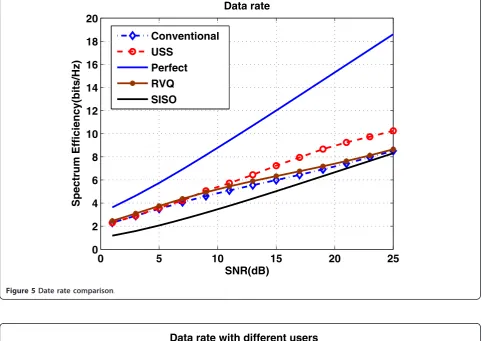
Figure 5 shows the throughput among SISO, perfect SCI feedback, conventional feedback with 7 bits CSI quantization, 4 bits RVQ feedback, and 7 bits USS feed-back (4 bits CSI quantization + 3 bits USS information). RVQ feedback needs to share random codebook between UE and BS through uplink feedback channel and this one-off overhead should be converted into each feedback period, assumed it is equal to 3 bits per feed-back period (the lifetime of random codebook is about 650 feedback periods). So, the totally feedback overhead of the three feedback scheme is same. In simulation, 2 paired users are selected from total 20 users. It can be seen that the performance of RVQ feedback is higher than conventional feedback and USS feedback in low SNR region. In high SNR region, the performance gain of RVQ feedback and conventional feedback compared to SISO is decreased. Unlike the conventional feedback, the performance gain of USS feedback is nearly constant with SNR increase, so the performance gain is not decreased in high SNR region and the performance gain is about 2 bits/Hz. From this result, it can be seen that
the proposed USS feedback scheme has better perfor-mance enhancement in high SNR region.
Figure 6 shows the throughput of two paired users which are selected from different number of users in conventional feedback with 7 bits CSI quantization, 4 bits RVQ feedback, and 7 bits USS feedback (4 bits CSI quantization + 3 bits USS information). It can be seen that the performance of RVQ feedback and conventional feedback changes very small with different number of users. This is because the user selection for conventional feedback and RVQ feedback cannot avoid large inter-user interference brought by channel quantization. For the USS feedback, the performance is increased with the number of users increasing. The increasing is obvious for small number of users and little for large number of users. It is because the user pairing procedure usually cannot find proper paired users for MU-MIMO trans-mission in small user number case. While the number of users increases, it has more users with little inter-user interference, and then the inter-user pairing procedure for USS feedback is easily to find proper paired users for MU-MIMO.
Figure 7 shows the throughput with different CSI quantization bits in USS feedback, RVQ feedback, and conventional feedback with 7 bits CSI quantization. As shown in Figure 4, the performance is almost same while the feedback bits is more than 3, so the perfor-mance of conventional feedback with 7 bits is showed here to stand for performance of conventional feedback with different feedback bits. It can be seen that the per-formance is increased with the feedback bits increase in RVQ feedback, as the quantization accuracy is increased. For the USS feedback, the performance is increased with feedback bits increased because of the enhanced quanti-zation accuracy. While the CSI quantiquanti-zation bits increase to 6 bits, there is a performance decreasing in high SNR region, that is, because with the CSI quantiza-tion bits increasing, the number of codebook subset is increase, so little users will be in one subset than lower CSI quantization bits. Hence, the user pairing procedure cannot find proper users to form MU-MIMO in this region, and performance will be decreased when SU transmission is adopted. From this result, it can be seen that the proposed USS feedback scheme is suitable for very low CSI quantization bits.
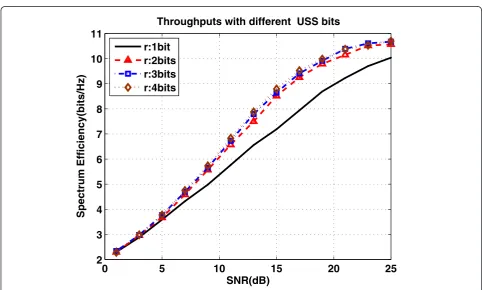
Figure 8 shows the throughput with case of r > 1 in USS feedback scheme. It can be seen that the
Table 1 The overhead comparison
Scheme Initialization Quantized CSI Additional Totally feedback bits/period
Conventional 0 B 0 B
USS 0 B (l-1)*r B+(l-1)*r
0
5
10
15
20
25
0
2
4
6
8
10
12
14
16
18
20
SNR(dB)
Spectrum Efficiency(bits/Hz)
Data rate
Conventional
USS
Perfect
RVQ
SISO
Figure 5Date rate comparison.
0
5
10
15
20
25
2
3
4
5
6
7
8
9
10
11
SNR(dB)
Spectrum Efficiency
Data rate with different users
Conventional:5users
Conventional:10users
Conventional:20users
USS:5users
USS:10users
USS:20users
RVQ:10users
RVQ:5users
RVQ:20users
0 5 10 15 20 25 2
3 4 5 6 7 8 9 10 11
SNR(dB)
Spectrum Efficiency(bits/Hz)
Throughputs with different USS bits
r:1bit r:2bits r:3bits r:4bits
Figure 8Throughput with different USS bits.
0
5
10
15
20
25
1
2
3
4
5
6
7
8
9
10
11
SNR(dB)
Spectrum Efficiency(bits/Hz)
Throughputs with different CSI quantization bits
Conventional:7bits
USS:2bits
USS:4bits
USS:6bits
RVQ:2bits
RVQ:4bits
RVQ:6bits
performance enhancement is larger while USS informa-tion increase from 1 bit to multiple bits. If the number of bits is more than 2, the enchantment is little. So, 2 bits (four orders) quantization of USS information is enough.
5. Conclusion
In this article, a novel USS feedback scheme and relative user selection procedure are proposed to avoid large inter-user interference in downlink ZF MU-MIMO for low rate fixed codebook feedback. The user inter-ference will largely decrease the MU performance gain in high SNR region and leads to the MU-MIMO throughput does not increase with the codebook size increasing. With the help of additional information, the proposed USS feedback scheme can avoid large inter-user interference in ZF MU-MIMO transmission, and it can be used in various configurations such as different codebook type, different number of antennas, and differ-ent paired users. Simulation results show that the pro-posed USS feedback scheme is efficiency for users with very low CSI quantization bits and paired other users at high SNR region.
Acknowledgements
This study was supported by the National Natural Science Foundation of China Project (Grant No. 61001119, 61027003), the International Scientific and Technological Cooperation Program (Grant No. 2010DFA11060, S2010GR0902), and the National S&T Major Program (No. 2009ZX03003-011-02, No. 2009ZX03003-009).
Competing interests
The authors declare that they have no competing interests.
Received: 20 July 2011 Accepted: 10 January 2012 Published: 10 January 2012
References
1. E Telatar, Capacity of multi-antenna Gaussian channels. Eur Trans Telecommun.10(6), 585–595 (1999). doi:10.1002/ett.4460100604 2. P Viswanath, DNC Tse, Sum capacity of the vector Gaussian broadcast
channel and uplink-downlink duality. IEEE Trans Inf Theory.49(8), 1912–1921 (2003). doi:10.1109/TIT.2003.814483
3. M Costa, Writing on dirty paper. IEEE Trans Inf Theory.29, 439–441 (1983). doi:10.1109/TIT.1983.1056659
4. H Weingarten, Y Steinberg, S Shamai, The capacity region of the Gaussian multiple-input multiple-output broadcast channel. IEEE Trans Inf Theory.
52(9), 3936–3964 (2006)
5. N Jindal, A Goldsmith, Dirty paper coding vs. TDMA for MIMO broadcast channels. IEEE Trans Inf Theory.51(5), 1783–1794 (2005). doi:10.1109/ TIT.2005.846425
6. G Caire, S Shamai, On the achievable throughput of a multiantenna Gaussian broadcast channel. IEEE Trans Inf Theory.49(7), 1691–1706 (2003). doi:10.1109/TIT.2003.813523
7. LU Choi, RD Murch, A transmit preprocessing technique for multiuser MIMO systems using a decomposition approach. IEEE Trans Wirel Commun.
3(1), 20–24 (2004). doi:10.1109/TWC.2003.821148
8. QH Spencer, AL Swindlehurst, M Haardt, Zero-forcing methods for downlink spatial multiplexing in multiuser MIMO channels. IEEE Trans Signal Proc.
52(2), 461–471 (2004). doi:10.1109/TSP.2003.821107
9. N Jindal, MIMO broadcast channels with finite rate feedback. IEEE Trans Inf Theory.52(11), 5045–5059 (2006)
10. T Yoo, A Goldsmith, On the optimality of multiantenna broadcast scheduling using zero-forcing beamforming. IEEE J Sel Areas Commun.24, 528–541 (2006)
11. J Lee, N Jindal, High SNR analysis for MIMO broadcast channels: dirty paper coding vs. linear precoding. IEEE Trans Inf Theory.53(12), 4487–4792 (2007) 12. J Sanchez-Garcia, L Soriano-Equigua, RW Heath, Quantized antenna
combining for multiuser MIMO-OFDM with limited feedback. Signal Process Lett IEEE.16(12), 1027–1030 (2009)
13. B Song, M Haardt, Effects of imperfect channel state information on achievable rates of precoded multi-user MIMO broadcast channels with limited feedback, inIEEE International Conference on Communications (ICC 2009), vol. 1. Dresden, Germany, pp. 1–5 (2009)
14. E Bjornson, D Hammarwall, B Ottersten, Exploiting quantized channel norm feedback through conditional statistics in arbitrarily correlated MIMO systems. IEEE Trans Signal Process.57(10), 4027–4041 (2009)
15. S Zhou, Z Wang, GB Giannakis, Quantifying the power loss when transmit beamforming relies on finite-rate feedback. IEEE Trans Wirel Commun.4(4), 1948–1957 (2005)
16. M Sharif, B Hassibi, On the capacity of MIMO broadcast channels with partial side information. IEEE Trans Inf Theory.51(2), 506–522 (2005). doi:10.1109/TIT.2004.840897
17. H Shirani-Mehr, G Caire, Channel state feedback schemes for multiuser MIMO-OFDM downlink. IEEE Trans Commun.57(9), 2713–2723 (2009) 18. T Yoo, N Jindal, A Goldsmith, Multi-antenna downlink channels with limited
feedback and user selection. IEEE J Sel Areas Commun.25(7), 1478–1491 (2007)
19. DJ Love, RW Heath, VKN Lau, D Gesbert, BD Rao, M Andrews, An overview of limited feedback in wireless communication systems. IEEE J Sel Areas Commun.26(8), 1341–1365 (2008)
20. O Souihli, T Ohtsuki, Joint feedback and scheduling scheme for service-differentiated multiuser MIMO systems. IEEE Trans Wirel Commun.9(2), 528–533 (2010)
21. F Liang, Y Maofan, G Ping, W Weiling, An efficient user scheduling scheme for MU-MIMO systems with limited feedback. in2010 International Conference on Communications and Mobile Computing (CMC).2, 348–351 (2010)
22. Z Chen, W Wang, M Peng, F Cao, Limited feedback scheme based on zero-forcing precoding for multiuser MIMO-OFDM downlink systems, in2010 The 5th Annual ICST Wireless Internet Conference (WICON), vol. 1. (Chengdu, China, 2010), pp. 1–5
23. X Xia, G Wu, S Fang, S Li, SINR or SLNR: in successive user scheduling in mu-mimo broadcast channel with finite rate feedback. in2010 International Conference on Communications and Mobile Computing (CMC).2, 383–387 (2010)
24. M Trivellato, F Boccardi, F Tosato, User selection schemes for MIMO broadcast channels with limited feedback. inIEEE 65th Vehicular Technology Conference (VTC2007-Spring)(Dublin, Ireland).1, 2089–2093 (2007) 25. A Bayesteh, AK Khandani, On the user selection for MIMO broadcast
channels. IEEE Trans Inf Theory.54(3), 1086–1107 (2008)
doi:10.1186/1687-1499-2012-7
Cite this article as:Liet al.:Rbits user selection switch feedback for zero forcing MU-MIMO based on low rate codebook.EURASIP Journal on Wireless Communications and Networking20122012:7.
Submit your manuscript to a
journal and benefi t from:
7Convenient online submission
7Rigorous peer review
7Immediate publication on acceptance
7Open access: articles freely available online
7High visibility within the fi eld
7Retaining the copyright to your article