R E S E A R C H
Open Access
Power control for cognitive relay
networks with sensing uncertainties
Hangqi Li
†, Xiaohui Zhao
*†and Yongjun Xu
Abstract
Power control (PC) is a key solution to enable spectrum sharing between secondary users (SUs) and primary users (PUs). However, previous research lacks sensing uncertainties for the status of PUs. In this article, we focus on the PC problem for a cognitive relay network under the spectrum sensing uncertainties to minimize the total bit error rate (BER) of SUs under the constraints of maximum transmit power budgets, signal-to-interference-and-noise ratio (SINR) constraints, and interference requirements to provide protection for PUs. We first formulate the interference model by taking sensing uncertainties into account, while the worst-channel-state-information (worst-CSI) PC algorithm is introduced to limit the BER of SUs, which only needs to operate the algorithm in one link whose CSI is worst. And a cooperative spectrum sensing (CSS) strategy is considered to optimize the sensing performance. To deal with the optimization problem, the original min-max BER problem is converted into an equivalent max-min SINR problem solved by Lagrange dual decomposition method. Finally, simulation results are presented to indicate that our proposed algorithm can obtain good BER performance and guarantee quality of service of PU.
Keywords: Cognitive relay networks, Sensing uncertainties, BER minimization, The worst-CSI PC algorithm
1 Introduction
The spectrum survey conducted by the Federal Commu-nications Commission has revealed that some frequency bands of the allocated spectrum are heavily used, but oth-ers are unused in most of the time with the spectrum utilization ranging only from 15 to 85 % [1]. Cognitive radio (CR) [2] as an intelligent technique for the next generation of wireless communication can significantly improve spectrum utilization and deal with spectrum shortage problem through the spectrum sharing scheme, in which secondary users (SUs) (i.e., unlicensed users or CR users) can opportunistically access to the licensed spectrum bands allocated to primary users (PUs) (i.e., licensed users) [3]. In general CR networks (CRNs), power control (or resource allocation) techniques are used based on perfect channel state information (CSI) and spectrum s ensing results. Power control (PC) technology is to obtain a certain ideal goal (e.g., utility maximization, through-out maximization, total power minimization) by adjusting
*Correspondence: [email protected]
†Equal contributors
College of Communication Engineering, Jilin University, Nanhu Road, 130012 Changchun, China
the transmit power of secondary system with no harmful interference for communications of PUs.
In wireless communication, the quality of service (QoS) of users may not be guaranteed when users locate in the edge of networks or the distance between users is far away. Thus, relay technology (i.e., cooperative technol-ogy) has been proposed as an effective way to overcome the problem [4]. The earliest emergence of relay networks can be traced back to the late 1970s in [5, 6], Cover and others indicate that the transmission scheme using relays can effectively increase the capacity and coverage of sys-tem by ensuring credible communications between users from the viewpoint of information theory. Since cogni-tive relay networks have more advantages than traditional CRNs (i.e., non-relay networks) and more suitable for actual communication scenarios (i.e., heterogeneous net-works, 5G communications), in this paper, we study the PC problem in cognitive relay networks with a multi-user scenario.
As we know, PC technique as a key solution can improve the performance of CRNs and control the interference power of PUs so that SUs share licensed spectrums opportunistically. In order to obtain good system perfor-mance and improve spectral efficiency, PC is based on
various network structures such as traditional CRNs, cel-lular CRNs, and multiple-input multiple-output (MIMO) CRNs. has been studied in many works [7–9]. In [7], an adaptive PC scheme relying on partial CSI for an under-lay CRN is studied to obtain a good trade-off between the interference introduced by SUs on PUs and SU’s perfor-mance. In [8], for an overlay two-way cellular network, a spectrum sharing protocol is proposed for device-to-device (D2D) communication to maximize the sum rate of both D2D and cellular communication. In [9], based on Euclidean projection, a distributed PC algorithm with QoS requirements is studied to minimize total power con-sumption of SUs under time-varying channel scenario. In [10], the authors extend the pricing concept to a multi-channel MIMO CR scenario and propose two iterative PC and channel allocation algorithms.
Since there are many advantages of flexible spectrum scheduling of orthogonal frequency division multiplexing (OFDM) technology, OFDM has been widely introduced to CRNs [11–13]. In [11], for an OFDM-based multi-hop CRN, a cross-layer optimization design is proposed to address both aggregate utility maximization and energy consumption minimization. In [12], radio resource allo-cation in an underlay CRN based on OFDMA is studied to maximize the sum capacity of the secondary service and to find the optimal allocated power, subcarrier, and rate across all subcarriers and different SUs. In [13], the authors propose a robust ergodic resource alloca-tion (ERA) scheme in the framework of an OFDM-based underlay heterogeneous network to maximize the average sum rate while guaranteeing macro network interference requirements with any desired high probability.
Obviously, the articles mentioned above are mainly based on the perfect spectrum sensing information (i.e., without considering spectrum sensing uncertainties). In real communications, due to user’s mobility and time-varying characteristics and fading characteristics of wire-less channels, a spectrum detector cannot exactly detect the status of PUs in the spectrum sensing phase. Thus, it is necessary to take sensing uncertainties or the imper-fect spectrum sensing information into account since inevitable estimation errors and uncertainties may pro-duce harmful interference to PUs for their communica-tions and make the received signal-to-interference-and-noise ratio (SINR) at SU receiver below the target require-ments of SUs. Over the last decade, PC problem with the spectrum sensing uncertainties has been extensively studied for various network structures (e.g., traditional CRNs, OFDM-based CRNs, heterogeneous cellular net-works, micro CRNs). Considering traditional CRNs under the spectrum sensing uncertainties, PC problem is stud-ied in [14, 15]. In [14], a joint bandwidth and power allocation is proposed to minimize total power of SUs and guarantee their QoS requirements. In [15], resource
allocation problem with the imperfect spectrum sensing is considered to maximize capacity of SU. Considering OFDM-based CRNs under the spectrum sensing uncer-tainties, PC problem is studied in [16, 17]. In [16], the authors investigate the energy efficient resource alloca-tion strategy to maximize energy efficiency of CR sys-tem subject to total transmission power budget and each PU interference constraints. In [17], for an OFDM-based heterogeneous CRN including single network and multi-homing network, the resource allocation problem with the imperfect spectrum sensing is solved to maximize sys-tem capacity and the joint subcarrier, and PC problem is formulated under total transmission power constraint, interference constraint, and QoS constraint. Consider-ing Femtocell CRNs with the imperfect spectrum sensConsider-ing in [18], PC in a two-tier OFDM-based heterogeneous cellular network to maximize the sum throughput of Fem-tocell users (FUs) is provided. Considering CRNs with the imperfect spectrum sensing and one primary network (PN) or many micro CRNs in [19], a hybrid spectrum access strategy is proposed to maximize the capacity of the secondary link over the Rayleigh fading channel, which is different from the traditional underlay or the overlay strat-egy. However, research on PC in cognitive relay networks with the spectrum sensing uncertainties is quite few.
In this paper, a PC algorithm is proposed to minimize total bit error rate (BER) of SUs in OFDM-based cognitive relay networks under the spectrum sensing uncertainties. Multiple PUs, multiple SUs, and multiple relays are con-sidered in our model. The min-max criteria is used to minimize the total BER of SUs under maximum trans-mit power constraints, interference power constraints, and SINR constraints. Then, the original min-max BER optimization problem is transformed into an equivalent max-min SINR problem solved by Lagrange dual decom-position while the Lagrange multipliers can be updated by a sub-gradient method. Simulation results will show the effectiveness and reliability of the proposed algorithm. Compared with the existing research, our main contribu-tions are as follows:
• An OFDM-based cognitive relay network with
multiple PUs, SUs, and relays is considered. The BER of the SUs with the spectrum sensing uncertainties is minimized under maximum transmit power
constraints, SINR constraints, and interference constraints.
• The uncertainties in the spectrum sensing and errors
• The worst-CSI PC algorithm is introduced to limit the total BER of SUs, which only needs to operate the algorithm in one link so that the complexity and convergence time of the algorithm are reduced.
The remainder of this paper is organized as follows. In Section 2, a system model and a spectrum sensing model are described. Section 3 introduces a cooperative spectrum sensing (CSS) scheme and formulates the inter-ference model under the spectrum sensing uncertainties. Then, PC problem is formulated and our proposed algo-rithm is given in Section 4. Section 5 presents simulation results and performance analysis of the system. Finally, Section 6 provides conclusion of the paper.
2 System model
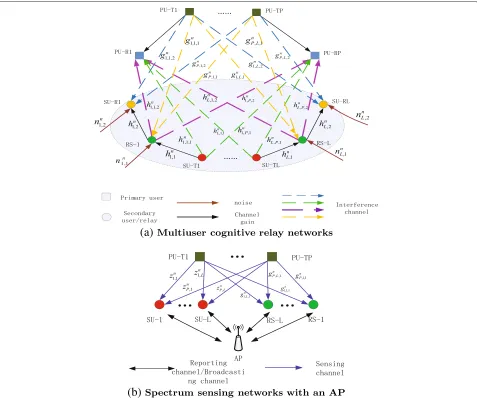
In this paper, we consider an overlay cognitive amplify-and-forward (AF) relay network withPPUs andLSUs as
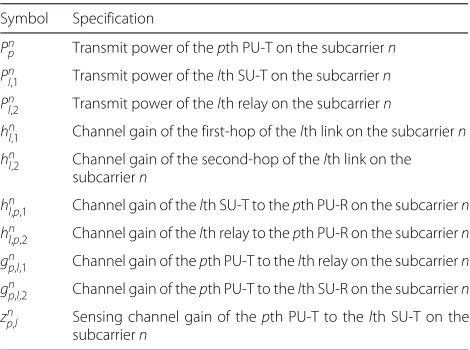
shown in Fig. 1a. The related symbol explanation is given in Table 1. The setL= {1, 2,· · ·,L}denotes the number of SUs,P= {1, 2,· · ·,P}denotes the number of PUs, and ∀l,j ∈ L,∀p ∈ P. Let SU-T and SU-R (PU-T and PU-R) denote the secondary (primary) transmitter and receiver, respectively, and RS denotes the relay node. We assume the CRN uses OFDM modulation mode, in which the total bandwidth is divided intoN = {1, 2,· · ·,N}orthogonal subcarriers and∀n∈N. And we also assume that the sub-carrierncan only be used by one PU. This model is a dual-hop relay network in which time-division half-duplex relays are used to help communication of SUs. The direct communications from the secondary source nodes to the secondary destination nodes are not considered. Under an overlay spectrum sharing scenario, multiple source nodes and relays are available to obtain spectrum information in the spectrum sensing phase. The relays first assist the SUs to detect vacant bands via cooperative spectrum sensing,
(a)
(b)
Table 1Important notation in the paper
Symbol Specification
Pn
p Transmit power of thepth PU-T on the subcarriern Pn
l,1 Transmit power of thelth SU-T on the subcarriern
Pn
l,2 Transmit power of thelth relay on the subcarriern
hn
l,1 Channel gain of the first-hop of thelth link on the subcarriern
hn
l,2 Channel gain of the second-hop of thelth link on the subcarriern
then an access point (AP) collects local detection results from the SUs and relays. AP takes fusion criterion and makes a global decision for data transmission as shown in Fig. 1b. Let Vpn and Onp represent the licensed spec-trum unoccupied and occupied over the subcarriernby the pth PU, respectively. Vˆn
p and Oˆnp are used to indi-cate the status of the licensed spectrum estimated by the secondary network. In this overlay scenario, SUs cannot access the licensed spectrum, unless they receive the posi-tive sensing results (i.e.,Vˆn
p). The channels are assumed to be independent random variables. In addition, we assume the fading channels are flat and remain almost constant within a symbol period. In other words, the channels are time-invariant during the sensing phase and communica-tion phase so that the BER is a meaningful value under this channel condition. In our study, the information is trans-ferred by SUs under multiple phase shift keying (MPSK) or multiple quadrature amplitude modulation (MQAM). And binary phase shift keying (BPSK) modulation is used to support data transmission over the reporting channel in the spectrum sensing phase.
3 Spectrum sensing process
3.1 Cooperative Spectrum Sensing (CSS)
Energy detector (ED) [4] is used by sensing nodes in the spectrum sensing phase in order to make a decision about the spectrum occupied or unoccupied by PUs through comparing the energy of the received signal with a detec-tion threshold. We assume that the observadetec-tion time spent by each subcarrier is τ/N, where τ is the observation time window on the whole licensed spectrum. And each sensing node that performs ED in a fixed bandwidth for each subcarrier isf. Therefore, the time bandwidth prod-uct on each subcarrier is fτ/N [4]. Let xn
p(i) be the transmit signal from thepth PU on the subcarriernand
∀i ∈ {1, 2,· · ·, 2fτ/N}. The received signal from thepth PU on the subcarriernat thelth SU-T and relay is given by
subcarriernwhich are the independent zero-mean white Gaussian noise (AWGN) with power densityN0.α
repre-sents the state of thepth PU on the subcarriern, which is given by
α=
1, Onp
0, Vpn (2)
When the subcarriernis unoccupied by thepth PU (i.e.,
Vpn),α = 0, otherwiseα = 1. According to the energy calculation formula [20], the expressions of the received signal energy from thepth PU on the subcarriernat the
lth SU-T (i.e.,Epn,l,1) and thelth relay (i.e.,Enp,l,2) are
We assume that the channel gains are time-invariant during the sensing phase and suppose the decision thresh-old of energy detector as ε at the lth SU-T and thelth relay on the subcarriern. For∀k ∈ {1, 2,· · ·, 2L},anp,k is a binary number denoting the status of the comparative results. The decision criterion is
ˆ
p andOˆnpdenote the sensing result of the sensing node on the subcarriernunoccupied and occupied by the
pth PU, respectively.
IfEnp,l,1 > εandEpn,l,2 > ε, it indicates that thelth SU-T and thelth relay have successfully detected the presence of thepth PU on the subcarriernthat satisfies the hypoth-esisOnp(the result of sensing isOˆn
whereuis equal tofτ/N.χ22ufollows a central chi-square distribution with 2udegrees of freedom, and χ22u(2γpn,k) follows a non-central chi-square distribution with 2u
degrees of freedom and a non centrality parameter 2γpn,k [4]. Andγpn,kis the instantaneous signal-noise ratio (SNR) of the received signal from thepth PU at thekth sensing node on the subcarriern.
In order to insure the generality of the sensing, we take the spectrum sensing uncertainties into considera-tion so that we can derive the expressions of the average detection probability, false-alarm probability, and miss-detection probability. In order to simplify the calculations, we assume that the decision threshold ε is a constant parameter.
Pdn,p,k =EPrEpn,k> ε|Onp=Prχ22u(2γpn,k) > ε (7)
Pnfa,p,k =EPrEpn,k> ε|Vpn= (u,ε2)
(u) (8)
Pnmd,p,k =1−Pnd,p,k (9)
where E[·] denotes the expectation andPr(·)is the prob-ability.m,x˜is the incomplete gamma function given by m,x˜ = x˜∞vm−1e−vdv, and (m) is the gamma function.Pnd,p,kandPfan,p,kdenote the detection probability and the false-alarm probability. AndPmdn ,p,k denotes the probability of miss-detection.
In the next sub-phase, the sensing nodes report detec-tion results to AP, which makes the global decision to follow the OR fusion rule [4]
Snp= 2L
k=1 anp,k=
≥1, Oˆnp
0 , Vˆpn (10)
The decision at thekth sensing node is reported to AP and expressed byanp,k ∈ {0, 1} for BPSK modulation.Snp
denotes a parameter that clearly identifies the state of the subcarrier n (unoccupied or occupied by the pth PU). We assume that the distance between any two sensing nodes (i.e., SUs and relays) is much smaller than the dis-tance from any sensing nodes to the primary transmitters. Therefore, the received signal at every sensing node expe-riences an almost identical path loss, which results in the independent and identically distributed (i.i.d.) Rayleigh fading with the instantaneous SNRs of the received sig-nal from PUs at the sensing nodes on the subcarriern. In other words, the instantaneous SNRs γpn,1,· · ·,γpn,2L are i.i.d. and exponentially distributed random variables with the same meanγ¯n
p. Based on the above, we can take false-alarm probabilitiesPfan,p,k as identical sincePfan,p,k is independent ofk, and the global decision of false-alarm probability can be denoted byPnfa(i.e.,Pr(Oˆnp|Vpn)). In the
case of the AWGN channel, the detection probabilities at the sensing nodes are independent of k, so that the detection probabilities are identical and the global deci-sion is expressed byPnd(i.e.,Pr(Oˆnp|Onp)). Similarly, taking the global decision of the mis-detection probability asPnmd
(i.e.,Pr(Vˆpn|Onp)), we have
Pnfa=1−
2L
k=1
1−Pnfa,p,k≈1−1−Pnfa,p,k2L (11)
Pnd=1−Pnmd (12)
Pnmd= 2L
k=1
Pnmd,p,k (13)
Considering the error probability Pen of the reporting channel on the subcarriern, we change the expression of the miss-detection probability as
Pnmd= 2L
k=1
Pnmd,p,k1−Pne+
1−Pmdn ,p,k
Pne
(14)
According to the above explanations, the process of CSS can be summarized as follows:
• Each sensing node (i.e.,L SUs and L relays)
independently evaluates its own spectrum detection, then makes detection information (i.e., a binary decision on status of PU).
• The binary decisions made by all sensing nodes are
reported to an AP in the local area network (LAN) or networks.
• AP fuses all detection information and makes global
decision about the status of PU to determine whether PU is present or not.
3.2 SINR expressions (AF protocol)
A dual-hop communication link is considered. The first hop instantaneous SINR on the subcarriernis denoted by SINRnl,1, and the second hop is SINRnl,2. For the AF proto-col, the expression of the equivalent SINR of the SU link is the following [21]
SINRnl,eq =T(SINRnl,1, SINRnl,2)
= SINR
n
l,1SINRnl,2
SINRnl,1+SINRnl,2+1
(15)
where
T(x,y)= xy
andx=SINRnl,1andy=SINRnl,2. Specifically, SINRnl,1and
In order to guarantee the QoS of the PUs, the transmit power of the SUs and relays should be suitably controlled while the interference power at PU-R cannot break the interference temperature (IT) level. There are four situa-tions for CSS as shown in Table 2. From Table 2, we can see that a miss-detection situation has a negative effect on the communications of the PUs. In other words, there are harmful interference to the PUs produced by the SUs and relays.
Since there is a half-duplex scheme at the relay nodes, the interference to thepth PU in each hop can be written as
wherePr(Onp)is a probability that the subcarriernis occu-pied by thepth PU. Pnmd is a miss-detection probability (i.e., Pr(Vˆpn|Opn)).ISPp andIRPp are the interference pro-duced by all SU transmitters and all relay transmitters, and they must be limited by the IT constraint.
4 Proposed algorithm
The BER expressions at SU-R for MQAM (21) or MPSK modulation (22) [22] over the AWGN channel are written as
Table 2Four situations for CSS
Spectrum state CSS result Relative probability CR power
Occupied (On
2 dwis a Gaussian Q-function, b=log2M, andMis the number of bits of the modulation symbols.
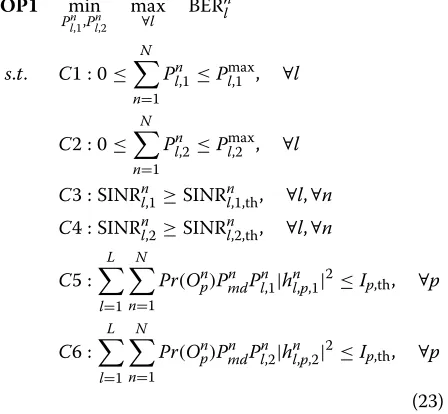
In this paper, a worst-CSI PC algorithm is presented to limit the BER of the SUs while keeping the interference leakage to the PUs below the IT level, the maximum trans-mit power of the SU and relay below certain thresholds. Here, we introduce the SINRs at SU-R and relay in order to guarantee the requirements for each hop. Thus, the optimization problem is formulated asOP1
OP1 min SU-T and relay, respectively. SINRnl,1,th and SINRnl,2,th are the SINR thresholds at the relay and SU-R, respectively.
Ip,this the interference threshold prescribed by thepth PU
the objection ofOP1is a monotonic function about the equivalent SINR SINRnl,eq,OP1can be converted into
OP2 max
Pnl,1,Pnl,2 min∀l SINR n l,eq
s.t. C1∼C6 (24)
Therefore, the original optimization problem OP1
becomes a worst-CSI SINR maximization problemOP2. The criterion about the selection of the worst-CSI user is
hnl,12hnl,22≤hnj,12hnj,22 (25)
If the channel gain of two hops can satisfy (25), we regard the lth SU as the worst case. OP2is not convex due to the constraintsC3 andC4. In order to simplify our analysis, we takeC3 andC4 on reciprocal as
C3 : 1
Then, the equivalent SINR is
SINRnl,eq=
Furthermore, to make the equivalent SINR tractable, we adopt the following approximation [23]
SINRnl,eq≈ a
Therefore,OP2can be rewritten as
give a Lagrange function with Lagrange multipliers The dual problem of the Lagrange function (39) is
D Since the primal problem in (38) is convex, strong dual-ity holds, and the dual problem can be solved by an iterative manner using the gradient projection method [24]. By the Karush-Kuhn-Tucker (KKT) condition, the optimal transmit powerPnl,1andPln,2at SU-T and relay can
The optimal solutions are
Pnl,1∗=x∗1=
must be carefully chosen to ensure a fast convergence rate. A simple but effective way to decide these multipliers is to employ the subgradient method as follows
λl,1(d+1)=
obtaining the interference channels information (i.e.,hnl,p,1
andhnl,p,2) about other SUs and relays, respectively. Finally, taking the optimal solutions Pnl,1∗ and Pln,2∗
Based on the above development, we get our algorithm reaching the optimum control power at SU-T and relay for the optimization problem. And the specific power allocation algorithm can be given in Algorithm 1.
Algorithm 1 Optimizing transmit power of SU-T and
relay
Step 1 Initialization: setd=0,λl,1(0) >0 ,λl,2(0) >0 ,
λn
l,3(0) >0 ,λnl,4(0) >0 ,λp,5(0) >0 ,λp,6(0) >0 andβq>0; q=1, 2, 3, 4, 5, 6;Plmax,1 >0,Pmaxl,2 >0;
SINRnl,1,th>0, SINRnl,2,th>0;Ip,th>0. Step 2 Process:
(a) Solve problem (38) to obtainPnl,1andPnl,2and corresponding SINRnl,eq, thus BER of the selected link can be calculated.
(b) Update the Lagrange multiplier by (46)∼(51). (c) Update the transmission powerPn
l,1andPln,2by (44) and (45). (d) Go to (a) until
Pˆn
l,1(d+1)− ˆPln,1(d)≤ρandPˆln,2(d+1)− ˆPnl,2(d)
≤ρ, respectively, whereρis iteration precision which is a small positive constant to control the algorithm accuracy.
Step 3 End:If the optimal solutionPn
l,1∗andPnl,2∗have been calculated by (44) and (45),|SINRnl,eq,current− SINRnl,eq,previous| ≤ρ, the converged value of SINRnl,eqis the optimal in (24), taking the optimal solutionPn
l,1∗andPnl,2∗into (21) and (22) respectively, the optimal BER can be obtained.
5 Simulation results
In this section, we present the simulation results to show the effectiveness of the proposed algorithm. We assume that there are four SUs and relays (i.e., L = 4), one PU (i.e.,P = 1), and four subcarriers (i.e.,N = 4), and each SU occupies one subcarrier. The sensing channel suffers with the Rayleigh fading and the average SNR ranges from 0 to 15 dB. The error rate of the transmit symbol for BPSK modulation on the reporting channel is Pne= 10−3. We set the target SINR on each subcarrier at relay, and SU-R is SINSU-Rnl,1,th/SINRnl,2,th =3 dB. The maximum transmit power of each SU-T and relay isPmaxl,1 /Pmaxl,2 =1.5 mW. And we also assume that Pr(Onp) is the same for every subcarrier, e.g.,Pr(On
p)= 0.1. Similar to [25], the normal values of the interference channel gainshnl,p,1,hnl,p,2,gpn,l,1, and gpn,l,2 are selected from the interval (0, 0.3) respec-tively. The normal values of the channel gainshnl,1andhnl,2
are randomly chosen from the intervals (0, 1) and (0, 1), respectively. And the normal value of the sensing chan-nel gain znp,l is also randomly chosen from the interval (0, 0.3). The background noise power on each subcar-rier is assumed to be identical and equal to 0.01 mW, i.e.,
Nln,1 = Nln,2 = 0.01 mW [26]. The termination condi-tion ρ is 10−6. The simulation results are presented in Figs. 2, 3, 4, 5, 6, 7, 8, and 9 and in Table 3.
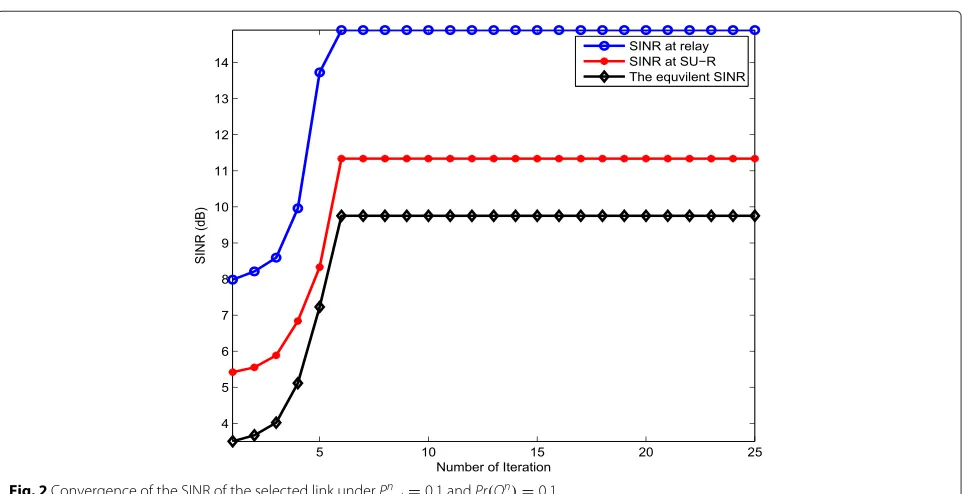
Figure 2 shows the convergence of SINRs at relay and SU-R of the selected link. And the equivalent SINR of the selected link also quickly converges to a stable point. From Fig. 2, we can see that the SINRs of the link increase
Fig. 2Convergence of the SINR of the selected link underPn
Fig. 3Maximum BER of the secondary user underPn
md=0.1 andPr(Onp)=0.1.aConvergence of the maximum BER.bMaximum BER against the equivalent SINR
first with the increase of iteration number, then they con-verge to the equilibrium points that satisfy the basic SINR requirements of each hop without outage probability all the time. It indicates that our proposed algorithm can provide SU normal communication. Based on the normal communication of SUs, the minimization of BER of the system is meaningful.
Fig. 4Convergence of the maximum BER underPn
md=0.1 andPr(Onp)=0.1
through increasing the SINR of each hop while keeping the interference power at PU-R belows the IT level.
Figures 4 and 5 give the comparison of the BER perfor-mance of SU and the interference power at PU-R between the proposed PC algorithm and the PC algorithm with-out sensing errors. Figure 4 shows the maximum BER performance of the selected SU link. The BER of pro-posed algorithm for the given IT levelIp,th = 0.01 mW
is higher than that of the PC algorithm without sensing errors, which provides the protection of PU when SUs share the spectrum opportunistically. From Fig. 4, we can see that the maximum BER of the proposed algorithm for both MPSK and MQAM modulation quickly converges to the stable point, and the optimization goal is achieved by minimizing the maximum BER of the worst-CSI channel to limit the total BER of the SUs. Briefly, the purpose of
Fig. 5Convergence of interference at PU-R underPn
Fig. 6Interference at PU-R against differentPmax l
minimizing the BER of the system is obtained by adjust-ing the transmit power of SU-T and relay transmitter, which improves the performance and ensures the QoS of SUs.
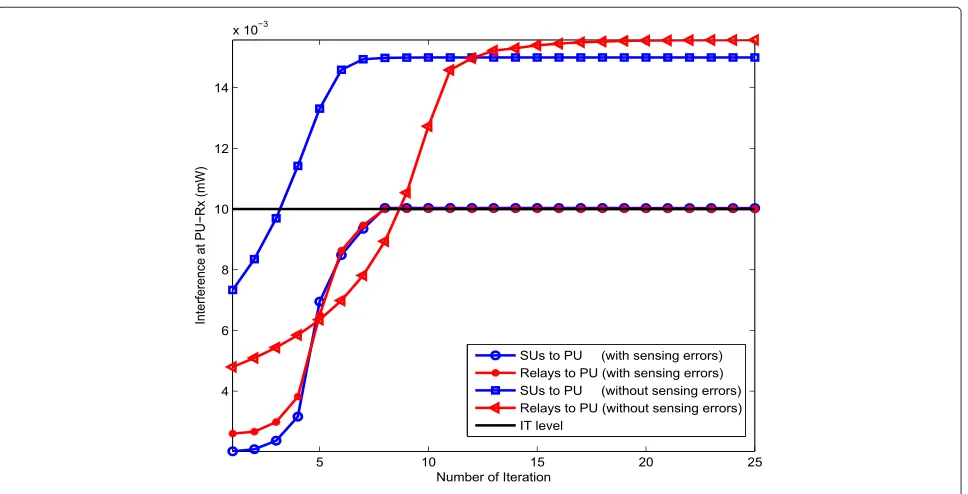
From Fig. 5, we can see that the PC algorithm under the imperfect spectrum sensing can guarantee the inter-ference power at PU-R always below the IT level, whereas the PC algorithm without sensing errors fail to keep the actual received interference power at PU-R in the allow-able region. From Figs. 4 and 5, we conclude that the
proposed algorithm can provide well protection for PU at the cost of little BER increases.
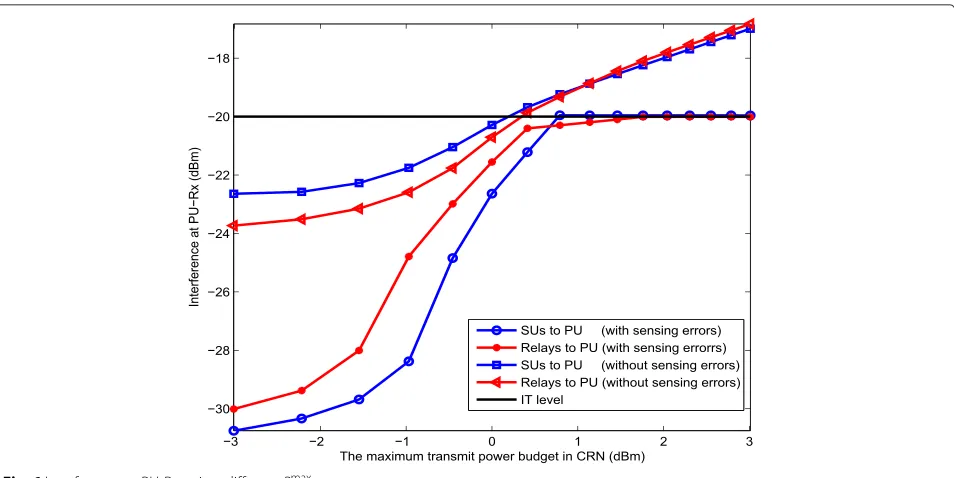
Figure 6 shows the characteristics of the interference to PU produced by secondary system for different maxi-mum transmit power budgetPlmax(i.e.,Pmaxl,1 =Pmaxl,2 =Pmaxl ) with and without sensing errors in PC algorithm. From Fig. 6, we know that the interference power at PU-R of the algorithm without sensing errors is higher than that of our proposed algorithm and exceeds the IT level.
Fig. 8Maximum BER under differentIp,thandPmaxl withPnmd=0.1 andPr(Onp)=0.1
In Fig. 7, we present the maximum BER versus the IT level from Ip,th = −20 dBm toIp,th = −5 dBm of our
proposed algorithm for differentPmdn and show the maxi-mum BER performance against the interference threshold
Ip,th and the miss-detection probability Pmdn for MPSK
(M=2) and MQAM (M= 2) modulation. ForPmdn =0.1, the maximum BER of the SUs decreases first with the increasing interference power constraint, then keeps flat because of the maximum transmit power constraints. We find that the BER performance of our proposed algorithm under different Pnmd is the same when the interference
power constraint is large, for example, whenIp,this larger
than−12 dBm. The BER performance for Pnmd = 0.08 is the best under three modulations when the IT level is low. Since largerPnmd stands for more harmful interfer-ence to PU, less transmit power is allocated to provide the protection to PUs for their communications.
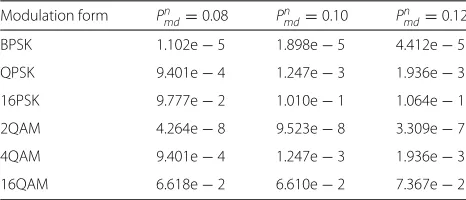
Table 3 shows the maximum BER versus different miss-detection probabilitiesPmdn forIp,th=0.01 mW, the
trans-mission data for MPSK (M = 2, 4, and 16) and MQAM (M = 2, 4, and 16) modulation. From Table 3, we find that the spectrum sensing requirement is improved from
Table 3Maximum BER at SU-R for differentPnmd
Modulation form Pnmd=0.08 Pnmd=0.10 Pnmd=0.12
BPSK 1.102e−5 1.898e−5 4.412e−5
QPSK 9.401e−4 1.247e−3 1.936e−3
16PSK 9.777e−2 1.010e−1 1.064e−1
2QAM 4.264e−8 9.523e−8 3.309e−7
4QAM 9.401e−4 1.247e−3 1.936e−3
16QAM 6.618e−2 6.610e−2 7.367e−2
Pmdn =0.12 toPnmd = 0.08 for the given modulation, and the maximum BER of the system decreases accordingly. This implies that, with the improved spectrum sensing requirement, a spectrum hole is accurately detected, thus less interference occurs between the primary network and the secondary network, resulting in decreased BER for the secondary transmission. Furthermore, we also find that the maximum BER of the system increases with the increase of the number of bits of modulation symbols. Since the decision region of the corresponding received signal decreases with the increase of M, when the sig-nal suffers to the interference and the damage caused by noise, the error probability of the received signal will be bigger.
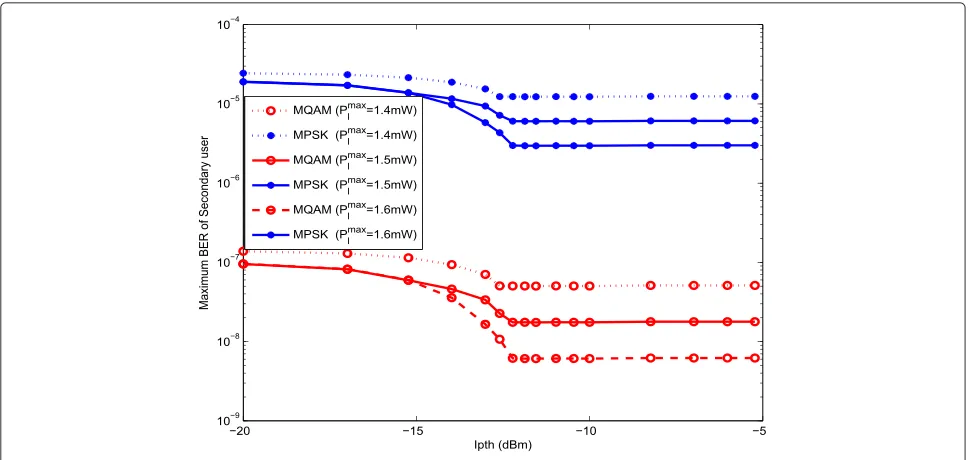
Figure 8 shows the maximum BER performance of our proposed algorithm against Ip,th under different
maxi-mum transmit power budgetsPmaxl . In Fig. 8, for the given transmit power budgetPmaxl = 1.5 mW, the maximum BER decreases first then keeps flat whenIp,th increases.
We find that the BER performance of our proposed PC algorithm under different maximum transmit power bud-gets is almost the same when the interference power constraint is low, and the BER performance for Pmaxl =
1.6 mW is significant when the interference power con-straint is large, for example, larger than −12 dBm. In fact, from another perspective, the interference power constraints represent the distance, with the increasing dis-tance between the SU and the PU, more transmit power is allocated to achieve a lower BER.
In order to further specify the effect of the sensing uncertainties on the PU, we demonstrate the characteris-tic of the interference to the PU produced by a secondary system in Fig. 9. And the characteristics of the interfer-ence is versus the IT level fromIp,th= −20 dBm toIp,th =
−5 dBm of our proposed algorithm for different Pmdn . From Fig. 9, we find that the interference power at PU-R of our proposed algorithm increases with the increasing miss-detection probability from Pnmd = 0.06 to Pnmd =
0.12. For the given miss-detection probabilityPnmd = 0.1, the interference power at PU-R of the proposed algorithm increases first then keeps constant when Ip,th increases
because of the maximum transmit power constraints.
As emphasized, the larger the miss-detection probabil-ity Pmdn is, the more the concurrent transmission of the PUs and SUs and the greater the harmful interference to PU. In conclusion, the sensing uncertainties should be considered to adapt actual communication scenarios and provide better protection for the communication of the PU.
6 Conclusions
This paper studies the PC problem in a cognitive relay network under the spectrum sensing uncertainties. We propose a PC algorithm under maximum transmit power constraints, SINR constraints and interference constraints to minimize the total BER for all SUs according to the actual situations. The worst-CSI PC algorithm and min-max criteria formulation are applied to the optimization problem converted into the max-min equivalent SINR problem solved by the Lagrangian duality theory. Com-pared with the PC algorithm without the spectrum sens-ing uncertainties, simulation results show the advantages of our proposed PC algorithm which can well protect the communication of the PU though there is a little BER increase of the secondary system at the expense. We also find that the BER of the secondary system decreases as the probability of miss-detection decreases in our pro-posed algorithm. In our future research, the PC optimiza-tion problem with the introducoptimiza-tion of more complicated channels in the underlay cognitive relay networks will be conducted.
Competing interests
The authors declare that they have no competing interests.
Authors’ contributions
HL contributed in the conception of the study and design of the study and wrote the manuscript. Furthermore, HL carried out the simulation and revised the manuscript. XZ and YX helped to perform the analysis with constructive discussions and helped to draft the manuscript. All authors read and approved the final manuscript.
Acknowledgements
The authors would like to thank the reviewers for their detailed reviews and constructive comments, which have helped improve the quality of this paper. The work of this paper is supported by the National Natural Science Foundation of China under grant no. 61571209.
Received: 19 December 2015 Accepted: 19 April 2016
References
1. Spectrum Policy Task Force: Report of the spectrum rights and responsibilities working group. Federal Communications Commission. Technical Report, Nov (2002)
2. J Mitola III, GQ Maguire Jr, Cognitive radio: making software radios more personal. IEEE Pers. Commun.6(4), 13–18 (1999)
3. S Haykin, Cognitive radio: brain-empowered wireless communications. IEEE J. Sel. Areas Commun.23(2), 201–220 (2005)
4. KB Letaief, W Zhang, Cooperative communications for cognitive radio networks. Proc. IEEE.97(5), 878–893 (2009)
6. AE Gamal, TM Cover, Multiple users information theory. Proc. IEEE.
68(12), 1466–1483 (1980)
7. HY Huang, Z Li, JB Si, L Guan, Underlay cognitive relay networks with imperfect channel state information and multiple primary receivers. IET Commun.9(4), 460–467 (2015)
8. YY Pei, YC Liang, Resource allocation for device-to-device communication overlaying two-way cellular networks. Proc. IEEE Inf. Conf. on Wireless Communications and Networking Conference (WCNC): PHY. Apr.
9(4), 3346–3351 (2013)
9. YJ Xu, XH Zhao, Optimal power allocation for multiuser cognitive radio networks under QoS and interference temperature constrains. China Commun.10(10), 91–100 (2013)
10. MG Adian, H Aghaeinia, Spectrum sharing and power allocation in multiple-in multiple-out cognitive radio networks via pricing. IET Commun.6(16), 2621–2629 (2012)
11. MV Nguyen, CS Hong, SW Lee, Cross-layer optimization for congestion and power control in OFDM-based multi-hop cognitive radio networks. IEEE Trans. Commun.60(8), 2101–2112 (2012)
12. M Dashti, P Azmi, K Navaie, Radio resource allocation for orthogonal frequency division multiple access-based underlay cognitive radio networks utilising weighted ergodic rates. IET Commun.6(16), 2543–2552 (2012)
13. N Mokari, H Saeedi, P Azmi, Quantized ergodic radio resource allocation in cognitive femto networks with controlled collision and power outage probabilities. IEEE J. Sel. Areas Commun.32(11), 2090–2104 (2014) 14. Y Wu, DH Tsang, Joint bandwidth and power allocations for cognitive
radio networks with imperfect spectrum sensing. Wireless Per. Commun.
57(1), 19–31 (2011)
15. SB Behera, DD Seth, inProc. IEEE Inf. Conf. on Electrical, Electronics, Signals,
Communication and Optimization (EESCO). Efficient resource allocation in
cognitive radio network under imperfect spectrum sensing and unsecured environment, (2015). doi:10.1109/EESCO.2015.7253850 16. Y Gao, WJ Xu, SY Li, K Niu, JR Lin, inProc. IEEE Inf. Conf. on 2013 IEEE 24th
Annual International Symposium on Personal, Indoor, and Mobile Radio
Communications (PIMRC). Sept. Energy efficient resource allocation for
cognitive radio networks with imperfect spectrum sensing. Sept, (2013), pp. 3318–3322. doi:10.1109/PIMRC.2013.6666720
17. F Chen, WJ Xu, YC Guo, JR Lin, inProc. IEEE Inf. Conf. on Communications and Networking in China (CHINACOM), 2013 8th International ICST
Conference on. Aug. Resource allocation in OFDM-based heterogeneous
cognitive radio networks with imperfect spectrum sensing and guaranteed QoS, (2013), pp. 46–51. doi:10.1109/ChinaCom.2013.6694563 18. YJ Zhang, SW Wang, Resource Allocation for Cognitive Radio-Enabled
Femtocell Networks with Imperfect Spectrum Sensing and Channel Uncertainty. IEEE Trans. Veh. Technol (2015).
doi:10.1109/TVT.2015.2500902
19. XB Tan, H Zhang, J Hu, Capacity maximization of the secondary link in cognitive radio networks with hybrid spectrum access strategy. IET Commun.8(5), 689–696 (2014)
20. FF Digham, MS Alouini, MK Simon, On the energy detection of unknown signals over fading channels. IEEE Trans. Commun.55(1), 21–24 (2007) 21. ZX Liu, HH Yuan, HX Li, XP Guan, HJ Yang, Robust power control for
amplify-and-forward relaying scheme. IEEE Commun. Lett.19(2), 263–266 (2015)
22. XR Xu, JR Bao, HY Cao, YD Yao, SQ Hu, Energy efficiency based optimal relay selection scheme with a ber constraint in cooperative cognitive radio networks. IEEE Trans. Veh. Technol (2015). doi:10.1109/TVT.2015.2389810 23. MY Ge, SW Wang, inProc. IEEE Inf. Conf. on 2013 IEEE Wireless
Communications and Networking Conference (WCNC). Apr. Energy-efficient
power allocation for cooperative relaying cognitive radio networks, (2013), pp. 691–696. doi:10.1109/WCNC.2013.6554647
24. S Boyd, L Vandenberghe,Convex Optimization. (Cambridge Univ. Press, Cambridge, U.K., Mar. 2004)
25. P Setoodeh, S Haykin, Robust transmit power for cognitive radio. Proc. IEEE.97(5), 915–939 (2009)
26. S Biyanwilage, U Gunawardana, R Liyanapathirana, inProc. IEEE Inf. Conf.
on TENCON Spring Conference, 2013 IEEE, Apr. Resource allocation in
multiple DF relay assisted OFDM cognitive radio relay networks with the knowledge of fading statistics, (2013), pp. 406–410.
doi:10.1109/TENCONSpring.2013.6584480
Submit your manuscript to a
journal and benefi t from:
7Convenient online submission
7Rigorous peer review
7Immediate publication on acceptance
7Open access: articles freely available online
7High visibility within the fi eld
7Retaining the copyright to your article