R E S E A R C H
Open Access
Minimum decoding trellis length and truncation
depth of wrap-around Viterbi algorithm for TBCC
in mobile WiMAX
Yu-Sun Liu
*and Yao-Yu Tsai
Abstract
The performance of the wrap-around Viterbi decoding algorithm with finite truncation depth and fixed decoding trellis length is investigated for tail-biting convolutional codes in the mobile WiMAX standard. Upper bounds on the error probabilities induced by finite truncation depth and the uncertainty of the initial state are derived for the AWGN channel. The truncation depth and the decoding trellis length that yield negligible performance loss are obtained for all transmission rates over the Rayleigh channel using computer simulations. The results show that the circular decoding algorithm with an appropriately chosen truncation depth and a decoding trellis just a fraction longer than the original received code words can achieve almost the same performance as the optimal maximum likelihood decoding algorithm in mobile WiMAX. A rule of thumb for the values of the truncation depth and the trellis tail length is also proposed.
Keywords:WiMAX, tail-biting convolutional codes, circular decoding
1 Introduction
The IEEE 802.16 defines the wireless metropolitan area network (MAN) technology that is commonly referred to as WiMAX. The IEEE 802.16 includes two sets of standards, IEEE 802.16-2004 (802.16d) [1] for fixed WiMAX and IEEE 802.16-2005 (802.16e) [2] for mobile WiMAX. In mobile WiMAX, tail-biting convolutional codes (TBCCs) [3] are designated as the mandatory error-correcting codes. In the WiMAX transmitters, data bursts are divided into data blocks, and each data block is separately encoded by a TBCC encoder. The circular decoding algorithm [4-6], in which the wrap-around Viterbi algorithm traverses on the circular code trellis, has been shown to be a simple and effective decoding method for TBCCs. Its performance depends on both the truncation depth of the Viterbi algorithm [7] and the length of the circular decoding trellis [8]. The larger the truncation depth or the longer the decoding trellis, the better the performance, but also more computational overhead and longer delay.
The goal of this paper is to investigate how to choose truncation depth and decoding trellis length in mobile WiMAX. The rule of thumb for truncation depth has been studied in the literature [9,10], but never for higher order modulations on the Rayleigh channel. Several cir-cular decoding algorithms with adaptive decoding trellis length were proposed in [11-14]. These methods do not guarantee fixed number of computations. However, for DSP/ASIC implementation, fixed decoding trellis length with fixed number of computations and delay is prefer-able. In this paper, we examine the performance of the circular decoding algorithm with finite truncation depth and fixed trellis length for all transmission rates in mobile WiMAX. We first derive upper bounds on the error probabilities induced by finite truncation depth and finite trellis length. We show that the circular decoding algorithm with an appropriately chosen trun-cation depth and a fixed-length decoding trellis just a fraction longer than the original one can achieve almost the same performance as the maximum likelihood (ML) decoding algorithm in mobile WiMAX. Moreover, the truncation depths and trellis lengths that yield losses of 0.05 dB relative to ML decoding algorithm are obtained for all transmission rates on the Rayleigh channel.
* Correspondence: [email protected]
Department of Electronic Engineering, National Taipei University of Technology, Taipei, 10608, Taiwan, ROC
Finally, we also obtain a rule of thumb for the relative values of truncation depth and trellis tail length.
2 Circular decoding algorithm
In mobile WiMAX systems, data bursts are divided into data blocks. Each data block is separately encoded by the binary (171, 133) convolutional encoder with
mem-ory m= 6. Before encoding, the convolutional encoder
memory is initialized with the last 6 bits of the data block being encoded. Thus, the initial state of the code trellis is the same as the end state. After encoding, the TBCC code word is then punctured to realize the desig-nated code rater, wherer can be one of the three possi-ble code rates 1/2, 2/3, or 3/4. LetL denote the length of a data block, and let (d0, d1,...,dL-1) denote the data
block. It follows that the resulting TBCC code word
with lengthn=L/r can be viewed as one period of the
periodic convolutional code word generated by periodic data bits with periodL. The circular decoding algorithm
(similar to the one in [6]) with truncation depthWand
trellis tail lengthUdiscussed in this paper is described as follows:
Step 1: For each received codeword metric sequence
¯
v= (v0,v1,. . .,vn−1), lengthen the sequence by copying
the first U/r entries of the sequence and appending
them to the end of the sequence.
Step 2:Data bits are decoded by using the
soft-deci-sion Viterbi algorithm with truncation depthW[9] and
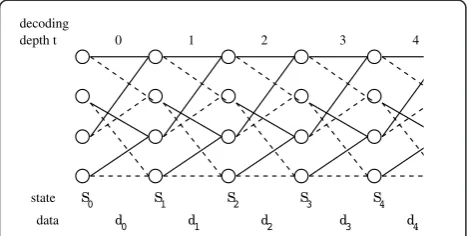
decoding trellis lengthL+U. It is convenient to explain the Viterbi decoding algorithm by means of a trellis dia-gram. Figure 1 illustrates an example of decoding trellis
for a convolutional code withm = 2. The Viterbi
algo-rithm is initialized by assigning the same metric value to all possible initial states. At each decoding deptht, t≥
W-1, the information bit on the branch at depth t -W
+ 1 is decoded by selecting the best survivor path at stateSt+1and tracing back the path to find the
informa-tion bitdt-W+1. Thus, a total ofL+U- W+ 1 data bits
are decoded by the Viterbi algorithm. It is to be noted
that the lastU - W+ 1 decoded bits are obtained in the second round of traversing the circular decoding trellis.
Step 3: Replace the firstU - W+ 1 decoded data bits
by the last U - W + 1 decoded bits to obtain the final
data sequence of length L. Since the initial state of the TBCC encoder is unknown to the Viterbi decoder, the bit error rates (BERs) of the first few decoded data bits are much larger than those of the rest. Thus, the first few unreliable decoded bits are replaced by those decoded bits obtained in the second traverse of the cir-cular decoding trellis.
3 Upper bounds on error probabilities
In this section, we derive the theoretical upper bound on the bit error probability of rate-1/2 TBCC for QPSK modulation over AWGN channel. It is to be noted that the bit error probability is independent of the correct code word. Thus, from now on we assume that the cor-rect path is the all-zero path. Let0¯ denote the all-zero state. LetS∗i andd∗i denote the state and the data bit on the chosen path (corresponding to stateSi and data bit
di in the example in Figure 1), respectively. The bit
error probability of thekth decoded data bit in Step 2,k
= 0, 1,..., L+U - W , is upper bounded by the sum of
probabilities of the following four error events.
1. The chosen path at decoding depth k+ W - 1
diverges from the correct path at stateSt1, 0≤ t1 ≤k
and merges into the correct path for the first time at stateSt2,k<t2≤k+Wand the decoded datad∗k = 0.
2. The chosen path at decoding depth k+ W - 1
diverges from the correct path at stateSt1, 0 ≤t1 ≤k,
never merges with the correct path, and reaches stateS∗k+W,S∗k+W=0¯.
3. The chosen path has an initial stateS∗0=0¯ and merges into the correct path for the first time at stateSt2withk+m < t2 ≤k+W. (This is because if
a path merges into correct path at stateSt2, the last mdata bits must be correct.)
4. The chosen path has an initial stateS∗0=0¯, never merges with the correct path and reaches state S∗k+W =0¯.
From the definition of the first error event, we observe that the probability of this event,P1, is upper bounded
by the bit error probability of ML decoding for zero-tail convolutional codes. Let
be the transfer function of the zero-tail convolutional
code [15], where dfree is the free distance of the
decoding
Figure 1Part of a trellis diagram for a convolutional code with
convolutional code, aij is the number of paths with
Hamming weightithat are generated by data sequences
containingjnon-zero bits, and the exponents ofDand
Ndescribe the Hamming weights of coded sequences
and data sequences of the paths, respectively. From [15], we get
spectral density of AWGN, and
D0= e−Es/2N0. (5)
The second error event is induced by finite truncation depth. Let
denote the transfer function for paths of length ℓ,
which start from a state SB, SB∈B, end in a stateSE,
SE∈E, and never merge with the all-zero path in
between, where bi is the number of such paths with
Hamming weight i, and the exponent of D describes
the Hamming weights of such paths. The probability of the second error event,P2, is upper bounded by the
sum of all error probabilities caused by each possible error paths in the second error event. Thus, by
follow-ing an argument similar to the ones in [10,15], P2
satisfies
whered2 is the minimum weight of error paths in the
second error event, andAis the set of all 64 states. The third error event is caused by the uncertainty of the encoder’s initial state. Similarly, The error probabilityP3
of the third error event satisfies
P3≤c(d3)
whered3 is the minimum weight of error paths in the
third error event. Finally, the error probability of the last error event,P4, satisfies
P4≤c(d4)·TAk+\{¯W0},A\{¯0}(D0) (9)
whered4 is the minimum weight of error paths in the
fourth error event. This error probability is caused by both finite truncation depth and the uncertainty of the encoder’s initial state. The bit error probability of the
kth decoded bit is upper bounded by the sum of four
upper bounds in (2), (7), (8), and (9).
We first analyze these error probabilities for high sig-nal-to-noise ratio. In this case, the value of D0 is very
small, and only the term with the smallest power ofDis significant. In the upper bounds of P1, P2, P3, and P4,
the smallest powers ofDaredfree,d2,d3, andd4,
respec-tively. Let W* and k*be the least values of W and k
such that d2>dfreeandd3>dfree, respectively. It follows
that, if truncation depth is W* and the first k* - 1
decoded bits in Step 2 are replaced in Step 3 (equiva-lently, trellis tail length U* =W* + k*- 2), the error
probabilities P2 and P3 of each bit in the final data
sequence will be small compared to the error probability of ML decoding for zero-tail convolutional codes. The
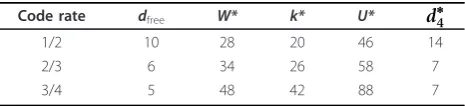
values of W*, k*, andU* for the three code rates are
obtained using a method similar to the one in [10] and are listed in Table 1. It is to be noted that for the
rate-2/3 and rate-3/4 TBCCs,W* may be different for
differ-ent bits in a puncturing period. Thus, the values ofW*
in Table 1 are the maximum values of W*over a
punc-turing period. In this table,d∗4that denotes the value of
d4 for the case W = W* and k = k* is also listed.
Observe that d∗4>dfreefor every code rate. Therefore,
we conclude that the bit error rate of circular decoding
algorithm withW=W*andU=U* will asymptotically
approach that of the ML decoding algorithm for zero-tail convolutional codes for high signal-to-noise ratio. From (7) and (8), it follows that if the generator
Table 1 The values ofW*,k*, andU* for TBCCs
Code rate dfree W* k* U* d∗4
1/2 10 28 20 46 14
2/3 6 34 26 58 7
polynomials of convolutional codes are symmetric [10],
k∗=W∗−m−1. (10)
From Table 1 we observe that even though the three codes in mobile WiMAX do not have symmetric gen-erator polynomials, W* -m-1 is still a good estimation fork*.
We now examine how bit error rate is affected by the finite truncation depth and the uncertainty of the initial state for a not-so-high signal-to-noise ratio. We first consider the circular decoding algorithm with a very long tail length. With a long tail length, the upper bounds ofP3and P4 for each data bit (after replacement
in Step 3) are much smaller than those of P1 and P2.
Thus, the average bit error rate is upper bounded byP1
+P2. In other words, the degradation of decoder
perfor-mance is mainly caused by finite truncation depth. It is to be noted that even if the trellis tail length is only 60 +W (equivalently, the first 61 decoded bits are replaced in Step 3), the value ofP3 +P4is many orders of
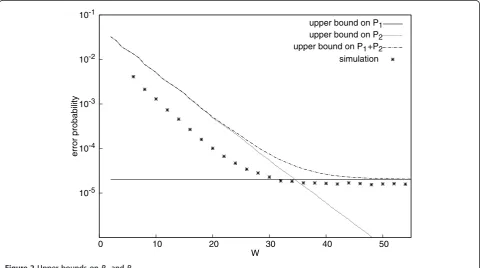
magni-tude smaller than the upper bounds of P1+P2. Figure 2
plots the upper bounds ofP1 andP2 and their sum
ver-sus the truncation depthW for Eb/N0 = 4 dB. At this
signal-to-noise ratio, the BER of optimal ML decoding algorithm (without memory truncation) is approximately 10-5. For comparison, simulation results of BER with tail
length U = 120 are also plotted in the figure. We
observe that the upper bound of P2 decreases
exponentially with the truncation depthW, so that BER
is dominated by the error probability P1 for truncation
depthW≥W’= 35.
Next, we examine how bit error rate of each decoded bit (in Step 2) is affected by the uncertainty of the initial state. We consider the Viterbi algorithm with a very long truncation depth. With such a truncation depth, the
upper bounds ofP2andP4are much smaller than those
ofP1andP3for each decoded bit. Thus, the BER is upper
bounded byP1 +P3. It is to be noted that even if the
truncation length is only 60, the value ofP2+P4is many
orders of magnitude smaller than the upper bounds ofP1
+P3. Figure 3 plots the upper bounds ofP1andP3and
their sum for each decoded bit withEb/N0= 4 dB. For
comparison, the simulated BER for each decoded bit with
truncation depthW= 100 is also plotted in the figure.
We observe that the upper bound ofP3decreases
expo-nentially when bit indexkincreases. In other words, the performance degradation caused by the uncertainty of the initial state abates rapidly as the decoder traverses through the trellis. From the figure, we see that BER is dominated by the error probabilityP1 fork≥ k’= 27.
Thus, if the firstk’- 1 decoded bits are replaced in Step 3, all the resulting data bits will have almost the same bit error probability. It is noteworthy thatW’-m- 1 is still a good estimation fork’. Figures 2 and 3 are plotted forEb
/N0= 4 dB. AsEb/N0increases, the values ofW’andk’
decrease. Moreover, the values ofW’andk’approach the
10-5 10-4 10-3 10-2 10-1
0 10 20 30 40 50
error probability
W
upper bound on P1
upper bound on P2 upper bound on P1 +P2 simulation
values ofW*andk*in Table 1 asEb/N0approaches 5 dB
and BER≈5 × 10⁻⁷.
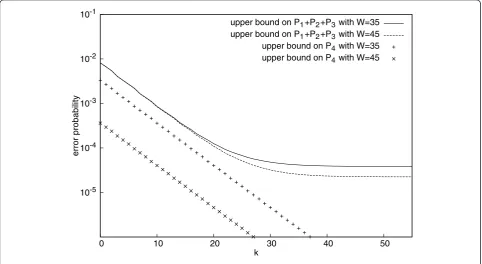
Finally, we examine the error probabilityP4. Figure 4
plots the upper bounds ofP4 andP1 +P2+P3 for each
decoded bit withEb/N0 = 4 dB. The upper bound ofP4
depends both on the truncation depth Wand the bit
indexk. From the figure, we observe that if the
trunca-tion depth is chosen as W’ = 35, the sum of upper
10-5 10-4 10-3 10-2 10-1
0 10 20 30 40 50
error probability
k
upper bound on P1 upper bound on P3
upper bound on P1 +P3 simulation
Figure 3Upper bounds onP1andP3for each decoded bitk.
10-5 10-4 10-3 10-2 10-1
0 10 20 30 40 50
error probability
k
upper bound on P1 +P2 +P3 with W=35 upper bound on P1 +P2 +P3 with W=45 upper bound on P4 with W=35
upper bound on P4 with W=45
bounds on all the other three error probabilities is much
larger than the upper bound of P4. As the truncation
length W increases, the contribution of P4 to BER
becomes even more insignificant.
4 Simulation results
In this section, the performance of the circular decoding algorithm is evaluated for fully interleaved Rayleigh fad-ing channel. All simulation results are obtained with no
repetition coding and with data length Lequal to the
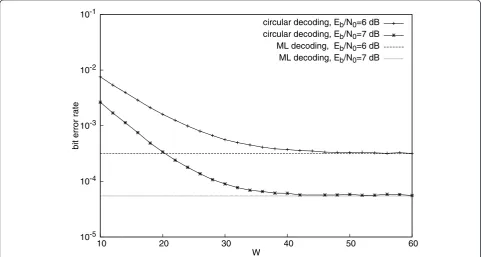
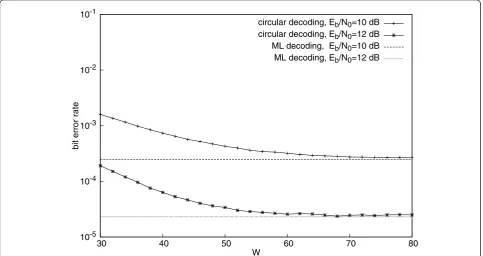
maximum data block length in the mobile WiMAX standard. Figures 5, 6, and 7 plot the average BERs of the circular decoding algorithm versus truncation depth for QPSK rate-1/2, 64QAM rate-2/3, QPSK rate-3/4 with very long tail length (U= 120), respectively. As a benchmark for comparison, the average BER of the opti-mal ML decoding algorithm (without memory trunca-tion) is also plotted in the figures. These figures show that the circular decoding algorithm with a sufficiently large truncation depth can achieve almost the same error performance as optimal ML decoding. We also observe that all TBCCs require smaller truncation depth asEb/N0increases, which agrees with the observation in
the previous section. Table 2 lists the least value of truncation depthW that yields losses within 0.05 dB of optimal ML decoding for BER≈ 10-5. Eb/N0 values in
Table 2 are the required bit signal-to-noise ratios for
BER ≈ 10-5. From the table, we obtain a rule of thumb
for the truncation depthW. The rate-1/2 code requires
a truncation depth of six to seven times the memory of the convolutional code, and the rate-2/3 and rate-3/4 codes require a truncation depth of ten to eleven times the memory. From the table, we also observe that high-order modulations require larger truncation depths than low-order ones.
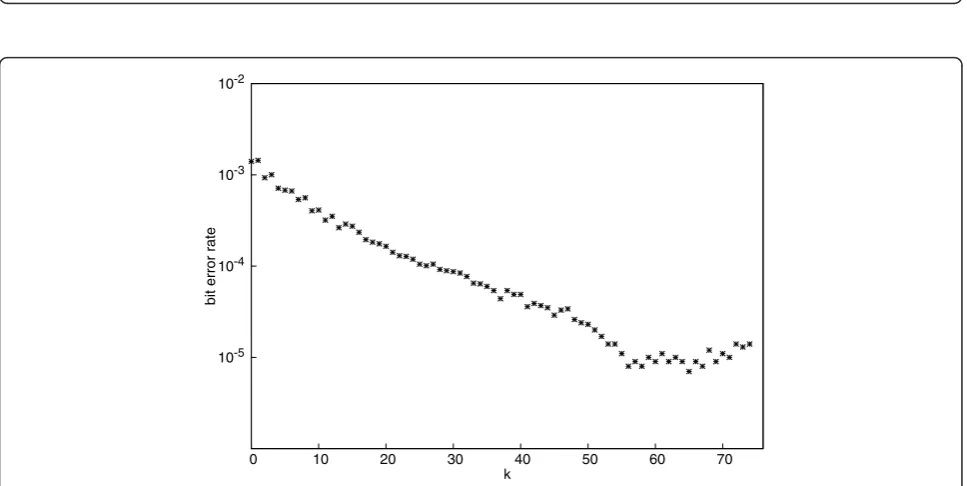
Figures 8, 9, and 10 plot the BER of each decoded bit
in Step 2 for QPSK rate-1/2 (with Eb /N0 = 8 dB),
64QAM rate-2/3 (withEb/N0= 17 dB), and QPSK
rate-3/4 (withEb/N0= 12.5 dB) with large truncation depth
(W = 100), respectively. We observe that even though
the BER tends to decrease in general as the Viterbi decoder traverses through the trellis, the BER is not a
monotonically decreasing function of index k. This is
caused by a short block lengthLand small interleaving
depth in Figure 8. When pairs of coded bits for QPSK signals are deinterleaved to form a codeword trellis in the receivers, coded bits in some pairs end up being very close to each other on the trellis, while others are further apart. In Figures 9 and 10, this problem is further complicated by code puncturing in rate-2/3 and rate-3/4 convolutional codes and unequal protection of
each coded bit in high-order modulation. Definek as
the index of the first decoded bit that attains losses within 0.05 dB of optimal ML decoding. Table 2 lists the values ofk for BER≈ 10-5. It is to be noted that for rate-2/3 and rate-3/4 TBCCs, each data bit in a punc-turing period has a different protection level and the
values of k in the table are obtained by using the
10-5
average BERs over a puncturing period. We observe that only a small fraction (less than 1/3) of the decoded bits in the first decoding round are unreliable, and thus should be replaced. We conclude that if truncation
depth isW and the firstk−1decoded bits in Step 2
are replaced in Step 3 (equivalently, trellis tail length
U=W+k−2), the losses caused by truncation and the
uncertainty of the initial state will be both within 0.05
10-5 10-4 10-3 10-2 10-1
20 30 40 50 60 70 80
bit error rate
W
circular decoding, Eb/N0=15 dB circular decoding, Eb/N0=17 dB
ML decoding, Eb/N0=15 dB ML decoding, Eb/N0=17 dB
Figure 6Average BER of rate-2/3 TBCC with 64QAM modulation over the Rayleigh channel,L= 192.
10-5 10-4 10-3 10-2 10-1
30 40 50 60 70 80
bit error rate
W
circular decoding, Eb/N0=10 dB circular decoding, Eb/N0=12 dB ML decoding, Eb/N0=10 dB
ML decoding, Eb/N0=12 dB
dB relative to ML decoding. We also observe
k≤W−m−1 for all transmission rates. Thus,
W−m−1can be used as a rule of thumb for the
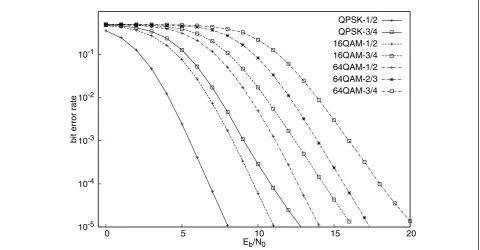
choice ofk. It is noted that if the tail length is chosen according to another criterion that the average BER over the whole TBCC codeword attains a loss less than 0.05 dB, the tail length will be substantially less thanU. Finally, Figure 11 plots the average BERs of the circular
decoding algorithm with truncation depthW and trellis
tail length U for all transmission rates in mobile
WiMAX.
Table 2 The values ofW,k, andUfor all transmission rates.
Modulation Code rate Eb/N0(dB) W k U
QPSK 1/2 8 35 26 59
QPSK 3/4 12.5 60 45 103
16QAM 1/2 11 39 27 64
16QAM 3/4 16 65 42 105
64QAM 1/2 14 43 36 77
64QAM 2/3 17 64 52 114
64QAM 3/4 20 67 57 122
10-5 10-4 10-3 10-2
0 10 20 30 40 50 60 70
bit error rate
k
Figure 8BER of each decoded bitkfor QPSK rate-1/2 over the Rayleigh channel withW= 100 andL= 288.
10-5 10-4 10-3 10-2
0 10 20 30 40 50 60 70
bit error rate
k
5 Conclusions
We have investigated the error probabilities of TBCCs caused by memory truncation and the uncertainty of the initial state. From the upper bounds on the error
probabilities, we found that if the same criterion is used
to choose the truncation depth Wand the first reliable
decoded bitk, thenk=W-m- 1 for symmetric
convo-lutional codes. The truncation depth, the index of the
10-5 10-4 10-3 10-2
0 10 20 30 40 50 60 70
bit error rate
k
Figure 10BER of each decoded bitkfor QPSK rate-3/4 over the Rayleigh channel withW= 100 andL= 288.
10-5 10-4 10-3 10-2 10-1
0 5 10 15 20
bit error rate
Eb/N0
QPSK-1/2 QPSK-3/4 16QAM-1/2 16QAM-3/4 64QAM-1/2 64QAM-2/3 64QAM-3/4
first reliable bit, and the trellis tail length with 0.05 dB losses on the Rayleigh channel were obtained by simula-tion for each transmission rate in the mobile WiMAX standard. From the results, we obtain a rule of thumb
for the truncation depth Wand trellis tail length U .
The rate-1/2 code requires a truncation depth of six to
seven times the memorym, and the rate-2/3 and rate 3/
4 codes require a truncation depth of ten to eleven
times m. Moreover,W- m- 1 is an appropriate rule of
thumb for the first reliable decoded bitk. Thus, the rule of thumb for trellis tail length is U= 2W- m- 3. The results show that the circular decoding algorithm with an appropriately chosen truncation depth and a circular trellis just a fraction longer than the original trellis can achieve almost the same performance as the optimal ML decoding algorithm in mobile WiMAX. Moreover, it is observed that high-rate TBCCs require larger trun-cation depths and longer trellis length than low-rate ones, and high-order modulations require larger trunca-tion depths and longer trellis length than low-order ones.
Acknowledgements
This work was supported by the National Science Council, R.O.C., under the contract NSC 97-2218-E-027-010.
Competing interests
The authors declare that they have no competing interests.
Received: 21 June 2011 Accepted: 25 September 2011 Published: 25 September 2011
References
1. IEEE, IEEE Standard for Local and Metropolitan Area Networks. Part 16: Air Interface for Fixed and Mobile Broadband Wireless Access Systems, IEEE Std 802.16-2004. New York (2004)
2. IEEE, IEEE Standard for Local and Metropolitan Area Networks. Part 16: Air Interface for Fixed and Mobile Broadband Wireless Access Systems, IEEE 802.16e-2005 and IEEE Std 802.16-2004/Cor 1-2005 (Amendment and Corrigendum to IEEE Std 802.16-2004). New York (2006)
3. HH Ma, JK Wolf, On tail biting convolutional codes. IEEE Trans Commun.34, 104–111 (1986). doi:10.1109/TCOM.1986.1096498
4. M Yehushua, J Watson, M Parr, System and method for decoding tailbiting code especially applicable digital cellular base stations and mobile units. U.S. Patent 5,369,671 (1994)
5. S Chennakeshu, RL Toy, Generalized Viterbi algorithm with tail-biting. U.S. Patent 5,349,589 (1994)
6. YE Wang, R Ramésh, inProceedings of the Seventh IEEE International Symposium on Personal, Indoor and Mobile Radio Communications. To bite or not to bite–A study of tail bits versus tail-biting.2, 317–321 (1996) 7. S Lin, DJ Costello Jr,Error Control Coding: Fundamentals and Applications,
(Prentice-Hall, Englewood Cliffs, NJ, USA, 1983)
8. W Sung, Minimum decoding trellis lengths for tail-biting convolutional codes. Electron Lett.36, 643–645 (2000). doi:10.1049/el:20000517 9. F Hemmati, DJ Costello Jr, Truncation error probability in Viterbi decoding.
IEEE Trans Commun.25, 530–532 (1977). doi:10.1109/TCOM.1977.1093861 10. IM Onyszchuk, Truncation length for Viterbi decoding. IEEE Trans Commun.
39, 1023–1026 (1991). doi:10.1109/26.87203
11. RV Cox, CW Sundberg, An efficient adaptive circular Viterbi algorithm for decoding generalized tailbiting convolutional codes. IEEE Trans Veh Technol.43, 57–68 (1994). doi:10.1109/25.282266
12. KS Zigangirov, VV Chepyzhov, inProceedings of the 4th Joint Swedish-Soviet International Workshop Information Theory. Study of decoding tailbiting convolutional codes, 52–56 (1989)
13. Q Wang, VK Bhargava, An efficient maximum likelihood decoding algorithm for generalized tail biting convolutional codes including quasicyclic codes. IEEE Trans Commun.37, 875–879 (1989). doi:10.1109/26.31187
14. RY Shao, S Lin, MPC Fossorier, Two decoding algorithms for tailbiting codes. IEEE Trans Commun.51, 1658–1665 (2003). doi:10.1109/ TCOMM.2003.818084
15. AJ Viterbi, Convolutional codes and their performance in Communication systems. IEEE Trans Commun.19, 751–772 (1971). doi:10.1109/ TCOM.1971.1090700
doi:10.1186/1687-1499-2011-111
Cite this article as:Liu and Tsai:Minimum decoding trellis length and truncation depth of wrap-around Viterbi algorithm for TBCC in mobile WiMAX.EURASIP Journal on Wireless Communications and Networking2011 2011:111.
Submit your manuscript to a
journal and benefi t from:
7Convenient online submission
7 Rigorous peer review
7Immediate publication on acceptance
7 Open access: articles freely available online
7High visibility within the fi eld
7 Retaining the copyright to your article