
CSEIT17218 | Received : 22 March 2017 | Accepted: 31 March 2017 | March-April-2017 [(2)2: 18-23 ]
International Journal of Scientific Research in Computer Science, Engineering and Information Technology © 2017 IJSRCSEIT | Volume 2 | Issue 2 | ISSN : 2456-3307
24
Data Transfer using LI-FI Technology
Nirmal Saini, Priyanka Bhowar, Shridhar Sahu, Satish Yadav,Dr. Mahavir Devmane
Information Technology, University, Pvppcoe, Mumbai, Maharashtra, India
ABSTRACT
The term Li-Fi was coined by Professor Harald Haas, and refers to light based communications technology that delivers a high-speed, bidirectional networked, mobile communications in a similar manner as Wi-Fi. This paper focuses on developing a Li-Fi based system and analyze its performance with respect to existing technology. The proposed use of Li-Fi technology mainly comprises of light-emitting diode (LED) bulbs as means of connectivity by sending data through light spectrum as an optical wireless medium using Visible Light Communication(VLC).
Keywords: Li-Fi(Light-Fidelity), Wi-Fi(Wireless-Fidelity), LED(Light Emitting Diode), VLC(Visible Light Communication, Photo Detector
I.
INTRODUCTION
The term Li-Fi was coined by Professor Harald Haas, and refers to light based communications technology that delivers a high-speed, bidirectional networked, mobile communications in a similar manner as Wi-Fi.[5]
Li-Fi is transmission of data through illumination by taking the fiber out of fiber optics by sending data through an LED light bulb that varies in intensity faster than the human eye can follow. Li-Fi is the term some have used to label the fast and cheap wireless communication system, which is the optical version of Wi-Fi. Li-Fi uses visible light instead of Gigahertz radio waves for data transfer. This technology uses a part of the electromagnetic spectrum that is still not greatly utilized, from the infrared through visible light and down to the ultraviolet spectrum providing a wide range of frequencies and wavelengths [5]. It is possible to encode data in the light by varying the rate at which the LEDs flicker on and off to give different strings of 1s and 0s [2]. The LEDs intensity is modulated so rapidly that human eyes cannot notice, so the output appears constant. Moreover, parallel data transmission using arrays of LEDs, where each LEDS transmit a different data stream is possible. Efforts are being made by using mixtures of red, green and blue LEDs to alter
the light's frequency, with each frequency encoding a different data channel which is capable of transmitting of data of about 100-500 Mb/s [5].
II.
METHODS AND MATERIAL
WORKING OF LI-FI
enables data transmission using binary codes switching on an LED is a logical '1', switching it off is a logical '0'. By varying the rate at which the LEDs flicker on and off, information can be encoded in the light to different combinations of 1s and 0s. This method of using rapid pulses of light to transmit information wirelessly is technically referred to as Visible Light Communication (VLC), though it is popularly called as Li-Fi because it can compete with its radio-based rival Wi-Fi.
III.
RESULTS AND DISCUSSION
1. Implementation & Design
Li-Fi system is as follows:
a) A high brightness white LED which acts as transmission source.
b) A silicon photodiode with good response to visible light as the receiving element. LEDs can be switched on and off to generate digital strings of different combination of 1s and 0s. To generate a new data stream, data can be encoded in the light by varying the flickering rate of the LED.
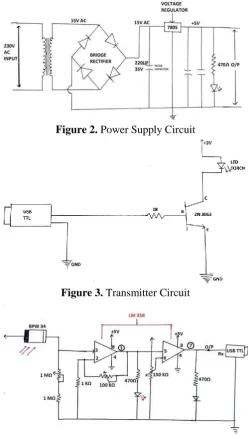
There are 3 circuit diagrams for construction of lifi system they are as follows:
i Power supply circuit
ii Transmitter circuit
iii Receiver circuit
Figure 1: Design of prototype with USB interface[1].
Figure 2. Power Supply Circuit
Figure 3. Transmitter Circuit
Figure 4. Receiver Circuit
The power supply circuit is required for both the transmitter and receiver side with is used to main a constant rate of current through the circuit.
Software Construction:
The software is been coded in Microsoft visual studio 2015. The construction of software is taken place at two levels:
i Front end(User interface)
ii Back end(Events and controls)
Sending Messages
which may or may not be human-readable, and human readable messages delivered via computer software for person-to-person communication.
a) Message passing is a form of communication used in concurrent and parallel computing, object-oriented programming, and inter-process communication, where communication is made by sending messages to recipients. In a related use of this sense of a message, in object-oriented programming languages such as Smalltalk or Java, a message is sent to an object, specifying a request for action.
b) Instant messaging and e-mail are examples of computer software designed for delivering human-readable messages in formatted or unformatted text, from one person to another.
Steps for sending a message:
1. First a connection is established wherein the transmitter is connected to the computer using USB to TTL adaptor.
2. Similarly the receiver is switched on the and plugged to the other computer.
3. Respective port setting are done in the „Devices Manager‟.
4. Now we run the program and an window appears where again the ports need to be configured.
5. Once this is done we are ready to send a message.
6. A message is typed in a particular field which is as shown
7. If the connections are done properly then we will receive the same message on the other device.
2. Features of Li-Fi
Li-Fi features include benefits to the capacity, energy efficiency, safety and security of a wireless system with a number of key benefits over Wi-Fi but is inherently a complementary technology.
well contained in a tight illumination area whereas RF tends to spread out and cause interference.
c) High speed: Very high data rates can be achieved due to low interference, high device bandwidths and high intensity optical output.
d) Planning: Capacity planning is simple since there tends to be illumination infrastructure where people wish to communicate, and good signal strength can the data transmission requires negligible additional power.
c) Environment: RF transmission and propagation in water is extremely difficult but Li-Fi works well in this environment.
iii) Safety
a) Safe: Life on earth has evolved through exposure to visible light. There are no known safety or health concerns for this technology.
b) Non-hazardous: The transmission of light avoids the use of radio frequencies which can dangerously interfere with electronic circuitry in certain environments.
iv) Security
a) Containment: It is difficult to eavesdrop on Li-Fi signals since the signal is confined to a closely defined illumination area and will not travel through walls. b) Control: Data may be directed from one device to another and the user can see where the data is going; there is no need for additional security such as pairing for RF interconnections such as Bluetooth.
3. Applications of LI-FI
There are many applications for Li-Fi. These include:
• RF Spectrum Relief: Excess capacity demands of cellular networks can be off-loaded to Li-Fi networks where available. This is especially effective on the downlink where bottlenecks tend to occur.
• Smart Lighting: Any private or public lighting including street lamps can be used to provide Li-Fi hotspots and the same communications and sensor infrastructure can be used to monitor and control lighting and data.
• Mobile Connectivity: Laptops, smart phones, tablets and other mobile devices can interconnect directly using Li-Fi. Short range links give very high data rates and also provides security.
Figure 5 : Application of Mobile communication
• Hazardous Environments: Li-Fi provides a safe alternative to electromagnetic interference from radio frequency communications in environments such as mines and petrochemical plants.
• Hospital & Healthcare: Li-Fi emits no electromagnetic interference and so does not interfere with medical instruments, nor is it interfered with by MRI scanners.[4]
• Aviation: Li-Fi can be used to reduce weight and : Application in Aviation[6]
cabling and add flexibility to seating layouts in aircraft passenger cabins where LED lights are already deployed. In-flight entertainment (IFE) systems can also be supported and integrated with passengers‟ own mobile devices.
• Underwater Communications: Due to strong signal absorption in water, RF use is impractical. Acoustic
waves have extremely low bandwidth and disturb marine life. Li-Fi provides a solution for short-range communications.
• Vehicles & Transportation: LED headlights and tail-lights are being introduced. Street lamps,
Figure 6 : Application in Aviation[6]
Figure 7 : Application for vehicles & transportation signage and traffic signals are also moving to LED.
This can be used for vehicle and vehicle-to-roadside communications. This can be applied for road safety and traffic management.
• RF Avoidance: Some people claim they are hypersensitive to radio frequencies and are looking for an alternative. Li-Fi is a good solution to this problem. • Location Based Services (LBS): Highly accurate location-specific information services such as advertising and navigation that enables the recipient to receive appropriate, pertinent information in a timely manner and location.
• Toys: Many toys incorporate LED lights and these can be used to enable extremely low-cost communication between interactive toys.[3]
IV.
CONCLUSION
applications. An evergrowing interest in VLC throughout the world can be expected to lead to real-world applications in the future. The transmission is based on the assumptions of direct LOS (line-of-sight) channels and simplex channel conditions. The tests were carried out under moderate indoor ambient light conditions. It is envisaged larger coverage can be obtained by using LED arrays. Finally, the wireless communication technology could be embedded into the visible light source which is the ultimate goal of the project.
V.
REFERENCES
[1] www.lificonsortium.org
[2] http://www.academia.edu/31766137/IRJET-Li-Fi_Technology_Transmission_of_Data_Through_ Visible_Light_Communication, [Divyani Kamble] [3] http://ijaegt.com/wpcontent/uploads/2014/12/4092
99-pp-342-344-virisha-t.pdf/,[Golthi Tharunn] [4]
https://www.slideshare.net/UzmaRuhy/lifi-perfect-slides
[5] https://www.ijedr.org/papers/IJEDRCP1401007.pd f ,[K. Lakshmisudha]
![Figure 6 : Application in Aviation[6]](https://thumb-us.123doks.com/thumbv2/123dok_us/1014346.1125722/4.595.298.547.125.446/figure-application-in-aviation.webp)