R E S E A R C H
Open Access
Basics of coalitional games with applications to
communications and networking
Farshad Shams
1*and Marco Luise
2Abstract
Game theory is the study of decision making in an interactive environment.Coalitional gamesfulfill the promise of group efficient solutions to problems involving strategic actions. Formulation of optimal player behavior is a fundamental element in this theory. This paper comprises a self-instructive didactic means to study basics of
coalitional games indicating how coalitional game theory tools can provide a framework to tackle different problems in communications and networking. We show that coalitional game approaches achieve an improved performance compare to non-cooperative game theoretical solutions.
1 Introduction
The increase of the number of wireless services, combined with demand for high-definition multimedia communi-cations, have made the radio resources, and particularly the spectrum and power, a very precious and scarce resource, not because of their unavailability but because they are used inefficiently. For licensed spectrum, the measurements by Shared Spectrum Company [1] shows that the maximal usage of the spectrum is a low per-centage of the whole licensed. While the number of users and the spectrum usage steadily increases, the amount of spectrum is still considered a limited resource. Besides, to differentiate between the true signal and back-ground noise is complex for a radio equipment. Gener-ally, this complex process enforces terminals to transmit strong version of signals, which wastes the energy of a transmitter.
The modern wireless entities, i.e., wireless terminals and base stations, have considerable capacities to exe-cute dynamic processes. This capability encourages wire-less service providers to consider wirewire-less entities as autonomous agents which could cooperate and negotiate with each other to achieve an efficient resource allo-cation in different situations. Cooperation among wire-less terminals is usually intended to achieve a fair radio resource allocation. Cooperation between base stations
*Correspondence: [email protected]
1Consorzio Nazionale Interuniversitario per le Telecomunicazioni (CNIT) Viale G.P. Usberti, 181/A, Parma, Italy
Full list of author information is available at the end of the article
can be devised to mitigate interference and promote soft handover where channel gain is varying rapidly which is a challenge in LTE [2].
Game theory is the most prominent tool to analyze interaction issue in social sciences, wherein often, cooper-ation among autonomous agents is essential for successful task completion. In many settings, groups of competing agents are simultaneously concerned with both individ-ual and overall benefits. In the game theory literature, this branch is known as cooperative game [3,4]. The play-ers, as the main decision making entities in the game, are considered to negotiate with each other to deter-mine a binding agreement among them. If we assume that all users act rationally and we know what the behavior of the users are, it is possible to determine the overall performance of a system since the actions of one user becomes part of the circumstances for another user. Thus, we are interested in individual performance and over-all system performance under a specific set of rules. To fully develop the different possibilities within a game for cooperation among players, we have to address which groups the players can achieve collectively. Indeed, if a player assesses that within a certain group it does not receive what it is able to get by itself, then it might decide to abandon the cooperation and pursue an alternative allocation by itself. Cooperative game the-ory offers the opportunity to extend and expand the treatment of the players in traditional non-cooperative games, especially where selfish players compete over a set of resources. The cooperative game theory is divided into two parts: coalitional game theory and bargaining
games [3,4]. In this contribution, we focus on the coali-tional game theory. We show that in comparison to non-cooperative game theory, coalitional games approaches can achieve better results in terms of performance and stability.
Saad et al. in a tutorial paper [5] classify coalitional games into three categories: canonical (coalitional) games, coalition formation games, and coalitional graph games. In canonical games, no group of players can do worse by joining a coalition than by acting non-cooperatively. In coalition formation games, forming a coalition brings advantage to its members, but the gains are limited by a cost for forming the coalition. In coalitional graph games, the coalitional game is in graph form, and the interconnection between the players strongly affects the characteristics as well as the outcome of the game.
In the last few years, cooperative game theory has been successfully applied to communications and net-working. Hossain et al. [6] provides a guide to state-of-art which unifies the essential information, addressing both theoretical and practical aspects of cooperative communications and networking in the context of cel-lular design. The current literature is mainly focused on applying cooperative games in various applications such as distributed/centralized radio resource allocation [7-9], power control [10,11], spectrum sharing in cognitive radio [12,13], cooperative automatic repeat request (ARQ) mechanism [14], cooperative routing [15], and coopera-tive communications [16,17]. These problems in wireless networks can be modeled as a cooperative game since it is highly likely that each wireless user can obtain a better utility value by forming groups and controlling resources cooperatively rather than individually. It has been shown that cooperation can result in an enhanced QoS in terms of throughput expansion, bit error rate reduction, or energy saving [6].
Cooperation can be realized at various layers of the network. At the physical layer, different separate anten-nas can constitute a cluster and then cooperate with each other to exploit multiple-input multiple-output gains. At the MAC sublayer, some wireless terminals can cooperate with each other to share a common wireless medium in an efficient manner and consequently mitigate the inter-ference hazard. There is also the possibility of cooperation of physical and application layers among individual termi-nals to adapt channel and source codings in multimedia communications. The altruistic decision of cooperation with other network entities may result in an improvement of the overall network performance and concurrently achieve an egoistic interest of self improvement.
The rest of this paper is divided into eight sections. The following section provides an introductory discussion of coalitional game theory. We systematically study funda-mental definitions and conditions of coalitional games:
superadditivity and convexity. Then, Section 3 and the sub-section inside discuss the core set solution as the most known solution for payoff distribution. Section 4 is devoted to a study of a strong payoff distribution, the so-called Shapley value. In Section 5, we present a systematic study of two other reward divisions called thekerneland
nucleolus. Then, in Section 6, we extend the concept of Nash equilibria in coalitional games. Section 7 is an inves-tigation of the concept of coordinated equilibria, where players of the game are admitted to pre-communicate among themselves at once. Section 8 helps the reader to understand the basic concepts and importance of dynamic learning in coalitional games. Every section contains some motivation examples that are expedient to understand how different communication network problems can be modeled as coalitional game. We discuss the features of mentioned approaches in Section 9, and finally we con-clude this paper in Section 10.
2 Preliminaries
Game theory deals with the study, through mathemati-cal models, of conflict situations in which two or more rational players make decisions that will influence each other’s welfare. The theory of coalitional games [3,4] also assumes that binding agreements may be established among the players in the course of the conflict situation. In transferable utility (TU) games, the agreement may be reached by any subset of the players, and the gain obtained from this agreement is a real number and is transferable among these players. In non-transferable utility (NTU) games, the agreement may be reached by any subset of the players, but the gain may be non-transferable. The main focus of this dissertation will be on the study of TU games.
A TU game is a pairG = (K,ν), whereK =[1,. . .,K] denotes the set of players, and ν the coalition (charac-teristic) function which is interpreted as the maximum outcome (a real number) to each coalition (subset ofK) whose players can jointly produce. An NTU game is a pair
G=(K,V)whereVis a mapping which for each coalition
A, defines a characteristic set,V(A), satisfying
(1) V (A)is non-empty and closed subset ofR|A|, (2) For eachk∈A, there is aVk∈R, such that
V ({k})=(−∞,Vk],
(3) V(A)is comprehensive, i.e., for allx∈V(A)and for ally∈R|A|, ify[k]≤x[k]∀k∈A, theny∈V(A), (4) The setV (A) y∈R|A||y[k]≥Vk∀k∈Ais
bounded.
when the characteristic set for each coalitionAtakes the form
V(A)=
x∈R|A|:
k∈A
xk ≤ν (A)
, (1)
wherex = x1,. . .,x|A| ∈ R|A| andxk is the payoff of
playerkinAandν : 2K −→ R. IfAis a coalition (sub-set) ofK formed in G, then its members get an overall payoffν(A), zero for the empty set. Each coalition can be represented as a pure strategy in non-cooperative game theory. There exist only few works on NTU game applica-tions to problems in communicaapplica-tions [18]. This is because defining a utility function which meets all conditions of a character set in NTU game is not always feasible.
An important property of interest in characteristic form TU games is superadditivity, which, if present, implies that the value of the unite of any two disjoint coalitions is at least as big as the sum of their values.
Definition 1.A TU gameGis superadditive if
ν(Ai∪Aj)≥ν(Ai)+ν(Aj) ∀Ai,Aj⊂Ks.t.Ai∩Aj=∅
(2)
In a superadditive TU game, there are positive syner-gies and the players prefer to join each other rather than act alone. Under superadditivity condition, the players are willing to form thegrand coalition(the setK).
Convexor alternativelysupermodularcoalitional games were introduced by Shapley [19]. He models coalitional situations, where the marginal contribution of a player to a coalition increases as the coalition becomes larger.
Definition 2.A TU gameGis convex or supermodular if for allk∈K
ν(Ai∪ {k})−ν(Ai)≤ν(Aj∪ {k})−ν(Aj)
∀Ai⊆Aj⊂K\ {k}. (3)
Equivalently,
Definition 3.A TU gameGis convex or supermodular if
ν(Ai)+ν(Aj)≤ν(Ai∩Aj)+ν(Ai∪Aj) ∀ Ai,Aj⊆K.
(4)
Convexity means that there are increasing returns to scale. Note that a convex game is superadditive. To bet-ter understand the importance of convexity approach in network problems, we verify the convexity condition in aK-user channel access game. The payoff of each coali-tion of players (transmitters) is defined as the outer MAC
capacity region. ParandehGheibi et al. ([20], Lemma 1) shows that in a multiple access channel scenario, the inequality (4) is not met. This means that the game is not convex, and thus adding a new player does not give benefit to other transmitters.
3 The core solution
A central question in a coalitional game is how to divide the extra earnings (or cost savings) among the members of the formed coalition. In a TU game, an allocation is a func-tionxfromKtoRthat specifies for each playerk∈Kthe payoffxk ∈Rthat this player can expect when it
cooper-ates with the other players. The payoff of each player can show the cost borne by the player, the power of influence, and so on, depending on the problem setting.
Definition 4.LetKbe the set ofKplayers of the super-additive TU gameG, and letνbe the payoff of the game. The set of all ‘imputations’ ofGis the set
I(K,ν)=
x∈RK :
(i)
k∈K
xk=ν(K)
(ii) xk ≥ν({k}) ∀k∈K
, (5)
where x = [x1,. . .,xk,. . .,xK] ∈ RK is the imputation
vector of the players. The former condition is called the
feasibility, and the latterindividually rationalcondition.
Thecoreconcept was introduced in [21] and is the most attractive and natural way to define a payoff distribution: if a payoff distribution is in the core, no agent has any incentive to be in a different coalition. The core of a TU game is the subset of all imputationsx∈ I(K,ν)that no other imputationdirectly dominates, that is,y∈I(K,ν)
s.t. yk > xk ∀k ∈ K. As can be seen, for coalitional
games as well as non-cooperative games, the notion of dominance is essentially equivalent; the payoffs under the various situations are compared, and one situation domi-nates the others if these payoffs are higher. The core actu-ally presents a condition stronger than Nash equilibrium in non-cooperative game: no group of agents should be able to profitably deviate from a configuration in the core. Equivalently, no set of players can benefit from forming a new coalition, which corresponds to the group rationality assumption.
In an NTU gameG=(K,V), the core apportionment is defined as ([4], Ch. 12)
Definition 5.LetKbe the set ofKplayers of the super-additive NTU-gameG, and letVbe the payoff of the game. The core ofGis the set
S(K,V)=x∈V(K):∀y∈V(A)∃k∈As.t.xk ≥yk
wherexis the payoff distribution across players, andxk ∈
xif and only if no coalition can improve uponxk.
In a TU gameG = (K,ν), the core apportionment is defined as follows:
Definition 6.LetKbe the set ofKplayers of the super-additive TU gameG, and letνbe the payoff of the game.
tribution across players, and xk ∈ x if and only if no
coalition can improve uponxk. The second condition is
callednon-blockingcondition.
The core consists of the set of allocations that can be blocked by any coalition of agents. If for some set of agents
A the non-blocking condition does not hold, then the agents inAhave an incentive to collectively deviate from the coalition structure and divideν(A)among themselves. In general, the core of a given TU game(K,ν)is found by
Madiman [22] introduces some intuitive applications of core solution to information theory contexts, e.g., source coding and multiple-access channel, and summa-rizes some of its limitations in multi-user scenarios. Li et al. [23] show that the cooperation among wireless nodes and core apportionment can increase spectrum efficiency in a TDMA cooperative communication. In [24], Niyato and Hossain apply the core solution in a coalition among different wireless access networks to offer a stable and efficient bandwidth allocation.
Indeed, there is a number of realistic application sce-narios, in which the emergence of the grand coalition is either not guaranteed or might be perceivably harmful, or is plainly impossible [25]. For a non-superadditive coali-tional game, the coalition formation process does not lead the players to form the grand coalition. In this case, Def-inition 6 does not apply. Let us redefine the core set in a general (not necessarily superadditive) coalitional forma-tion TU game [9]. Let ψ = [A1,A2,. . .,Am] denote a
partition of the setK, whereinAi∩Aj = ∅fori = j,
m
i=1Ai = K andAi = ∅ fori = 1,. . .,m, and let denote the set of all possible partitionsψ. Let us also defineF=[A1,A2,. . .,An], such thatni=1Ai=Kand
Ai = ∅fori = 1,. . .,n, as a family of (not necessarily
disjoint) coalitions.
Definition 7.A ‘core apportionment’x∈ RK is a payoff distribution with the following property:
S(K,ν)=
Note that, if G is superadditive, then max ψ∈
A∈ψ
ν(A) =
ν(K).
The core allocation set can be found through linear programming; its existence in general, depends upon the feasibility of (8). Unfortunately, the core is a strong notion, and there exist many games where it is empty. We can study the non-emptiness of the core without explicitly solving the core equation. The following notation helps simplify the dual of (8):
Definition 8. A superadditive TU gameG for a family
F of coalitions istotally balancedif for anyA ∈ F, the inequality
A∈F
μA·ν(A)≤(K) (10)
holds, where μA is a collection of numbers in [ 0, 1] (balanced collection of weights) such that
A∈F
μA·1A=1K, (11)
with 1A ∈ RK denoting the characteristic vector whose
elements are
(1A)[i]=
1, i∈A
0, otherwise. (12)
The following pathbreaking result in the theory of TU games was independently gave by Bondareva [26] and Shapley [27].
Lemma 1. [3]. A totally balanced TU game has a non-empty core set.
Where forming the grand coalition is not guaranteed, the following notation is applied:
Definition 9.A (not necessarily superadditive) TU game
A∈F
μA·ν(A)≤max ψ∈
A∈ψ
ν(A). (13)
So, if a TU game is totally balanced, then the core is non-empty; therefore, it is a convenient solution concept on the class of totally balanced TU games. There is an interesting relation between convex and balanced games.
Lemma 2. [4]. A convex game is totally balanced, but the converse is not necessarily true.
The other key feature of coalitional convex games is
Lemma 3.[19] The core set of a convex game is unique.
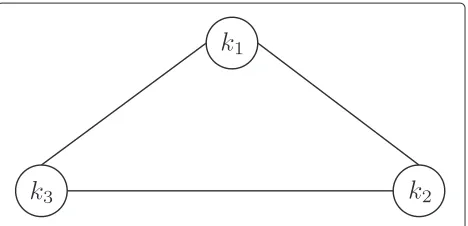
Now, we illustrate an intuitive example of power dis-tributionbased on core set solution. This example is an extended form of the example established by ([28], Ch. 12). The network sketched in Figure 1 wishes to allocate power among three playersK= {k1,k2,k3}, according to
their will to cooperate with each other. A power of 1 mW is provided to the network if three players decide to cooper-ate, or equivalently if the grand coalition will form. If only one player refuses to cooperate, a power of 0.8 mW will be assigned to the pair of cooperating nodes. The coalition game of Figure 1 is defined by
ν(A)= ⎧ ⎪ ⎨ ⎪ ⎩
0 if|A| =1; 0.8 if|A| =2; 1 if|A| =3.
(14)
The players of each coalition will cooperate with each other. The player of a singleton coalition will be isolated.
Each player receives a positive payoff if it decides to cooperate, whereas all players receive zero if no agree-ment is bound. To divide the total payoff (power) in some appropriate way, we rest on the core set definition. It is straightforward to show that the coalitional TU game defined by (14) is superadditive. From Equations 3 and 4,
Figure 1Network allocates power among three players according to their will to cooperate with each other.A selfish player receives zero. A pair of cooperative players receives 0.8 mW, and the network supplies 1 mW to the grand coalition.
it is easy to show that TU game (14) is not convex (super-modular). To check whether the core set of TU game (14) is empty or not, we resort to the balanced solution. TU game (14) is not balanced even though assigning the bal-anced weights asμA = 1 for singleton coalitions, and
μA = 0 otherwise, inequality (10) holds. Using the fact that other balanced collection of weights exists in which
μA = 12 for|A| =2 andμA =0 otherwise, the game is not balanced, and its core set may be empty. Note that this resultdoes notmean that the core set of the game issurely
empty.
Now, we heuristically find a core apportionment study-ing various possible networks. When there is no coop-eration among players, the players are not provided with any power, that is,F = [{k1},{k2},{k3}] with payoff
distribution:
xk1 =xk2 =xk3 =0.
If only one player decides to stay alone, the payoff 0.8 is equally divided between the two cooperative players, and the isolated player gets zero, that is, for instance, F = [{k1,k2},{k3}] with payoff distribution:
xk3 =0
xk1 =xk2 =0.4.
Now, we suppose a player, for example k2, decides to
cooperate with both k1 and k3, but the two players k1
andk3do not bind an agreement to mutually cooperate.
It is reasonable to suppose that the player k2 can act as
a relay betweenk1 andk3, and it must be provided with
more power, that is,F =[{k1,k2},{k2,k3}] with payoff
distribution:
xk1 =xk3 =0.2 xk2 =0.6.
Finally, in the complete network, each player receives the same payoff, that is, F = [{k1, k2,k3}] with payoff
distribution:
xk1 =xk2 =xk3 =1/3.
As can be easily seen, the above argument satisfies fea-sibility and non-blocking conditions of the core set appor-tionment in Definition 6. It is worthwhile to note that the core set definition does not imply an even division of the whole payoff across players. Thus, it is clear that this game consists of multiple core sets. The power distribution problem can also be solved by game-theoretic bargaining solutions, e.g., Nash bargaining game and auction [3].
3.1 On core stability
playersk1andk2find an opportunity to meet each other.
Obviously, they quickly take advantage to cooperate and achieve payoff distribution x = [ 0.4, 0.4 , 0 ]. Then, it is profitable for playerk1to invite playerk3 to join,
there-fore improving its own payoff from 0.4 to 0.6 and that of playerk3from zero to 0.2 . On the other hand, this new
agreement causes a decreasing payoff of playerk2 from
0.4 to 0.2, and now the playersk2 andk3have an
incen-tive to cooperate and increase their proper payoff from 0.2 to 1/3. Note that this agreement makes the playerk1’s
payoff decrease from 0.6 to 1/3. The unfavorable decision of playerk2 would tempt playerk1to retaliate. A
nego-tiation betweenk1andk3to release cooperation withk2
results increasing their payoffs and boiling downk2’s
pay-off to zero. The result of the above argument concerns the network is sustained by only one pair cooperation under the threat of ‘If you cooperate with the third player, then I will do the same’.a It is fairly clear that the
play-ers would seek to cooperate only as pairs for the purpose of negotiation, and not cooperate in the grand coalition framework, even though the game is superadditive. This is due to the fact of being superadditive but not balanced. The pairs can be changed as time goes on. In fact, the core apportionment suffers the lack of ‘farsighted’ (i.e., long-term)stability.
A coalition structure based on the core set is not ade-quately farsighted to avoid the elusiveness of the negoti-ation structure. At first sight, the core appears to be an extremely myopic notion, requiring the stability of a pro-posed allocation to deviations or blocks by coalitions, but not examining the stability of the deviations themselves. In general, the stability requirement is that the outcome be immune to deviations of a certain sort by coalitions. To provide the formal definition of farsighted stability, we need some additional notation.
Definition 10.[29] Forx,y∈I(K,ν),xindirectly dom-inatesy, which is denoted byyx, if there exist a finite sequence of imputations y = x1,x2,. . ., xm= xand a
finite sequence of nonempty coalitions A1,A2,. . .,Am,
such that for each j = 1, 2,. . .,m−1: (i) by the devia-tion ofAj, the imputation ofxjis replaced toxj+1, and (ii)
xj[k]<x[k] for allk∈Aj.
Condition (i) says that each coalition inAjhas the power
to replace imputationxjby imputationxj+1, and condition
(ii) says that each player inAjstrictly prefers imputation
xto imputationxj. It is clear that the indirect dominance
relation contains the direct dominance relation.
Definition 11.[29,30] Let G = (K,ν) be a TU game. A subsetJ ofI(K,ν)is afarsighted stableset if: (i) for all x,y ∈ J, neither x ynor y x, and (ii) for all
y ∈ I(K,ν)\J there existsx ∈ J such that y x. Conditions (i) and (ii) are called internal stability and
external stability, respectively.
By internal stability, there is no imputation inJ that is dominated by another imputation inJ. By external sta-bility, an imputation outside a stable setJ is unlikely to be attained. Let us introduce three other different pay-off distribution concepts which capture foresight of the players.
4 Shapley value
The Shapley value is an alternative solution for the pay-off distribution in TU games. The Shapley value has long been a central solution concept in coalitional game theory. It was introduced by L. S. Shapley in the seminal paper [31] and it was seen as a reasonable way of distributing the gains of cooperation, in a fair and unique way, among the players in the game. In the Shapley solution, those who contribute more to the groups that include them are paid more. Let us denoteφk(ν)as the Shapley value of playerk
in the TU game defined byν. The surprising result due to Shapley is the following theorem.
Theorem 1. There is a unique single-valued solution to TU games satisfying efficiency, symmetry, additivity, and dummy. It is the well-known Shapley value, the function that assigns to each playerkthe payoff:
φk(ν)=
∀A⊆K s.t.k∈A
(|A| −1)!·(K− |A|)!
K! (ν(A)−ν(A\{k})).
(15)
The expressionν(A)−ν(A\{k})is the marginal payoff of playerk to the coalitionA. The Shapley value can be interpreted as the expected marginal contribution made by a player to the value of a coalition, where the distribu-tion of coalidistribu-tions is such that any ordering of the players is equally likely. That makes the Shapley value exponentially hard to compute. Shapley characterized such value as the unique solution that satisfies the following four axioms:
(1) Efficiency: The payoffs must add up toν(K), which means that all the grand coalition surplus is allocated, that is,
k∈K
φk(ν)=ν (K).
In the absence of superadditivity, instead we use max
ψ∈
A∈ψ
ν(A).
players are substitutes because they contribute the same to each coalition, the solution should treat them equally, that is,
ν(A∪ {k})=ν(A∪ {i}) =⇒ φk(ν)=φi(ν).
(3) Additivity: The solution to the sum of two TU games must be the sum of what it awards to each of the two games, that is,
φk(ν+ω)=φk(ν)+φk(ω) ∀k∈K.
(4) Dummy player: The player k is dummy (null) if
ν(A∪ {k})=ν(A)for allAnot containingk. If a playerk is dummy, the solution should pay it nothing, i.e.,φk(ν)=0.
The Shapley value is a feasible allocation, but need not be individually rational. Whenever the TU game is super-additive, the Shapley value is feasible and individually rational, but need not be in the core, hence can be directly dominated by another imputation. [19] shows that the Shapley value of a supermodular TU game is a core impu-tation, that is, the Shapley value is not dominated. For a superadditive TU game, the Shapley value is an internal and external stable imputation, and for NTU games, it is formulated in [32,33]. To make an example, let us calculate the Shapley value of the players in the power distribution game of Figure 1:
ν=
⎧ ⎪ ⎨ ⎪ ⎩
0 {k1},{k2},{k3};
0.8 {k1,k2},{k1,k3},{k2,k3};
1 {k1,k2,k3}.
=⇒
φk1(ν)=φk2(ν)=φk3(ν)=0 + 1! . 1!
3! (0.8−0) + 1! . 1!
3! (0.8−0)+ 2! . 0!
3! (1−0.8)= 1/3. Young [34] defines an equivalent definition for Shap-ley value. He withdraws the additivity axiom, and instead adds an axiom of marginality.
(1) Marginality: If the marginal contribution to coalitions of a player in two games is the same, then the award of the player must be the same, that is, if
ν(Ai)−ν(Ai\{k})=ω(Aj)−ω(Aj\{k})
∀Ai∈ν and ∀Aj∈ω,
thenφk(ν)=φk(ω).
Marginality is an idea with a strong tradition in economic theory. In Young’s definition, marginality is assumed and additivity is dropped. Young [34] shows that the Shapley value is unique.
Theorem 2.[34] There exists a unique single-valued
solution to TU games satisfying efficiency, symmetry, and marginality; this solution is the Shapley value.
In the network engineering literature, Kim [35] pro-poses an energy efficient routing protocol based on the Shapley value. The concept of the Shapley value is used by Khouzani and Sarkar [36] to achieve a fair aggregate cost of link sharing, among primary and secondray users in a cognitive network. Using the Shapley value, a suitable net-work resource sharing among multimedia users is fairly achievable, as Park and van der Schaar propose in [37].
5 The kernel and nucleolus
LetG=(K,ν)be a coalitional game with transferable pay-off. Theexcessof the coalitionAwith respect to the payoff vectorx∈RK is defined as
e(A,x)=ν(A)− k∈A
xk. (16)
A positive excess can be interpreted as an incentive for a coalition to generate more utility. Using the excess notion, the core apportionment in a TU game can be redefined as
S(K,ν)=
x∈RK: e(K,x)=0, ande(A,x)≤0∀A⊂K.
(17)
Themaximum excessof playerkagainstiis defined as
eki(x)=max{e(A,x) |A⊂K, k∈A, i∈K\A}. (18)
If playerkdeparts fromx, the most it can hope to gain (the least to lose) without the consent of playeri is the amount of maximum excess. The extensions of the excess for NTU games are formalized in [38].
As defined by Osborne and Rubinstein ([3], Ch. 14), a coalition Ai is an objection of k against i to x, if Ai
includeskbut notiandxi > ν({i}). Equivalently,Aiis a
coalition that containsk, excludesi, and which gains too little. A coalitionAj is acounter-objectionto the
objec-tion Ai of k against i, if Aj includes i but not k and eAj,x
≥e(Ai,x). Equivalently,Ajis a coalition that
con-tainsiand excludeskand that gains even less. Objections and counter-objections are exchanged between members of the same coalition inAi.
The idea captured by thekernelis that if at a non-empty imputationx, the maximum excess of playerkagainst any other playeriis less than the maximum excess of player
i against the player k, then playerk should get less. Of course, the players cannot get less than their individual worths ifxis an imputation. The definition of the kernel follows:
Definition 12.The kernel is the set of all imputations
x with the property that for every objection Ai of any
(a) eki(x)=eik(x); or
(b) eki(x) <eik(x) and xk =ν({k}); or
(c) eki(x) >eik(x) and xi=ν({i}).
The kernel is the set of imputationsxsuch that for any coalitionAi, for each objectionAjof a userk ∈ Aiover
any other memberi ∈ Ai, there is a counter-objection
of i to Aj. The kernel is contained in the (non-empty)
core in any assignment game ν ([39], Theorem 1). In Figure 1, the unique kernel element is the equal splitx=
[ 1/3, 1/3, 1/3 ]; otherwise, for the single player coalition objection of the player with the minimum payoff, there is no any counter-objection.
The last type of a stable imputation we will study is the nucleolus. With the nucleolus, no confusion regard-ing the player set can arise. The basic motivation behind the nucleolus is that one can provide an allocation that minimizes the excess of the coalitions in a given coali-tional game G = (K,ν). For a TU game G = (K,ν)
and the payoff vector x ∈ RK, let us denote E(x) =
[· · · ≥e(A,x)≥ · · ·: ∅ =A=K] as a 2K −2 dimen-sional vector whose components are the values of the excess function for all A ⊂ K, arranged in a non-increasing order. The nucleolus of a game is the impu-tation which minimizes the excess with respect to the lexicographic order b over the set of imputations. The nucleolus ofGwith respect toI(K,ν)is given by
{x∈I(K,ν)|E(x)lexE(y) ∀y∈I(K,ν)}. (19) The definition of the nucleolus of a coalitional game in characteristic function form entails comparisons between vectors of exponential length. Thus, if one attempts to compute the nucleolus by simply following its definition, it would take an exponential time. In the network engineer-ing literature, Han and Poor [40] apply the Shapley value, excess, and nucleolus solutions to study a possible cooper-ative transmission among intermediate nodes to help relay the information of wireless users.
This defining property makes the nucleolus appealing as a fair single-valued solution. It is easy to see that when-ever the core of a game is non-empty, the nucleolus lies in it [4]. Moreover, the nucleolus always belongs to the kernel and satisfies the symmetry and dummy axioms of Shapley: dummy players receive zero payoffs. If a null player is removed from the game, the payoff allocation of the remaining players is uninfluenced by its depar-ture. Because of these desirable properties, the nucleolus solution has found a lot of applications in cost sharing and resource allocation as Maschler in [41] reports. How-ever, the nucleolus possesses certain features that makes it less agreeable. The original definition treats the excesses of any two coalitions as equally important, regardless of coalition sizes and coalition composition. Some unap-pealing features of utility distribution, derived with the
nucleolus, are listed in [34]. For instance, the nucleolus lacks many monotonicity properties, that is, if a game changes so that some player’s contribution to all coalitions increases, then the player’s allocation should not decrease. Monotonicity states that as the underlying data of game change, the utility must change in a parallel fashion.
6 Cooperative Nash equilibria
Coalitional games aim at identifying the best coalitions of the agents and a fair distribution of the payoff among the agents. The classic core solution is an extension of the Nash equilibrium, since the coalitions bind agreements of agents with each other and earns a vector value rather than a real number. In ([42], Section 7.6), it is shown that the core set of an underlying coalitional game, if it exists, asymptotically coincides with the set of Nash equi-libria of the repeated game, in the long run. The result of the Nash equilibrium is not always a satisfactory out-come for an external observer (e.g., prisoner’s dilemma game). Aumann in [43] and Bernheim et al. [44] introduce a stronger notion of Nash equilibria based on coalitional game theory. First, let us review the definition of the Nash equilibrium, where each pure strategy in a static game is presented as a coalition in a coalitional game. Thus, each player belongs to only one coalition.
Definition 13.A pure strategy (coalition)
combina-tion ψ = [A1,A2,. . .,Am], wherein Ai
Aj=i = ∅,
m
i=1Ai=K, and a payoff distributionx=[x1,. . .,xK] is
a pure Nash equilibrium, if a playerk ∈ Kwhose unilat-eral deviation to a different coalition (pure strategy) yields a new distribution y =[y1,. . .,yK], such thatyk > xk,
does not exist .
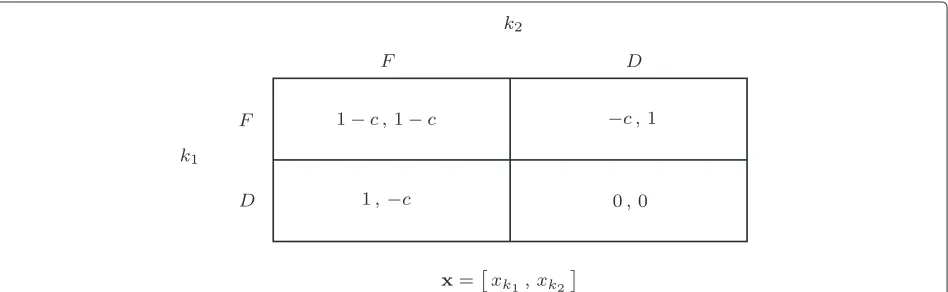
In other words, in a Nash equilibrium, no agent is moti-vated to deviate from its coalition (strategy) given that the others do not deviate. As an example, we study the for-warder’s dilemma game [45] presented in Figure 2. This game is intended to represent a basic wireless relay oper-ation between two different wireless terminals. These two agents, represented by players k1 andk2, are supposed
to operate a direct link that enables them to communi-cate without intermediaries. Each player wants to send a packet to its destination, d1 and d2 respectively, in
each time step using the other player as a forwarder. We assume that each forwarding has a energy cost 0<c1.
If player k1 forwards (F) the player’s k2 packet, player k2gets a reward 1 and vice versa. Each player’s utility is
its reward minus the cost. Each player is allured to drop (D) the received packet for saving energy. The strategic form of this game is depicted in Figure 3. In the coop-erative representation of the forwarder’s dilemma game, there are two coalitionsψ = [AF,AD], and each player
inK = {k1,k2}must choose one coalition. For instance, ψ = [AF = {k1,k2},AD= ∅] is equivalent to the
strat-egy profile (F,F), and ψ = [AF= {k2},AD= {k1}]
corresponds to the strategy profile (D,F),and so on.
Unilateral deviation of player k1 from ψ =
[AF= {k1,k2},AD= ∅] toψ = [AF= {k2},AD= {k1}]
increases its own payoff; therefore, the pure strat-egy profile (F,F) is not a Nash equilibrium point. The same applies to the departure of player k2
from ψ = [AF = {k1,k2},AD= ∅] to the pure
strategy ψ = [AF = {k1},AD= {k2}]. We can
easily check the different combinations of ψ =
[AF= {k1},AD= {k2}], ψ = [AF = {k2},AD= {k1}],
and finally ψ = [AF = ∅,AD= {k1,k2}]. The
unilateral move of user k1 (respectively k2) from
the strategy profile ψ = [AF= ∅,AD= {k1,k2}]
to ψ = [AF = {k1},AD= {k2}] (respectively to ψ = [AF= {k2},AD= {k1}]) does not yield any benefit.
This game has a unique Nash equilibrium at the pure joint strategyψ =[AF= ∅,AD= {k1,k2}] with unsatisfactory
payoff distribution x =[ 0, 0]. At the Nash equilibrium point, either players choose the ‘competitive’ and ‘egoistic’ strategyD.
In many games, there are opportunities for joint devia-tions that are mutually beneficial for a subset of players. This led Aumann [43] to propose the idea ofstrong Nash equilibriumwhich ensures a more restrictive stability than the conventional Nash equilibrium. Strong Nash equilib-rium reflects the unprofitability of coalition deviations. It is a strategy profile that is stable against deviations not
only by single players but also by all coalitions of play-ers. A strong equilibrium is defined as a strategic profile for which no subset of players has a joint deviation that strictly benefits all of them, while all other players (in the subset) are expected to maintain their equilibrium strategies.
Definition 14.A strategy (coalition) combinationψ =
[A1,A2,. . .,Am], whereAiAj=i = ∅andmi=1Ai = K with payoff distribution x =[x1,. . .,xK] is a strong
Nash equilibrium if there do not exist a coalitionAi ∈ψ
whose deviation yields a new distributiony=[y1,. . .,yK]
such that yk ≥ xk ∀k ∈ Ai and∃k ∈ Ai such that yk >xk.
This definition of strong equilibrium is actually slightly different from those of [43] and [44]. Definition 14 allows a coalition to deviate from a strategy profile that strictly increases the payoffs of some of its members without decreasing those of the other members, whereas the orig-inal definition allows only deviations that strictly increase the payoffs of all members of a deviating coalition. We note that if a game implements a strategy for strong equi-librium, it does not necessarily implement it for Nash equilibrium. Both interpretations of strong Nash equi-librium are prominent in the literature, and in most games, the two definitions lead to the same sets of strong Nash equilibria; however, the one that we use here is slightly more appealing in the context of network for-mation games (see, e.g., [46]). Network forfor-mation games involve a number of independent players that interact with each other in order to form a suited graph that connects them.
Now, we restudy the forwarder’s dilemma game and try to find strong Nash equilibria profile. We will show that the game possesses strong Nash equilibria which are not equivalent to the Nash equilibrium. We pick
Figure 3The strategic form in the forwarder’s dilemma game.In each cell, the first value is the payoff of playerk1, whereas the second is that of
different coalition combinations and test whether any coalition whose deviation satisfies its own members or not exists.
1. ψ =[AF = {k1},AD= {k2}]is not a strong Nash
equilibrium because the deviation ofAFincreases
its member’s payoff.
2. ψ =[AF = {k2},AD= {k1}]is not a strong Nash
equilibrium because the deviation ofAFrenders its
member’s payoff higher.
3. ψ =[AF = ∅,AD= {k1,k2}]is not a strong Nash
equilibrium because the deviation of both players fromADtoAFincreases payoff distribution.v2
4. ψ =[AF = {k1,k2},AD= ∅]is a strong Nash
equilibrium because the departure of one or both players fromAFtoADdecreases at least one
player’s payoff.
The unique strong Nash equilibrium is the strategy pro-file (F,F) which corresponds to the coalition set ofψ =
[AF = {k1,k2},AD= ∅], since no deviation can better off
the payoff distribution vectorx=[ 1−c, 1−c]. In fact, at the strong Nash equilibrium, both players choose the ‘cooperative’ and ‘altruistic’ strategy ofF in spite of the energy transmission cost.
In network problems, Zhong and Wu show that using strong Nash equilibria context makes possible a collusion-resistant routing in non-cooperative wirelessad hoc net-works [47]. Altman et al. [48] examine a dynamic random access game with orthogonal power constraints, in which the probability of the transmission of a terminal in each slot depends on the amount of energy left prior to that slot. They show the existence of a strong Nash equilibrium point.
Conventional Nash equilibrium is concerned with the possibilities of only one step deviation by any player. The notion of strong Nash equilibrium requires an agreement not be subject to an improving (one step) deviation by any coalition of players given that all other coalitions be inert. This notion is stronger than the Nash equilibrium, but it is not resistant to further deviation by sub-coalitions (the subsets of a coalition). Recognizing this problem, Bern-heim et al. [44] introduced the notion ofcoalition-proof
Nash equilibrium, which requires only that an
agree-ment be immune to improving deviations which are self-enforcing. The definition of a self-enforcing deviation is recursive.
Definition 15. For a singleton coalition, a deviation is self-enforcing if it maximizes the player’s payoff. For a coalition of more than one player, a deviation is self-enforcing if (1) it is profitable for all its members and (2) if there is no further self-enforcing and improving deviation available to a proper sub-coalition of players.
Generally, a deviation by a coalition is self-enforcing if no sub-coalition has an incentive to initiate a new devia-tion. In the forwarder’s dilemma game, the Nash equilibria is upset by a deviation of the coalition of both players
k1 andk2. At the pure strategy Nash equilibrium where
each player choose strategyD, they each obtain a payoff of 0. By jointly deviating (both choosingFinstead)k1and k2, each earn a payoff 1 −c. This deviation is not
self-enforcing even though the movement to the pure strategy
ψ = [AF = {k1,k2},AD= ∅] is profitable for both
play-ers. At strong Nash pure strategy (F , F), the player k1
tempts to move to strategy (D , F) to get more payoff, and playerk2to that (F , D). Thus, the strong Nash equilibrium
is not immune against self-enforceability.
This notion of self-enforceability provides a useful means of distinguishing coalitional deviations that are viable from those that are not resistant to further devia-tions. With the concept of self-enforceability, our notion of coalition-proofness is easily formulated.
Definition 16.In a one player game, a strategy is a coalition-proof Nash equilibrium if it maximizes the player utility. In a game with more than one player, a com-bination strategy is coalition-proof Nash equilibrium if no sub-coalition has a self-enforcing deviation that makes all its members better off.
This solution concept requires that there is no sub-coalition that can make a mutually beneficial deviation (keeping the strategies of non-members fixed) in a way that the deviation itself is stable according to the same cri-terion. In the forwarder’s dilemma game, the strong Nash equilibrium profile(F,F) is not equivalent to coalition-proof Nash equilibrium. This is due to the fact that the deviation of {k1} ⊂ AF = {k1,k2} to the strategy (D,F)increases payoff ofk1. In this game, any
coalition-proof Nash equilibrium does not exist due to the fact that all pure strategies have at least one self-enforcing deviation.
In the network engineering literature, Félegyházi et al. [51] apply the concept of coalition-proof Nash equilib-ria to achieve a stable and fair channel allocation solution in a competitive multi-radio multi-channel wireless cog-nitive network. Gao et al. investigate radio multi-channel allocation in multi-hop ad hoc networks [52]. To better understand the concepts of self-enforceability and coalition-proof Nash equilibrium, let us introduce an intuitivesubcarrier allocation game in an OFDMA net-work. Let us focus on three wireless transmitters K = {k1,k2,k3}and an OFDMA base station with two
subcar-riersN = {1, 2}. Every subcarriern∈N has a frequency spacing f. Each user k ∈ K experiences a Gaussian complex-valued channel gain|Hkn|2on thenth subcarrier
to the base station. We assume that each subcarrier can be shared among more than one transmitter. The payoff of each player (transmitter) is defined as the achieved Shan-non channel capacity. Each userk∈Kis allowed to either spend a certain powerpkon only one chosen subcarrier, or equally divide it among both subcarriers. In the pure strategya1, playerktransmits with the maximum power pkon subcarriern = 1 and does not transmit any infor-mation on subcarriern = 2. The strategya2is contrary
to a1, i.e., exclusively transmitting on subcarriern = 2
with maximum power. Finally, strategya3equally divides
its power on two subcarriers and exploits transmitting on both tones. The terminalkachieves a channel capacity:
Ck =
n∈N
Ckn, (20)
whereCknis the Shannon capacity achieved by userkon thenth subcarrier
Ckn=f ·log2
1+ |Hkn|
2p kn
k=i∈K|Hin|2pin+σw2
, (21)
whereinpknrepresents the power allocated by terminalk
over thenth subcarrier and where the interference term
k=i∈K|Hin|2pin is approximated with a Gaussian
ran-dom variable of equal mean and variance. Choosing the strategya1means selecting pk1 = pk andpk2 = 0. For
the strategy a2, pk1 = 0, and pk2 = pk, and for
strat-egya3,pk1= pk2= p2k. The parameterσw2 is the power
of the additive white Gaussian noise (AWGN). Note thats in an OFDMA system, there is no interference between adjacent subcarriers. Hence, Ckn considers only
intra-subcarrier noise that occurs when the same intra-subcarrier is shared by more terminals.
Figure 4 reports the simulation results obtained after 100 random realizations of a network with terminals dis-tributed at a distance between 3 m and 50 m from the base station. In the pure strategy matrix form of Figure 4, playerk1chooses the row, playerk2chooses the column,
and playerk3chooses the matrix. Each payoff reports the
(rounded) value of the achieved Shannon channel capac-ity in kb/s. We consider the following parameters for our simulations: the maximum power of each terminal k is
pk = 10 mW; the power of the ambient AWGN noise on each subcarrier isσw2 = 100 pW, and finally the car-rier spacing isf = 102410 MHz.cThe path coefficients |Hkn|2, corresponding to the frequency response of the
multipath wireless channel, are computed using the 24-tap ITU modified vehicular-B channel model adopted by the IEEE 802.16m standard [53].
It is easy to show that the (pure) Nash equilibrium strategies of Figure 4 are(a3,a3,a3) equivalent to ψ =
Aa1 = ∅,Aa2 = ∅,Aa3 =K and (a1,a2,a2) to ψ =
Aa1 = {k1}, Aa2 = {k2,k3},Aa3 = ∅. The Nash
equi-librium strategy(a3,a3,a3)is neither coalition-proof nor
strong. With the deviation of the coalition Aa3 to the
strategy profile (a2,a1,a3), all players profit more with
payoff distribution [ 13, 9, 11 ]. This change is no longer valid since there exists a self-enforceability for playerk1
to transit to the strategy profile(a3,a1,a3). This
transi-tion is not favorable for playersk2andk3. The playerk2is
tempted to transit to the Nash equilibrium point to earn a
Figure 4Subcarrier allocation in OFDMA network game in strategic form.The three strategies for three playersk1,k2, andk3are transmitting
with the maximum power only on subcarrier number 1(a1), transmitting with the maximum power only on subcarrier number 2(a2), and equal
higher payoff, whereas the Nash equilibrium strategy pro-file(a1,a2,a2)with payoff vector [ 15, 10, 10 ] is a strong
and coalition-proof Nash equilibrium. This is due to the fact that inψ = Aa1 = {k1},Aa2 = {k2,k3},Aa3 = ∅ ,
there is no deviation and self-enforceability that can improve the payoff distribution. As can be seen, all play-ers prefer to stay at the coalition-proof Nash equilib-rium rather than at the pure Nash equilibequilib-rium strategy
(a3,a3,a3). Note that a strong or coalition-proof Nash
equilibrium does not necessarily coincide with a Nash equilibrium strategy profile, and the result of Figure 4 is an exception.
In general, the existence of a pure cooperative or non-cooperative Nash equilibrium for subcarrier allocation game in OFDMA network is not guaranteed. Given dif-ferent parameter approaches to quite difdif-ferent channel capacities, and this may result a matrix form without any type of Nash equilibrium. There even might exist a Nash equilibrium which is Pareto-dominated by another strat-egy profile. This shows that in OFDMA networks, an appropriate resource allocation technique is needed [9].
7 Coordinated equilibrium
The most common solution concept in (non-cooperative) game theory, Nash equilibrium, assumes that players take mixed actions independently from each other. Coopera-tive games allow players to coordinate each other to find out possible equilibria and (joint) optimizations that the players can perform on their own. Unlike evolutionary games ([3], Ch. 3), in coordinated games, the interaction between players is implemented once among all play-ers by a central authority to increase their throughput. The notion of correlated equilibriumwas introduced by Aumann [54]. Correlated equilibria are defined in a con-text where there is an intermediator who sends random (private or public) signals to the players. An intermedi-ator needs not to have any intelligence or knowledge of the game. These signals allow players to coordinate their
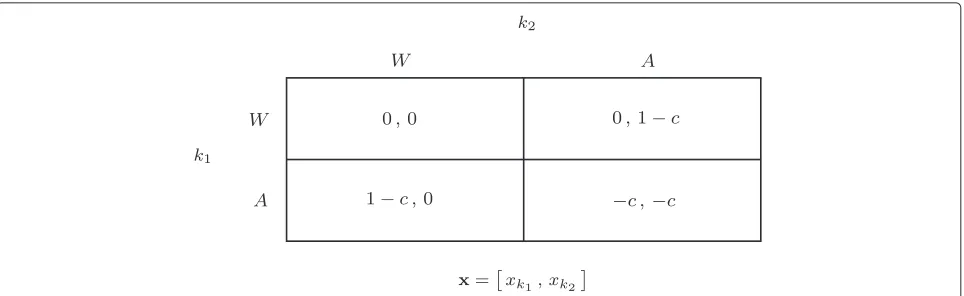
actions and, in particular, to perform joint randomization over strategies. ‘Correlated strategies are familiar from cooperative game theory, but their applications in non-cooperative games are less understood’, says Auman [54]. This is because the players of a coordination game are not totally isolated and without a communication between them, achieving coordinated strategy profile not possible. Let us start with an intuitive example. Consider the mul-tiple access game ([45], Table three) described in Figure 5. The playersk1andk2wish to send some packets to their
receivers sharing a common resource, i.e., the wireless medium. They are in the sight of each other, and accord-ingly, they interferer if transmitting at the same time. The users have two possible pure strategies: access (A)
and wait (W). In this game, two identical transmitters must simultaneously decide whether to access to channel or wait. The transmission of each packet has an energy cost of 0 < c 1. Each player earns a payoff 1 if it succeeds to transmit its packet without collision with the other. Waiting does not bring either cost or reward for the player. Each player’s utility is its reward minus the cost. This game has three Nash equilibria: (A,W),
(W,A), and a mixed strategy Nash equilibrium, where each player transmits with the probability 1 − c ([45], Sections 2.3 and 2.4). The utilities of Nash equilibria strategies are(1−c, 0),(0, 1−c), and(0, 0), respectively. It is clear that the mixed strategy is not resistant to an improving deviation. In the following, we give the possi-bility of preplay communication to achieve a stable Nash equilibria.
In the game with ‘cheap conversation’, each player simul-taneously and publicly announces whether it decides to access or wait. Following the announcements, each player makes its choice. Suppose the players agree to partici-pate to the game binding the following agreement: each player announcesA with probability 34. If the profile of announcements is either (A,W) or (W,A), then each player plays its own announcement. Otherwise, each
player plays Awith probability 12. Note that no further communication is possible. The use of joint deviation requires the unanimity of all members of the deviating coalition. A player agrees to be a part of a joint devia-tion if given its own informadevia-tion the deviadevia-tion is prof-itable. Thus, if a joint deviation is used, it is common knowledge that each deviator believes that deviation is profitable.
This tradeoff results in an expected payoff for each player of 11−3216c > 0, while in the mixed Nash equilib-rium of the original game, each player has an expected payoff of 0. In this coordinated Nash equilibrium of the game, the players effectively play the correlated strategy
[54,55] (of the original game) given in Figure 6, in order to face a higher utility in strategy profiles (A,W) and
(W,A). It is important to note that this joint probability distribution is not the product of its marginal distribu-tions and therefore cannot be achieved from a mixed strategy profile of the game without correlation among players.
As can be seen, the proposed correlated deviation from the mixed strategy equilibrium makes both players better off. Note that the players are allowed to bind an agreement only on the space of feasible outcomes. In the correlated multiple access game, the outcome is feasible since the correlated results are in the range between the smallest and highest possible payoff. In fact, the set of correlated equilibria contains those equilibria from which no coali-tion has a self-enforcing deviacoali-tion, making all members better off.
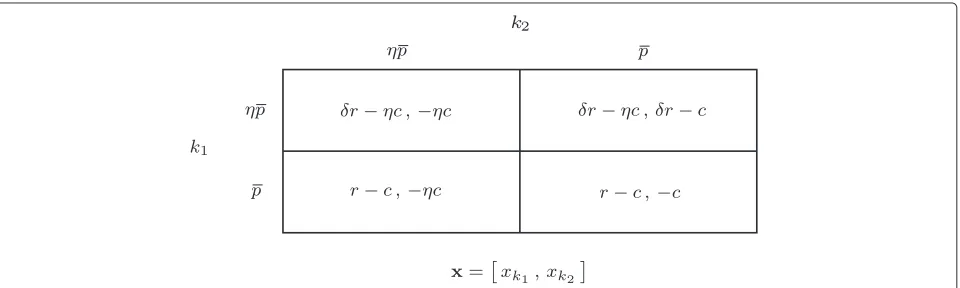
Let us describe a more complicated correlated equilib-rium. We study the near-far effect game established by Bacci et al. ([56], Figure six). The basic idea of near-far effect game scheme is depicted in Figure 7. Two wire-less terminalsk1andk2are placed close to and far from
a certain access point (AP), respectively, in a code divi-sion multiple access (CDMA) network with high SINR regime. The strategy of each player is to transmit either with the maximum powerpor with a weakened levelηp,
where 0 < η < 1. Due to the interference at the AP, the throughput (the amount of delivered information) of each player depends on the strategies chosen by both play-ers. Transmitting with a higher power increases the BER, and this results decreasing the throughput. Each player is rewarded r if it successfully delivers its packet and a reducedδr, if it delivers a corrupted version of the packet, where 0 < η < δ < 1. If the near playerk1 decides to
transmit with the powerp, the farther playerk2will not be
able to deliver any information to the AP.
This results in no benefit fork2and causes a power
con-sumption cost equal to−ηcifk2chooses strategyηpand
−cotherwise, wherec r. Obviously, transmitting with power pfor k1 results in a complete information
deliv-ery. This concerns a payoff equal to reward minus power consumption cost, i.e.,r−c, irrespective of thek2
strat-egy. The packets of playerk2are successfully delivered if it
chooses the maximum powerpand playerk1that reduced ηp. On the other hand, if both players decide to transmit with reduced powerηp, the near player takes the payoff
δr−ηc>0, while the farther playerk2will not successfully
deliver any packet and suffers only a power cost−ηc. The payoff matrix of the near-far effect game is depicted in Figure 8. As can be seen, the unique pure strategy of this game is represented by the strategy(p,ηp)with benefits
r−cand−ηcfork1andk2, respectively. This means that at
the Nash equilibrium point, the farther player is not able to send any information. On the other hand, the Pareto optimal solutions of the game are the strategies(p,ηp)and
(ηp,p). This is an unsatisfactory outcome for the far player
k2, while the near playerk1takes the highest possible
pay-off. Now, let us find the mixed strategy of the game. We denoteα1 the probability with which the near player k1
decides to transmit with the maximum powerpandα2the
same probability for the far playerk2. The payoffs of the
playersk1andk2are represented by
xk1 =α1((1−δ)r − (1−η)c)+(δr−ηc) (22a) xk2 =α2((1−α1) δr − (1−η)c)−ηc. (22b)
Figure 7The network scenario in the near-far effect game.
Both players want to maximize their own payoff. As can be seen,xk1takes its maximum valuer−cwithα1=1. On the
other hand, withα1=1, the far playerk2earns a negative
payoff whateverα2∈[0, 1]. Instead, withα1=0, the near
playerk1gainsδr−ηc, and playerk2setting upα2 = 1
achieves the payoffδr−c. Thus, the best values forα1
andα2are 0 and 1, respectively. The conclusion is that the
mixed strategy is equivalent to the pure strategy (ηp,p)
with payoffx=[δr−ηc,δr−c]. In this game, there is no (totally) mixed strategy and that is equal to the one of the pure Pareto optimal points.
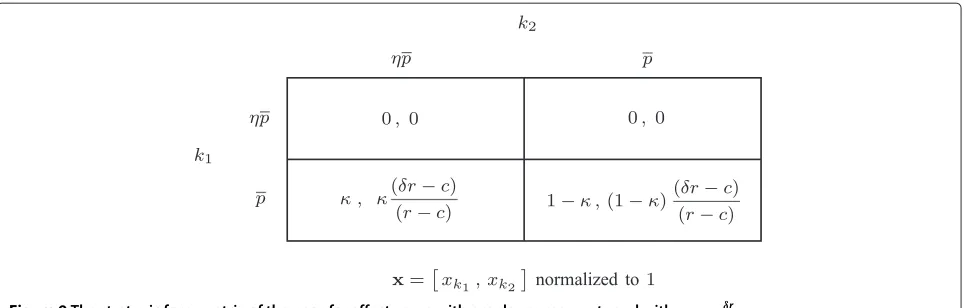
The near player earns the highest possible payoff at the Nash equilibrium; hence, it does not leave this strategy profile. The highest possible payoff for the far player is on the contraryδr−c. We show that an appropriate agree-ment among players can satisfy both of them at correlated equilibrium. Playersk1andk2can guarantee an expected
payoff of x = [r−c,δr−c] by playing the correlated strategy profile:
δr
(1−η)c·(p,ηp) +
1− δr
(1−η)c
·(p,p). (23)
This is a plausible end since both players earn their own highest possible payoff. The correlated strategy (23) is derived from the fact that picking any real numberκin the expression κ ·(p,ηp)+(1−κ)·(p,p) is indifferent for the near playerk1, since it gets its own highest possible
payoff,r−cas well. To satisfy the far playerk2, it is enough
to solve the following equation forxk2:
κ·(p,ηp)+(1−κ)·(p,p)=[r−c,δr−c] . (24)
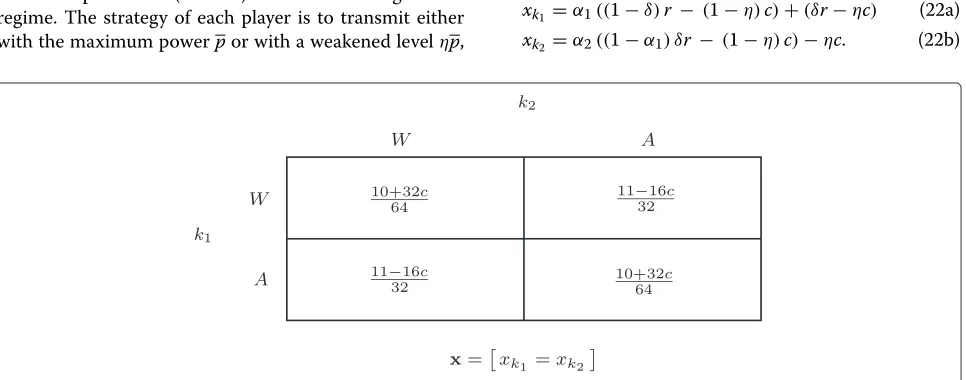
Supposingκ = (1−δrη)c < 1, the correlated strategy (23) means that the near player always transmits at its highest power levelp, and the far player transmits at that reduced
ηpwith probability(1−δrη)c, and the maximum powerp oth-erwise. Actually, the near and far players effectively play the matrix form game of Figure 9.
Bonneau et al. [57] show that the coordination among mobile users can significantly increase the performance of access to a common channel in ALOHA setting. A coor-dination mechanism is also considered by Bonneau et al. [58] to achieve the optimal power allocation in a wireless network, wherein each terminal knows only its own chan-nel state. The concept of correlated equilibrium is also introduced in a multi-user interference channel context in [59]. Different types of coordination are deeply discussed and widely used in [55].
8 Dynamic learning
Until now, we have realized that the Nash equilib-rium suffers from the lack of farsighted stability, i.e., the relative results can be unsatisfactory; because of this, any player can have incentive to improve its out-come by moving to another strategy. The existence of the strong and coalition-proof Nash equilibrium is not
Figure 9The strategic form matrix of the near-far effect game with preplay agreements and withκ= δr (1−η)c.
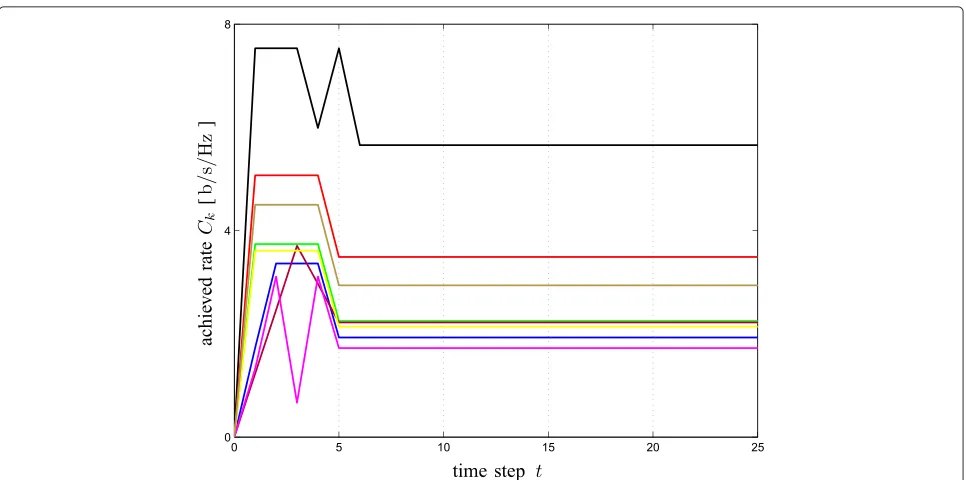
guaranteed and even if so, when the number of pure strategies is large, finding such solutions is very com-plicated. The challenge of finding a profitable accord among players is persistent in coordinated equilibria solu-tion. In this section, the main question we seek an answer to isHow can the players be led to a stable joint pure strategy gaining an acceptable payoff? This ques-tion is important, even if multiple equilibrium points with the same payoff have been identified, since each player may autonomously decide to stay in a different strategy.
Dynamic learning[60] has been widely used in order to get rid of the anarchy derived from the conflicts between selfish decisions. Learning is a joint adaptive process for agents to converge and to get the best final response. The agents either have a common interest like a team work or each agent has its own greedy goal. Generally, there are three learning process types:individual learn-ing,joint-action learning, andstochastic learning. In indi-vidual learning process, the independent agents cannot observe one another’s actions, i.e., for each player, the opponents are passive agents. Instead, during joint-action learning process, the notion of the ‘optimality’ is improved by adding the observation of other concurrent learners to accomplish a stable optimal solution. The stochastic learning framework, having Markovian property and a stochastic inter-state transition rule, enables each player to observe the opponents’ actions history.
In the network engineering literature, van der Schaar and Fu [61] introduce a stochastic learning process among autonomous wireless agents for the optimization of dynamic spectrum access, given the QoS of multimedia applications. A reconfigurable multi-hop wireless network is studied by Shiang and van der Schaar [62], wherein a decentralized stochastic learning process optimizes the transmission decisions of nodes aimed at supporting mission-critical applications. In [63], Lin and van der Schaar propose a reinforcement learning among agents of
a multi-hop wireless network based on Markov decision process. Each terminal autonomously adjust transmis-sion power in order to maximize the network utility, in a dynamic delay-sensitive environment.
Here, we study a well-known individual reinforcement learning task, namely the so-called Q-Learning [64]. We assume a set of playersK, and each playerkhas a finite set of individual actionsAk. Each agentkindividually chooses
a pure joint action (strategy) to be performed ak = (a1,. . .,aK) ∈ A1× · · · ×AK from the available joint
strategy space. Q-learning enables the individual learners to achieve optimal coordination from repeated trials. Q-learning introduces a certain valueQ as the immediate reward obtained after having moved to the new strategy. Each player individually updates a Q value for each of its actions. In each time step and after having selected the new joint actionak, the values ofQtk is individually
updated. In particular, the value ofQtk+1(ak)estimates the
utility of performing the joint strategyakfor userk. In the
seminal paper of Watkins and Dayan [64], theQvalue is updated by the following recursion:
Qtk+1(ak)←−
1−fkt+1·Qkt(ak)+fkt+1·
rk(ak)+δk·Qtk(ak)
,
(25)
where δk ∈ (0, 1) is a discount factor, and rk(ak) is a
reward of the joint actionakfor the respective player;fkis
a function oftwhich is related to ‘learning rate’. Watkins and Dayan showed that given bounded rewards, learning rate 0≤fkt<1, and
∞
t=1
fkt= ∞, and ∞
t=1
fkt2<∞ ∀k∈K (26)
allQkvalues updating (25) converge a common joint pure
strategy with probability one. The reward rk is defined