© 2015, IRJET.NET- All Rights Reserved
Page 1931
Comparative Study of Flat Slab and Conventional Slab Structure Using
ETABS for Different Earthquake Zones of India
Mohana H.S
1, Kavan M.R
21
PG Student, Dept of civil engineering, AIT chikkamagaluru, Karnataka, India
2
Assistant professor, Dept of civil engineering, AIT chikkamagaluru, Karnataka, India
---***---Abstract - In today’s construction activity the use of flatslab is quite common which enhances the weight reduction, speed up construction, and economical. Similarly from the beginning conventional slab has got place in providing features like more stiffness, higher load carrying capacity, safe and economical also. As the advancement era began practice of flat slab becomes quite common. In the present dissertation work a G+5 commercial multistoried building having flat slab and conventional slab has been analyzed for the parameters like base shear, storey drift, axial force, and displacement. The performance and behavior of both the structures in all seismic zones of India has been studied. In the present work the storey shear of flat slab is 5% more than conventional slab structure, the axial forces on flats lab building is nearly 6% more than conventional building, the difference in storey displacement of flat and conventional building are approximately 4mm in each floor. The present work provides reasonable information about the suitability of flat slab for various seismic zones without compromising the performance over the conventional slab structures.
Key Words:
flat slab, drop, conventional slab, storey
shear, storey displacement, axial forces.
1. INTRODUCTION
In this modern industrial era we can see huge construction activities taking place everywhere, hence there will be a shortage of land space, so construction of tall structures has been triggered up to overcome this problem. There are several elements are modified to make work faster and economical also like introducing flat slab construction which reduces dead weight, and makes beams invisible, enhances floor area.. To know the performance of the structure it should be subjected to all type loadings, all seismic zones factors, various soil categories then only we can extract best choice or suitability parameter for the structures.
In the present work the performance of flat slab and Conventional slab structures for various loads all seismic zones factors have been studied.
1.1 Objectives of the Present Work
To study the performance of flat slab and conventional slab structure subjected to various loads and conditions.
To the study the behavior of both structure for the parameters like storey shear, storey displacement Drift ratio, axial forces.
Comparisons of flat and conventional building for the above parameters.
1.2 Material Properties and Loads
This work has been analyzed using ETABS software. For the analysis the material properties like grade of concrete, steel, density, modulus of elasticity must be define initially. And also the various loads like dead, live, SDL, wind, seismic needs to be define earlier.
Grade of concrete: M20 Grade of steel: Fe 500
Modulus of elasticity E: 2x10⁵N/mm2 Live loads: 5kN/m2
SDL: 3.5kN/m2
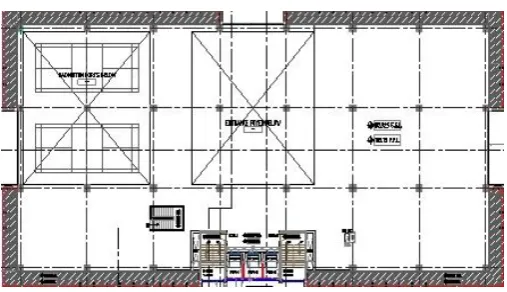
1.3 Model Description
© 2015, IRJET.NET- All Rights Reserved
Page 1932
Fig 2: Elevation View of BuildingTable 1: Structure Plan Details Number of stories G+5
Height of each storey 3.7m Total height of building 25.9m Number of bay’s along X 7 Number of bays along Y 3
Table 2: Structure Element Details columns 800x800, 300x900,
beams 600x750, 500x750,
Flat slab 200mm
Flat drop 450mm
Conventional slab 175mm
1.4 Earthquake and Wind Load Data
The structures are more vulnerable to lateral loads, as the height of building increases the structures becomes flexible and prone to damage. Hence lateral loads are mainly derived from seismic and wind loads for which structure needs to be analyzed.
Table 3: Earthquake and Wind Load Data Seismic zone II, III, IV, V
Zone factor Z 0.1, 0.16, 0.24, 0.36 Importance factor I 1
Response reduction factor 3 Damping ratio 0.05 Type of soil medium Basic wind speed Vb 33m/sec Design wind pressure Pz 1.6kN/m2
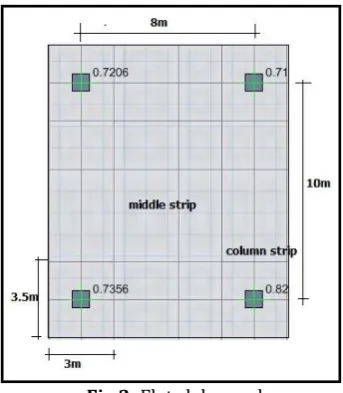
2. Design of Flat Slab (Direct Design Method)
For the analysis and design of flat slab different methods are available like finite element, equivalent frame, and direct design methods. In this present work direct approach is adopted for manual design of flat slab and to
check for punching shear against software. Flat slabs are more vulnerable to punching shear because of the absence of beam. In direct design method following criteria must be satisfied for design of flat slab.
The panel must be square or rectangle
Ratio of longer span by shorter span not more than 2
Live load should not be more than 3 times design dead load.
In the present work only manual design of flat slab taken and punching shear values of software is compared with
Ultimate load = 1.5x24.75= 37.125kN/m2
Design load on the slab= 37.125x10x8 = 2970kN
Moment Calculation:
Mo = WoLx/8 = 2980kN-m
Mo = WoLy/8 = 3712kN-m
Check for depth of slab at drops:
Taking 49% of negative BM along x-direction
Mo= .49x2980= 1460.2 kN-m
Dreq= √Mu/0.138fckb = 375mm Dpro= 450mm, hence safe
Check for punching shear: τv=1.07N/mm2 (manual),
τc= 1.25N/mm2 τv=1.12N/mm2 (ETABS value)
© 2015, IRJET.NET- All Rights Reserved
Page 1933
2. Analysis of Flat and Conventional Slab Building
using ETABS
The analysis of flat and conventional slab structure has been done by using ETABS software package. Before analysis all the required elements of the structure needs to be defined earlier like material properties, loads, load combinations, size of members, response spectrum etc. once the analysis has been done we can extract the results like displacement, storey shear, bending moment, drift ratio, axial forces for comparing the performance of flat and conventional slab building. The following flow chart shows the steps involved in the analysis by ETABS.
Fig 4: Steps in Analysis of Structure
3. RESULTS AND DISCUSSIONS
In this section the results obtained from analysis of flat slab and conventional slab building using ETABS have been tabulated. The performance and behavior of both structures on different criteria like storey shear, storey displacement, drift ratio, and axial design forces has been analyzed and discussed as follows.
3.1 Storey Shear of FSB and CSB for SRSSX Load
Case:
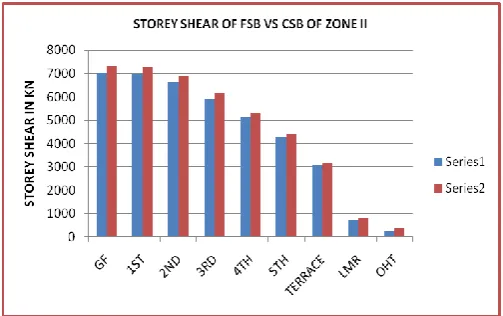
Chart 1: Storey Shear of FSB Vs CSB Zone II
Chart 2: Storey Shear of FSB Vs CSB Zone III
Chart 3: Storey Shear of FSB Vs CSB Zone IV Defining dimensions
of the plan
Defining the members and material properties
Assigning loads and load combinations
Run check model to find errors
Run analysis
© 2015, IRJET.NET- All Rights Reserved
Page 1934
Chart 4: Storey Shear Of FSB Vs CSB Zone VChart 5: Storey Shear Variation Of FSB And CSB
The Storey shear is Maximum at ground level and keeps on decreasing towards the top storey of the structure. From the chart it shows storey shear of flat slab structure is more than the conventional slab structure. And also as the seismicity level increases the storey shear intensity is also increases.
3.2 Axial forces on FSB & CSB 1.5(DL+LL+SDL)
Chart 6: Design Axial Force Of FSB And CSB Zone II
Chart 7: Design Axial Force Of FSB And CSB Zone III
Chart 8: Design Axial Force Of FSB And CSB Zone IV
Design axial forces I the zone II and zone III conventional slab has got more intensity compared to flat slab structure. There is a difference of 5% in between flat and
conventional slab structure in zone II and zone III.
© 2015, IRJET.NET- All Rights Reserved
Page 1935
Chart 10: Variations of Axial Force In All Seismic ZonesAxial forces are important in design of foundation elements, these forces are derived from live load, dead load, wind loads ad earthquake loads. From the above chart intensity of design reaction increses as the seismicity level increases as shown in from zone II to zone. From zone II and zone III conventional slab carryig more axial loads, where from zone IV to zone V flat slab is ahead of conventional slab structure. From zone II to zone V there is an increase of average 35% axial forces in both the structures.
3.3 Storey Displacement of FSB and CSB for SRSSX
Load case
Storey displacement is Maximum at top storey and least at the base of structure. This criterion is important when structures are subjected to lateral loads like earthquake and wind loads. Displacement is depends on height of structure and slenderness of the structure because structures are more vulnerable as height of building increases by becoming more flexible to lateral loads.
Chart 11: FSB Storey Displacement In All Seismic Zones
Chart 12: CSB Storey Displacement In All Seismic Zones
Chart 13:Comparisons of FSB And CSBStoreydisplacement
From the above two charts it shows displacement of flat slab building is slight more than conventional slab building in all seismic zones. The differences of storey displacement between these two structures are nearly 4mm in each storey.
3.4 Drift Ratio Comparisons of FSB and CSB
Chart 14: Drift Ratio Comparisons of FSB And CSB
© 2015, IRJET.NET- All Rights Reserved
Page 1936
storey height is 3700 mm. Therefore limited storey drift is calculated as = storey drift /3700 =0.0044. CONCLUSIONS
1. Storey shear of flat slab is 6% more compared to conventional slab structure, and storey shear is Maximum at base and least at top storey.
2. The design axial forces on flat slab are more compared to conventional structure the difference of forces is nearly 5.5%.
3. Storey displacement is Maximum at roof level than at base, and storey displacement of flat slab structure is greater than conventional structure, there will be an average 4mm displacement variation in each seismic zone for both structures.
4. As the seismic level increases all parameters like axial force, displacement, storey shear intensities are increases.
4.1 Scope of Future Work
Comparisons of flat plate (without drop) and flat slab
(with drop) can be studied for all seismic zones.
Comparisons of pretension and post tensioned flat
slab with or without drops.
Cost comparisons of various types of slabs available.
REFERENCES
[1] Ravi Kumar Makode et al comparisons of flat and grid slab Int. Journal of Engineering Research and Applications Vol. 4, Issue 2(Version 1), February 2012
[2] Navyashree k, Sahana, use of flat slabs in multi-storey commercial building situated in high seismic zone volume: 03 issue: 08 | aug-2014 www.ijret.org
[3]Sumit Pahwa, Vivek Tiwari Comparative Study of Flat
Slab with Old Traditional Two Way Slab Vol. 4 Issue 2 July
2014.
[4] Prof. K S Sable, V A Ghodechor, Prof. S B Kandekar Comparative Study of Seismic Behavior of Multistorey Flat Slab and Conventional Reinforced Concrete Framed Structures”, Volume 2, Issue 3, June 2012
[5] IS875-1997: Indian Standard Code of Practice for Structural Safety of Buildings Loading Standard.
[6] IS1893-2002: Indian Standard Code of Practice for Criteria for Earthquake Resistance Design of Structures
[7] N KRISHNA RAJU Book of advanced reinforced concrete design”.
[8] Plain & Reinforced Concrete Code of Practice” Fourth Revision IS: 456:2000.
[9]P.C Varghese a book of advanced reinforced concrete design”
[10] Bhavikatti S.S, “Advance R.C.C. Design” , New Age International (p) Limited, Publishers, New Delhi, India