R E S E A R C H
Open Access
Toward network function virtualization for
cognitive wireless mesh networks: a TCP case
study
Wooseong Kim
Abstract
Nowadays, cognitive radio (CR) is considered the key technology to deploy wireless nodes that are able to adapt their transmission parameters based on the characteristics of the environment. In our previous works, we leveraged the reconfigurability properties offered by the CR technology to implement Cognitive Wireless Mesh Networks (CMNs) operating on the 2.4-GHz industrial, scientific, and medical (ISM) band.Urban-X, a new architecture for Multi-radio Cognitive Mesh Networks, self-configures and self-adapts to the dynamic interference conditions experienced on the Wi-Fi channels in dense urban environments.Urban-Xestimates traffic load of existing users outside the mesh in each channel and utilizes less occupied channels opportunistically. In such dynamic environment, a transport layer protocol can suffer from variation in delay and available bandwidth due to spectrum sensing and mobility. Several TCP solutions for the CWMNs have been proposed but they could not be employed for implementation due to complexity and inefficiency. Instead, we adopt network function virtualization (NFV) technique which allows to instantiate virtualized network functions (VNFs) dynamically on demands. For this, we propose overall architecture of NFV framework for the CMNs and apply TCP accelerators (ACC) VNFs to improve TCP throughput as a case study. Simulation results show TCP-ACC VNF can achieve a notable performance enhancement compared to previous TCPs for the CMNs.
Keywords: Cognitive radio; Network function virtualization; TCP
1 Introduction
The proliferation of electronic devices equipped with Wi-Fi transceivers has favored the rapid deployment of large-scale wireless mesh networks (WMNs) based on Wi-Fi backbone in several highly dense urban areas of the world [1, 2], which is considered a cheaper alterna-tive to the traditional cabling solutions for the Internet access and Internet of thing (IoT). However, the perfor-mance of WMNs is still not competitive since the mesh nodes in highly dense urban environments must share the 2.4-GHz industrial, scientific, and medical (ISM) chan-nels with several external devices, primary nodes (PNs), that cannot be governed by the mesh nodes and pos-sibly interfere with the WMNs transmissions. Cognitive radio (CR) researches have mainly investigated the poten-tial of reconfigurable radio technology for enabling an
Correspondence: [email protected]
Department of Computer Engineering, Gachon University, Seongnam street, Seongnam, Korea
opportunistic spectrum access paradigm [3, 4], in which a cognitive device exploits the portions of the spectrum left vacant and less interfered multi-hop routes by the licensed users. While this solution can effectively improve the spectrum utilization of wireless communication, it also poses formidable challenges for its implementation, e.g., the legacy aspects for the utilization of licensed spectrum and the protection of the licensed users.
We proposed the utilization of CR technology for the deployment of self-configuring and self-adapting WMNs in the 2.4-GHz ISM band, which isUrban-X [5], a cog-nitive mesh network (CMN) in highly dense urban area. Here, we underline that the utilization of CR technology on the 2.4-GHz ISM band does not pose the legacy issues of the conventional CR technology, since a mesh node is not expected to protect a PN and leave the frequency once a PN is detected. This greatly simplifies the hardware design of the cognitive mesh nodes as accurate PN detec-tion is not required. Instead, simplified spectrum sensing
can be used in order to infer the load on the different channels in the ISM band and utilize this information for, e.g., channel assignment.
Reconfigurability in a mesh node can be realized by software on top of the simple hardware. In ourUrban-X
testbed that uses general purpose processor (GPP)-based personal computers [6], most of the wireless communi-cation functions including even physical modulation, a media access control (MAC) protocol, channel sensing, and switch for cognitive radio are implemented by soft-ware on top of Window operating systems. Owing to the increasing general computing power, thus mesh nodes can be easily reconfigured or updated over the air by remote software management technologies. For example, if a new MAC protocol needs to be replaced, the protocol soft-ware is downloaded over the air and installed in each mesh node.
Recent software-defined network (SDN) and network function virtualization (NFV) concepts help the above procedure more smoothly being done. NFV adopts cloud computing technologies for creating or renewing net-work functions easily on top of virtual machine. In the above example, a new software package including the new MAC protocol is downloaded and then a new comput-ing instance is created to load the new package. After the new mesh node instance works successfully, old mesh node instance with an old MAC protocol is removed. This SDN and NFV change network architecture and opera-tion mechanism in WMNs. Granelli et al. [7, 8] depicts an overall picture of SDN and NFV use for the WMNs. In short, the SDN can set up forward tables of multi-hop nodes along shortest path in the WMNs using switch or router control protocols, such as OpenFlow [9]. And NFV instantiates or removes virtualized network functions (VNFs) dynamically using cloud computing technologies such as virtual machine, cloud protocol stack, etc. For example, [10] the proposed “CloudMAC” that virtualizes a MAC protocol of the WMNs and controls a path from the software MAC to a physical radio interface dynami-cally to reduce latency and save power consumption using the OpenFlow.
In this paper, we propose a new NFV and SDN architec-ture for a cognitive wireless mesh network, theUrban-X, in which various VNFs can be realized on top of the reconfigurable network devices for the cognitive radio such as firewall, packet filter, content cache, etc. And we implement a TCP accelerator VNF that accelerates TCP throughput by splitting a TCP connection for a case study of NFV and SDN in the CMNs, because TCP performance in the Urban-X is very limited even if it is one of most important protocols carrying popular application proto-cols like HTTP. From simulation, we confirm that our NFV-based approach improves TCP performance in the CMNs.
The rest of the paper is organized as follows. Section 2 introduces concept of theUrban-Xand architecture of a cognitive mesh node, and Section 3 shows reconfigurable hardware platforms for theUrban-X. Section 4 describes SDN and NFV architecture for theUrban-X, and Section 5 presents a TCP case study of SDN and NFV techniques in theUrban-X. Related works and conclusions follow in Sections 6 and 7.
2 TheUrban-Xarchitecture
CR constitutes one of the most investigated solutions to deploy flexible and high capacity wireless networks. A CR device is defined as a wireless node that is able to adapt its transmission parameters based on the charac-teristics of the environment and on the requests of the applications [3].
In our previous works, we proposed the utilization of CR technology in the ISM bands for WMNs, Urban-X, and CMNs [5]. In the following, we discuss drawbacks and benefits of this approach, and we review details of the
Urban-X.
Benefits While several recent studies demonstrate the presence of unused portions of the spectrum in the licensed bands, the practical utilization of these frequen-cies by CR devices poses several challenges in terms of spectrum access regulations and of CR devices and network deployment. At present, the existing IEEE stan-dards (e.g., IEEE 802.22 wireless regional area networks (WRANs)) enable the opportunistic usage on a limited set of frequencies and introduce strict constraints on the protection of the licensed users. On the opposite, cog-nitive WMNs on the license-exempt bands do not need to implement specific spectrum protection policies. This is because interference is common in those frequencies and mesh routers (MRs) and PNs can coexist on the same channels. Therefore, protection mechanisms need not be implemented, and a MR is not forced to vacate a channel already occupied by a PN. Also, as we will see later, the standard Wi-Fi MAC layer does not necessarily need to be modified. This greatly simplifies the hardware design of the cognitive mesh node and also facilitates the WMN deployment over realistic scenarios.
Urban-Xis cross-layer protocol framework for cognitive multi-radio mesh networks. The main goal of the Urban-Xis to adapt the WMN operations to the current channel utilization conditions and to favor the co-existence of dif-ferent networks operating over the shared ISM bands. To this aim, Urban-X borrows the principles of “spectrum reconfigurability” and “spectrum sensing” from classical CR devices, in order to estimate the amount of exter-nal interference on each Wi-Fi channel and thus, the capacity left for the mesh nodes. Based on this infor-mation,Urban-Xadapts the network operations through three layers of self-configuration: (1) frequency adapta-tion (i.e., dynamically decide the channel to be used on each MR in a distributed way), (2) path adaptation (i.e., dynamically re-configure the routing process based on the actual network conditions), and (3) load adaptation (i.e., dynamically decide the channel/flow to be served at each MR).
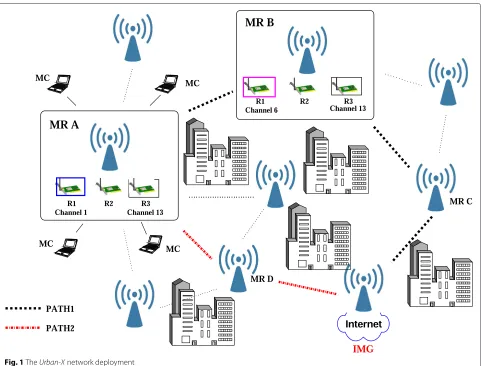
Figure 1 shows a practical deployment of theUrban-X
network over an urban scenario. Urban-X is composed of three types of nodes: the (1) Internet mesh gateways
(IMGs), the (2) mesh clients (MCs) that correspond to the user devices, and the (3) MRs that form a static back-bone between the MCs and the IMGs and forward the MCs’ traffic toward the closest IMG or the MG where the destination MC is attached to.
The MRs are wireless access point (APs) with rout-ing and cognitive capabilities equipped with three stan-dard Wi-Fi radio interfaces (i.e., R1, R2, andR3). Each radio interface is tuned to one of the Wi-Fi channels in the ISM band. The R1 and R2 interfaces are used to receive or transmit data packets produced by appli-cations, while the R3 interface is tuned to a common control channel (CCH) for exchanging control messages required for network management, routing, and channel (re-)configuration. More specifically, the R1 interface is used to receive ingoing traffic from other mesh nodes and is tuned to a semi-dynamic channel that is decided based on the PN activity and on the mesh internal network traffic load. The R2 interface is used to transmit ongo-ing traffic toward other mesh nodes and thus, dynamically switches among the available channels with a predefined
switching interval (e.g., 40 ms), which can adapt based on the traffic load for forwarding. The wireless communica-tion among MRs is implemented as follows. When a MR, e.g., MRAof Fig. 1, needs to forward data to another MR, e.g., MRBof Fig. 1, thenAmust tune itsR2 interface to the channel used by the R1 interface of node B (that is channel 6 considering the example of Fig. 1). Through the utilization of two radios for sending and receiving, Urban-Xcan preserve the network connectivity, while expanding the network capacity by allocating interfering MRs on different channels.
3 Urban-Ximplementation
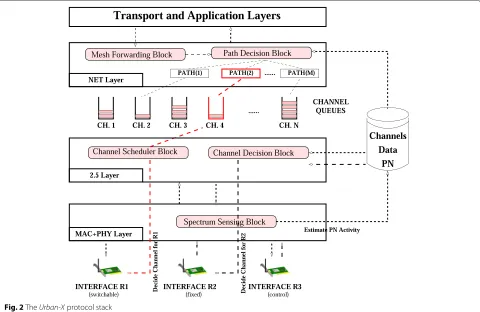
Cognitive MR architecture in the Urban-X is depicted in Fig. 2. Through thespectrum sensing block, each MR gathers information about the PNs activity and esti-mates the capacity left for the WMNs operations on each Wi-Fi channel. The channel information is continuously updated and shared among the layers of the protocol stack through the implementation of a cross-layer repository. Based on the amount of PNs interference on each chan-nel and on the traffic requests from the nodes of the WMNs, each MR dynamically decides the channel to be used on its fixed interfaceR2, through thechannel deci-sion block. Themesh forwarding block is responsible for
building and updating the routing tables of the MRs. In
Urban-X, the routing algorithm implements a multi-path approach, i.e., multiple (possibly overlapping) paths can be discovered and kept for each pair of source-destination traffic flows, as shown in Fig. 1. When a MR must for-ward data tofor-ward a destinationd(wheredcan be a MC or the closest IMG), thepath decision blockdynamically selects the optimal next-hop node towardd, based on the performance of each path. We highlight that the perfor-mance of each link/channel might dynamically change as a consequence of a variation of PNs activity and/or of the internal WMN traffic. These changes are handled by the
Urban-Xarchitecture through a configuration adaptation performed by thechannel decision blockand/or from the
path decision block. Moreover, since each MR uses a sin-gle transceiver to transmit on multiple channels (i.e.,R2),
Urban-Xincludes achannel scheduler blockto determine at any time the channel served by the switchable inter-faceR2. Thechannel scheduler blockis between the MAC and routing layer and maintains a separate queue for each Wi-Fi channel. Once the next-hop node for dis decided (e.g., MRB), the data packets are inserted into the queue corresponding to the channel used by the receiving inter-face R1 of the MRB (e.g., channels). The message will be transmitted once the interfaceR2 of node A is tuned
to channels. Thechannel scheduler blockimplements the channel scheduler algorithm on theR2 interface, based on the traffic load of each channel. In the following, we briefly present the main characteristics of the Block components of theUrban-Xarchitecture. Technical details are out of the scope of this paper but can be found in [5] and [11].
Spectrum sensing block In Urban-X, each MR node senses the spectrum periodically through an energy-detector scheme and estimates the workloads of PN traf-fics (ω) on each channel. Let ω(s,i) be the workload of channel s, estimated by MR i. In our experiments, we computew(s,i)as:
ω(s,i)= Number of busy samples ons
Total number of samples monitored ons
(1)
where a sensing sample is classified as “busy” if the average power perceived onsis higher than an energy threshold for channel clear assessment (CCA) of Wi-Fi. Since the spectrum conditions might dynamically change over time, each MR performs periodic spectrum sensing on the cur-rent channels used by the R1 and R2 interfaces with a fixed frequency and for a duration ofTssensing time inter-vals. Moreover, cooperative techniques are introduced to reduce the overhead of spectrum scanning, i.e., the MRs share the workload information by broadcasting these values on the control interfaceR3.
Channel decision block Based on the sensing informa-tion, each MR node decides the channel for its receiving interfaceR1, by choosing among the available channels of the ISM band. Currently, most of the commercial APs are manually configured and are usually set to one of the three orthogonal channels provided by the IEEE 802.11 tech-nology. Some APs implement automatic channel selection schemes that choose the Wi-Fi channel providing the highest signal-to-noise ratio (SNR). However, both these channel selection techniques do not take into account the effective amount of utilization of each channel. In our approach, we attempt to allocate each MR to the chan-nel that provides the highest capacity needed to serve the current traffic request of the node. To this aim, we com-pute the remaining capacity (RC) of each channel, defined as the portion of bandwidth left from the PNs for mesh usage. Each MRicomputes the RC of each channelsas follows:
RC(s,i)=(1−w(s,i))·C (2)
whereCis the maximum capacity of a channel that can be offered by the version of the IEEE 802.11 standard in use. Based on the values of the RC(s,i), thechannel deci-sion blockimplements a distributed algorithm to select a channel for the receiving interface by taking into account
the available capacity based on mesh external traffic (RC) and factoring in the amount of traffic required to forward mesh internal traffic toward the destination MRs or the IMGs. Once the channel is selected, a control message is sent onR3 to inform neighboring MRs which then update their repository information accordingly [5].
Mesh forwarding block This block is responsible for establishing the path between the current MR (i.e., MR
i) and any possible node of the Urban-X network. The routing algorithm implements an enhanced version of the popular AODV protocol, with multi-path capabili-ties. During network setup, each MR creates an adaptive forwarding mesh structure, with multiple next-hop candi-dates toward the target IMG/MR. The different paths can have links or nodes in common and can be used sequen-tially or concurrently from the MR based on the path and link conditions, through the path scheduler scheme described below.
Path decision block In case a MR i has to forward a message toward a destinationdand has multiple routing entries, thepath decision blockdecides the next-hop node to be used to transmit a message. To this aim,Urban-X
utilizes a novel routing metric that estimates the quality of each path, considering both the path length and its relia-bility in terms of PN interference [11]. Once the next-hop node is determined (i.e., MR j), the message is inserted into the queue corresponding to the fixed channel used by theR2 interface of MRjand transmitted according to the scheduler implemented by the channel scheduler block.
Channel scheduler block Instead of using a single queue for ongoing packets, inUrban-X, each MR keeps a sep-arate packet queue for each Wi-Fi channel. The queue
k contains the packets to be transmitted on channel k
using the switchable interfaceR1. EveryTswitchsecond, the
channel scheduler blockdecides the channel queue to be served and tunes the interfaceR1 accordingly. Once the channel is tuned in by the switching radio, all packets are sent on the channel using the standard 802.11 MAC layer operations. This greatly reduces complexity and allows to implementUrban-Xon off-the-shelf hardware.
The Universal Software Radio Peripheral (USRP) board is a commercial hardware platform which is highly reconfigurable and frequently used to implement vari-ous aspects of CR architectures such as spectrum sens-ing and co-existence [12] or integrated MAC/physical layer (PHY) processing [13]. USRP provides the moth-erboard which hosts an field-programmable gate array (FPGA), analog/digital conversion, and the interface to the host. Specific radio front-ends can be used to implement a software-based radio solution for different frequency bands. The signal processing is done on the host computer using the open-source GNURadio software, which sup-ports both C++ programming for real-time critical tasks and Python for high-level implementation. However, sup-ported RF bandwidth is quite limited and the performance may be suboptimal due to its internal block structure leading to delays in the processing.
Wireless Open-Access Research Platform (WARP) [14] is a scalable and programmable wireless platform com-posed of custom hardware, platform support packages, open-access repository, and several research applications. An FPGA allows to implement complex PHY processing tasks such as MIMO. In addition, a PowerPC processor supports C-based applications providing an interface to the FPGA running the PHY layer code. Interestingly, tools are available which expose the WARP hardware to MAT-LAB thus integrating signal processing code implemented in a high-level language with the hardware in a fast way. Nevertheless, the FPGA programming for the PHY layer makes it quite difficult to implement.
SORA [15] is a radio platform which is fully pro-grammable on commodity PC architectures. Therefore, wireless protocol stacks such as IEEE 802.11a/b/g can be implemented (including baseband processing) on stan-dard off-the-shelf PCs. One or more dedicated processor cores can be reserved for signal and protocol process-ing. SORA uses a radio control board in order to transfer high-fidelity digital waveform samples from the hard-ware RF front-end board to PC memory via Peripheral Component Interconnect Express (PCIe) bus for process-ing supportprocess-ing up to 16.7 Gbps (×8 mode) through-put at below microsecond latency. In the host PC, the software architecture uses extensive lookup operations together with single-instruction multiple-data processor extensions to speed up waveform processing, which even can be implemented over multiple cores. In [6], we implemented a new MAC protocol for theUrban-XMR using the SORA PCIe boards and Dell PCs, in which we defined several additional MAC states for perform-ing spectrum sensperform-ing to estimate channel workload and selecting a least occupied channel and configuring it for theR2.
OPENAIRINTERFACE.ORG [16] is an open-source hardware and software initiative for experimental radio
experimentation. It features software written in C-code for physical and link layer functionalities that can be used to implement cellular and mesh network topologies. The software runs under a real-time application interface (RTAI) as an extension of the Linux operating system. In addition, a hardware platform is available based on FPGA, which can use the same baseband processing resources for multiple radio standards.
Coral [17] provides a framework for MAC and PHY layer control using a standard multi-radio Wi-Fi router. Due to its modular design, it can be used to implement typical CR features such as channel assignment, spectrum sensing, or controlling radio access in time space and fre-quency. However, fine grained co-existence mechanisms required by typical CR approaches such as vacating spec-trum immediately once PNs are detected might be diffi-cult to implement due to the limited capabilities of the hardware platform.
4 Network function virtualization inUrban-X NFV technique enables conventional hardware-based net-work equipment to be implemented as software on top of bare metal servers, e.g., server farm, which can reduce cost of network deployment and management effort. In addition, the network function can be dynamically created or removed just in time when triggered by applications based on policies or rules, which saves time for network deployment compared to the hardware equipment and also computing resources. This easy-to-deploy virtual-ized network equipment helps establishing various service chains flexibly.
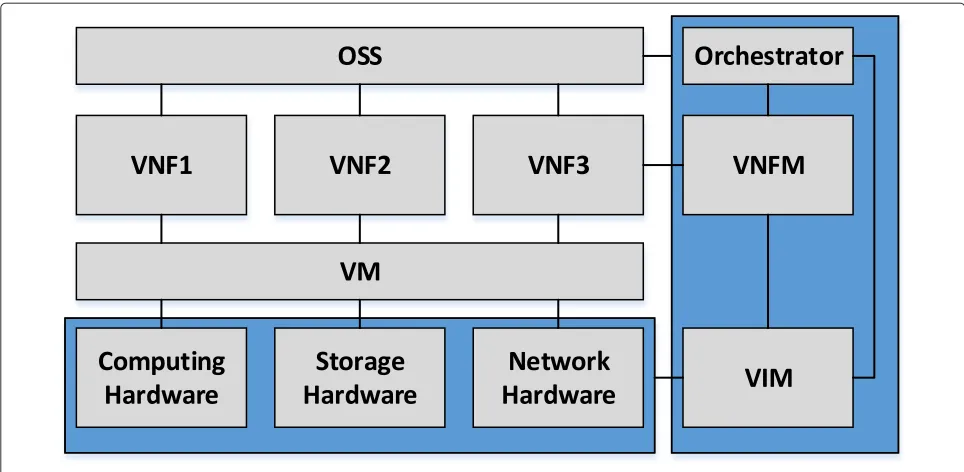
Recently, several standard organizations such as ITU, European Telecommunications Standards Institute (ETSI) NFV Industry Specification Group (ISG) [18], and Open Networking Foundation (ONF) [19] are developing NFV concept and its system framework. Open Platform for NFV Project (OPNFV) [20] releases an open-source plat-form following such standard like ETSI NFV architecture [21]. The NFV architecture mainly consists of an opera-tion system layer like operaopera-tions support system (OSS), VNF, virtual machine (VM), and a management layer as shown in Fig. 3.
Fig. 3System architecture of network function virtualization
is orchestrated by the management layer, in which overlay network for the VNFs is established using network control protocols like OpenFlow [9].
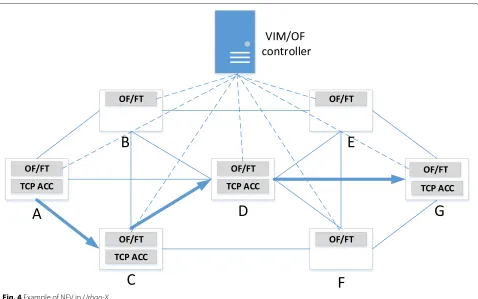
Figure 4 shows a newUrban-X architecture combined with SDN and NFV technologies. The VIM has a network controller to establish a multi-hop route for end-to-end communication. Here, the network controller uses Open-Flow (OF) that is one of the most popular control pro-tocols, which manipulates a forward or a routing table of each mesh node along the route. In the figure, sup-posed that a MC near the nodeAsends packets to another MC near the node F, the path can be set as the bold line:A-C-D-G. For this, an OpenFlow client at each mesh node reports link status information that is actually a RC value of Eq. 2 to the OpenFlow controller periodi-cally. Based on this information, the controller calculates cumulated expected transmission time (CETT) of possi-ble routes for the flow and then creates or updates for-warding tables (FT) of the mesh nodes along a minimum CETT route. An incoming interface to the nodeAfrom the MC is mapped with an interface to the nodeCfor the flow identification (ID) (e.g., addresses, port number, etc) in the FT. Then, all incoming packets with the flow ID are forwarded automatically to the interface toward the nodeC. The control packets for mesh node configuration between VIM and mesh nodes like OpenFlow messages are exchanged through the CCH of R3 in Fig. 2. The VIM/OF controller is basically a logical entity that can be included in one of the mesh nodes in the figure. In case the VIM/OF cannot reach directly each mesh node,
it can send or receive the control messages by multi-hop routing.
According to the service chain, various VNFs can be cre-ated in the mesh nodes such as deep packet inspection (DPI), firewall, authentication server, QoS-based packet queueing, etc. Among them, TCP accelerator (ACC) is a very attractive VNF for theUrban-X because there is a limitation to provide good TCP throughput to the MC due to complexity of CMNs. Detailed reason will be explored in Section 5. Also, most of the recent applications includ-ing even video streaminclud-ing use TCP connections. Acceler-ating TCP throughput using NFV techniques is therefore applied to our Urban-X architecture as can be seen in Fig. 4. VIM instantiates VNFs of TCP-ACC at each mesh node once the OpenFlow controller decides a TCP flow path within the Urban-X. In detail, VIM informs the OpenFlow controller to send control messages to the OF client in order to instantiate the TCP-ACC on each mesh node when the path information is given to the VIM. As a result, the nodeA,C,DandGcreate TCP-ACCs over the VMs and snoop the TCP flow with a flow ID to accelerate. This TCP-ACC or proxy as the VNF is interesting also to researchers in wired or wireless cellular communica-tion areas. Thus, our CMN model with TCP-ACC can be considered for WiMAX or LTE mesh networks and IEEE 802.22-based mesh networks even though evaluation is performed using Wi-Fi connectivity between the mesh nodes.
Fig. 4Example of NFV inUrban-X
connections as many as number of hops in the Urban-X. Split TCP connections by the TCP-ACCs can lead to higher overall throughput by reducing the round-trip time. In addition, the TCP-ACC can relieve the rest of the path from having to carry end-to-end retransmis-sions as well. Previously, multiple TCP proxies along the route for the wireless ad hoc networks were con-sidered in order to improve throughput in [22–24]. The TCP split scheme was originally designed to sep-arate the different mediums of wire and wireless in wireless cellular networks. For the multi-hop ad hoc networks (MANETs), Kopparty et al. [22] divided an orig-inal long route into a sequence of short TCP connec-tions by locating TCP proxies every three nodes along the original route to improve the throughput of end-to-end TCP connection. Ouyang et al. [25] proposed more efficient TCP proxy placement based on link sta-tus information since processing packets at the higher layer by proxies causes overhead. For this, cross-layer approach between network and transport layers is con-sidered to find optimal nodes to place the TCP proxy. In detail, source routing protocols collect queued pack-ets and retransmission counts of links along the route and select TCP proxy nodes. Then, a sender piggybacks a TCP proxy node list on TCP SYN, and each proxy node responses SYN-ACK to establish segmented TCP connection.
5 A case study: TCP inUrban-X
In the Urban-X, TCP performance may be adversely affected due to not only multi-hop transmission in ad hoc networks but also channel sensing and channel mobility for cognitive radio. Several studies have been undertaken to optimize TCP for the WMNs in order to enhance network performance solving problems caused by node mobility and route breaks. For example, explicit notifi-cation messages provided by the network layer [26, 27] help distinguishing a temporary disconnection due to deep fading or mobility. However, such approaches do not consider the unique properties of cognitive radio net-works. For instance, periodic channel sensing and spec-trum mobility and transmission channel switching can cause significant additional delay and jitter. Round-trip time (RTT) variation because of them degrades eventually TCP performance by distorting adversely bandwidth esti-mation and retransmission timeout (RTO), which requires a rethinking of transport layer protocol design.
and increased interference and packet loss. Not only the packet loss due to fluctuation in wireless channel quality and external PN interference but varying delay from chan-nel sensing and switching affects TCP performance in the
Urban-X, since the end nodes at the transport layer has limited information about reasons for the loss or delay. Here, we discuss details of three major challenges for the TCP operations in theUrban-X, especially for the conges-tion control mechanism which may considerably reduce achievable throughput.
• Unpredictable external interference from PNs: Due to co-existing PNs creating interference, CMN transmissions may face heavy packet loss. Such packet loss can lead to increased RTT due to MAC layer retransmits. This may result in low TCP throughput due to frequently triggered slow start. The channel assignment inUrban-X has been designed exactly to minimize the probability of external interference by selecting the channel least impacted by PN traffic.
• Spectrum sensing: For the channel assignment, CMNs estimate PN workload based on spectrum sensing. However, during such, cooperative sensing nodes are not able to transmit, potentially leading to TCP RTO. There is a trade-off between estimation accuracy and sensing overhead. To reduce the total sensing time, CMNs can exchange sensed channel workload information. Such collaboration among CMNs can decrease the required sensing window, which eventually may improve TCP throughput.
• Channel mobility/switching: InUrban-X, nodes adjust the receive channelR1 dynamically and inform neighbors with Hello messages transmitted on the CCH. During this switch over, CMN links become disconnected, leading to potential packet loss. Likewise, nodes switch the transmitting radio channel (R2 ) to send packets to different neighbors. Once theR2 radio switches to the next channel, it stays there for a predefined switching interval. Packets arriving to the receiving interface are queued
at the correct channel queue for the next hop. If a node serves many neighbors, there may be a potential large switching delay until a given specific channel is served again. Such large delay can be detrimental to TCP performance as the number of intermediate forwarding nodes in the path increases. This is because channel switching jitter distorts RTT estimates and negatively affects RTO and throughput.
5.1 TCP performance inUrban-X
In the following, we evaluate the performance of TCP Reno over the multi-hopUrban-Xthat is extended from ns-2 simulator for the cognitive radio-based ad hoc net-works as can be seen in Fig. 2.
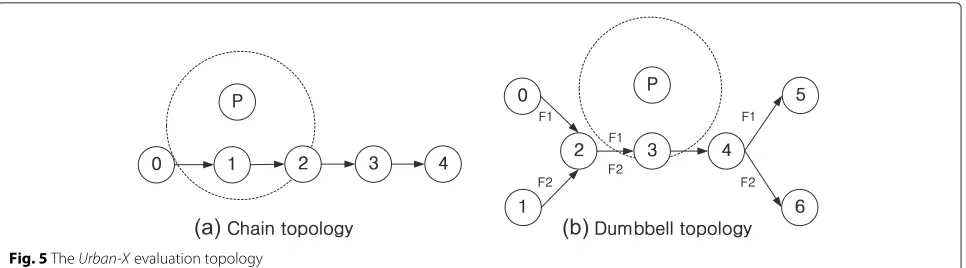
Every simulation was repeated 50 times, and a data point denotes the average of those simulation runs. We send a single TCP flow over the chain topology (Fig. 5(a)) from node 0 to node 4. In the Fig. 5(a), 11 PNs are present on all 11 available channels at the same position with the same traffic load but different traffic pattern. Maximum data rate of each channel is 2 Mbps. Unless otherwise stated, the following parameters are used: a node peri-odically senses the spectrum for 70 ms, followed by 1-s transmission time. During the transmission time, the node switches to a channel with non-empty queue and stays there for a switching interval of 50 ms. The channel switching overhead, i.e., the time for the hardware to re-configure the card once the channel switch is triggered, is assumed to be 1 ms.
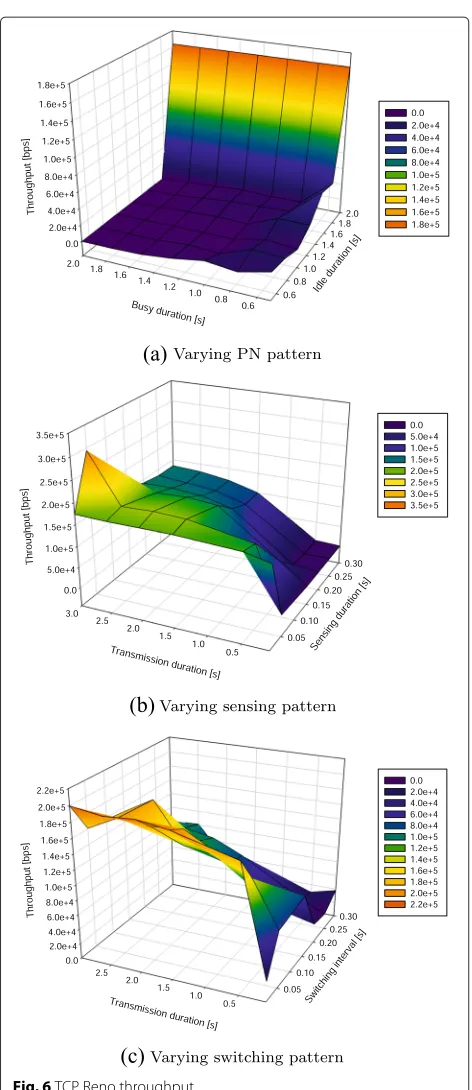
First, we evaluate throughput of the TCP Reno in the
Urban-X under different PN traffic patterns by varying the idle and busy duration. As shown in Fig. 6a, TCP throughput is highest when PNs have long idle and short busy duration. This allows TCP to effectively ramp up its congestion window. Rapid ON/OFF patterns of PNs lead to low TCP throughput as TCP cannot increase its window size fast enough. At fixed idle duration (e.g., 0.5 s), throughput increases slightly when busy duration decreases because the smaller the busy duration, the more time for TCP to transmit.
Fig. 6TCP Reno throughput
As a consequence, TCP throughput decreases drasti-cally as the workload of PN traffic increases as the avail-able capacity for the mesh decreases. Interestingly, the TCP throughput decreases more than the reduction of available channel capacity RC due to PN traffic load. This is the additional negative effect on TCP of packet loss caused by PN interference.
Figure 6b shows the impact of the sensing pattern under fixed PN traffic pattern (Tidle = 2 s; Tbusy = 0.5 s) on achievable TCP throughput. Sensing is conducted after transmission duration finishes. TCP throughput increases obviously with transmission duration. The higher this value, the less overhead due to sensing and the longer time TCP has to increase its congestion window. Throughput with varying sensing period is almost comparable except cases of long transmission duration. When the sensing duration is larger than 200 ms, however, throughput again is penalized as packets need to wait too long in the buffers. Switching interval is an important parameter to con-sider as it directly impacts the delay jitter and the achiev-able TCP throughput. Once the transmitting interfaceR2
switches to a given channel with non-empty queue, it stays on that channel for a predefined switching interval (await-ing for more packets to arrive to the queue) in order to minimize switching overhead. A small switching interval leads to smaller jitter and is sensitive to channel mobility of neighbor nodes, but less time on a given channel.
In Fig. 6c, as the switching interval decreases, TCP throughput generally increases unless a very small switch-ing interval and transmission duration are used, which reduces throughput due to overhead. Also, longer trans-mission duration increases TCP throughput. However, there is a constraint on the maximum transmission dura-tion to measure timely channel occupancy from primary users.
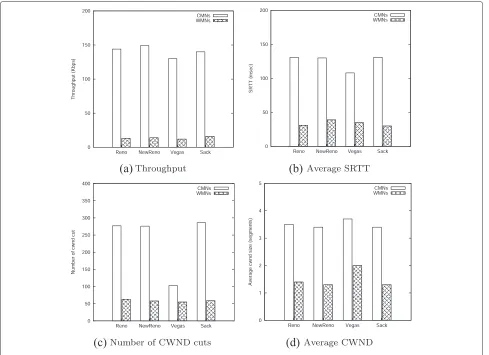
TCP performance comparison regarding the external PN interference is shown in Fig. 7. Figure 7a shows the throughput achievable for TCP Reno, NewReno, Vegas, and SACK. Throughput of TCP is significantly higher for Urban-X (i.e., CMNs) compared to WMNs that are unaware of interference from PNs across all TCP versions, because theUrban-X selects the least interfered channel having highest available capacity and least probability for collisions due to PN traffic.
In Fig. 7(d), the average CWND size also shows that the sending data rate for TCP inUrban-Xis higher than for standard WMNs. As a conclusion, the spectrum aware channel assignment helps effectively to reduce exter-nal interference due to PN traffic, which in turns leads to lower packet loss rate and significantly higher TCP throughput. The additional price to pay for the spectrum sensing is well utilized in higher throughput.
5.2 TCP accelerators on cognitive mesh nodes
Fig. 7TCP performance comparison with or without cognitive radio
leading to significant end-to-end delay variation. The TCP throughput is measured for different path lengths (fix-ing the sender at node 0 and vary(fix-ing the receiver from nodes 1 to 4 and configuring the switching interval as 40 ms, spectrum sensing duration as 10 ms, transmis-sion duration as 1 s). When path length increases to four hops, throughput decreases much more severely and the packet drop rate increases to around 5 %. We repeated the same simulation using User Datagram Pro-tocol (UDP). The UDP throughput was 1.3 Mbps for a four-hop path even although the delivery ratio was low (around 60 %). This is because UDP’s traffic pattern is unidirectional. In contrast, TCP data packets are acknowl-edged leading to a two-way traffic pattern. Accordingly, the chain topology leads to frequent channel switches for the intermediate nodes in Fig. 5a as they need to switch between transmissions toward their upstream and downstream neighbor nodes to send TCP data and TCP-ACK. Such channel switch delay leads to large end-to-end delay variations affecting RTO and leading to frequent TCP timeouts. As the number of hops increases, channel
switching mainly limits TCP throughput. As a conclusion, TCP should be re-built to cope with those effects in the
Urban-X.
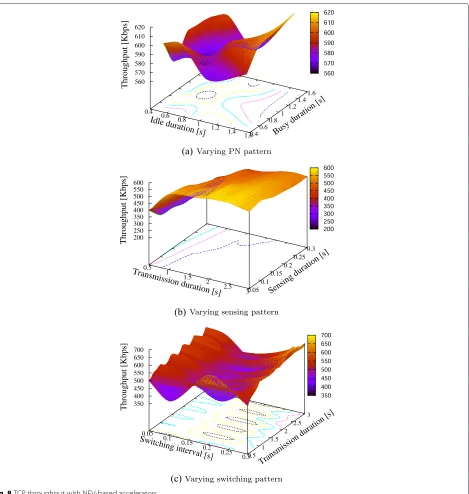
We demonstrate the TCP Accelerator (TCP-ACC) in the Urban-X under same simulation condition as previ-ous one in Fig. 8. Figure 8a depicts TCP throughput under varying PN traffic with different idle and short busy dura-tion, which forms an irregular concave shape. This graph does not show clear relationship between TCP throughput and PN traffic patterns compared to the result in Fig. 6a, but throughput is relatively higher in short busy and long idle duration. In contrast to the previous TCP Reno case, packet loss affection that happened near node 1 in Fig. 5 is not propagated to the remaining TCP path in the TCP-ACC case. To say, such partial PN interference in the sub-TCP path does not direct overall throughput toward a consistent way.
Fig. 8TCP throughput with NFV-based accelerators
the TCP Reno. However, TCP throughput is almost com-parable with varying sensing duration in TCP-ACC while throughput gets improved in case the transmission dura-tion is long in the TCP Reno. From this, we can confirm again the TCP throughput is not much affected by subset
Table 1TCP Reno throughput with number of hops
Number of hops 1 2 3 4
Throughput (Kbps) 1413 886 291 141
Packet drop rate 0 0 0.05 0.05
of TCP path that is interfered by PN traffic. Packet loss from the PN traffic can be recovered fast owing to the short TCP path. However, the overhead of sensing dura-tion degrades TCP throughput slightly in any transmission duration.
Fig. 9TCP performance comparison inUrban-X
causes long RTT or RTO. However, the TCP-ACC does not suffer from such long RTT due to short sub-TCP path. Although long switching interval does not degrade throughput with the long RTT, it can increase packet buffering in intermediate TCP proxy nodes, which may not be a preferable situation for real-time applications.
Table 2 shows throughput of the TCP-ACC and RTTs of the TCP subset. The RTT is measured at each node, which is a time gap between packet arrival time at the node and acknowledged time from a next node. TCP through-put decreases according to the number of hops since the backlog increases at each node due to packets arrived out of order or loss due to PN interference or channel
Table 2TCP-ACC throughput with varying TCP length
Number of hops 1 2 3 4
Throughput (Kbps) 1408 1104 692 689
Number of paths 0–1 1–2 2–3 3–4
RTT (ms) 7.74 13.3 34.7 25.3
noise. Coincidentally, the RTT increases drastically from the node 3, in which the throughput also decreases. There could be better algorithm with asymmetric TCP, for exam-ple, the last and intermediate TCP sinks conduct different operation. However, in this paper, all same TCP-ACCs are supposed to be deployed in mesh nodes by NFV tech-niques, which is simple and manageable. To investigate proper number of TCP-ACCs along the end-to-end route, we deploy TCP-ACCs every two hops in the same chain topology. Throughput is 360.68 Kbps at the node 4 that is almost a half of one in Table 2; processing delay in the TCP-ACC is less considerable compared to delay from channel sensing and switching. Processing overhead for the TCP-ACC will be measured in our future work since some nodes of CMNs can have very limited hardware platforms.
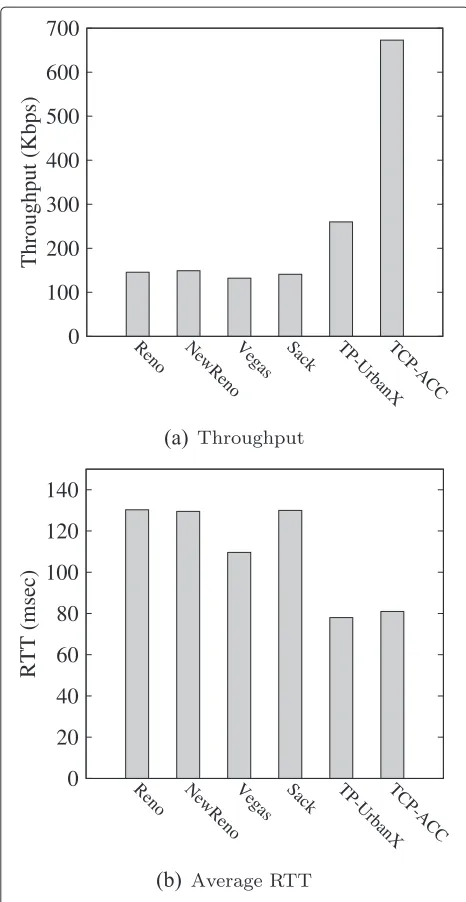
Figure 9 shows comparison of average TCP throughput and RTT in a chain topology with PN traffic (Tidle = 2 s and Tbusy = 2 s) with two TCP variants, TP-UrbanX and TP-CRAHN for CMNs for performance comparison. The TP-UrbanX outperforms than other previous TCP versions by about 50 %, which increases or decreases con-gestion window adaptively based on the feedback infor-mation. In [33], TP-CRAHN also improves throughput by 20∼30 % of conventional TCP throughput according to PN traffic load. Compared to the two cognitive TCPs, the TCP-ACC achieves impressive performance, more than four times of conventional end-to-end TCP variants and more than double of TCPs specialized for the CMNs. The RTTs of conventional end-to-end TCP variants are similar with each other while RTT of theTP-UrbanXis reduced about 30 % due to adaptive transmission. Basically, the RTT value is tightly coupled to TCP throughput. Even though end-to-end RTT of the TCP-ACC is close to the
TP-UrbanX, it should be divided into multiple RTTs of sub-TCPs. Unfortunately, the RTT of each sub-TCP con-nection can be different as shown in Table 2. In such case, TCP throughput is depending on the longest RTT value. From this observation, we can consider to place TCP accelerators first near mesh nodes that suffer from PN interference because the RTT of sub-TCP path can be longer than others due to packet loss if we have to limit the number of TCP-ACCs in theUrban-X.
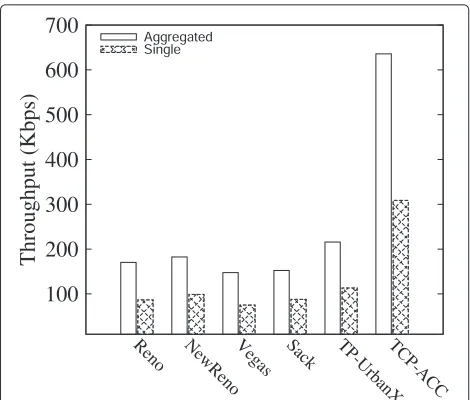
Figure 10 shows a simulation result from two flows in a dumbbell topology illustrated in Fig. 5b. FlowF1andF2
5 and 6. The aggregated throughput of all TCP versions was only as much as throughput of a single flow in Fig. 7 because bottleneck links to share. Although the shared links are not fully utilized by two flows, channel switching in nodes 2 and 4 limits aggregated throughput. For exam-ple, the node 2 should switch three channels for the nodes 0, 1 and 3 with the defined interval. From this effect, fair-ness between two flows was mostly achieved as shown in Fig. 10 when both flows start at a same time; through-put of a single flowF1is almost a half of the aggregated throughput ofF1andF2.
6 Related works
Many researches about cognitive radio technology have been conducted for the last decade. The cognitive radio improves capacity of ad hoc networks by scavenging white spaces in spectrum and avoiding internal interference [34]. In [5, 11], CMNs are exploited in unlicensed bands. They propose a multi-hop routing protocol and a for-warding scheduling algorithm for the CMNs. Youssef et al. [4] shows overall comparison among multi-hop rout-ing protocols proposed for cognitive multi-hop ad hoc networks.
A few studies have investigated TCP performance under the cognitive radio-based networks. Slingerland et al. [35] analyze TCP performance in dynamic spectrum access (DSA) scenarios using a single-hop cognitive radio access network such as considered by, e.g., 802.22 WRAN. Sarkar et al. [36] also propose TCP Everglades (TCPE) for the single-hop cognitive radio networks. Authors assumed spectrum sensing duration is longer than RTO and extended TCP Westwood [37] with several rules of a knowledge-based module that decides TCP operation.
Fig. 10TCP fairness in dumbbell topology
Chowdhury et al. [33] propose a new transport layer protocol, TP-CRAHN, for cognitive ad hoc networks. In TP-CRAHN, additional TCP states are defined for cog-nitive operation such as channel sensing and switching, and state transition is triggered by explicit notification from nodes along the TCP path. Kim et al. [38] propose
TP-UrbanX, a new transport control protocol for cogni-tive wireless mesh. TP-UrbanX uses feedback and TCP acknowledgement information to detect network conges-tion considering the intrinsic properties of the environ-ment such as channel switching, spectrum sensing, or external interference. It integrates reinforcement-based learning techniques in order to adapt its operation over time to changing network conditions.
Recently, software defined networking (SDN) technol-ogy is considered for controlling resources and steering traffic in wireless networks. Liu et al. [39] addressed the multi-flow update problem in the SDN and proposed a polynomial time heuristic algorithm. Yang et al. [8] shows comparative analysis among proposed SDN solu-tions with research challenges for the SDN-based wireless networks. Granelli et al. [7] describe architecture of cellu-lar and Wi-Fi wireless networks changed by the SDN and introduce standardization activity. And virtualized wire-less networks by the SDN are converged with user services effectively [40].
Network function virtualization (NFV) has started by demands from wireless network operators who want to reduce CAPEX and OPEX. ETSI NFV industry specific group is now investigating NFV structure and interoper-ability between vendors or other standard organization [18]. In [10], software Wi-Fi APs are virtualized by sep-arating logical entities, e.g., MAC from an entire Wi-Fi module. Liang et al. [41] suggests a NFV model for 5G wireless networks for information centric networking. Gember-Jacobson et al. [42] proposes OpenNF, a control model to support service level agreement and networking monitoring in order to optimize performance by coordi-nating packet processing and forwarding.
7 Conclusions
for interference avoidance. Compared to previous works that requires modification of TCP, TCP splitting is much simpler than end-to-end TCP optimization schemes in terms of implementation and management. The recon-figurable NFV platform and increasing computing power allow a mesh node to create or remove dynamically a TCP proxy for acceleration without severe overhead to deal with every packet in the TCP layer. From simulation results, we can confirm that NFV-based TCP accelerators can improve TCP throughput by more than four times of conventional TCP variants in theUrban-X. As future works, we will implement VNFs including TCP-ACC on our testbed of CMNs using open NFV protocol stacks and measure processing overhead and latency to instantiate or delete VNFs.
Competing interests
The author declares that he has no competing interests.
Acknowledgements
This research was supported by the Gachon University research fund GCU-2015-0044 of 2015.
Received: 20 July 2015 Accepted: 14 September 2015
References
1. Muniwireless project. Http://www.muniwireless.com/ 2. Chaska wireless solutions. Http://www.chaska.net/
3. IF Akyildiz, W-Y Lee, MC Vuran, S Mohanty, Next generation/dynamic spectrum access/cognitive radio wireless networks: a survey. Comput. Netw.50(13), 2127–2159 (2006)
4. M Youssef, M Ibrahim, M Abdelatif, L Chen, AV Vasilakos, Routing metrics of cognitive radio networks: a survey. Commun. Surv. Tutorials IEEE.16(1), 92–109 (2014)
5. W Kim, A Kassler, MD Felice, M Gerla, inProc. of IFIP Wireless Days. Urban-X: Towards distributed channel assignment in cognitive multi-radio mesh networks, (2010)
6. J Bajaj, W Kim, S Oh, M Gerla, inIEEE 22nd International Symposium on Personal, Indoor and Mobile Radio Communications, PIMRC 2011. Cognitive radio implementation in ISM bands with microsoft SORA (Toronto, ON, Canada, 2011), pp. 531–535. doi:10.1109/PIMRC.2011.6140018. http://dx. doi.org/10.1109/PIMRC.2011.6140018
7. F Granelli, AA Gebremariam, M Usman, F Cugini, V Stamati, M Alitska, P Chatzimisios, Software defined and virtualized wireless access in future wireless networks: scenarios and standards. IEEE Commun. Mag.53(6), 26–34 (2015). doi:10.1109/MCOM.2015.7120042
8. M Yang, Y Li, D Jin, L Zeng, X Wu, AV Vasilakos, Software-defined and virtualized future mobile and wireless networks: a survey. Mob. Netw. Appl.20(1), 4–18 (2014)
9. N McKeown, T Anderson, H Balakrishnan, G Parulkar, L Peterson, J Rexford, S Shenker, J Turner, Openflow: enabling innovation in campus networks. ACM SIGCOMM Comput. Commun. Rev.38(2), 69–74 (2008)
10. P Dely, J Vestin, A Kassler, Cloudmac—using openflow to process 802.11 MAC frames in the cloud. Prax. Informationsverarbeitung Kommun.36(1), 53 (2013). doi:10.1515/pik-2012-0068
11. W Kim, A Kassler, MD Felice, M Gerla, inProc. of IEEE IPCCC. Cognitive multi-radio mesh networks on ism bands: A cross-layer architecture, (2010)
12. Z Yan, Z Ma, H Cao, G Li, W Wang, inCircuits and Systems for
Communications, 2008. ICCSC 2008. 4th IEEE International Conference On. Spectrum sensing, access and coexistence testbed for cognitive radio using usrp (IEEE, 2008), pp. 270–274
13. R Dhar, G George, A Malani, P Steenkiste, inNetworking Technologies for Software Defined Radio Networks, 2006. SDR’06.1 St IEEE Workshop On.
Supporting integrated mac and phy software development for the usrp sdr (IEEE, 2006), pp. 68–77
14. P Murphy, A Sabharwal, B Aazhang, inSignal Processing Conference, 2006 14th European. Design of WARP: a wireless open-access research platform (IEEE, 2006), pp. 1–5
15. K Tan, H Liu, J Zhang, Y Zhang, J Fang, GM Voelker, SORA: high-performance software radio using general-purpose multi-core processors. Commun. ACM.54(1), 99–107 (2011)
16. F Kaltenberger, R Ghaffar, R Knopp, H Anouar, C Bonnet, Design and implementation of a single-frequency mesh network using openairinterface. EURASIP J. Wirel. Commun. Netw.2010, 19 (2010) 17. J Sydor, inWireless Communication Systems (ISWCS), 2010 7th International
Symposium On. Coral: A wifi based cognitive radio development platform (IEEE, 2010), pp. 1022–1025
18. ETSI NFV ISG. Http://www.etsi.org/technologies-clusters/technologies/ nfv
19. ONF. Https://www.opennetworking.org/about/onf-overview 20. OPNFV. Https://www.opnfv.org/
21. GS NFV 002 Network Functions Virtualisation (NFV); Architectural Framework. NFV ISG
22. S Kopparty, S Krishnamurthy, M Faloutous, S Tripathi, inProc. of IEEE GLOBECOM. Split TCP for mobile ad hoc networks, (2002)
23. J Liu, S Singh, Atcp: TCP for mobile ad hoc networks. IEEE J. Sel. Areas Commun.19(7), 1300–1315 (2001)
24. A Bakre, BR Badrinath, inDistributed Computing Systems, 1995., Proceedings of the 15th International Conference On. I-TCP: indirect TCP for mobile hosts, (1995), pp. 136–143. doi:10.1109/ICDCS.1995.500012 25. T Ouyang, S Jin, M Rabinovich, inDistributed Computing Systems
Workshops, 2009. ICDCS Workshops’ 09. 29th IEEE International Conference On. Dynamic tcp proxies: Coping with disadvantaged hosts in manets (IEEE, 2009), pp. 530–536
26. K Chandran, S Raghunathan, S Venkatesan, R Prakash, inProc. of IEEE ICDCS. A feedback-based scheme for improving TCP performance in ad-hoc wireless networks, (1998)
27. J Monks, P Sinha, V Bharghavan, inProc. of Mobile and Multimedia Communications. Limitations of TCP-ELFN for ad hoc networks, (2000) 28. MD Felice, KR Chowdhury, W Kim, AJ Kassler, L Bononi, End-to-end
protocols for cognitive radio ad hoc networks: an evaluation study. Perform. Eval.68(9), 859–875 (2011). doi:10.1016/j.peva.2010.11.005 29. W Kim, AJ Kassler, M Gerla, inCogART 2011, International Conference on
Cognitive Radio and Advanced Spectrum Management. TCP performance in cognitive multi-radio mesh networks (Barcelona, Spain, 2011), p. 44. doi:10.1145/2093256.2093300. http://doi.acm.org/10.1145/2093256. 2093300
30. S Floyd, T Henderson, inInternet Engeneering Task Force, Request for Comments (Experimental) 2582. The new Reno modification to TCP fast recovery algorithm, (1999)
31. L Brakmo, L Peterson, TCP Vegas: end to end congestion avoidance on a global internet. IEEE J. Sel. Areas Commun.13(8), 1465–1480 (1995) 32. M Mathis, J Mahadavi, S Floyd, A Romanow, inInternet Engeneering Task
Force, Request for Comments (Experimental) 2018. TCP selective acknowledgment options, (2006)
33. KR Chowdhury, MD Felice, IF Akyildiz, inProc. of IEEE INFOCOM. TP-CRAHN: a transport protocol for cognitive radio ad-hoc networks, (2009) 34. IF Akyildiz, W-Y Lee, KR Chowdhury, Crahns: Cognitive radio ad hoc
networks. Ad Hoc Netw.7(5), 810–836 (2009). doi:10.1016/j.adhoc.2009.01.001
35. AMR Slingerland, P Pawelczak, R Venkatesha Prasad, A Lo, R Hekmat, in
New Frontiers in Dynamic Spectrum Access Networks, 2007. DySPAN 2007. 2nd IEEE International Symposium On. Performance of transport control protocol over dynamic spectrum access links, (2007), pp. 486–495. doi:10.1109/DYSPAN.2007.71
36. D Sarkar, H Narayan, inProc. of IEEE INFOCOM CWCN. Transport layer protocols for cognitive networks, (2010)
37. S Mascolo, C Casetti, M Gerla, SS Lee, M Sanadid, inUCLA CSD Technical Report. TCP Westwood: congestion control with faster recovery, (2000) 38. W Kim, M Gerla, AJ Kassler, MD Felice, in12th IEEE International Symposium
doi:10.1109/WoWMoM.2011.5986210. http://dx.doi.org/10.1109/ WoWMoM.2011.5986210
39. Y Liu, Y Li, Y Wang, AV Vasilakos, J Yuan, inProceedings of the 2014 ACM SIGCOMM Workshop on Distributed Cloud Computing. Achieving efficient and fast update for multiple flows in software-defined networks (ACM, 2014), pp. 77–82
40. Q Duan, Y Yan, AV Vasilakos, A survey on service-oriented network virtualization toward convergence of networking and cloud computing. IEEE Trans. Netw. Serv. Manag.9(4), 373–392 (2012)
41. C Liang, FR Yu, X Zhang, Information-centric network function virtualization over 5g mobile wireless networks. IEEE Netw.29(3), 68–74 (2015). doi:10.1109/MNET.2015.7113228
42. A Gember-Jacobson, R Viswanathan, C Prakash, R Grandl, J Khalid, S Das, A Akella, inProceedings of the 2014 ACM Conference on SIGCOMM. Opennf: Enabling innovation in network function control (ACM, 2014), pp. 163–174
Submit your manuscript to a
journal and benefi t from:
7Convenient online submission
7 Rigorous peer review
7Immediate publication on acceptance
7 Open access: articles freely available online
7High visibility within the fi eld
7 Retaining the copyright to your article