R E S E A R C H
Open Access
PAPR reduction scheme with efficient
embedded signaling in MIMO-OFDM systems
Mouna Sghaier
*, Fatma Abdelkefi
*and Mohamed Siala
*Abstract
Multiple input multiple output (MIMO) orthogonal frequency division multiplexing (OFDM) is a promising transmission scheme for high performance broadband wireless communications. However, this technique suffers from a major drawback which is the high peak to average power ratio (PAPR) of the output signals. In order to overcome this issue, several methods requiring the transmission of explicit side information (SI) bits have been proposed in the literature. In fact, the transmitted bits must be channel-encoded as they are particularly critical to the performance of the considered OFDM system. Consequently, this channel-encoding highly increases the system complexity and decreases the transmission data rate. To overcome these problems, we propose in this paper two robust blind techniques that embed the SI implicitly into the OFDM frame. The first technique, referred to as Blind Space Time Bloc Codes (BSTBC), is inspired from the conventional selected mapping (SLM) approach. This technique banks on an adequate embedded signaling that mainly consists in a specific Space Time Bloc Codes (STBC) patterns and a precoding sequence codebook. In addition, in order to improve the signal detection process and the PAPR gain, we propose a new efficient combined Blind SLM-STBC (BSLM-STBC) method. Both methods propose an optimized scheme during the signal estimation process that is based on the maximum a posteriori (MAP) algorithm. A
simulation study shows that our investigated approaches result in a spectacular PAPR reduction and furthermore lead to a perfect signal recovery at the receiver side.
Keywords: OFDM; PAPR; Selected mapping (SLM); Alamouti algorithm; Space Time Bloc Codes (STBC); Maximum a
posterior (MAP); MIMO; Side information (SI); Max-log approximation; Rotated and unrotated quadrature amplitude modulation (QAM); Channel coding; Embedded signaling
1 Introduction
Orthogonal frequency division multiplexing (OFDM) modulation technique is a multicarrier transmission scheme that recently has been widely adopted in var-ious wireless communication standards (WLAN, DVB-T. . . ), thanks to its high spectral efficiency and robustness offered, especially for the frequency selective channels [1, 2]. This technique has also been combined with the multiple input multiple output (MIMO) systems [3] and has recently been adopted for many important wire-less standards such as the Third Generation Partner-ship Project (3 GPP) of long-term evolution advanced (LTE-A) [4]. However, the transmitted signals in OFDM systems may potentially have high peak values in the time
*Correspondence: [email protected]; [email protected]; [email protected]
MEDIATRON Laboratory, Sup’com, Tunis, Tunisia
domain since many independent subcarrier components are added via an inverse fast Fourier transform (IFFT) operation. This aspect may considerably increase the peak power at the output of the high-power amplifier (HPA) at the transmitter [5, 6].
Since high peak values can occur in any transmitted branch of the MIMO-OFDM system, this issue becomes more serious mainly when using several transmitter antennas. It is for this reason that several research works were interested in the PAPR reduction by applying existing single input single output (SISO) algorithms separately on each transmit antenna such as ordi-nary selected mapping (SLM) [7] and partial transmit sequence (PTS) techniques [8]. Such techniques need a number of side information (SI) equal to the number of used sequence phase for each antenna. Therefore, the SI increases highly with the number of antenna which weakness this approach. To overcome this problem,
interesting solutions are proposed in the literature such as cross-antenna rotation and inversion [9], direct SLM [10], direct PTS (dPTS) [11], unitary rotation [12], opti-mal PAPR reduction [13], and polyphase interleaving and inversion [14]. These techniques consist of selecting the transmitted sequence with the lowest average PAPR over all transmit antennas. However, all these methods decrease the SI but imply an explicit SI transmission to recover the useful data at the receiver side. As such, these approaches cause a resource wasting (in terms of channel bandwidth) that can considerably decrease the data rate. Moreover, a wrong estimation of the SI at the received side could damage the total signal recovery which leads to significant performance deterioration in terms of bit error rate (BER). Thus, several recent research works, known as blind techniques [15–17], have been proposed to avoid the sending of the explicit SI. Some of these studies required the use of a special phase rotations of candidate signals
(0 or π) [15], which degrade the PAPR performance.
The other proposed approaches are only relevant for two antennas [16] or are too complex to be implemented [17]. This paper focus on avoiding the transmission of the explicit SI in MIMO-OFDM systems. To achieve this goal, we propose two efficient blind methods. In the first part, we propose a new blind technique, one inspired from classical SLM techniques, referred to as Blind Space Time Bloc Codes (BSTBC). This method requires, at the transmitter side, a special precoder codebook containing different configurations of two Space Time Bloc Codes (STBC) patterns. Among them, the one leading to the minimum PAPR will be kept in the PAPR reduction pro-cess. Consequently, this leads to an embedded signaling that guarantees a reliable and perfect signal recovery at the receiver side through a hard or a soft decision process. The second method consists of combining the BSTBC method with BSLM scheme already investigated in [18]. This combined method, referred to as Blind SLM-STBC (BSLM-STBC), exploits two forms of signaling which are the set of rotated and unrotated constellations and a precoders codebook containing different configura-tions of STBC patterns. In this paper, we show that BSLM-STBC approach does not only lead to significant reduce of the PAPR level but also enhances the recovery process at the receiver side. Furthermore, both methods consider a MAX-Log-MAP estimation technique which takes an optimal advantage from these embedded sig-naling. Compared to the existing works, our proposed methods have the advantage to consider an embedded signaling process that exploits both the transmitter and the receiver sides to jointly reduce the PAPR and guar-antee a perfect signal reconstitution without use of an explicit SI.
The remainder of this paper is organized as follows. First, we define the system model in Section 3. Then,
we review the conventional SLM technique used in SISO-OFDM system. In Section 4, we describe our pro-posed blind techniques mainly BSTBC and BSLM-STBC and detail their improved version in Section 5. Subse-quently, we present in Section 6 the simulation results to illustrate the performance of our proposed methods. Finally, Section 7 presents the conclusions of this study and makes some suggestions for future work.
2 Notations
Throughout this paper, the boldface lower case and upper cases letters denote vectors and matrices respectively.IN
refers to the identity matrix of dimensionN. The
super-scripts .Tand .∗denote the transpose and the element wise conjugation, respectively. Finally,Erefers to the expecta-tion operator,|.|denotes the absolute value, andPrrefers to the probability.
3 MIMO-OFDM system, PAPR metric, and SLM approach
Recently, OFDM combined with MIMO technology has received a great deal of attention since it represents an interesting candidate for mobile communication systems thanks to its robustness to multipath fading channels, abil-ity to achieve high data rate and very high bandwidth efficiencies [20, 21]. Moreover, in order to attain optimum performance in MIMO-OFDM systems, several kinds of diversity (time, frequency, channel coding) are often used. Furthermore, authors in [19] have shown that the per-formance of OFDM systems using Space-Time Coding
(STC) yielded significant gains (∼5 dB) in terms of BER
in a multi path channel with a 30-Hz Doppler spectrum and the absence of any time-interleaving. These codes can be classified into STBC and space-time trellis codes (STTCs) [22].
The STBC utilizes the orthogonality property of the used code to achieve full diversity, yet it cannot achieve full-rate transmission when the number of transmit antennas is greater than two [21]. On the other hand, the STBC can guarantee full diversity by the use of enough trellis coding, but the decoding complexity increases exponentially with the number of transmit antennas [34, 35]. For these reasons, we consider the STBC code in this work. The first and well-known STBC is the Alamouti code, which is an orthogonal STC and has the advantage to be full rate contrarily to those proposed by Tarokh et al. [23, 24].
3.1 System model
For simplicity of presentation, we consider a multiple input single output (MISO) system with two transmit and one receive antennas using an Alamouti code [25] denoted asSTBC2.
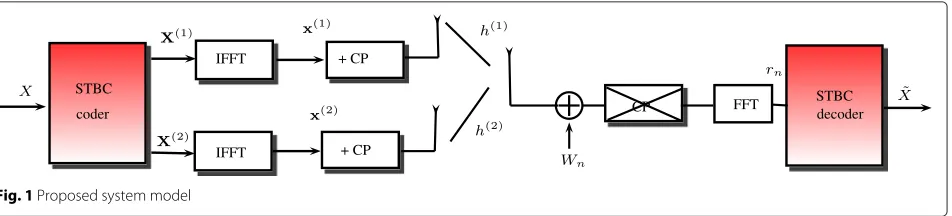
As shown in Fig.1, the input data block X =
[X0,. . .,XN−1]T is first encoded by one possible
space-We note that the Alamouti code word generated by C(nSTBC)is given by the following expression:
C(nSTBC)=
whereI2is the 2 × 2 identity matrix. After performing
anN-length IFFT, we obtain the two following sequences
x(i)=x(0i),. . .,x(Ni)−1T, such that
At the transmitter side, IFFT processing is usually fol-lowed by a cyclic prefix (CP) insertion in order to mitigate the intersymbol interference (ISI). Finally, x(1) and x(2) are transmitted from the first and the second antennas, respectively.
Regarding the receiver side, we assume that the channel over the two consecutive data symbols is constant during two time slotsTs, henceH2(in)=H2(in)+1,i=1, 2.
In addition, the received signal at timetandt+Ts, is given by the following expression:
where Wn are independent and identically distributed
(i.i.d.) complex additive white Gaussian noise (AWGN) with zero mean and varianceσ2. In Eq. (4),Hn(i)denotes
the multipath channel frequency response of thenth
sub-channel between the ith transmitter and the receiver’s
antenna. Therefore, the Eq. (4) can be expressed as
rn =
2
i=1
Xn(i)Hn(i)+Wn,n=0,. . .,N−1. (5)
We also suppose that the channel responses are per-fectly estimated at the receiver. Thus, the estimated trans-mitted symbol can be obtained as
˜
The conventional expression of the PAPR for the MIMO-OFDM system is expressed as
PAPR=
whereNtdenotes the number of the transmitter antennas.
3.3 SLM technique
To guarantee that the input signal will be in the linear region of the HPA, many techniques were proposed [5]. Among these solutions, the first and the simplest one
is the clipping of the signal to be amplified [26]. Other methods including coding techniques [27] or based on the relationship between some coding properties and OFDM modulator [28] have been proposed to reduce PAPR. Challenging solutions were proposed such as tone reser-vation (TR) [29], selected mapping [30], partial transmit sequence [31], etc. Among the cited techniques, we con-sidered in this study the SLM technique due to its ability to reduce the PAPR without causing signal degradation in OFDM system and also thanks to its reduced complex-ity. Basically, the SLM generates, first, a special D× N
phase matrix denoted as Z = e−jφ(0),. . .,e−jφ(D−1)T,
by theDindependent phase sequences which produce a
modified data block denoted by r(d) = r.e−jφ(d),d = 0,. . .,D−1.
Finally, the IFFT of the multiplied sequences are taken to
produce theDsequencesx(d)among which the one with
the lowest PAPR is selected for the transmission as
˜
The main steps of the conventional algorithm are sum-marized according the following Algorithm 1
Algorithm 1Classical SLM PAPR reduction algorithm
Require: D,N,randφ(d)=
1: Define the used SLM phase matrixZ=
To perform the appropriate inverse operation, the receiver should know which phase sequence is used at the transmitter side. Thus, a portion of the bandwidth must be allocated for the transmission of the SI index. Obvi-ously,log2(D)bits are required to explicitly represent this
SI. Hence, a wrong estimation of it at the received side leads to a damage on the total signal recovery. One alter-native may be to protect the SI with some forms of coding techniques, but this will result in further bandwidth loss and resources waste.
For these reasons, we have proposed in our previous work [18] a new Blind SLM (BSLM) for SISO-OFDM systems. The proposed method defines at the
transmit-ter side a specific set E of the possible candidate phase
sequences in order to embed the SI. This set E induces
two subsystems:E =E1∪E2whereE2is the set of rotated
constellation with a specific φ angle whereas E1 leaves
the constellation unchanged. Then, theDcandidate phase
sequencesφ(d)D−1
d=0, used in conventional SLM, are
ran-domly generated from the setE. This construction allows
introducing a new code vector defined as follows:
Vn(d)=
0 ifφ(nd)∈E1,
1 ifφ(nd)∈E2,d=0. . .,D−1,n=0,. . .,N−1.
(9)
This code stands for an embedded signaling which
is used to detect the selected sequence phase d˜
at the received side. This is accomplished by comparing the Hamming distance between the received signal and
the rotated and unrotated M-QAM constellation (Q =
{q0,. . .,qM−1},Q
At the receiver side, the estimation technique is based on the MAP decoding algorithm that calculates the likeli-hood ratio(LR)corresponding to each hypothesisHi,i= 0, 1, with reference to the received symbolSn. Then, each componentVn(d˜)is estimated through the following metric as
In the next section, we detail our powerful blind method which is an extension of the Blind SLM method con-ceived to protect the SI. This proposed technique banks on an adequate embedded signaling that mainly consists on a specific STBC patterns and a precoding sequences codebook.
4 Blind PAPR reduction scheme for MIMO-OFDM systems
system. This technique is blind and banks on the SLM principle. To achieve this objective, first, we start by explaining the construction of this codebook banking on the STBC class. Then, we detail the investigated technique dedicated to reduce the PAPR level. Finally, we illustrate the processing of estimating the SI.
4.1 Principle of the codebook construction
In order to embed the SI, we define, at the transmitter side,
a binaryK× N2 matrix denoted also a codebook which is
the following:
M=Seq(1),. . .,Seq(K)T, (12)
whereKpresents the number of precoding sequence. We
call a precoding sequence a 1× N2 binary vector which
refers to the way to decode the original data according to the two different Alamouti codes (Sch0andSch1). To
explain more, ifSeq(nk) =0, then theSch0will be used to
decode(X2n,X2n+1). Otherwise, we will exploit the other
schemeSch1. This can be summarized as follows:
We note that the choice of the two used schemes is done such as:
• First, we kept only the non-equivalent schemas. For
example, for two antennas [25], we can define the non-equivalent schemes as follows:
A=
X2n −X2∗n+1
X2n+1 X2∗n
,B=
X2n X2∗n+1
X2n+1 −X∗2n
,
C=
X2n X2n+1
−X2∗n+1 X2∗n
,D=
X2n X2n+1
X∗2n+1 −X2∗n
.
• Then, for each combination (for two antennas we
define six possibilitiesAB,AC,AD,BC,BD, andCD),
we perform the proposed coded scheme (see Eq. (13)) and calculate the PAPR according to the Eq. (7)).
• Finally, we keep the two schemes that lead to the
minimum PAPR.
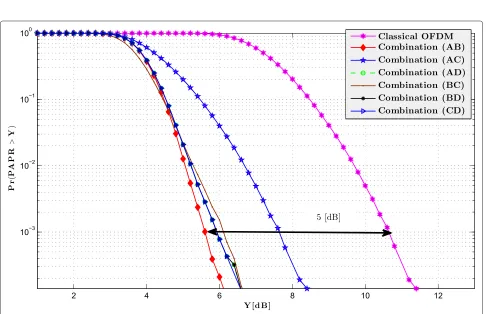
In the case of two antennas, we conclude from Fig. 2 where the curves of the complementary cumulative density function (CCDF) of the PAPR versus its threshold
are plotted. We note that a significant gain around 5dB
if Seq(nk)=0 ⇒(X2n,X2n+1),decoded withSch0,
if Seq(nk)=1 ⇒(X2n,X2n+1),decoded withSch1,n=0,. . .,N2 −1,k=0,. . .K−1.
(13)
is observed between the combination (AB) and the
classi-cal OFDM scheme for both scenarios, i.e.,N = 128 and
4-QAM constellation.
Consequently, through simulation results, we define the two optimal combined Alamouti codes used in this paper denoted as combination (AB).
Sch0=A:
This can be justified by the fact that these two schemes offer more diversity at the antennas level (see Eq. (14)).
4.2 PAPR reduction algorithm
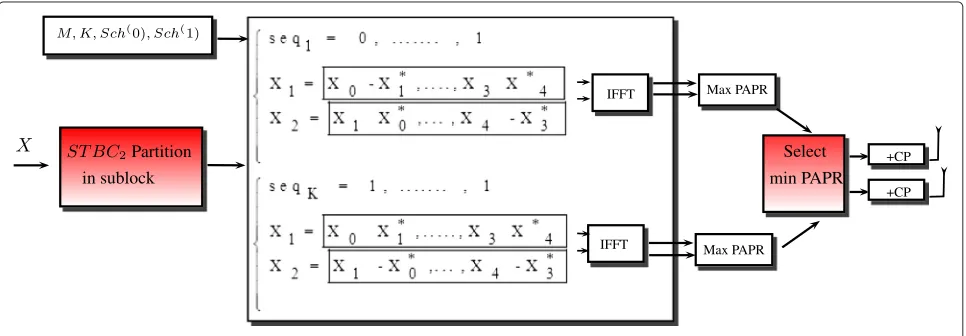
To reduce the PAPR level, we reiterate the same SLM methodology as explained in Section 3.3 where the dic-tionary of the rotation factor in SLM is equivalent, in our
case, to the STBC codebookMas it is showed in Fig. 3.
To explain the proposed PAPR algorithm, we
consid-ered anSTBC2MISO system, where the number of the
transmitter antennasNt=2,N=8,K=3 and
ted sequence. We recall that each row ofMcorresponds
to a possible precoding sequence of X that is encoded
into two vectorsX(1) andX(2). As we considerSch0and
Sch1previously defined in Eq. (14), then each precoding
sequence Seq(k) leads to one possible coding scheme as
follows:
Then, we kept the precoding sequence Seq(k0)
corre-sponding to thekth0 row of the precoding matrix leading to the minimum PAPR level according to Eq. (7). Finally, the proposed precoding technique is detailed in Algorithm 2.
Algorithm 2PAPR reduction algorithm based on STBC
codebook forNt2
Require: K,N,Nt2 ,X.
DefineSch0,Sch1andMaccording toNt fork=0 toK−1do
Define X(1) ,. . . , X(Nt) according to Seq(k) (as explained in Eq. 13)
Calculate x(1) = IFFTN(X(1)) ,. . . , x(Nt) =
Regarding the receiver side, we propose an efficient decision technique based on the MAP estimator to recover the transmitted sequenceXas it will be explained in the next section.
4.3 Decoding of the side informationk0
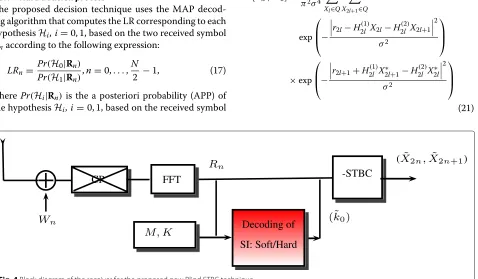
In this section, we present the block diagram for the recovery of the SI index as shown in Fig. 4.
For the rest of the paper, we assume that both the transmitter and the receiver consider the same
code-bookMand that during the recovery process, the
chan-nel state information (CSI) is perfectly known. Letr =
[r0,. . .,rN−1]T be the received sequence where rn is
defined in Eq. (5) andRn is the couple of the received
sequences such that
Rn=[r2n,r2n+1]T,n=0,. . .,
N
2 −1. (15)
It is clear thatrn is a function ofX(i),i = 1, 2, which depends on the used precoder sequenceSeq(k0)and leads
to the minimum value of the PAPR. Subsequently, to effi-ciently detect the used index, we consider two hypotheses that arise from the methodology used to define the code-book Min order to encode the couple (X2n,X2n+1) as
H
0:(X2n,X2n+1) is encoded according to(Sch0),
H1:(X2n,X2n+1) is encoded according to(Sch1).
(16)
In the following paragraph, we explain the hard deci-sion process dedicated to detect the used indexk˜0in an
efficient way.
4.3.1 Hard decision process
The proposed decision technique uses the MAP decod-ing algorithm that computes the LR corresponddecod-ing to each hypothesisHi, i=0, 1, based on the two received symbol Rnaccording to the following expression:
LRn= the hypothesisHi,i=0, 1, based on the received symbol
Rn. Then, using the Bayes’ theorem, the expression of
Pr(Hi|Rn)is as follows:
Furthermore, we deduce from the total probability theorem thatPr(Rn|Hi)has the following expression:
Pr(Rn|Hi)=
variables, thus we can reformulate the last expression as follows
and
It results that the quantityLRncan be obtained as
LRn = PrPr((RRnn||HH01)) =
ered constellation, including the M-QAM and the QPSK modulations, and the functionsf andgare defined as
fX2l,X2l+1= 1
Since it is easier to manipulate theLog operator when
dealing with the exponential function, the equivalentLR
expression becomes equivalent to theLLRthat is defined
as follows:
In order to avoid the explicit evaluation of the expo-nential function and to reduce the complexity, we exploit the max-log approximation [32]. Using this approxima-tion, we assume that a single element can be retained in the numerator and the denominator and which has the major contribution in the sum as
As result, using this approximation, we define the
MLLRnmetric as
MLLRn≈ln
Finally, the proposed decision criteria used to estimate theSeq(k0)components is
Besides, as the precoder matrix is known at the receiver side, then by using the min-max criteria, the index of the considered precoder sequencek˜0is deduced according to
the following metric:
Indeed, the hard decision criteria ensures good decision performance, but when it is close to zero (for low sig-nal to noise ratio (SNR) values), making a hard decision based onH0orH1could lead to a wrong estimation of the
code vector and subsequently introduce a major decision error. To resolve this issue, we investigate, in the following paragraph the soft decision criteria.
4.3.2 Soft decision process
To resolve the issue of very low |LLR|, we define a new decision in which the estimation of the code vectorSeq(k˜)
depends on the whole received sequenceRnas
˜
k0= argmax
0≤k≤K−1
PrRn|Seq(k) . (29)
To deduce the decision metric, we first begin by defining the closed-form expression of the conditional probability Pr(Rn|Seq(k)). Since the precoder sequences
Seq(nk) N/2−1
n=0 are by construction assumed to be i.i.d.,
˜
k0= argmax
0≤k≤K−1
PrRn|Seq(k)
= arg max
0≤k≤K−1
N/2−1
n=0
log
⎧ ⎨ ⎩
Pr
Rn|Seq(nk)
Pr
Rn| ¯Seqn(k) ⎫ ⎬ ⎭,
(31)
whereSeq(nk)is the complementary ofSeq(nk).
Finally, we deduce that the estimated index k˜0 can be
expressed as follows:
˜
k0=arg max 0≤k≤K−1
N
2−1
n=0
nξn(k)= arg max
0≤k≤K−1
% ξ(k),&,
where
ξ(k) n =
1 if Seq(nk)=0,
−1 if Seq(nk)=1. n=MLLRn,n=0,. . ., N
2 −1. (32)
5 Blind SLM-STBC technique
In this section, we propose a powerful detection
pro-cess denoted as “BSLM-STBC” technique. As it is
illus-trated in Fig. 5, this technique consists on combining
both the STBC precoder codebook M and the set of
rotated and unrotated M-QAM constellations used in
[18]. This embedded signaling enhance the detection pro-cess described in the Section 4 and also significantly reduce the PAPR level.
5.1 Embedding the SI into the OFDM symbol
The main steps of the improved algorithm performed at the transmitter side are summarized according to the
fol-lowing steps. First, we multiply the original data X by
independent phase sequences to obtain Xφ. Then, each
couple X2φn,X2φn+1 will be encoded according to the
Alamouti codebookM. Finally, the sequence that has the
lowest PAPR is kept and then transmitted.
Compared to the previous situation, we note that the
codebookM is replaced by a (K × N2) matrix denoted
G, where K present the precoder vector sequences
denoted by Cseq(k). Also, each component matrix ,
[G(k,n)]n=1,..., N
2
k=1,...,K, refers to 3 bits where:
1. The first bit indicates if theX2nbelongs to the
rotated set i.e.,E2or not i.e.,E1. Thus, IfSeqn(k)=0,
thenX2ϕn=X2n.ejϕ1,ϕ1∈E1, otherwise
X2ϕn=X2n.ejϕ2,ϕ2∈E2.
2. The second bit indicates if theX2nbelongsE2orE1.
IfSeqn+1(k)=0,thenXϕ2n+1=X2n+1.ejϕ1,ϕ1∈E1, otherwiseX2ϕn+1=X2n+1.ejϕ2,ϕ2∈E2.
3. The third bit refers toSchi,i=0, 1. IfSeqn+2(k)=0,
thenX2ϕn,X2ϕn+1will be coded by using the scheme
codeSch0. If it is not the case, we considerSch1.
To simplify the analysis of the proposed technique, we suggest first to refer to the hard decision metric instead of the soft one and then we propose the use of an hierarchi-cal coding scheme at the transmitter side assuming thatG contains only 010 and 101. This is equivalent to transform the hypothesis of Eq. (16) as
Hr
0 : ifG(i,j)=010⇒(X2n∈E1,X2n+1∈E2)and(Sch0),
Hr
1 : ifG(i,j)=101⇒(X2n∈E2,X2n+1∈E1)and(Sch1).
Then, forK = 2 andN = 4, the obtained sequences is
described as follows:
G=
In the following section, we analyze how the actually transmitted side information index will be estimated.
5.2 Precoder sequenceCseq(k0)estimation
Once the precoder matrixGis defined, in the receiver side, we reiterate the same reasoning to recover the transmit-ted signal as in Section 4.1 and where we perform a hard decision. The decision process will bank on the embedded signaling defined through the STBC precoders codebook
G. Therefore, the Eq. (24) can be redefined as follows:
LLRn = ln resent the coordinates of the rotated and the unrotated constellation points, respectively.
Then, theMLLRncan be estimated as
MLLRn ≈ln
After computing the MLLRn, the estimated vector
Cseq(k0)can be constructed as
In the second step, and as the precoder matrix G is
known at the receiver side, this vector must be mapped to the closest sequence. Therefore, the index of the con-sidered sequencek˜0is deduced according to the following
minimization metric:
Finally, the transmitted sequence is deduced.
It should be noted that the complexity of our proposed methods at the receiver side is based mainly on the choice of the used STBC decoder. In our study, we consider a conventional decoder, where authors in [33] showed that
the complexity of STBC detection algorithms is equal
to O(NQ), where N denotes the number of subcarriers
and Q denotes the number of transmitted symbols per
STBC block. Thus, since we exploit in our estimation pro-cess two conventional STBC schemes, we can conclude that the complexity of our proposed methods is equal to 2∗O(NQ).
6 Simulation results
The performance of the proposed blind methods in MIMO-OFDM systems is evaluated through simulation results. These simulations are performed for both the transmitter and the receiver sides. At the transmitter side, the performance is evaluated in terms of the CCDF of the PAPR versus its threshold. At the receiver side, the perfor-mances are highlighted in terms of the side information error rate (SIER) that indicates the percentage of failure detection of the phase sequence and the BER.
6.1 Simulation parameters
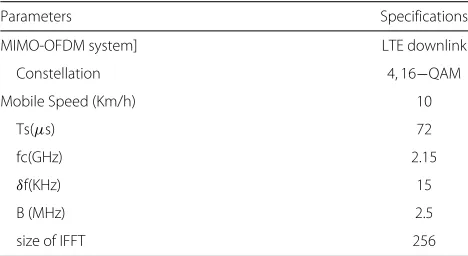
In this section, we detailed the simulation parameters based on three GPP specifications of the downlink LTE standard [36], as shown in Table1.
Besides, we consider a selective channel where the assumption of Alamouti decoder is fulfilled, which means that the channel response will be constant during the transmission period of Alamouti codeword. To achieve this assumption, we consider in the simulation, a mobile speed equal to 10 Km/h, where the variations in time and in frequency of the used channel are drawn in Fig. 6.
Table 1Parameters of simulations
Parameters Specifications
MIMO-OFDM system] LTE downlink
Constellation 4, 16−QAM
Mobile Speed (Km/h) 10
Ts(μs) 72
fc(GHz) 2.15
δf(KHz) 15
B (MHz) 2.5
Fig. 6Time-varying channel frequency response (mobile speed = 10 km/h)
6.2 Transmitter side
In order to evaluate the performance of the proposed blind methods, we first consider the case of STBC with a full rate i.e., the rate is set to 1, and then the case of a rate equal to34.
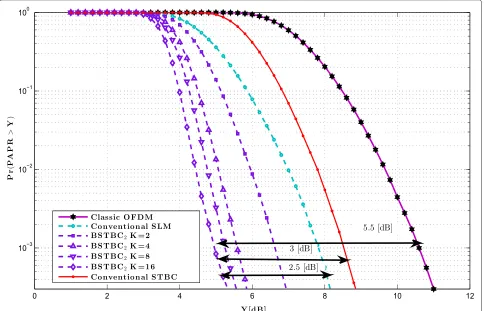
As shown in Fig. 7, we vary the number K of the
used precoder sequences in the STBC matrix denoted by
STBC2. We deduce that whenKincreases, the PAPR level
decreases. Moreover, forK = 8, we obtain respectively
a gain of 5.5, 3, and 2.5 dB, compared to the classical
Fig. 8Performance in terms of PAPR in the case of STBC34-rate for 4-QAM andN=128
Fig. 10Uncoded soft-BSTBC versus uncoded hard-BSTBC SIER whereK = 4 and 4-QAM
OFDM system, the conventional STBC and the SLM sys-tem. Using the same reasoning outlined in Section 4 and considering the schemes of the 34-rate STBC [23, 24], the Sch0andSch1can be written as
sch1= ⎛
⎝ X2n X
∗
2n+1 X2∗n+2 0
X2n+1 −X2∗n 0 X∗2n+2
X2n+2 0 −X2∗n X∗2n+1
⎞ ⎠,
sch0= ⎛
⎝ X2n −X
∗
2n+1 −X2∗n+2 0
X2n+1 X2∗n 0 −X2∗n+2
X2n+2 0 X∗2n X2∗n+1
⎞ ⎠.
We can observe from Fig. 8 that at a probability equal to 10−4, the Blind3
4-rate STBC method, denoted by STBC3,
reduces the PAPR by 6 and 7 dB when K = 4 and 8,
respectively. Furthermore, the STBC 34-rate improves the
PAPR reduction compared to the case of STBC2, where we
achieve a gain around 2 dB forK =2. This gain is obtained
in the case of the STBC3since the amount of information
is reduced, for each antenna, compared to the STBC2. In
other words, only34of data will be sent contrary to STBC2
where all the data is sent.
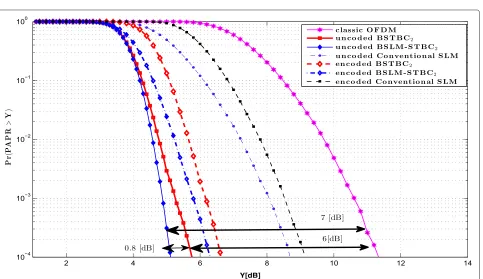
In Fig. 9, we consider a convolution encoder and a Viterbi decoder. In this figure, we compared the coded and the uncoded PAPR in the case of conventional SLM-STBC and the proposed Blind methods. We notice from
this figure that, both methods, i.e., the encoded and the uncoded, enhance the performance in terms of PAPR compared to the conventional OFDM and the method SLM-STBC described in [17]. In addition, performing the proposed BSLM-STBC technique improves the PAPR
reduction where the gain is around 0.8 dB forK = 8.
6.3 Receiver side
Figure 10 illustrates the SIER curves for 4-QAM constel-lation. Clearly, we observe that both the hard and soft decision processes lead to a good system performance. Furthermore, the soft decision technique leads to a gain compared to the hard decision of 3 dB in the case of N = 256.
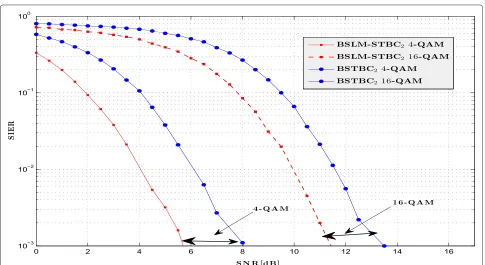
In Fig. 11, we present the obtained SIER curves ver-sus the SNR considering the two proposed decision techniques, ie., the one using only the hard STBC and the BSLM-STBC. We conclude that both the hard-BSTBC and BSLM-STBC decisions processes lead to a good system performance. Furthermore, the BSLM-STBC decision technique leads to a significant gain compared to the hard decision technique. Indeed, in the case of
Rayleigh fading channel of lengthL = 4, and
consider-ing 4-QAM and 16-QAM constellations, the BSLM-STBC technique can reach to 2 dB.
Moreover, to evaluate the performance of the receiver side in terms of BER, first, we consider two
Fig. 12BER performance comparison: uncoded and encoded (Viterbi) Blind SLM-STBC in the case of Rayleigh fading channel whereK = 4,
Fig. 13BER performance comparison: encoded (Viterbi) and uncoded BSTBC technique in the case of a Rayleigh fading channel whereK = 4,
N = 256, andL = 1
cases: the case where we perform a Blind technique (BSTBC, BSLM-STBC) and the one where the phase sequence is perfectly known at the receiver side. Second, we consider a conventional Viterbi decoder
with a rate equal to 12 and a hard decoder at the
receiver side.
Figures 12 and 13 illustrate the performance of BER for convolution encoder/Viterbi decoder and uncoded Blind technique in the case of a Rayleigh fading channel where
K = 4 andN = 256 forL = 1 andL = 4,
respec-tively. For the case of QAM constellation, we observe a good fitting between the uncoded/encoded BSLM-STBC curves and the perfect uncoded/encoded classical curves. This proves well that our proposed bind methods lead to a performance which is quasi-identical to the ordinary one with perfectly known SI. Finally, we notice that using the Viterbi decoder at the receiver side enhance the perfor-mance in terms of BER, where we obtain 4 dB of a gain in
the case of 4-QAM andL = 1.
7 Conclusions
In this paper, we investigate an efficient PAPR reduction technique dedicated to the MIMO-OFDM systems using STBC precoders codebook. The main feature of our proposed method is to induce an embedded signaling through the advanced precoders codebook. This form of
signaling leads to a powerful recovery of the transmit-ted signal and guarantees a very low failure decision rate. To further improve the decision process, we proposed an additional embedded signaling that consists of a set of rotated and unrotated QAM constellations. Indeed, when this latter is used in the decision process (using a hard decision deduced from a Max-Log-MAP decod-ing), it improves the MIMO-OFDM system performances in terms of the CCDF, PAPR, SIER, and BER. The work perspective will be devoted to the applicability of our pro-posed technique in the spectrum sensing case for the cognitive radio systems.
Competing interests
The authors declare that they have no competing interests.
Acknowledgements
Parts of this paper were published in the IEEE Wireless Communications and Networking (WCNC) 2013 conference [37].
Received: 6 March 2015 Accepted: 7 September 2015
References
1. LJ Cimini, Analysis and simulation of digital mobile channel using orthogonal frequency division multiplexing. IEEE Trans. Commun.33(7), 665–675 (1985)
3. YR Zheng, M Wang, W Zeng, C Xiao, Practical linear precoder design for finite alphabet multiple-input multiple-output orthogonal frequency division multiplexing with experiment validation. IET Commun.7(9), 836–847 (2013)
4. K Zheng, B Fan, J Liu, Y Lin, W Wang, Interference coordination for OFDM-based multihop LTE-advanced networks. IEEE Wirel. Commun.
18(1), 54–63 (2011)
5. G Wunder, RFH Fischer, H Boche, S Litsyn, J-S No, The PAPR problem in OFDM transmission: new directions for a long-lasting problem. IEEE Signal Proc. Mag.30(6), 130–140 (2013)
6. E Costa, M Midrio, S Pupolin, Impact of amplifier nonlinearities on OFDM transmission system performance. IEEE Commun. Lett.3(2), 37–39 (1999) 7. MS Baek, MJ Kim, YH You, HK Song, Semi-blind channel estimation and
PAR reduction for MIMO-OFDM system with multiple antennas. IEEE Trans, Broadcast.50(4), 414–424 (2004)
8. MS Baek, MJ Kim, YH You, HK Song, Semi-blind channel estimation and PAR reduction for MIMO-OFDM system with multiple antennas. IEEE Trans. Broadcast.50, 414–424 (2003)
9. M Tan, Z Latinovic, Y Bar-Ness, STBC MIMO-OFDM peak-to-average power ratio reduction by cross-antenna rotation and inversion. IEEE Commun. Lett.9(7), 592–594 (2005). http://ieeexplore.ieee.org/xpl/login.jsp?tp= &arnumber=1461674&url=http%3A%2F%2Fieeexplore.ieee.org%2Fiel5 %2F4234%2F31451%2F01461674
10. RFH sher, M Hoch, Directed selected mapping for peak-to- average power ratio reduction in MIMO OFDM. IEE Electron. Lett.42(22), 1289–1290 (2006)
11. RFH sher, M Hoch, Partial transmit sequences for peak-to-average power ratio reduction in multiantenna OFDM. EURASIP J. Wirel. Commun. Netw. Special Issue on “Multicarrier Systems”, (2010)
12. H Lee, DN Liu, W Zhu, MP Fitz, Peak power reduction using a unitary rotation in multiple transmit antennas. IEEE Int. Conf. Commun.4, 2407–2411 (2005)
13. A Sauffr, ER Meng, Optimal peak-to-average power ratio reduction in MIMO systems. IEEE Int. Conf. Commun. (ICC).7, 3094–3099 (2006) 14. Z Latinovic, Y Bar-Ness, SFBC MIMO-OFDM Peak-to-average power ratio
reduction by polyphase interleaving and inversion. IEEE Trans. Commun. Lett.10(4), 266–268 (2006). http://ieeexplore.ieee.org/xpl/articleDetails. jsp?arnumber=1613742&navigation=1
15. CL Wang, SS Wang, HL Chang, A low-complexity SLM based PAPR reduction scheme for SFBC MIMO-OFDM systems. Proc. IEEE Wirel. Commun. Netw. Conf, 1449–1453 (2011)
16. MF Naeiny, F Marvasti, Selected mapping algorithm for PAPR reduction of space-frequency coded OFDM systems without side information. IEEE Trans. Vehi. Tech.60(3), 1211–1216 (2011). http://ieeexplore.ieee.org/xpl/ articleDetails.jsp?arnumber=5703137&newsearch=true&queryText= Selected%20Mapping%20Algorithm%20for%20PAPR%20Reduction %20of%20Space-Frequency%20Coded%20OFDM%20Systems %20Without%20Side%20Information
17. MF Naeiny, PAPR Reduction scheme in SFBC MIMO-OFDM systems without side information. IEEE ICC, 4708–4712 (2013)
18. M Sghaier, F Abdelkefi, M Siala, Efficient embedded signaling through rotated modulation constellations for SLM-based OFDM systems. IEEE ICC, 3846 (2013)
19. RA Stirling Gallacher, Z Wang, Improving performance of coherent coded OFDM systems using space-time transmit diversity. Electronic Lett.37, 457–458 (2001)
20. L Zheng, DNC Tse, Diversity and multiplexing: a fundamental trade-off in multiple-antenna channels. IEEE Trans. Inform. Theory.49(5), 1073–1096 (2003)
21. DB KF Lee, A Williams, space-frequency transmitter diversity technique for OFDM systems. IEEE Globecom.3, 1473–1477 (2000)
22. V Tarokh, N Seshadri, AR Calderbank, Space-time codes for high data rate wireless communication: performance criterion and code construction. IEEE Trans. Inf. Theory.44, 744–765 (1998)
23. V Tarokh, H Jafarkhani, AR Calderbank, Space-time block codes from orthogonal designs. IEEE Trans. Inf. Theory.45, 744–765 (1999) 24. V Tarokh, H Jafarkhani, AR Calderbank, Space-time block coding for
wireless communications: performance results. IEEE J. Sel. Areas Commun.17, 451–460 (1999)
25. A SM Alamouti, simple transmit diversity technique for wireless communications. IEEE J. Sel. Areas Commun.16(8), 1451–1458 (1998)
26. J Armstrong, Peak-to-average power reduction for OFDM by repeated clipping and frequency domain filtering. IET Electron. Lett.38(5), 246–247 (2002)
27. H Ochiai, ‘A novel trellis-shaping design with both peak and average power reduction for OFDM systems’. IEEE Trans. Commun. 52(11), 1916–1926, (2004) Telecommun., vol.52, no. 1/2, pp. 58–67, Feb. 1997 28. F Abdelkefi, P Duhamel, F Alberge, Impulse noise correction in Hiperlan 2:
improvement of the decoding algorithm and application to PAPR reduction. IEEE Int. Conf. Commun. (ICC).3, p2094—2098 (2003) 29. T Jiang, Y Zhou, An improved tone reservation scheme with fast
convergence for PAPR reduction in OFDM systems. IEEE Trans. Broadcast.
57(4), 902–906 (2011)
30. DW Lim, SJ Heo, JS No, On the phase sequence set of SLM OFDM scheme for a crest factor reduction. IEEE Trans. Signal Proc.12(2), 93–96 (2005) 31. L Yang, KK Soo, SQ Li, YM Siu, P A P R reduction using low complexity PTS
to construct of OFDM signals without side information. IEEE Trans. Broadcast.57(2), 284–290 (2010)
32. L Hanzo, M Munster, BJ Choi, T Keller,OFDM and MC-CDMA for broadband multi-user communications, WLANs and Broadcasting. (IEEE Press and John Wiley & Sons, Ltd, Chichester UK, 2003)
33. C Xu, D Liang, Reduced-complexity soft STBC detection. IEEE Globecom.
57(2), 42170–4221 (2012)
34. K Fazel, S Kaiser,Multi-carrier and spread spectrum systems, 2nd ed. (John Wiley, Sons, United Kingdom, 2008)
35. Y Lu, G Stuber,Orthogonal Frequency Division Multiplexing for Wireless Communications. (Springer, Atlanta, USA, 2006)
36. 3rd Generation Partnership Project, Technical Specification Group Radio Access Network; Evolved Universal Terrestrial Radio Access (UTRA): Base Station (BS) Radio Transmission and Reception, TS 36.104. V8.7.0 September 2009
37. M Sghaier, F Abdelkefi, M Siala, Efficient embedded signaling through Alamouti STBC precoders in MIMO-OFDM systems, (WCNC), 4053-4058 (2013). http://ieeexplore.ieee.org/xpl/login.jsp?tp=&arnumber= 6555226&url=http%3A%2F%2Fieeexplore.ieee.org%2Fxpls%2Fabs_all.jsp %3Farnumber%3D6555226
Submit your manuscript to a
journal and benefi t from:
7 Convenient online submission 7 Rigorous peer review
7 Immediate publication on acceptance 7 Open access: articles freely available online 7 High visibility within the fi eld
7 Retaining the copyright to your article