R E S E A R C H
Open Access
Interference-aware high-throughput channel
allocation mechanism for CR-VANETs
Madiha Tabassum
1, Md Abdur Razzaque
1*, Mohammad Mehedi Hassan
2, Ahmad Almogren
2and Atif Alamri
2Abstract
The incorporation of cognitive radio (CR) technology in vehicular ad hoc networks (VANETs) has given birth to a new network, namely CR-VANET, which facilitates the vehicular network to achieve communication efficiency in many resource-demanding applications including video and audio streaming, collision warning, gaming, etc. One of the primary challenges in this CR-VANET network is to allocate high-throughput licensed channels to the application requests in face of interference between the primary users (PUs) and the secondary users (SUs) and among the SUs on the channels. In this paper, we address the channel allocation problem in CR-VANET with the objective of
system-wide throughput maximization while maintaining the application quality-of-service (QoS) requirements in terms of channel throughput and packet delivery delay for data transmission. We develop conflict graphs of link-band pairs to describe the interference relationship among source-destination vehicle pairs on different channels and determine independent sets of vehicle pairs that can communicate simultaneously to maximize the spatial reuse of the licensed channels. Finally, we formulate a high-throughput channel allocation problem as a mixed-integer linear programming (MILP) problem. Through extensive simulations, we demonstrate that the proposed interference-aware high-throughput channel allocation mechanism (HT-CAM) provides with better network performances compared to state-of-the-art protocols.
Keywords: CR-VANET, Spatial reusability, Throughput, Channel utilization, Mixed-integer linear program
1 Introduction
The increasing number of on-road vehicles, their use of smart devices, and significant rise in vehicular appli-cations and services, especially in urban environments, have resulted in an overlay crowded dedicated short-range communication (DSRC) spectrum in the 5.9-GHz band. This spectrum scarcity causes degraded vehicular com-munication efficiency for safety applications (e.g., collision warning, road traffic reporting), bandwidth demanding real-time multimedia (e.g., video and audio streaming), and other legacy applications (e.g., email, web surfing, and so on) [1–5]. However, the spectrum utilization measure-ments over the past few years indicated a notable num-ber of unused and underused licensed spectrum bands over different space and time. According to the Fed-eral Communications Commission (FCC), temporal and
*Correspondence: [email protected]
1Green Networking Research (GNR) Group, Department of Computer Science and Engineering, University of Dhaka, Dhaka, Bangladesh
Full list of author information is available at the end of the article
geographical variations in the utilization of the assigned spectrum range from 15 ∼ 85 % [6]. Thus, the licensed bands have now opened by the regulatory agencies such as FCC for opportunistic use by the unlicensed or secondary users (SUs) to increase the utilization efficiency of the available spectrum bands [6–10]. The SUs use the licensed bands through the use of cognitive radio (CR) technology. The CR is an emerging technology to improve spectrum usage and to alleviate spectrum scarcity by exploit-ing underutilized spectrum resources through oppor-tunistic spectrum access without intercepting the legal or primary users (PUs) of the certain portion of the spectrum.
The growing spectrum-scarcity problem is further intensified due to the augment of high-bandwidth mul-timedia applications for in-car entertainment, driver-support services, intelligent transportation, etc. These demands have driven the use of CR technology in vehicular environment. The CR technology in vehicu-lar ad hoc network (VANET) enables the vehicles to
use underutilized licensed bands (e.g., TV white space, GSM white space, and so on) opportunistically. Hence, it improves vehicular communication efficiency by facilitat-ing more efficient radio spectrum usage. In CR-VANETs, each CR-enabled vehicle is equipped with an OBU that has moderate computing and communication capabili-ties with the entire neighbor vehicles as well as the RSU for Internet accessibility, information sharing, and many other intelligent applications [7]. In such a network, each CR-enabled vehicle needs to implement spectrum man-agement functionalities to (1) detect vacant spectrum opportunities, (2) decide the channel to use based on the quality-of-service (QoS) requests of the applications, and (3) transmit on it but without causing any harm-ful interference to the licensed owners of the spectrum. Hence, an efficient channel allocation mechanism is of great importance for a CR-enabled vehicle to opportunis-tically utilize the available licensed spectrum bands. One of the key challenges in this domain is how to perceive higher throughput for CR-enabled on-board devices in vehicles through dynamic access to the available licensed spectrum in the presence of interferences from PUs as well as SUs on different channels.
Although the opportunistic channel access mechanisms for CR networks [11–13] and VANETs [14–17] have been extensively studied in separate, the research in the context of CR-VANET is still at a preliminary stage. The oppor-tunistic channel allocation mechanism in CR-VANET has been investigated in a few number of existing works in the literature [18–21]. A cluster-based optimal channel access framework is proposed in [18], with an objective of maximizing the utility of data transmission by vehicles in a cluster under QoS constraints and collision prob-ability with licensed users. In [19], authors propose a game-theoretic spectrum access scheme for vehicles to opportunistically access licensed channels in a distributed manner where the spectrum access process is modeled as a non-cooperative congestion game. However, these stud-ies fail to achieve maximum possible throughput of the network due to the fact that they deal with individual vehi-cles to allocate a better channel instead of exploring how to achieve an optimal mapping for the allocation of the available channels to the requested users.
Authors in [20] propose a throughput-efficient channel allocation framework for multi-channel cognitive vehicu-lar networks with the objective of system-wide through-put maximization. A centralized two-step scheme for the spectrum resource allocation is developed in [21] to improve system efficiency and fairness. However, none of the above studies consider spatial reusability [22] of licensed channels for allocating those among non-interfering OBU pairs which can highly improve the overall network throughput as well as the white space utilization.
High vehicular density and mobility and spatial and temporal usage variation of licensed channels by PUs and SUs cause the problem of high-throughput channel allo-cation in CR-VANET a challenging one. In this work, we propose a novel interference-aware high-throughput channel allocation mechanism for CR-VANET, namely HT-CAM, that focuses on interference-free reusability of licensed channels to maximize the network throughput while the user QoS requirements are met in terms of channel bandwidth and data delivery delay. To cope with the rapidly changing vehicle locations, HT-CAM employs dynamic channel allocation approach at each RSU, which allocates available licensed channels to requested OBU pairs at each scheduling cycle.
In HT-CAM, the number of simultaneous CR trans-missions is maximized, i.e., the channel reusability is enhanced with the objectives of maximizing system-wide throughput as well as white space utilization. To achieve this, the HT-CAM develops conflict graphs of link-band pairs to describe the interference relationship among vehicle pairs and determines independent sets of vehicle pairs that can communicate simultaneously. That is, the HT-CAM optimally assigns available chan-nels to the vehicle pairs that want to communicate in a scheduling cycle such that network-wide throughput is maximized, rather exploring an individual vehicle’s achievable throughput. We formulate a channel assign-ment problem as a multi-constraint linear programming problem. The contributions of this paper are itemized as follows:
– A novel interference-aware high-throughput channel allocation mechanism, HT-CAM, has been proposed. – Interference-free maximum independent sets of
link-band pairs have been constructed exploiting conflict graphs so as to maximize the spatial reusability of licensed channels.
– A mixed-integer linear programming (MILP) optimization function is formulated which maximizes network throughput while maintaining QoS requirements of vehicular applications in terms of channel bandwidth and data delivery delay. – The performance of HT-CAM is simulated
extensively and compared with the state-of-the-art channel allocation mechanisms using NS-3.
2 Related works
Channel allocation problem constitutes an interesting and well-investigated research issue of CR networks and VANETs. There are many channel allocation mecha-nisms proposed for general-purpose CR networks and VANETs which cannot be directly applied to CR-VANETs. This is because the unique features of both vehicular environment and cognitive radio network need to be taken into account while designing the spectrum man-agement mechanisms for CR-VANETs. Despite the sig-nificant number of channel allocation mechanisms for VANETs [14–17] and CR networks [11–13, 23], a very few works have been done in the context of CR-VANETs.
In [18], Niyato et al. investigated the optimal chan-nel access in a cluster-based CR-VANETs to maximize the utility of vehicles in a cluster under certain QoS constraints for a grid-like urban street layout, under the assumption that the channel availability statistics are known by the vehicles. In [19], authors studied the channel availability for CR-VANETs in urban scenarios, taking the mobility pattern of the vehicles into account. Exploiting the statistics of licensed channel availability, a distributed opportunistic spectrum access scheme that is based on a non-cooperative congestion game is proposed. How-ever, these methods focus on allocating optimal channel to a vehicle pair requesting transmission that maximizes the throughput of that particular transmission but fails to maximize the aggregated throughput of the network. Hence, new channel allocation mechanisms are needed for network-wide throughput maximization.
In [20], authors proposed a centralized channel allo-cation framework for system-wide throughput maxi-mization in CR-VANETs. They consider high vehicular mobility, spatial-temporal variations of licensed channels as well as collision probability constraints imposed by the PUs. They developed a probabilistic polynomial time algorithm based on linear programming in order to maxi-mize overall network throughput. The channel allocation decision is taken based on vehicles’ packet priorities and packet sizes, expected remaining idle time of each licensed channel.
Authors in [21] considered a centralized CR-VANET architecture where the network is divided into several cognitive cells. A cooperative bargaining spectrum allo-cation mechanism based on game theory is proposed to formulate the inter-cell and intra-cell resource allocation in CR-VANET with the objective of maximizing system efficiency and fairness.
The existing works allocate channels to the vehicles only considering their interference with primary users. How-ever, none of the existing works have considered the spa-tial reusability of licensed channels among non-interfering OBU pairs, i.e., they cannot schedule a single channel to more than one non-interfering OBU pairs. Thus, the
existing mechanisms do not perform very well when the number of primary users in the network is very high and a very small number of licensed channels are avail-able for opportunistic use. Therefore, we have designed an interference-aware HT-CAM that maximizes over-all network throughput by considering spatial reusability of licensed channels. For this purpose, HT-CAM deter-mines independent sets of non-interfering OBU pairs by developing conflict graphs. Finally, HT-CAM develops a linear programming model to obtain the optimal policy for channel assignment to the OBU pairs with objective of network-wide throughput maximization while QoS con-straints (e.g., channel bandwidth, data delivery delay) for data transmissions are met.
3 System model and assumptions
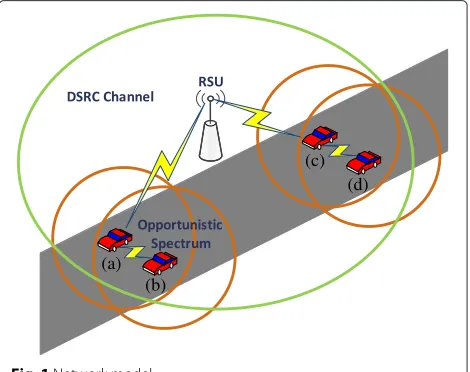
We assume a CR-VANET with multiple vehicles, each containing an OBU, opportunisically access vacant licensed channels and an RSU (a base station), which serves a group of on-road vehiclesN = {1, 2, 3,. . .,n}, as shown in Fig. 1. The vehicles move on predetermined roads at high speeds and enter/exit the coverage area of an RSU. An OBU is a communication device mounted on vehicles. In CR-VANETs, a vehicles’ OBU communicates with other vehicles’ OBUs for varieties of applications as mentioned in Section 1. From now on, in this paper, we use the terms “OBU” and “vehicle” interchangeably.
The PU network and the VANET are generally unrelated in terms of communication and services they provide to the customers. While the former uses licensed channels, the latter works on unlicensed channels. In this work, we assume that they co-exist in the same area [6, 7]. We also assume that the arrival pattern of PUs on a channel is Poisson distributed. The OBUs in the vehicles are SUs for the licensed spectrum when no PUs are accessing it.
(a) (b)
(d) (c)
In this environment, the OBUs are the CR-enabled SUs of licensed channels. Vacant channels are detected by an individual OBU through periodically running a suitable spectrum-sensing algorithm [24, 25]. Many signal detec-tion techniques can be used for spectrum sensing in order to improve the probability of detection. Existing tech-niques are categorized as based on energy detection [26], matched filter detection [27], cyclostationary detection [28], and wavelet detection [29]. Any of these techniques can be applicable in our proposed mechanism. Each OBU knows its one-hop neighbor nodes by periodically running neighborhood discovery mechanism, described in Section 4. Each OBU also knows its (x,y) location using GPS.
The list of available licensed channels for an OBU varies over time depending on its location. LetB= {1, 2,. . .,b} be the set of licensed channels, and their bandwidths are W1,W2,. . .,Wb, respectively. Let Bi ∈ B represent the set of licensed channels that are not used by the PUs (i.e., available for opportunistic use), sensed by OBUi ∈ N , Bimay be different fromBj, where,i =j, ∀i,j∈ N , i.e., possibly,Bij=Bi∩Bj= ∅.
In HT-CAM, each OBU has a single transceiver and only single hop communication between source-destination OBUs is considered, no multi-hop communication is allowed. Each OBU has a transmission queue, where data packets are stored temporarily until they are transmitted. We assume that all the data packets in the transmission queue of source OBUicorrespond to the same application at a given time and destined to a particular OBUj. LetDij be the size of the transmission queue, where the length of the data packets in the queue isLiat a particular time.
The proposed HT-CAM emphasizes on locally avail-able spectrum bands, and, most importantly, the temporal
and spatial variations in the PU’s channel activities are exploited to determine the optimal allocation of chan-nels. OBUs communicate with each other using one of the available licensed channels decided by the RSU. The com-munications between an OBU and the RSU are done on the dedicated short-range communication (DSRC) con-trol channel [6, 30]. A transmitter and receiver OBU having a common licensed channel between them can communicate on that channel. Such OBU pairs can be far away from each other and may not be within the interfer-ence range of each other. Thus, aforesaid OBU pairs can transmit on the same channel without interfering each-other transmissions. Assume that two OBUsAandCneed to send data to the OBUsBandD, respectively, as shown in Fig. 1. SinceAandCare not in the interference range ofBorDand vice versa, the transmissions at OBU pairs (A,B) and(C,D)on the same channel will not interfere with each other.
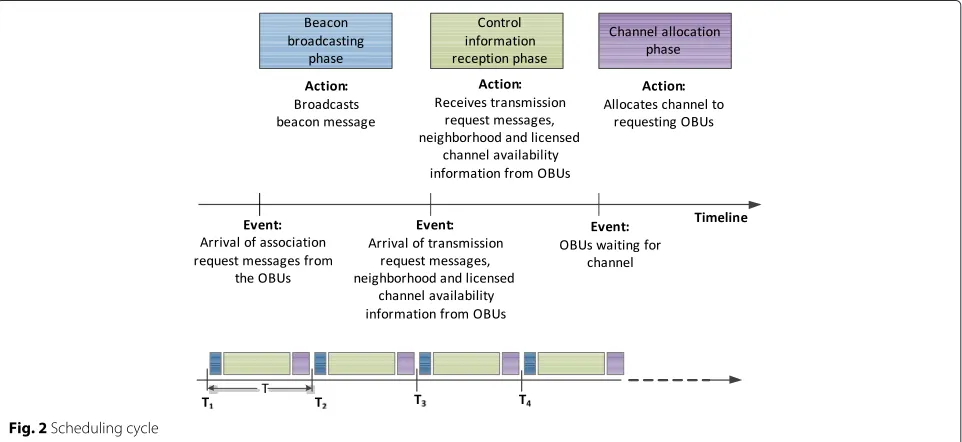
In HT-CAM, time is partitioned into equal schedul-ing cycles with length T. Each scheduling cycle con-sists of three phases: beacon broadcasting phase, control information reception phase, and channel allocation phase as shown in Fig. 2. In beacon broadcasting phase, RSU broadcasts beacon message containing its identity. This broadcast message is received by all OBUs, helping them to register with RSU for newly arrived OBUs and checking connectivity for the already registered OBUs. Once registered, OBUs that have packets in its trans-mission queue request the RSU for licensed channels to communicate with the destination OBUs. In the control information reception phase, RSU receives transmission request messages, sensing, and neighborhood information from the OBUs. Finally, in channel allocation phase, the RSU allocates licensed channels to the OBUs by executing
Table 1List of notations
Notation Description
B Set of licensed channels in the network
Wb Bandwidth of channelb
N Set of OBUs registered with an RSU
Bi Set of available licensed channels at OBUi
Bij Bi∩Bj, set of common channels available atiandj
T Length of scheduling cycle
Ni Set of neighbors of OBUi
Ptri Transmission power of an OBUi
Dij Number of data packets awaited in the queue of OBUifor transmission from OBUito OBUj
ψij Required data rate for transmission
δij Tolerable maximum transmission delay
Zb PU idle time at channelb
λb PU arrival rate at channelb
qbij Transmission quota of OBU pair{i,j}on channelb sbij Success probability of OBU pair{i,j}on channelb Rbij Achievable data rate from OBUito OBUjon channelb
ζ Medium access delay
SINRbij SINR value between OBUiand OBUjon channelb Li Length of the packets at the transmission queue of OBUi
τb
ij Required tx time for OBU pair{i,j}on channelb
ρI Weight of independent setI
Set of all maximum independent sets P Set of all OBU pairs requesting transmission I(i) Set of OBUs in the interference range of OBUi
ω(G) Set of all independent vertices in a conflict graphG
our proposed channel allocation mechanism to determine the most suitable channel for a given transmission.
We also assume that each OBU i uses a fixed trans-mission powerPtri corresponding to a fixed transmission range and interference range is typically 1.5 to 3 times higher than the transmission range. The notations used to model the problem are listed in Table 1.
4 Design of HT-CAM
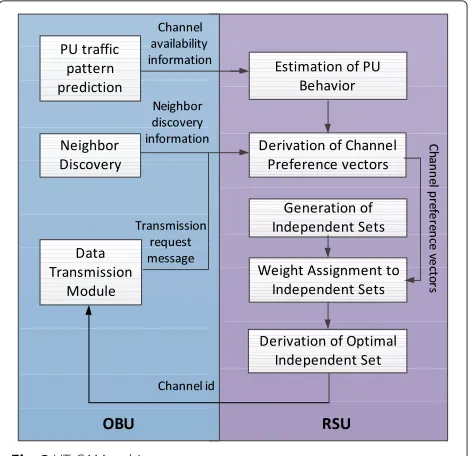
In this section, we describe in detail the proposed interference-aware high-throughput channel allocation mechanism, called HT-CAM for CR-VANET. The design components of HT-CAM architecture is shown in Fig. 3. The RSU derives channel preference vectors based on the neighbor discovery and sensing information received from OBUs and generates independent sets by establish-ing conflict graphs. After that, the RSU assigns weight to each independent set using channel preference vectors. Finally, the RSU selects an independent set such that the
Fig. 3HT-CAM architecture
network throughput is maximized and assigns channels to OBUs following the channel assignment strategy of the selected independent set.
4.1 Activities of OBUs
OBUs with data packets in transmission queue send request to the RSU for licensed channels. RSU is respon-sible for allocating communication channels to the OBUs. To facilitate the channel allocation decision at RSU, OBUs need to periodically predict the PU traffic pattern in the licensed channels and send this information to the RSU. OBUs also need to send their neighborhood information to the RSU periodically.
4.1.1 Neighbor discovery
Each OBU maintains a neighbor table. Each neighborjof ihas|Bij|entries in its neighbor table where an entry is structured as < j, SINRbij >, where SINRbij is the signal to interference plus noise ratio between OBUiandjon license channelb∈Bij.
Neighbor discovery is done by each OBUiby period-ically broadcasting HELLO message on all the licensed channels inBi. When an OBUjreceives HELLO message from OBUivia a licensed channelb ∈ Bij, OBUj calcu-lates SINRbij and enters a new entry< i, SINRbij >in its neighbor table. SINRbijis computed as follows [31],
SINRbij= Pij Pnoise+∀k∈νb
kPkj
(1)
wherePnoiseis the signal strength of Gaussian noise, which
the set of all OBUs from which OBUjreceives HELLO message on channelb, except OBUi.Pij is the received signal strength from an interfering OBUiat receiver OBU jand is described as follows:
Pij= P tr i
||i−j||η (2)
where ||i − j|| stands for the instantaneous distance between OBU i and OBU j andη is the parameter for considering power decay due to distance, and it is usu-ally set between 2 and 4 depending on the environment [32]. Thus, OBUs can easily update their neighbor tables by receiving periodic HELLO messages on their avail-able licensed channels. Afterwards, each OBU performs neighbor discovery and reports its neighbor table to the RSU during control information reception phase in Fig. 2.
4.1.2 PU traffic pattern prediction
All the licensed channels are monitored periodically by the OBUs to assess the communication environment. Through repetitive monitoring of the licensed spectrum, a history of channel usage can be developed. Once a usage history is established, different prediction models (e.g., autoregressive (AR), autoregressive moving average (ARMA) with time varying coefficients, autoregressive integrated moving average (ARIMA), seasonal ARIMA (SARIMA), and so on [33]) can be used to forecast the future PU traffic pattern.
PU traffic pattern prediction enables the OBUs to esti-mate the licensed channel availability and channel utiliza-tion. There are normally two factors considered in the traffic pattern prediction: PU arrival rate and PU idle time. In this paper, OBUs use SARIMA model to predict PU arrival rate and PU idle time. SARIMA model can cap-ture the daily repetitive nacap-ture of PU traffic flow and the dependence of present traffic conditions on the immedi-ate past and provide more rational short-term PU traffic flow prediction compared to conventional AR, ARMA, and ARIMA model.
Each OBUi estimates the PU arrival rate,λbi, and PU idle time,Zib, at each of the licensed channelsb∈Busing SARIMA model according to [34], on the reception of beacon message from the RSU. Afterwards, each OBUi reports a list of PU traffic prediction samples to the RSU. Each sample is structured as< i,b,α,Zbi,λbi >. Here,αis a binary value which represents the availability of channel bto OBUi(0=PU absent, 1=PU present).
4.1.3 Transmission request
On reception of beacon message from the RSU, each OBU that has packets on its transmission queue sends a trans-mission request message,Treqto the RSU. Let i,jbe a
pair of OBU where source OBUiwants to send packets to the destination OBUj. The source OBU,iof the OBU pair
i,j, sendsTreqmessage to the RSU. TheTreqmessage is
structured as < Dij,Pitr,ψij,δij >, whereDijis the num-ber of data packets at sourcei’s transmission queue that needs to be transmitted to receiverj,ψij is the required data rate for transmission, and δij is the maximum data delivery delay that can be tolerated.ψijandδijare the QoS parameters for a particular transmission. The RSU assigns a channel to the OBU pairs in P such that these QoS requirements are met. Here,Pis the set of all OBU pairs that sentTreqat current scheduling cycle.
4.2 Activities of RSU
The responsibility of an RSU is to allocate the most opti-mal channel to the requesting OBU pairs. On reception of transmission request messages and sensing information from the OBUs, the RSU computes PU arrival rate (λb) and PU idle time (Zb) for each licensed channelb ∈ B observed by each useri ∈N . After that, it develops two channel preference vectors:transmission quotavector,Qij, andsuccess probabilityvector,Sij, for each pair of OBUs {i,j} that wants to communicate (see Section 4.2.2 for details). Then, the RSU solves an optimization problem to maximize overall system throughput by optimal allocation of non-interfering channels to OBU pairs. What follows is to present the details of the RSUs’ operation components.
4.2.1 Computation ofλband Zb
Let Zb = Z1b,Z2b,. . .,Zib andb = λb1,λb2,. . .,λbi be the sets of PU idle times and PU arrival rates, respec-tively, at channelb ∈ Bsensed by each vehiclei ∈ N . The RSU first drops the sensing results that are less trust-worthy (i.e., results that deviate much from the mean) and updates the setsZbandbas follows,
TheseZb andλbvalues are used to derive the chan-nel preference vectors, to be discussed in the following subsection.
4.2.2 Derivation of Qijand Sij
To ensure optimal allocation of available licensed channels to the requesting OBU pairs, the RSU needs to quantify the preference of each channelb∈Bin terms of its success probability and availability. The HT-CAM RSU maintains atransmission quotavector,Qij, and asuccess probability vector,Sij, for each OBU pair{i,j}based on the computed channel usage statistics, derived in the previous section. We representQij andSij as 1D column vector of length |Bij|, where Bij is the set of common licensed channels between OBUiandj, as shown in Eq. (7). Each entry is corresponding to a specific free data channelb ∈Bij, i.e., qbijandsbijrepresent transmission quota and success prob-ability of OBU pair{i,j}on channelb, respectively. In the following, we explain the derivation of column vectorsQij andSij. as the maximum number of packets that can be transmit-ted successfully through a given channelb ∈ Bij during the interval for which the channel is predicted to be free. Therefore, the upper value ofqbijis determined by achiev-able data rate,Rbij, of a given channelb∈Bijand its PU idle time,Zb. Therefore, the expression forqbijcan be written as follows,
where Dij is the queue size of transmitting node i and the achievable data rate from OBUito OBUjon chan-nelb, andRbij can be calculated using Shannon’s capacity equation as follows, the signal-to-interference plus noise ratio between OBUi
and OBUjon channelb, computed in Eq. (1). Hence, the column vectorQijbecomes
Qij=
Now, we derive the column vector Sij for each pair of OBUsi,jthat quantifies the probability that all the awaiting packets in transmission queue (Dij) will be suc-cessfully transmitted on each channel b ∈ Bij. The successful transmission probability of OBU pairi,jon channelb∈Bijwithout PU interruption is the probability that no PU will appear on channelbduring the required transmission periodτijb,
τb ij =
Li×Dij
Rbij +ζ. (11)
whereζis the medium access delay.
Thus, using Poisson distribution, we can calculate the successful transmission probability,sbij, of OBU pairi,j on channelb∈Bijas follows,
sbij=e−λbτijb, (12)
Thus, the column vectorSijbecomes
Sij=
The channel preference vectors are used to assign weight to the each OBU pair, to be discussed in the following subsections.
4.2.3 Generation of independent sets
To generate independent sets, the RSU first creates conflict graphs based on the requests received from the OBU pairs(i,j) ∈ P and available licensed channelsBij between OBUs iandj. We define a conflict graphG =
(V,E), whereV is the set of vertices andE is the set of edges; each vertexv∈V corresponds to a link-band pair (ij,b), which indicates that the OBU pair {i,j} operates on available licensed channelb ∈ Bij and the edge setE is constructed in such a way as to represent every inter-ference possibility that can be inferred among OBU pairs inG. Transmissions of two link-band pairs(i1j1,b1)and
(i2j2,b2)inGare said to interfere each other if any of the
following two conditions holds true:
– Condition 1 : Two different OBU pairs have at least one common OBU, that is,{i1,j1} ∩ {i2,j2} = ∅
– Condition 2 : If two OBU pairs are using the same channel, their transmissions interfere with each other when the transmitter or receiver OBU of one pair falls within the interference range of the transmitter or receiver OBU of the other pair. That is, if there are two channel assignments(i1j1,b1)and(i2j2,b2)such
thatb1=b2, then the transmissions of OBU pairs
(i1j1,b1)and(i2j2,b2)interfereiff(i1)∈{I(i2)∪I(j2)}
or(j1)∈ {I(i2)∪I(j2)}and vice versa. Here,I(i)
is the set of OBUs that fall within the interference range of OBUi.
Based on aforementioned conditions, the RSU connects two verticesv1 ∈V andv2∈ V ofGwith an undirected
edge e ∈ E, if their corresponding OBU pairs interfere with each other. Let ξ be the set of all possible con-flict graphs that can be generated based on the requests received from the OBU pairs (i,j) ∈ P and available
licensed channelsBij between OBUsiandj, then its size can be calculated as follows,
|ξ| =
∀(ij)∈P
|Bij| (14)
wherePis the set of all requesting OBU pairs at current scheduling cycle.
Given a conflict graph G = (V,E), we describe the impact of vertexv1∈Von vertexv2∈V, denoted asγv1v2 as follows,
γv1v2=
1 if there is an edgee∈Ein betweenv1andv2
0 otherwise;
If there is a vertexv ∈ V inGsatisfying the following condition,
∀u∈G u=v
γvu<1, (15)
then transmission at vertexvwill be successful even if all the other verticesu∈Vare transmitting at the same time. Such a vertexvis called an independent vertex. The RSU updates the set ξ based on the number of independent vertices in the conflict graphs as follows,
ξ =
G∈ξ| (|ω(G)| =max ∀G∈ξ|ω(G)|)
, (16)
whereω(G)is the set of all independent vertices in a con-flict graph G. Now, the RSU obtains the updated set ξ using Eq. (16), which contains the conflict graphs hav-ing maximum number of independent vertices. The set of allmaximum independent setscan now be obtained fromξ. Themaximum independent setis defined as the
(a)
(b) (c)
maximum number of vertices inG∈ξsuch that each ver-texv ∈ V is an independent vertex. That is, adding any other vertex to the set forces the set to be not independent. The job of RSU is to decide which maximum independent set to choose from.
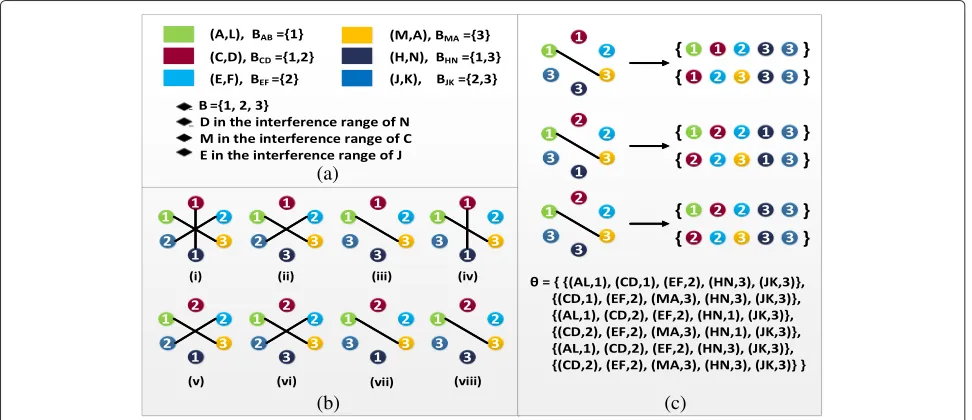
Here, we provide an illustration of the independent set generation procedure with the help of an example in Fig. 4. The requesting OBU pairs, their common avail-able licensed channels, and the network scenario is shown in Fig. 4a. Figure 4b shows all possible conflict graphs for the scenario of Fig. 4a. Each conflict graph is corre-sponding to a valid assignment of licensed channels to the requesting OBU pairs. In the conflict graphs, a node is corresponding to an OBU pair (represented by a spe-cific color as shown in Fig. 4a) and the assigned channel to the OBU pair is shown by the channel number asso-ciated with each node. In the conflict graph (i), as OBU pairs (A,L) and (M,A) have OBU A in common, their corresponding vertices are connected by an edge in E according to condition 1. Following condition 2, the ver-tices corresponding to OBU pairs(C,D)and(H,N) are also connected by an edge because they are assigned with the same licensed channel 1 and OBUDis in the inter-ference range of OBUN. There is another edge connected to the vertices corresponding to OBU pairs (E,F) and (J,K)for similar reasons. The RSU takes only the conflict graphs with maximum number of independent vertices. In this case, following Eq. (16), only 3 conflict graphs (iii), (vii), and (viii) are selected by the RSU as each of them have 4 independent vertices. The RSU finds the maximum independent sets for each of the conflict graphs (iii), (vii), and (viii) and developsas shown in Fig. 4c.contains all possible maximum independent sets of a particular scenario.
4.2.4 High-throughput channel allocation
Once we find the maximum independent set, transmis-sion quota vectorQij, and transmission success probability vectorSij, the problem of high-throughput channel allo-cation boils down to selecting an independent set from that maximizes the network throughput in a given scheduling cycle, maintaining the QoS requirements of the requesting OBUs. In this subsection, we formulate an LP objective function and the constraints that can solve the required high-throughput channel allocation problem. In HT-CAM, the RSU assigns a weightρIto each inde-pendent setI ∈ using the derived channel preference vectors as follows,
ρI =
∀(ij,b)∈I
qbij×sbij. (17)
Note that higher value ofρI is corresponding to high-throughput transmission for the independent setI. Thus,
the RSU formulates the mixed-integer linear program-ming (MILP) problem as follows,
max
I ρI, (18)
s.t.
∀I∈ (19)
τb
ij ×xbij≤Zb, ∀(ij,b)∈I,∀b∈Bij (20)
∀(ij,b)∈I
xbij≥0, ∀b∈Bij (21)
Rbij≥ij, ∀(ij,b)∈I (22)
τb
ij ≤δij, ∀(ij,b)∈I (23) Bij= ∅, ∀(ij,b)∈I (24)
wherexbijis a boolean variable,xbij=1 if OBU pairi,jis scheduled on channelb, 0 otherwise.
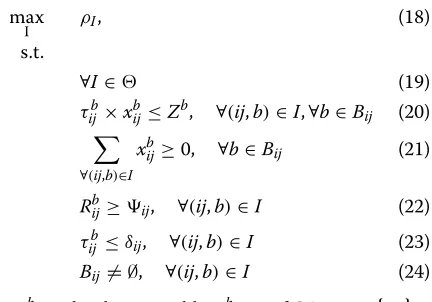
In Eq. (18), the objective is to maximize the weight of independent sets under constraints given in (19–24). The constraint (19) indicates that each independent set is a member of, which is the set of all maximum indepen-dent sets. The constraint (20) implies that the idle time of a channel must be greater than or equal to the maximum required transmission time of the OBU pairs scheduled on that channel. The constraint in (21) refers that vehi-cle pairs can use the same channel simultaneously if their transmissions do not interfere with each other, allowing frequency reuse to achieve better throughput and channel utilization. The constraint in (22) ensures that the achiev-able data rate of an OBU pair on a channel must be greater than or equal to its required data rate. The constraint in (23) ensures that the delay requirement for data transmis-sion will be met. In (24), the constraint implies that there must be at least one common licensed channel between the source and destination OBU pair. To evaluate the influence of the different parameters on the optimization function, we have used an NEOS optimization tool [35] to solve the MILP problem. Note that, for large number of vehicles and channels, it is an NP-complete problem; how-ever, the constraints (20–24) facilitate us to significantly reduce the input sets in CR-VANET environment and thus the optimal solution was found in polynomial time.
The RSU assigns a channel to the OBU pairs follow-ing the assignment strategy of the derived independent set from Eq. (18). Once a channel is allocated to a source-destination OBU pair, the RSU adds that channel to the busy channel set,Bbusy. As soon as an OBU pair completes
transmission on a licensed channel or leaves the transmis-sion range of the RSU, the RSU removes that channel from Bbusyand marks that channel as free.
5 Performance evaluation
compared its performances with the state-of-the-art channel selection mechanisms TE-CAM [20] and CC-VANET [21].
5.1 Simulation environment
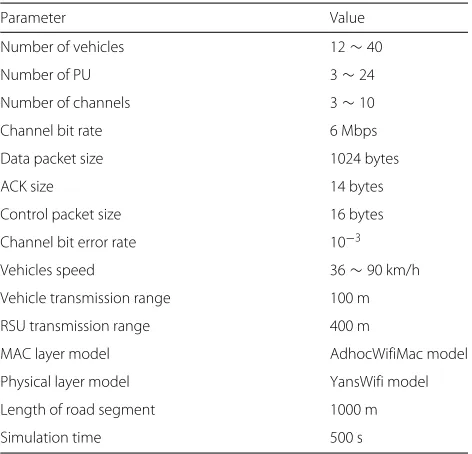
In our simulation environment, an RSU unit is installed in the middle of a 1000-m road segment where vehicles move with random speeds. First, we have generated the mobility trace of the vehicles using the SUMO tool [37], which is an open-source microscopic traffic road simula-tion package designed to handle large road networks. The mobility trace file is then imported into the NS-3 tool [36]. For different experiments, we have varied the number of vehicles from 12 to 40, PUs from 3 to 24, and licensed channels from 3 to 10. The data rate of each channel is set to 6 Mbps. The size of each packet is 1024 bytes. Each vehicle runs on the road with a random speed from the range 36∼90 km/h. The transmission ranges of the RSU and OBU are set to 400 and 100 m, respectively. We have defined each scheduling cycleT as 1 s long. Each simula-tion run lasts for 500 s and the results from 50 simulasimula-tion runs are averaged for each data points of the graphs. The simulation parameters are listed in Table 2.
5.2 Performance metrics
We compare the performances of the studied channel allocation mechanisms HT-CAM, TE-CAM [20], and CC-VANET [21] based on the following metrics [38].
– Throughput: The number of bytes received
successfully by each destination node per unit time is measured, and then the average is taken for all destinations to calculate the average throughput
Table 2Simulation parameters
Parameter Value
Number of vehicles 12∼40
Number of PU 3∼24
Number of channels 3∼10
Channel bit rate 6 Mbps
Data packet size 1024 bytes
ACK size 14 bytes
Control packet size 16 bytes
Channel bit error rate 10−3
Vehicles speed 36∼90 km/h
Vehicle transmission range 100 m
RSU transmission range 400 m
MAC layer model AdhocWifiMac model
Physical layer model YansWifi model
Length of road segment 1000 m
Simulation time 500 s
achievable by a channel allocation mechanism. Higher value corresponds to better performance. – Packet delivery ratio: It is the ratio of total number of
packets successfully delivered at destination nodes to the total number of packets generated during the whole simulation period.
– Channel utilization ratio: It is the ratio of the number of scheduled OBU pairs to the number of available licensed channels during the whole simulation period. – End-to-end average packet delivery delay: The
end-to-end delay is the time from when a packet becomes head of the line packet to the time when the source receives acknowledgement from the
destination for that packet. Then, the average delay is calculated for all packets sent during the whole simulation period. Lower end-to-end delay means better channel allocation mechanism.
– Operation overhead: We calculate the amount of control bytes transmitted during the whole
simulation period for successful transmission of each byte of user data in the studied channel allocation mechanisms to compare the operation overhead.
5.3 Simulation results
5.3.1 Impacts of increasing number of PUs
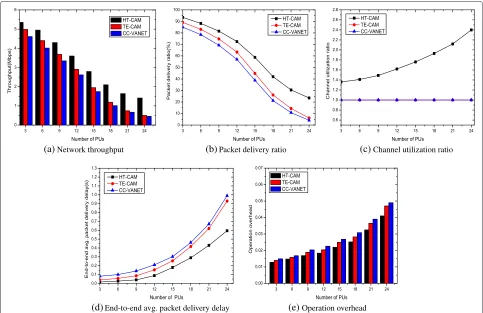
In this section, we measure the aforementioned perfor-mance metrics for varying number of primary users rang-ing from 3 to 24, as shown in Fig. 5. The number of vehicles and licensed channels in the network is set to 24 and 7, respectively.
As the number of PUs increases, all the studied pro-tocols suffer from performance degradation in terms of throughput, as shown in Fig. 5a. We can see that HT-CAM achieves better network throughput than TE-CAM and CC-VANET. This is mainly due to the fact that the HT-CAM considers spatial reusability of licensed channels, i.e., it can schedule a single channel to more than one non-interfering OBU pairs at each scheduling cycle. Moreover, the HT-CAM allocates channels to the requested OBU pairs in such a way that the most optimal channels (in terms of PU activities) are allocated to the maximum possible number of OBU pairs. As a result, more data packets are transmitted successfully to the destination OBUs without experiencing interruptions from primary users, achieving higher throughput.
(a) (b) (c)
(d) (e)
Fig. 5Impacts of number of PUs.aNetwork throughput.bPacket delivery ratio.cChannel utilization ratio.dEnd-to-end average packet delivery delay.eOperation overhead
interfere with each other. As a result, the chance of PU appearance in the allocated licensed channels is lower in our proposed HT-CAM than that in TE-CAM and CC-VANET. Therefore, the number of packet drops decreases and more data packets are delivered successfully to the destination.
In Fig. 5c, we observe the performance of studied pro-tocols in terms of available licensed channel utilization. When the number of PUs is large in the network, only a small number of licensed channels are available for opportunistic use. The number of requested OBU pairs TE-CAM and CC-VANET can schedule is equal to the number of available licensed channels. Therefore, when the number of available licensed channels is very low in the network, they can allocate only a small number of requested OBU pairs. On the other hand, HT-CAM is able to schedule a much higher number of OBU pairs with limited number of available licensed channels by spatial reuse. Thus, the utilization of available licensed channels increases with increasing number of PUs in the network.
In Fig. 5d, we observe the performance of the studied protocols in terms of end-to-end average packet delay. Note that the end-to-end average packet delay increases sharply as the number of PUs increases in all the studied
protocols. The performance of HT-CAM is still better than TE-CAM and CC-VANET because of better chan-nel allocation by HT-CAM and reduced waiting time offered by it. Moreover, in TE-CAM and CC-VANET, the chance of PU appearance in the allocated licensed chan-nels is slightly higher than HT-CAM that results in more packet drops. Thus, the number of packet retransmissions increases, which in turn extends the average end-to-end average packet delay.
5.3.2 Impacts of increasing number of vehicles
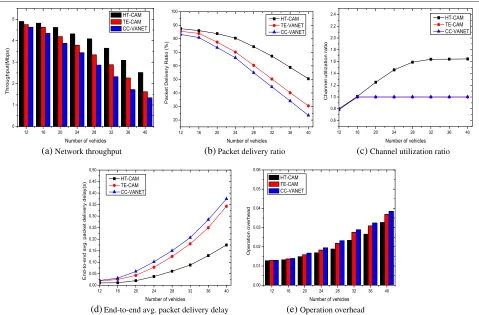
We study the performances of the studied algorithms for increasing number of vehicles in the network, ranging from 12 to 40, as shown in Fig. 6. The number of PUs and licensed channels in the network is set to 9 and 7, respectively.
The number of vehicles has a great impact on the net-work throughput. In Fig. 6a, we observe that in all the studied protocols, the throughput reduces as the number of vehicles in the network increases. This happens because the number of requests arriving to the RSU increases with the number of vehicles at each scheduling cycle. But the RSU can schedule only a portion of the requested OBUs because of the fixed number of licensed channels in the network. Initially, when the number of requested OBU pairs is small, all the studied protocols show sim-ilar performances. However, as the number of vehicles increases in the network, HT-CAM shows much bet-ter performance than TE-CAM and CC-VANET. This is caused by HT-CAM’s capability of scheduling more OBU pairs on the licensed channels. Therefore, the throughput performance gap between the HT-CAM and the others increases with the number of vehicles.
In Fig. 6b, we can observe that HT-CAM performs much better than TE-CAM and CC-VANET, in terms of packet delivery ratio with increasing number of vehi-cles. This happens because HT-CAM can schedule much higher number of OBU pairs at each scheduling cycle than TE-CAM and CC-VANET. Thus, more data packets are received by destination OBUs at each scheduling cycle, which in turn increases the packet delivery ratio in the network.
The utilization of available licensed channels is also affected by the number of vehicles. In Fig. 6c, we observe that, initially when the number of vehicles in the network is small, the channel utilization ratio is less than one for all of the studied mechanisms. The reason behind that is the available licensed channels remain underutilized with small number of requests at the RSU. We can also see that the channel utilization ratio of HT-CAM increases rapidly with increasing number of vehicles, since more OBUs are scheduled by the RSU with fixed number of licensed chan-nels in the network. After a while, the utilization ratio becomes almost stable because only a fixed portion of the vehicles can utilize the licensed channels and any further increment of vehicles does not have much impact on the
(a) (b) (c)
(d) (e)
utilization of licensed channels. On the other hand, in TE-CAM and CC-VANET, once the utilization ratio reaches to 1.0, it becomes stable since it cannot reuse the channels. Figure 6d depicts that the end-to-end average packet delivery delay is much smaller in HT-CAM than TE-CAM and CC-VANET. In TE-TE-CAM and CC-VANET, the number of OBUs transmitted at each scheduling cycle is limited by the number of available licensed channels. Due to their poor resource utilization, the packets spend more time in the transmission queues, increasing the delivery delay. In contrast, HT-CAM can accommodate a much higher number of requests arriving at the RSU and thus it decreases the end-to-end average packet delivery delay.
In Fig. 6e, we observe that the operation overhead increases with the increasing number of vehicles in all the studied protocols as expected theoretically. The pro-posed HT-CAM performs better than TE-CAM and CC-VANET since it achieves higher amounts of data byte delivery for a little increase in control byte transmissions.
5.3.3 Impacts of increasing number of licensed channels
In this section, we study the performance of the studied channel allocation mechanisms for increasing number of licensed channels in the network ranging from 3 to 10, as
shown in Fig. 7. The number of vehicles and PUs in the network is fixed at 24 and 9, respectively.
In Fig. 7a, we can observe that, with the increase of licensed channels, the network throughput increases gradually. But the increment rate is much higher for HT-CAM than both TE-HT-CAM and CC-VANET, because of the spatial reusability mechanism of HT-CAM, which allows more OBU pairs to transmit data packets even if the number of licensed channels in the network is lim-ited. However, at higher number of licensed channels, the throughput of the studied mechanisms comes closer due to the more resource availability compared to the traffic loads.
We observe the performance of studied mechanisms in terms of packet delivery ratio in Fig. 7b. The graphs state that the packet delivery ratio grows rapidly with increasing number of licensed channels for all the studied mechanisms, as expected theoretically. However, the HT-CAM shows better performance than TE-HT-CAM and CC-VANET, especially, when the number of licensed channels in the network is small, caused by spectrum reuse capabil-ity of HT-CAM.
Figure 7c depicts that the channel utilization ratio decreases in HT-CAM with increasing number of licensed
(a) (b) (c)
(d) (e)
channels in the network. This happens as the number of licensed channels increases the utilization of individual licensed channel reduces. However, the channel utiliza-tion ratio of HT-CAM is still higher than TE-CAM and CC-VANET because of the more efficient allocation of licensed channels among the requested OBU pairs.
The graphs of Fig. 7d depict that the end-to-end aver-age packet delivery delay decreases rapidly as the number of licensed channels increases in the network for all the studied protocols. Initially, when the number of licensed channels is very small in the network, HT-CAM shows significant performance improvement than TE-CAM and CC-VANET. The fact behind this is already stated in earlier graphs.
The graphs of Fig. 7e state that the proposed HT-CAM has less overhead compared to TE-CAM and CC-VANET, since the former offers better throughput in cost of little control byte overheads.
6 Conclusions
In this paper, we have developed an interference-aware high-throughput channel allocation mechanism, called HT-CAM, that addresses the unique challenges of CR-VANETs. We create conflict graphs of link-band pairs to extract non-interfering OBU pairs that can communicate simultaneously on a given channel, increasing the spatial reuse of the available channels. The multi-constraint lin-ear optimization technique of HT-CAM helps it to make channel allocation decision more efficient. The results of the simulation experiments, carried out in NS-3, reveal that the HT-CAM outperforms state-of-the-art channel allocation mechanisms for CR networks in terms of net-work throughput, channel utilization, end-to-end packet delivery delay, etc.
Competing interests
The authors declare that they have no competing interests.
Acknowledgements
The authors would like to extend their sincere appreciation to the Deanship of Scientific Research at King Saud University for its funding of this research through the Research Group Project no. RGP-VPP-281. Special thanks to the ICT Division of the Government of Bangladesh for student fellowship.
Author details
1Green Networking Research (GNR) Group, Department of Computer Science
and Engineering, University of Dhaka, Dhaka, Bangladesh.2College of
Computer and Information Sciences, King Saud University, Riyadh 11543, Kingdom of Saudi Arabia.
Received: 29 September 2015 Accepted: 8 December 2015
References
1. MM S Al-Sultan, AH Al-Doori, H Al-Bayatti, A Zedan, Comprehensive survey on vehicular ad hoc network. J. Netw. Comput. Appl.37, 380–392 (2014) 2. AM Vegni, M Biagi, R Cusani,Smart vehicles, technologies and main
applications in vehicular ad hoc networks. Vehicular
Technologies—Deployment and Applications, (2013). DOI: 10.5772/55492
3. Y Zeng, K Xiang, D Li, AV Vasilakos, Directional routing and scheduling for green vehicular delay tolerant networks. Wirel. Netw.19(2), 161–173 (2013)
4. L Zhou, YZ Song, KW Jing, Distributed media services in P2P-based vehicular networks. IEEE T. Veh. Technol.60(2), 692–703 (2011) 5. W Viriyasitavat, M Boban, H-M Tsai, A Vasilakos, Vehicular
communications: survey and challenges of channel and propagation models. IEEE Veh. Technol. Mag.10(2), 55–66 (2015)
6. KD Singh, P Rawat, J-M Bonnin, Cognitive radio for vehicular ad hoc networks (CR-VANETs): approaches and challenges.EURASIP. J. Wirel. Commun. Netw.2014, 49 (2014)
7. MD Felice, R Doost-Mohammady, KR Chowdhury, L Bononi, Smart radios for smart vehicles: cognitive vehicular networks. IEEE Veh. Technol. Mag. 7(2), 26–33 (2012)
8. S-S Byun, I Balashingham, AV Vasilakos, H-N Lee, Computation of an equilibrium in spectrum markets for cognitive radio networks. IEEE Trans. Comput.63(2), 304–316 (2014)
9. V Chakravarthy, X Li, Z Wu, MA Temple, F Garber, R Kannan, A Vasilakos, Novel overlay/underlay cognitive radio waveforms using SD-SMSE framework to enhance spectrum efficiency.Part I: theoretical framework and analysis in AWGN channel. IEEE Trans. Commun.57(12), 3794–3804 (2009)
10. M Yang, D Jin, L Zeng, X Wu, AV Vasilakos, Software-defined and virtualized future mobile and wireless networks: a survey. MONET.20(1), 4–18 (2015) 11. Z Han, R Zheng, HV Poor, Repeated auctions with Bayesian
nonparametric learning for spectrum access in cognitive radio networks. IEEE Trans. Wirel. Commun.10(3), 890–900 (2011)
12. O Naparstek, A Leshem, E Jorswieck,Distributed medium access control for energy efficient transmission in cognitive radios. ArXiv e-prints, (2014). http://arxiv.org/abs/1401.1671
13. R Hossain, R Rijul, MA Razzaque, MA Wadud, Prioritized medium access control in cognitive radio ad hoc networks: protocol and analysis. Wirel. Pers. Commun.79, 2383–2408 (2014)
14. K Liu, J Guo, N Lu, F Liu,RAMC: A RSU-Assisted Multi-channel Coordination MAC Protocol for VANET. (IEEE GLOBECOM Workshops, Hawaii, USA, 2009) 15. Y Zang, L Stibor, B Walke, H-J Reumerman, A Barroso,A Novel MAC
Protocol for Throughput Sensitive Applications in Vehicular Environments. (IEEE, Vehicular Technology Conference, 2007)
16. Q Wang, S Leng, Y Zhang, H Fu,A QoS Supported Multi-channel MAC for Vehicular Ad Hoc Networks. (Vehicular Technology Conference, IEEE 73rd, Budapest, 2011), pp. 1–5
17. X Xie, B Huang, S Yang, T Lv,Adaptive Multi-channel MAC protocol for dense VANET with Directional Antennas. (Future Generation Communication IEEE conference, Hainan Island, China, 2008)
18. D Niyato, E Hossain, P Wang, Optimal channel access management with QoS support for cognitive vehicular networks. IEEE Trans. Mob. Comput. 10(4), 573–591 (2011)
19. N Cheng, N Zhang, N Lu, X Shen, JW Mark, F Liu, Opportunistic spectrum access for CR-VANETs: a game-theoretic approach. IEEE T. Veh. Technol. 63(1), 237–251 (2014)
20. Y Han, E Ekici, H Kremo, O Altintas, inINFOCOM, 2014 Proceedings IEEE. Throughput-efficient channel allocation in multi-channel cognitive vehicular networks, (2014), pp. 2724–2732
21. Z Lei, L Tao, L Wei, Z Siting, L Jianfeng, Cooperative spectrum allocation with QoS support in cognitive cooperative vehicular ad hoc networks. 11(10), 49–59 (2014). Communications, China, IEEE
22. T Meng, F Wu, Z Yang, G Chen, A Vasilakos, Spatial reusability-aware routing in multi-hop wireless networks. IEEE Trans. Comput.99, 1–1 23. T Jiang, H Wang, AV Vasilakos, QoE-driven channel allocation
schemes for multimedia transmission of priority-based secondary users over cognitive radio networks. IEEE J. Sel. Areas Commun. 30(7), 1215–1224 (2012)
24. T Ycek, H Arslan, A survey of spectrum sensing algorithms for cognitive radio applications. IEEE Commun. Surv. Tutorials.11(1), 116–130 (2009) 25. M Subhedar, G Birajdar,Spectrum sensing techniques in cognitive radio
networks: a survey. International Journal of Next-Generation Networks, vol. 3. (AIRCC Publishing Corporation, Chennai, Tamil Nadu, India, 2011) 26. D Cabric, A Tkachenko, RW Brodersen, Spectrum sensing measurements
of pilot, energy, and collaborative detection. Washington DC, 2342–2348 (2006)
Next-Generation Networks.5(1), 142–146 (2013). AIRCC Publishing Corporation, Chennai, Tamil Nadu, India
28. M Ghozzi, F Marx, M Dohler, J Palicot, in1st International ICST Conference on Cognitive Radio Oriented Wireless Networks and Communications. Cyclostatilonarilty-based test for detection of vacant frequency bands (IEEE, Mykonos Island, 2007), pp. 1–5
29. E-NS Youssef, SE El-Khamy, MS El-Mahallawy, inProceedings of the 2013 International Conference on Computing, Networking and Communications (ICNC). Improved wideband spectrum sensing techniques using wavelet-based edge detection for cognitive radio (IEEE Computer Society, San Diego, USA, 2013), pp. 418–423
30. H Hartenstein, KP Laberteaux, A tutorial survey on vehicular ad hoc networks. IEEE Commun. Mag.46, 164–171 (2008)
31. G Hasegawa, G Kang, Y Taniguchi, H Nakano, inAICT 2011: The Seventh Advanced International Conference on Telecommunications. Extending the protocol interference model considering sinr for wireless mesh networks (Think Mind, St. Maarten, The Netherlands Antilles, 2011), pp. 26–31 32. M Zorzi, RR Rao, Capture and retransmission control in mobile radio. IEEE
J. Sel. Areas Commun.12, 1289–1298 (1994)
33. R Adhikari, RK Agrawal, An introductory study on time series modeling and forecasting. Comput. Res. Repository.1302.6613, 1–67 (2013) 34. X Li, SA Zekavat, inIEEE Wireless Communications and Networking
Conference. Traffic pattern prediction and performance investigation for cognitive radio systems (IEEE, 2008), pp. 894–899
35. NEOS optimization server. http://www.neos-server.org/neos/, Accessed on 20 Sep, 2015.
36. The network simulator version 3 (NS-3). http://www.nsnam.org/, Accessed on 12 Sep, 2015
37. Simulation of Urban Mobility (SUMO) project. http://sumo.sourceforge. net/, Accessed on 11 Sep, 2015
38. M Youssef, M Ibrahim, M Abdelatif, L Chen, Routing metrics of cognitive radio networks: a survey. IEEE Commun. Surv. Tutorials.16(1), 92–109 (2014)
Submit your manuscript to a
journal and benefi t from:
7Convenient online submission
7 Rigorous peer review
7Immediate publication on acceptance
7 Open access: articles freely available online
7High visibility within the fi eld
7 Retaining the copyright to your article