R E S E A R C H
Open Access
Compact difference scheme for
two-dimensional fourth-order hyperbolic
equation
Qing Li
1and Qing Yang
1**Correspondence:
1School of Mathematics and Statistics, Shandong Normal University, Jinan, China
Abstract
In this paper, we mainly study an initial and boundary value problem of a
two-dimensional fourth-order hyperbolic equation. Firstly, the fourth-order equation is written as a system of two second-order equations by introducing two new variables. Next, in order to design an implicit compact finite difference scheme for the problem, we apply the compact finite difference operators to obtain a fourth-order discretization for the second-order spatial derivatives and the Crank–Nicolson difference scheme to obtain a second-order discretization for the first-order time derivative. We prove the unconditional stability of the scheme by the Fourier method. Then a convergence analysis is given by the energy method. Numerical results are provided to verify the accuracy and efficiency of this scheme.
Keywords: Fourth-order hyperbolic equation; High accuracy method; Compact
difference scheme; Stability analysis; Convergence analysis
1 Introduction
LetΩ= (0,a)×(0,b) and we consider the two-dimensional fourth-order hyperbolic equa-tion with initial and boundary condiequa-tions:
⎧ ⎪ ⎪ ⎪ ⎪ ⎪ ⎪ ⎪ ⎪ ⎪ ⎪ ⎪ ⎨ ⎪ ⎪ ⎪ ⎪ ⎪ ⎪ ⎪ ⎪ ⎪ ⎪ ⎪ ⎩
(a) utt+ρ2u=f(x,y,t), (x,y,t)∈Ω×(0,T],
(b) u(x,y, 0) =f1(x,y), ∂u∂t|(x,y,0)=f2(x,y), (x,y)∈Ω,
(c) u|x=0=h1(y,t), u|x=a=h2(y,t),
u|y=0=h3(x,t), u|y=b=h4(x,t), t∈[0,T],
(d) u|x=0=g1(y,t), u|x=a=g2(y,t),
u|y=0=g3(x,t), u|y=b=g4(x,t), t∈[0,T],
(1)
whereutt=∂
2u
∂t2,2u=
∂4u ∂x4 + 2
∂4u ∂x2∂y2 +
∂4u
∂y4.f(x,y,t) is the given source term.f1(x,y) and
f2(x,y) are initial value functions.h1(y,t),h2(y,t),h3(x,t),h4(x,t) andg1(y,t),g2(y,t),g3(x,t),
g4(x,t) are boundary value functions.ρis a given positive constant.
The two-dimensional fourth-order hyperbolic equations have very important physical background and a wide range of applications. For example, they can be used to describe the vibration of a plate and in large-scale civil engineering, spaceflight, and active noise control
(see [1–5]). Compared with the second-order equations [6–11], it is usually necessary to use higher-order finite element methods or thirteen-point difference schemes in order to solve the numerical solution of the two-dimensional fourth-order equations. The former is difficult to calculate. The latter has some difficulties to deal with the boundary and only achieves second-order accuracy.
The compact finite difference method, compared to the traditional finite difference method, has a narrower band width and achieves a higher accuracy. Hence, they have long been studied, for example, in [12,13]. In the last few years, high-order computational methods for different kinds of differential equations were studied (see [6–8,12–17]). In [14–16] fourth-order equations are written as a system of two second-order equations by introducing two new variables. Then, in order to design a high-order scheme for the problem, the spatial derivatives are discretized by applying the compact finite difference method or compact volume method.
In this paper, we apply similar ideas to the two-dimensional fourth-order hyperbolic equation (1). Firstly, the fourth-order equation is written as a system of two second-order equations by introducing two new variables. Next, we use the compact operators to ap-proximate the second-order derivatives in the space variables and rewrite the above prob-lem as an initial value probprob-lem for a system of two second-order ordinary differential equa-tions. Then we develop a two time level compact finite difference scheme. We prove the stability for the high-order compact difference scheme by the Fourier method. The con-vergence of the high-order compact difference scheme is given by the energy method.
The rest of the paper is arranged as follows. In Sect.2we formulate the fourth-order compact finite difference scheme for problem (1). A stability analysis is given by the Fourier method in Sect.3, and a convergence analysis is given by the energy method in Sect.4.
Numerical experiments are performed in Sect.5to test the accuracy and efficiency of the
proposed compact finite difference scheme. Conclusions are given in Sect.6.
2 Compact finite difference scheme
To design a proper finite difference scheme, we setv= –ρu, w=∂u∂t and reformulate
problem (1) in terms of the coupled system of second-order equations
⎧ ⎪ ⎪ ⎪ ⎪ ⎪ ⎪ ⎪ ⎪ ⎪ ⎪ ⎪ ⎪ ⎪ ⎪ ⎨ ⎪ ⎪ ⎪ ⎪ ⎪ ⎪ ⎪ ⎪ ⎪ ⎪ ⎪ ⎪ ⎪ ⎪ ⎩
(a) ∂w∂t –v=f(x,y,t), (x,y,t)∈Ω×(0,T],
(b) ρw+∂v
∂t = 0, (x,y,t)∈Ω×(0,T],
(c) w(x,y, 0) =f2(x,y), v(x,y, 0) = –ρf1(x,y), (x,y)∈Ω,
(d) w|x=0=∂h1
∂t (y,t), w|x=a= ∂h2
∂t (y,t),
w|y=0=∂h3
∂t (x,t), w|y=b= ∂h4
∂t (x,t), t∈[0,T],
(e) v|x=0= –ρg1(y,t), v|x=a= –ρg2(y,t),
v|y=0= –ρg3(x,t), v|y=b= –ρg4(x,t), t∈[0,T].
(2)
Obviously,uis a solution to (1), if and only if (v,w) is a solution to (2).
Lethx=Nxa+1,hy=Nyb+1 be the spatial step in thexandydirections,τ=TN be the time
step andxi=ihx, 0≤i≤Nx+ 1,yj=jhy, 0≤j≤Ny+ 1,tk=kτ, 0≤k≤N,h=max{hx,hy}.
The theoretical solutionsu,v,wat the point (xi,yj,tk) are denoted byukij,vkij,wkijand the
Our compact method for (1) is based on the system (2). To do this, we set
Defining the difference operators
Ax= 1 +
and applying a Taylor expansion, we get
δx2vkij= Axθijk+ (Rx)kij, δy2vkij= Ayϑijk+ (Ry)kij,
where
Replacingvki,j,wki,jby their approximationsVi,jk,Wi,jkand neglecting the higher-order terms, we derive a finite difference scheme as follows:
⎧
where the discretized boundary values and initial values are denoted by
W0,jk =∂h1
Remark2.1 From (5) it is easy to see that the local truncation error for this scheme is O(τ2+h4).
3 Stability analysis
In this section, we adopt the Fourier method to analyze stability of the scheme (6). Assume thath=g(τ), whereg(τ) is a continuous function andg(0) = 0. In order to prove stability of the scheme (6), we consider a difference scheme of the form
whereAmandBmare 2×2 matrices,N0andN1are finite sets containing 0, positive
in-tegers and negative inin-tegers, Um
j is a two-dimensional column vector. Using the Fourier
method we get the growth factorG(xi,yj). Then the scheme (7) is stable if and only if the
family of matrices
Gn(xi,yj);x0= 0 <x1<· · ·<xNx+1=a,
y0= 0 <y1<· · ·<yNy+1=b,n= 1, 2, . . . ,N
(8)
is uniformly bounded. We introduce the following two lemmas.
Lemma 3.1([18]) To prove that the family of matrices(8)is uniformly bounded,it is nec-essary and sufficient to prove that the family of matrices
Gn(x,y); 0 <x<a, 0 <y<b,n= 1, 2, . . . (9)
is uniformly bounded.
Proof Accuracy is obvious, we now prove the necessity. We use the meshes withNx= 2m,
Ny= 2k,m= 1, 2, . . . ,k= 1, 2, . . . . Denote by (xp,yq) the grid points in the mesh for given
m and k, wherexp=2ap,yq=2bq,p= 1, 2, . . . ,m,q= 1, 2, . . . ,k. Assume
Gn(xp,yq)≤M, 0≤nτ ≤T,
where Mis a constant that has nothing to do with partition. We setτ →0, therefore,
h→0, then
Gn(xp,yq)≤M, n= 1, 2, . . . .
Noting that the bisecting points{(xp,yq)}are dense on [0,a]×[0,b], andG(x,y) is a
con-tinuous function, we get
Gn(x,y)≤M, 0≤x≤a, 0≤y≤b,n= 1, 2, . . . .
Lemma 3.2([18]) Assume G(x,y)is an2×2matrices and use gijto represent the element
of the ith row and the jth column.The eigenvalues of G areλ1andλ2.The family of matrices {Gn(x,y)}is uniformly bounded if and only if
⎧ ⎪ ⎪ ⎨ ⎪ ⎪ ⎩
(α) |λi(x,y)| ≤1, i= 1, 2, 0≤x≤a, 0≤y≤b,
(β) G(x,y) –1
2(g11(x,y) +g22(x,y))I
≤M(|1 –|λ1(x,y)||+|λ1(x,y) –λ2(x,y)|), 0≤x≤a, 0≤y≤b.
(10)
Remark3.1
(1) From the relationship between roots and coefficients in the quadric equation λ2–bλ–c= 0, the modulo of two roots is not bigger than one if and only if
(2) In the condition(β),we need to calculate the norm of a2×2matrix. We usually use theFrobenius-norm, which is defined as
KF=
2
i,j=1 |kij|2
1 2
, (12)
for a matrixK= (kij).
Theorem 3.1 The scheme(6)is unconditionally stable.
Proof We use the Fourier method to prove the stability of the scheme (6). Using the defi-nitions ofAhandBh, the scheme (6) is written as
⎧ ⎪ ⎪ ⎪ ⎪ ⎪ ⎨ ⎪ ⎪ ⎪ ⎪ ⎪ ⎩
(1) 1441 [c1+ 10(c2+c3) + 100c4] –241(r1d1+ 2r2d2+ 2r3d3– 20r1d4)
=1441 [c1+ 10(c2+c3) + 100c4] +241(r1d1+ 2r2d2+ 2r3d3– 20r1d4),
(2) 24ρ(r1c1+ 2r2c2+ 2r3c3– 20r1c4) +1441 [d1+ 10(d2+d3) + 100d4]
=–ρ24(r1c1+ 2r2c2+ 2r3c3– 20r1c4) +1441 [d1+ 10(d2+d3) + 100d4],
(13)
where
rx= τ
h2 x
, ry=
τ
h2 y
, r1=rx+ry, r2= 5rx–ry, r3= 5ry–rx,
c1=Wi–1,j–1k+1 +Wi–1,j+1k+1 +Wi+1,j–1k+1 +Wi+1,j+1k+1 ,
c2=Wi–1,jk+1+Wi+1,jk+1, c3=Wi,j–1k+1+Wi,j+1k+1, c4=Wi,jk+1,
d1=Vi–1,j–1k+1 +Vi–1,j+1k+1 +Vi+1,j–1k+1 +Vi+1,j+1k+1 ,
d2=Vi–1,jk+1+Vi+1,jk+1, d3=Vi,j–1k+1+Vi,j+1k+1, d4=Vi,jk+1,
c1=Wi–1,j–1k +Wi–1,j+1k +Wi+1,j–1k +Wi+1,j+1k ,
c2=Wi–1,jk +Wi+1,jk , c3=Wi,j–1k +Wi,j+1k , c4=Wi,jk,
d1=Vi–1,j–1k +Vi–1,j+1k +Vi+1,j–1k +Vi+1,j+1k ,
d2=Vi–1,jk +Vi+1,jk , d3=Vi,j–1k +Vi,j+1k , d4=Vi,jk.
LetWk
jm=vk1eiσ1jhxeiσ2mhy,Vjmk =vk2eiσ1jhxeiσ2mhy, wherevk1andvk2are the amplitude at time
levelk,σ1andσ2represent the wave numbers in thexandydirections. By inserting these
expressions into the coupled scheme (13), we have
1 144
eiσ1(j–1)hxeiσ2(m–1)hy+eiσ1(j–1)hxeiσ2(m+1)hy+eiσ1(j+1)hxeiσ2(m–1)hy
+eiσ1(j+1)hxeiσ2(m+1)hy+ 10
144
eiσ1jhxeiσ2(m–1)hy+eiσ1jhxeiσ2(m+1)hy
+eiσ1(j–1)hxeiσ2mhy+eiσ1(j+1)hxeiσ2mhy+100
144e
iσ1jhxeiσ2mhy
vk+11
–
1
24(rx+ry)
Equations (14) and (15) can be written as
Then from (16) we immediately get the matrix of growth of the scheme (13),
G(σ1hx,σ2hy) =
Next, we have
Hence, there exists a constantM≥12
√ 1+ρ2
√ρ such that (10β) holds for anyrx> 0,ry> 0.
Then from Lemma3.2we know that the difference scheme (13) is stable.
4 Error analysis
In this section we give the convergence analysis by the energy method. We introduce the spacesSh={u|u∈R(Nx+2)×(Ny+2)},S0h={u|u∈R(Nx+2)×(Ny+2),u0,j=uNx+1,j=ui,0=uNy+1,0=
For the error analysis, we first note that our numerical scheme is based on (5) with
ρ
2Bh
wk+1ij +wkij+ Ah vk+1
ij –vkij τ
=gk+ 1 2
ij ,
1≤i≤Nx, 1≤j≤Ny, 1≤k≤N,
where
gk+12≤
C1
τ2+h4, gk+12≤C
2
τ2+h4, (23)
withC1,C2positive constants. And our numerical scheme (6) is equivalent to
Ah Wk+1
ij –Wijk τ
–1
2Bh
Vijk+1+Vijk= Ahf k+12 ij ,
1≤i≤Nx, 1≤j≤Ny, 1≤k≤N,
ρ
2Bh
Wijk+1+Wijk+ Ah Vk+1
ij –Vijk τ
= 0,
1≤i≤Nx, 1≤j≤Ny, 1≤k≤N.
Lettingξi,jk =wki,j–Wi,jk andηki,j=vki,j–Vi,jk replace the approximation errors, we can get the error equations
Ahξijk+1–ξijk–τ 2Bh
ηk+1ij +ηijk=τgk+ 1 2
ij ,
1≤i≤Nx, 1≤j≤Ny, 1≤k≤N, (24)
ρτ
2 Bh
ξijk+1+ξijk+ Ah
ηijk+1–ηkij=τgk+ 1 2
ij ,
1≤i≤Nx, 1≤j≤Ny, 1≤k≤N. (25)
Using the discrete Green formula, we know that the difference operatorsδx2andδ2yare self-adjoint and symmetric positive definite. We find that the difference operators Ah, Bh
are self-adjoint and symmetric positive definite as well. To give the error estimate, the lemmas used later are first given as follows.
Lemma 4.1([7]) For any grid function u,v∈S0
h,we have (1) (Ahu,v) = (u, Ahv),(Bhu,v) = (u, Bhv),
(2) (δ2
xu,v) = (u,δ2xv),(δy2u,v) = (u,δy2v).
Lemma 4.2([19,20]) For any grid function u∈S0h,we have
(1) 2 3u
2≤(A
xu,u)≤ u2, 23u2≤(Ayu,u)≤ u2; (2) 49u2≤(A
hu,u)≤ u2; (3) h2
x(Ayδxu,δxu)≤4(Ayu,u),h2y(Axδyu,δyu)≤4(Axu,u).
Theorem 4.1 Let{wk,vk}be the solution of Eq. (2)and{Wk,Vk}be the solution of scheme (6).For the compact finite difference scheme,assuming that both rxand ryare bounded,we
have
max
0≤kτ≤T
Proof Taking the inner product withξk+1+ξkon both sides of (24), we have
Ah
ξk+1–ξk,ξk+1+ξk–τ 2
Bh
ηk+1+ηk,ξk+1+ξk=τgk+12,ξk+1+ξk. (27)
Taking the inner product withηk+1+ηkon both sides of (25), we have ρτ
2
Bh
ξk+1+ξk,ηk+1+ηk+Ah
ηk+1–ηk,ηk+1+ηk=τgk+12,ηk+1+ηk. (28)
From Lemma4.1we have
Bh
ηk+1+ηk,ξk+1+ξk=Bh
ξk+1+ξk,ηk+1+ηk. (29)
Multiplying byρboth sides of (27), we have
ρAh
ξk+1–ξk,ξk+1+ξk–ρτ 2
Bh
ηk+1+ηk,ξk+1+ξk
=ρτgk+12,ξk+1+ξk. (30)
Combining (28) with (30), we obtain
ρAh
ξk+1–ξk,ξk+1+ξk+Ah
ηk+1–ηk,ηk+1+ηk
=ρτgk+12,ξk+1+ξk+τgk+12,ηk+1+ηk.
Using Lemma4.1, we obtain
ρAhξk+1,ξk+1
–ρAhξk,ξk
+Ahηk+1,ηk+1
–Ahηk,ηk
=ρτgk+12,ξk+1+ξk+τgk+12,ηk+1+ηk.
By the inequalityab≤12(a2+b2) and (a+b)2≤2(a2+b2), we get
ρAhξk+1,ξk+1
–ρAhξk,ξk
+Ahηk+1,ηk+1
–Ahηk,ηk
≤ρτ
2 g
k+122
+ρτξk+12+ξk2+τ 2g
k+122
+τηk+12+ηk2.
Summingkfrom 0 ton, then
ρAhξn+1,ξn+1
–ρAhξ0,ξ0
+Ahηn+1,ηn+1
–Ahη0,η0
≤τ
2
n
k=0
ρgk+122+gk+122+ρτ
n
k=0
ξk+12+ξk2
+τ n
k=0
which implies that
Applying the discrete Gronwall lemma to (32), we get
ρξn+12+ηn+12≤Cτ
This completes the proof.
5 Numerical experiments
In this section we give some numerical results for the two-dimensional model problems given below. These results are obtained by using Matlab.
Example1 We seek the numerical solution for the following problem:
The theoretical solution is taken as u(x,y,t) =e–πtsin(πx)sin(πy). f(x,y,t), the initial
and boundary value functions in (36), can be obtained fromu(x,y,t). We havev(x,y,t) = 2π2e–πtsin(πx)sin(πy) and w(x,y,t) = –πe–πtsin(πx)sin(πy). The compact difference scheme (6) is used to solve the problem (36). As comparison with our method, the central difference scheme is used to solve this problem.
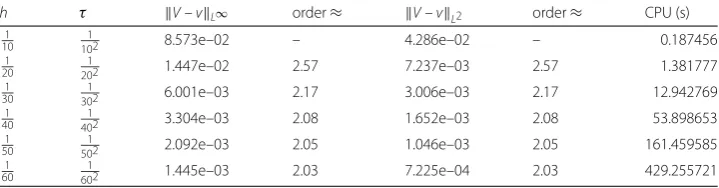
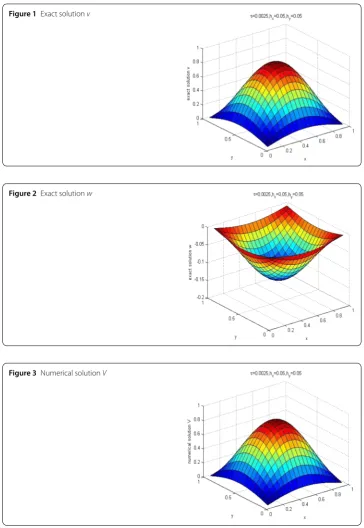
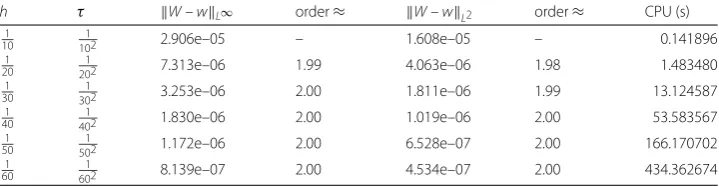
In our numerical results, errors and computational orders inL2-norm andL∞-norm of the compact difference scheme and the central difference scheme are given in Tables1–4. From these tables we can find that the compact difference scheme can achieve a higher accuracy and efficiency than the central difference scheme in identical mesh. The exact
Table 1 Errors and computational orders of compact difference scheme forW
h τ W–wL∞ order≈ W–wL2 order≈ CPU (s)
1 10
1
102 2.408e–03 – 1.204e–03 – 0.210328
1 20
1
202 1.215e–04 4.31 6.076e–05 4.31 2.012129
1 30
1
302 2.192e–05 4.22 1.096e–05 4.22 16.707314
1 40
1
402 6.618e–06 4.16 3.309e–06 4.16 65.458675
1 50
1
502 2.634e–06 4.13 1.317e–06 4.13 192.643835
1 60
1
602 1.246e–06 4.11 6.230e–07 4.11 484.401023
Table 2 Errors and computational orders of central difference scheme forW
h τ W–wL∞ order≈ W–wL2 order≈ CPU (s)
1 10
1
102 1.279e–01 – 6.395e–02 – 0.187456
1 20
1
202 3.655e–02 1.81 1.827e–02 1.81 1.381777
1 30
1
302 1.646e–02 1.97 8.229e–03 1.97 12.942769
1 40
1
402 9.296e–03 1.99 4.648e–03 1.99 53.898653
1 50
1
502 5.960e–03 1.99 2.980e–03 1.99 161.459585
1 60
1
602 4.143e–03 1.99 2.071e–03 1.99 429.255721
Table 3 Errors and computational orders of compact difference scheme forV
h τ V–vL∞ order≈ V–vL2 order≈ CPU (s)
1 10
1
102 1.306e–03 – 6.532e–04 – 0.210328
1 20
1
202 5.261e–05 4.63 2.631e–05 4.63 2.012129
1 30
1
302 9.433e–06 4.24 4.717e–06 4.24 16.707314
1 40
1
402 2.850e–06 4.16 1.425e–06 4.16 65.458675
1 50
1
502 1.136e–06 4.12 5.680e–07 4.12 192.643835
1 60
1
602 5.379e–07 4.10 2.690e–07 4.10 484.401023
Table 4 Errors and computational orders of central difference scheme forV
h τ V–vL∞ order≈ V–vL2 order≈ CPU (s)
1 10
1
102 8.573e–02 – 4.286e–02 – 0.187456
1 20
1
202 1.447e–02 2.57 7.237e–03 2.57 1.381777
1 30
1
302 6.001e–03 2.17 3.006e–03 2.17 12.942769
1 40
1
402 3.304e–03 2.08 1.652e–03 2.08 53.898653
1 50
1
502 2.092e–03 2.05 1.046e–03 2.05 161.459585
1 60
1
Figure 1Exact solutionv
Figure 2Exact solutionw
Figure 3Numerical solutionV
results v(x,y,t) andw(x,y,t), with a mesh forhx=hy= 0.05 are plotted in Figs.1and2
fort= 1, respectively. The numerical results{Vijn+1}and{Wijn+1}, with a mesh forhx=hy=
0.05, are plotted in Figs.3and4fort= 1.
Example2 We consider the numerical solution for the problem (36) with the exact solu-tion
u(x,y,t) =t2e
–(x–0.5)2–(y–0.5)2
Figure 4Numerical solutionW
Table 5 Errors and computational orders of compact difference scheme withβ= 10 forW
h τ W–wL∞ order≈ W–wL2 order≈ CPU (s)
1 10
1
102 5.803e–07 – 3.316e–07 – 0.315426
1 20
1
202 4.149e–08 3.81 1.840e–08 4.17 2.235077
1 30
1
302 7.796e–09 4.12 3.417e–09 4.15 16.917521
1 40
1
402 2.358e–09 4.16 1.046e–09 4.11 64.900482
1 50
1
502 9.320e–10 4.16 4.199e–10 4.10 193.079116
1 60
1
602 4.528e–10 3.96 1.998e–10 4.07 494.024067
Table 6 Errors and computational orders of central difference scheme withβ= 10 forW
h τ W–wL∞ order≈ W–wL2 order≈ CPU (s)
1 10
1
102 2.906e–05 – 1.608e–05 – 0.141896
1 20
1
202 7.313e–06 1.99 4.063e–06 1.98 1.483480
1 30
1
302 3.253e–06 2.00 1.811e–06 1.99 13.124587
1 40
1
402 1.830e–06 2.00 1.019e–06 2.00 53.583567
1 50
1
502 1.172e–06 2.00 6.528e–07 2.00 166.170702
1 60
1
602 8.139e–07 2.00 4.534e–07 2.00 434.362674
Then f(x,y,t), the initial and boundary value functions in (36), can be obtained from u(x,y,t). And we get the functions
v(x,y,t) =
4
β –
(2x– 1)2
β2 –
(2y– 1)2
β2
t2e
–(x–0.5)2–(y–0.5)2
β , 0≤x,y≤1, 0≤t≤1,
w(x,y,t) = 2te
–(x–0.5)2–(y–0.5)2
β , 0≤x,y≤1, 0≤t≤1.
The compact difference scheme (6) is used to solve the non-homogeneous problem with
β= 10 andβ=101.
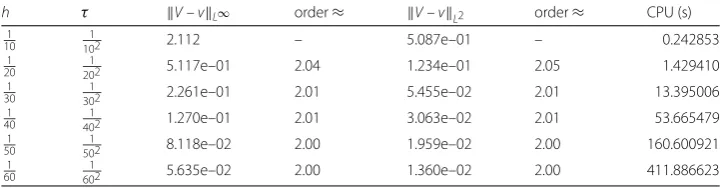
Errors and computational orders inL2-norm andL∞-norm of the compact difference
scheme and the central difference scheme withβ= 10 are given in Tables5–8. Tables9–12
show errors and computational orders inL2-norm andL∞-norm of the compact
differ-ence scheme and the central differdiffer-ence scheme withβ= 1
10. From these tables we can see
differ-Table 7 Errors and computational orders of compact difference scheme withβ= 10 forV
h τ V–vL∞ order≈ V–vL2 order≈ CPU (s)
1 10
1
102 2.711e–07 – 1.367e–07 – 0.315426
1 20
1
202 1.347e–08 4.33 9.382e–09 3.87 2.235077
1 30
1
302 2.201e–09 4.47 1.691e–09 4.23 16.917521
1 40
1
402 6.851e–10 4.01 5.122e–10 4.15 64.900482
1 50
1
502 2.889e–10 3.93 2.052e–10 4.10 193.079116
1 60
1
602 1.405e–10 3.95 9.756e–11 4.08 494.024067
Table 8 Errors and computational orders of central difference scheme withβ= 10 forV
h τ V–vL∞ order≈ V–vL2 order≈ CPU (s)
1 10
1
102 1.673e–05 – 9.189e–06 – 0.141896
1 20
1
202 4.142e–06 2.01 2.230e–06 2.00 1.483480
1 30
1
302 1.844e–06 2.00 1.022e–06 2.00 13.124587
1 40
1
402 1.036e–06 2.00 5.752e–07 2.00 53.583567
1 50
1
502 6.628e–07 2.00 3.682e–07 2.00 166.170702
1 60
1
602 4.603e–07 2.00 2.558e–07 2.00 434.362674
Table 9 Errors and computational orders of compact difference scheme withβ=101 forW
h τ W–wL∞ order≈ W–wL2 order≈ CPU (s)
1 10
1
102 1.915e–03 – 1.065e–03 – 0.330710
1 20
1
202 1.379e–04 3.80 7.647e–05 3.80 3.542983
1 30
1
302 2.823e–05 3.91 1.539e–05 3.95 18.320414
1 40
1
402 9.027e–06 3.96 4.847e–06 4.02 68.516085
1 50
1
502 3.670e–06 4.03 1.976e–06 4.02 221.163513
1 60
1
602 1.767e–06 3.01 9.499e–07 4.02 540.818697
Table 10 Errors and computational orders of central difference scheme withβ=101 forW
h τ W–wL∞ order≈ W–wL2 order≈ CPU (s)
1 10
1
102 1.146e–01 – 3.162e–02 – 0.242853
1 20
1
202 2.780e–02 2.04 7.803e–03 2.02 1.429410
1 30
1
302 1.239e–02 1.99 3.480e–03 1.99 13.395006
1 40
1
402 6.961e–03 2.00 1.958e–03 2.00 53.665479
1 50
1
502 4.453e–03 2.00 1.253e–03 2.00 160.600921
1 60
1
602 3.092e–03 2.00 8.699e–04 2.00 411.886623
Table 11 Errors and computational orders of compact difference scheme withβ=101 forV
h τ V–vL∞ order≈ V–vL2 order≈ CPU (s)
1 10
1
102 9.674e–02 – 2.651e–02 – 0.330710
1 20
1
202 5.744e–03 4.07 1.572e–03 4.08 3.542983
1 30
1
302 1.130e–03 4.01 3.094e–04 4.01 18.320414
1 40
1
402 3.570e–04 4.01 9.772e–05 4.01 68.516085
1 50
1
502 1.461e–04 4.00 3.999e–05 4.00 221.163513
1 60
1
Table 12 Errors and computational orders of central difference scheme withβ=101 forV
h τ V–vL∞ order≈ V–vL2 order≈ CPU (s)
1 10
1
102 2.112 – 5.087e–01 – 0.242853
1 20
1
202 5.117e–01 2.04 1.234e–01 2.05 1.429410
1 30
1
302 2.261e–01 2.01 5.455e–02 2.01 13.395006
1 40
1
402 1.270e–01 2.01 3.063e–02 2.01 53.665479
1 50
1
502 8.118e–02 2.00 1.959e–02 2.00 160.600921
1 60
1
602 5.635e–02 2.00 1.360e–02 2.00 411.886623
ence scheme in identical mesh when they are applied to solving the problem based on the Gaussian pulse.
6 Conclusions
In this article, we have developed a compact finite difference scheme for two-dimensional fourth-order hyperbolic equation. The stability of the scheme is proved by using a Fourier analysis and the convergence of the scheme is obtained. The numerical results show that this scheme has high order of accuracy and is efficient.
Acknowledgements
The authors would like to thank editor and referees for their valuable advice for the improvement of this article.
Funding
The work is supported by Shandong Provincial Natural Science Foundation, China (ZR2017MA020).
Competing interests
The authors declare that they have no competing interests.
Authors’ contributions
The authors read and approved the final manuscript.
Publisher’s Note
Springer Nature remains neutral with regard to jurisdictional claims in published maps and institutional affiliations.
Received: 22 September 2018 Accepted: 10 April 2019
References
1. Conte, S.D.: Numerical solution of vibration problems in two space variables. Pac. J. Math.4, 1535–1544 (1957) 2. Katsikadelis, J.T., Kandilas, C.B., Greece, A.: A flexibility matrix solution of the vibration problem of plates based on the
boundary element method. Acta Mech.83, 51–60 (1990)
3. Huang, Q.: Research on Sound Radiation of the Plate with Two Opposite Sides Simply Supported and Other Two Free. Southwest Jiaotong University, Chengdu (2007) (in Chinese)
4. Yuan, X., Li, S.: Natural vibration analysis of thin rectangular plate under different boundary conditions. Aeroengine
31, 39–43 (2005)
5. Luo, Z.D., Jin, S.J., Chen, J.: A reduced-order extrapolation central difference scheme based on POD for two-dimensional fourth-order hyperbolic equations. Appl. Math. Comput.289, 396–408 (2016)
6. Ding, H.F., Zhang, Y.X.: A new fourth-order compact finite difference scheme for the two-dimensional second-order hyperbolic equation. J. Comput. Appl. Math.230, 626–632 (2009)
7. Cui, M.R.: High order compact alternating direction implicit method for the generalized sine-Gordon equation. J. Comput. Appl. Math.235, 837–849 (2010)
8. Mohebbi, A., Dehghan, M.: High-order solution of one-dimensional sine-Gordon equation using compact finite difference and DIRKN methods. Math. Comput. Model.51, 537–549 (2010)
9. Dehghan, M., Salehi, R.: A method based on meshless approach for the numerical solution of the two-space dimensional hyperbolic telegraph equation. Math. Methods Appl. Sci.35, 1220–1233 (2012)
10. Dehghan, M., Ghesmati, A.: Combination of meshless local weak and strong (MLWS) forms to solve the two dimensional hyperbolic telegraph equation. Eng. Anal. Bound. Elem.34, 324–336 (2010)
11. Yang, Q.,: Numerical analysis of partially penalized immersed finite element methods for hyperbolic interface problems. Numer. Math., Theory Methods Appl.11, 272–298 (2018)
14. Cheng, T., Liu, L.B.: Compact difference scheme with high accuracy for solving fourth order parabolic equation. Coll. Math.2(26), 71–75 (2010) (in Chinese)
15. Fu, Y.Y., Yang, Q.: Compact finite volume scheme and its error analysis for fourth-order linear equation. J. Shandong Norm. Univ.3(32), 16–21 (2017) (in Chinese)
16. Wang, Y.M., Guo, B.Y.: Fourth-order compact finite difference method for fourth-order nonlinear elliptic boundary value problems. J. Comput. Appl. Math.221, 76–97 (2008)
17. Wang, Y.M.: Error analysis of a compact finite difference method for fourth-order nonlinear elliptic boundary value problems. Appl. Numer. Math.120, 53–67 (2017)
18. Li, R.H., Liu, B.: Numerical Solutions of Partial Differential Equations. Higher Education Press, Beijing (2008) (in Chinese) 19. Deng, D., Zhang, C.: A new fourth-order numerical algorithm for a class of three-dimensional nonlinear evolution
equations. Numer. Methods Partial Differ. Equ.29, 102–130 (2013)