Modeling Multiple Conductor Transmission Lines
Michael LeRoy Riddle
Center for Communications and Signal Processing
Department of Computer Science
North Carolina State University
ccsr-
TR-88/16
TABLE OF CONlENTS
Abstract
IIIList of Figures
1v
List of Abbreviations and Symbols
v
Chapter 1 -- Introduction
1
Chapter
2 --
Review of Single Conductor Theory
3
Chapter
3 --
Multiple Conductor Systems
1
0
Section 1 -- Impedance-Voltage Method.
1
0
Section
2 -- Paul's State Variable Method
1 7
Section
3 --
Gruner's Method
20
Summary --
24
Chapter
4 -- Numerical Simulation and Comparison
with
Actual
Measurements
.
26
Test
1 A --
2
7
Test
1 B
-~.
2 7
Test
1
C -- .
2 8
Test
1 D -- .
2
8
Comments on Theoretical vs.
Measured
Results
3 3
Test
1 A --
3 3
Test
1 B -- .
3
5
Test 1
C -- .
3 6
Test 1 D -- .
3 6
Paul's
and Gruner's Methods
3 7
Comments .
3
7
Chapter
5 --
Conclusions
4
1
Notes
62
Bibliography
64
Abstract
This
paper will present a new
way
of modeling multiple
conductor transmission lines.
Actual physical measurements will be
used to verify the theory.
Chapter 1 will summarize the current
state of research.
Chapter
2
will review the behavior of single
conductor systems.
Chapter 3 will present three approaches to
LIST OF FIGURES
Figure 1 -- A single conductor transmission system .
3
Figure 2 -- Distributed line parameters
4
Figure 3 -- Equivalent circuit for single conductor line at x
=
O.
7
Figure 4 -- Per unit parameters for a two conductor system
.
1 1
Figure 5 -- Boundary conditions at source for multiple conductors 1 3
Figure 6 -- Load for a two conductor system
.
1 6
Figure 7 -- Gruner's circuit model for two conductors
.
2 1
Figure 8 -- Configuration for Test 1A
. 2 7
Figure 9 -- Configuration for Test IB
. 2 7
Figure 10 -- Configuration for Test 1C
.
2 8
Figure 11 -- Configuration for Test ID
. 2 8
Plot 1(a) -- Theoretical voltage vs. distance (Test #lA)
. 4 3
Plot l(b) -- Theoretical current vs. distance (Test
#.lA)
.
44
Plot l(c) -- Measured voltage vs. distance (Test #lA)
. 45
Plot
led) --
Measured current vs. distance (Test
#lA)
.
4 6
Plot 2(a) -- Theoretical voltage vs. distance (Test #lB)
. 4 7
Plot 2(b) -- Theoretical current vs. distance (Test #lB)
. 4 8
Plot 2(c) -- Measured voltage vs. distance (Test #lB)
.
4 9
Plot 2(d) -- Measured current vs. distance (Test #lB)
.
5 0
Plot 3(a) -- Theoretical voltage vs. distance (Test #1 C)
. 5 1
Plot 3(b) -- Theoretical current vs. distance (Test #lC)
. 5 2
Plot 3(c) -- Measured voltage vs, distance (Test #lC)
.
5
3
LIST OF SYNIBOLS
Z -- per unit impedance matrix
Y -- per unit admittance matrix
r --
reflection coefficient matrix
Zo -- characteristic impedance matrix
y
0 --characteristic admittance matrix
ZL --
load impedance matrix, also referred to as receivmg end
impedance
matrix
Y
L
--
load admittance matrix, also referred to as receiving end
admittance
matrix
Z
s --
source impedance matrix, also referred to as sending end
impedance
matrix
y
s --
source admittance matrix, also referred to as sending end
admittance
matrix
y -- propagation constant matrix
V +
forward travelling voltage wave vector
w
V
backward travelling voltage wave vector
w
I
+
forward travelling current wave vector
w
I
backward travelling current wave vector
w
d
F --
derivative of F, i.e. dx F(x)
G(x,~)
-- Green's function matrix
V
s --
source voltage vector
Is
source current vector
U -- unity matrix
C1>
--
transition matrix
Chapter
1
Introd uction
An electrical transmission line is an electromagnetic medium
which serves to guide the flow of energy from one point to another.
The equations governing this system are ultimately derived from
Maxwell's equations, but usually it is more convenient to derive
them
by
applying circuit theory.
Equations describing single
conductor systems have been developed and extensively researched
[1,2].
Although several final forms of the equations exist and related
notation is not standardized, one can show
~with some algebraic
manipulation, that these seemingly different equations are
In
fact
equivalent.
Of equal importance, these mathematical models have
been verified through associated empirical work [3,4].
complications resulting from standing wave patterns.
At present,
methods for predicting what these patterns will be on
multiconductor utility networks are lacking or inadequate.
While there has been research in characterizing multiple
conductor lines [5-15], the theory thus far developed has not lent
itself well to computer simulations of complex networks.
The matrix
equations used to describe these systems require considerable
computer resources which has
not
been widely available until
recently.
Another problem has been the form of the equations
themselves.
While they adequately describe
the
behavior of
the
line
(as will be shown
in chapter
3),
their
form
is somewhat cumbersome.
Consequently,
they
do not allow for
ready extension
to network
systems.
Finally, research to compare the theory
with
measurements
of actual systems has
been
almost non-existent.
This paper will provide a set of equations
modeling
multiple
conductor systems which extends directly
from
single
conductor
circuit theory.
They are relatively compact and can easily be
used
to
Chapter
2
Review
of Single
Conductor
Theory
This chapter will review the theory governing single conductor
systems such as that shown in Figure 1.
The parameters that we
know are the source voltage and the two terminations.
In addition,
we have some description of the parameters of the transmission line
itself.
What we are trying to solve for is the voltage and current at
...
...---.I(L)
l
any point along the line.
I(O)~
o
L
v,
V(O)
V(L)
Figure 1 -- A single conductor transmission system.
complete description of the characteristics of the line, we can now
proceed to solve the system of equations describing it.
r
~x1
z x
ao----~x
r
~x l~xr
~x
1
z.x
Figure 2 -- Distributed line parameters.
Two differential equations can be written to describe the
behavior of this circuit.
V'(x)
=
-Z I(x)
I'(x)
= -
y Vex)
The general solution for these equations is [1,2]:
+
-
'VYVex)
=
V
e-yx.
+
Veil.
w
w
where
r
=
~
Zy
is the propagation constant.
(1)
(2)
(3)
(4)
v"
and 1+ are referred to as the forward travelling voltage and
w
w
current waves, and V
and 1-
are referred to as the backward
travelling voltage and current waves.
These are defined with respect
.ish some relationships between
tension of circuit theory we know
d current waves will be related
o.
This will also be true for the
ent waves, and thus we can
(5)
a
(5) b
Zo
=
Y-ly=
Zr
l
This allows us to rewrite equations (3) and (4) as:
lex)
=
L(v+
e-
YX -
v:
e
YX )
Zo
w
w
(5)
c
(6)
(7)
Another relationship which we can define between the
reflection coefficient is defined as the ratio between the forward and
backward travelling voltage waves.
Specifically, it is:
v
w
")
rex)
= -
e,,·:y(x-L)
(8)
v+
w
It follows then that equation (6) can be rewritten as:
+
Vex)
=
V
w
e-Yx
[1
+
rex)]
(9)
and at the beginning of the line, we can write an equation for V(O)
simply as:
(10)
and from
here we can easily write a transfer function for the system:
(11 )
and
likewise for the current:
( 12)
While the transfer function
ISuseful, especially in numerical
First, we can also write
YeO)
in terms of the sending end
termination
Zs
and the effective input impedance
Zin(O)
of the
system at its sending end.
But, first we must define the input
impedance at all points along the line.
This is done by simply finding
V(x)/I(x), and it can be shown that in general this will be:
1
+
rex)
Zin(X)
=
ZOI _
r
(X )
(13)
Notice that the equivalent circuit at x=O becomes as shown
In
Figure 3 below.
1(0)
~o
t - + - - - . .
V
(0 )
Figure 3 -- Equivalent circuit for single conductor line at x=O.
This implies
that:
1
+
rco)
Zin(O)
=
ZOI _ reO)
and from Figure 3
it is easy to see that:
YeO)
= V
s
Zin(O)
Zs
+
Zin(O)
(14 )
Substituting, we obtain:
Vex)
=
V
s Zin(O)
e-Yx
(l
+
rex))
z,
+
Zin(O)
(1
+
reO))
We can now
define the reflection coefficient at each
termination
as:
r -
Zs - Zo
s -Zs
+
Zo
and
In addition, we can
see that rex) can be defined by:
r(x)
=
rL e2y(x-L)
And again substituting as appropriate, we can write:
In
the same way, we can find an expression for the current:
and a
more useful expression for the input impedance:
(16)
(17)
(18 )
(19 )
(20)
(21 )
1
+
rLe 21'(x-L )
Z:
(x) -
Zo
(22)
In -
1 _
rLe 2y(x-L)
of the
system,
including
the
net effect
of
any
and all reflections
on
the line.
By
also having them in a transfer function form and
by
having a closed form expression for the input impedance at the
beginning of the line, large networks can be constructed and
analyzed at any point on the network.
A program called CAPNET
[3,4] has been developed which does exactly this.
In the next
Chapter
3
Multiple
Conductor
Systems
This chapter will present three methods for determining the
voltage and current at any point along multiple conductor
transmission lines.
Section 1 will review the Impedance-Voltage
Method which simply extends the model of the previous chapter to
multiple
conductors.
Section
1 --
Impedance-Voltage
Method.
First, let us consider how we will characterize the line itself.
In
chapter 2 we worked with the Per Unit Impedance and Admittance.
This
proved
to
be
quite convenient, and
we
can extend the concept of
per
unit
values to multiple
conductor
systems.
Figure 4 shows
a
two
conductor system and illustrates how the parameters relate to one
another.
N
otice
that this implies that we must now express all
parameters in matrix farm.
Also notice that the coupling between
lines is expressed in two parts.
Y12
represents capacitive coupling
between line 1 and line 2, and
Z12
represents inductive coupling
between
them.
Applying some simple circuit theory and
USInglinear algebra
preceding chapter.
First, we have two differential equations of the
form:
V'(x) ::: -Z
1(0)
I'(x)
=
-y YeO)
which are exactly the same as for the single conductor case.
However, for multiple conductors V and I are vectors of n length
where n is the number of conductors (not including the ground
plane), and Z and Yare n x
n matrices of the form:
(23)
y
11
dx
Zll
dx
r0'
Y12
ZlZ
dx
!
dx
J
ZzzdX
'0'
Y 22
dx
J
!
I
IJ
aii
i
~+
2
r
Again, paralleling the development for the single conductor
case, the general solution for this differential equation is:
Vex)
=
e-yx.
v:
+
e"(X
v:
w
w
. -yx
+
yx.
•
Itx)
=
Y
0
e
I
w -
Yo
e
I
w
(24)
a
(24) b
where
Vex)
and
lex)
are the voltage and current vectors,
respectively.
V+
and 1+ are the forward travelling voltage and
w
wcurrent waves.
V
and 1-
are the backward travelling voltage and
w
w
current waves.
We can now define the reflection coefficient and
input impedance at any point along the line.
rex)
e-"(X
v~
=
erx
V~
V~
=
e-yx.
rex)
e-rx
v~
and
Vex)
=
z.
(x)
lex)
In
These are:
(25)
a
(25) b
(26)
From this last equation we can derive the relationship:
which gives us an alternate way of defining
rex).
That is:
(27)
From the boundary conditions at the source (shown In Figure
5),
we can see that:
-1
V(O) = Zin(O) [
z,
+
Zin(O)]
V
s
(29 )
and
that
Vex) = [
u
+
rex)]
e-
rx
V;
(30)
V(O)= [ U
+
r(Q] V:
(31 )
-1
V: = [
u
+
reO)]
V(O)
(32)
1(0)
~o
...---..V(O)
Figure 5 -- Boundary conditions
at
source
for
multiple conductors.
It then follows that
and hence that
-1
Z. (x) = [
u
+
rex) ][
u -
r(x)] Z
In
0
(33)
and at the load, i.e. at x
=
L we have
r ., r ,-1
Z.
(L)
=
ZL
= I U
+
rn.:
!i
U -
rn.:
JIZ
ill ~ ....
0
= [
U
+
r
L] [
U -
r
L
r
Zo
This allows us to further write:
r(x)
=
e-y(x-L)
r
e-y(x-L)
L
and so at x
=
0:
(35 )
(36)
(37)
(38)
a
(38) b
Substituting as appropriate, we finally arnve at a complete
solution.
and
[ U
y(x-L)
r
Y(X-L)]
-yx [
U _
e-yL
r
e -yL
r
lZ
I(x)
=
Yo
-
e
L e e
L
J
0
[ z,
+ (
U
+
e-yL
r
L e -yL ) (
U -
e-yL
r
L e-yL
J
1
Zo
J
1
(41 )
However, once again for purposes of simulating large networks,
these equations
are
more useful in their transfer
function
form:
-1
Vex)
= [
U
+
e"f{x-L)r
L ey(x-L) ] e-Yx [U
+
e-yLr
L e-YL]YeO)
- 1
lex)
=
Y
0 [U -
e ')'(x-L)r
L e ')'(x-L) ] e -yx [U -
e -yLr
L e-)i.] ;
1(0)
Some consideration needs to be
given
to the terminations.
( 42)
As
stated earlier, these will be modeled as n
x
n matrices.
The question
then anses as to how we determine their exact form.
First, let us consider the load termination, such as the two
conductor load shown in Figure 6.
Notice that the load has been
defined in terms of admittances.
This is strictly for convenience.
(It
could also have been defined
In terms of impedances, but finding an
expression is more difficult.)
Applying Kirchhoffs voltage and
current laws, we obtain:
I(L)
= YL
V(L)
where
(43)
.f'
it
I
(L)
YL11
YL12
(L)
YL22
I
x=L
Figure 6 -- Load for a two conductor system.
In general, we can show that for n
conductors,
Y
1I + Y12 + ·· · +
Y
l n
-Y
1 2
-YIn
- y
1 2
Y
22
+
Y
1:;
+ ... +
Y
2n
-
y
2 n
-y
1-y
Y
+
Y
+ ...
Y
n (n-1 )n nn 1n (n-l)n
For impedances,
VeL)
=
ZL
I(L)
where
(46 )
(47)
The situation
ISconsiderably more complex with the source
termination.
This is because of the greater number of permutations
of possible configurations, i.e. one could have
a
voltage source in
series with impedances or
a
current source in parallel with
admittances or something
else.
However,
by
drawing out the
configuration and applying Kirchhoffs laws, Z, or Y
s
can be properly
determined.
There are several advantages to having the equations In the
impedance-voltage form.
For one, arbitrary load conditions can
be
handled.
In addition, it is easy to apply
them
to a n=l single
conductor system and show that
they
reduce to the exact same
equations as shown in the previous chapter.
Also, they are relatively
easy to implement in a computer simulation, and can be readily
extended to complex networks.
Section 2 -- Paul's State Variable Method [14].
matrix.
In this approach, we set up the differential equations
governing the system as:
-Z]
[V(X)]
On
lex)
(48 )
and from state
variable theory,
we know that the general form of
the
solution to this equation
IS:where
<1>11' <1>12' <1>21'
and
<1>22
are n x n matrices.
Paul goes on to show that
the
elements
of
<1>
are:
-1
<t>
(x)
=
-Y
cosh(yx) Y
11
<1>12(x)
=
-Zo
sinh(yx)
.. 1
<1> 21 (x)
=-
sinh(yx)
Zo
<1> 2/x)
=
cosh(yx)
where again
y
=
..Jyz
( 49)
(50)
(50)
a
(50) b
(50)
c
In section 1,
y was said to equal
...j
YZ and this same definition
has been used in this section.
One might ask
if it could not just as
easily be defined as
...j
ZY.
The answer is yes.
Paul explains that a
parallel development exists for the case where
y
=
...j
ZY. Using linear
algebra theory, one can show that the same general equations as
presented in this and the preceding section hold.
The only change
ISthat
Zo
must also be redefined to
Zo
=
'Y
y-l
=
r 1
z.
Having defined all the elements of
<t>
one has only to solve for
YeO)
and 1(0) in order to compute
Vex) and I(x).
Equations (29) and
(38) from the preceding section can be used to do this.
With a little algebraic manipulation, it can be shown that Paul's
equations can be reduced in the single conductor case to exactly
those presented in chapter 2.
Presumably they will reduce as well
for the multiple conductor case, but the degree of complexity in
demonstrating this increases dramatically.
However, in numerical
simulation of the same data sets, both Paul's method and the
impedance-voltage method produce nearly identical results.
The principle advantage of the impedance-voltage method
IS InMatrix Operation
Volt.-Imped.
State-Trans.
exponent
2
2
add/subtract
2
2
muttipty
2
2
transpose
0
1
vector add/subtract
0
2
vector
multiply
4
4
scalar
multiply
0
2
Total operations
10
15
Chart 1 -- Comparison of number of matrix operations.
Section 3 --
Gruner's method
[15].
Paul's method begins
by
dealing strictly with the transmission
line itself.
Consideration of meeting boundary conditions is handled
after first developing necessary equations to describe the behavior of
the line itself.
The effects of the terminations ultimately are taken
into account in solving for V(O) and 1(0).
The impedance-voltage
method takes the effects of terminations into account along the way
Gruner begins by defining the differential equation describing
the change in voltage and current as one moves away from the
source in his circuit model shown in Figure 7.
This is given by:
r
~(x)]
=
[On
L
I(x)
-v
-z] [
V(X)]
+
[V
~
On
I(x)
IsJ
(51 )
where
V
s
and
Is
are the distributed input voltage and current
sources.
,---,
I I
I I I
I
I I
1'1
Ys12
I
4,:
I t
I I I I I I
it
I IIV
1
(L)
YL11
II
i
~
.
(L)
: -7 11
L12
r
:V
2(L)
L22
I I
i~
I I
I ,
t---1
x=O
x=L
From two-point boundary value theory, we know that the
general solution of a system of the form y'
=
Ay
+
f(x), subject to
two
point boundary conditions Way(a)
+
Wby(b)
=
0, has a solution of the
form:
b
y(x)
=
J
G(x,~)f(~) d~
a
where
-1
a
-1G(x,~)
=
cI>(x) D W <I>(a)<1>
(~),
G(X,~)
=-cI>(X)
D-IWbcI>(b)cI>-l(~),
(52)
(53)
a
(53) b
<I>
(x), WS, WL, D, and
G(x,~)
are 2n x 2n matrices.
<1>(x) represents an
arbitrary fundamental
matrix from the homogeneous counterpart of
(51).
Gruner determines
<I>(x) to
be:
<1>(x)
=
cosh(yx)
-sinhC'''?x) [yT] "v
-sinh(yx)
y-l
Z
cosh(yTx)
(54 )
which
is equivalent to equation
(50)
given by Paul.
However, Gruner
goes on to say that there are computational advantages to using a
different fundamental matrix
which
he gives as:
(55 )
Gruner does not show exactly how he obtained this equation,
but in two computer simulations, one
using
equation (54) and the
other using equation (55).. nearly the same answers were obtained.
Additionally, using equation (55)
and
assuming only one conductor,
one can obtain the exact set of equations as shown in chapter 2.
(This is
done
by
assuming
Is
=
0 and
Es(~)=
Vs , i.e. applied voltage is
only at the source end which implies that
~=
0.) [15]
W
Sis derived from the source boundary conditions and
In
the
case of Figure 7 is:
s
[U
W=
On
(56)
W
L
is derived from the load boundary conditions and
In
the
case of Figure 7 is:
(57)
D is defined by:
D =
WS<I>(O)
+
WL<1>(L)
and for Figure 7 is equal to:
(58)
D=
U +ZsY
o
-yL_yT
L
e
-';'e
Yo
u -
ZsY
o
yL
yT
L
e
+
ZL
e
Yo
Substituting as appropriate, we now have
G(x,~):
G
12(X,~)
G22(X,~)
(60)
For the single conductor case with only a voltage source at the
source end, one can show that Gruner's approach leads
to
exactly the
same equations as obtained in section 1 of this chapter.
Once again,
the equations in section
1-
have a computational advantage and some
advantage
in intuitive presentation.
However, Gruner's method can
easily be extended to
a variety of line situations.
In
particular,
it can
handle both distributed voltage and current sources at any point
along the line.
However, without equations for input impedance such
as those derived in section
l , it is difficult, at best, to extend this
approach to
complex multiconductor networks.
Summary
complex network systems.
However, as the next chapter will
show,
Chapter
4
Numerical
Simulation
and
Comparison
with
Actual
Measurements
The equations presented
Inthe previous chapter have been
developed into four computer simulations:
( 1) A simulation based on the equations In section 1.
(Appendix
A)
(2) A
simulation based on Paul's approach.
(Appendix
B)
(3)
Two simulations based on Gruner's approach.
(a) One using Gruner's full fundamental matrix
~
as
given
in equation
(54).
(Appendix
C)
(b)
One using Gruner's simplified fundamental matrix
<I>
as
given in equation (55).
(Appendix D)
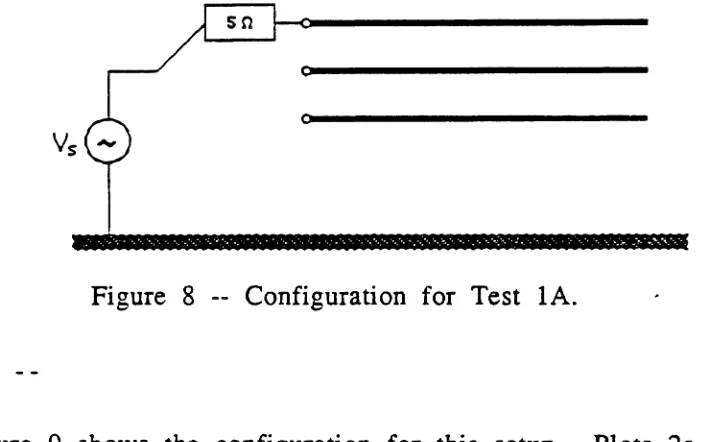
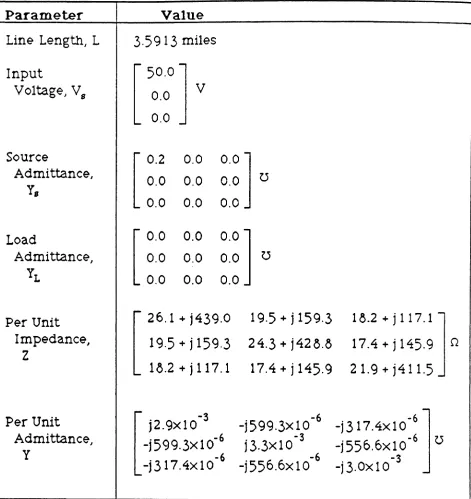
Test 1
A
--Figure 8 shows the configuration for this setup.
Plots 1a and
1b show the theoretical voltage and current along
the line.
Plots 1c
and ld show the actual measured voltage and current on the line.
Table 1 gives the parameters used for the simulation.
o
Figure 8 -- Configuration for Test
lA.
Test 1 B
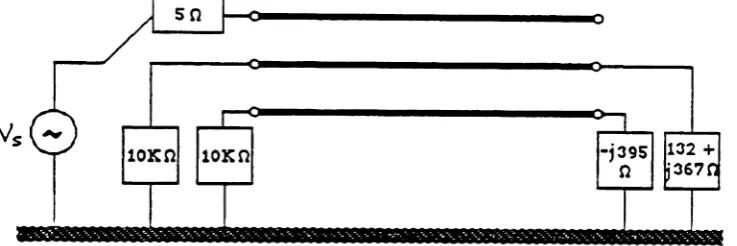
Test 1
C
--Figure 10 shows the configuration for this setup.
Plots 3a and
3b show the theoretical voltage and current along the line.
Plots 3c
and 3d show the actual measured voltage and current on the line.
Table
3
gives the parameters used
for
the simulation.
Figure 10 -- Configuration for
Test
1C.
Test 1 D
--Figure
11 shows the
configuration for
this setup.
Plots
4a
and
4b show
the
theoretical
voltage and
current along
the line.
Plots
4c
and 4d show the
actual
measured voltage and current on the
line.
Table 4 gives the parameters used
for the
simulation.
Parameter
Value
Line
Length,
L
3.5913
miles
-
-Input
50.0
Voltage}
v.
0.0
V
~
0.0 _
Source
- 0.2
0.0
0.0
-Admittance,
0.0
0.0
0.0
U
y.
0.0 _
_ 0.0
0.0
-
-Load
0.0
0.0
0.0
Admittance}
0.0
0.0
0.0
U
Y
L
... 0.0
0.0
0.0 _
Per
Unit
- 26.1
+
j439.0
19·5
+
j
159·3
la.2+j117.1-Impedance,
19.5
+
j
159.3
24.3 + j42a.&
17.4 +
j 145.9
n
Z
_ la.2+j117.1
17.4
+
j
145.9
21.9+j411.5_
--
-3
-6
-6
Per Unit
j2.9x
10
-j599.3xIO
-j
317.4xl
0
Admittance,
-6
-3
-6
U
-jS99.3xlO
j3.3xIO
-j556.6xIO
y
-6
-6
-3
-j317.4xI0
-j556.6xIO
-j
3.0x
10
-
Parameter
Value
Line Length, L
3·59 13
miles
~
-Input
50.0
Voltage} V
s
50.0
V
50.0
-
-Source
,-0.2
0.0
0.0
-Admittance,
0.0
0.2
0.0
U
Y
s
-. 0.0
0.0
0.2 _
-
0.0
0.0
0.0
-Load
Admittance,
0.0
0.0
0.0
U
Y
l
-. 0.0
0.0
0.0 _
Per Unit
- 26.1
+
j439.0
19·5 ...
j
159.3
1a.2
+
j
11 7.1
-Impedance}
19.5
+
j
159.3
24.3
+j428.8
17.4+j145.9
n
Z
17.4 +
j
145.9
21.9+j411.5 _
__ 18.2
+
j
117.1
--
-3
-6
-6
Per Unit
j
2
.9xl 0
-j599.3xIO
-i317.4xIO
Admittance,
-6
-3
-6
1<.5
-j599.3xIO
j
3.3x
10
-j556.6xIO
y
-6
-6
-3
-j317.4xI0
-j556.6xI0
-j3.0xlO
-
Parameter
Value
3.59
13
miles
-Line Length, L
Input
Voltage} V
s
Source
Admittance}
y.
Load
Admittance.
Y
L
-
-50.0
0.0
_ 0.0 _
-
0.2
0.0
_ 0.0
-
0.0
0.0
.. 0.0
v
0.0
-6
IOO.OxIO
0.0
0.0
-3
-j2.0xIO
0.0
0.0
0.0
t5
-6
IOO.OxlO
_
0.0
0.0
U
.
-3
-]2.0 xl 0
_
Per Unit
Impedance,
Z
- 26.1
+
j439.0
19.5
+
j
159.3
... 16.2+j117.1
1
9.5
+
j
159.3
24.3
+j42~.a
17.4
+j
145.9
18.2
+
j
117.1
-17.4+j145.9
o
21.9+j411.5_
-Per Unit
Admittance,
y
-
-3
j2.9x
10
-6
-jS99.3xl0
-6
-j317.4xIO
--6
-6
-j599.3xIO
-j317.4xIO
-3
-6
0
j3.3xIO
-j556.6xIO
-6
-3
-j556.6xIO
-j3.0xIO
Parameter
Line Lengtn. L
Input
Voltage
lV.
Source
Admittance.
Y
s
Load
Admittance.
Y
L
Value
3.5913
miles
-
-50.0
50.0
V
50.0
-.
-
,.-0.2
0.0
0.0
-0.0
0.2
0.0
U
... 0.0
0.0
0.2 _
~
0.0
0.0
0.0
-0.0
-j
2.0
x
10
-3
0.0
U
_ 0.0
0.0
-]2.0xIO
.
-3
_
Per Unit
Impedance,
Z
- 26.1
+
j439.0
19.5
+
j
159.3
__ 1a.2
+
j 11 7. 1
1
9.5
+
j
159.3
24.3
+
j4Za.8
17.4+j145.9
1~.2+j117.1
17.4+j145.9
n
21.9+j411.5_
Per Unit
Admittance
ly
--
-3
-6
-6
j2.9xIO
-j599.3
x 1O
-j317-4x
10
-6
-3
-6
U
-j599.3
x 1O
j3.3xlO
-j556.6xIO
-6
-6
-3
-j317.4xIO
-j556.6xI0
-j3·
0x 1O
Comments
on
Theoretical
vs.
Measured
Results
.-Overall there was some disparity between the theoretical
predictions and the actual measurements.
Before discussing possible
reasons for this and their implications, let us first briefly compare
them.
Test
lA:
Voltage Curves -- The measurements show marked variation
on phase A, which was the only phase to have voltage
applied to it
in
this test., while phases Band C remained
relatively constant at around 16V.
The pattern observed on
phase
A
is generally what we would expect for
a
line
terminated in an
open
circuit.
Physically it
IS
approximately
one
half wavelength.
This
indicates that the propagation
velocity along the line is very close to the speed of light,
since the physical wavelength is nearly equal to the
theoretical one, i.e.
(3.0
x
10
8
m/sec)/(25kHz)
(25kHz
was
the frequency of the sinusoidal voltage generator in the
experiment.).
Also there is no perceptible damping,
i.e.
the
line appears to be relatively lossless.
The pattern observed
on phases Band
C
is more difficult to explain.
It was
higher than on phase A.
This has not yet been fully
explained.
The theoretical predictions parallel the measurements
only
loosely.
Phase
A
shows
the
general standing wave pattern
for an open circuit, but also seems to show that the line
ISslightly longer than one half wavelength.
While the
beginning point is also at 50V, it is at a different point
along
the line.
Thus, the voltage rises somewhat before falling,
unlike the measurements which clearly show the voltage
falling.
Like the measurements, the voltages on phases B
and C are much lower than that on phase A, but the curves
are
not
flat
as they are in the experime-ntal results.
Current Curves -- The current measurements also indicate that
the length of the line is one half wavelength.
As in the
voltage curves, phase
A
is obviously dominate.
However,
the currents on phases Band C, while considerably lower
than that
on A, do track A's general shape.
Test IB:
Voltage Curves -- The measurements once again indicate that
the line is on the order of a half wavelength long.
Since
equal voltage was applied to all three lines, and their
terminations were also equal, we would expect the voltage
on
each phase to be about the same.
This was, in fact,
observed.
Additionally, the pattern observed was what we
would expect for lines terminated in open circuits.
As in Test lA, the predicted voltage curves indicate
a
longer wavelength than the measurements do.
In addition,
the predicted curves indicate that the voltage will
nse
somewhat before falling, while the data shows the voltage
falling immediately.
Also, near the maximum values in the
predicted results, there
is
considerable difference in the
voltage between phases.
However, the predictions are
consistent for open circuited lines.
Current Curves -- Again, the measurements show
a
half
wavelength and
are
consistent with an open circuit
termination.
Notice, however, that there
are
some
irregularities
In
the curves.
The predicted values are consistent with an open circuit,
but again they indicate something other than a half
wavelength.
Notice that relative values of the currents
ISTest
ic.
Voltage Curves -- The measurements and predictions compare
in the same manner as in Test IA.
Current Curves -- The measurements and predictions compare
In
the same for the dominant phase A.
In the case of phases
Band C, the irregular shape of their curves is not preserved
In
the predictions.
Test ID:
Voltage Curves -- The dominant phase in this test was C,
peaking at over 200V.
N otice that if we judge by the phase
C curve, the line would be longer than one half wavelength
as shown in the previous test cases.
Phases A and B have
distinct shapes and do not appear to track one another or
phase C.
Phase
C
of the predicted results tracks the measured data
fairly well.
However, phases A and B bear only a loose
resemblance to the data.
Notice that the relative location of
the curves and their associated minima are preserved while
absolute values are not.
It is also interesting to note that
the values at the beginning and end points do correspond.
Phase
C of the predicted results tracks the measured data
fairly
well.
However, phases A and B bear
little
resemblance to the actual data.
Unlike the case for the
voltage as indicated above, even some of the termination
point values do not match.
Paul's and
Gruner's
Methods:
Plots 5, 6, and 7 show the predicted voltage for Test lA using
Paul's and the two variations of Gruner's approaches.
They are
almost identical to the predictions made using the impedance-voltage
approach previously discussed and are typical of several
comparisons that were done.
Comments
As stated before, the theoretical predictions did not correspond
as closely as had been hoped.
Naturally, possible explanations for
this are needed.
Basically, they can be organized along three lines:
(1)
those dealing with the model,
(2)
those dealing with the
parameters used in the simulation, and
(3)
those dealing with the
experiment.
These will be discussed one
by
one.
The parameters -- It
ISfelt that the parameters used in the
simulation are the primary source of error.
First, there is some
doubt as to the exact distance of the lines.
3.5913 miles is the
distance according to pre-construction architectural drawings.
This
ISthe only data available.
One would expect that the actual distance
might be
a
little different.
Weather conditions can also affect the
length of utility power lines, but the measurements were done
In
mild weather, so this should not introduce much error.
More
importantly, the Z and Y values are probably in error.
Several authors have presented methods for analytically
determining the per unit parameters for overhead lines using line
characteristics and geometry.
However, there are a number of
assumptions that must be made in doing this, some of which
may
not
apply to the CP&L
test site.
This is laid out in
more detail in Mr.
Suh's paper, but for purposes of this paper, let us just list a few of
the approximations that had to be made.
First, it was assumed that
the line geometry was the same all along the
line.
This was
obviously not the case, but
it was felt that the differences would not
be overly significant.
Second, an average value was chosen for
the
resistivity of the earth itself,
SInce
no actual data for
the
test sight
was able.
Finally, a neutral
WIre,
grounded at each pole, was treated
as a part of the ground plane.
able to come up with per unit values that produced results that more
closely matched the experimental data.
These are not included
in
this paper because there was simply no scientific basis for them.
There are empirical methods for deriving the per unit
parameters.
In fact, after performing an open circuit and short
circuit test to derive two input impedance matrices which we shall
refer to as Zse and Zoe, using the equations found in section 1 of
chapter 3, we can derive:
(6 I )
and
(62)
which gives us two methods for finding the characteristic admittance.
We can also derive an equation for
y:
-1
(
-1 )"( =
2L In [U -
K
1
[U
+
K ]
where
This is discussed
In
more detail
In
Mr. Suh's paper.
(63)
(64 )
idiosyncrasies of the test site
may
have affected the open and short
circuit tests to the point of making their results useless.
Once
again,
this
ISdiscussed in more detail in Mr. Suh's paper.
Chapter
5
Conclusions
This paper has presented three methods for modeling multiple
conductor transmission lines.
Of
the three, it is felt that the
impedance-voltage method provides the best combination of
versatility and numerical efficiency.
By having equations for the
input impedance, and V(x) and l(x) in terms of V(O), 1(0),
y,
and
rL,
the method can readily simulate a single conductor or a
multiconductor network.
In addition, it is a relatively fast and easy
method to implement.
In particular, using a tree structure approach
such as that used in CAPNET, which is implemented in C in order to
take advantage of its recursive programming, data structures, and
dynamic memory allocation capabilities, one could readily handle a
complex network.
None of the methods, however, are any good without accurate
values for Z and Y, the per unit impedance and admittance.
There
are methods to derive them analytically, but work needs to be done
to verify these methods empirically.
Along the same lines, the
models themselves need to be verified with physical measurements
and modified if necessary.
The models are quite useless if they do
not accurately predict real-world situations.
the case. some other approach, such as a table based method or
perhaps some form of an extension to these models using fractals,
might be necessary.
However, it will not be known which direction
to
take until more empirical research is done.
This paper has compared simulations produced
by
the models
with one such set of data.
The results, however, are somewhat
inconclusive.
The models showed some ability to predict the
behavior of the lines.
Unfortunately, insufficient data was available
to make meaningful adjustments to the simulation parameters in
order to try to get better results.
This illustrates the importance of
0
r~
'T:z
\
" 1<") I I \ ",
I \ I , 0 , (\.J I.~ "- ,I rr,
<
.... I<,
lJl
~ <,...
~ "
:
0 r--lIl'~ " rJj
~
"
'.'J r:C ~ ~ 0 'L' .~ ..,.. I
-
I~ I"\,J I
U
I-=
Z
0 ItflI<
0 ~ (\JE
W
I-
I ~ ~0
oJ)0'+-'L'
U ) I I
>=-
\, z,~
,
I
0\ I I
~ , (\J
-+'
c...'
, III/
/ ,
-<
/ ,/
\
LJ
~ / \ ' 0
~ / " 0
>
(
" OJa
>=-
" ,(LJ "
,
0
r»
"0
i') \ ,~ .~
+-' -, r"
,,'
~ /:
()
>
00 0 0 0 0 0 0 0 0 0 0
0 0 r·(') (.0 en (\J If) ((I --l ~
t"'- <D LI) ~ ~ r<) (\J (\J --l
Cor reri
t
.200
.-',
I I I I I I + f
-1.20 1.60 2.00 2.~~0 2.80 3.c.·,~, 3.'.=,'.'1 -1.00
/ \ \ \
,
~,, \ '\,-,
.800.>'>:
/ "A)t
,
CURHENT VS. DISTANCE (TESTff.ll)
,-'
,/
,/
II
/
! ---
...."".,""
" , " "
0\
~
Lr'\+
\
~i
(Y').~ \ I
~
0\ \ Y"""'1 -+I
C"t1 ~ ~~-.
"- it 0\~l
'"
:+,
"-~
i
N
"--." "
,..-... ,
~
I
<!
<.
~<,
;i
0\ lJ")
:::tt:::
~
("'t") w~
-'
In1!
N ... W ~ ~ '--' "'-"'" :.tn
:1
LUji 0
w
0
u
0
~
~a:::
«
:J
)
N ::>~ 0 -J ~; V>
0
j
>
I 0 ~
-J
~
0«
\()a::
0:::: U-fo-~
...-4 ~ W WZ
:1
u
~
i
0z
0
Db
N et
t-
I-W :
,
...-4 (J")
en
~i
...
«
: I0
I : I
CL
::i
a
q
mJ
co
~
\
01 \ 1 \
; i
0[J:tJ ~
l
i 0~
.
,i
~J
U
00
0 0 0 0
a
a
a
U"\ ~ ('Y") N Y"""'1
>O-l~(/,)
\ 0\ Il'\ ("tj 0\ f"""'4 ('t') 0\
'"
N...-...
0\ U'")W("'t")
-1 N H~
' - '
0 lLJ 0 Uc:::
N
=>
0
V')
0 ~
\0 0
a::
...
LL W U 0 Z N«
I -...-4 lJ") H 0 0 co 0o·
~ 0 0a
0 \ \, \ '.:q..
q
\ ". .-, . '\.", \', \. ~p / ,"
o
:/
.:; ;' / / ';OJ
/..
' / .: / / / / / / e;Oo / : I I I I ctJqJ
I I,
I ~ \ \ \ \ \ ~ \ \ \ \ \~\ ~
o
0 0 0 0 0 0 0 0 0 O· 0~ 0 ~
ro
~ ~ ~ ~ ~ N ~,...
~o
0 ('Y') N P-I ... U1 .-Z W 0::a:::
=:>
u
w
If)«
I Q.. Ee::t---_.
i
VOLTAGE VS. DISTANCE (TEST# IE)
V<:'JI
tl~(~le
(V)
150 -" ~ ~ 0 rt N ~ ~ <;» I I H
::r
ro 0 t1ro
rt...
n P3 f-I<
a
~ rt ,,-.... P3 .t' OQ ...ro
'-"<
(/).
p.....
en
rt P3 t:i nro
,,-.... Hro
Ul rt ~ ~ tJj ' - ' 135 120 105 90.0 75.0 60.0 45.0 30.015.0
I I I ./.,
,',', ' ,/ "'".,
I I I I I , / . , Ii . I'l' ,'f ,," ~~, "
.. / - - " ' - , "
" -, \ \ \ \
"
'.,
.\\ ~ , (, 1 / ,
, l
" / '
, I , /
.'/
//
/..!
,/, , / '/ 3.20 2.80 2.~O 2.00 1.co
1.20
.800 • '-tOOo
TI---~'~----;:':-:---~Ir:-:---~'t----+-I
o
----+1
- - - - + + - - - 1 - - - - .-I
Cor-r-eri
t
(A)
.300
CURRENTVS. DISTANCE (TEST#lB)
\ \ '\
\\\\\
, \. \/~""""'-"
/ , I , I , I I II / . ,
:'
/,/
://
I I
'/:'
/
,
\ I ,
0\ Ll'\ M 0\ ... C"W1 0\
'"
N "...-., 0\ U1 C"W1 W -.J N H ~ '-" 0 LLI 0 Uc::
N ::> 0
(f)
0 ~
\0 0
c::
...
L..W
U
0 Z
N
c::
~P-t If)t-f
Cl 0 to 0 0 ~ 0 0 0 0 0
o
...
o
No
C"W1 >O....Jt-V') "", "':...'.'''"',"
.~.<,
"~ ",-" ~ \" .....
'
\ \o
\0 <.nw
C)<
~ -1o
>
-1«
et:: ~::>
w
z
o
~w
en
<! I 0... OJPHASE CURRENTS (TEST#
1
B)
~ f-' o rt90
N ~ 0.-<:»80
,....-.-6-/ ' / ' . / ~3.59
3.19
2.79
<, <, 't::i ... ~O" . -,~
\\
o '\
'.\
.
\ ,, .\
.;.
.... '/!}. ". \ \.\\
.\. \ \ ' .\~. ..'\
. \ , ... ~, ..'\. "''.~'8
2.39
2.00
...··8··....1.60
1.20
0.80
/ /ira - : ,D'
'"
/' /'
./
/ '
/ / , / O'
;l//.- .
~.
/ ~
. . ,/ "
j ' . :
-=...
-l..:~
T
0
r~
,r)to
'-IJ~ 1(")
U
'....
UI
~ '...<,
Il'
~ 0 r--t
~ (f;
~ (\J
E
~
~ 0 'L
I
~ T
f\J 1_'
~ I
U
II~I
Z
0 tJl-<
0~ (\J ~
tr:
'_I. . - I ~
0
0'DI-+-III
fJ..2 ( _I
t>
I-:
I 0 I I~ I, I'"\J +-'
0
. / , 1j"1, / I
<
/ \,~ .I '-'. 0 L l
~
/
0>
"
I))0
\
>-
'-'"1) 0
r»
I 0o
-, ,I -':f'-+-' "" ,I
,...
"
0 I
>
00 0 0 0 0 0 0 0 0 0 0
0 0 ,..r) {£J r» (\J L() IX' --4 'T
t'- <D Lf) <t" --:r ,..r) (\J ('\J
'-'
t~
0
.'fJ
rrJ
~ 0
'.\.J
I
U
, ,r,- - l
~·II
::::t::t:::
~ 0 ~Il'
o:
((I~ 1'J ,-C
~ - :
~ ./ , 0
rLI
/ ·T
~ I
,'\j r_,
/ ,
U
(
IZ
"
I" 1_'
<
"0 IJJ 0
~ ,
(\J
;:~ I E
I
I , I
~
0
1_-, 0
4-<, (~
<,
u::2
ell>-
'_I~ 0 ~
1'J I I
Z
1:
+'
~ IfI
0::::
U0::::
<C IX;I---...
.,....J
U
\-t-1
-
0!- 0
(1) ~
L
(
5
(-.J
0
0 0 0 0 0 0 (\.J (\J (\,j t'\J 0
0 00 (0 ..;:r (\J C" I I I I
(\J --t --t --4 --4 --4 V () V 4.'
0 0 0 0
0 0 0 0
OJ (,D "1" (\J
PHASE TO NEUTRAL VOLTAGES (TEST
#
1
C)
/ ¥..
---+-/ ,1
<>
OJ.::.:
'-:'~'~:~:~B'~.·.~.~~:·~~·~·~·:~:=:·~···~.~~O~ :.~
..
_~.:~:~-'.~.'.~.:~:.~~ ~'.~.:~:~:~.'.:.'.~.:~:~:.~.'~'. ~.:~:.~:~.: ~~.'.
. =:
~:.~.'g
0-1
50
40
30
20
10
t-d~
0
rt W
r<;
n
'-" I I
~ CD Pl
en
~
t1
CD CL
~
0
J-J
rt
~
(JQ
V
(1)
,...",
0
Ln ~
W m
L
<:»
.
CL
T
I-Ie
S
en
rt
Pl
~
n rn ~
H
CD
en
rt
~
..-n
0\
r
Lt\("t"')0\ --I (Y) 0\ ,... N ~
0\ (JjW
C"1 ..J
N
...
~'-"'"
0
w
0
u
c:: N =:> 0V)
a
~\0 0
a:::
.-t I.L W U 0 Z N C( ~
...
V)...
0 0co
0 0 ~ 0 0 0 0o
o
...
/ ~I I / /-c
\ \"
", \ ....\~
r.
l\
IiU
o
N /tJ
~ I,
\\
.
\.
\Q
.i
:/:.'l
1o
-o
\ \ \,
0
13
I / / / / /c
-o
.; / I \ \ <10
<,"
o
o
(Y)o
co
a
0\o
o
~ (J1 I -Z W Ct: 0::: ~ U W (J1 <{ I CLI
-VOLTAGE
VS.
DISTANCE (TEST#ID)
225 200 175
___ --~.~.r~:~
/i ;' ///
//
/
/'
. /' '-" \ \ "'\
",
"
,
". r > :
. / "'-.
"'=J C' T 0 ,"£j
.:
.-t<'J // / , /~ / 0
0
I'\J1(",....-,
::::t=t::: / 1.1"1
~ / 'll
/
0 ..--irr:
I); ('-Ic-["-1
c E---~. 0 ILl T ~ I-
I (\JU
~ -;Z
-:: I,
<
, 0-0 IJI
~ I
/
{\J
;::C! \ , ~I I
1----4 \ ,
-0
, L-.'"
0'+-\.0
v~ IL'
t>
I I:..
\ t;
~ \
\, 0 iI
t"'\J
-Z
\ " " -+-'U", \ ~ \ ,,
0:::
CJ 00::
0.--.
<
(I)~ .'.(
U
/ \+-J \
-
/ \ 0L. / , 0
IV \ 'T
\
L.
\ L \ \ ~ \i.:
, 00 0 0 0 0 0 0 0 0 1\J 0
0 "T co f\J
so
0 'T 00 (\.J I(.£J L/) 'T 'T ,-0 r~" (\J ~ --4 Q.. 0 0
cD
PHASE T() NEIJTRAL VOLTAGES (TEST #1
D)
250
/ '
:¥.
... 0···
"
,
~
/
~
I \ \ / \ / \ I \ / \ I \ I \ I \ / '. I '. IA
~,~
'. I / /
\ . / '
"
}~./~ef</:···O
\ 0 .
\ .' .. ' / / ' I
.' ;,-' I
.·0 \ /
. \
\ / / I
.,/'\ I
,./
\ , 6'/ <, ",...-fr-._ / ' --~ / / ' /f
/ / I / / / Ifl
...0
0 .
/ / ,/