IRNSS/NavIC On-Board Clock
Characterization
Kaitha Rajaiah 1, Manamohan Kamat 2, Nirmala S 3, S C Ratnakara 4
Scientist/Engineer –‘SD’, Space Navigation Group, ISRO Satellite Centre, Bangalore, India1
Scientist/Engineer –‘SE’, Space Navigation Group, ISRO Satellite Centre, Bangalore, India2
Scientist/Engineer –‘SF’, Space Navigation Group, ISRO Satellite Centre, Bangalore, India3
Scientist/Engineer –‘H’, Space Navigation Group, ISRO Satellite Centre, Bangalore, India4
ABSTRACT: The stability and accuracy of the on-board clocks play an important role in the performance of any
navigation system. The navigation user’s position is determined by measuring the time of travel of the signals broadcasted from satellites to the users. The error in the measurement of time interval effects the user position. Therefore the on-board clock behaviour has to be continuously monitored and any malfunctioning has to be noticed immediately to improve the capability of the timing system for accurate positioning of the user.
Each IRNSS satellite carries three Rubidium Atomic Frequency Standards (RAFS), one primary and two redundant clocks (Hot redundant & Cold redundant). The stability of these satellite clocks can change with time due to several factors, such as environmental effects and aging. Hence, it is important to characterize the time-varying clock behaviour. An algorithm was developed to measure the clock inaccuracies in terms of stability and detection of anomalies. This paper provides In-Orbit clock performance results of IRNSS RAFS using both conventional Overlapping Allan Deviation (OADEV) and Dynamic Allan Deviation (DADEV). All IRNSS satellites meet the desired stability specifications of 5.0E-14 at 10000 secs hence ensuring the user equivalent error due to clock noise is better than 0.4 ns
KEYWORDS:Satellite clock, Allan variance, Atomic Frequency Standard, Clock characterization.
I. INTRODUCTION
Indian Space Research Organization (ISRO) has evolved an independent Indian Regional Navigation Satellite System (IRNSS) which is named as Navigation with Indian Constellation (NavIC) to provide position accuracy better than 20m over India and the region extending about 1500 kilometres around India. The space segment of IRNSS comprises of seven satellites: three satellites in GEO (Geo-stationary Earth Orbit) located at 32.50 E, 830 E, 129.50E and four satellites in IGSO (Inclined Geosynchronous orbit) with longitude crossings at 550E and 111.750E [1]. All the IRNSS satellites carry 3 Rubidium Atomic Frequency Standards (RAFS): one primary and two redundant (hot redundant and cold redundant). RAFS produces a frequency of 10MHz and is converted in to fundamental frequency of 10.23MHz. This fundamental frequency is used to generate navigation signal in L5 and S bands.
Accuracy and repeatability of IRNSS will be ultimately determined by the inherent stability and accuracy of the on-board clocks. Frequency stability is widely used to measure the clock noise which indicates the degree to which an oscillating signal produces the same frequency for a specified interval of time. Depending on this information, one can judge the expected time error during navigation broadcast period. Overlapped Allan Deviation (OADEV) is a standard statistical tool to estimate clock stability which is a fundamental quantity used to assess the performance of a clock and its impact on the performance of the system that uses the clock [2].
The stability of IRNSS RAFS can change with time due to several factors, such as environmental effects and aging, hence an extension to OADEV known as Dynamic Allan Deviation (DADEV) was implemented to provide instantaneous frequency stability and detect anomalies viz. frequency jumps, increased noise. The DADEV has used in applications to space and satellite systems, in particular in monitoring the clocks of the Global Positioning System (GPS) [3], European Galileo project [4, 5], and in the NASA exploration of deep space [6].
In this paper on-board clock performance of all IRNSS satellites have been discussed. OADEV technique is used to study the long term behaviour and DADEV has been implemented to study instantaneous clock stability and thus detect the possible non-stationary behaviour and related clock anomalies.
II. ON-BOARD CLOCK CHARACTERIZATION
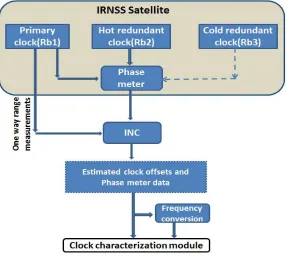
IRNSS spacecraft carries phase meter payload which provides the phase error between primary and redundant RAFS. Also the carrier phase measurements obtained from navigation signals can be used to derive the absolute phase error of primary clock with respect to IRNWT. Below figure shows the on-board clock data flow for IRNSS.
Figure 1: On-board clock data flow in IRNSS
errors except satellite clock [7]. Estimated clock offsets are embedded with measurement noise and orbit inaccuracies, whereas relative clock offsets obtained from phase meter are free from external noise sources and hence provides better resolution of RAFS behaviour. Hence, the characterization is done using relative clock offsets from phase meter. Relative clock offsets are further converted to frequency domain for characterization.
Since primary and redundant RAFS are identical, statistically it can be assumed that half of the measured variance comes from each RAFS, thus the measured Allan deviation can be corrected for one RAFS by dividing it by √2 [8]. Phase meter data is available with sampling of every 2 sec through spacecraft telemetry; hence the stability is available from minimum averaging time of 2 sec. Following table provides the specifications of IRNSS on-board RAFS.
Parameter Specifications Frequency accuracy +/-1.0E-9 Frequency drift 5.0E-13/day Frequency stability 1s 10s 100s 1000s 10000s 5.0E-12 1.5E-12 5.0E-13 1.5E-13 5.0E-14 Mass 3.2kg Power < 35W
Table 1: IRNSS RAFS specifications
Currently, IRNSS clock behaviour is being characterized in terms of long term stability using OADEV in offline and short term clock stability using DADEV in near real time. OADEV can be estimated from a set of M frequency measurements for averaging time τ =mτ0, where m is the averaging factor and τ0 is the basic measurement interval, by
the expression [9]
σ(τ) = 1
2m (M−2m + 1) [y −y ]
But OADEV has its own limitations and it cannot capture anomalies and the non-stationary behaviour in the random signal. It indicates the average stationary behaviour of the clock for the given dataset. Also events such as data gaps, phase jump and frequency jump cannot be easily handled using OADEV. To overcome the above limitations, a new algorithm has been recently developed known as DADEV [10-12]. DADEV is a sliding version of the Allan deviation where the time series is truncated at a window of length T centered at the epoch t1, and the Allan variance of the
windowed data is then estimated. The window is slide to a second epoch t2, and the Allan deviation is estimated around
that epoch. The repetition of this procedure results in the evolution of the Allan variance with time. This algorithm also captures the periodic variations present in the satellite clocks [13]. The Allan deviation obtained through DADEV is represented using 3D graph.
III.RESULTS AND DISCUSSIONS
IRNSS on-board clock performance was studied using both conventional OADEV and DADEV along with the frequency offset. Datasets were chosen specifically to highlight non-nominal performance to show the effectiveness of DADEV.
A. OADEV performance:
Figure 2:Frequency stability for all IRNSS satellites
From the above figure, it is clear that all IRNSS RAFS have similar performance and meets the navigation requirements. The stability at 10000 sec is better than 4.0E-14, which corresponds to uncertainty of better than 0.3 ns.
B. DADEV performance:
Various kinds of anomalies observed in the on-board clocks have been chosen from the dataset of 3 years from Jan2014-Dec2016. The raw frequency obtained from phase meter is smoothened using exponential weighted moving average filter for aiding frequency jump detection. DADEV performance is shown for nominal dataset, frequency jumps, increased noise and missing data. The window length of 3000 sec was chosen for the computation.
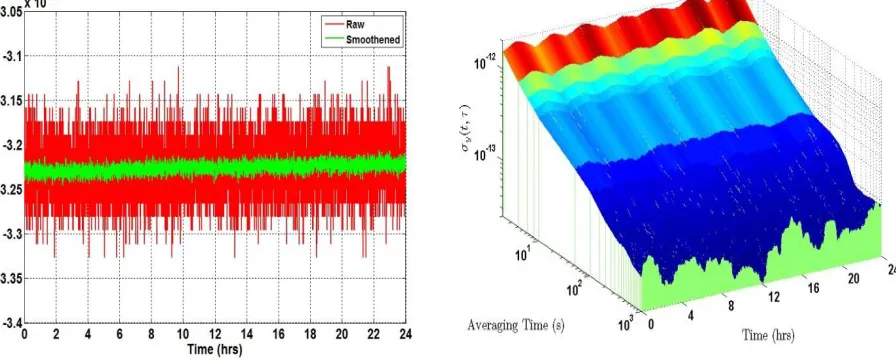
Figure 3 and 4 shows the frequency and it’s DADEV during nominal behaviour. The short term stability can be clearly assessed and it meets the desired specifications.
Figure 3: Nominal frequency behaviour Figure 4: DADEV during nominal frequency behaviour
Figure 5: Frequency data with jumps Figure 6: DADEV for frequency data with jumps
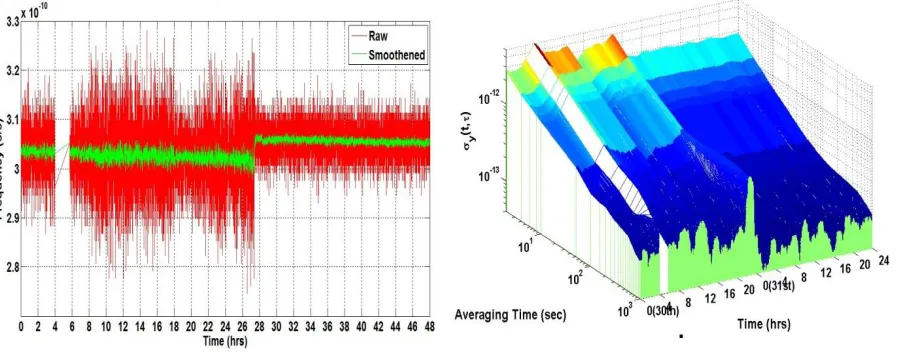
Figure 7 and 8 shows the frequency and its DADEV with multiple events i.e. missing data, large noise and frequency jumps. Simultaneous effect of two events viz. reduction in noise and frequency jumps can be seen to be immediately adapted by the DADEV statistics.
Figure 7: Frequency data with data gap, increased noise and jump Figure 8: DADEV for frequency data with data gap, increased noise and jump
IV.SUMMARY AND CONCLUSION
identified from large dataset of around 3 years. The results have been shown for events such as missing data, large noise and frequency jumps. The statistics derived from DADEV graphs can be used to clearly identify all these events and aid the Navigation Center to take appropriate action. The frequency jump magnitude upto 5.0E-13 can be easily detected using the DADEV graphs.
ACKNOWLEDGMENT
The authors wish to acknowledge all the members of Space Navigation Group (SNG), ISRO Satellite Center for their motivation, help and their constructive comments for this work.
REFERENCES
[1] Ganeshan A.S., Ratnakara S. C., Nirmala S., Babu R., Neetha T., Kartik A., “Successful Proof-of-Concept Demonstration First Position Fix with IRNSS”, Inside GNSS, 2015.
[2] D W Allan, “Statistics of Atomic Frequency Standards”, Proc. IEEE, vol. 54, no. 2, pp. 221–230, 1966.
[3] “Naval Center for Space Technology Monthly Analysis Report”, U.S. Naval Research Laboratory, Washington, D.C, 2006.
[4] Hahn, J., Gonzalez, F., Waller, P., Navarro-Reyes, D., Píriz, R., Mozo, A., Fern´andez, V., Cueto, M., Tavella, P., Sesia, I., “GIOVE-A apparent clock assessment and results”, 39th Annual Precise Time and Time Interval Systems Applications Meeting (PTTI), Long Beach, CA, 2007. [5] Sesia, I., Galleani, L., and Tavella, P., “Implementation of the Dynamic Allan variance for the Galileo system test bed V2”, EEE FCS-EFTF,
Geneva, Switzerland, 2007.
[6] Miranian M., Weaver G. L., and Reinhart M. J., “An ensemble of ultra-stable quartz oscillators to improve spacecraft on-board frequency stability”, 38th Annual Precise Time and Time Interval Systems Applications Meeting (PTTI), Reston, VA, 2006.
[7] D.Kaplan, J.Hegarty, “Understanding GPS principles and applications”, second edition, 2006.
[8] W.J. Riley, “Application of the 3-cornered hat method to the analysis of frequency stability”, Hamilton Technical serv., http://www.wriley.com/3-CornHat.htm, 2003.
[9] W.J. Riley, “Hand book of frequency stability analysis”, NIST special publication 1065, 2008.
[10]Galleani L., and Tavella P., "The Characterization of Clock Behavior with the Dynamic Allan Variance", Joint FCS/EFTF Meeting, pp. 239-244, 2003.
[11]Sesia I., Galleani L., and Tavella P., “Application of the Dynamic Allan Variance for the characterization of space clock behavior,” IEEE Transactions on Aerospace and Electronic Systems, vol. 47, no. 2, pp. 884–895, 2011.
[12]Galleani, L.; Tavella, P., ” Tracking Nonstationarities in Clock Noises Using the Dynamic Allan Variance”, IEEE International Frequency Control Symposium and Exposition, Vancouver, BC, Canada, pp. 392–396, 2005.