Removal of Crystal Violet from Aqueous
Solutions Using Eggshell
Fatemeh Abedi
Professor of Chemistry, Islamic Azad University, Kazerun Branch, Iran
ABSTRACT: The present study aimed to evaluate the potential of eggshell as an inexpensive, available absorbent in removing crystal violet from aqueous solutions. In this regard, four major factors were investigated, including the contact time, pH, absorbent and temperature, as the main influential factors in the efficiency of removal using the Taguchi method. According to results, eggshell could remove a high percentage of crystal violet by the mentioned method at the pH of five, contact time of 60 minutes, temperature of 50C, and two grams of absorbent.
KEYWORDS: Crystal Violet, Eggshell, Taguchi Method
I. INTRODUCTION
Various types of dyes are applied in textile and leather industries, the direct discharge of which is a significant environmental pollutant of the water and soil [1]. Organic pigments are also harmful to human health, even in trace amounts, while industrial wastewaters can cause diseases in aquatics and humans as well.
Crystal violet is an organic pigment, which is used as inkin the printing industry, as a disinfectant in the textile industry and an antifungal agent in the aquatics industry. This compound can enter the water through industrial wastewaters. Metabolic properties of crystal violet could cause cancer and mutation in humans. Nevertheless, crystal violet is a pigment with numerous applications in the aquatics industry due to its low cost and high efficacy [2].
Methods of removing pollution from water sources are of great importance since the quality of water largely influences the health of living creatures. Therefore, efficient approaches must be adopted to eliminate these harmful pigments from the water. Some of these techniques include common biological and physical-chemical methods, which can remove pollution from wastewaters. Other methods in this regard are anaerobic-aerobic removal [3], coagulation [4], oxidation-ozonation, membrane separation, membrane processes [5], and absorption [6].
Biological methods cannot be used frequently due to the toxicity of the pigments, such as crystal violet, which kills bacteria and microorganisms, particularly those that are used for absorption. On the other hand, in the chemical methods of pigment removal, use of chemicals may lead to other contaminations in the water since during the removal process, development of new and secondary compounds can contribute to cancer. This highlights the need for proper solutions in this regard.
Compared to the chemical and biological approaches, absorption is an efficient technique to eliminate dyes from wastewater. Various absorbents are used in this process, including active carbon, palm fibers, brans, sawdust, tassel, rice and chitosan [7-10].
Considering the high cost of active carbon and problems associated with the restoration of saturated absorbents, inexpensive absorbents have been frequently used in recent years. Eggshell is a cheap material composed of calcium hydroxylapatite. With its porosity, eggshell can be a suitable absorbent to remove environmental pollutants [11]. The structure of this material consists of 4% organic compounds, 94% calcium carbonate, and the remaining 32% constitutes calcium phosphate and magnesium carbonate [12]. The present study was conducted by the Taguchi method in order to save the time and cost of contaminant removal.
method in the current research was to determine the effective parameters in the design and study of the changes during the process relative to the changes in the parameters and levels of controllable factors in order to achieve the highest efficiency [14].
Taguchi has reduced the number of experiments in his method by using orthogonal arrays represented by Ln(Xy), in which L is the Latin squares, n shows the number of experiments, x is the number of factor levels, and Y denotes the maximum number of the factors that can be studied by the given array. These arrays are selected based on the specific features of all the experiments in the full-factorial method. Of course, Taguchi does not claim that the optimal solution certainly lies in the selected experiments, but rather, suggests that by using the calculations relating to the array experiments, we can determine optimal conditions. Eventually, by performing a confirmatory test (repeating the experiment under the optimal conditions and verifying its reproducibility), the accuracy would be obtained [15]. In the current research, four parameters of absorbent, contact time, pH and temperature were investigated for the removal of crystal violet from aqueous solutions using eggshell as a natural absorbent. Each of the parameters was studied on three levels.
II. EXPERIMENTS
Chemicals and Apparatus
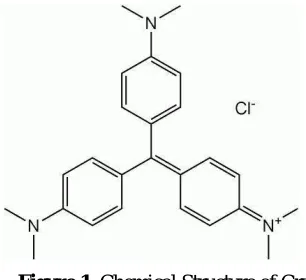
Crystal violet pigment was purchased from Merck Company (Germany). Molecular form of crystal violet is C25H30N3CL, and its chemical structure is depicted in Figure 1. To measure the dye in the present study, we used the Lambda-5 Perkin-Elmer spectrometer at the maximum absorption wavelength of 590 nm for crystal violet. In addition, all the pH measurements were carried out by a pH-meter (model: pH/Ion 699), and hydrochloric acid and soda were used for pH regulation. Eggshell was prepared by a 40-60 μm mesh.
Figure 1. Chemical Structure of Crystal Violet
Preparation of the Absorbent
Initially, the eggshells were washed with distilled water and dried at laboratory temperature of 20-250C. Afterwards, the eggshells were crushed by a porcelain pounder and broken into smaller pieces by a 40-60 nm mesh.
Procedures
Table 1.Selected Parameters and Levels
Levels
1 2 3 Parameters Number 3 90 7 50 2 60 5 40 0.5 30 3 25 Absorbent Mass (g)
Contact Time (min) pH
Temperature (0C) 1
2
3
4
Results
Removal of Crystal Violet Using Eggshells
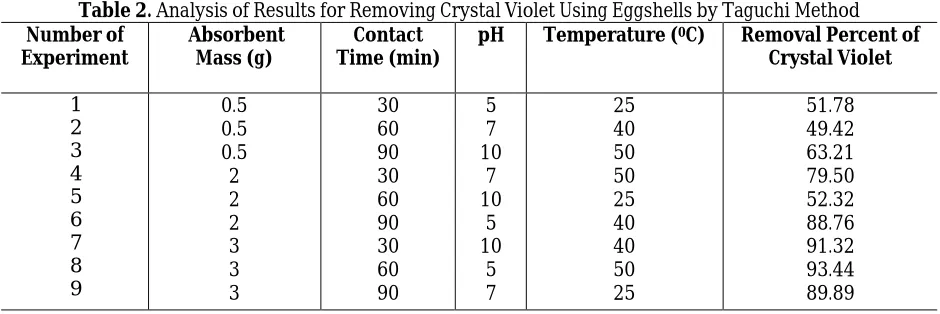
Analysis of the results of removing crystal violet by eggshells based on the L9 orthogonal arrays is shown in Table 2.
Table 2. Analysis of Results for Removing Crystal Violet Using Eggshells by Taguchi Method Removal Percent of
Crystal Violet Temperature (0C)
pH Contact Time (min) Absorbent Mass (g) Number of Experiment 51.78 49.42 63.21 79.50 52.32 88.76 91.32 93.44 89.89 25 40 50 50 25 40 40 50 25 5 7 10 7 10 5 10 5 7 30 60 90 30 60 90 30 60 90 0.5 0.5 0.5 2 2 2 3 3 3 1 2 3 4 5 6 7 8 9 Absorption Process
In the absorption process, we first addressed the basic factor in this process, which is the amount of the absorbed dye on the absorbent per mass of the absorbent, as represented by q and calculated by equation (1) [16]:
(1)q =( ) )
where C0 and Ce are the initial and balanced concentrations in mg L-1, respectively, V is the volume of the solution in litre, and m shows the absorbent mass in grams. In addition, equation (2) was used to calculate the absorption
efficiency/percentage, as follows: (2) % R =
×
100where C0 and Ce are the initial and balanced concentrations in mgL-10, respectively (17). Based on Table 2 and equation (2), the eighth experiment was observed to have the highest removal efficacy, estimated at 93.44%.
Main Effects of the Studied Factors
In the present study, after conducting the experiments and obtaining the results, another table was drawn to determine the most effective factors in the Taguchi design experiment (Table 3).
(3)A
L=Table 3. Most Effective Factors in Crystal Violet Removal by Taguchi Method
Lmax - Lmin L3
L2 L1
Factors
36.75 7.62 11.67
9.65 91.55
76.52 86.96 70.15 73.53
68.90 76.48 79.80 54.78
11.32 75.29 73.78 A. Absorbent (g)
B. Contact Time (min) C. pH D. Temperature
(0C)
For instance, by reviewing Column A in Table 3, we observed that level one of the experiment for A1 was 1,2,3; therefore, the mean effect of A1 was calculated by equation (4), as follows:
(4)R=Result Ads( )
=
A1Table 3 shows the optimal conditions for the measurement of crystal violet based on the Taguchi experimental design. Additionally, Table 3 was used to demonstrate that if zero was between X1 and X4, the factor would be ineffective in measuring the crystal violet, while the absolute largest number indicated that this factor had the most significant effect. Also, the absolute smallest figure belongs to the factor with the least significant effect on the measurement of crystal violet. With respect to the last column of Table 3, the effects of these factors in order of significance were as follows:
m>pH>T>t
III. CONCLUSION
According to the results of the present study, with its high calcium hydroxyl apatite content and porous structure, eggshell is a cost-efficient and effective absorbent for removing crystal violet from aqueous solutions. Furthermore, results of the Taguchi experiment based on the L9 orthogonal arrays indicated the highest rate of crystal violet removal to be 93.44%. In conclusion, our findings suggested that among the four studied factors, the absorbent mass had the most significant contribution to the absorption process, while the contact time had the least significant effect in this regard.
REFERENCES
1. Meshko, V., Markovska, L., Mincheva, M. and Rodrigues, A.E. (2001), Adsorption of basic dyes on granular activated carbon and natural zeolite”.Water Research, 35(14), 3357–3366.
2. Thammu Naidu .J. and Meikap.B.C., BiswasInd.Eng .M.N. (2006).Removal of crystal violet from wastewater by activated carbons, Chem. Res.45.5165.
3. Chinwetkitvanich, S., Tuntoolvest, M. and Panswad, T. (2000). Anaerobic decolorization of reactive dyebath effluents by a two-stage UASB system with tapioca as a co-substrate.Water Research, 34(8), 2223-2232.
4. Namasivayam, C., Muniasamy, N., Gayatri, K., Rani, M. and Ranganathan, K. (1996). Removal of dyes from aqueous solutions by cellulosic waste orange peel.Bioresource Technology, 57(1), 37-43.
5. Gong, R., Ding, Y., Li, M., Yang, C., Liu, H. and Sun, Y. (2005). Utilization of powdered peanut hull as biosorbent for removal of anionic dyes from aqueous solution. Dyes and Pigments, 64(3), 187-192.
7- Arami, M., YousefiLimaee, N. and Mahmoodi, N. M. (2006). Investigation on the adsorption capability of egg shell membrane towards model textile dyes. Chemosphere, 65(11): 1999–2008.
8- Janus, M., Kusiak, E., Choina, J., Ziebro, H. and Morawski A. W. (2009) Enhanced adsorption of two azo dyes produced by carbon modification of TiO2. Desalination, 249(1): 359–363.
9- Moussavi, G. and Mahmoudi, M.( 2009) Degradation and biodegradability improvement of the reactive red 198 azodye using catalytic ozonation with MgOnanocrystals. Chemical Engineering Journal 152(1): 1–7.
10- Cheul,S., Yong, N., Choel, L., Hee, L. and Lim, Ch.( 2004) Characterization of HANARO neutron radiography facility in accordance with ASTM standard E545-91/E803-91 for KOLAS/ISO17025. Applied Radiation and Isotopes, 61(4): 631-638.
11- Tsai, W. T., Yang, J. M. and Lai, C. W., (2006) Characterization and adsorption properties of eggshells and eggshells membrane. Bioresorce Technology, 97(3): 488-493.
12- Dong, Q., Su H and Zhang, D., (2007). Synthesis of hierarchical mesoporoustitania with interwoven networks by eggshell membrane directed sol-gel technique. MicroporousMesoporous Materials, 98(1-3): 344-351.
13. Dias, A. G., and Philips, D. T., (1986); Principles of Exprimental Design and Analysis «.Kopps, S., Myslak, ZW., (2004); Carcinogenicity of azo colorants: influence of solubility and bioavailability «, Toxicol. Lett, 151: 203-10.
14. Nam-Ng, Y., Black, D., and Luu, Kh., (1995); Taguchi methods, Curtin University Handout Notes for Computer Aided Engineering. 15. Wily-VCH., (2003); Ullmann s ncclopedi a of Industrial chemistr , Vol,10.