Performance Evaluation of Segmentation
Based on RGB Color Model
E.Boopathi Kumar 1, V.Thiagarasu 2
Research Scholar, Department of Computer Science, Gobi Arts & Science College, Tamilnadu, India.1 Associate Professor, Department of Computer Science, Gobi Arts & Science College, Tamilnadu, India.2
ABSTRACT: Image segmentation is the process of grouping an image into units that are consistent with respect to one or more characteristics. Segmentation in gray images has lot of methods to segment and it has several set of algorithms to represent it. But the images produce more information in scenes i.e., color images have few numbers of methods to segment it. So, this paper represent color image segmentation methods in the literature and getting to prepare novel segmentation method with combined form of masking, filtering and Thresholding methods. Otsu method is one of the best and classical Thresholding method used in color image segmentation. It uses various combinations of masks to scan over the image to detect the correct boundary. Otsu method divides the segmentation tasks in two or more phases and provides the results properly. In the same way this paper discusses about RGB color model and fuzzy membership functions method and particularly about the usage of trapezoidal membership function which is used to create mask with some sort of rules based on RGB values to scan the image with few combinations and include Threshold method and filtering for further to produce the output image in well enhanced manner. This Research work includes previous work done through fuzzy logic trapezoidal membership function to detect the edges present in the given input image with two different masking properties.
KEYWORDS: Segmentation, Fuzzy Logic, Membership Functions, RGB Color Model, Trapezoidal Membership Function.
I. INTRODUCTION
Segmentation is an image processing method, which divides the image into several regions with their own characteristic for the sake of extracting useful target, and it is a key step from the image processing to image analysis. It is one of the most important steps leading to the analysis of processed image data, which refers to grouping of similar pixels together and separating the particular portion of the image for the purpose of identification [1]. Its main goal is to divide an image into parts that have strong correlation with objects or areas of the real world contained in the image. Generally, Segmentation is the process of partitioning a digital image into multiple segments which gives more meaning and easier to analyse and is to cluster pixels into prominent image regions, i.e., regions corresponding to individual surfaces, objects, or natural parts of objects. Image segmentation algorithms are based on either discontinuity principle or similarity principle. The idea behind the discontinuity principle is to extract regions that differ in properties such as intensity, color, texture, or any other image statistics and the similarity principle is to group pixels based on common properties.
A. Color Image Segmentation
techniques which involves edge detection in image. Alternatively, the second concept is based on the discontinuity of pixel values as same as pixel-based and region-based techniques. It is an effective concept which is accepted overall by all categories of applications. Finally, a complete different approach is the third concept which is based on a statistical approach like Model-based techniques. This technique provides approximate mathematical calculation in order of statistical way. There are various color models such as RGB, CMY, and HSV etc, which are considered to examine color segmentation process. In this work RGB color model is taken for research.
B. Edge Detection Method
Edges of an image are considered as a type of crucial information that can be extracted by applying detectors to find the edges with different methodology. The task of edge detection requires neighbourhood operators that are sensitive to changes and suppress areas of constant gray values for gray images. In this way, a feature image is formed in which those parts of the image appear bright where changes occur while all other parts remain dark same as black and white concept. Only if it can formulate a model of the edges, can determine how accurately and under what conditions it will be possible to detect an edge and to optimize edge detection concept. Edge detection is always based on differentiation in one or the other form. In discrete images, differentiation is replaced by discrete differences, which only approximate to differentiation. Edge detection also becomes more complex in higher-dimensional images and it is more suitable for grey level images. In three dimensions, volumetric regions are separated by surfaces, and edges become discontinuities in the orientation of surfaces [3].
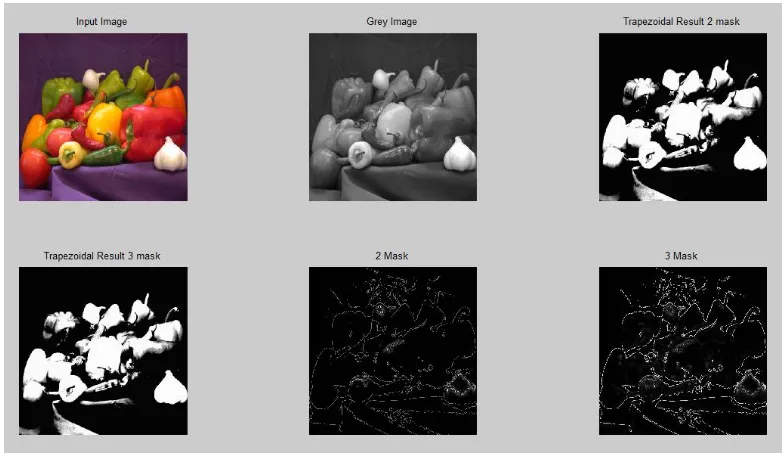
Figure 1: Image Result of Trapezoidal Membership Function
Basically Color is perceived by humans as a combination of tristimuli R (red), G (green), and B (blue) which is usually called three primary colors. From R, G, B representation, we can derive other kinds of color representations by using either linear or nonlinear transformations.
The paper is organized into five sections as follows: Section 2 discuss about the related works carried out in the field of color image segmentation. Section 3 discuss about the modules to be proposed based on Fuzzy logic Trapezoidal Membership Functions. Section 4 highlights discussion on the experiments to be done through Trapezoidal Membership Function by 2x2 masks. Section 5 finally concludes the paper with future enhancement.
II. RELATEDWORK
Firas Ajil Jassim proposed a novel algorithm based on combining two existing methods to obtain a significant method to partition the color image into significant regions. On their first phase, the traditional Otsu method for gray channel image segmentation were applied for each of the R,G, and B channels separately to determine the suitable automatic threshold for each channel. After that, the new modified channels are integrated again to formulate a new color image. The resulted image suffers from some kind of distortion. To get rid of those distortion, the second phase is arise which is the median filter to smooth the image and increase the segmented regions. Totally they used seven types of masks sizes to examine their work and conclude 15x15 produce clear results.
A.Kalaivani, Dr.S.Chitrakala represented K-Means Clustering algorithm which is the popular unsupervised clustering used for dividing the images into multiple regions based on image color property. The major issue of the algorithm is that the user has to specify the number of clusters-K, which is used to split the image into K regions. To overcome the issue, they focused on determining K automatically based on local maxima of gray level co-occurrence matrix. Automatic generated K value is then passed to Fast K-means Clustering algorithm for segmenting color images into multiple regions. They took RGB color model for their clustering process.
Navkirat Kaur presented color image segmentation algorithm in the form of color conversion. They convert RGB image to HSV because it gives the color according to human perception. Further three matrixes are made by three different planes. Firstly, a single new matrix is formed so as to see values of RGB at each pixel. If two rows are equal in a single new matrix then combine those rows. After that total number of colors existing in an original image is calculated. To see the exact color enter the number of colors wants to see and finally processed image is converted from HSV to RGB color space.
Rafael Guillermo Gonzalez Acuna generalizes Otsu’s binarization method towards reduction of color levels in color images. Color defines a multi-dimensional property vector at each pixel location, and this can be further generalized towards considering arbitrarily finite-dimensional property vectors at pixel locations. Otsu’s binarization method, originally already briefly discussed by Otsu for multi-Thresholding, was efficiently mapped earlier into a segmentation method for grey-level images by recursively applying the original binarization method. They generalize further by proposing a recursive algorithm for finite dimensional property vectors at pixel locations.
Chaohui Lü, Xingyun Yang and Sha Qi implements a system of applying ant colony algorithm to image segmentation, which is based on the aspects of the discreteness of digital image and the fuzzy clustering ability of ant colony algorithm. There are mainly three contents in the algorithm. The first part is to extract the features of an image including the RGB values, the gradient, and the neighborhood. The second part is to set the clustering center with the method of a combination of statistics and artificial selection. And the third part is to apply the ant colony algorithm to segment a color image and they introduced a method based on the statistics and the artificial participation to find clustering centers.
between a pixel and its belonging region which is either the object or the background. The optimal threshold can be effectively determined by minimizing the measure of fuzziness of the image. The main criteria for fuzzy based histogram threshoding approach are membership functions and fuzzy measures. While implementation, it has been noticed that bandwidth of s-membership function cannot be determined automatically. Other membership functions like Huang-wang, Gaussian, and Gamma are unable to produce same threshold irrespective of any fuzzy measure. Their membership function has provided consistent results to determine the global threshold in an image with respect to all described fuzzy measures.
Huang-Chia Shih, En-Rui Liu proposed a novel Automatic Reference Color Selection scheme for the adaptive Mathematical Morphology method, and that is specifically designed for color image segmentation applications. However, the Mathematical Morphology process typically neglects the details of reference color determination. Their proposed ARCS scheme is used for determining the ideal reference color for Mathematical Morphology and for color image segmentation application. In addition, they use both 1D histogram-based modeling scheme binning from 3D color spaces such as red–green–blue and hue–saturation–intensity, and 2D color models such as (H, S), (Cb, Cr), and (I, By). By quartile analysis, the threshold determination reacts with less sensitivity to the context variations of the images tested. To evaluate the system, four quantitative indices were utilized for an Automatic Reference Color Selection comparison using advanced segmentation methods in their experiments.
III.METHODOLOGY
Color is perceived by humans as a combination of tristimuli Red, Green, and Blue (RGB) which are usually called three primary colors. From R, G, B representation, we can derive other kinds of color representations by using either linear or nonlinear transformations [17]. Several color spaces, such as RGB, HSI, CIEare utilized in color image segmentation, but none of them can dominate the others for all kinds of color images. Selecting the best color space still is one of the difficulties in color image segmentation [18]. Red, green, and blue components can be represented by the brightness values of the scene obtained through three separate filters (red, green, and blue) based on the variables present in the membership functions.
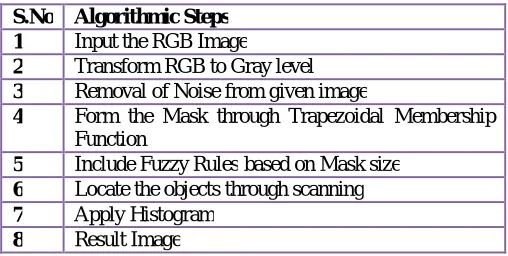
Table 1: Steps to Follow
S.No Algorithmic Steps 1 Input the RGB Image
2 Transform RGB to Gray level
3 Removal of Noise from given image
4 Form the Mask through Trapezoidal Membership Function
5 Include Fuzzy Rules based on Mask size
6 Locate the objects through scanning
7 Apply Histogram
8 Result Image
Fuzzy sets and fuzzy operators are the subjects and verbs of fuzzy logic. It is a rule based approach allows to change the modalities as user need. These if-then rule statements are used to formulate the conditional statements that comprise fuzzy logic. A single fuzzy if-then rule assumes the form if x is Black, y is White then Z is Edge where Black, White and Edge are linguistic values defined by fuzzy sets on the ranges X, Y and Z respectively. The if-part of the rule “x is Black” and “y is White” is called the antecedent or premise, while the then-part of the rule “z is Edge” is called the consequent or conclusion. An example of such a rule might be
If P1 is black and P2 is black and P3 is black and P4 is white then output1 is edge
The concept edge is represented as a number between 0 and 1, and so the antecedent is an interpretation that returns a single number between 0 and 1. Conversely, Black and White is represented as a fuzzy set, and so the consequent is an assignment that assigns the entire fuzzy set Edge to the output variable z.
IV.RESULTS &DISCUSSION
Parameters of triangular membership function are denoted as a, b, c where b is peak point. Here 2*2 masks are used in this algorithm, input pixels are divided into Black and White i.e. two fuzzy sets while the output pixel is divided into three fuzzy sets i.e. Black, Edge and White. For 2*2 masks, rule base of 16 rules is set for various conditions that can occur. Rule of 16 satisfy all the conditions and process the image by sliding over as mask. The result of proposed method was compared to existing operators and it was suggested to 3*3 dimension window for further work. For 3*3 mask rule base of 28 are framed based on different combinations. It has extra condition to satisfy the needs of masks to scan the images properly.
A Trapezoidal Membership Function is specified by four parameters {a, b, c, d} as follows:
0,
.
.
( ; , , , )
1,
.
0,
x
a
x
a
a
x
b
b a
Trapezoid x a b c d
b
x
c
d
x
c
x
d
d
c
d
x
By using min and max in the inference system variables declared are calculated in between parameter range. In scenes, it can be altered in inference system based on the parameters range to be selected. We have an alternative expression for the preceding equation as follows.
( ; , , )
m ax min
x
a
,1,
d
x
, 0
Trapezoid x a b c
b
a
d
c
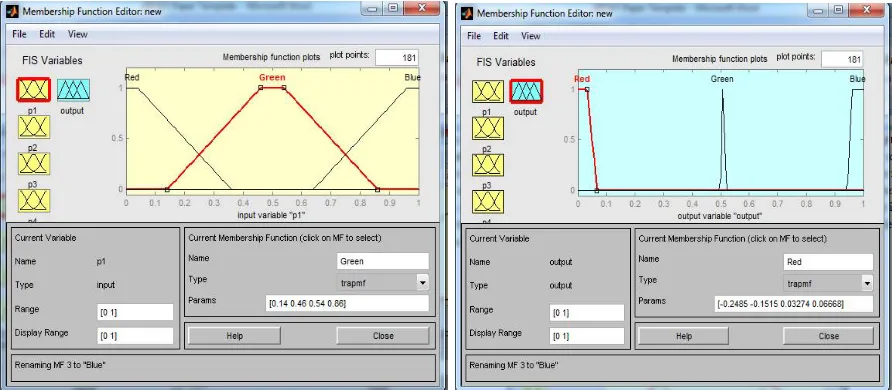
is implemented with the help of flexible Trapezoidal Membership Function formula. Fuzzy inference system editor contains four input variables p1, p2, p3, p4 and one output variable. Two fuzzy sets are used for the input i.e. Black & White and three fuzzy sets are used for the output. It is a 2*2 mask scanning process which is done by using those four input variables p1, p2, p3 and p4. P4 variable is chosen for output where the results are based upon fuzzy rules. In membership function editor, the value and degree of membership is denoted and the function trapf is Chosen. The mask moved over an area of the input image, changes the P4 pixels value and then shifts one pixel to the right and continues to the right until it reaches the end of a row. It then starts at the beginning of the next row & process continues till the whole image is scanned. When this mask is made to scan over the image, the output is generated by the fuzzy inference system based upon the rules and the value of the pixels P1, P2, P3 and P4. In fuzzy inference system editor, input variables such as P1, P2, P3 and P4 notify input and output type of the pixels which are find out at image scanning section. Likewise, this concept is taken further to implement color images with same variables. Sample form of input and output variables is shown in below figure.
Figure 2: Membership Function Editor for (a) Input Variable (b) Output Variable
Figure 2 shows the input and output membership function editor values with respect to the parameters set for 2x2 mask. Here the values plotted for P1 is shown in figure (a) and output plotted values are shown in figure (b). Three parameters namely Red, Green and Blue represent three variables of trapezoidal membership function which denotes REG color model [27]. Every variable having certain parameter range between 0 to 1 and it will be set based on the range to be selected. Each variable i.e. R, G and B have different parameter range and it will be pointed as left, right position. Output parameter has certain parameter range that will be allotted with the combination of input parameters (RGB) range values.
further for proposed work to develop the new algorithm based on fuzzy inference system’s membership functions. Two mask types such as 2x2 and 3x3 are tested with grey level images and the results were presented.
V. CONCLUSION
Segmentation techniques used in image segmentation especially on color image using RGB model have been represented in this paper. Each technique described in this work has its own advantage and disadvantage based on their segmentation properties. Many authors stated that combining two or more methods will produce effective segmentation results while applying to color images. On calculating performance analysis, masking method produce much better results with accuracy while comparing to other techniques. Variation in masking properties gives different types of results with respect to RGB and results proves that increasing window sizes makes images more clear. This paper concludes that color image segmentation using Trapezoidal membership function with the mask range of 2x2 and 3x3 produce better results in starting level window sizes by using Fuzzy rule based Inference system. Generally, implementation process can be done through two phases. On the first phase, the fuzzy membership function based edge detection for gray channel image segmentation were applied for each of the R,G, and B channels separately to determine the suitable automatic threshold for each channel. After that, the new modified channels are included with channel wise and again to form a new color image. The resultant image suffers from some kind of alteration. To get rid of this warp, the second phase is arise which is the median filter to smooth the image and increase the segmented regions. Experimental results were presented on a variety of test images to support the proposed algorithm effectively.
REFERENCES
[1] Anil K Jain (2014), “Fundamentals of Digital Image Processing”, ISBN 978-81-203-0929-6, Pearson Education.
[2] Rafael C Gonzalez and Richard E Woods (2013), “Digital image processing”, ISBN 978-81-317-2695-2, Pearson Education.
[3] Rafael C Gonzalez, Richard E Woods and Steven L Eddins (2011), “Digital image processing using MATLAB”, ISBN – 13: 978-0-07-070262-2, Tata McGraw Hill Education.
[4] Firas Ajil Jassim, Fawzi H. Altaani, “Hybridization of Otsu Method and Median Filter for Color Image Segmentation”, International Journal of Soft Computing and Engineering (IJSCE) ISSN: 2231-2307, Volume-3, Issue-2, May 2013.
[5] A.Kalaivani, Dr.S.Chitrakala, “Automatic Color Image Segmentation”, International Conference on Science, Engineering and Management Research (ICSEMR 2014), ©2014 IEEE.
[6] Md. Habibur Rahman, Md. Rafiqul Islam, “Segmentation of Color Image using Adaptive Thresholding and Masking with Watershed Algorithm”, 978-1-4799-0400-6/13/ ©2013 IEEE.
[7] Navkirat Kaur, V. K. Banga, Avneet Kaur, “Image Segmentation Based on Color”, International Journal of Research in Engineering and Technology, Volume: 02, Issue: 11, Nov-2013
[8] Rafael Guillermo Gonzalez, Junli Tao, “Generalization of Otsu’s Binarization into Recursive Color Image Segmentation”, 978-1-5090-0357-0/15/, © 2015 IEEE.
[9] Suryakant, Neetu Kushwaha, “Edge Detection using Fuzzy Logic in Matlab”, International Journal of Advanced Research in Computer Science and Software Engineering, Volume 2, Issue 4, April 2012.
[10] Shikha Bharti, Sanjeev Kumar, “An Edge Detection Algorithm based on Fuzzy Logic”, International Journal of Engineering Trends and Technology, Volume 4, Issue 3, 2013.
[11] Mehul Thakkar, Prof. Hitesh Shah, “Edge Detection Techniques Using Fuzzy Thresholding”, 978-1-4673-0126-8/ 2011, IEEE.
[12] Song Gao, Chengcui Zhang, and Wei-Bang Chen, “An Improvement of Color Image Segmentation through Projective Clustering”, IEEE IRI 2012, August 8-10, 2012. Jan Puzicha and Serge Belongie, “Model–based Halftoning for Color Image Segmentation”, UC Berkeley, Department of Computer Science, December 2002.
[13] Soumya Dutta, Bidyut B. Chaudhuri, “Homogenous Region based Color Image Segmentation”, Proceedings of the World Congress on Engineering and Computer Science, ISBN: 978-988-18210-2-7, Volume 2, October 2009.
[14] E. Boopathi Kumar, M. Sundaresan, “Edge Detection Using Trapezoidal Membership Function Based on Fuzzy‘s Mamdani Inference System”, IEEE, 2014.
[15] E. Boopathi Kumar, M. Sundaresan, “Fuzzy Inference System based Edge Detection using Fuzzy Membership Functions”, International Journal of Computer Applications, ISSN: 0975 – 8887, Volume 112, Issue: 4, February 2015.
[18] Sneha M. Mahajan, Yogita K. Dubey, “Color Image Segmentation Using Kernalized Fuzzy C-means Clustering”, Fifth International Conference on Communication Systems and Network Technologies, IEEE 2015.
[19] E. Boopathi Kumar, V. Thiagarasu, “Segmentation using Fuzzy Membership Functions: An Approach”, IJCSE, ISSN 2347-2693, Pages: 101-105, Volume 5, Issue 3, March 2017.
[20] E. Boopathi Kumar, V. Thiagarasu, “Segmentation using Fuzzy Logic in Color Images Based on Membership Functions”, IJESRT, ISSN 2277 – 9655, Pages: 38-45, Volume 6, Issue 6, June 2017.
[21] Huang-Chia Shih, En-Rui Liu, “Automatic Reference Color Selection for Adaptive Mathematical Morphology and Application in Image Segmentation”, IEEE Transactions On Image Processing, 2016.
[22] Chaohui Lü, Xingyun Yang and Sha Qi, “Color Image Segmentation Based on the Ant Colony Algorithm”, th International Congress on Image and Signal Processing, IEEE, 2015.
[23] Mehul Thakkar, Prof. Hitesh Shah, “Edge Detection Techniques Using Fuzzy Thresholding”, 978-1-4673-0126-8/ 2011, IEEE.
[24] Shikha Bharti, Sanjeev Kumar, “An Edge Detection Algorithm based on Fuzzy Logic”, International Journal of Engineering Trends and Technology, Volume 4, Issue 3, 2013.
[25] Suryakant, Neetu Kushwaha, “Edge Detection using Fuzzy Logic in Matlab”, International Journal of Advanced Research in Computer Science and Software Engineering, Volume 2, Issue 4, April 2012.
[26] Simranjit Singh Walia, Gagandeep Singh, “Color based Edge detection techniques– A review”, International Journal of Engineering and Innovative Technology, Volume 3, Issue 9, March 2014.
[27] E. Boopathi Kumar, V. Thiagarasu, “Color Image Segmentation Using Fuzzy Masking Method”, IJIRCCE, ISSN: 2320 – 9801, Pages: 7627 – 7634, Volume 5, Issue 4, April 2017.