
Experimental Study on MEPS Concrete and
Brick using Nano Materials
Shaik Hakeem Thousif Ahmed 1, Konapuram Prashanthi Kumari 2
Assistant Professor, Department of Civil Engineering, ACET, Hyderabad, India1
Assistant Professor, Department of Civil Engineering, GPREC, Kurnool, India2
ABSTRACT: Modified Expanded Polystyrene [MEPS] aggregates are the artificial aggregates developed from non-biodegradable Expanded Polystyrene waste [EPS] based on Heat Treatment Method [HTM]. In HTM, EPS waste is placed in closed hot air oven at 1300 C for 15 minutes. EPS waste become hardened & forms as MEPS aggregates. MEPS aggregates are used as MEPS Coarse Aggregate [MEPS CA] & MEPS Fine Aggregate [MEPS FA] by sieving based on their sizes. The present investigation directed towards the development and performance evaluation of the MEPS aggregate concrete containing MEPS CA, MEPS FA, Water, Super Plasticizer and OPC partially replaced by pozzolonic materials like GGBS, Silica Fume, Fly Ash , nano Tio2, nano Fe2O3 and nano Mgo at different levels. The
final optimal mixture of MEPS aggregate concrete was selected among experiments under consideration to manufacture the light weight bricks. The compressive strength is inversely proportional to workability were compared with similar concrete composites as reported earlier.
KEYWORDS:LWC, ULWC, Artificial aggregates, MEPS Concrete, MEPS Bricks.
I. INTRODUCTION
It is clear that with the improvement of human civilization, concrete will continue to be a governing construction material in the future. Concrete is only second to water as the most profoundly consumed substance with about six billion tons being produced every year. The civil construction is growing rapidly, increased the demand of natural aggregates [NA] which is reducing the natural sources and on the other hand industrial by-products, soil wastes such as expanded polystyrene or thermocol, styrofoam, plastic, rubber, glass, iron, steel fibres, wood, brick-bats, thermal waste etc. are creating a huge loss to environment. For this reason, the Civil and Environmental Engineers have been challenged to covert the above waste materials to useful construction material. Hence, we require new artificial aggregates [AA] with equal NA properties. Modification to the above waste can result in new constructions material which can replace NA requirements. Hence, it is essential to advancing the new technologies which can result in new construction materials. This will create comfort to the environment pollution and facilitate the natural balance of life.
spheres. Chen and Liu applied styrene-butadiene rubber [SBR] latex to improve the strength of concrete.
Expanded Polystyrene [EPS] used as equipments production tools to absorb vibration during handling and transportation process. After this process, the EPS serves as disposal waste. Disposal is difficult as EPS is non-biodegradable and due to its light weight characteristics, it has the capacity to serve as aggregates in concrete by modifying it by Heat Treatment. As it is not eco-friendly, this waste EPS can be used in preparation of concrete. The EPS waste was kept in a closed hot air oven at 1300 C for 15 minutes & resulted in Modified EPS aggregates [MEPS]. MEPS aggregate concrete consists of larger & finer MEPS aggregates, pozzolonic materials, water and superplasticizer. Natural aggregates are completely absent in MEPS aggregate concrete. Here, few special investigations of the MEPS lightweight concrete and bricks made by MEPS lightweight aggregate concrete and the mechanical properties of MEPS brick masonry have been reported. The brick is produced through extrusion moulding technique which can avoid the segregation of MEPS aggregates. The production of MEPS lightweight concrete bricks with low thermal conductivity can also provide an alternative solution for the utilization and development of MEPS lightweight aggregate concrete in engineering considering the economic and practical factors. During cement the production of cement, Co2 is released &
causes global warming. Hence, the main objective of this paper is to reduce cement content & provide some basic information about the relationship between the elementary composition and the properties of MEPS concrete. The density and compressive strength were tested and discussed. Then, the optimal mixture proportioning of MEPS lightweight aggregate concrete was seeking to manufacture the lightweight bricks based on the requirements on density, strength, cost, and thermal conductivity. The properties of the brick masonry under compressive and shear loadings were studied. To make MEPS concrete economical with high quality, acid & weather resistance with durability properties, the pozzolonic materials such as Fly Ash, GGBS, Silica Fume, nano Mgo, nano Tio2 and nano Fe2O3 are
replaced to weight of cement at different levels.
II. MATERIALS AND THEIR PROPERTIES
The materials used in the present investigation are as follows;
1. MEPS Coarse Aggregates 2. MEPS Fine Aggregates 3. Water 4. Super Plasticizer
5. Cement 6. Fly Ash 7. Ground granulated blast slag [GGBS] 8. Silica Fume
9. Nano Titanium dioxide [Tio2] 10. Nano Magnesium oxide [Mgo] 11. Nano Iron oxide [Fe2O3]
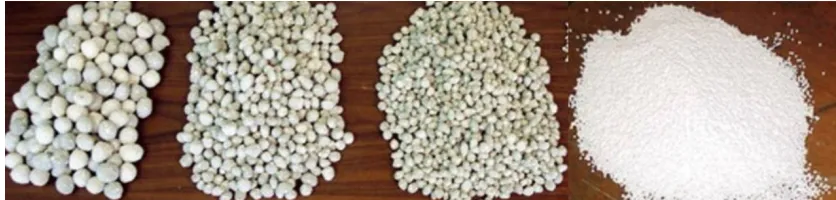
The modified EPS aggregates are divided with respect to their sizes as per IS 383:1970 and because of nominal size selected is 20 mm, the max. & min. sizes of MEPS coarse aggregates is 20 mm & 4.75 mm. with specific gravity factor 0.24 and lesser to 4.75 mm aggregates as MEPS fine aggregate with specific gravity factor 0.34. These specific gravity factor values are not a true specific gravity, because its value incorporates compensation for absorption of free water by the MEPS aggregates and it can be used in exactly the same way to calculate the aggregate volume relationship. MEPS aggregates consists of density less than 300 kg/m3 and compressive strength is up to 9 MPa. MEPS are hydrophobic aggregates and they do not absorb water because it consist of about million closed cellular and the inside voids filled with melted matter, but the MEPS Aggregates catches the water included to the voids on the surface thickness caused due to heat treatment process.
Water is an important constituent of concrete, it should receive due attention in preparation and for quality control of concrete. Water used for mixing and curing is pure domestic water, conforming to IS: 3025 – 1964 part 22, part 23 and IS: 456 – 2000. Super plasticizers, also known as high range water reducers, are chemical admixtures used where well-dispersed particle suspension is required. These polymers are used as dispersants to avoid particle segregation [ coarse and fine aggregates], and to improve the flow characteristics of suspensions such as in concrete applications. Their addition to concrete or mortar allows the reduction of the water to cement ratio, not affecting the workability of the mixture, and enables the production of self-consolidating concrete and high performance concrete. This effect drastically improves the performance of the hardening fresh paste. The strength of concrete increases when the water to cement ratio decreases. However, their working mechanisms lack a full understanding, revealing in certain cases cement-super plasticizer incompatibilities. The addition of super plasticizer in the truck during transit is a fairly new development within the industry. Admixtures added in transit through automated slump management systems allows concrete producers to maintain slump until discharge without reducing concrete quality. Since w/c ratio should be less so high range water reducer is used. To increase strength, water content should be reduced. Master Glenium sky 8233 formely B-233 which is poly-carboxylic ether based superplasticizer is used. It is brought from BASF India Ltd construction chemicals –Chennai. It is a Light brown colour liquid whose pH & specific gravity is 6 & 1.08, comply with ASTM C494 Type F.
In this present investigation, JSW GGBS powder confirming to 12089:1987, Sigma Nano Tio2 powder of
particle size 5 to 10 nm, Astra silica fume powder confirming to ASTM C1240 & IS 15388:2003, Kirti Adhia nano Mgo of particle size 30-80 nm and nano wings nano Fe2O3 of particle size 30-50 nm are used to replace Chettinad
cement of ordinary Portland cement [OPC] of 53 Grade was used which satisfies the requirements of IS: 12269-1987.
III. MIX PROPORTIONS
The selection of mix proportions is the process of choosing suitable ingredients of concrete and determining their relative quantities with the object of producing as economically as possible concrete of certain minimum properties. Here it is intended to investigate the potential influence that a range of ingredient parameters have on the mechanical properties and thermal performance of EPS lightweight concrete. In general, the coefficient of thermal conductivity is closely related with the density. The lower the density of concrete, the higher is its thermal insulation. But there is an inverse relation that low density results in a decrease in compressive strength. Hence this program was concentrated on reduction of OPC use in MEPS concrete. In the present study, the best possible levels of mix proportions are investigated to get maximum compressive strength. Therefore, the factors and levels to be considered for concrete are given in the below tables. The MEPS concretes were initially designed as per trails & previous experience and modified by incorporating the OPC at different volume percentages in the MEPS concrete with no grade of concrete. OPC is replaced by Fly ash mixes namely F1,F2,F3,F4, & F5; GGBS mixes namely G1,G2,G3,G4, & G5 at 10%, 20%, 30%, 40%, & 50%; ; Silica Fume[SF] mixes namely S1,S2,S3,S4, & S5 at 5%, 10%, 15%, 20%, 25%; nano Mgo mixes namely M1,M2,M3,M4, & M5; Nano Tio2 mixes namely T1,T2,T3,T4, & T5; Nano Fe2O3
mixes namely i1,i2,i3,i4, & i5 a1%, 2%, 3%, 4% & 5% which are compared to M0.
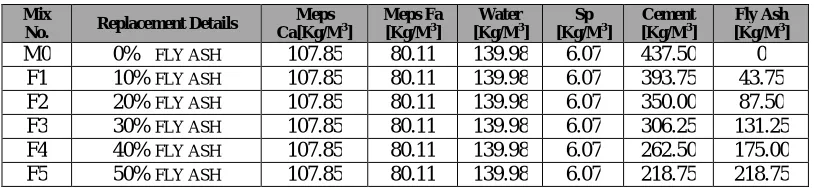
Table 1: Mix Proportions of fly ash replaced MEPS Concrete
Mix
No. Replacement Details
Meps
Ca[Kg/M3] Meps Fa [Kg/M3] [Kg/MWater 3] [Kg/MSp 3] [Kg/MCement 3] [Kg/MFly Ash 3]
M0 0% FLY ASH 107.85 80.11 139.98 6.07 437.50 0
F1 10% FLY ASH 107.85 80.11 139.98 6.07 393.75 43.75
F2 20% FLY ASH 107.85 80.11 139.98 6.07 350.00 87.50
F3 30% FLY ASH 107.85 80.11 139.98 6.07 306.25 131.25
F4 40% FLY ASH 107.85 80.11 139.98 6.07 262.50 175.00
Table 2: Mix Proportions of GGBS replaced MEPS Concrete
Mix
No. Replacement Details
Meps Ca[Kg/M3]
Meps Fa [Kg/M3]
Water [Kg/M3]
Sp [Kg/M3]
Fly Ash [Kg/M3]
Cement [Kg/M3]
GGBS [Kg/M3] M0 0% GGBS 107.85 80.11 139.98 6.07 0 437.50 0 G1 10% GGBS 107.85 80.11 139.98 6.07 131.25 275.625 30.625 G2 20% GGBS 107.85 80.11 139.98 6.07 131.25 245.00 61.25 G3 30% GGBS 107.85 80.11 139.98 6.07 131.25 214.375 91.875 G4 40% GGBS 107.85 80.11 139.98 6.07 131.25 183.75 122.50 G5 50% GGBS 107.85 80.11 139.98 6.07 131.25 153.125 153.125
Table 3: Mix Proportions of Silica Fume replaced MEPS Concrete
Mix
No. Replacement Details
Meps Ca[Kg/M3]
Meps Fa [Kg/M3]
Water [Kg/M3]
Sp [Kg/M3]
Fly Ash [Kg/M3]
GGBS [Kg/M3]
Cement [Kg/M3]
SF [Kg/M3] M0 0% SILICA FUME 107.85 80.11 139.98 6.07 0 0 437.50 0
S1 5% SILICA FUME 107.85 80.11 139.98 6.07 131.25 61.25 232.75 12.25
S2 10% SILICA FUME 107.85 80.11 139.98 6.07 131.25 61.25 220.50 24.50
S3 15% SILICA FUME 107.85 80.11 139.98 6.07 131.25 61.25 208.25 36.75
S4 20% SILICA FUME 107.85 80.11 139.98 6.07 131.25 61.25 196 49
S5 25% SILICA FUME 107.85 80.11 139.98 6.07 131.25 61.25 183.75 61.25
Table 4: Mix Proportions of Nano Mgo replaced MEPS Concrete
Mix
No. Replacement Details
Meps Ca[Kg/M3]
Meps Fa [Kg/M3]
Water [Kg/M3]
Sp [Kg/M3]
Fly Ash [Kg/M3]
GGBS [Kg/M3]
SF [Kg/M3]
Cement [Kg/M3]
Nano Mgo [Kg/M3]
M0 0% NANO MGO 107.85 80.11 139.98 6.07 0 0 0 437.50 0
M1 1% NANO MGO 107.85 80.11 139.98 6.07 131.25 61.25 36.75 206.168 2.083
M2 2% NANO MGO 107.85 80.11 139.98 6.07 131.25 61.25 36.75 204.085 4.165
M3 3% NANO MGO 107.85 80.11 139.98 6.07 131.25 61.25 36.75 202.003 6.248
M4 4% NANO MGO 107.85 80.11 139.98 6.07 131.25 61.25 36.75 199.92 8.33
M5 5% NANO MGO 107.85 80.11 139.98 6.07 131.25 61.25 36.75 197.838 10.413
Table 6: Mix Proportions of Nano Fe2O3 replaced MEPS Concrete
IV. EXPERIMENTAL PROCEDURE
The mixing of concrete is essential for the production of uniform concrete. The mixing should be making sure that the concrete becomes homogeneous, uniform and consistency. Mixing of concrete is done according to IS: 516-1959. Mixing of the concrete is done using a pan mixer of capacity 40kg. To avoid segregation only required hand compaction blows while casting are followed by continuous mixing at very low speed. 50% extra quantity of concrete are mixed to avoid volumetric loss. Ingredients such as powder material, MEPS FA, MEPS CA, 2/3 part of water and 1/3 water diluted with measured super plasticizer are introduced to the pan mixer. Initially dry powder materials and MEPS FA were mixed for about 3 min at low speed to which MEPS CA were added and thoroughly mixed for another 3–5 min. The water, super plasticizer added water is introduced to this mixture in three intervals. The mixture is allowed to mix until it forms a homogeneous mixture.
Figure 2: Pan Mixer
standard metallic moulds in three layers and it was compacted each time by tamping rod. The concrete in the moulds was not vibrated but the tamping blows are enough helpful in finishing smoothly being compacted thoroughly with a tamping rod to avoid voids. The cube specimens were casted at an average temperature of 240 C and the moulds are covered with wet gunny bags for 10 hours after casting to maintain ambient moisture content, de-moulded after 24 hours and were kept immersed in a clean water tank for curing. After 28 days of water curing, the specimens were tested for compressive strength and split tensile strength. The compressive strength is inversely proportional to workability were compared with similar concrete composites.
V. RESULTS AND DISCUSSIONS
Most of the MEPS concrete mixes displayed good workability but it was observed that with increase in replacements to OPC, there is gradual decrease in workability. Slump test had carried out to evaluate the workability and recorded slump were given in chart 1. There is increase in density in all MEPS concrete mixes except in fly ash mixes. A comparison of variation of compressive strengths with different volume percentages of cement replacement to Fly Ash, GGBS, Silica Fume, Nano Mgo, Nano Tio2 and Nano Fe2O3 at 28-D curing age were given in chart 1 & 2.an
be better understood and visualize. The optimum compressive strength in fly ash is 15.7 Mpa at 40% replacement to OPC which kept as constant in continuing mixes.
Nano material effects comprise inter-particle void filling, acceleration of cement hydration, formation of additional Calcium-Silicate-Hydrate [C-S-H] by pozzolanic reaction, higher compressive strength, improved frost resistance and lower permeability. Nano Mgo, Nano Tio2 and Nano Fe2O3 do not only fill the voids left by large
particles, but by being highly reactive they react with calcium hydroxide and additionally act as nucleation sites for the production of very fine C-S-H phase. Small quantity of nano material is enough to increase its mechanical properties. The optimum of compressive strength in Nano Mgo and Nano Tio2 mixes at 1% and 4% replacement to OPC of the
optimum cement in last mixes. The final optimal mixture of MEPS aggregate obtained at Mix No. i5 concrete at 30% Fly Ash, 20% GGBS , 15% Silica Fume, 1% Nano Mgo, 4% Nano Tio2 and 5% Nano Fe2O3 replaced to OPC and
VI. APPLICATION
Figure 3: Geometrical configuration of masonry prism for [a] Compression Test and [b] Shear Test.
The final optimal mixture of MEPS aggregate [i.e., Mix No. i5] concrete was selected among experiments under consideration to manufacture the light weight bricks. The tests were executed in conditions of applying the load at a uniform rate so that the maximum load was reached in 1–3 min. The masonry prisms were considered as extracted from a real masonry wall. The arrangements are shown in figure 3. It can be considered that the MEPS lightweight bricks were suitable for masonry walls. The cracking mode is illustrated in figure 4 and it appeared that the cracks along the head joints and crossed also the joined bricks. Then, horizontal deformation developed without relevant increasing of the compression stress and the masonry fractured with vertical cracks. The elasticity modulus has been considered as the secant modulus at 40% of the ultimate stress. The compressive strength of three masonry specimen were 3.2, 3.4 and 3.5 Mpa and the shear strength results of six masonry specimens were 0.16, 0.19, 0.17, 0.15, 0.14 and 0.18 MPa, respectively. The failure mode is presented in figure 4.The mortar cores had been formed by the filling of the brick cavities with fresh mortar, which could contribute to a resistance in shear of the masonry work.
VII. CONCLUSIONS
By using EPS waste for MEPS aggregate production not only solves the EPS disposal problems, but also helps to preserve natural resources. A new recycling technology to shrink waste EPS was developed by using Heat Treatment Method. By keeping EPS waste in a closed hot air oven at 1300 C for 15 minutes resulted in Modified EPS aggregates [MEPS]. The final optimal mixture of MEPS aggregate obtained at Mix No. i5 concrete at 30% Fly Ash, 20% GGBS , 15% Silica Fume, 1% Nano Mgo, 4% Nano Tio2 and 5% Nano Fe2O3 replaced to OPC and Maximum compressive
strength of 20.77 Mpa is achieved in i5 Mix. From the economic and practical concern, a compromise composition of MEPS concrete [i5 mix] was chosen to produce MEPS lightweight bricks. The compressive strength of three masonry specimen were 3.2, 3.4 and 3.5 Mpa and the shear strength results of six masonry specimens were 0.16, 0.19, 0.17, 0.15, 0.14 and 0.18 MPa, respectively. The compressive strength is inversely proportional to workability were compared with similar concrete composites. In Concrete construction, Self Weight represents a very large portion of the load on the Structure and use of MEPS aggregates in concrete can reduce the self weight up to 60% and are considerably advantages in reducing the cross-section dimensions of beams, columns & footing. This will have the double advantage of reduction in the cost of construction materials and also cost of waste disposal.
ACKNOWLEDGEMENT
The Author is thankful to the President, Ayaan Educational Society and authorities of the department of civil engineering, Ayaan College of Engineering & Technology, Hyderabad, India for the facilities and guidance to carry out this research work during January 2016 to June 2017.
REFERENCES
1. Shaik Hakeem Thousif Ahmed, V.K. Visweswara Rao & Dr.T.Chandra Sekhara Reddy., A novel material for new generation Using modified thermocol waste as aggregates in concrete., in International Journal of Civil, Structural, Environmental and infrastructure engineering research and development, vol - 5, edition oct 2015
2. Babu, K.G., Babu, D.S., 2003. Behavior of lightweight expanded polystyrene concrete containing silica fume. Cement and Concrete Research 33, 755–762.
3. Babu, K.G., Babu, D.S., 2004. Performance of fly ash concretes containing lightweight EPS aggregates 26, 605–611.
4. Hantila, F., Maricaru, M., Popescu, C., Ifrim, C., Ganatsios, S., 2007. Performances of a waste recycling separator with permanent magnets. Journal of Materials Processing Technology 181, 246–248.
5. Kan, A., Demirboga, R., 2007. Effect of cement and EPS beads ratios on compressive strength and density of lightweight concrete. Indian Journal of Engineering & Materials Sciences 14, 158–162.
6. Neville, A.M., "Properties of concrete", long man group limited, fourth and final edition, 2000, p.831
7. Vivian, W.Y., Tam, C.M., 2006. Evaluations of existing waste recycling methods: a Hong Kong study. Building and Environment 41, 1649– 1660.
8. Yanhong, L., Yunge, F., Jianbiao, M., 2001. Thermal, physical and chemical stability of porous polystyrene-type beads with different degrees of crosslinking. Polymer Degradation and Stability 73, 163–167.
9. Babu DS, Babu KG, Wee TH. Properties of lightweight expanded polystyrene aggregate concretes containing fly ash. Cem Concr Res 2005;35[6]:1218–23.
conference on advances in composites, Bangalore, India; 18–20 December 1996.
11. Ahmed Tafraoui,GillesEscadeillas ,soltaneLebaili and Thierry Vidal “Metakaolin in the formulation of UHPC”, [2009].
12. Ali Nazari, Shadi Riahi, “ TiO2 nano particles effects on physical, thermal and mechanical properties of self compacting concrete with GGBS as binder”, Energy and Buildings,43[2011] 995-1002.
13. Jun Chen, Shi-Cong Kou, Chi-sun Poon. “ Hydration and properties of nano-TiO2 blended cement composites”, Cement and concrete composites 34[2012] 642-649.
14. Blast Furnace Slag” ,International Journal of Emerging Technology and Advanced Engineering ,Volume 4, Issue 11,November 2014.
15. KannanV, Ganesan K, “Mechanical and transport properties in ternary blended self compacting concrete with matakolin and fly ash ”,IOSR Journal of Mechanical and Civil Engineering[IOSRJMCE], Volume 2, Issue 4,pp 22-31, Sep-Oct.2012.
16. Anusha Suvarna, Prof.p.j Salunke, Prof N.G.Gore, Prof T.N. Narkehde “Silica Fume and Groun Granulated Blast Furnace Slag as Cement Replacement in Fibre Reinforced Concrete”, International Research Journal of Engineering and Technology, Volume 2, Issue7,Oct 2015. 17. K.V.Pratap,M.Bhaskar,P.S.S.R.Teja, “Triple Blending of Cements Concrete With Fly Ash and Ground Granulated Blast Furnace Slag ”,
International Journal of Education and applied research,Volume 4,Issue Spl-2,Jan-June 2014.
BIOGRAPHY
Shaik Hakeem Thousif Ahmed, graduated in Civil Engineering in the year 2013, pursued his Master of Technology in Structural Engineering from G. Pulla Reddy Engineering College [Autonomous], Kurnool City, Andhra Pradesh, India. He is serving as Assistant Professor in Civil Engineering Department of Ayaan College of Engineering & Technology, Hyderabad, Telangana, India since December 2015. His areas of interest includes lightweight concretes, high strength & performance concretes and nano-materials.


![Figure 3: Geometrical configuration of masonry prism for [a] Compression Test and [b] Shear Test](https://thumb-us.123doks.com/thumbv2/123dok_us/1603073.1198162/8.595.101.498.508.752/figure-geometrical-configuration-masonry-prism-compression-test-shear.webp)