A Wind Driven Optimization Based WDM
Channel Allocation Algorithm
Preet Kamal Singh1, Neena Gupta2
P.G. Student, Department of Electronics Engineering, PEC University of Technology, Chandigarh, India1
Head & Professor, Department of Electronics Engineering, PEC University of Technology, Chandigarh, India2
ABSTRACT: Nature-inspired algorithms are becoming powerful methods for solving many tough optimization problems. The performance of the system is significantly reduced which is due to the undesirable phenomenon that is Four wave mixing, a non-linear effect which becomes the main downside in optical communication systems. This crosstalk caused by four wave mixing can be decreased in WDM systems which have high capacity and do not use repeaters in the network by the utilization of an allocation technique that has been proposed in this paper, which comprises of channels that are unequally spaced in the system based on optimal Golomb ruler which permits the FWM reduction at the same time sustaining bandwidth efficiency. Both the systems employing equal and unequal channel spacing has been compared in order to attain affordable BER and Q-factor. The outcome of using this type of channel spacing is tested using OptSim. Simulations are presented to show the effectiveness of this technique in a 4-channel, 10-Gb/s per channel, system.
KEYWORDS:DWDM System, Four wave mixing, equal and unequal channel spacing, Golomb ruler algorithm, Wind driven Optimization.
I. INTRODUCTION
Nature has the brilliant ability to optimize its elements which can motivate for creating various optimization methods that can be used to solve problems in engineering. The optimization process involves the exploration of the best values of parameters in a problem which are environment specified i.e. mainly it aims to search those values that qualify an objective function to produce the maximum or minimum value. In standard WDM systems, center frequencies which are equally spaced from each other determine the allocation of channels. Due to this, the noise (like FWM) has large possibility that they may enter into the equally spaced channels which results in severe crosstalk [1]. The crosstalk due to FWM proves to be the most serious limiting causes of performance degradation in optical systems employing WDM due to the fact that the lower input power in the optical systems are incorporated in this in contrast to other nonlinearities. To improve the performance, the FWM generation is avoided at the channel frequencies [1]–[7].
The crosstalk produced by FWM in optical systems is suppressed by using techniques of unequally spaced channel allocation (USCA) which are explored in [1], [8]–[14]. However, using unequal channel spacing increases the required bandwidth in contrast to equal spaced channel allocation (ESCA). This paper proposes an unequally spaced bandwidth channel allocation algorithm by considering the notion of optimal Golomb rulers (OGRs). These USCA methods to allocate channels decreases the FWM in optical communication systems effect resulting in the improvement of the performance of the WDM system without incorporating extra expense in terms of bandwidth [7], [15]–[17].
optimization technique which is based on population for solving multi-dimensional and multi-modal problems with additional capability to instigate constraints on the search space.
The content of remaining sections is mentioned as follows: a brief work related to the algorithm is presented in section II, a brief concept of Golomb rulers is exhibited in section III, the proposed WDO algorithm on which allocation of channels is based shown in section IV. Section V gives the simulation results comparing equal and unequal channel spacing. Section VI presents some concluding remarks.
II. RELATEDWORK
The Golomb Ruler sequences can be generated using various techniques which can be classical methods, soft computing approaches and nature-inspired algorithms. The classical methods include Extended Quadratic Congruence (EQC) and Search Algorithm (SA) while soft computing approaches comprise Genetic Algorithm (GA), Biogeography Based optimization (BBO). The nature-inspired techniques involve Firefly Algorithm (FA), Bat Algorithm (BA), etc. But as the algorithms are based on different approaches there is no single algorithm which can be applied to all the problems. Therefore, all these algorithms are application specific which we can apply based on the optimization problem in hand.
III.GOLOMB RULER
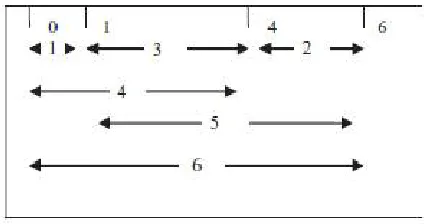
The phrase “Golomb ruler” [31] denotes a set of positive integer values, where any two numbers from the set consisting of different pairs do not have the same difference. Theoretically, this is identical to a ruler formed in a way where any two pairs of marks do not calculate the same distance. An illustration of the Golomb ruler is displayed in Figure 1. An Optimal Golomb Ruler depends on given number of marks and is the shortest ruler possible [32]. For allocating channels in WDM system, it is feasible to attain the least distinct number by applying Optimal Golomb Ruler to the channel allocation problem. The new FWM frequencies produced will not lie in the one previously allocated for the channels due to the fact that any two numbers taken as a pair do not have the same distance.
Figure 1: A perfect Golomb ruler with length 6.
IV.WIND DRIVEN OPTIMIZATION TECHNIQUE
To generate OGRs, a novel optimization nature–inspired metaheuristic algorithm called WDO is being proposed in this paper.The wind blows to balance the air pressure in our atmosphere which means it gusts from a high pressure region to a low pressure region with a speed that is relative to the pressure gradient [38, 39]. Taking assumptions of hydrostatic air balance and vertical movement is weaker than the horizontal movement, the change in pressure as well as the motion of wind can be taken as a horizontal movement [39]. Although, our world is a three-dimensional, the motion of wind takes into account addresses multi-dimensional problems. Furthermore, to derive the operators employed in WDO algorithm, specific assumptions and simplifications are required. The algorithm initializes with Newton’s second law of motion that offers very precise results when utilized to analyze the motion of wind [40, 41]:
= ∑ i (1)
where, the air density is denoted by , denotes the acceleration vector, and the forces acting on the mass are denoted by Fi. The relation between air pressure, density and temperature is given by:
P = RT (2)
Where pressureis denoted by P, universal gas constantis denoted by R and temperature is denoted by T.
The equation (1) specifies that the motion of wind in a specific direction or path is controlled by four main forces in which the most dominant force that makes the movement of air is the pressure gradient force (FPG), whereas the friction
force (FF) opposes such movement. The definition of friction force is given by equation (6). Gravitational force (FG)
acts as an important force that pulls the particles in the direction of the origin of the coordinate system. Another force which happens due to rotation of earth and causes the movement of wind from one dimension to another is the Coriolis force (FC). The implementation of WDO as the movement in one dimension influences the speed in another.
The equations by which these forces are defined are given below, where δVdenotes an infinitesimal air volume.
Rotation of the earth is represented as Ω represents the, gravitational acceleration is denoted by g, and velocity vector of the wind is denoted by u.
FF = − (3)
FG = (4)
FC = −2Ω× (5)
FPG= −∇PδV (6)
All the above equations defining forces may be added up and put in the right-hand side of the Newton’s second law of motion. The equation formed is given below:
∆ = ( ) + (−∇ ) + (− ) + (−2Ω× ) (7)
The velocity update equation can be derived from the above equation by considering an infinitesimal air particle that moves with the wind. The pressure in equation (2) can be substituted in place of and an assumption of time step to be
unity (Δt = 1) is taken which gives the velocity update equation:
= (1− ) − + − − + (8)
The updating of the location of air parcels and their velocity is done in each iteration which is done by using equation (8) whereas updating their position is done by employing the below equation:
= + ( ∆ ) (9)
4.1 Generation of near-optimal Golomb ruler sequences using WDO Algorithm
Wind Driven Optimization to Generate OGRs Begin
/* WDO parameter initialization */
Channels (marks) ‘n’ initialization and set upper bound on the ruler length
While not Popsize /* User defined size of population*/ Define Pressure function, coefficients and boundaries; Generate initial random population and velocity of air parcels; Check Golombness of each air parcel;
If Golombness is satisfied Keep that individual;
Else
Delete that specific air parcel from the generated population;
End if End while
/* End of WDO parameter initialization */ Evaluate initial population;
Find best air parcel in the initial population;
While not S /* S is a stopping criterion */ Get an air parcel velocity randomly;
Evaluate its pressure (fitness);
Update velocity and check velocity limits; Update position and check position limits;
A: Recheck Golombness of new air parcels;
If Golombness is satisfied
Keep that air parcel and then go to B;
End if
Delete that particular air parcel from the population; Generate a new air parcel and then go to A;
B: Recompute the pressure (fitness) value of the modified air parcels; Sort the population from best to worst based on pressure values (fitness); Replace the Global pressure values with the best;
Keep the best solutions;
Solutions are ranked and best solution currently is found;
End while End
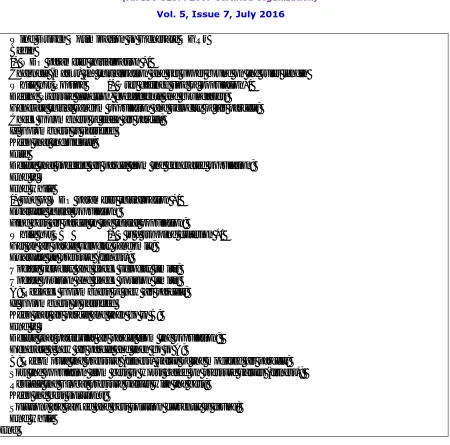
Figure 2: Pseudo-code for WDO Algorithm to produce near-optimal Golomb ruler sequences.
All the steps to generate Golomb ruler sequences from WDO algorithm is given in Figure 2. The steps initiate from initialization of parameters and end at checking Golombness and raking the population from best to worst.
V. SIMULATION RESULTS AND DISCUSSION
5.1 Simulation parameters for WDO
To obtain near-optimal sequences after a set of thorough experimentation, subsequent optimum WDO parameters have been established as shown in Table 1. The RT coefficient, Gravitational constant and Coriolis Effect is chosen to provide optimum efficiency.
Table 1: Simulation Parameters for WDO algorithm
Parameter Value
Number of Air Parcels (Popsize) 30
RT Coefficient (RT) 3
Gravitational Constant (ɡ) 0.2
Coriolis Effect (c) 0.4
Constant in the Update Equation (α) 0.4
Maximum Allowed Speed 0.3
Maximum Iterations 1000
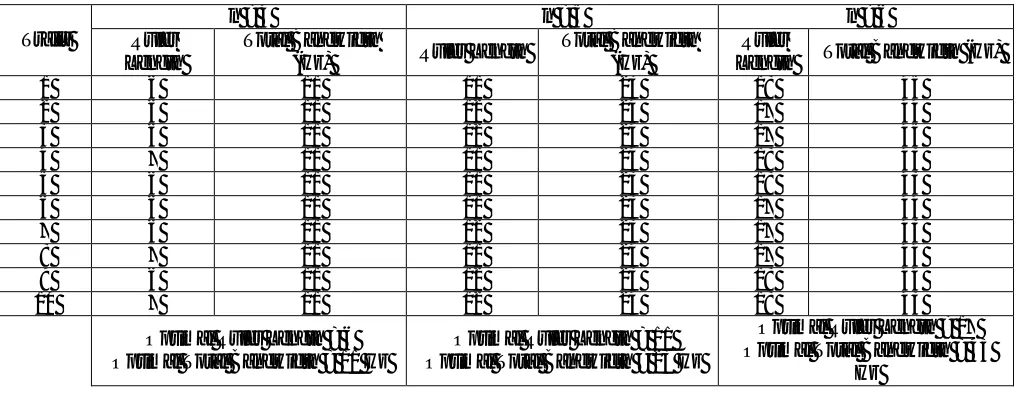
With these parameters configuration, a number of trials for different marks were done. A collection of 10 trials for n = 4 to 6 are shown in Table 2. All the sets perform similar as shown in Table 2.
Table 2: Performance of WDO for Different Marks in a Set of 10 Trials
Trails
n = 4 n = 5 n = 6
Ruler Length
Total Bandwidth
(Hz) Ruler Length
Total Bandwidth (Hz)
Ruler
Length Total Bandwidth (Hz)
1 6 11 11 23 18 45
2 6 11 12 24 17 44
3 6 11 12 24 17 45
4 7 11 11 24 18 43
5 6 11 11 23 18 43
6 6 11 11 23 17 44
7 6 11 12 23 17 43
8 7 11 11 24 17 44
9 6 11 12 23 18 44
10 7 11 12 24 18 43
Optimal Ruler Length = 6 Optimal Total Bandwidth = 11 Hz
Optimal Ruler Length = 11 Optimal Total Bandwidth = 23 Hz
Optimal Ruler Length = 17 Optimal Total Bandwidth = 43
Hz
5.2 SIMULATION SETUP OF EQUAL AND UNEQUAL CHANNEL SPACING
The simulation arrangement to estimate the influence of changing spacing between input channels in a DWDM system in presence of FWM is displayed in Figure 3 consisting of four Continuous Wave lasers which are modulated by 10 Gbps NRZ data externally with channel spacing of 0.2 nm for equal spacing.
Figure 3: Simulation setup of DWDM system
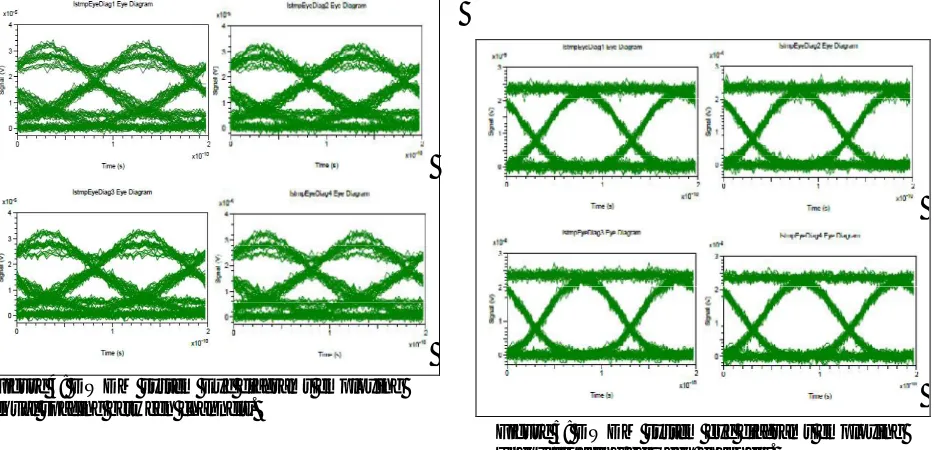
In Figure 4, the outcome of a 4-channel DWDM system is shown in the form of eye diagrams with channel spaced equally with 0.2 nm spacing whereas Figure 5 shows the 4-channel DWDM system with the spacing of channels defined by the use of Golomb rulers i.e. unequal channel spacing.
Figure 4: DWDM system Eye diagrams employing equal spacing between channels.
Figure 5: DWDM system eye diagrams employing unequalspacing between channels.
Table 3: BER and Q factor for equal channel spacing in the given DWDM system
Channel Frequency (nm) BER Q (dB)
1550 1.9424e-011 1.6402e+001
1550.20 2.0546e-011 1.6391e+001
1550.40 2.2248e-011 1.6375e+001
1550.60 2.5439e-011 1.6349e+001
Table 4: BER and Q factor for unequal channel spacing in the given DWDM system
Channel Frequency (nm) BER Q (dB)
1550 6.9988e-031 2.1210e+001
1550.20 8.2000e-031 2.1200e+001
1550.45 9.4653e-031 2.1190e+001
1550.75 1.0334e-030 2.1185e+001
VI. CONCLUSION
In this paper, we have formulated the function of a novel metaheuristic nature–inspired WDO to solve the highly complex problem of optimal Golomb ruler sequences. It has been seen that the proposed metaheuristic algorithm generates OGR sequences with high efficiency and effectiveness. An implementation of DWDM system has been studied to evaluate Q factor and BER with FWM present in the system. The system is designed under consideration of channels with equal and unequal spacing. It has been realized that using unequal channel spacing increases the required bandwidth in contrast to equal spaced channel allocation. Our outcomes after simulations provide a proficient method of utilizing Golomb rulers for allocating channels with unequal spacing resulting in the improvement of the performance of the WDM system without incorporating extra cost in terms of bandwidth and also results in decrease in FWM effect.
REFERENCES
[1] Kwong, W. C., and Yang, G. C. “An Algebraic Approach to the Unequal-Spaced Channel-Allocation Problem in WDM Lightwave Systems”,
IEEE Transactions on Communications, Vol. 45, No. 3, pp. 352–359, 1997.
[2] Chraplyvy, A. R., “Limitations on Lightwave Communications Imposed by Optical–Fiber Nonlinearities” J. Lightwave Technol., Vol. 8, pp.
1548– 1557, 1990.
[3] Aggarwal, G. P., “Nonlinear Fiber Optics. Second Edition”, Academic Press, San Diego, 2001.
[4] Thing, Vrizlynn L. L., Shum,P., and Rao, M. K., “Bandwidth–Efficient WDM Channel Allocation for Four-Wave Mixing-Effect
Minimization”, IEEE Transactions on Communications, Vol. 52, No. 12, pp. 2184–2189, 2004.
[5] Saaid, Nordiana M., “Nonlinear Optical Effects Suppression Methods in WDM Systems with EDFAs: A Review”, In Proceedings of the
International Conference on Computer and Communication Engineering (ICCCE 2010), (11–13 May 2010), Kuala Lumpur, Malaysia, 2010.
[6] Forghieri, F., Tkach, R. W., Chraplyvy, A. R., and Marcuse, D., “Reduction of Four–Wave Mixing Crosstalk in WDM Systems Using
Unequally Spaced Channels”, IEEE Photonics Technology Letters, Vol. 6, No. 6, pp. 754–756, 1994.
[7] Babcock, W. C., “Intermodulation interference in radio systems”, Bell Systems Technical Journal, pp. 63– 73, 1953.
[8] Sardesai, H. P., “A Simple Channel Plan to Reduce Effects of Nonlinearities In Dense WDM Systems”, Lasers and Electro–Optics, (23–28,
May–1999), pp. 183– 184, 1999.
[9] Forghieri, F., Tkach, R. W., and Chraplyvy, A. R., “WDM systems with unequally spaced channels”, J. Lightwave Technol., Vol. 13, pp. 889–
897, 1995.
[10] Hwang, B., and Tonguz, O. K., “A generalized suboptimum unequally spaced channel allocation technique—Part I: In IM/DDWDMsystems”,
IEEE Trans. Commun., Vol. 46, pp. 1027–1037, 1998.
[11] Tonguz, O. K., and Hwang, B., “A generalized suboptimum unequally spaced channel allocation technique—Part II: In coherent WDM
systems”, IEEE Trans. Commun., Vol. 46, pp. 1186–1193, 1998.
[12] Atkinson, M. D., Santoro, N., and Urrutia, J., “Integer sets with distinct sums and differences and carrier frequency assignments for nonlinear
repeaters”, IEEE Trans. Commun., Vol. COM-34, 1986.
[15] Bloom, Gray S., and Golomb, S.W., “Applications of Numbered Undirected Graphs”, In Proceedings of the IEEE, Vol. 65, No. 4, (April 1977), pp. 562–570, 1977.
[16] Thing, Vrizlynn L. L., Rao, M. K., and Shum, P., “Fractional Optimal Golomb Ruler Based WDM Channel Allocation”, In Proceedings of the
8th Opto-Electronics and Communication Conference (OECC–2003), Vol. 23, pp. 631-632, 2003.
[17] Shearer, James B., “Some New Disjoint Golomb Rulers”, IEEE Transactions on Information Theory, Vol. 44, No. 7, pp. 3151–3153, 1998.
[18] http://theinf1.informatik.uni-jena.de/teaching/ss10/oberseminar-ss10
[19] Robinson, J. P., “Optimum Golomb Rulers. IEEE Transactions on Computers”, Vol. C-28, No. 12, (December 1979), pp. 943–944, 1979.
[20] Shearer, James B., “Some New Optimum Golomb Rulers”, IEEE Transactions on Information Theory. IT-36, (January 1990), pp. 183–184,
1990.
[21] Galinier, Jaumard, Morales, and Pesant, G., “A constraint–Based Approach to the Golomb Ruler Problem”, In Proceeding of 3rd International
workshop on integration of AI and OR techniques (CP-AI-OR 2001).
[22] Leitao, Tiago, “Evolving the Maximum Segment Length of a Golomb Ruler”, Genetic and Evolutionary Computation Conference, USA, 2004.
[23] Rankin, William T., “Optimal Golomb Rulers: An exhaustive parallel search implementation”, M.S. thesis, Duke University, 1993.
[24] Shobhika “Generation of Golomb Ruler Sequences and Optimization Using Genetic Algorithm”, M. Tech. Thesis, Department of Electronics
and Communication Engineering, Thapar Institute of Engineering and Technology, Deemed University, Patiala, 2005.
[25] Soliday, Stephen W., Homaifar, A., and Lebby, Gary L., “Genetic Algorithm Approach to the Search for Golomb Rulers”, In Proceedings of
the Sixth International Conference on Genetic Algorithms (ICGA-95), Morgan Kaufmann, pp. 528–535, 1995.
[26] Robinson, John P., “Genetic Search for Golomb Arrays”, IEEE Transactions on Information Theory, Vol. 46, No. 3, pp. 1170–1173, 2000.
[27] Ayari, N., The Van Luong, and A. Jemai, “A Hybrid Genetic Algorithm for Golomb Ruler Problem”, In Proceeding of ACS/IEEE
International Conference on Computer Systems and Applications (AICCSA 2010), pp.1–4, 2010.
[28] Bansal, S., “Optimal Golomb Ruler Sequence Generation for FWM Crosstalk Elimination: Soft Computing Versus Conventional Approaches”
Appl. Soft Comput. J. 2014.
[29] Bansal, S., Singh, K., “A Novel Soft–Computing Algorithm for Channel Allocation in WDM Systems”, International Journal of Computer
Applications (IJCA), Vol. 85, No. 9, pp. 19–26, 2014.
[30] Wolpert, D. H., and Macready, W. G., “No free lunch theorems for optimization,”IEEE Trans. Evol. Comput., vol. 1, pp. 67–82, Jan. 1997.
[31] Singer, J., “A theorem in finite projective geometry and some applications to number theory”, Trans. Am. Math. Soc.43 (3) (1938) 377–385.
[32] ProjectOGR, /http://www.distributed.net/OGR
[33] Lam, A.W., and Sarwate, D.V., “On Optimal Time-hopping Patterns”, IEEE Transactions on Communications (COM-36), pp. 380–382, 1988.
[34] Lavoie, P., Haccoun, D., and Savaria, Y., “New VLSI Architectures for Fast Soft-Decision Threshold Decoders”, IEEE Transactions on
Communications, Vol. 39, No. 2, pp. 200–207, 1991.
[35] http://mathworld.wolfram.com/PerfectRuler.html
[36] http://mathworld.wolfram.com/GolombRuler.html
[37] Robinson, J. P., and Bernstein, A. J., “A Class of Binary Recurrent Codes with Limited Error Propagation”, IEEE Transactions on Information
Theory, IT-13, pp. 106–113, 1967.
[38] Wallace, J. M., and Hobbs, P. V., “Atmospheric Science: An Introductory Survey”, 2nd Ed., Elsevier, 2006.
[39] Thompson, R. D., “Atmospheric Processes and Systems”, Routledge, 1998.
[40] Ahrens, C. D., “Meteorology Today: An Introduction to Weather, Climate, and the Environment”, 7th Ed., Thomson –Brook/Cole, 2003.