ISSN(Online): 2319-8753 ISSN (Print): 2347-6710
International Journal of Innovative Research in Science,
Engineering and Technology
(A High Impact Factor & UGC Approved Journal) Website: www.ijirset.com
Vol. 6, Issue 8, August 2017
An Overview of Smart Technologies for
Modern Power System
Prabhash Nanda 1, C.K.Panigrahi 2, Abhijit Dasgupta 3
Research Scholar, School of Electrical Engineering, KIIT University, Bhubaneswar, India1
Professor, School of Electrical Engineering, KIIT University, Bhubaneswar, India2
Professor, School of Electrical Engineering, KIIT University, Bhubaneswar, India3
ABSTRACT: Apart from supplying uninterrupted power, there are numerous obstacles before the Utility organizations around the world. Interest of new changed Market framework, Energy administration, demand response, distributed generation and Green house gas emission regulation and some of the difficulties confronted by the power industry. The thought behind 'Smart Grid Vision for India' is to change the Indian power sector into a protected, versatile, sustainable, and digitally empowered ecosystem that gives quality energy to all with dynamic investment of partners. Difficulties like insufficient access to power, supply shortages, high system losses, low quality, reliability and power theft should be tended to. It is normal that Smart Grid would solve the above problems and make a major impact on present grid system so as to make it more efficient and dependable which would help efforts being made by government to make the power available to all.
This paper focuses on the overview of technologies by which the traditional grid infrastructure can be made more efficient with the existing production and the rate of carbon emission for power production is kept on check. Smart grid is considered to be the most efficient energy management system accomplished by automation of transmission and distribution, productive utilization of present system and combination of various smart devices and technologies. Power grids are conceived to be changed into “Smart Grids” having a high level of intelligence with a perspective to improve the unwavering quality and efficiency of power generation, transmission and distribution systems. Real-time checking of grid parameters empowers more successful management of power generation. The Smart Grid constitutes of technologies like AMI, DR, Optimization of Grid and Renewable Energy integration to the grid, are supported with advancements in communication and networks, High performance Computing and Data Management . Smart Grid is likely to revolutionize the power in terms of dependability, efficiency and power quality and the way it is delivered, consumed and accounted.
KEYWORDS
:
Smart Grid(SG), Advanced Metering Infrastructure (AMI), Demand Response(DR), Information and communication technology (ICT) , Phasor measurement units(PMU).I. INTRODUCTION
World Economic Forum Report on Energy Innovation by Gartner - ID number: G00157684 in 2008 had suggested that 50% more power will be required by 2030 than it used in 2008 and the carbon emission is set to increase in same ratio[1]. The focus over energy security and atmosphere changes have turned out to be more primitive among the countries in the world and a modern technique towards power generation, transmission, distribution and its use are the major areas which can make the possible changes in present power system. The scene of whole value chain of power system -generation, transmission and distribution, has changed essentially all through the world, over the previous decade. There is an outlook change in the route with which the power sector is being seen. The penetration of renewable generation in the installed capacity has increased to 12% by March 2014.
ISSN(Online): 2319-8753 ISSN (Print): 2347-6710
International Journal of Innovative Research in Science,
Engineering and Technology
(A High Impact Factor & UGC Approved Journal) Website: www.ijirset.com
Vol. 6, Issue 8, August 2017
market has necessitated focusing on aspects like curbing AT&C(Aggregate Technical and Commercial) losses, bringing efficiency in entire supply chain, use of alternate/renewable sources, demand side management etc. So, to commensurate with industry requirement and consumer aspirations, it has become necessary that the power engineering community should gear up to meet the challenges. The obstacles in the path of an efficient power system can be removed if we can move ahead in future with intention of making our power system Smart. Smart Grid technology gives way to various methods for Smart Metering, Demand Response, power outage/blackout management, decrease in AT&C losses along with increase in consumer satisfaction. Smart Grid utilizes information and communication technology (ICT) along with the data gathered from the system to enhance the efficiency, reliability and quality of the Power Supply keeping in mind the economics. Smart Grid is supposed to give its consumer more information about the parameters like pricing at different times and comparative information so that consumer can change their energy utilization accordingly.
It is clear that the way forward is a coagulation of dispersed renewable energy, buyer association in the power system and Demand response (DR) management. These form the major segments of "Smart Grid"(SG) which can be considered as answer to all the energy issues. This modern network structure has option of both Conventional and non-conventional energy sources blended with automated control technologies and communication system for enhancing dependability, productivity and protection [2]. SG can possibly bring the required change and make a direction towards low carbon emission.
This paper reviews about various possible technologies that can be used for making a Smarter Grid so that power system can be more reliable contribute towards lowering the carbon emission. Section II mention about SG and its drivers for increasing the efficiency of the power system. Segment III. and IV depicts about the various SG technologies which can be utilized. Emerging technologies which can be also be utilized are mentioned in Section V.
II. SMARTGRID
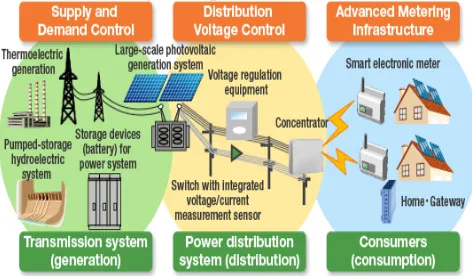
Smart Grid is an interconnected arrangement utilizing ICT and is in whole power sector including power generation, transmission, distribution and the consumer [3]. SG provides two-way flow of electricity and information.
Framework of Smart Grid incorporates three main parts mentioned below(Fig.1): 1. Actual power
2. the information transfer and control and 3. the application part.
These parts comprise of their own sub parts. The drivers for the SG includes Growth in Energy Demand, requirement of reliable Network and protection, Energy Security along with combining of dispersed energy sources (like Solar, Wind and so on). The smart grid supports both way interaction between utilities and consumers thereby permitting both to be more adaptable and responsive in their usage and operations.
ISSN(Online): 2319-8753 ISSN (Print): 2347-6710
International Journal of Innovative Research in Science,
Engineering and Technology
(A High Impact Factor & UGC Approved Journal) Website: www.ijirset.com
Vol. 6, Issue 8, August 2017
Microgrids fulfil specific local objectives, for instance focus to accomplish particular local goals e.g. durability, reliability, control of carbon emission, consideration of distributed energy sources, energy cost decrease and demand response. Microgrids are setup with a rationale in self-healing facility in home automation i.e. power quality, response to varying costs of electricity automatically and so forth .If there should be an occurrence of a outage, consumers who are connected to any microgrid can meet their energy requirements just as a standalone system.
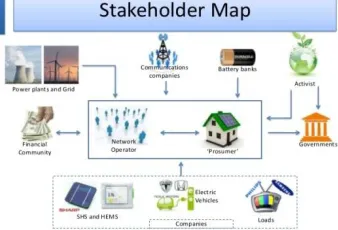
To address the problems faced in the present legacy grid and bring efficiency, seamless integration of emerging technologies in the field of monitoring, automation, control, communication and IT systems with active participation of all stakeholders are inevitable ( as shown in Fig.2). In this direction, smart grid which integrates 21st century technology with the 20th century electrical grid has potential to revolutionize electricity delivery system and provide access to electricity for all. It offers hundreds of millions of populations the possibility of accessible, reliable power - a fundamental requirement of inclusive growth. Each global driver for smart grids applies to India, however it has some extra drivers, which are as given below [4]:
For Utilities:
Reduction of Transmission and Distribution losses in all utilities utilities and also enhanced collection efficiency
Peak load management – various choices from direct load control to customer estimating incentives/motivations .
Reduction in power purchase cost
Better grid management and increased perceivability. Self-healing grid
Distributed energy sources (Renewable) integration For Customers:
“Power for All”. Improved Power quality to all customers. Interaction with utilities
More choice to customers, including green power
Customer can be “Prosumer” (producer as well as consumer)
Options to save money by shifting loads from peak periods to off-peak periods
Fig. 2: Stakeholder's Map in a SG For Government & Regulators:
Satisfied customers Financially sound utilities
System upgrade and modernization
ISSN(Online): 2319-8753 ISSN (Print): 2347-6710
International Journal of Innovative Research in Science,
Engineering and Technology
(A High Impact Factor & UGC Approved Journal) Website: www.ijirset.com
Vol. 6, Issue 8, August 2017
III. TECHNOLOGIES
A. Automated Metering Infrastructure: AMI
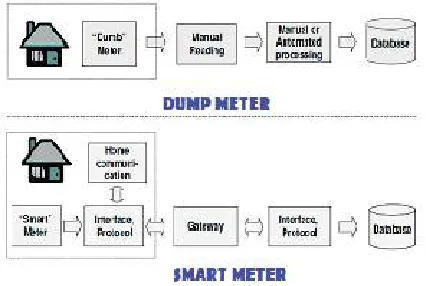
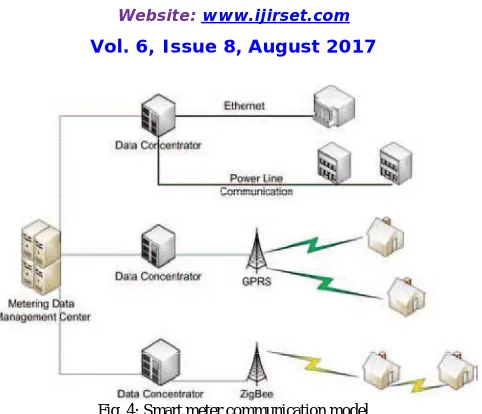
AMI suggests system that measure, look at and read energy consumption. It comprises of advanced electronic equipment with ICT technology. The hardware consist of a Smart meter installed at the consumer site provide various data like electricity consumption, voltage quality, etc. of the consumer to the service provider[5]. These meters provide the real time data on a periodic basis which can range from milliseconds to a few minutes. This data is received by the Meter Data Management System (MDMS) with help of any of the communication system like Power Line Communications (PLC), RF networks or GSM based system (Fig. 3).
Fig. 3: Working of a dump and Smart meter
Smart meters can senses, records and resolve any abnormality, misuse or tampering events and send an alert to the control centre. These Meters can be remotely configured and controlled for remote load management. These meters have a Disconnect / Reconnect switch for power supply and contactor for part/full load. A disconnect operation on this meter stops all outgoing power from the meter. The present state or the meter reading of smart meter can be checked by "on-demand" remote polling. Consumer’s agreed load can be programmed remotely into the meter and whenever the consumer surpasses his agreement amount of power over a concurred interim, the supply can get disconnected (using connect/ disconnect switch). A few customizations can be made with regards to the contract understandings between the parties. To avoid load shedding, the utility can force power usage limits during peak demand hours of the day when the consumer is restricted to used less than indicated amount of power. Utilizing a communications network, the internal antenna present in smart meters sends power utilization information to the utility on a regular basis as programmed. An external antenna may be needed in a few regions for enhancing signals over longer distances and ensuring reliable data transmission (Fig. 4).
ISSN(Online): 2319-8753 ISSN (Print): 2347-6710
International Journal of Innovative Research in Science,
Engineering and Technology
(A High Impact Factor & UGC Approved Journal) Website: www.ijirset.com
Vol. 6, Issue 8, August 2017
Fig. 4: Smart meter communication model
Smart Meters can help in Revenue Protection by analysis of any tampering event, power failures and consumer utilization patterns to distinguish and check power pilferage situations. They can be programmed such as to create various reports viz. daily , monthly reports for any study of consumer power usages. Formulation and execution of utility-particular rules for various services to consumer like commands for connecting and disconnecting the electricity connection. Moreover, couple of reasons for introduction of smart meters may be to present new tariff plans(e.g. ABT) which may permit benefits to the end consumer and better demand response as a result of proper load adjustments to get a flat load curve.
Finally, it can be concluded that Smart Meters are the stepping stone for Smarter Grid. This may be useful for the Utilities to prepare future grids thereby giving Customized services to the consumers and also the end consumers can be sensitized to decrease use of energy according to their instructions to reduce the energy cost [6].
B. SCADA
Supervisory Control and Data Acquisition(SCADA) is used for monitoring and control of the power in a delivery network system [7]. This framework uses intelligent control mechanism and automation to distributed generation management at various substations. Therefore, it certainly aid in decreasing the operation and up keeping costs of the grid and ensure the quality of power supplied [8]. The SCADA unit includes a Human-Machine Interface (HMI), a supervisory SCADA expert server, Remote Terminal Units (RTUs) and/or PLC, Intelligent Electronic Devices (IEDs) and Communication Networks. Data received from remote substation is fed thru RTUs to SCADA master server. This communication takes place through a network where state estimation is constantly updated to help operator of power system who can alter and/or streamline the power system operation and to verify whether various operational conditions are steady or not. Solitary SCADA system does not exist. They are either Ethernet/IP based or not [9].
C. Smart Monitoring and Measurement:
Monitoring, observation and measurement of various parameters forms one of the essential function for checking the grid status at any time. Sensors and phasor measurement units(PMU) used for monitoring and measurement are reviewed in this section.
Sensors: As of now, Sensors or sensor systems are being utilized for checking and estimating of any distinct purpose
[10]. With a specific goal to distinguish different mechanical failures in grids system such as conductor failures, tower breakdowns, hot spots and other extreme mechanical conditions, sensor are implanted throughout the grid. This facilitate to check the all round condition of transmission line on real-time basis. In case of any fault condition in the transmission system, the data from Sensors can be acquired to get a real time physical and electrical status of the power system and thereafter analyse pending as well as permanent failures, and finally decide suitable control measures that could be automatically taken and/or recommended to the system operators.
ISSN(Online): 2319-8753 ISSN (Print): 2347-6710
International Journal of Innovative Research in Science,
Engineering and Technology
(A High Impact Factor & UGC Approved Journal) Website: www.ijirset.com
Vol. 6, Issue 8, August 2017
has many necessities[11-12]such as Quality-of-Service (QoS) prerequisites, Resource constraints, Remote maintenance and configuration, High security requirements and Harsh environmental conditions.
Phasor Measurement Unit (PMUs) is a device PMU is a monitoring device to measure the electrical waves on an
electricity grid using common time source for checking the condition of the grid. PMU gives the data as a Phasor which is a complex number representation of both magnitude and phase angle of the sine waves found in power present at a particular node. It helps to create a reliable power transmission and distribution infrastructure [13]. A PMU devices that allows both magnitude and Phasor measurements at the same time are called synchrophasor. Normally, PMU data are received from generally scattered areas in a power system network . These data are time stamped for synchronization by a common time source. The utilities can utilize the gathered information to check the power system condition and take action quickly to any system eventuality in a dynamic fashion having a large number of PMUs installed in the field. This is possible due to ability of PMU's to compare shapes of AC readings anywhere and everywhere on the grid [14].Therefore, inclusion of PMUs in the transmission systems and major sub-stations will be critical and essential for achieving a smarter grid.
IV. COMMUNICATION SYSTEM
Communication system is the essence of operational Smart Grid. Communication integration and data mobility between various systems, devices and applications for setting up of the Smart Grid are discussed here. This section overviews the various subsystem of smart communication system followed by the wireless and wired communication technologies.
Consumer's devices and smart meters may utilize different communication methods viz. ZigBee, Wi-Fi, and power line communications. Societies and Colonies are connected with their respective electric utilities by means of free-space optical, satellite, microwave, or cellular systems. PLC is generally used by a substation for communicating with an electric utility.
A. Wireless Technologies
Wireless technologies have noteworthy points of interest over wired innovations, for example low establishment cost, quick arrangement, versatility, mobility and so forth. They are appropriate mainly for applications at far-off places. Wireless communications has now been utilized as a part of our everyday life and can be deployed at anyplace, whenever required. In future also some important technologies of wireless communication and networking mentioned below are going to be used in Smart Grid.
1) Wireless Mesh Network: In this communication network system radio nodes are sorted out in a mesh configuration This topology is expected to become a key innovation for future networking with wireless technology.
2) Cellular Communication Systems: A cellular communication system is a communications network where the last link is wireless, for example, GSM , 3G (WCDMA and CDMA) and 4G. The network is dispersed over area zones said to be cells, every one of them are served by no less than one transceiver, called cell site or base station. In this type of network, each cell utilizes an alternate arrangement of frequencies from neighbouring cells, to prevent interferences and ensure guaranteed bandwidth within each cell. To cover a widespread geographic region for radio coverage, the cells are joined together. This enables a large number of transceivers like mobile phones, pagers, etc. to communicate with each other and with fixed transceivers and telephones anywhere in the network. This communication is through the base stations, even if some of the transceivers are moving through more than one cell during transmission. It has proved itself as a reliable technology for information transaction for a long while now. By utilizing the current telecom technology like 3G (or even 4G), data transmission covering vast geographical area can be swift and affordable [15].
3) Cognitive Radio: Cognitive Radio (CR) is an a versatile, savvy radio and network system that can consequently recognize accessible channels in a wireless spectrum and change transmission parameters enabling more communications to run simultaneously thereby enhancing the radio working behaviour. It is accepted to suit the present management prerequisites and additionally has the potential for application in the future. It can be assumed that the full spectrum may be utilized when SG is as a part of substantial scale commercial use.
ISSN(Online): 2319-8753 ISSN (Print): 2347-6710
International Journal of Innovative Research in Science,
Engineering and Technology
(A High Impact Factor & UGC Approved Journal) Website: www.ijirset.com
Vol. 6, Issue 8, August 2017
technologies based on IEEE 802.15.4 protocol are suggested to be used in SG [16]. These are ZigBee, Wireless HART, and ISA100.11a. ZigBee is generally utilized for radio-frequency applications since it requires a low data rate, long battery life and secure networking.
5) Satellite Communications: In this case, signal exchange between the sender and receiver happens with utilization of satellite. It's a decent answer to the remote monitoring and control, since it can deliver worldwide and that too with a rapid installation [17]. At times at some places where communication becomes hurdle, particularly for isolated substations and generation arrangements, satellite communication can be considered the best and cost-effective arrangement. However, such a technology also has certain disadvantages which is described as limitations. First limitation is a considerably higher delay compared to a global communication system. This limitation makes some protocols like TCP unreliable for satellite communications [18]. Secondly is the impact of environment and the climate conditions on signal transmission. The satellite channels attributes differ for different environmental conditions . The above limitations can hazardous for performance and execution of certain key signal transmission[16].
6) Microwave or Free-space Optical Communications: Microwave communication is the sending of signals by radio waves. The transmission of radio waves takes place by the use of an arrangement of microwave towers. It's a form of "line of sight" communication. There must be nothing blocking the transmission of information between these towers. In this way, they are broadly utilized for communications between only two points. Wavelength being small, permits utilization of suitable directional antennas for transmission of secured information at high bandwidths. Another "line of sight" wireless communication technology called Free-space optical communication (FSO) uses light propagating in free space. In this case also, wireless transmission of point-to-point data takes place for telecom or computer networking . This technology has an advantage of high bit rates with little bit error rates in communication of data. Since, both the above mentioned technologies are "line of sight" communication, their quality of communication are extraordinarily influenced by impediments (e.g. structures, buildings and hills etc.) and environmental constraints (e.g., rain etc).
B. B. Wired Technologies
Apart from wireless technologies discussed above, wired communication technologies will always remain an integral part of Smart Grid. Important wired communication technologies are given below.
Fibre-optic Communications: Fibre-optic communication is a technique of transmitting information by sending light pulses through an optical fiber. In this case, the electromagnetic carrier wave is the light which is modulated to carry information from one place to another. Optical fiber is being preferred for transmitting telecom signals, Internet communication, and HQ TV signals because of much lower attenuation and interference in comparison to existing copper wire in long-distance and high-demand applications. Since the bandwidth capacity of light wave is much higher and it has invulnerability qualities, optical fibres are expected to have an essential part in transmission of information in the future SG [15]. Despite the fact of high laying and execution expenses of fibre optics network, it is still viewed as an cost -effective communications network for high speed communication. Presently, this technology has been extensively used in broadband internet communications. Therefore, it is certainly going to backbones the future SG. Powerline Communications: Powerline communications (PLC) ) carries data on a conductor which is also utilized at the same time for AC electric power transmission or distribution. Utility companies around the globe use PLC for remote operations like metering and applications of load control . The PLC is a preferred choice for utilization in future SG. This extensively used system also has a few constraints like security issues due to present condition of power lines but still in future with improved infrastructure, it can be hoped that this technology will find a widespread use in communication system [19].
V. EMERGINGTECHNOLOGIES
ISSN(Online): 2319-8753 ISSN (Print): 2347-6710
International Journal of Innovative Research in Science,
Engineering and Technology
(A High Impact Factor & UGC Approved Journal) Website: www.ijirset.com
Vol. 6, Issue 8, August 2017
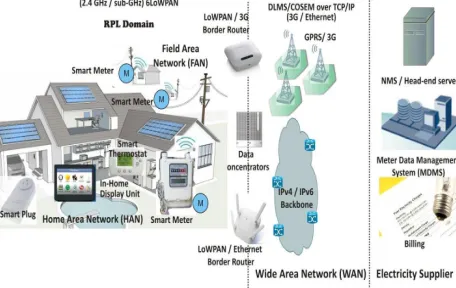
protocols for communicating with one another. Communication will be the very basic essence of Smart Grid for any exchange of information between consumer and the service provider. To have a real time monitoring and response system in a grid, proper arrangement of distributed monitoring system with telecommunication system is needed. Therefore, Smart Meter as a monitoring and communicating device offer a dependable, safe and economical service. The flow of data in the Smart meter takes place in two steps. Step one has flow of information from various sensors ( like thermostat, smart plug ) and home appliances (like TV, refrigerator ) to billing meters. In step two, smart meters communicate with the data centres of utilities takes place. The technology used for this communication depends on radio spectrums, data rates, coverage range, and limitations to protocol but cellular technologies is always preferred. This Smart Meter Infrastructure (SMI) has following networks: WAN, FAN and HAN which represent networks in Wide Area, Field Area and Home Area. The internet has helped in the development of various programs to suit the internet protocol. The figure given below give the various possible technologies for information/data flow in each domain.
AMI involves various technologies and systems [21]. The technology is chosen depending on the geographical location, practical field issues and the comfort level of the service provider in national perspective. Since, every technology has advantages and disadvantages, hence a service provider may use a combination of technologies to suit them the best.
Fig. 5 : Smart Metering Network Infrastructure
Internet of Things (IoT) has emerged as the latest technology in the area of communication. It uses the same Internet Protocol (IP) via Internet to link sensors and smart meters through wired or wireless networks. IoT may have “Things”-oriented, “Internet”-oriented or “Semantic”-oriented approach as described in the literature [22]. Approach based on Internet Protocol is based on open standard interchange protocol where the data is openly available for public. Therefore, this technology is fit for deployment in large area/scale and is suitable for approach towards IoT enabled application for automated meter reading . For standardizing various layers in a Smart Grid, the layers (Fig. 5) are defined by respective organizations. IEEE has defined about physical, data-link and application layer. Communication systems are defined by
IEC, DLMS /COSEM and ITU while the basic IP's in Routing (RPL) & Constrained Application (CoAP) are defined by (Internet Engineering Task Force) IETF whose goal is to make the Internet work better.
ISSN(Online): 2319-8753 ISSN (Print): 2347-6710
International Journal of Innovative Research in Science,
Engineering and Technology
(A High Impact Factor & UGC Approved Journal) Website: www.ijirset.com
Vol. 6, Issue 8, August 2017
VI. SUMMARY AND CONCLUSION
The technologies used in Smart Grid can prudently check in real time the supply margins, enhance operational effectiveness in the distribution system, and take into consideration various applications for energy efficiency (e.g. demand supply management) along with sensitizing the consumers about the judicious use of energy.
The distributed energy sources using RES are having their impact felt in energy and carbon emission. These distributed generation units when combined with the grid is certainly going to fill up the demand supply gap. This type of Smart grid with the use of Smart Metering Technology will likewise encourage the consumers to become "Prosumers" which will result in greater usage of green power. Also, monitoring of the cogeneration energy injected into the grid will benefit the consumers financially by the method of NET metering.
Emerging technologies like Cloud computing, Internet of Things (IoT) etc are also mentioned in this paper. Utilization of IoT for AMI and details of open protocol standard stack are also discussed.
Cloud computing has distinctive advantages in modelling a system which can be beneficial to both consumers and the service providers. Both the parties are going to be benefited by this technology due to everywhere computing, self-service, pay-per-use and a likelihood of integration with SG. The SG cloud has every potential to reduce cost in various steps of power system e.g. operation costs( in generation, distribution system), defer capital investments and by reduction in failure of equipments, electricity losses, reduction in major outages, reduction in restoration costs alongwith SO2 , NO2 emissions. Even if, cloud computing reduces the infrastructure and maintenance cost incurred at the data centers but the owner's data is exposed to cyber thefts .
Finally, it can be concluded that once the Smart Grid is setup and in place, the energy market is expected to open up in a major manner.
REFERENCES
[1] World Economic Forum Report on Energy Innovation by Gartner - ID Number: G00157684, 2008.
[2] V. C. Gungor, B. Lu, and G. P. Hancke, “Opportunities and challenges of wireless sensor networks in smart grid,” IEEE Trans. Ind. Electron.,vol. 57, no. 10, Oct. 2010, pp. 3557–3564.
[3] FICCI, India Smart Grid Day, India Smart Grid. [Online].Available: http://indiasmartgrid.org/en/Documents/Context of Smart grids in India-Knowledge paper of India Smart Grid Day2013.pdf .
[4] Smart Grid Vision and Roadmap for India- Ministry of Power, August 2013, pp 6-7.
[5] Mukhopadhyay, P., and H. K. Chawla "Approach to make Smart Grid a reality." In Advances in Energy Conversion Technologies (ICAECT),2014 International Conference on. IEEE,2014,pp.77-82.
[6] EPRI, Advanced Metering Infrastructure (AMI) [Online].A vallable: http://www. ferc.gov/eventcalendar/Files/2007042309IS46 -EPRI%20-%20Advanced%20Metering.pdf [Accessed:30 July13
[7] A. R. Metke, R.L. Ekl, "Smart Grid security technology, "in Conf Innovative Smart Grid Technologies (ISGT), Gaithersburg: MD, Jan. 2010, pp.I-7.
[8] G.N. Ericsson, "Cyber security and power system communication - essential parts of a smart grid infrastructure," IEEE Trans. Power Delivery, vol. 2S, no. 3, Jul. 2010, pp. ISOI-IS07.
[9] S. Galli, A.Scaglione, Z. Wang, "For the Grid and Through the Grid: The Role of Power Line Communications in the Smart Grid," Proc. of the IEEE, vo1.99, no.6, June 2011, pp.99S-1027.
[10] I. F. Akyildiz, W. Su, Y. S. Subramaniam and E. Cayirci, “A survey on sensor networks”, IEEE Communications Magazine, vol. 40, no. 8, 2002, pp. 102–114.
[11] V. C. Gungor, B. Lu and G. P. Hancke, “Opportunities and challenges of wireless sensor networks in smart grid”, IEEE Transactions on Industrial Electronics, vol. 57, no. 10, 2010, pp. 3557–3564.
[12] Y. Wang, W. Lin and T. Zhang, “Study on security of wireless sensor networks in smart grid”, 2010 International Conference on Power System Technology, 2010, pp. 1–7.
[13] A. Armenia and J. H. Chow, “A flexible phasor data concentrator design leveraging existing software technologies”, IEEE Transactions on Smart Grid, vol. 1, no. 1, 2010, pp. 73–81.
[14] J. De La Ree, V. Centeno, J. S. Thorp and A. G. Phadke, “Synchronized phasor measurement applications in power systems”, IEEE Transactions on Smart Grid, vol. 1, no. 1, 2010, pp. 20–27.
[15] B. Akyol, H. Kirkham, S. Clements and M. Hadley, “A survey of wireless communications for the electric power system”, Prepared for the U.S. Department of Energy, 2010.
[16] Y. Hu and V. Li, “Satellite-based Internet: a tutorial”, IEEE Communications Magazine, vol. 39, no. 3, 2001, pp. 154–162.
ISSN(Online): 2319-8753 ISSN (Print): 2347-6710
International Journal of Innovative Research in Science,
Engineering and Technology
(A High Impact Factor & UGC Approved Journal) Website: www.ijirset.com
Vol. 6, Issue 8, August 2017
[18] V. C. Gungor, B. Lu and G. P. Hancke, “Opportunities and challenges of wireless sensor networks in smart grid”, IEEE Transactions on Industrial Electronics, vol. 57, no. 10, 2010, pp. 3557–3564.
[19] W. Liu, H. Widmer and P. Raffin, “Broadband PLC access systems and field deployment in European power line networks”, IEEE Communications Magazine, vol. 41, no. 5, 2003, pp. 114–118.
[20] Kalkitech Intelligent energy system [Online]. Available : http://www.kakitech.com.
[21] Khan, Muhammad Faisal, Abhishek Jain, V. Arunachalam, and A. Paventhan. "Roadmap for smart metering deployment for Indian smart grid." In PES General Meeting| Conference & Exposition, 2014 IEEE, pp. 1-5.
[22] Luigi Atzori, Antonio Iera, and Giacomo Morabito. The Internet of Things: A survey. Computer Networks, 54(15): 2010, pp 2787–2805. [23] NIST, The NIST Definition of Cloud Computing. [Online].Avallable:csrc.nist.gov/publications/nistpubs/800-14S/SP800-14S.pdf, July 2013. [24] Mehmi, Sandeep, Harsh K. Verma, and A. L. Sangal. "Smart grid cloud for Indian power sector." In Recent Advances and Innovations in