Analysis of Various Shortcomings in Contract
Systems in Use of Major Building Projects and
Proposing Recommendations for Rectification
G.Guruvardhan Raju, L.Sabarigirivasan
Department of Civil Engineering, SRM University Chennai, India
ABSTRACT: The construction management (CM) industry should attack the subject in detail. This paper begins the attack by discussing some of the inherent problems in obtaining quality work. It offers some solutions, including the need to develop standards and sharing part of the contractor’s responsibilities in providing them. Specifically, this paper presents three proposals. First, it makes a case for the CM industry to develop general as-built standards that could be used for most construction contracts. Second, it offers a payment vehicle to the contractor for producing them. Finally, it proposes that the construction manager take an active role in the as-building process. Decisions are made every day in construction processes based on incomplete information, assumptions and the personal experience of the construction professionals. Project changes and/or adjustments are inevitable as they are a fact-of-life at all stages of a project’s life cycle. Managing changes effectively is crucial to the success of a construction project. Change management in construction requires an integrated solution to discipline and coordinate the process, for example, documentation, drawing, process, flow, information, cost, schedule and personnel. The construction industrial needs an effective construction change management process. This paper summarizes various aspects of the existing construction change management processes and provides a comprehensive literature review as well as some comments on possible future directions.
KEYWORDS: Distresses, Repair, Structural strengthening, Construction chemical products.
I. INTRODUCTION A. General
Contract system handles day by day contractual issues in an agreement execution and adapts to them as per the advancement of the entire task. Contractual issue might be identified with time, cost, quality and different commitments set out in the agreement. This paper endeavors to highlight contract system quire for time and cost control for development ventures. In a common trust environment, either party advises to other of likely occasions which may bring about postponement in venture fruition and require extra cost.
B. Objective
At the design stage of construction, safety by design appears to be critical to enhancing OHS performance. Designers must work and communicate with the principal parties of a construction project such as supervisors or clients, and ensure that the following safety considerations are reflected in site plans and designs:
Site remediation and methods;
Provision of amenities/services;
Site security/access;
Excavation;
Adequate ground conditions and type of control medium (e.g., batters, trench boxes, shoring);
Machinery types best equipped to mitigate dust; and
Stable structures during deconstruction or reconstruction.
C. Scope
some of the important areas, which are more prone to recurrence of lapses/irregularities, in a large number of organizations. The booklet has been divided into two parts - Part I deals with award of Contracts and Part II with the execution of Contracts. The main emphasis is on objectivity and transparency in award and execution of contracts. A dire need is also felt to inculcate a culture and spirit of professionalism amongst officials managing the contracts so as to ensure high standards of quality and timely completion of works.
II. WORKINGMETHODOLOGY
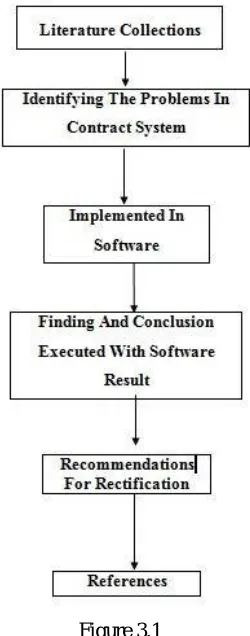
The proposed methodology was designed to eliminate the causes of the defects detected in the identification phase of the research as shown in Figure 3.1
Figure 3.1
III. METHODOLOGYTOIMPROVEDESIGNQUALITY
The proposed methodology was designed to eliminate the causes of the defects detected in the identification phase of the research. These problems the can be solved acting through four different actions:
A.SUPERVISION
Supervision of the design process. A construction company must participate
B.COORDANIBALITY
Coordination of the different specialties through a logic sequence of information transfer, avoiding incorrect assumptions, and giving a priority level for changes in order to avoid lack of coordination and to improve the design compatibility.
C.STANDARADIZATION
Standardization of design information, to avoid the omissions, errors and continuous changes, that affects the normal development of the projects.
D.CONTROL
Control of the flow of information, verifying that the requirements of previous processes are fulfilled, in order to avoid that design defects arrive to the construction site. Four forms of actions are proposed to introduce continuous improvement based on the above elements.
IMPROVE COORDINATION THROUGH
A planning scheme of the design sequence for building projects, in order to stabilize and control the information flow, to establish priorities among the specialties to avoid the lack of information or the use of assumptions when information is not available. This scheme also helps to coordinate the installation, location and lay out of different systems, equipment, and other items. The establishment of this plan for the information transfer through all the design process allows the users to organize the requirements of input data for each one of the specialties and the precedence order of these requirements.
INTRODUCE STANDARDIZATION THROUGH
The development of “task lists”, in order to generate for each one of the designers, the input data for his own design process.
The development of “work specifications”, in order to standardize the presentation of the information and to establish requirements for the different designers.
Reduce the impact of the lack of construction knowledge of the designers by introducing construction criteria, in the” task list “ and “ work specifications “.
Improve Control by developing “check lists” to control the parameters established in the “task list” and the requirements imposed in the “work specifications”.
This methodology is applied to each project and allows the compilation of data to provide an effective feedback for continuous improvement of the methodology. These lists, plans and specifications we will be called “Design Control Documents”.
IV. ABOUTTHESOFTWARE
Primavera enables the organizations to manage time, tasks, costs, resources, contracts, change and risks to consistently execute profitable projects. Primavera is the industry leading project and program management solution for projects of any size. Organizations leverage Primavera to Effectively. Collaborate across the entire project team. Proactively manage projects to meet success requirements. Standardize business processes and best practice.
Primavera's software packages include P6, Prosight, Contract Manager, Cost Manager, Pertmaster, SureTrak, Evolve and Inspire. The newest addition to the suite of project management solutions is Primavera P6, which is an integrated PPM (project portfolio management) solution that provides a real-time view of portfolio performance. P6 also offers what-if scenario modeling, tabular scorecards and capacity analysis.
BENEFITS OF USING PRIMAVERA
Easy-to-use solution
Great for simple projects
We serve your kind of company
Modern platform
Open technology
Full construction mgmt application
Easy to do business with
Clear understanding
Inclusive deployment to all stakeholders and participant
V. RESULTS
REQUIREMENTS PROBLEMS AND THEIR SOLUTIONS POOR REQUIREMENTS QUALITY Problem
In practice, the actual quality of many specified requirements is poor. These requirements do not exhibit the accepted properties that should characterize all well engineered requirements. By poor requirements quality , I specifically mean that far too many ‘requirements’ specified in real requirements specifications are ambiguous, not cohesive, incomplete, inconsistent, incorrect, out-of-date, specified using technical jargon rather than the terminology of the user or business/application domain, not restricted to externally-visible behavior or properties of the system, infeasible to implement or manufacture, not actually mandatory (i.e., merely nice-to-haves on someone’s wish list), irrelevant to the system being built, lacking in necessary metadata such as priority and status, untraced, in a form that is unusable to the requirements many stakeholders, unverifiable, and unvalidatable.This problem arises because many requirements engineers who are inadequately trained, have inadequate access to stakeholders and other sources of the requirements, and who are given inadequate resources or authority to properly engineer the requirements. Other major causes of this problem are the prevalent myths that it is too costly, too difficult, and even impossible to produce good requirements, especially nonfunctional requirements. These myths are especially prevalent with regard to quality and specialty engineering requirements (e.g., availability, interoperability, performance, portability, safety, security, and usability), where there is still a prevailing but mistaken belief that it is impossible to specify these requirements in a verifiable form containing actual minimum acceptable thresholds. Not only is it possible to specify explicit quality thresholds, without them it is impossible for architects to know when their architectures are good enough and how to properly make architectural trade-offs between different quality requirements; without thresholds, it is also impossible for testers to produce proper quality tests and to generate associated test completion criteria.
Negative Consequences
Requirements engineering is the first engineering activity during which major mistakes can be made, and the negative consequences of these mistakes are felt during all downstream activities such as architecting, design, implementation, and testing. Poor-quality requirements greatly increase development and sustainment costs and often cause major schedule overruns. As long ago as the early 1990s, it was well known that defects discovered once a system is fielded cost 50 to 200 times as much to correct as they would have had they been found during requirements evaluations [Boehm and Papaccio 1988], and these depressing figures have not changed significantly since then. As noted in Wiegers 2001], “Industry data suggests that approximately 50 percent of product defects originate in the requirements. Perhaps 80 percent of the rework effort on a development project can be traced to requirements defects.” Because these defects are the cause of over 40% of accidents involving safety-critical systems [HSE 1995], the unnecessary engineering of poor requirements has even been the ultimate cause of both death and destruction.
Solutions
characteristics (e.g., unambiguous, complete, correct, mandatory, readable, etc.). You should use simple tools to identify inherently vague words being used in the requirements. Involve members of the architecture and test teams when verifying the quality of requirements to ensure that the requirements are feasible and verifiable. Ensure that the requirements engineers are enabled and required to collaborate with stakeholders until the requirements have sufficient quality. Finally, requirements engineers should rework or delete all requirements that lack the required characteristics of good requirements.
INAPPROPRIATE CONSTRAINTS Problem
In practice, many requirements are not actually mandatory. Instead, too many of them are architecture, design, implementation, and installation/configuration constraints that are unnecessarily specified as requirements. Because stakeholders and/or requirements engineers sometimes incorrectly assume that a common way to implement a requirement is actually the only way to implement the requirement, they confuse the implementation with the requirement and inappropriately specify how to build the system rather than what the system should do or how well the system should do it. This problem is largely due to the fact that requirements engineers are not sufficiently qualified in the problem domain and specialty engineering areas (e.g., safety and security) to act as sources of the requirements and they are neither qualified nor authorized to architect, design, and implement the system. Similarly, many of the different kinds of stakeholders (e.g., users, customers, marketing, operators, maintainers, etc.), who are appropriate sources of the requirements, may be too caught up in the current system to envision how it could be significantly improved by new technologies and business process reengineering.
Negative Consequences
By unnecessarily specifying constraints, the requirements needlessly tie the hands of the architects, designers, implementers, and installers. This often prevents a better solution to the problem from being selected. Worse, it often prevents innovative solutions that can significantly improve the system and associated business processes, and eliminates an opportunity to differentiate both the system
and its enterprise from the competition. Perhaps the canonical example of this occurs when specifying security requirements. Too often, instead of the specifying necessary levels of user identification and authentication, requirements engineers unnecessary specify the use of textual user identifiers and passwords, which are architectural constraints mandating specific security countermeasures. Mandating user IDs and passwords not only eliminates the selection of more modern countermeasures such as biometrics, smartcards, and digital signatures; it also mandates the use of countermeasures that have proven to provide the weakest level of security.
Solutions
The most important solution to this problem is to ensure that all collaborators in the requirements engineering process are aware of it. Looking for improperly specified constraints (i.e., specifications of how rather than what and how well) should be one of the most important items on the requirements inspection checklist
REQUIREMENTS NOT TRACED Problem
be traced to only the most important architectural elements and for non-functional quality requirements to not be traced at all.
Negative Consequences
This lack of tracing makes it difficult, if not impossible, to know the impact of proposed and actual changes, both to the requirements themselves and the architecture, design, and implementations derived from them. When changes occur as they will on any real endeavor, the requirements and both the upstream and downstream work products get out of synch as inconsistencies develop among them. Architecting, designing, implementing, and testing also become more difficult, expensive, and time consuming to perform.
Solutions
Ensure that requirements tracing is mandated in the contract and explicitly
specified in the requirements engineering method. Also be sure to mandate and verify the tracing of all requirements, not just the functional requirements. Provide user friendly and scalable tool support for requirements tracing. Ensure management understands the negative consequences of not tracing requirements, and obtain support for proper tracing, including providing adequate resources to trace the requirements. Ensure that tracing occurs both early in the project development cycle as well as later during design, development, and maintenance. Finally, ensure that the evaluation of requirements tracing is a documented part of the requirements verification method.
MISSING REQUIREMENTS Problem
Midsized systems often have hundreds of requirements and many large systems can end up with several thousand separate requirements, especially when one considers the derived requirements that are allocated to subsystems and their subsystems. Still, it is not at all uncommon for important bits of functionality to slip through the cracks. Given an iterative, incremental development cycle, these minor slips do not usually cause much harm so long as the omissions are identified and added to later builds or releases. In fact, many information systems often are specified to have numerous features that are not used by almost all users and possibly not needed at all. Overlooking such requirements is not what this problem is primarily about. The real problem is that many architecturally-significant requirements are accidentally overlooked.
VI. CONCLUSION
This paper discusses about the problems faced by the contract administrator during the construction of major building projects and payment procedures. Currency fluctuation was the major factor that gave rise to the negative impacts. The climatic conditions cost time are the major factors that affect the contract and their impact has been discussed.
REFERENCES
1. Bill Davison. and Richard J. Sebastian. (2011), 'An Analysis of the Consequences of Contract Administration Problems for Contract Types', Macro think Institute, Vole 1, No.2, pp. 1-32.
2. Dr. Jur.Tunav KOKSAL. (2011), 'FIDIC Conditions Of Contract As A Model For An International Construction Contract', International Journal of Humanities and Social Science, Vol. l, No.8, pp. 140-157.
3. J. Rodney Turner. (2001), 'Project Contract Management and Theory of Organization', Erasmus Research Institute of Management, ERS-2001-43-0RG, pp 5-20.
4. Jyh-Bin Yang. and Chih-Kuei Kao . (2009), 'The Open Construction and Building Technology Journal', Licensee Bentham Open, Vole 3, pp. 81-89.
5. Shahnawaz Khan, Salem Gul and Attaullah Shah. (2011), 'A Review Of Literature On The Role Of Trust And Partnering In Success Of Construction Projects', African Journal Of Business Management, Vol. 5(35), pp 13541-13549.
6. RRanchmenPerera (2009), 'Construction Contract Arbitration', SLQS Journal, Vol. 2, pp. 34-41.
7. Rene G. Redon. (2011), 'Assurance of Learning in Contract Management Education', National Contract Management Association, Vole 9, pp. 9-16.