IoT based Agro Automation System using
Machine Learning Algorithms
Akash Raj N, Balaji Srinivasan, Deepit Abhishek D, Sarath Jeyavanth J, Vinith Kannan A
U.G. Student, Department of ECE, RMK Engineering College, Tamil Nadu, India
U.G. Student, Department of ECE, RMK Engineering College, Tamil Nadu, India
U.G. Student, Department of ECE, RMK Engineering College, Tamil Nadu, India
U.G. Student, Department of ECE, RMK Engineering College, Tamil Nadu, India
U.G. Student, Department of ECE, RMK Engineering College, Tamil Nadu, India
ABSTRACT: The needs and necessities of an agro automation system in large scale applications for monitoring various parameters are on a rise. The overview of all core challenges faced by the farmers can highly be overcome with the proposed 'IoT based Agro Automation System using Machine Learning Algorithms' which is established through multiple sensor fusion with the affirmation of results in a hybrid app. A semi-autonomous agro robot with a completely secured and reliable system is deployed for simplifying the endeavours undertaken by farmers. The monitoring and analysis is achieved with the use of PTC ThingWorx cloud computing platform and the experimental results are defined with high accuracy taking into consideration of many case studies predominantly evaluated for the development of this system in all agricultural applications.
KEYWORDS:Internet of Things, Machine learning, Hybrid app, Sensor fusion, Cloud computing.
I. INTRODUCTION
The need for automation in agricultural spheres is an essential requirement to spearhead the technological era of enhancing the methods of farming and simplifying the lives of farmers. The primary necessities relate to the continual monitoring of parameters in agriculture, resolve the issue of inability of a farmer or owner to control and supervise the farming related activities from a distant place, instantaneous simulation and streaming of video to process the data, implement an all terrain robot to facilitate the tasks, provision of power supply to do the required endeavours and establish a secured technological system with the appropriate authentication.
Resolving all the drawbacks that nullifies the effect of agriculture in this modern period, it is high time to incorporate the use of technology to simplify the life a farmer and provide a visionary eco-friendly expertise in assisting the methods of farming. The solution to the above problems can be built based on the largely evolving conception pertaining to Internet of Things(IoT), machine learning, cloud computing, multiple sensor fusion through node interfaced communication, develop an semi-autonomous agro robot and establish a hybrid app.
II. IOT BASED AGRICULTURAL MONITORING AND ANALYSIS
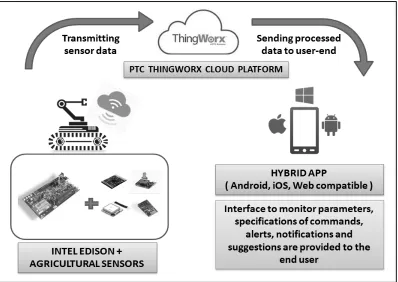
The monitoring of agricultural data is accomplished by instituting a multiple sensor fusion in the land at a cost effective node interconnected architecture. The data from sensors is obtained by Intel Edison and transmitted to the cloud platform using the inbuilt WiFi chip on board or the GSM module. The token ID is established for each of the nodes for evaluating the various parameters with the help of sensors mainly like temperature, humidity, moisture, water level and these vary as per the requirements of the corresponding farmer. The automation is effectuated by instructing the action to be taken after monitoring the present situation of land by the farmer. The water flow, fertilizer effect, growth of crops, ambient response are all taken into consideration for analysis. Based on the data received, the robot is given the command to necessitate the required action by the farmer or owner of the agricultural land.
Fig. 1. Structural and functional block diagram of the IoT monitoring and analysis
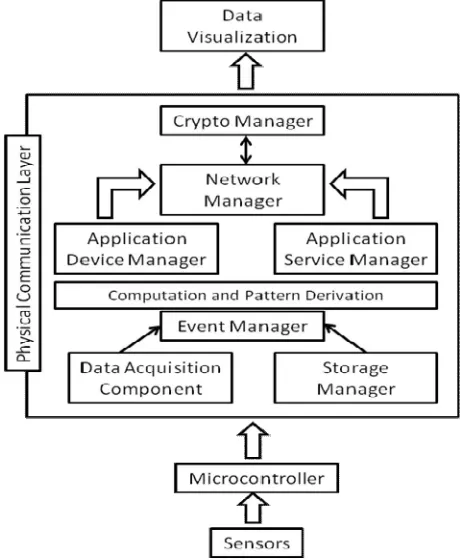
The system architecture is defined with regard to the cloud server corresponding to the system as shown in Fig. 2. From specific data acquisition(DAQ) device as that of microcontroller, the sensors are connected to the same relating to the electronic circuit. The physical communication layer consists of the event and network manager which are established through a secured connection using crypto manager.
Fig. 2. System architecture and functional layers
From the microcontroller interconnected electronic circuit in the land, data acquisition undertaking is carried out and the respective storage of the values obtained through multiple sensor fusion. The event manager leads to the computation of data and results in deriving the results. With the application service manager coordinating the data from Global Positioning System(GPS) module and the sensor values acquired, the cloud database assists in the storage of data. On cloud hosting and web services, the network manager is cohesively used in this purpose. The user-end interface receives the ascertained results through the hybrid application. The significance of outcome lies in the sensor data acquisition based on the framework and architecture of the system.
III. DEPENDENCY ON MACHINE LEARNING ALGORITHMS
establishing eco-friendly aspects in the project with the objective of going along with the nature conditions. With this model, the failure or decrease in the productivity of crop can eventually come to a standstill, thereby facilitating a trusted technologically blend application for the farmers.
IV. EXPERIMENTAL RESULTS
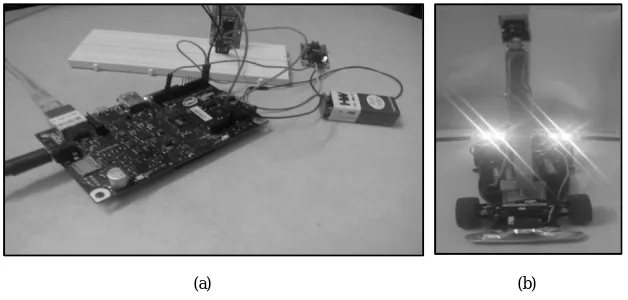
As a part of experimentation and case study carried out in the implementation of of 'IoT based Agro Automation System using Machine Learning Algorithms', the Intel Edison incorporated circuit connected to PTC ThingWorx cloud platform was evaluated and the results were ascertained in the PTC ThingWorx mashup. With the agro-robot facilitating all types of automation on land, specific cases have also been taken into account to provide an all-terrain robot, including the use of drones to monitor large-scale activities on all types of surfaces.
Fig. 3. Hardware setup (a) Intel Edison with temperature, humidity and water sensors (b) Agro automation bot
Specific type of designation if preferred according to the farming areas the agro bot is subjected to application. A land rover is used for ordinary type of farming including horticulture whereas in areas like vineyards, the quad copter is deployed to achieve the necessary aerial action and processing. In case of prawn farming, an underwater vehicle can be preferred with node based connectivity for obtaining the sensor data. The fuelling of robot is highly based on the solar power supply as the global demand for green energy is on a steady rise. Absence of manual inputs during emergencies will enable the robot to behave as an autonomous vehicle and efficient solar power to fuel the robot. This is one of the essential factors that is being involved in incorporating machine learning algorithms in the project on evaluating the specific time duration of turning on and off the autonomous functionality.
The agro robot for experimental testing was developed with FRDM KL25Z built using ARM Cortex M0+ processor. Further, the specific need for power was overcome with solar power for longer periods and piezo power supply for shorter periods. On leading the pathway for the robot, the image processing using NI myRIO was carried out by means of the NI LabVIEW software. This also enhanced the value proposition pertaining to accuracy in real time implementation as the simulation oriented initial approach eliminated almost all types of errors that could be dealt with when established in the agricultural fields. Feedback from farmers suggested the lack of proper accessibility to nearby towns during needs of famine and drought for finding the possible solution. Citing this reason, our team ensured that the app interface is also linked automatically to the local bodies and agricultural units for empowering the bad pattern of farming by identifying them based on the copy of results obtained. Obviously, the farmers with acres of land primarily dependant on agriculture can now sustain with a system that offers a trusted technological operation.
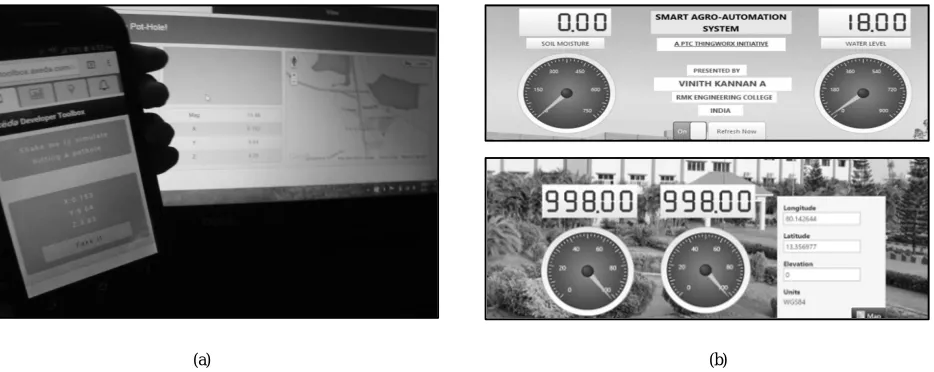
The PTC ThingWorx composer is extensively made use of to provide a quick streaming of sensor data to the end user with the help of widgets and locate the agro robot movement with the help of GPS coordinates.
Fig. 4. Experimental evaluations (a) App interface to control the bot (b) Monitoring the agricultural parameters
On supplementing the proposed system with real time interface, the PTC Vuforia platform can be dealt with for the Augmented Reality development where the agricultural parameters can be visualized in actual scenario and driven for operation of robot. Any erroneous note would be automatically located, thus understanding the position of inaccuracy and pattern of undesired production.
V. CONCLUSION
From the market overview of the system, the perceived large scale users of this product and service oriented architecture can be related to the farmers, owners, stakeholders relating to agricultural farms, horticulture farming, prawn farming, vineyards, poultry farming and orchards. The unique and innovative aspects of 'IoT based Agro Automation System using Machine Learning Algorithms' makes it easily accessible and reliable for the receiver end to monitor and supervise the parameters from anywhere around the world, thanks to Internet of Things. As a future outlook of this proposed system, the drone application with image processing features can predict the pattern of crop and soil performance with high end machine learning models.
REFERENCES
[1] Jzau-Sheng Lin, Chun-Zu Liu, A monitoring system based on Wireless Sensor Network and a SoC Platform in Precision Agriculture, 2008 IEEE. [2] Predictive Weather Application using PTC ThingWorx,
http://www.thingworx.com/ecosystem/academic-program/iot-projects/predictive-weather-application.
[3] Dr. R. K. Prasad , Mr. S. R. Madkar, Design & Implementation of Wireless Transceiver for Data Acquisition in Wireless Sensor Network, Volume 3, Issue 7, July 2013 ISSN: 2277 128X International Journal of Advanced Research in Computer Science and Software Engineering. [4] War1e, T., Corke, P.; Sikka, P. et al.: Transforming Agriculture through Pervasive Wireless Sensor Networks, IEEE Pervasive Computing,
2007, 6 (2), pp. 50-57.
[5] Modeling for IoT and ThingWorx with PTC Integrity Modeler, http://learningconnector.ptc.com/video-tutorial/Tutorials/5047. [6] ThingWorx documentation, http://support.ptc.com/cs/help/thingworx_hc/thingworx_6.5_hc.
[7] Herman Sahota, Ratnesh Kumar, Ahmed Kamal Jing Huang, an Energy-efficient Wireless Sensor Network for Precision Agriculture, 2010 IEEE.