AN ANALYSIS OF THE CHANGES I N V O L V E D I N A CASE
OF PROGRESSIVE MUTATION’ CARL D. LA R U E A N D H. H. BARTLETT
University of Michigan, Ann Arbor, Michigan
[Received June 14, 19171
The relation of cell size to the size and organization of organisms has been investigated by many workers. The earliest and still one of the most important contributions to the subject was that of SANICI
(1872), who studied the size of the cells in the pine. He found that at the base of the trunk the length of the tracheids increases in the first few annual rings to a maximum, which then remains constant. This length, which is constant a t only one height, increases upward for a distance, reaches a maximum, and then decreases towards the top of the tree. The cells of the branches are smaller than those of the trunk but vary according to their position, following the same rule as those of the trunk.
I t ,was SACHS who first appreciated the desirability of determining to what extent the size of an organ is correlated with the size of the cells composing it. I n 1892 he set the following as the annual prize problem for the UNIVERSITY OF WURZBURG: “ES sind zahlreiche Messungen
anzustellen, welche Auskunft dariiber geben, ob und inwiefern Bezieh- ungen zwischen dem Volumen der Zellen und dem Volumen der Pflan- zenorgane bestehen.” The prize was won by AMELUNG, who published his data in 1893. His chief conclusion was that in morphologically similar parts of plants the mean cell size remained so nearly constant that the difference in size of organs could be ascribed, without sensible error, wholly to the number of cells composing them. I n this conclusion
SACHS (1893) concurred, making the further deduction from AM- ELUNG’S data that under normal conditions every plant or animal species attains a definite specific mean size, and that regardless of how much this specific mean size may vary from species to species, homologous cells are always of approximately the same size. I n drawing these con- clusions it is obvious that SACHS and AMELWNG disregarded fluctuating
208 CARL D. L A R U E AND H. H. BARTLETT
variations as small as those which SANIO had found occurring within a n individual.
STRASBUKGER (1893) stated as a result of his work that just as the stronger or weaker development of an organ is without commensurate influence on the size of its constituent cells in their fully extended con- dition, so it is also without influence on the cells in their embryonic condition. H e was struck by the fact that although individuals of the same species differed in number but not in size of cells, species of the same genus showed not inconsiderable deviations from one another. H e added as an example Lycopodium Selago, L. clavatziwz, and L. com- planatuiiz and pointed out the large cell size of the Ranunculaceae, dif- fering appreciably from other Dicotyledones and agreeing with the Monocotyledones.
As more critical work than that of SACKS and AMELUNG was done, it became obvious that these investigators had perhaps generalized more freely than their data warranted. GAUCHERY (1899) studied various cases of environmental nanism and found that even when other cell characters are unmodified, the diameter of the vessels is usually less in the dwarfs. The epidermal cells are ordinarily the same in dwarfs as in plants of the normal size (e.g., Datura Strawzofiiuwz) but a dwarf of
buckwheat proved an exception in having smaller epidermal cells. SCHNEGG (1902) published cell measurements of several species of Gunnera which are of interest chiefly because they so signally fail to substantiate the conclusions which their author draws from them. The genus Gunnera is remarkable for including species of ordinary size, together with others which are among the most gigantic of non-woody Dicotyledones. SCHNEGG extended AMELUNG’S thesis to cover large and small species within the same genus, but his data, except with re- gard to the epidermis of the leaf, do not bear out his conclusion.
In general, robust plants differ from dwarf ones primarily in the number of cells
of which they are composed, rather than in the size of the constituent cells, although environmental or internal factors that tend to accelerate growth also tend to increase slightly the size of the cells.
The most recent work has shown the necessity of taking nuclear char- acteristics into consideration in dealing with the relation of cell size
to the organization of the individual. It is now known that accessions to the number of chromosomes in the nucleus bring about an increase in cell size, since the size of the cell may be considered as a function of the size of its nucleus. (See literature cited in the preceding paper
CHANGES INVOLVED IN A PROGRESSIVE MUTATION 209
by
TUPPER
and BARTLETT (1918)). Consequently, in the cases where the difference between two species is primarily due to a difference in chromosome number, SACHS’S conception is obviously inapplicable.SIERP (1914) has made the most recent and exhaustive study of the relation of cell size to nanism, and has given especial attention to heredi- tary dwarfs. H e makes a clear distinction between merely depauperate plants and true constitutional dwarfs, pointing out that his predecessor
GAUCHERY had not, as he thought, dealt with the latter class of plants. H e found that all depauperate plants had smaller cells than normal plants, but by no means smaller in proportion to the reduction of the plant size from the normal. T h e fact was established that the cells of a depauperate plant are not smaller than those of any juvenile plant of the same species, thus indicating that the difference is due to nutritional factors similar to those that a re presumably concerned in the variation of wood cells in different parts of the pine. H e compares his results with those of SANIO (1872), pointing out that the mean cell size in- creases from internode to internode, from a minimum at the base of the stem, where the cells are no larger than in depauperate plants, to a max- imum at about the middle of the stem, and decreases to a minimum again at the apex of the stem. With regard to constitutional dwarfs, he found three conditions : ( I ) The cells are smaller than in the typical form (e.g., Solanum, Zea, Pisum, Clarkia). ( 2 ) The cells are of the
same, or about the same, size (e.g., Mirabilis, Lathyrus). ( 3 ) T he cells of the dwarf are larger (e.g., Nigella).
W e may leave the third case out of consideration, as presumably one of cell gigantism due to chromosomatic modification (although in Prim- ula there are cell giants that have the same number of chromosomes as the typical forms ; may there not, however, be an increase of chroma- tin even in such cases?). The other two cases concern us more in the present paper. I t has been possible to use the rich material presented by our Oenothera mutations to study cell conditions in constitutional dwarfs of known ancestry, grown under reasonably uniform conditions. I t must be said in criticism of SIERP’S admirable paper that he was un- able to study dwarfs of known derivation, and that therefore he had no proof that the dwarfs with smaller cells than typical plants had xc- tually sprung from strains presenting the same cell conditions as the non-dwarfs studied by him. In the two species whose dwarfs did not show a reduced cell size, the normal plants and dwarfs were undoubtedly af the same lineage. Mirabilis JucZapum is the only commonly cultivated species of the genus, and is relatively constant, aside from color varieties.
210 CARL D. L A R U E AND H. H. BARTLETT
Latlzyrus odoratus is likewise so well circumscribed that it crosses with no other species; it has given rise to its cultivated varieties, including the dwarfs, by mutation (BATESON 1913). I n the cases of Zea, Solanum (group of
S.
tuberosuwz), Pisum, and Clarkia, the dwarfs are of un- known lineage, being derived from polymorphic groups within which there may well be considerable variation with regard to cell size. In the case of Zea, particularly, there is evidence (KUWADA 1911, 1915) that the chromosome number varies considerably from form to form,so that we should expect, a priori, a correlated variation in cell size. Aside from the occurrence of slight variations analogous to those of depauperate plants, there is little adequate evidence that hereditary dwarfs with the same chromosome number as the parent species ever have smaller cells.
I n this paper we bring forward remarkably consistent evidence that hereditary nanism, in cases where the reduction in size is not associated with a changed chromosome number, is due to a diminished capacity for cell division. The cells of typical plants and dwarfs are potentially of equal size but differ in number and distribution. The series of forms investigated by us is remarkable in that the first three members show successive reduction stages from the typical individual of normal size to an extreme dwarf. W e interpret these stages as exemplifying retro- gressive evolution. The fourth member, however, shows a reversal of the direction of evolution. In the plant as a whole, the path of retro- gression is partially retraced, and in one organ, the capsule, the original point of departure is passed, resulting in a net progression at the end of the evolutionary process. W e are especially concerned in this paper with an analysis of the progressive mutation, as the title of the paper indicates, but the retrogressive mutations receive, incidentally, as com- plete a study.
Before presenting the data, our final conclusion may be stated briefly as follows: In a series of mutations showing both reduction and in- crease in the size of the entire plant and its organs, the size characters prove to involve only number and arrangement of cells, and not at all the size of the cells, which remains the same throughout the whole series.
In previous publications (BARTLETT 1915; LA RUE and BARTLETT 1917), we have described the origin by mutation from Oenotlaera Rey- noldsii of three types of dwarfs, known as mut. senaialta, mut. debilis,
and mut. bilomga). They arise in the order in which they are listed,
Oenothera ReynoZdsii giving rise to mut. semialta, mut. semialta to mut.
CHANGES INVOLVED I N A PROGRESSIVE MUTATION 2 1 1
all originated from Oenothera Reywoldsii directly. Mut. semialta shows considerable reduction from Oenothera Reynoldsii forma typica in both stature and leaf size, and may be characterized as a half-dwarf. Mut.
debilis is a true dwarf with about a quarter the height of f. typicam. It
is not so greatly reduced as some of those derived from other species of Oenothera, notably Oe. pratimcola, but is about as small a dwarf as any that are sufficiently fertile to be maintained in cultures. Mut. bilonga
shows a progressive trend, returning to the stature of mut. semialta. It is therefore a half-dwarf. In the case of the capsules, there is a very remarkable progression, resulting in a capsule twice as long as that of the other half-dwarf, mut. semialta, and much longer than that of f .
typic. which forms the starting point of the evolutionary series.
Years ago SACHS (1893) made some interesting speculations in re- gard to the changes in the number of cells in an organism, the repetition of which may serve to indicate why we have interpreted increases in cell number as progressive evolution, and decreases as retrogressive.
If one were to select from a genus of many species one typical of the genus, and of medium size, it would be possible to conceive of the changes that might follow either from increasing or decreasing the number of cells. I n the former case the possibilities of variation would diminish as the number of cells diminished ; simplification of structure and decrease of differentiation would inevitably follow if the process were carried far enough. I n the latter case, however, it would be im- possible . to predict the differentiations and specializations that might result with increase in number of cells. T h e possibilities of evolution in the one case are limited, in the other case unlimited. W e do not wish to be understood as denying that specialization may not sometimes ac- company decrease in cell number, for it is well known that many small organisms are highly complicated and many larger ones are relatively simple. Nevertheless, we believe that the proposition is in general true, and that in the absence of other criteria, increase in cell number leads to greater complexity and may therefore be interpreted as evidence of progressive evolution.
Within the family Onagraceae we think no one would be inclined to doubt that Circaea is a more reduced type than Oenothera o r Epilobium. It has presumably been evolved by reduction from the more generalized types like Oenothera. I t has a meristic difference from other members of the family (two carpels instead of four). T h e same meristic varia- tion occurs in Oenothera pycnocarpa Atkinson and Bartlett as a somatic mutation. Its most marked reduction, however, has been in the number
212 CARL D. L A R U E AND H. H. BARTLETT
of cells comprising- the capsule. T h e reduction has gone so far that the seeds are reduced to two in Circaea Lzitetiana, and to one in the weakest and most reduced species of all, Circaca alpina. With the reduction of the fruit the mechanism for dehiscence has been lost, a simplification resulting as a natural sequence from reduction in the number of the cells. I t is hard to see how further evolution can take place in the direction that has led to the genus Circaea. C. a l p h a is reduced almost to lowest terms, and unless a reversal of the direction of evolution oc- curs, the group must remain a terminal one.
The case of the genus Gaura is similar, although not so extreme. Here the meristic reduction has not occurred, the carpels remaining four in number as in the generalized types of the family. The reduction of the carpels has taken place, however, resulting in indehiscent fruits with only one or two seeds developing. In a tribe very closely allied to the Gaureae, and presumably descended from the latter, the meristic reduc- tion to a 2-celled ovary has taken place. ?\loreover the same tribe, the truly remarkable Gongylocarpeae (J. DONNELL SMITH and ROSE 1913) shows u s a new evolutionary trend, marked as we should have antici- pated, by an increase in number of cells. The annual or biennial Gaura- like type has become perennial. The indehiscent fruits remain attached and become imbedded in the wood of the growing stem, giving rise, in the genus Burragea, to one of the most bizarre and unusual types in the plant kingdom. Here we find a good illustration of the truth of
SACHS’S remark that the possibilities of increase in cell number are hardly to be foretold.
W e have therefore interpreted the change from dwarf to half-dwarf stature which occurs in the production of mut. bilonga from mut. debilis
CHANGES INVOLVED I N A PROGRESSIVE MUTATION 213
Gates. Crossed with one another, the mutations and the parent form all give matroclinic progenies except when mut. b i l m g a is one of the forms involved. I n that case, mut. bilonga, crossed with its immediate parent, mut. debilis, gives a matroclinic progeny when mut. bilonga enters the cross as the egg parent, and a dimorphic progeny consisting of both parent forms when it enters as the sperm parent.
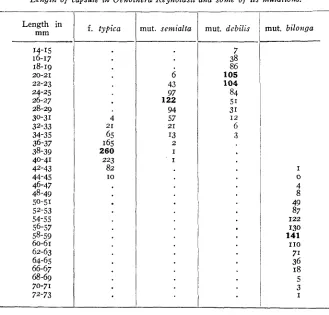
W e have.no numerical data with regard to plant height of the muta- tions. Such data have, however, been kept for the dimensions of the leaves, which show exactly the same tendencies a s the heights. Table I shows measurements of leaf length and leaf width in these forms. By comparing it with table 2, in which the capsule measurements of all
the forms are given, it may be seen that the reduction in leaf size is nearly proportional to that of capsule length in mut. semiulta. I n mut.
debilis, however, the reduction in capsule length is considerably less, proportionately, than that in leaf length and leaf width. T he discrep- ancy between the percentage of reduction in stature and that in capsule size is still greater, especially in mut. debilis. These facts suggest that the factors determining fruit length may not be affected in the mutative process which gives rise to mut. debilis and mut. semicllta but that the
TABLE I
L e n g t h and w i d t h of leaves in Oenothera Reynoldsii and some of i t s mutations?
Length
in mm
40-49 50-59
70-79
9-99 100- 109
110-119
120- I 29
130- I39 140-149 150- I59
I 60- 169
170- I79 180- 189 190- I99 200-209 210-219 220-229 230-239 60-69 80-89 typica
6
5 I9 46 122- 88 14 2 I remi- alta 2 21 49 59 73 35 I4 3 !ebilis7-
bilonga- I 12 60 101 37 I - I6 69 110 30 I Width in mm
12-13 14-15 16-17 18-19 22-23 24-25 26-27 28-29 30-31 32-33 34-35 36-37 38-39 40-41 42-43 44-45 46-47 48-49 50-51 20-21 typica I 0 6 4 4 5 34 66 71 42 17 I O I remi- alta
i
I5 30 42 51 48 39 I9 3 21 lebilis I9 75 72 36 8 2 - ilonga 5 8 32 5 2 79 28 I5 7 I214 CARL D. LARUE AND H. H. BARTLETT
TABLE 2
Length of capsule in Oenothera Reynoldsii and some of its mutations. -
Length in mm
14-15 16-17 18-19
22-23 24-25 26-27 28-29 30-31 32-33 34-35 36-37 38-39
20-21
40-41 42-43 44-45 46-47 48-49
50-51
52-53 54-55 56-57 58-59 60-61 62-63 64-65 66-67 68-69 70-71 72-73
f . typica
4 21
65 165 260 223 82
IO
mut. semialta
6
43 97 122 94 57
I3
21
2 I I
mut. dcbilis
7 38 86
105
104 84 51 31 I 2 6 3
mut. bilonga
I
0
4 8 49 87
I22
130 141
71 36 18 5 3
I10
I
slight reduction may be due to lessened vegetative vigor. This idea a p plies especially well to mut. debilis, which is a very weak form. When mut. deb& gives rise to mut. bilonga there is a doubling, not only of height and leaf size, but of capsule length as well. The resulting capsules, although borne by a half-dwarf, are the largest among the evening prim- roses, far exceeding in length those of any of the eastern American species with which experimenters are familiar. An inflorescence in fruit is shown at natural size in fig. I.
FIGURE I.-Oenothera Reynoldsii mut. bilonga. Fruiting inflorescence, exactly natural size. The longest capsule is 64 mm long. The pedigree of this particular individual through six generations was : typica-, typic- typica-, d e b i l i s 4 bilonga+bilonga.
( A member of culture 23; see LA RUE and BARTLETT 1917, p. 123.)
216 CARL D. L A R U E AND H. H. BARTLETT
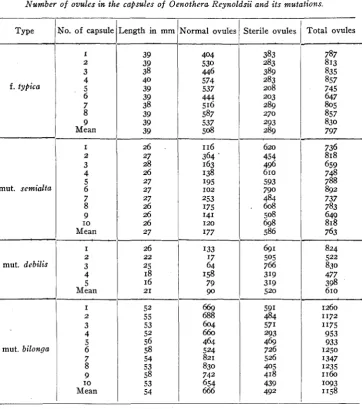
All of the forms show a considerable amount of sterility, as is common in Oenotheras. In muts. senzialta and debilis the degree of sterility is greatest and these are the forms with the shortest capsules. In view of this fact a correlation of percentage of sterility and length of fruit seemed probable. Another explanation was possible, namely that cap- sule length might depend upon the total number of ovules rather than upon the number which develop. Mut. bilonga offered a more interesting case since the evidence given by it was expected to show whether or not the type represents a true progressive mutation. DAVIS (1915)~ in dis- cussing these forms, suggested that a large increase in the total number of ovules in mut. bilonga over that in mut. debilis and the others would indicate a “true progressive advance,” but should the increase in length be attended by an increase in the number of f e r t i l e o z d e s only it would indicate merely a reversion to an ancestral type having a higher degree of ovule fertility.
To determine the facts concerning the sterility of the ovules in these forms, counts of the sterile and of the fertile ovules were made in each of the four types. Capsules were selected for these counts of modal length as nearly as possible. All of these plants were growing in the same field and were of about the same maturity. T h e capsules were of mature size though the seeds were not fully ripened in any of them. The fruits were all gathered on the same day and were preserved in alcohol until the counts could be made.
The ovules were removed from the capsules, placed on a slide, and counted under a binocular microscope. After the ovules had been ap- parently removed from the capsules, it was found that many flat, aborted ovules still remained clinging to the placentae. I t was therefore neces- sary to examine the placentae in all cases and count the ovules found there. This process was more troublesome than that of counting the other ovules and most of the errors made in counting were made here. Some errors were unavoidable as the interiors of the capsules are very mucilaginous and the very small, flat, aborted ovules cling together and to the larger fertile ones very tightly. The ovules were separated by fine needles and each was turned over to avoid overlooking any smal1 attached ones. By using great care in this way it was possible to avoid any considerable percentage of error. In any case the errors should have been about the same f o r each of the forms and the large number
of ovules in each capsule tends to make them less significant. Only those ovules were considered sterile which were entirely flat and ob-
CHANGES INVOLVED I N A PROGRESSIVE MUTATION 217
Table 3 shows that mut. semhlta: and mut. deb& have about the same total number of ovules as forma typica. On the other hand the number of sterile ovules is greatly increased. T h e decrease in fruit length here must be due at least in part t o an increase in ovule sterility. This in- crease in sterility may be due to decreased vegetative vigor and thus to decreased nutrition. This explanation seems more probable in the
TABLE 3
Number of ovules in the capsules of 0en.othera Reynoldsii and its mutations.
f . typica
mut. semialta
mut. de bilis
mut. bilonga
$0. of capsule
I 2 3 4 5 6 7 8 9 Mean I 2 3 4 5 6 7 8 9 Mean IO I 2 3 4 5 Mean I 2 3 4 5 6 7 8 9 Mean IO
,ength in mm
39 39 38 40 39 39 38 39 39 39 26 27 28 26 27 27 27 26 26 26 27 26 25 18 16 22 21 52 55 53 52 56 58 54 53 58 53 54
Jormal ovules
404 530 446 574 537 444 516 587 537 508 116 364
.
163 138 I95 253 I75 141 I20 I77 I02 I33 17 64 158 79 90669
688 604 660 464 524 821 830 742 654 666Sterile ovules
383 283 389 283 208 203 289 270 293 289 620 454 496 610 593 790 484 , 608 508 698 586 691 505 766 319 319 520 591 484 571 293 469 726 526 405 418 439 492
Total ovules
787 813 835 857 745 647 805 857 830 797 736 818 659 748 788 892 737 783 649 818 763 824 522 830 477 398 610 I260 I 172 1175 953 933 1250 I347 1235
I I 6 0
1093
218 CARL D. L A R U E AND H. H. BARTLETT
light of some recent work of DAVIS (1916) in which he tried the effect on fertility of cutting down the nutrition of plants of Oenotheras by removing leaves. H e found that the reduction of nutrition had a very decided effect on the fertility of his plants.
Mut. bilonga is not normally so sterile as mut. debilis which produces it. Table 3 shows it to have about the same percentage of sterility as f. typicn. The total number of ovules, on the contrary, is greatly in .excess of that in f. typicn so that the increase in length of fruit is cor- related with an increased number of ovules rather than with an increase in fertility. I t appears that the formation of this mutation has intro- duced a higher ovule number and that the type represents ‘a real case of progressive mutation.
A study of the cells of the capsules seemed desirable for the purpose of determining whether or not the changes in capsule length were due to or accompanied by giant or dwarf conditions of the cells. KEEBLE
(1912) described cell gigantism in Primula unaccompanied by an altera- tion in the chromosome number and the case of Nigella mentioned by
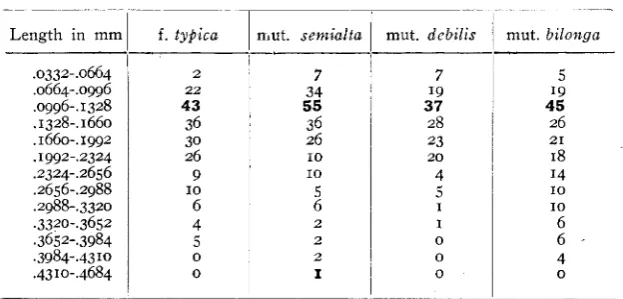
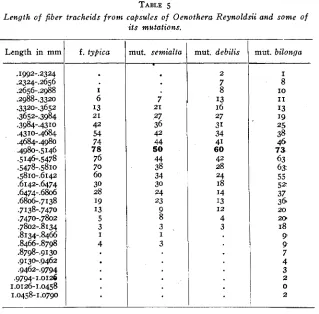
SIERP (1914) may be similar. I t seemed possible that such a condition of cell gigantism might account for, or at least accompany, the differ- ence in capsule length between mut. debilis and mut. bilonga. Tables 4 and j show the results of measurements of spiral tracheids and fiber tracheids from capsules of each type. For this work modal capsules were selected, macerated, and the wood elements measured with an eye- piece micrometer. A mechanical stage was used to avoid duplication
of measurements.
TABLE 4
L e i i g f h of spiral tracheids from capsules of Oenothera Reyizoldsii and some of its mzctatiom.
Length in mml f . tybica
L
mut. semialta.0332-.0664
. ~ 9 6 - . I 328
.1660-.1992
.
I992-.2324 .2324-.2656 .2656-.2988 ,2988-. 3320 .3320-.3652 .3652-.3984 ,3984-.43 10.43 10-4684 .0661-,0gg6
.1328-. 1660
2
22
43 36 30 26 9
6 4 5
I O
0
0
7
34
55
36 26 I O
I O
5 6 2 2
2 I
mut. debilis
7 19
37 28 23
4 5 20
I
I 0 0 0
-- mut. biloitga
5 I9 45 26
18 21
I4
I O
I O 6 6 4
CHANGES INVOLVED I N A PROGRESSIVE MUTATION
TABLE 5
Length of fiber tracheids from caQsdes of Oenothera Reynoldsii and some o f
219
i t s mutations.
Length in mm f . typic0
I 6 I3 42 54 74 78 76 70 60 30 28 I9 I3 5 3 4 21 I
nut. semialta
;
21 .27 36 42 44 50 44 38 34 30 24 23 9 8 3 3 Imut. deb,ilis
2 7 8 I3 16 27 31 34 41 60 42 28 24 18 I4 I3 4 3 I2 -
-mut. bilonga
I I O I1 8 I3 19 25 38 46 73. 63 6 5 55 5 3 37 361 18 9 9 7 4 3 2 0 2 20 2 0
The results given in tables 4 and
5
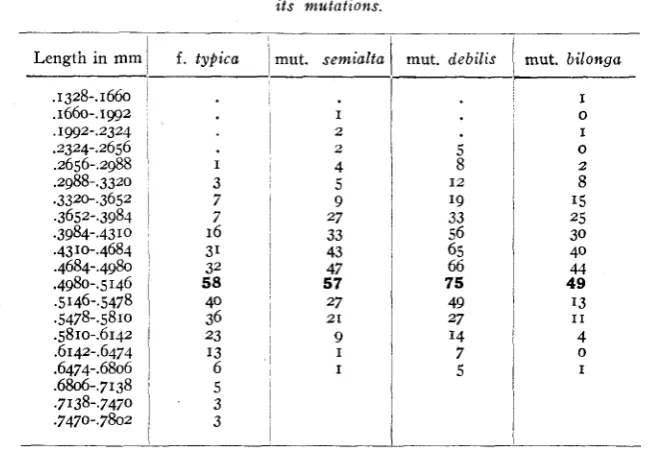
show that both types of tracheids have the same modal length in all four forms. The range of fluctuation is greatest in mut. biZo.nga, and the environmental effect of diminishedL nutrition is obvious in the case of mut. debilis, through the greater number of short cells; but on the whole the conclusion is obvious t h a t the cells of all four forms are so similar in size as not to account in any degree for the differences of capsule length.In order to trace the possible influence of cell size on plant height, mature normal stems of each type were selected and samples of wood' were taken from the base of the stem. These samples were macerated and studied in the same way as the capsules but in this case only one. type of cell was measured. Table 6 gives the result of this stddy. I n no case was the wood of a type taken from the same plant as the capsule yet the results are the same. This is the more interesting be- cause the wood of the capsule is primary, and that of t h e rower stem< almost all secondary. From this evidence it appears that m t a t i v e pro-
2 2 0 CARL D. L A R U E A N D H. H. BARTLETT
TABLE 6
L e n g t h o f fiber tracheids of wood a t base of steins of Oenothera Reynoldsii and i t s mutations.
Length in mm
. I 328-. I 660 .1660-.1gg2 . 1 ~ 2 - . 2 3 2 4
.2988-.3320 .3320-,3652 .3652-.3984 .3984-.43 10
.4310-.4684 .4684-.4980 .4980-. 5146 5146-5478 .5478-.5810 .5810-.6142 .6142-.6474 .6474-.6806 .6806-.7138 .7138-.7470 .7470-.7802 .2324-.2656 .2656-.2988
f. typica
I 3 7 7 16 31 32 58 40 36 23 I3 6 5 3 3
nut. semialta
I 2 2 4 5 9 27 33 43 47 57 27 9 2 1 I I
tnut. debilis
i
8 I9 33 56 65 66 75 49 27 I4 7 5 I 2mut. bilonga
I 0 I 0 2 8 15 25 30 40 44 49 I3 4 I 1 0 I
cesses which produce forms entirely distinct from the parent in general characters and genetic behavior may still not be sufficiently deep-seated to affect such conservative tissues as those of the xylem.
CHANGES INVOLVED I N A PROGRESSIVE MUTATION 221
mut. debilis and mut. bilonga often failing t o persist for even a short time in a rosette stage. T he wood specimens studied were therefore not as strictly comparable as one might infer from their position in the stem. The identical modes of all the variation curves consequently afford all the more striking confirmation of our general conclusion that the retrogressive and progressive evolution in the mutation series of
Oe. Reynoldsii is tied up with changes in the number and arrangement of cells, rather than with their size.
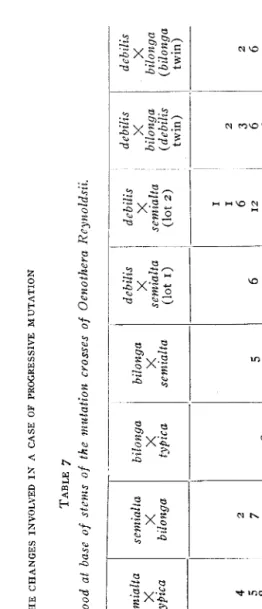
Samples of wood of such of the hybrids between the various forms as have been secured were also studied. T h e authors' studies on these hybrids are described in the paper cited elsewhere in this article. I t was found that these forms, with one exception, show matroclinic in- heritawe. Since all the forms have the same type of wood cells, it was not to be expected that these would shed any light on the problem of matroclinic inheritance in the hybrids. Nevertheless it is highly desir- able to know just what their behavior is. The studies of the hybrids were made in the same manner as those of the uncrossed types. I t is noted in the paper on matroclinic inheritance that some of the possible crosses have not been secured. These are mut. semialta X mut. debilis
and mut. bilonga X mut. debilis. I n addition to these missing forms the hybrid mut. debilis X f. typica is lacking in the wood studies because all the plants of this form were very weak so that good specimens could not be obtained. Table 7 shows the results, which, in the main, are what might be expected from the data given on the parents. The one notable exception will be discussed later. It will be noticed that in the cross mut. debilis X mut. bilonga data are given on two forms. This cross gives twin hybrids, one of which resembles the ovule parent and the other the pollen parent. All of the crosses showed wood cells like those of the parents. An effect on the cells akin to heterosis (the vigor
of heterozygosis) was the most that might have been expected if the crosses had been different from the parents. As we have shown ( L A RUE
and BARTLETT 1917) no such effect was discernible externally, and none could be discerned in the cells. This is just what might have been antici- pated from the hypothesis of non-equivalent gametes, which we have elsewhere applied to the mutations in question.
T he cross mut. deb& X mut. semiulta departs from the others in its behavior and gives a bimodal curve. T h e first set of results aroused a suspicion of an accidental mixture of the material. So a second sample was macerated from the same plant. All possible care was taken to secure a thorough mixing of the cells but the result was the same. I n
LA RUE, C. D., AND BARTLETT, H. H., AN ANALYSIS OF THE CHANGES INVOLVED IN A CASE OF PROGRESSIVE MUTATION Length in mm TABLE 7 Length of fiber tracheids of wood at base of stems of the mutation crosses of Ocnothera lieynoldsii. tYfiica typica typica X X X semialta debilis bilonga I
semiaka typzca
x
selnialla bilonga b ilo nga typica Xx
bilonga>r:
scmzalta deb ilis deb& dcbilis debilis X X X semialta semialta bilonga (lot 2) (debilis (lot I) twin) Xbilonga (bilonga twin)
37 44
'
50 66 30 32 34 46 69 32
4 I2 20 34
60 41 37 17 I2 9
2
20
7l
31I
'
52 67 OI I/
I 3 5 19 24 37 37 40
60 30 I7 17 6 6 4
4i
7 20I
:B
6 611
3 I8 22 25 26 47
61 39 I3 9 2 3 2
5 15 38 46
20 53 58 28 16 6 3 4
38 40
89
2 3 6 6 23 31 69
82 93 35 26 14 2 1
2 6 4 8
23 32 45 73 49 22 14 IO 3
GENETICS
3:
222
MY
CHANGES INVOLVED I N A PROGRESSIVE MUTATION 223
measurements involving a population of any sort a bimodal curve is interpreted as an indication of a mixture of types. I n a single plant it may be explained in a similar way. If a mutation should occur in the form of a chimaera such a mixing would occur. I n this case it would affect only a part of the plant, the remainder having the same curve of variability as the other types. Unfortunately the wood samples were taken before the seeds were ripe so that no seeds of this plant were se- cured. One can only speculate on the possible behavior of a mutation which affects only the internal structure. If there had been external evidence of its existence it would have been detected and saved, for the culture in which it occurred was repeatedly inspected by both the writers.
It might have been possible to determine from the existing material whether the chimaera was of a sectorial or a mosaic character but, since the study must have ended there, it was not thought worth the trouble.
SUMMARY A N D CONCLUSIONS
( I ) The series of mutations derived from Oenothera Reynoldsii
shows both retrogressive and progressive evolution with regard to plant height, retrogressive from f . typica through mut. semidta to mut. debilis,
progressive from mut. deb& to mut. bilonga. The changes ar e all con- cerned with the number and arrangement of cells, not with the size of the individual cells.
( 2 ) The length of the wood elements is the same in the various
matroclinic mutation crosses as in the self-pollinated strains. T he crosses do not show, either in external or internal characters, any vigor due to heterozygosis. No such effect would be anticipated in view of the considerations developed in a former paper, in regard to non-equiva- lent gametes.
(3) The mutation series shows a relatively small reduction in capsule length from f. typica through mut. s e m d t a to mut. debilis. This re- duction is interpreted as probably a physiological manifestation, the less vigorous forms having the capacity to mature fewer ovules into seeds, and therefore producing shorter mature capsules. The number of ovules is nearly the same in the three forms, but the sterility increases with the degree of dwarfness of the form. Th e wood elements of the c a p sules of all three forms are of the same size.
(4) The process which results in the formation of mut. bilonga in- volves an increase over any of the other forms in the number of ovules, but not an increase in fertility over f. typka;. It is therefore interpreted as a case of progressive evolution. The increase in number of ovules
224 CARL I).LA R U E AND H . H . BARTLETT
is accompanied by a doubling in the length of the capsule; and this cdoubling is due to an increase in number of cells rather than to an in- crease in the size of the cells. The capsule of mut. bilonga is the largest known among the small-flowered Oenotheras of the bienizis alliance.
( 5 ) Aside from the possibility that one bimodal curve may have indi- cated the occurrence of a sectorial chimaera with smaller cells, there is no evidence that the retrogressive and progressive evolutionary changes which have taken pla,ce in Oe. Reynold&, affecting plant height, capsule length, and number of ovules, are accompanied by significant alterations in such conservative tissues as the xylem.
LITERATURE CITED
AMELUNG, E., 1895 Uber mittlere Zellengrosse. Flora 77 : 176-2207.
BARTLETT, H. H., 1915 Mutation en masse. Amer. Nat. 49: 129-139.
BATESON, WM., 1913 Problems of genetics. pp. 258. Yale University Press. DAVIS, B. M., 1915 Additional evidence of mutation in Oenothera? Amer. Nat.
(Read a t New York meeting of the Botanical Society of America.)
GAUCHERY, P., 18gg Recherches sur le nanism vCg6tal. Ann. Sci. Nat. 8" ser. 9 : 61-156.
KEEBLE, F., 1912 Gigantism in Primula sirzensis. KUWADA, Y., 1911
49 : 702-706.
1916 Malnutrition as a factor in pollen and seed sterility of Oenothera.
Jour. Genetics 2 : 163-188.
Maiosis in the pollen mother cells of Z c a Mays L. Bot. Mag.
1915 Bot. Mag. Tokyo 29: (Cited by ISHIKAWA, M. A list of the number of
LA RUE, C. D., and BARTLETT, H. H., I917 Matroclinic inheritance in mutation crosses
SACHS, J., 1893 Physiologische Notizen. VI. Ueber einige Beziehungen der speci-
SANIO, KARL, 1872 Jahrb.
SCHNEGG, H., 1g0z Flora 90: 161-208.
SIERP, HERMAN, I914 Uber die Beziehungen zwischen Individuengrosse, Organgrosse und Zellengrosse, mit besonderer Beriicksichtigung des erblichen Zwerg- wuchses. Jahr. f. wiss. Bot. 5 3 : 55-124.
SMITH, J. DONNELL, and ROSE, J. N., 1913 A monograph of the Hauyeae and Gon-
gylocarpeae, tribes of the Onagraceae. Cont. U. S. Nat. Herb. 1 6 : 287-298.
STRASBURGER, E., 1893 Uber die Wirkungssphare der Kerne und die Zellengrosse.
Hist. Beitr. 5 : 95-124.
Tokyo 25 : 163-181.
chromosomes.
of Oenothera Reynoldsii. Amer. Jour. Bot. 4 : 119-144.
fischen Grosse der Pflanzen zu ihrer Organisation.
f . wiss. Bot. 8:401-420.
Bot. Mag. Tokyo 30: 404-448.)
Flora 77 : 49-81.
Uber die Grosse der Holzzellen bei der gemeinen Kiefer.