20th International Conference on Structural Mechanics in Reactor Technology (SMiRT 20) Espoo, Finland, August 9-14, 2009 SMiRT 20 - Division V, Paper 1603
Missile Impact on Structural Members
Xian-Xing (Lambert) Li
aa
SNC-Lavalin Nuclear Inc., e-mail: [email protected]
Keywords: Impact, Missile, Yielding; Ductility; Plate; Beam.
1
ABSTRACT
A unified methodology is presented for structural analysis of concrete and steel plates/beams subjected to hard missile impact. Two ultimate limit states including overall collapse due to excessive plastic deformation and perforation are addressed. Analytical equations are proposed for the overall collapse mechanism due to yielding of a portion of the member. The proposed method yields reasonable and conservative results as comparing with available experimental results.
Structural ductility is calculated in terms of maximum plastic displacement and plastic hinge rotation to meet the code specified ductility demand. Since the proposed approach is compatible to code check for members under the impact load in combination with area and point design loads, this approach can be used for the analysis and design of structural plates, slabs, walls, and beams in nuclear facilities to evaluate the effect of tornado- and turbine-generated missile impact.
2
INTRODUCTION
A variety of impact loads caused by tornado-generated or turbine-generated missiles must be considered in nuclear power plant design. A major portion of the plant structures must be designed against these loads. Although the loads are localized, the structural response of target members may be substantial.
ASCE Manual No. 58 (1980) provided and summarized general guidance in the structural design and analysis for impact loads. The formulae for penetration and perforation calculation of concrete and steel plates are based on assumption of rigid targets. However, flexible steel and concrete members subjected to missile loads were not reasonably addressed. For flexible concrete targets, the maximum response of the concrete targets was calculated with the impact forces determined from the rigid target assumption or missile failure, i.e., the impact force was calculated based on the concrete penetration, crushing strength of missile, or compressive stress wave propagation. This approximation violates the Conservation Theorems of Energy and Momentum for flexible members, because the impact force directly relates to the plastic deformation of targets and can not be predicted in advance without knowing the plastic displacement, and vice-versa.
Analysis of overall structural failure requires development of rational methodologies, so that steel and concrete targets can be designed without concern of perforation and overall collapse. Jones et al. (1989, 1997) and Chen and Li (2003) investigated the structural behavior of flexible members subjected to hard missile loads with the application of conservation theorems of energy and momentum. It is still a challenge to obtain a general structural analysis for the flexible members and with all design loads to be combined including missile impact, area and point loads.
3
PLASTIC ANALYSIS OF PLATES
3.1 Analytical model
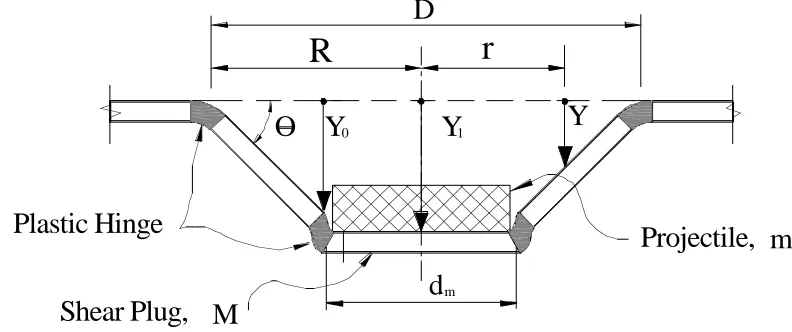
When an orthotropic plate (different materials properties or strengths in different orthogonal directions, such as reinforced plates) is subjected to a projectile impact, a plastic deformation region will be formed. Fig. 1 shows a schematic representation of the middle section through the deformed circular cone frustum of the plate.
d
mY
Y
10
Y
D
r
Projectile, m
M
Shear Plug,
Fig. A. Plastic hinge formation
O
Plastic Hinge
R
Fig. 1 Plastic hinge formation 3.2 Conservation of energy
The total energy including the kinetic energy and plastic deformation energy in the plate and the projectile is conserved, which equals to the initial impact energy of the projectile. The plastic deformation is controlled by the conservation of energy:
(
)
(
)
!
+ +
+ =
"
+ +
+
!
+
# # $ % & & '
(•
!
+
# # $ % & & '
( •
+
2 /
2 / 2
1 2 4 1 2 2 1
0 1 2
2 / 2
2 2 /
2 / 2
1 2
1
D
d
dr r Y p pY
m d PY i mV
Y Y r Q m d r m R r
M m d
dr r R
d r M dr
r Y D
d h Y
m M
m
m m
)
)
)
*
µ
)
*
µ
)
*
+
µ
)
),
(1-1)
where,
Y = plastic displacement of the plate, which can be represented by the following equation:
(
)
! ! !
" ! ! !
# $
> % % &
&
< %
=
2 0
2 2
2 0
2 0
1
D r if
D r m d if m d D
r D Y
m d r if Y
Y
!
" = circumferential curvature =
(
D dm)
r Y dr
dY
r = !
!1 2 0 , for
2 2
D r m d
!
! ;
r
r
m = negative flexural strength in one orthogonal direction, =mrx (in another orthogonal direction,
ry m ); 1
Y = plastic displacement of the shear plug;
0
Y = maximum plastic displacement of the plate;
=
D diameter of the outer circumferential plastic hinge;
i
V = initial impact velocity of the projectile;
M = shear plug mass;
m = projectile mass; ! = plate density;
h = plate thickness;
rx m ry m rx M ry
M / = /
=
µ , the plate
orthogonality ratio;
m
d = diameter of the shear plug or missile impact crater;
! = circumferential plastic hinge rotation;
P = concentrated load;
p = uniformly distributed load.
Thus, integrating and simplifying Eq. (1) gives
(
)
(
)(
)
(
)
(
)
(
)(
2)
012 1 2 4 1 2 2 1 0 1 0 2 2 0 3 48 2 1 2 1 pY m d D m d D pY m d PY i mV Y Y r Q m d Y m d D r m r M D Y m d D m d D h Y m M + ! + + + = ! + ! + + " " # $ % % & ' • + ! + " " # $ % % & ' • + ( ( ( µ ( () (1-2)
At the end of the first phase of motion, the shear plug moves with the projectile under the plate shear resistance Qr, and thus the acceleration of the projectile and the plug and velocity satisfy following equations: m M r Q m d Y + ! = • • "
1 ; (1-3)
where, Qr = shear resistance per unit length. To motivate the possibility of the plastic hinge failure, the material resistance factor may not be included the shear resistance.
Differentiating Eq. (1-2) and substituting Eq. (1-3) as well as Y•1=Y•0into the differentiated equation results in:
(
)
(
)
[
]
(
3)(
)
22 ) 1 ( 24 0 m d D m d D h r m r M D r Q m d m d D Y ! + + ! + ! = • • " µ # (1-4) where,
(
)(
)
! " # $ %& + + ' +
= P dmp D dm D dm p
r Q m
d 12 2
1 2 4 1 1 ( ) (1-5)
3.3 Conservation of momentum
At the end of the first phase of motion, the sliding of shear plug ceases. At this moment, the conservation of momentum in the impact direction requires that
(
)
(
)
! ! # $ $ & ' • + • + ( =+ 1 2 /2
Integrating and differentiating Eq. (1-6) and substituting Eq. (1-3) into the differentiated equation yields:
(
)
[
]
(
D dm)(
D dm)
h
r m r M r
Q m d Y
2 2
12
0 +
!
+ !
= • •
"
µ
(1-7)
3.4 Diameter of plastic hinge
By equating Eqs. (1-7) and (1-4), the plastic hinge diameter, D, can be determined as follow:
(
" !)
! ! "
" !
# +
# + + + # =
2 1
2 2 2 2 ) 3 1 (
m d
D
(1-8)
where,
(
)
r
Q m d
r m r M +
= µ
! 2 (1-9)
The plastic hinge diameter, D, determined by Eq. (1- 8) shall satisfy dm!D!L, whereL = diameter of circular plate which is inscribed within the plate boundary of the principal (shorter) span. This imposes a condition on Eq. (B1 – 8): ! "!max, in which
(
)
[
]
(
) (
)
!"#$%
& + +
+
+
'
+ +
=
2 2 1 / 2 1
2 ) 3 1 ( 2 /
2 1 max
m d L m d L
(
( (
(
) (1-10)
If " >"max and "!1, then D=L. The upper bound, !=1.0, is determined from Eq. (1-9). If this condition is violated, i.e., " >1#! , the plastic hinge will not form due to high flexural strength. The limit state of local perforation, however, should be checked using methods in ASCE Manual No. 58 (1980). 3.5 Maximum plastic displacement
At the end of the second phase of motion, velocity of the plate and projectile equals to zero, at which time, max
1 0 Y Yp
Y = = . From Eq. (1-2), the maximum plastic displacement can be obtained below:
(
)
(
Mr mr)
D dm dmQr Di mV m d D p
Y
) (
2 4
2 max
! !
+ ! =
"# µ
" (1-11)
3.6 Maximum elastic displacement
For a rectangular plate, the maximum elastic displacement can be calculated by
EI L m P e
Y
! "
2 2
1 max
, #
$ % & ' ( )
= (1-12a)
Where
(
)
(
)
!!
" ! ! # $
+ + =
sides. four all on supports fixed
for 5 / 41 138
sides; four all on supports simply
for 3 / 27 59
L W
L W
% (1-12b)
EI L m P e
Y
! "
64 2 2
1 max
, #
$ % &
' ( )
= (1-13a)
For a circular plate with simply supported boundary, the maximum elastic displacement is
(
)(
)
EI L m P e
Y
! " "
64 2 1
3 max
, = + # (1-13b)
in which =
L span length of the plate in the direction of the short side or the diameter; =
W width of the plate of the long side.
(
Mr mr)
D p P mP = + ! 2 !
12
2" µ "
! = Poisson’s ratio ≈ 0.3 for steel and 0.17 for concrete.
I = Moment of inertia
3.7 Permissible ductility for impact loads
The maximum plastic displacement shall not exceed the allowable ductility limit. For steel plate, the criterion of the ANSI/AISC N690 (2006) is
20 max
max max
!
+
e Y
e Y p
Y
(1-14)
For reinforced concrete plate, the criteria of the CSA N287.3-93 (ref. 3) are: 10
05 . 0 max
max max
! " # !
+
$ $
e Y
e Y p
Y
(1-15)
and
(
)
0.0065 0.07rad 2/ max max
! !
" + =
c eff d m
d D
e Y p
Y
r# (1-16)
3.8 Validation of the approach
3.8.1 Steel target
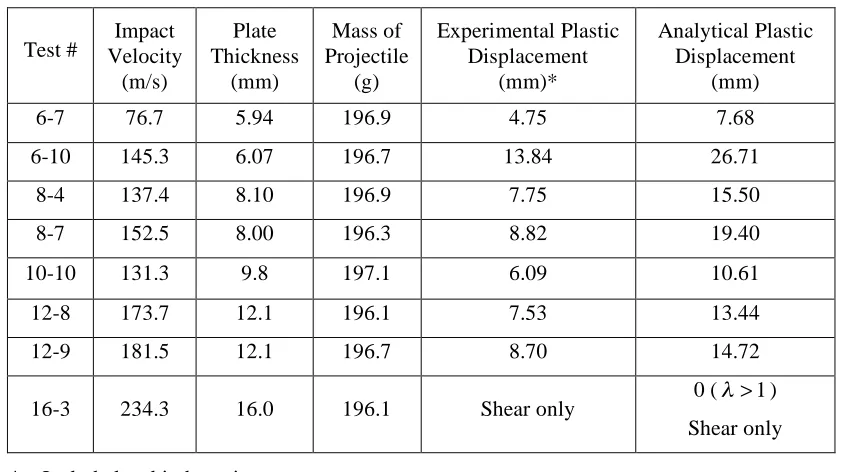
Some experimental results for steel projectile impact on circular steel plate were reported by Borvik, et al (2003). The diameter of the projectile is 20mm. The yield strength of the projectile is 1900MPa. All the steel plate targets were manufactured from the same Weldox 460 E with yield stress of 490MPa. The circular steel plate is clamped at support with diameter of 550mm. The test results of the plastic displacement are listed in the following Table 1. The theoretical prediction given by the proposed approach is also listed in this Table for the sake of comparison. Only those test results without significant residual velocity of projectiles after perforation are presented so that appropriate strength can be evaluated. The dynamic increase effect on the material properties of the plate is conservatively ignored.
From the comparison shown in Table 1, the analytical results in terms of the plastic displacement are 70% - 120% greater than the experimental results, except for the Test #16-3 on which analytical prediction conforms to the experimental result that plate perforation occured. In general, the analytical results correspond well to the experimental results and stay on the conservative side.
Test # Velocity Impact (m/s)
Plate Thickness
(mm)
Mass of Projectile
(g)
Experimental Plastic Displacement
(mm)*
Analytical Plastic Displacement
(mm)
6-7 76.7 5.94 196.9 4.75 7.68
6-10 145.3 6.07 196.7 13.84 26.71 8-4 137.4 8.10 196.9 7.75 15.50 8-7 152.5 8.00 196.3 8.82 19.40 10-10 131.3 9.8 197.1 6.09 10.61 12-8 173.7 12.1 196.1 7.53 13.44 12-9 181.5 12.1 196.7 8.70 14.72 16-3 234.3 16.0 196.1 Shear only 0 (! >1)
Shear only * Include local indentation.
3.8.2 Concrete target
Concrete plates have been widely tested over many years for local penetration of projectiles. However, experiments for the objective of flexural failure of reinforced concrete plate are rare to see in the literature. One slab test for this purpose was carried out and reported by Zineddin and Krauthammer (2007). The test 2#3-2 is made of 3 1/2" thick slab with short span of 3 ft and long span of 9 ft, reinforced with 6” X 6” mesh of No. 3 steel rebars (0.375” in diameter) placed under 1” of concrete cover. An impact mass of 5750 lbs dropped from a height of 6”.
The support conditions were “best described as somewhere between simple supported and fixed”, since all four edges of the slab were bolted thru steel channels that were supported by a test frame. The semi-rigid condition is closer to the simple support than fixed condition. One third of the flexural strength is assumed to represent the boundary condition.
The measured maximum total displacement is 1.667”. The analytical result of the plastic displacement is 1.835” and the total displacement of 1.880”, which agrees well with the experimental result.
4
PLASTIC ANALYSIS OF BEAMS
4.1 Analytical model
When a beam is subjected to a projectile impact, plastic deformation region will be formed in the vicinities of the projectile and non-simple supports. The schematic representation of the plastically deformed shape in Fig. 1 can be used for the beam model. The magnitude of the plastic moment at the beam supports depend upon the nature of end fixity. For example, the plastic moment of simple supports is zero.
4.2 Conservation of energy
The plastic deformation is controlled by the conservation of energy:
(
)
(
)
(
)
!
+ +
+ =
"
+ +
+
# # $ % & & ' (• !
+
# # $ % & & ' ( •
+
2 /
2 / 2 1 1
2 2 1
0 1 2 2
2 2 /
2 / 2
1 2
1
L
m d
dx Y p pY m d PY i mV
Y Y r Q r
m r M dx Y L
m d b Y
m
M
*
)
(2-1)
where,
(
)
!! " !! # $
% % &
&
< % =
2 2
2 0
2 0
1
L x m d if m d L
x L Y
m d x if Y
Y
1
Y = plastic displacement of the shear plug;
0
Y = maximum plastic displacement of the beam;
=
L span length of the beam ;
i
V = initial impact velocity of the projectile;
M = shear plug mass;
m = projectile mass;
b
! = density of beam per unit length;
r
M = cross-sectional flexural strength of the beam;
rs
m = flexural strength at the supports;
m
d = diameter of the shear plug or missile impact crater;
! = plastic hinge rotation;
P = concentrated load;
p = uniformly distributed load per unit length.
By integrating and simplifying Eq. (2-1), we have
(
)
(
)
(
)
(
)
02 1 1 1
2 2 1
0 4
2 0 6
2 1 2
1
pY m d L pY
m d PY i
mV
Y m d L
rs m r M Y
m d L b Y
m M
!
+ +
+ =
!
+ +
" " # $ % % & ' • !
+
" " # $ % % & ' •
+ (
(2-2)
4.3 Maximum plastic displacement
At the end of the second phase of motion, velocity of the plate and projectile equals to zero, at which time, max
1 1 Y Yp
Y = = . From Eq. (2-2), the maximum plastic displacement can be obtained below:
(
)
(
Mr mrs) (
L dm)
Qr b imV m d L p
Y
! "
" +
" =
4 8
2
max (2-3)
where,
(
)
!" # $
%
& + + '
= P dmp L dm p
r Q b
2 1 2
1
( (2-4)
4.4 Maximum elastic displacement
The maximum elastic displacement can be calculated by
EI L m P e
Y
! 3 max
, = (2-5a)
where
! " # =
ends. both at supports fixed
for 192
ends; both at supports simply
for 48
$ (2-5b)
in which
(
)
Lp PL r m r M m
P = + ! !
2 1 4
4.5 Permissible ductility for impact loads
For steel beams of closed (pipe, box, etc.) or compact (Class 1) sections, the criterion of Eq. (1-14) can be used to assess the acceptance of the beams. For reinforced concrete beams, the criteria of Eqs. 15) and (1-16) are applicable to the beams as well.
5
CONCLUSION
A unified methodology, based on the conservation theorems of energy and momentum, has been proposed to evaluate missile impact effects on the flexible reinforced concrete and structural steel members including plates/walls and beams. Analytical formulae for structural responses in terms of the yielding regions, maximum plastic displacement, punching shear force are provided for the structural design. The proposed method yields reasonable and conservative results as comparing with available experimental results.
The structural failure mechanisms can be classified into two limit states, i.e., overall collapse due to excessive plastic displacement resulted from yielding of a portion of a member, and perforation without overall member yielding. The former limit state can be considered as ductile behaviour of the flexible targets and analytical equations are proposed for the impact analysis. The later limit state is local perforation behaviour of rigid targets and available equations as adopted in the ASCE Manual No. 58 (1980) can be used to evaluate the capacity.
For the collapse limit state of the members, the coded specified ductility demand is used as design criteria. The proposed methodology is able to calculate the ductility in terms of the maximum plastic displacement and plastic hinge rotation to assess the adequacy of the structural members. In addition to the missile impact, uniformly distributed pressure and point loads are combined into the missile impact load as generally required for the load combinations taking into account the tornado wind pressure and other loads. The proposed methodology can be easily applied to the structural analysis design with simple calculations.
REFERENCES
ACI 349, 2006. Code Requirements for Nuclear Safety-Related Concrete Structures. American Concrete Institute.
ANSI/AISC N690, 2006. Specification for Safety-Related Steel Structures for Nuclear Facilities. American Institute of Steel Construction.
ASCE Manual and Report No. 58, 1980. Structural Analysis and Design of Nuclear Plant Facilities, American Society of Civil Engineers.
Borvik, T., Hopperstad, O.S., Langseth, M., and Malo, K.A., 2003. Effects on target thickness in blunt projectile penetration of Weldox 460 E steel plates. International Journal of Impact Engineering, Vol. 23, No. 4, pp. 413-464.
Chen, X.W. and Li, Q.M., 2003, Shear Plugging and Perforation of Ductile Circular Plates Struck by A Blunt Projectile. International Journal of Impact Engineering, Vol. 28, No. 5, pp. 513-536.
Jones, N., 1989. Structural Impact. Cambridge University Press.
Jones, N., Kim, S.-B., and Li, Q.M., 1997. Response and Failure of Ductile Circular Plates Struck by A Mass. ASME Journal of pressure vessel technology, Vol. 119, No. 3, pp. 513-536.